



13,99 €
Mehr erfahren.
- Herausgeber: The History Press
- Kategorie: Geisteswissenschaft
- Sprache: Englisch
More than 10,000 Germans and Austrians fled Nazi persecution and served with British forces during the Second World War. At the end of the conflict, many returned to the land of their birth with the intelligence Corps and Military Government to begin the rebuilding process. The huge task they faced, which involved the removal of all adherents of Nazism and Nazi ideology from every facet of public life and employment , was termed Denazification. Some of these ex-refugees were involved with the hunt for Nazi war criminals; others interrogated prisoners of war or gathered evidence from the concentration camps and interviewed the survivors. Two of them even provided close protection for Winston Churchill and Clement Atlee. They were also instrument (in the West, at least) in re-educating the German and Austrian people about the values of democracy and a free society. This fascinating book, which is based on first-hand accounts from veterans, provides an important insight into how Germany and Austria were rebuilt after the end of the Nazi tyranny.
Das E-Book können Sie in Legimi-Apps oder einer beliebigen App lesen, die das folgende Format unterstützen:
Seitenzahl: 361
Veröffentlichungsjahr: 2011
Ähnliche


















DENAZIFICATION
DENAZIFICATION
Britain’s Enemy Aliens, Nazi War Criminals and the Reconstruction of Post-war Europe
HELEN FRY
For James Hamilton a creative voice and my co-author in fiction
The reading of all good books is like a conversation with the finest minds of past centuries.
René Descartes
First published 2010
The History Press
The Mill, Brimscombe Port
Stroud, Gloucestershire, GL5 2QG
www.thehistorypress.co.uk
This ebook edition first published in 2011
All rights reserved
© Helen Fry, 2010, 2011
The right of Helen Fry, to be identified as the Author of this work has been asserted in accordance with the Copyrights, Designs and Patents Act 1988.
This ebook is copyright material and must not be copied, reproduced, transferred, distributed, leased, licensed or publicly performed or used in any way except as specifically permitted in writing by the publishers, as allowed under the terms and conditions under which it was purchased or as strictly permitted by applicable copyright law. Any unauthorised distribution or use of this text may be a direct infringement of the author’s and publisher’s rights, and those responsible may be liable in law accordingly.
EPUB ISBN 978 0 7524 7608 7
MOBI ISBN 978 0 7524 7607 0
Original typesetting by The History Press
CONTENTS
Acknowledgements
Introduction
One
His Majesty’s Most Loyal Enemy Aliens
Two
Hunt for Nazi War Criminals
Three
War Crimes Investigations
Four
War Crimes Trials and Courts
Five
Interpreters, Interrogators and Translators
Six
Military Government
Seven
Media and Newspapers
Eight
POW Camps and Re-education
Nine
Civilian Life
Postscript
Bibliography
ACKNOWLEDGEMENTS
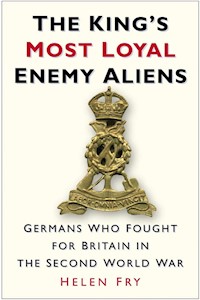
Six years ago I embarked on research which has unexpectedly led to the publication of an extraordinary number of books, all centred on the theme of refugees from Nazism who fought for Britain during the Second World War. The initial research resulted in two books: Jews in North Devon during the Second World War and The King’s Most Loyal Enemy Aliens: Germans who Fought for Britain during the Second World War. Two further books followed during 2009 called Freuds’ War and From Dachau to D-Day. In January 2010 German Schoolboy, British Commando was published. Now this book, Denazification, is a direct spin-off of the ever-widening research, and covers what the ex-refugees from Nazism did from the end of the war in May 1945 until their demobilisation. Many were seconded to the Intelligence Corps or Interpreters Corps to carry out their final duties in British army uniform. In many cases it involved top-secret work, making use of their fluent knowledge of German.
This book could not have been written without the help of the veterans themselves. My first thanks are to these exceptional veterans, many of whom have become close personal friends over the last few years. They have given up their time to be interviewed, which is often a lengthy process. They have entrusted me with their private stories, often painful memories of a time that formulated their young lives and a period that hides deep scars. They were proud to serve in British army uniform but have terrible recollections of the loss of comrades in action on the battlefields of Europe. Little did they or I realise when I embarked on my first account of their stories that it would lead to several years of writing and research and nearly a shelf of books! During the writing of these books I have received unprecedented support from Colonel John Starling and Norman Brown of the Royal Pioneer Corps Association. Many thanks to you both. Much material has been given to me by the veterans themselves, often in the form of unpublished memoirs. Upon completion of this book I am looking to deposit material that I have acquired into the Imperial War Museum so that future historians and researchers can have access to them.
Work on this book would not have been possible without the dedicated help and support of staff at the Imperial War Museum, London and the Jewish Military Museum in Hendon, north-west London. My grateful thanks for all their help with archival material. The Association of Jewish Refugees has given me exceptional support – with special thanks to Michael Newman, Howard Spier, Esther Rinkoff, Myrna Glass and Hazel Beiny. Huge thanks are due to Alexia Dobinson for typing up many of the interviews for this book. Her support is so much appreciated. To my friend and mentor Mary Curry, I owe an enormous debt of gratitude for her commitment and support of all my writings, this book being no exception. She has read and commented extensively on every draft of the chapters at every stage of writing and found research information which I would have missed. I am indebted to Sophie Bradshaw, Peter Teale and Simon Hamlet at The History Press for making this book possible. A special word of thanks to Mick Catmull at BBC South-West, who produced a miniature documentary for BBC South-West’s Inside Out programme, screened in October 2006 called The King’s Most Loyal Enemy Aliens. Also huge thanks to Mark Handscombe and Mark McMullen of True North Productions for making a one-hour documentary for National Geographic Channel entitled Churchill’s German Army, screened regularly across Europe, Central Asia and America in 2009 and 2010. The documentary is based on my research, especially my paperback book Churchill’s German Army, and is drawn upon other books that I have written about the German and Austrian refugees who fought for Britain during the Second World War.
My grateful thanks go to my writing partner in fiction James Hamilton for his loyal friendship and continued support. Under the pseudonym J.H. Schryer we have co-authored Goodnight Vienna and Moonlight Over Denmark. I am also indebted to the following friends for their encouragement: Richard Bernstein, Daphne and Paul Ruhleman, Jon Russell, Frank and Brana Thorn-Gent, Louisa Albani and Colin Hamilton. Huge thanks to Marian Stranavsky of Kenwood House for the red carpet! Special thanks to my family: to my husband Martin who has supported me since the early days of my writing career. Thanks to our three boys Jonathan, David and Edward for their interest and help with computer technology at crucial points. As ever my mother Sandra has been a tower of strength and practical help.
INTRODUCTION
History marks the end of the Second World War as 8 May 1945, the day that Germany surrendered unconditionally to Allied forces. The four occupying powers, Britain, America, France and Russia, had a huge task ahead of them in restoring democracy: to reconstruct post-war Germany and Austria, and remove adherents of Nazism and Nazi ideology from every facet of public life and employment. This process was termed ‘denazification’. At the Yalta Conference in February 1945, the Allied leaders had already met to set the agenda for post-war Germany and Austria. This included dividing the countries into four zones, administered initially by occupying military forces who were to be gradually replaced by the Control Commission. The Allied powers did not underestimate the challenges. At the fore of everyone’s mind was the need to hunt down and bring to justice the perpetrators of the most horrendous crimes against humanity. Eleven million people had been mercilessly murdered in the death camps, 6 million of them Jews, a million children.
One group of veterans, whose contribution to the denazification process is largely unknown, are the refugees from Nazism who fought for Britain during the war. Having served in various regiments of the British forces, they transferred in their thousands to the British Army of the Rhine (BAOR) and British Control Commission for work that required a fluent knowledge of German. This book is about them. At the outbreak of war on 3 September 1939, these men and women were termed ‘enemy aliens’ because of their enemy nationality. Later they anglicised their names in case of capture during combat, so tracing precise numbers is difficult. However, it is estimated that 3–4,000 German-speaking refugees were assigned to the Interpreters Corps and Intelligence Corps to undertake a range of duties. Their invaluable asset was their fluency in the German language. Their role became critical at this time for rebuilding the once Nazi-occupied countries of Europe. That work included the hunt for Nazi war criminals, ‘Odessa’ escapees, gathering evidence for war crimes trials, interrogations, intelligence duties, military government and all manner of work which required their knowledge of German. They were often sent back to the towns and cities of their birth because of their knowledge of the area and language. In the concluding chapter of The King’s Most Loyal Enemy Aliens (in paperback as Churchill’s German Army), I went so far as to argue that the enemy aliens became a vital, even indispensable, workforce for the occupying Allies. Much of the stability and successful reconstruction of post-war Europe is owed to their work in the British army.
Europe had seen six years of war. The beginning of the end for the Nazi regime really came with Operation Husky, the invasion of Sicily and Italy in the summer of 1943. It could only be a matter of time before a mass invasion force landed elsewhere. The place was to be Normandy; D-Day, 6 June 1944. Germany was the ultimate destination for Allied forces as they pushed through France, Belgium and Holland. The refugees amongst their ranks did not see this as the liberation of their former country, but the invasion of it. ‘This is an important distinction,’ comments ex-refugee from Bonn, Willy Hirschfeld, who as Willy Field fought with the 8th King’s Royal Irish Hussars. ‘We liberated France. We liberated Belgium and Holland, but we invaded Germany. The German people had readily accepted Hitler in 1933 and therefore we were not liberating Germany from an occupying force.’ Many cities and towns in Germany were decimated by Allied bombing. The challenge that faced the Allies was not limited to rebuilding the country, but also involved avoiding the mistakes made at the end of the First World War, as ex-refugee Colin Anson (Claus Ascher), who served in the commandos comments:
Smoldering resentment was the main engine which created the situation for Hitler to come to power in Germany in 1933. The First World War was often referred to as ‘the lost war’. Germany was humiliated and Europe was to pay a heavy price for it twenty-one years later. The Second World War had to go to total destruction before Germany could be built up again.1
This time there was the added complication of denazification – the total restructure of a society that had seen thirteen years of tyranny, brutality, mass murder, and lack of freedom and civil integrity. In that task the German-speaking refugees in British and American army uniform came into their own. It tended to be the male refugees serving in the army, rather than the females, who were assigned to denazification work in Germany, Austria or in POW camps in Britain. Unlike their British colleagues, these refugees in uniform faced a number of emotional traumas. Firstly, they had to bear the impact of the recent war and that included the loss of comrades on the front line or injuries they themselves suffered in battle. Secondly, they had to cope with the loss of their families in horrific conditions in the concentration camps across Europe. News of that was often slow to filter through and it sometimes took years to establish what had happened to their families. Thirdly, they had to concentrate their minds on the tasks ahead in their new roles in the army: reconstructing the country which had unceremoniously thrown them out. And finally, they had to absorb the shockwaves of seeing their former German countrymen now subject to absolute surrender and defeat. They returned to find much of the country reduced to rubble and the infrastructure in chaos. Harry Rossney (originally Helmuth Rosettenstein, b. Königsberg) reflects:
We witnessed the degradation of those once considered upright and honest people in German society: the doctors and teachers who were once admired and respected prior to the reign of Nazism. All this required tremendous adjustment. Past hatred and compassion for the present state of the people had to be resolved. That was not so easy for the ‘King’s most loyal enemy aliens’.2
Hitler had committed suicide in his bunker and the leading Nazi war criminals had gone into hiding.
Gideon Behrendt (Günter Behrendt), who enlisted in the Pioneer Corps before volunteering for the Parachute Regiment in 1943, wrote in his privately published memoirs The Long Road Home:
And then the guns went silent. It was all over. Germany’s unconditional surrender was signed. But for me there was no jubilation because by that time I had already seen photos and heard about the atrocities committed at the concentration camps, Bergen-Belsen and others. Our division had passed close by Bergen-Belsen on our way to Lüneburg and I had not known about the existence of such a place. The extent of the horrors the Nazis and their henchmen had perpetrated in other places of Europe, particularly in the East, only came to light at the end of the war. I was as shocked as the rest of the world, but the hurt went deeper into my soul. Hitler was said to be dead. The Nazis had surrendered. The German people seemed to have accepted their defeat. Large parts of Germany lay in ruins and ashes. I had achieved what I set out to do: I had helped towards the downfall of Hitler and his thugs. I had been one amongst the millions of simple people who fought for justice and freedom.
For the enemy aliens returning to the place of their birth, it was an experience that was bound to be full of mixed emotions. Peter Perry (Peter Pinschewer, b. Berlin) went with British forces to Berlin. The past was all around him:
Suddenly I was transported back to my early childhood. Behind me were the ruins of my father’s barber shop, and next to it the bakery which had supplied our fresh, crisp breakfast rolls. For a while I gazed up at our old flat on the second floor. Suddenly I became aware that the present occupants had appeared on the balcony and were looking down with some alarm at the uncertain outline of a soldier contemplating their residence in the moonlight. I should have gone in, introduced myself and used the opportunity once again to see the place where I was born and spent a happy childhood. Unfortunately, I missed that chance.3
Walter Eberstadt (b. Frankfurt), who had fought in the Oxfordshire and Bucks Light Infantry, reflects on his entry into Hamburg:
What did I make of all this? Does it sound plausible that I arrived in Hamburg, consumed with hatred of everything German, determined to avenge my family and everyone else persecuted by Hitler, to teach those bastards a lesson once and for all? Or that I would let on to no one who I really was, that this was the town in which I had spent my adolescence, gone to school, where many still lived who had known our family well? … I of course wandered around the streets, looked at our old house, but Hamburg was no longer all that familiar. I had spent ten years forgetting, suppressing my childhood, and quite successfully becoming English. I had spent almost half of my life in England.4
In the aftermath of the fighting, or when Allied troops occupied a town or city, denazification began immediately and usually meant the immediate replacement of the local bürgermeister (mayor) on the strength of local information. All Nazis had to be removed from positions of power or responsibility: from offices of government and political life, including those in leading economic positions, the judiciary and media. The term ‘denazification’ also came to mean the process of removing the stigma of having been a Nazi for those ‘lesser Nazis’ and led to restitution of full civil rights. This enabled lesser Nazis to vote again in general elections and to have their jobs restored. In the British zone the work was initially carried out by the British Army of the Rhine (BAOR), but as personnel were gradually demobbed, BAOR was replaced by the Allied Control Commission in Germany and Austria. Many ex-refugees served in one or both. As more and more responsibility was passed back to indigenous Germans and Austrians, the Control Commission could best be described as a kind of shadow government. No important measures could be implemented without its agreement. Its importance decreased the longer the occupation lasted, until it finally came to an end in 1955.
Historians have long debated whether the denazification process was successful; the majority conclude that ultimately it failed because many of the Nazi war criminals were never brought to justice.5 However, the men who were interviewed for this book argue very differently. Their view is that in spite of some failings with regard to justice and not capturing leading war criminals, denazification was successful because it led to a free, democratic Germany which functions as such today. Of the arrests of leading Nazi war criminals that were successful, most were carried out by the German-speaking refugees serving in the British forces. This included the arrest of Himmler, who eventually committed suicide whilst in British custody; Rudolf Höss, the notorious Commandant of Auschwitz; and SS Obergruppenführer Oswald Pohl, who had built up the Nazi administration during the 1930s. Walter Freud, one of Sigmund Freud’s grandsons, was assigned to investigate the case of the Hamburg-based company Tesch & Stabenow, which had supplied Zyklon B gas for mass murder in the concentration camps. Freud was also sent on the trail of Danish Nazi war criminal Christian Gustaf Jepsen, who was hanged in Hameln Prison in 1947 after a trial under a British court. When Prussian-born Erwin Lehmann enlisted in the Pioneer Corps in the autumn of 1940, little did he know then that under the name John Langford, but still as a German national, he would serve as Churchill’s bodyguard at the Potsdam Conference in July 1945. So too, Berlin-born Geoffrey Perry (Horst Pinschewer) did not realise what fate had in store for him when at the end of the war he captured Britain’s most notorious wartime traitor, William Joyce, near Flensburg on the Danish border. It was, for example, a group of five ex-German Jewish refugees serving in British Counter-Intelligence in Germany at the end of the war who discovered and translated the last will and testament of Adolf Hitler.6 These were extraordinary times, and the men from refugee backgrounds in the British forces found themselves involved in astonishing work for the Allies. Those who were not posted back to Germany or Austria remained in Britain for post-war military duties often connected to the denazification process. Some worked in German POW camps up and down the country where they were engaged in the interrogation of POWs with a view to denazifying them in their re-education programme. All played their part in the process, whether in Britain or abroad. It is fair to say that without the German-speaking refugees in the army, post-war Europe could not have been reconstructed in such a short space of time. Harry Rossney adds: ‘The contribution of the enemy aliens to the denazification process and the rebuilding of post-war Europe has a birthright to be heard for posterity and history’s sake.’
This book, Denazification, finally tells their story and gives them due recognition for their crucial part in the reconstruction and stability of post-war Europe.
Notes
1. Interview with the author.
2. Taken from several interviews with the author.
3. Peter Perry, An Extraordinary Commission, p. 84.
4. Walter Eberstadt, Whence We Came, Where We Went, p. 331.
5. Although 1,500 received summary justice from the Jewish Brigade. See Morris Beckman, The Jewish Brigade, pp. xiii–xiv.
6. See Herman Rothman, Hitler’s Will and Hugh Trevor-Roper, The Last Days of Hitler.
One
HIS MAJESTY’S MOST LOYAL ENEMY ALIENS
The contribution of refugees from Nazism to the British forces in the Second World War began in the latter months of 1939. To understand the background to the part they played at the end of the war, it is important to briefly outline their roles from the beginning of it. Eventually over 10,000 Germans and Austrians served in the British forces, but at the outbreak of war they were classified as ‘enemy aliens’ and as such had restrictions imposed on them. The country which had given them shelter, namely Britain, was at war with the country of their birth and they were acutely aware of this irony. As enemy aliens they could not be conscripted by the British government; all had to volunteer because they were not yet British nationals. Amongst them were some of the finest brains of Europe: doctors, dentists, lawyers, engineers, surgeons, artists and musicians.1 They had no hesitation in volunteering to fight Hitler’s regime as they wanted to play their part in the defeat of Nazism. This was their war. They were not going to sit back and allow others to do all the fighting. Their motivation was never in doubt, as Harry Brook (originally Heinz Brück) succinctly said: ‘I wanted to fight. I was humiliated by the Nazis when I lived in Germany and deprived of an education. I was angry and this was my opportunity to hit back.’ For Willy Field (Willy Hirschfeld, b. Bonn), survivor of Dachau concentration camp, his motivation for joining up was clear: ‘I volunteered for the British Forces because I wanted to give something back to Britain for saving my life. Without it I would have perished in the Holocaust alongside my parents and other family members. I wanted to fight the Germans. It was my duty.’ William Ashley Howard (born Horst Adolf Herzberg), half-Jewish in the eyes of the Nazis, served first in the Pioneer Corps and then in the Royal Navy: ‘Having been in Germany and lived through what was happening, every fibre of my body suggested that I had to do something. The regime was so evil. I was aware of the plight of the Jewish people and I considered it unquestionably my duty to fight at the highest level.’ Michael Sherwood (born Isi Schwarzbard in Leipzig, 1924) expressed similar sentiments: ‘This was my fight. In Germany we were kicked, molested, beaten up and had our property confiscated. We had no way to stand our corner. Being in the British forces was an instrument for education and to fight back.’2
Peter Sinclair (Peter Heinz Jacob, b. Berlin) enlisted in the British forces because ‘of a hatred of all that had happened to us in Germany. Seeing and experiencing the spirit of people in England was inspirational, quite fantastic, despite all the set-backs which occurred. My conscience wouldn’t let me sit back and not participate in the war. My father died in Argentina and my grandparents perished in Auschwitz.’
Once in uniform, the refugees swore allegiance to King George VI and became affectionately known as ‘the king’s most loyal enemy aliens’. Their full story has been told in an earlier book of that title and also in a book by veteran Peter Leighton-Langer. In the early years the men who enlisted were deeply disappointed that the only unit in the British army open to them as ‘enemy aliens’ was the Pioneer Corps – essentially a labour corps. The majority spent up to two or three years doing manual labour. There was much essential, if menial, work to be done constructing coastal defences, building Nissen huts, mixing concrete, forestry and carpentry. In 1942 their chance to fight came when the British government realised the recruiting potential of German-speaking refugees for special operations. Because of their knowledge of German, the first transfers from the Pioneer Corps were made early that year when certain individuals were vetted to discover their motives and suitability for secret missions behind enemy lines. The first group formed for hazardous missions was the Small Scale Raiding Force (SSRF), a kind of early commando unit. They received specialised top-secret training at Anderson Manor near Blandford in Dorset. From there, small groups of five or six men, usually with one German-speaker, were sent on coastal raids into North Africa, Norway and Normandy. Their aim: to test out defences, capture German POWs for interrogation, gather intelligence and capture radio transmission stations. It was a highly risky role and one in which some lost their lives. The second group trained for special missions were formed into a commando unit called 3 Troop of No 10 Inter-Allied Commando. They received the best and most rigorous training that the British army could offer. Once trained, they were the only commando unit that did not go into action together. They were assigned to other commando units, including the Royal Marine Commandos and No 6 Bicycle Brigade, for special raids and operations involving their knowledge of the German language. Some took part in the invasion of Sicily and Italy, or raids into the Yugoslav islands of Brač and Hvar in the Adriatic. Others landed on, or just after, D-Day and were part of front-line forces as they pushed through France. Due to the nature of their duties, often with reconnaissance missions behind the lines, 3 Troop had some of the highest fatality and casualty rates of the refugees who served in the war. The final group that trained together for special duties consisted of around 25–30 mainly ex-Austrians as part of Special Operations Executive (SOE). Their brief was to be parachuted into enemy territory in southern Austria to establish an Allied presence there and to try to take the strategic airbase at Zeltweg in the Styria region of the country. It was a high-risk venture involving a ‘blind drop’, with no one to meet them at the other end. One of those parachuted back into Austria was Anton Walter Freud, a grandson of Sigmund Freud, whose story is told in Freuds’ War.
From 1943, enemy aliens were permitted to transfer from the Pioneer Corps to all regiments of the British forces. Many took the opportunity to do so and transferred to the Royal Artillery, the Royal Armoured Corps, SAS, Royal Navy, RAF, Gordon Highlanders, Black Watch, Coldstream Guards, Argyll and Sutherland Highlanders and other infantry regiments, paratroops and airborne forces. They were involved in every campaign of the war, including action in Sicily and Italy, the invasion of Normandy on D-Day and front-line fighting spearheading the advance through France, Belgium, Holland and finally the Rhine crossings into Germany. Some were amongst the first wave of parachutists to be dropped into Normandy prior to D-Day to prepare dropping zones for the incoming airborne forces. Once in fighting units, the men anglicised their names in case of capture. If they had not done so they would have been killed as traitors rather than treated as POWs if captured by the Nazis. Amongst the highest casualties were suffered by those serving in infantry regiments. These crack regiments, with a long and proud tradition of their own, were called upon to lead the main offensive, including the major campaigns into Belgium, Holland and Germany. The knowledge of several European languages was used by reconnaissance patrols behind enemy lines ahead of their regiments and later to interrogate German POWs. They led major advances, often at night, into enemy territory and at a slow pace. Conditions were tough, sleep in short supply, and casualties and fatalities high as portrayed in the official war diaries. Sometimes, after an advance or capture of a village or town, hundreds of POWs would be taken in a short space of time. All had to be confined, fed and interrogated. Interrogations required a fluent command of German which is why the enemy aliens became so valuable. Some remained in Britain, where they were assigned to German POW camps or intelligence centres like Latimer House and Wilton Park. There they eavesdropped on the conversations of Nazi servicemen of differing ranks to glean useful information.
Refugee women made their own contribution to the British forces. It is estimated that just under 1,000 ex-German and ex-Austrian refugee women volunteered, most of whom were drafted into the Auxiliary Territorial Service (ATS). Here their skills and knowledge of German was largely undervalued or not used. Most were assigned to domestic duties and served in the Officers’ Mess. Others served in the Women’s Auxiliary Air Force. A handful of ex-refugee women were stationed at special listening posts like Bletchley Park. Some were recruited by MI6 to work at a top-secret propaganda station at Milton Bryan, a complex on the edge of the tiny Bedfordshire village just a few miles from the cipher school at Bletchley Park. Here the female refugees were involved in a clandestine German propaganda radio station, named Deutsche Kurzwellensender Atlantik, transmitting German radio broadcasts. It housed the latest technological equipment and included direct telephone lines to the BBC and Air Ministry. This complex later expanded its work to include another radio station, Atlantiksender. They made use of the most recent British military intelligence, thus providing credibility for their propaganda cover. However, the stories of the contribution made by ex-refugee women to the British forces during the war are among the least recorded. Very few have come forward to tell their tales, believing their contribution to be not particularly significant. Sadly, their testimonies are significantly under-represented.
Some German-speaking refugees, having risked their lives on the front line for the country that had saved them from Nazi tyranny, were captured during action. They spent time in POW camps in Germany and Austria. Stephen Dale (Heinz Günther Spanglet, b. Berlin), survivor of Sachsenhausen concentration camp, served with the SOE. He was taken prisoner and survived a number of different POW camps before being transferred to Kaisersteinbruck camp (Stalag 17a), then Oflag 79 near Brunswick, the latter being from where he was liberated by the Americans in the late spring of 1945. Martin Werner Goldman (Martin Goldmann, b. Leipzig, 1918) served with the Royal Corps of Signals and was captured in Greece where he spent two years in a POW camp. He was later transferred to Villach, 30 miles from Klagenfurt in Austria (Stalag XVIII), where he was forced to build railways for the Nazis until the lines were bombed by the Allies in 1945. Fortunately, most of the enemy aliens taken prisoner whilst in action managed to disguise their German or Austrian origins and were successfully released at the end of the war. But inevitably there were casualties and fatalities, with some of the highest losses being from members of 3 Troop, No 10 Inter-Allied Commando. The men gave their lives on the battlefields of Sicily, Italy, northern France, Belgium, Holland and Germany. Those who survived headed with their respective regiments for the invasion of Germany. When they finally crossed into Germany, they were returning with the victorious Allied forces, but were still faced with resistance from die-hard Nazis. Many were setting foot on German soil for the first time in at least six years, in some cases longer. Geoffrey Perry (Horst Pinschewer) comments: ‘Being back on German soil was like having goose-bumps but much more. It was a strange feeling, but was soon mingled with the reality of the horrors perpetrated by the Nazi regime in the concentration camps.’3
The full extent and horror of Hitler’s Final Solution to exterminate European Jewry became a graphic reality for the Allied forces that entered the concentration camps. On 15 April 1945, British soldiers liberated Bergen-Belsen and found unspeakable conditions. The first Jewish chaplain to enter Belsen was Rev. Leslie Hardman, followed shortly after by the Rev. Dr Isaac Levy, both British-born Jews. They began ministering to the needs of the desperately ill survivors and burying the thousands of bodies of those who had died of starvation and disease. Piles of thousands of rotting emaciated corpses lay in hastily dug open pits. Those who had survived were in a terrible condition, with thousands dying in the days that followed. For the medical staff and army personnel there was often little they could do to save them. Rev. Levy wrote home to his wife Tonie in Britain:
I have just returned from my first visit to the death camp of Belsen ... I went to find Jews. And God, did I find them. And how I found them and what specimens of humanity they are after the treatment they have received. I am certain that 90 per cent of those who survived will never really be normal. They have suffered too much. 4
Nazi war criminal Rudolf Höss, the infamous Commandant of Auschwitz, had visited Belsen concentration camp just before the end of the war. Later, after his arrest by the British, he described conditions as he had found them in Belsen on that visit. In his sworn statement, a copy of which survives in the Imperial War Museum, he wrote:
The Belsen camp, especially, was in a chaotic state. Thousands of dead bodies were lying around un-incinerated in the vicinity of the provisional crematorium. Sewage could not be disposed of. Orders were given to start immediately with the erection of temporary latrines. Obergruppenführer Pohl gave the order to Kramer that big squads of men had to collect all edible herbs in the nearby woods in order to contribute to the diet. Another increase of food could not be affected as the Regional Food Office refused to make greater contributions of food to the Belsen camp. I personally gave Kramer the advice to cut wood in the nearby forest (NB to expedite incinerations). Some time later when I visited the camp I found certain improvements concerning accommodation and drainage but the arch-evil, the lack of food, could not be met. Shortly afterwards, arriving transports from KZ [concentration camp] Mittelbau made everything illusory.5
Arnold Horwell (b. Berlin), who had been in 93 Company Pioneer Corps, carried out relief work in Belsen after its liberation. Correspondence to his wife back in England and other notes of his difficult work there survive in the archives of the Imperial War Museum. Horwell also acted as interpreter at the surrender of the Wehrmacht (the German army) in northern Germany. Amongst Horwell’s papers there is a typed report on the conditions in Belsen, which states that at its liberation there were an estimated 50,000 people in the camp, about 10,000 lying dead in the huts or around the camp. Those still alive had had no food or water for about 7 days, after a long period of semi-starvation. Typhus was raging, filth everywhere, the daily death rate high: ‘The tasks which faced the first comers must have appeared insurmountable. Nevertheless they were tackled with amazing success when one considers the resources available.’6 A short time later the adult population of Belsen was made to file through the camp to see for themselves the crimes that had been perpetrated there. The Allies wanted to ensure that no German could claim that he or she knew nothing of what had gone on there. The local population saw for themselves the extent of the mass extermination programme and the state of the survivors. This was the first important step towards the re-education of German people by the Allied forces.
At the end of the war ex-Berliner Sir Ken Adam (Klaus Adam), the only German-refugee fighter pilot in the RAF, was assigned to a POW camp in Germany in charge of Luftwaffe pilots. He visited Belsen. The horror left its indelible mark. He insisted that the Luftwaffe pilots under his control pass through Belsen to see the horror. ‘It shook them to the core,’ says Sir Ken. ‘One of them tried to commit suicide two days later.’ In the coming days, many of the ex-refugees serving in the British army entered Belsen with their respective regiments. Nothing prepared them for the utter horror of what they saw there – images which continue to haunt them over six decades later. Rolf Holden (Rolf Hirtz), a survivor of Buchenwald prior to coming to England, was amongst the first liberators into Belsen:
I was amongst the first British troops to enter Belsen, and from that moment, I was aware of exactly what had been going on in Germany since my departure. I had seen some horrible things in Buchenwald, but what I saw there … I’ll never forget the first night of the liberation of Belsen. Six of us sharing a tent and we all had different religions. We talked about our beliefs all night. After what we had seen that day, we all asked the same question: how could God tolerate such things. We came to the same conclusion: that there can’t be such a thing as God. From that moment, I was disillusioned with religion. Belsen profoundly affected every soldier who was there. We all had one priority – to try to alleviate the suffering of those who were still alive. For most of them, there was no hope. We caught many of the SS who ran the camp. Some of them dressed themselves as inmates but they were too well-nourished. It became an important matter to us to bring these people to justice.7
In his autobiography, Whence We Came, Where We Went, Walter Eberstadt graphically described the conditions as he witnessed them in the camp. A short extract is reproduced:
When we got to the mass graves, the SS had just arrived there with their huge death carts and trailers. They were carrying the dead to their graves on the double, forward and backward, body after body all the same dead faces, the sunken-in eyes, the shaved heads, the bony fleshless bodies. The most dreadful of all was that there was desperately little difference between the looks of the dead and the living. It was absolutely true to say that the living were just living dead. The slightest shock would take the last spark of life from them … I talked to the SS men. They knew they were going to die. We had shot two of them already while they were trying to escape. One committed suicide and one was buried alive when he collapsed into one of the mass graves. At the end of their day’s work the SS men were drilled on the double until they literally collapsed. From what they said I realized what brutes and animals they were, that they still did not realize the enormity of their crimes, that they were completely accustomed to what they saw around them.8
Garry Rogers (Gunter Baumgart), who served in the Pioneer Corps and the Royal Armoured Corps, was amongst those who entered Belsen. In his memoirs he writes:
We were advancing towards a town, Soltau, via the small German town of Bergen. We had come across mass graves before and we were not immune to the horrors of the Third Reich. The concentration camp of Bergen-Belsen opened our eyes to the real horror and atrocities Hitler and his henchmen had perpetrated. Much has been written about the horrors of the death camps and the Holocaust. At the time nothing was known to us while fighting was still in progress, although we had come across mass graves and other indications. Nothing could have prepared us for what we were about to see. Most of the guards had fled and all we found were the inmates in a condition which defies description. These are memories I have blocked out all my life. My own feelings at the time were that of shock rather than drawing any conclusions. Hate for the perpetrators, pity for the survivors, horror for the inhumanity of men, disbelief for the enormity of the crime, love for those I lost in the Holocaust. We tried to feed and comfort the inmates, but then had to pass them on to the medical staff and proceed with the war. Did it change me? Of course it did, and will always be a part of me.9
Herbert Landsberg, who entered Belsen with his Pioneer Corps company just days after its liberation, came unexpectedly face-to-face with the past:
We arrived at Belsen and could not believe our eyes when we saw the survivors in the camp. They were walking skeletons, having been systematically starved by the SS guarding them. We had orders to find the Medical Officer Dr Fritz Klein who had performed operations in the camp on Jewish inmates without anesthetic to find out how much pain a human body could withstand. By the time we arrived, he was hiding but we eventually found him. When I saw him, his face looked familiar. It suddenly came to me where we had met before. It was in 1931 when I was reading Law at Leipzig University. He was the Medical Officer there and I had to see him when I was suffering from an inflammation of the kidneys. He had looked at my papers then and shouted, ‘Go away, you bloody Jew boy! All you suffer from is a disease typical of your race.’ Here in Belsen, he stood before us, wanted for war crimes of unbelievable seriousness. At his trial in Nuremberg he was sentenced to death although he claimed what he did was in the interest of science.10
Landsberg was then posted to the Psychological Warfare Branch of Montgomery’s 21st Army as a staff-sergeant, attached to the Guard’s Armoured Division in a special mobile unit, travelling in an armoured scout-car equipped with sensitive listening equipment, guns and eight loudspeakers. His work involved the interrogation of German military personnel, including a German general on the Lüneburg Heath in the summer of 1945, when the German army of the west surrendered to General Montgomery’s 21st Army Group. Willy Field, tank driver in the 8th King’s Royal Irish Hussars, was not permitted by his commanding officer to enter Belsen, as he explains: ‘My commanding officer knew of my German-Jewish origin and wanted to protect me from the trauma of seeing the horror of the camp. My comrades went in, but I didn’t. I still did not know at this point the whereabouts of my own family. I began to fear that they might have suffered the same fate or that they were even in Belsen.’11 At the end of the war Rudi Oppenheimer, a one-time member of the Pioneer Corps and RASC, was a sergeant in the Intelligence Corps. He learnt of the survival of his brother’s three children, Eve, Paul and Rudi in Belsen, but their parents had perished in the camp only months before its liberation. Rudi Oppenheimer was granted permission to travel to Holland to collect Eve. Paul and Rudi returned to Britain later.12
As Allied forces entered Germany, attempts were made by the SS to cover up the evidence of the camps. In the last days of the war the SS were determined that prisoners in the concentration camps should not fall into the hands of the British and Canadian armies. They began moving prisoners, but the inmates were barely in a fit state to be taken anywhere. They were transported by cattle truck or taken on death marches to Sandbostel and Lübeck, where they systematically starved to death. Dr Hans Engel (originally from Hamburg) joined the Royal Army Medical Corps. On D-Day he was based on a British ship off the coast of Arromanches dealing with casualties from the Normandy landings.13 In mid-April 1945 his unit already knew about conditions at a concentration camp in Sandbostel where an outbreak of typhus had occurred. On 27 April Dr Engel drove with the director of medical services through the Lüneburg Heath to relieve the camp. His eye-witness recollections are an important testimony:




