


16,99 €
Mehr erfahren.
- Herausgeber: ibidem
- Kategorie: Geisteswissenschaft
- Sprache: Englisch
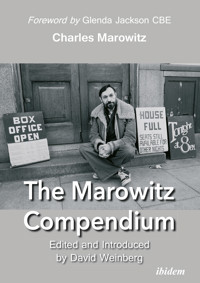
Charles Marowitz was the first American to direct at the Royal Shakespeare Company and the first American to direct at the Czech National Theatre (while collaborating with Vaclav Havel). Known as a maverick playwright, director, and critic, he nurtured numerous figures who have come to shape contemporary theatre and larger society. Without Marowitz the theories and ideas of Antonin Artaud would remain obscure. The entire trajectory and ecology of theatre and performance since the 1960s have been considerably influenced by this alone. The present-day popularity of ‘immersive theater’ was a mode of performance introduced to the British theatre by Charles Marowitz and Allan Kaprow in the famous ‘Happening’ at the 1963 Edinburgh Drama Conference. In 1968 Marowitz started the Open Space Theatre on Tottenham Court Road in collaboration with Thelma Holt. There is a gap in our collective understanding of this important figure and a gap in currently available literature about him. The Marowitz Compendium seeks to spark a revaluation. The audience for this book includes students, postgraduates, specialists and general readers interested in drama and the history of contemporary theatre.
Das E-Book können Sie in Legimi-Apps oder einer beliebigen App lesen, die das folgende Format unterstützen:
Seitenzahl: 416
Veröffentlichungsjahr: 2020
Ähnliche




















ibidem-Press, Stuttgart
Artists to my mind are the real architects of change and not the political legislators who implement change after the fact.—William S. Burroughs
Books by Charles Marowitz
THE SOUNDS OF MUSIC;
EARLY RECORDING ARTISTS - (World Audience, Inc.)
HOW TO STAGE A PLAY (Amadeus/Limelight)
THE OTHER CHEKHOV (Applause Boks)
ESSAYS ON THEATER (Drama/Denmark)
STAGE DUST (Scarecrow Press)
THE OTHER WAY (Applause Books)
ALARUMS & EXCURSIONS (Applause Books)
RECYCLING SHAKESPEARE (Macmillan)
DIRECTING THE ACTION (Applause Books)
BURNT BRIDGES (Hodder & Stoughton)
PROSPERO’S STAFF (Indiana Univ. Press)
POTBOILERS (Marion Boyars, Inc.)
CLEVER DICK (Dramatists Play Svc.)
SEX WARS (Marion Boyars, Inc.)
THE ACT OF BEING (Taplinger Press)
THE MAROWITZ SHAKESPEARE (Marion Boyars)
CONFESSIONS OF A (Eyre-Methuen)
COUNTERFEIT CRITIC
THE METHOD AS MEANS (Barrie & Rockliffe)
ROAR OF THE CANNON (Applause Books)
[Plays & Translations]
SILENT PARTNERS (Dramatists Play Svc.)
MURDERING MARLOWE (Dramatists Play Svc.)
QUACK (Dramatists Play Svc.)
BOULEVARD COMEDIES (Smith & Kraus)
STAGE FRIGHT (Dramatists Play Svc.)
BASHVILLE IN LOVE (Samuel French, Ltd.)
SHERLOCK’S LAST CASE (Dramatists Play Svc.)
CLEVER DICK (Dramatists Play Svc.)
WILDE WEST (Dramatists Play Svc.)
DISCIPLES (Dramatists Play Svc.)
HEDDA (Aschehoug, Norway.)
ARTAUD AT RODEZ (Marion Boyars, Inc.)
THE SHREW (Marion Boyars, Inc.)
MEASURE FOR MEASURE (Marion Boyars, Inc.)
AN OTHELLO (Penguin Books)
A MACBETH (Marion Boyars, inc.)
VARIATIONS ON THE (Marion Boyars, Inc.)
MERCHANT OF VENICE
THE CRITIC AS ARTIST (Hansom Books)
THE MAROWITZ HAMLET (Penguin Books)
& DOCTOR FAUSTUS
CYRANO DE BERGERAC (Smith & Kraus)
MAKBETT (Ionesco) (Grove Press)
AND THEY PUT HAND- (Grove Press)
CUFFS ON THE FLOWERS
(Arrabal)
List of Contributors
Thelma Holt CBE
After a successful career as an actor, Thelma Holt, in partnership with Charles Marowitz, founded the Open Space Theatre in Tottenham Court Road, which became the forerunner of the London fringe. Later Thelma Holt joined the Royal National Theatre and was responsible for several acclaimed West End transfers. She was also responsible for major tours of RNT productions to Paris, Vienna, Zurich, North America, Moscow, Tbilisi, Tokyo, and Epidaurus. Thelma Holt produced multiple visits to the RNT in London by international theatre companies, including performances of The Hairy Ape by Eugene O’Neill, directed by Peter Stein (production from the Schaubühne, Berlin), Miss Julie by August Strindberg and Hamlet by William Shakespeare both directed by Ingmar Bergman (productions from the Royal Dramatic Theatre, Stockholm), Macbeth by Shakespeare and Medea by Euripides both directed by Yukio Ninagawa (the Ninagawa Company from Tokyo), Tango Varsoviano by Teatro del Sur (Buenos Aires), The Grapes of Wrath by the Steppenwolf Theatre Company (Chicago), and Uncle Vanya by Anton Chekhov by the Moscow Art Theatre. For the first international season Thelma Holt received the Olivier/Observer Award for Outstanding Achievement in the Theatre and a special award from Drama Magazine. Among a list of celebrated productions Holt was Producer for Hay Fever by Noel Coward, directed by Peter Hall, starring Judi Dench, produced at Theatre Royal Haymarket, London, Six Characters in Search of an Author by Pirandello, directed by Franco Zeffirelli at the RNT. Holt was named Commander of the Order of the British Empire (CBE) in 1994 and was awarded the Order of the Rising Sun, (Golden Rays with Rosette) in 2004 by the Japanese government. She was awarded (with Bill Kenwright) the Tony Award for Best Revival in 1996 (A Doll’s House). Holt was Cameron Mackintosh Professor of Contemporary Theatre at Oxford University and has been a producer with the Royal Shakespeare Company since 2004.
Glenda Jackson CBE
Is an actor and former Member of Parliament (1992–2015). Jackson won a scholarship to the Royal Academy of Dramatic Art in London and was discovered by Charles Marowitz during the Theatre of Cruelty. In 1964 she had a breakthrough when she portrayed the French radical Charlotte Corday in the RSC/West End production of Marat/Sade. She reprised the role in the New York production in 1965, which marked her Broadway debut, and in the film version (1967). Jackson’s performance in 1970 in Ken Russell’s film Women in Love gained her the Academy Award (1971) for Best Actress. Jackson received Emmy Awards for her portrayals of Queen Elizabeth I, both in the BBC television miniseries Elizabeth R (1971) and in the film Mary, Queen of Scots (1971). She followed with a second-Best Actress Academy Award for A Touch of Class (1973). In 1992 Jackson left acting and won a seat in the House of Commons representing Hampstead and Highgate in North London. Known as an outspoken critic of the legacy of Margaret Thatcher, after leaving Parliament in 2015, Jackson resumed her acting career and in 2016 starred in a West End production of King Lear. Her performance earned Jackson her fourth Laurence Olivier Award nomination. Further acclaim including a Tony Award followed in 2018, when she appeared in the first Broadway staging of Edward Albee’s Three Tall Women. The next year she reprised her role as King Lear in the play’s Broadway staging. Jackson was named a Commander of the Order of the British Empire (CBE) in 1978.
David Weinberg, PhD
Is a theatre historian and theatre director. The Marowitz Compendium is Weinberg’s second book. He originally collaborated with Charles Marowitz in 1999 at the Malibu Stage Company in Los Angeles and continued to collaborate with him until his death in 2014. Weinberg has worked at West End theaters, including the Arts Theater, Leicester Square Theater, St. James Theater, Trafalgar Studios, and the Soho Theater, as well as Off-West End/regionally/internationally at the Young Vic Theater, Oxford Playhouse, Piper’s Opera House, Cockpit Theater, King’s Head Theater, Rose Playhouse, Theatro Technis, Baron’s Court Theater, Burton Taylor Studio, Etcetera Theater, Actors Lab Theater (Los Angeles), Hudson Theater (Los Angeles), RADA, and a festival hosted by the RSC in Stratford-upon-Avon. In 2012 it was confirmed that he was the first American to direct at the historic Rose Theatre, Bankside, where the plays of Shakespeare and Marlowe were originally performed. He has taught theater studies at Kingston University London and the University of London.
Table of Contents
Foreword by Glenda Jackson CBE
Introduction
Part One OUT OF THE MELTING POT (Four Excerpts)
Dumped in the Melting Pot
The Golden Year
Harold Pinter: Pinteresque until the End
Working with Havel
Part Two PRODUCTION DIARIES
RSC Theatre of Cruelty (1966)
The Four Little Girls by Pablo Picasso (1972)
The Sherlock File (1987)
Part Three PLAYS
The Marowitz Hamlet & Introduction (1968)
Tea with Lady Bracknell (1981)
Epilogue
Remembering Charles Marowitz by Thelma Holt CBE (2014)
Appendices
Artaud at Rodez (1972)
Conversation with Gaston Ferdiere
Conversation with Roger Blin
Conversation with Arthur Adamov
Foreword by Glenda Jackson CBE
Charles and I first met when I auditioned for what, many months later, became the Theatre of Cruelty. He was always work oriented, a style very different to his style as a friend. But whatever his ‘style’, he was always honest, creative, rambunctious absolutely, open to ideas, hungry for innovation, cynical, caustic, fearless and a true, true friend and a true, true believer in the power of theatre, to transform, engage, question, involve, and discover.
His was a transformative view of what a director can, perhaps even, should do. Never mis-lead, always lead, always explore, truth, truth, truth. He was deeply human, sensitive, intelligent, supportive or scathing if the situation warranted it. He was truly an explorer and I still feel privileged that I went on some of his journeys with him.
He would close as many doors as he would open, but he never left you outside on the doorstep. I’ll never forget ‘Charles’, as I always called him, and I am so grateful that I had the opportunity to work with him. Even more, he was a friend, much loved, much missed but never forgotten.
Introduction
During 1963 and 1964 Charles Marowitz and Peter Brook put Artaud’s theories into practice with the Royal Shakespeare Company Experimental Group/Theatre of Cruelty at LAMDA. This was the first full-fledged experimental project of its kind in Britain and injected Artaud’s ideas into contemporaneous theatre practice. Marowitz was the first American to direct at the Royal Shakespeare Company and the first American to direct at the Czech National Theatre (while collaborating with Vaclav Havel). A police raid on his theatre in London during the screening of an Andy Warhol film was the subject of a debate in the British Parliament involving a future prime minister. He wrote over a million words and numerous figures who have come to shape contemporary theatre and larger society were influenced in the formative stages of their careers by Marowitz. Marowitz directed the British premieres of Pablo Picasso’s The Four Little Girls, Samuel Beckett’s Act Without Words II, Arthur Miller’s The Man Who Had All The Luck, Saul Bellow’s The Bellow Plays, and the 1966/67 production of Joe Orton’s Loot, which received the Evening Standard Award for Best Play of the Year.
It has been seven years now since Marowitz’s passing on 2 May 2014 due to complications from Parkinson’s disease. It is important with perspective and hindsight to consider the significance of his life and career and his impact on theatre and the times in which he lived. Without Marowitz the theories and ideas of Antonin Artaud would potentially remain obscure. The entire trajectory and ecology of theatre and performance since the 1960s has been considerably influenced by this alone. The present-day popularity of ‘immersive theater’ was a mode of performance originally popularized in British theatre by Charles Marowitz and Allan Kaprow in the famous ‘Happening’ at the 1963 Edinburgh Drama Conference. The conference may be seen as marking the point when the experimental practices of the Edinburgh Fringe began to proliferate more widely to the rest of the UK.
In 1968 Marowitz started the Open Space Theatre on Tottenham Court Road in collaboration with Thelma Holt. The Open Space was an experimental theater run as a repertory company and introduced many important American writers to the British Theatre including Sam Shepard, Terence McNally, and John Guare. In many respects the Open Space was an Off Broadway Theatre based in London. It hosted an American season of plays in 1969 and continued to premiere many more American plays. The work at the Open Space also included British theatre artists such as Howard Barker and Mike Leigh in the early stages of their careers. There is a gap in our collective understanding of this important figure and a gap in currently available literature about him.
I collaborated with Marowitz four times and he sent me his new writing for feedback over the last fifteen years of his life. In an informal sense I inherited Charles’ collection of theater journals, magazines, and trade publications, and in reading my way through the material I found a number of gems that have not seen the light of day in fifty years or more. I also had works of his that have not been published as well as several hours of recorded interviews with Marowitz and his close associate Jim Haynes. This inspired me to organise a compendium of Marowitz’s unpublished and otherwise obscure but intensely valuable writings.
The purpose of The Marowitz Compendium, is first to spark a posthumous revaluation of Marowitz oeuvre and second to provide an edited collection that surveys his entire contribution to the theatre for generations encountering his work for the first time. The collection contains previously unpublished material including a selected section from Marowitz’s memoir Out of the Melting Pot (2014) as well as the play script for Tea with Lady Bracknell (1981). There is also obscure material of great value such as Marowitz’s 1966 interview with Roger Blin, director of the world premiere of Waiting for Godot. Included in the collection is work that is emblematic of his oeuvre and ‘greatest hits’ or at least reference to them such as the Broadway production diary for Sherlock’s Last Case (1987). The Epilogue is Marowitz Remembered (2014) by Thelma Holt his lifelong friend and closest collaborator.
This chapter introduces Marowitz and places him within the context of contemporaneous theoretical movements and changes in broader culture. In addition, indicators of his influence on performance are identified and discussed. This introduction provides a map of the book so that readers can more easily navigate each section. It also provides a brief description of the methodology, and a set of claims about substantive and theoretical issues at the core of the compendium’s purpose. This book shows that Charles Marowitz had an impact which has not been fully acknowledged or examined to date. It contributes to a more comprehensive and dynamic understanding of the forces which shape theatre and culture today. The audience for this book includes students, postgraduates, specialists, and general readers interested in drama and the history of contemporary theater.
Volume II
Due to the Covid pandemic it was not possible to access the Marowitz archive at the Harry Ransom Center at the University of Texas at Austin during the preparation of this collection. The archive contains adaptations of Timon of Athens, and Tartuffe, Poetry by Marowitz (Approximately 75 Pieces) and correspondence with Peter Brook, William Saroyan, Glenda Jackson, Vaclav Havel, Norman Mailer, Arthur Miller, Julie Harris, Lynn Redgrave, Trevor Nunn, Robert Brustein, Robert Lewis, Mel Brooks, Thelma Holt, Dudley Moore, Eric Bentley, Hermione Baddeley, Edward Albee, Larry Gelbart, John Schlesinger, Sir Andrew Lloyd Webber, Kenneth Tynan, Steven Berkoff, Sam Wanamaker, Jonathan Miller, Janet Suzman, and Christopher Fry. Given proper permissions there will almost certainly be a second volume of The Marowitz Compendium, containing some of this unpublished material once the pandemic is over. There are also Village Voice columns, personal columns from the Army (Chateauroux), The Promising Young Man (BBC script), Breach of Faith (BBC script) containing handwritten notes, play reviews, articles, and profiles from the London Guardian, London Times, and the New York Times including lengthy profiles of Peter Brook, Ingmar Bergman, Harold Pinter, and Glenda Jackson. Beyond that there is also the Open Space archive at the Victoria and Albert Museum in London.
Biography of Charles Marowitz1932–2014
Early Years
Marowitz was born in Manhattan on January 26th, 1932, and raised in poverty, the third child of exclusively Yiddish-speaking immigrants, on the Lower East Side of New York City. At the age of sixteen he read The Fervent Years (1945) by Harold Clurman. Clurman detailed the troubled history of the Group Theatre (1931-1941).At the age of seventeen Marowitz founded his own acting company on the Lower East Side of New York. In 1950, while still in High School Marowitz became the youngest theatre critic for the newly formed Village Voice and experienced first-hand the advent of the Off Broadway movement. Greenwich Village, where Marowitz spent his youth, was also the site of Off Broadway Theatres. ‘Off Broadway’ is a geographical demarcation but also has roots in definitions of the alternative theatre movement in America (Aronson 2000).
During the early 1950s Marowitz considered American life to be dominated by superficiality and conformity. He was drafted by the US Army during the Korean War but ended up spending two years stationed in France. He believed French culture could have a civilising influence upon him and began to imagine that he would have a more meaningful life in Europe. In due course he endeavoured to find a drama academy in France that he would be able to attend. However, there were no G.I. Bill approved drama schools in France whereas in England there were approved drama schools in both Glasgow and London. Marowitz opted to train at the London Academy of Music and Dramatic Art in the hope that he would be able to return to France on a regular basis.
London
At the age of twenty-four Charles Marowitz moved to London, during the summer of 1956. Continental influences as well as new American drama were beginning to open new possibilities for the future direction of the British Theatre (Shellard 1999: 17). Along with the work of Ionesco and Adamov and the London premiere of Waiting for Godot, in 1955 at the Arts Theatre, Joan Littlewood’s productions of Brecht promised change in theatre subject matter and practices. These productions were followed by the London tour of the Berliner Ensemble in the autumn of 1956. On 8 May 1956, Look Back in Anger, premiered at the Royal Court Theatre.
The Suez crisis as well as the Hungarian uprising in 1956 led to reverberations in British society. Other factors such as the growing power of young people, changes in family relationships, and new standards of sexual behavior would lead to widespread social upheaval in the two decades which followed. As a relative outsider Marowitz became conscious of certain tendencies within British culture. He found people obsessed with class identity. He found a society in the midst of radical change, given to dissent, anti-establishment fervor, and new trends which were convulsing British culture.
According to Marowitz, he became aware at LAMDA for the first time of the British as opposed to the American approach to acting. He developed a perception that the British approach was somewhat weighted towards voice and movement. He found that from his point of view, the British approach at the time was almost exclusively concerned with externals and uninterested in the concept of inner technique (Rebellato 1999: 78). In his view, Stanislavsky was given mindless lip service. Only one class at LAMDA theoretically touched on his ideas, a bi-weekly improvisation session. Marowitz considered these sessions to be a travesty of Method work, consisting exclusively of improvisations of little playlets worked up by the students under the instructor’s supervision. When some of the other American students who were already versed in the Method suggested that the work they were doing was devoid of appropriate actions, subtext, and palpable contact, the instructor did not appear to understand or be versed in the terminology they were using (Marowitz 1990: 14-15). Marowitz became bitterly disillusioned at LAMDA as did two of his American classmates who left the course. Marowitz wanted to follow suit but had he done so he would have lost his G.I. Bill subsidy and would have had to return to the United States, which he was unwilling to do.
Marowitz considered the training at LAMDA to be backward, although he did encounter some interesting work on verse technique and he was exposed to the habits of established British classical theatre practitioners. He found that acting was thought to be merely a mode of projecting language and physical technique. In his view the school was intellectually and artistically a kind of British feeder for the West End theatre establishment and he felt himself becoming increasingly anti-social. Marowitz decided to branch out into the London theatre itself and directed his first theatre production in Britain at the London Unity Theatre. He directed a production of his own adaptation of Gogol’s comedy Marriage, and the production received a favourable notice in The Times (Marowitz 1990: 17). Marowitz was then asked to work on a Living Newspaper called World on Edge, being devised at Unity in November 1956 on the subject of the recent Suez crisis and the Hungarian uprising (Chambers 1989: 340-345).
Shortly after that production Marowitz started a Method workshop at Unity Theatre which he used to introduce a number of English actors to the principles and ideas of Stanislavsky although Unity had run a Stanislavsky based school in the late 1930s (Chambers 1989: 361). He also developed his own exercises and ideas. Marowitz decided that instead of using material such as Clifford Odets, Gorky, and Arthur Miller he would use Shakespeare, Marlowe, and Webster (Marowitz 1990: 17). After one year at LAMDA Marowitz transferred to the Central School of Speech and Drama but found his experience there to be very similar to that at LAMDA and after his G.I. Bill subsidy ran out, the Method workshop became his primary source of income. He immersed himself as much as possible in the study and practice of Stanislavsky but found that applying this practice to texts by Shakespeare, Marlowe, and Webster was problematic just as others such as Michel Saint-Denis had found before him. Marowitz soon became associated with the Method label and at the age of twenty-nine, wrote his first book entitled The Method as Means (1961).
In-Stage
Marowitz began writing criticism for the Encore Reader magazine, the theatrical bi-monthly publication, which was originally started by Clive Goodwin in 1954 (Marowitz, Milne, Hale eds. 1965). Also, in 1958 Marowitz persuaded the British Drama League to allow him to convert a rooftop studio at Fitzroy Square in London into his own experimental theatre which he then called ‘In-Stage’ (Miles 2010: 125). At In-Stage Marowitz attempted to define a non-naturalistic style, building on the theories of the early Absurdist and Surrealists. This effort involved essentially a paring down of language as far as possible while establishing an ingrained awareness of what things are essentially, rather than what they seem to be on the surface. Marowitz’s experimental work was intended to run in parallel with classical theatre productions and commercial theatre and was warmly received by the critic Alan Pryce-Jones of the Observer (Marowitz 1990: 19-20).
In-Stage went on to produce a play by J.B. Lynne called The Trigon, with performances by Timothy West and Prunella Scales. The Trigon, transferred to Brighton and then the Arts Theatre Club in London’s West End. At In-Stage Marowitz also mounted the British premiere of Samuel Beckett's Act Without Words II, Arthur Miller’s The Man Who Had All the Luck, and William Saroyan's The Cave Dwellers. In-Stage was also the first theatre in Britain to produce works by the playwright Murray Schisgal. This was the period immediately before Marowitz’s affinity for Artaud found expression in his theatre practice.
Before long—one can never date these things but it was around the early Sixties—I realized I had been blinded by Strasberg in precisely the same way he had been conned by Stanislavski, and that in some kind of prophetic way, my attempt to apply Method to classics was really an indication of an entirely different temperament, one which found its realisation in the ideas of Artaud (Hewison 1986: 90-91).
At the In-Stage theatre at Fitzroy Square spectators would line up in a small room below the rooftop studio where they were offered tea and biscuits by Marowitz’s friend and collaborator Gillian Watt. When the show was about to start audience members would move in single file up the narrow staircase that led to the tiny platform stage. Marowitz would often be backstage working the lights and sound tape. After the performance the audience would file out and Gillian Watt would stand at the bottom of the staircase holding a wicker basket into which members of the audience would drop coins and sometimes notes.
At In-Stage the actors received no wages, and the audience paid no admission, which was also a characteristic of many contemporaneous Off Off Broadway theatres in New York (Crespy 2003). The productions were both offbeat and highbrow as were the audiences. Many of the audience members were readers of the New Statesman which, along with the British Drama League magazine, were the only publications In-Stage could afford to advertise in. The audiences at In-Stage formed the beginnings of a new theatre-going public, a public which would eventually patronise places such as the Roundhouse, UFO, Ambiance, Soho Poly, the Oval House, and the Open Space. These were the forerunners of what would eventually become the London Fringe.
Theatre of Cruelty
When Marowitz arrived in London in 1956 he was still writing and reviewing regularly forthe Village Voice. Once in LondonMarowitz started writing for The Encore Readeras well.In fact The Encore Reader was what originally brought Peter Brook and Charles Marowitz together as they were both regular contributors (Marowitz 1990: 81). One of the first productions Marowitz had seen after moving to Britain was Peter Brook’s 1957 production of Titus Andronicus, at Stratford-upon-Avon, which Marowitz reviewed for the Village Voice. In the review Marowitz stated, ‘A short scalene-shaped man named Peter Brook, aged 33, is the greatest director in England’ (Marowitz 1990: 81). One of the things which had attracted Marowitz to the Encorepublication was its association with Brook. Marowitz wrote a letter to Brook and invited him to a production he was directing at In-Stage of A Little Something for the Maid, by Ray Abell and Brook attended. Afterwards Brook and Marowitz met in London and then again in Paris where Brook originally introduced Marowitz to the idea of collaborating on the 1962 production of King Lear, with Paul Scofield.
Together Brook and Marowitz were primarily responsible for the injection of Artaud’s ideas into contemporary theatre practice (Kershaw 1992: 103). During 1963/64 Charles Marowitz and Peter Brook put Artaud’s ideas to the test with the Royal Shakespeare Company Experimental Group/Theatre of Cruelty at LAMDA. Initially Brook brought Marowitz into the RSC as his assistant on the famous 1962 production of King Lear, and it was through that relationship that the Theatre of Cruelty group came about (Chambers 2004: 152). The group’s stated intention was ‘to explore certain problems of acting and stagecraft in laboratory conditions, without the commercial pressures of public performance’ (Cole and Chinoy 1970: 430). This was the first full-fledged experimental project of its kind in Britain. Artaud saw the conventional use of language in theatre as a means of repressing society (Sontag in Artaud 1988: np). Artaud’s emphasis on non-verbal communication through movement and sound has influenced a trend in contemporary theatre towards prioritising the body over conventional literary interpretation.
It was Marowitz’s job during the first three months of the Theatre of Cruelty project to devise a series of exercises by which the actors’ untapped creativity could be accessed (Burns 1972: 178-179). This involved an effort to engage with areas of the actors’ minds and bodies which lay beneath, inaccessible to the conventional naturalistic techniques on which contemporary actors predominantly based their performances. Marowitz believed that Stanislavsky's most important discovery was the notion of ‘subtext’. Behind surface existence was something resembling a complex of needs, drives, symbols, and unformulated emotions which existed in the realm Artaud described as ‘that fragile fluctuating centre which forms never reach’ (Marowitz 1990: 85-86). The exercises Marowitz invented were intended to penetrate the realm of the actors’ primitive drives. They were designed to coax the actor into sounds, movements, spatial metaphors, and non-verbal improvisations which in theory derived from a place where individual human communication originates.
During the period when the Theatre of Cruelty was being formed it was also Marowitz’s job to audition actors who might join the experimental company (as distinct from the main RSC). Marowitz looked for actors who were open enough to accommodate highly unorthodox techniques. Instead of seeing actors on a one-to-one basis, Marowitz worked out a system of collective auditions whereby groups of eight and ten would interact with one another through improvisations, nonsense texts, and various theatre games engineered to test both their imaginations and their critical temperament.
Unlike a traditional rehearsal process which begins after actors have already been cast in particular roles, the Theatre of Cruelty’s creative process involved Marowitz and Brook putting the actors through a series of tests and exercises which primarily included improvisations and games in which actors’ personal imaginations were constantly being provoked into outward expression. The showing of the company's work was a kind of surrealist selection (Hewison 1986: 91). The pieces explored psychic interiors and the extremes of performance with wild bouts of violence and cruelty (Davies 1987: 159) while incorporating a variety of authors’ work (including John Arden, Shakespeare, Paul Ableman, Alain Robbe-Grillet, and others).
It was also during this season that Marowitz first wrote and directed his twenty-eight minute version of the collage Hamlet, which was later expanded to eighty minutes. Marowitz’s eighty-minute version of his collage Hamlet, was first produced with In-Stage for the Literarisches Colloquium, Berlin, at the Akademie der Kunste in 1965. It went on to the Jeanetta Cochrane Theatre in London in 1966 (Schiele 2005: 3). The company also presented a version of Genet’s The Screens, at the Donmar Studio, established in 1961 by West End producer Donald Albery as a rehearsal space for his production company Donmar Productions (whose name is derived from the first three letters of his name and his wife’s middle name, Margaret) and the RSC then turned the space into a theatre called The Warehouse (Chambers 2004: 72). Later, the company of eighteen actors was integrated into the main Royal Shakespeare Company and went on to utilise the language and techniques developed during the Theatre of Cruelty for the 1964 production of Peter Weiss’s Marat/Sade, directed by Peter Brook. Marowitz was offered a permanent position with the company but he turned it down because he did not want to become trapped in Brook’s shadow.
London Traverse
Following Marowitz’s participation in the landmark Happening during the 1963 Edinburgh Drama Conference, he and Traverse Theatre artistic director Jim Haynes, who had helped sponsor the conference, began to collaborate. In 1964 Marowitz persuaded future Nobel laureate Saul Bellow to allow him to direct three one-act plays Bellow had written, at the Traverse Theatre club in Edinburgh. The Traverse Theatre with Haynes (from Louisiana) was intended as a permanent year-round home for the kind of experimental work that was taking place during the Edinburgh Fringe Festival for three weeks in August every year. The programme became known as The Bellow Plays, and later transferred to the Fortune Theatre in London. Also, in 1964 Marowitz directed Jack Richardson’s Gallows Humour, at the Traverse during the Edinburgh Festival. In 1965 he directed Peter Barnes’s first work entitled Sclerosis, and Peter Weiss’s play A Night with Guests, at the Traverse (McMillan 1988: 105–110). Haynes believed that in order to maximise the trajectory of the Traverse’s work, both in terms of prospective talent as well as finance, a London venue needed to be directly linked with the Traverse in Edinburgh so successful productions could transfer. After a prohibitively expensive season of work at the Arts Theatre, Haynes relocated the venture to the Jeanetta Cochrane in London in 1966 and asked Marowitz to be associate director (Hewison 1986: 112).
In 1966-1967 Marowitz directed Joe Orton’s Loot, at the London Traverse, which received the Evening Standard Award for Best Play of the Year. Previously the play had a difficult run in the regions. Nonetheless Marowitz was approached by producers Michael White and Oscar Lewenstein about the play in 1966. During the regional run the cast sensed that audiences were not engaging with the material and so they began to add one-liners and inject their own collective invention into the ‘performance script’. When Marowitz was approached about doing the play at the London Traverse he asked to see the original version of the script and when he read it he was astonished by its sophisticated literary constructions and the subtle black comedy. He immediately agreed to stage the production during the London Traverse’s first season and then worked on the script with Orton.
Marowitz’s directorial approach to the play was to make social and moral excesses plausible, and to find the truth which lay deep within the material. The production opened in September 1966 and transferred to the Criterion Theatre in London’s West End in January 1967. Loot,ran for 342 performances (Shellard 1999: 127) but despite positive reviews the play continued to cause offended patrons to leave the theatre in the middle of the performance. Nevertheless, the production achieved such a profile that during the West End run directed by Marowitz the producers also negotiated the film rights for the play. The production also became a point of reference during the ‘dirty plays’ controversy initiated by the impresario Emile Littler, a controversy based around collective hostility towards displays of nudity, promiscuity, and most of all the representation of homosexuality (Marowitz 1990: 104–105).
Ten months after the play opened, Orton was murdered in his sleep on 9 August 1967 by his lover Kenneth Halliwell who then committed suicide by overdosing on sleeping pills (Shellard 1999: 126). The murder-suicide was headline news and Marowitz was subsequently approached by numerous journalists and researchers interested in any insights he could provide about Orton. Although Marowitz and Orton did not particularly like each other on a personal level (Marowitz 1990: 109), they shared a similar irreverence and hostility towards the British establishment which found expression in their collaborative work together.
Open Space
In 1968 Marowitz opened the Open Space Theatre on Tottenham Court Road in collaboration with Thelma Holt (Hewison 1986: 200), a young actor and producer who had recently completed training at the Royal Academy of Dramatic Art (Marowitz 1974: 7-10). Marowitz first met Holt when she was acting in Leonid Andreyev’s play, He Who Gets Slapped, at the Hampstead Theatre Club in 1964. Marowitz said he explained that he wanted to create a permanent home for a small resident company and mount experimental and unorthodox theatre and performance, including works which were not plays necessarily but collaborations collectively devised by a permanent ensemble. Holt was interested, according to Marowitz but only on the basis that she would have an active managerial role in the new theatre.
Over the next twelve years the Open Space would become one of the leading experimental theatres in Britain and introduce new works by such British playwrights as Howard Barker, Trevor Griffiths, Howard Brenton, Peter Barnes, David Rudkin, John Hopkins, and Mike Leigh. The Open Space would also introduce new work to the British theatre by many important American playwrights including Sam Shepard, John Guare, Terence McNally, Lawrence Melfi, Charles Ludlam, Mike Weller, as well as work by Jean Claude van Itallie.
Marowitz was interested in utilising the best material from Off Broadway and Off Off Broadway. Such material in addition to being novel material within a British context, was also written to be performed in very similar conditions to those provided at the Open Space. In his introduction to Off Broadway Plays 2, Marowitz explained that ‘The Open Space Theatre rapidly became a kind of extraterritorial Off Broadway outpost.’ (Marowitz 1972: 10) In many respects the Open Space was an Off Broadway Theatre in London. The Open Space was known for environmental pieces, Shakespeare collages, and premieres of new writing, including the 1971 British premiere of The Four Little Girls by Pablo Picasso. Picasso and Artaud had been friends and it was the link with Artaud that, at least in part, piqued Marowitz’s interest in directing the text as part of Picasso’s 90th birthday celebrations (Schiele 2005: 53).
The first production presented at the Open Space was Fortune and Men’s Eyes, by John Herbert. The play opened on 10 June 1968 and was set in a Canadian reformatory. The audience was ushered in through a fire exit instead of the main entrance and walked in single file through a narrow passage way on the iron fire escape. A metal door was opened by an armed guard who took the audience’s tickets while two inmates stared silently from behind iron bars as the audience entered. Another guard with a submachine gun supervised from above. The audience was fingerprinted, and then ushered into a cell until twelve people were in each cell. Meanwhile loudspeakers blasted announcements related to prison life until the sound of a shower and the appearance of the four actors who were central to the play marked the beginning of the performance.
The production was an attempt to break down the traditional barriers associated with a proscenium arch theatre and to implicate the audience directly in the action of the play. The audience is made to adopt a role and is inculcated into a subjective view of a criminal justice scenario. This in turn had the potential to alter the individual audience member’s view as it relates to the criminal justice system. Before the foundation of the Open Space Marowitz had repeatedly stated that, in his view, there was no theatre movement in Britain which could be described as avant-garde. His fundamental concern was with breaking down the conventional presentation of character (Schiele 2005: 111). The run of the play was extended at the Open Space until 4 October 1968. It transferred to the Comedy Theatre in London's West End on 17 October (Moffat 1978: 69).
In 1970, during the Open Space’s third year of operation, the theatre received £1500 (now worth roughly £40,000) from the Arts Council but was otherwise struggling financially. Marowitz and Thelma Holt decided to arrange film screenings of a new Andy Warhol film called Flesh, about a male prostitute who is pressured by his wife to raise money for her lesbian girlfriend’s abortion. Warhol was a popular sensation at the time. Marowitz and Holt believed that the film screenings would generate some much-needed income for the theatre and also reflect Marowitz’s interest in the avant-garde and Greenwich Village experimentation. The film was screened three or four times daily for three weeks, starting in January 1970. On 3 February thirty-two police constables and a superintendent from Scotland Yard raided the Open Space during a scheduled screening and ordered the projectionist to stop the film. The film and projector were confiscated by the police as were the Open Space’s documents, books, and receipts (Miles 2010: 292).
The following day the raid was headline news and there was shortly thereafter a debate in the House of Commons about the film, involving then Labour Home Secretary and future Prime Minister James Callaghan. Ultimately, the Director of Public Prosecutions advised the Metropolitan Police that a criminal prosecution with respect to charges of obscenity was not warranted. Nevertheless, a magistrate’s hearing on the lesser charge that the theatre had allowed members of the general public into a licensed club was allowed to go forward. The Open Space was fined £220 which was then paid by Andy Warhol himself in a gesture of public support for the theatre (Marowitz 1990: 143–145).
Works known as the Marowitz Shakespeare collages which were produced at the Open Space included Hamlet, A Macbeth, An Othello, The Shrew, Measure for Measure, and Variations on the Merchant of Venice (Marowitz 1978: 7–27). Marowitz’s intention in creating these works was primarily to confront the substructure of the plays in an attempt to test or challenge, revoke or destroy the foundations on which classical plays were revered and generally accepted. To accomplish this Marowitz challenged Shakespeare's presentation of theme and character and altered it to suit his own interpretation or intentions. He objected to the reverence with which he believed these plays had been treated and endeavoured to extract something new and pertinent by breaking them into pieces and reassembling them in a particular way (Schiele 2005: 15). Marowitz wanted to create a different vantage point and obtain an inside view of external developments which he believed would potentially alter the entire resonance of the theatrical experience. In challenging the institutionalisation of Shakespeare’s canonical texts Marowitz sought to reinvigorate these works and redirect their potential efficacy within culture and society in parallel with work his colleague Peter Brook was doing about the same time.
In addition to the Shakespeare collages Marowitz also adapted four additional works during his London period. Oscar Wilde's The Critic as Artist, was adapted in 1971 and produced at the Tottenham Court Road space as was George Buchner’s Woyzeck, in 1973. In 1979 Marowitz adapted August Strindberg's The Father, which was performed at the Open Space Euston Road premises, and Hedda, based on Hedda Gabler, in 1980 which was performed at London’s Roundhouse. Marowitz claimed his collage work and adaptations were primarily inspired by the work of William Burroughs whom he cast as President Nixon in Flash Gordon and the Angels, in 1970 (Miles 2010: 293) and again as Judge Hoffman in The Chicago Conspiracy(1971) both at the Open Space. The productions encompassed many different themes but share a common characteristic theme: the struggling individual bound by the strictures of conventional society and isolated from the rest of humankind because of a desire to break free from it.
Both verbal and visual shock tactics were incorporated into performances as an integral part of the means of expression. Simple or bare sets were used to facilitate quick changes, and lighting was the chief means of design, suggesting a different realm or reality from the real world, as in the use of gauze curtains and lighting effects in the Critic as Artist. Such design elements were utilised to remove the audience from the performance scenario by creating a dreamlike quality within the environment. Marowitz created an important and characteristic emphasis on speed. Speed generated a film-like technique in which the production would switch from one visual image to another unexpectedly and without rational explanation. This was intended to expose, through external expression, what was happening in the mind of a particular character as in a Hollywood movie.
Marowitz’s 1971 adaptation of The Critic as Artist, involved the addition of a dramatic scenario in which Oscar Wilde and Lord Alfred Douglas meet for the first time. The adaptation stripped away Wilde’s original prose from the piece, leaving only dialogue. The rationale for this move was to compensate for the fact that Wilde’s original was not intended as a piece of dramatic writing. The set was a Victorian sitting room and green carnations were handed out to the audience as they entered the theatre. Curtains made of gauze surrounded the space and, when lit, became transparent, giving a dreamlike quality to the production. Timothy West played the part of Oscar Wilde and Peter Davies played the role of Lord Alfred Douglas. The production was critically successful and ran for five and a half weeks.
The second original piece by Marowitz to be presented at the Open Space was Artaud at Rodez, in December 1975 (Schiele 2005: 214). Marowitz drew upon information he had gained through research into Artaud’s life and his interviews with Dr. Gaston Ferdiereand, Roger Blin, and Arthur Adamov in 1966. Dr. Ferdiere was the man responsible for Artaud’s electric shock treatments at Rodez where Artaud was hospitalised. The piece shows a man obsessed with a personal vision of what art in the theatre ought to be and who is driven mad by his inability to realise his vision. The play was dramatised as a confrontation between Dr. Ferdiere and Artaud himself. Dr. Ferdiere was portrayed as the personification of conformist values at odds with Artaud who was portrayed as the personification of the artistic temperament.
In 1976 The Open Space moved to temporary premises in a disused post office on Euston Road because the block of Tottenham Court Road where the original Open Space was located had been closed for redevelopment. The company responsible for the redevelopment promised to include plans for a new theatre for the Open Space to occupy on Tottenham Court Road upon completion. This promise helped to influence the Camden Council to approve the demolition, but there was no written agreement and the construction company subsequently failed to honour its spoken agreement (Schiele 2005: 7). This, along with a confluence of other factors, principally including the departure of Holt from the Open Space, led to the dissolution of the Open Space and Marowitz’s subsequent departure from the UK in 1980. During the period at the Open Space Theatre (1968–1979) more than 175 plays were produced. Many writers and directors, such as Sam Shepard and Mike Leigh (Hewison 1986: 204), who started their careers at the Open Space were to go on to have significant influence on the course of theatre history and cinema in subsequent decades.
1981 was the year that Marowitz left Britain and returned to the United States on a permanent basis. In 1981 his Hamlet, was presented at the Los Angeles Actors Theater (now the Los Angeles Theater Center). That production began an association which lasted until 1989. During this period, he was also a theatre critic with the Los Angeles Herald Examiner. While Marowitz was still the artistic director of the Open Space in 1974 there was a playwright who abruptly dropped out of a scheduled production after receiving a more lucrative offer elsewhere. This left the Open Space in the lurch with an imminent vacancy in the schedule looming and with rehearsal scheduled to begin in two-weeks. Thelma Holt suggested that Marowitz come up with something. This initially led to a one act called Sherlock’s Last Case, which after its production in the UK was eventually expanded into a full-length play which was first produced at the LAAT as part of the city’s 1984 summer Olympic festivities and then on Broadway starring Frank Langella in 1987.
He founded a new theatre, the Malibu Stage Company, in 1990 and was its artistic director for a dozen years. In 1991 Marowitz’s most popular and influential book Recycling Shakespeare, was published. In this book Marowitz delves deeply into the collected works, illuminating and interpreting the nature and nuances of the cannon. Marowitz shows how Shakespeare, like so many of his own earlier sources, can be reused, restructured, and recycled for contemporary consumption. While artistic director Marowitz continued to attempt with great difficulty to assemble a permanent company based around the Actors Equity Association’s 99 seat agreement within the Los Angeles area. During this period, he continued to create new works such as Murdering Marlowe, which premiered at the Malibu Stage Company in 2002. The play is a fiction about William Shakespeare’s involvement in a conspiracy to murder Christopher Marlowe.
Unfortunately, the end of Marowitz’s relationship with the company and its board was not amicable. Throughout his life Marowitz was famously involved in arguments both personally and professionally. When considering this aspect of his life it is important to note that this man was at his heart a subversive not unlike Kit Marlowe or Oscar Wilde and the drive to topple the apple cart of tradition, groupthink, and establishment orthodoxy was inextricably linked with who he was at all times.
During his time living in Malibu his home was threatened by fire on three occasions. When forced to evacuate he had to choose which possessions were a priority to save potentially from the fire. Marowitz chose to take his computer, a half dozen manuscripts, and as many 78 rpm records from his collection he could stuff into an oblong bag. In hindsight this led him to the conclusion that essentially words and music, were what really mattered to him. Music as nourishment and inspiration, and words as a product of that nourishment and inspiration.
In the spring of 1996 Marowitz read Eric Bentley’s The Brecht Memoir. He was immediately drawn to the material as he believed it was the most revealing work, he had read about the person of Bertolt Brecht. Marowitz wrote a letter to Eric Bentley (1916-2020), the celebrated drama critic who had started writing pieces for the theatre, expressing his enthusiasm and suggesting that Bentley consider turning his memoir into a play. He did not hear back from Bentley for four years. In 2000 Marowitz heard back from Bentley and this began a unique collaboration for both men which culminated first in February 2002 when Marowitz directed a rehearsed reading of Silent Partners, based on The Brecht Memoir, at the Coronet Theatre in Los Angeles where the original production of Brecht’s The Life of Galileo, starring Charles Laughton, was staged in 1947. Then in April 2006 Silent Partners, premiered at the Scena Theatre in Washington DC and in London at the White Bear Theatre in 2013.
In 2004 his biography of Michael Chekhov The Other Chekhov, about the largely forgotten Oscar-nominated nephew of Anton Chekhov was published. Throughout his life Marowitz described a certain tug-a-war between Stanislavski based approaches to theatre craft and more ‘metaphysical’ approaches such as those he believed were contained in the theories of Artaud. His interest in Michael Chekhov was part of this struggle to find methods that would potentially reconcile this aesthetic conflict. Michael Chekhov shared an ambivalence towards a limited naturalistic approach to theatre making as expressed in such writings as To the Actor (1953).
In 2005 Marowitz directed Vaclav Havel’s Temptation, at the Czech National Theatre in collaboration with the Nobel laureate and former president of the Czech Republic. Marowitz’s recollection of the production is enclosed within. Marowitz was the first American to direct at the Czech National Theatre. Following this production Marowitz began to slow in his output and activity. In 2009 he was offered a lecture tour of Denmark under the auspices of the US Embassy in Copenhagen of universities, societies, and theatre schools. Marowitz was invited to direct his Hamlet, collage at the University of Victoria in Canada for nine performances in March 2012. This was the last production he directed. He died on May 2nd, 2014 in Agoura Hills; California due to complications from Parkinson’s disease. He is survived by his wife, Jane Windsor-Marowitz, whom he married in 1982, and by a son, Konstantin, known as Kostya.
Marowitz as Thinker
Charles Marowitz became a key figure in an important new phase in the development of contemporary theatre. The groups and people associated with Marowitz would serve to delineate the antithetical purpose of the alternative theatre and establish an engagement between this sector and the commercial theatre establishment which could be argued had dialectical characteristics. A synthesis of alternative and mainstream characteristics has emerged and influenced contemporary theatre as a whole into a more comprehensive level of engagement with society. In this a somewhat more representative and comprehensive number of communities and voices find representation. One could go to the most commercial theatre in the present day and identify characteristics, such as an increased emphasis on physicality and non-verbal expression, or the irreverent deconstruction and decentring of canonical texts, and trace these characteristics back to the influence of the alternative theatre. In several societies, there is a tendency for mainstream theatre to draw direct influence from the alternative theatre if it exists.
In a conventional proscenium arch actor/audience scenario the audience is a part of an active/passive relationship. In conventional narrative-text-character based theatre the reception of the performance will be optically and auditorily focused and selective with regard to the incidents and their narrative significance. The audience member will sit in a designated position which orientates in a certain direction. The seat is fixed to the floor and the lights are extinguished except for a specific area where the performance activity is located. The audience is expected to acquiesce in a level of subordination and passivity. Marowitz’s theatre sought varieties of alternatives to such a rigid format.
These changes were intertwined with his own personal journey as well as contemporaneous events. Marowitz experienced the advent of Off Broadway firsthand as a youth in Greenwich Village and as a theatre critic for the Village Voice




