


1,49 €
Mehr erfahren.
- Herausgeber: BookRix
- Kategorie: Sachliteratur, Reportagen, Biografien
- Sprache: Englisch
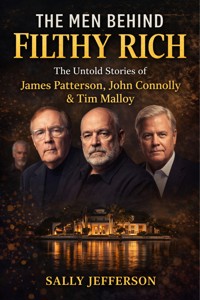
The Men Behind Filthy Rich reveals the untold story of how three men from radically different worlds, a bestselling novelist, a former NYPD detective turned investigative journalist, and an Emmy Award-winning war correspondent, came together over dinner at a Palm Beach restaurant and decided to expose the most protected predator in America.
This work is an independent biographical history based entirely on publicly available sources, including published interviews, court documents, government reports, and news coverage. It is not affiliated with or endorsed by any individuals discussed.
In 2016, James Patterson, John Connolly, and Tim Malloy published a book that revealed what powerful institutions had spent years suppressing. The media ignored it. Prosecutors did nothing. Three years later, Jeffrey Epstein was arrested, and everything the book had documented was confirmed.
Inside this book, you will discover:
How a phone call from a high school student launched a fourteen-year investigation that no newsroom would touch.
Why Vanity Fair killed Connolly's Epstein exposé, and what happened when he brought the story to Patterson instead.
The real division of labor behind the Patterson co-authorship model and what stylometric analysis revealed about who wrote the words on the page.
How the October 2016 election cycle buried the book's release beneath the Access Hollywood tape and WikiLeaks, and the cruel irony of a book about powerful men abusing women being drowned out by a tape about exactly that.
What the Netflix documentary changed, what it couldn't change, and what the eight-reviewer critical analysis reveals about Patterson's dual role as executive producer and on-screen narrator.
Why Julie K. Brown's Miami Herald series generated the institutional response that The Men Behind Filthy Rich documents Patterson's book could not, and what that failure reveals about the structural gap between commercial publishing and investigative journalism in America.
The full story of John Connolly's final years, his unpublished Pellicano manuscript, and the career that took him from an NYPD badge to the pages of Spy Magazine, Vanity Fair, and a Netflix documentary seen by millions.
How Tim Malloy pivoted from combat zones in Iraq and Afghanistan to the Quinnipiac University Poll, and returned to collaborate with Patterson on a number one bestseller in 2024.
What the 2025 Epstein Files Transparency Act and the release of over three million pages of government documents confirmed about every institutional failure the original book had identified a decade earlier.
This is not a retelling of the Epstein case. This is the story behind the story, a documented examination of how three writers built the first mass-audience account of one of the most consequential criminal cases of our time, and why the institutions that should have listened chose not to.
Readers who waited for the Epstein files already know the facts. This book shows them who fought to make those facts public when no one else would, and at what cost.
Every week, public interest in the Epstein case intensifies as new documents surface and new questions demand answers. The context this book provides is not available anywhere else. Once you understand who told this story first and why the world refused to hear it, you will never read the headlines the same way again.
Scroll up and order your copy now, before the next satisfying and shocking revelation satisfies the readers who got here first.
Das E-Book können Sie in Legimi-Apps oder einer beliebigen App lesen, die das folgende Format unterstützen:
Veröffentlichungsjahr: 2026
Ähnliche















THE MEN BEHIND
FILTHY RICH
Also, by SALLY JEFFERSON
THE MEN BEHIND
FILTHY RICH
The Untold Stories of
James Patterson, John Connolly
& Tim Malloy
SALLY JEFFERSON
COPYRIGHT & DISCLAIMER
© 2026 SALLY JEFFERSON. All rights reserved.
Published by SALLY JEFFERSON
First published 2026 by SALLY JEFFERSON
No part of this publication may be reproduced, stored in a retrieval system, or transmitted in any form or by any means — electronic, mechanical, photocopying, recording, or otherwise — without prior written permission of the publisher, except for brief quotations in critical reviews and scholarly commentary as permitted under fair use provisions of applicable copyright law.
This work of narrative nonfiction is based on publicly available records, published interviews, court documents, journalistic accounts, and web-accessible authoritative sources. The author has made every reasonable effort to verify historical accuracy across all factual claims. Where scholarly or evidentiary disagreement exists, competing interpretations are acknowledged.
Quotations from primary sources, court records, and published interviews are reproduced under fair use for purposes of historical commentary and analysis. All opinions and interpretive conclusions are the author's own and do not represent the views of any institution, publisher, or individual referenced herein.
The events described involve criminal conduct, including sexual abuse of minors. Reader discretion is advised.
Cover design by SALLY JEFFERSON
Printed in the United States of America
For the ones who spoke when no one was listening.
“In 2008, nobody cared about them.
The state didn’t care about them.
The media didn’t care about them.
Nobody cared about the girls.”
— James Patterson, Rolling
TABLE OF CONTENTS
INTRODUCTION
CHAPTER 1
The Kid from Newburgh
CHAPTER 2
The Cop Who Became a Writer
CHAPTER 3
The Man on the Ground
CHAPTER 4
The Predator in Palm Beach
CHAPTER 5
Meeting at the Palm Beach Grill
CHAPTER 6
Writing the Unwritable
CHAPTER 7
Nobody Thought It Was a Story
CHAPTER 8
The Patterson Machine
CHAPTER 9
The Reckoning
CHAPTER 10
The Screen
CHAPTER 11
The Last Story
CHAPTER 12
The Reporter Who Stayed
CHAPTER 13
The Weight of Ink
INTRODUCTION
"Three Men and a Monster"
On a Manhattan sidewalk sometime around 2012, James Patterson — the bestselling author alive, a man whose novels accounted for roughly one in every seventeen hardcover fiction sales in America — spotted a face he recognized from news reports. Jeffrey Epstein, a convicted sex offender, was strolling through the city with two strikingly young women on his arm. Patterson knew that Epstein had pleaded guilty to soliciting a minor for prostitution in Palm Beach County, just miles from Patterson's own home. He knew Epstein had received a sentence so lenient it scandalized the prosecutors who had built the case. And here was Epstein, walking free, apparently untouched by consequence.
That sidewalk encounter planted a seed. But Patterson alone could not have written the book that followed. For that, he needed two men whose careers had been shaped by the gritty, unglamorous work of chasing stories that powerful people wanted buried.
John Connolly was a former NYPD detective who had reinvented himself as one of New York's most relentless investigative journalists. Working for Vanity Fair, Spy, and Time, Connolly had spent decades exposing figures who operated at the intersection of wealth, celebrity, and criminality. He had been trying to write an article about Epstein for Vanity Fair — an article that kept getting suppressed. Tim Malloy was a fourteen-time Emmy Award–winning television reporter who had spent eighteen years at WPTV in West Palm Beach. His pursuit of the Epstein story began with a phone call from a student at Royal Palm Beach High School who told him about an older man paying young girls for massages. Malloy tracked the case for fourteen years as a local journalist before the rest of America learned the name Jeffrey Epstein.
The three men converged in Palm Beach County — Patterson through proximity and outrage, Connolly through investigative instinct, Malloy through years of dogged local reporting. Their collaboration produced Filthy Rich, published in 2016, which spent five weeks on the New York Times Bestseller List and was later adapted into a four-part Netflix documentary. The book brought the Epstein case to millions of readers years before his 2019 arrest and death in a Manhattan jail cell.
This book is not another retelling of the Epstein case. It is the story of the three men who told it first — their origins, their careers, their convergence, and what their unlikely partnership reveals about how investigative stories reach the public in modern America. A detective who became a journalist. A war correspondent who started with a local tip. The world's most commercially successful author is venturing into nonfiction for the first time. Each brought something the others lacked: Connolly brought sources and street-level instinct. Malloy brought years of ground-level reporting and courtroom familiarity. Patterson brought a publishing brand powerful enough to guarantee that the story could not be ignored — even though, for a time, it was.
John Connolly died on January 15, 2022, at seventy-eight. His story, and the stories of Patterson and Malloy, have never been fully told until now.
CHAPTER 1
The Kid from Newburgh
James Patterson's Origins and the Making of a Publishing Empire
The house on Grand Street was nothing special. A modest frame dwelling in a working-class neighborhood, set back from a cracked sidewalk in Newburgh, New York, a small Hudson Valley city that had seen better days and would soon see much worse. This was where James Brendan Patterson came into the world on March 22, 1947, the son of Charles Patterson, an insurance broker, and Isabelle Morris Patterson, a homemaker who also worked as a schoolteacher. The family was Irish Catholic, working class in the truest sense of the term, and rooted in the kind of mid-century American community where ambition was measured not in bestseller lists or advertising campaigns but in whether the bills got paid and the children stayed out of trouble.
Newburgh in the late 1940s and 1950s still carried the fading glow of its earlier prosperity. Perched above the Hudson River about sixty miles north of Manhattan, the city had once been a thriving commercial hub, its waterfront lined with brick warehouses and its downtown anchored by churches and small shops. George Washington had used a fieldstone farmhouse on the outskirts of town as his headquarters during the final months of the Revolutionary War. For a brief period in the nineteenth century, Newburgh had rivaled nearby Poughkeepsie as the economic engine of the Hudson Valley. But by the time young Jimmy Patterson was riding his bicycle through its streets, the decline had already begun. Factories were closing. The waterfront was quieting. Families who could afford to leave were beginning to drift toward the suburbs. Newburgh was becoming, block by block, a case study in postwar American urban abandonment, a process that would accelerate through the 1960s and 1970s until the city earned a grim national distinction: one of the most violent small towns in America.
Patterson would carry Newburgh with him for the rest of his life. Decades later, long after he had become the bestselling author on earth, he would return to his hometown to make a documentary called Murder of a Small Town, collaborating with a television journalist named Tim Malloy. That project examined the poverty and violence that had consumed the Newburgh he once knew. But in the 1950s, none of that darkness had fully arrived. What Patterson experienced was something more ordinary and, in its own way, more formative: a childhood defined by modest means, Catholic discipline, and an almost complete absence of books.
This last detail is one of the most striking facts about the man who would eventually sell more than four hundred million copies of his work worldwide. James Patterson did not grow up reading. He was a good student, attentive and capable, but literature held no particular fascination for him as a boy or as a teenager. The household was not bookish. There was no library of novels lining the walls, no tradition of bedtime reading that planted the seed of a future career. Patterson himself has said repeatedly that he did not fall in love with reading until after he graduated from high school, a confession that would seem almost disqualifying for someone who would one day reshape the American publishing industry. But the absence of early literary passion may have been, paradoxically, one of the sources of his later commercial genius. Patterson never developed the reverence for literary tradition that shapes most writers' identities. He came to books as a consumer before he came to them as a creator, and he never lost the consumer's instinct for what ordinary readers actually want.
After graduating from Newburgh Free Academy, Patterson enrolled at Manhattan College in the Bronx, a small Catholic institution run by the De La Salle Christian Brothers. It was here that the transformation began. Surrounded for the first time by rigorous academic expectations and a curriculum steeped in English literature, Patterson discovered that he could not only read with pleasure but also read with exceptional skill. He devoured novels and poetry. He wrote in his spare time. He graduated summa cum laude with a bachelor's degree in English, a performance so strong that it earned him a full scholarship to the graduate program in English at Vanderbilt University in Nashville, Tennessee.
Vanderbilt in the late 1960s was an intellectually serious place, and its English department carried the legacy of the Fugitive poets and the New Critics who had defined a generation of American literary scholarship. Patterson arrived intending to pursue a doctorate. He had the grades, the discipline, and the analytical ability. But something about the academic world did not fit. Years later, he would explain his departure from Vanderbilt in characteristically blunt terms: he realized he would not be able to keep reading the kind of books the program required him to read. The honest translation was simpler. Patterson was not built for the academic life. His mind worked in narratives, not theories. He wanted to tell stories, not deconstruct them. After completing his master's degree in English in 1970, he left Nashville and returned to New York City, armed with a first-rate education and no clear idea of what to do with it.
What he did was enter advertising.
In 1971, Patterson took a job as a junior copywriter at J. Walter Thompson, one of the oldest and most prestigious advertising agencies in the world. The firm's offices on Lexington Avenue occupied the upper floors of the Graybar Building, adjacent to Grand Central Terminal, and the culture inside was everything Vanderbilt's English department was not: fast, commercial, competitive, and unapologetically focused on selling things to people. Patterson thrived in this environment with an ease that surprised no one who knew him. Advertising rewarded exactly the skills that academia had undervalued: the ability to capture attention instantly, to communicate complex ideas in simple language, to understand what motivated ordinary people to act. Patterson had grown up in a household without books, in a town without pretension. He understood the American consumer because he had been one.
His rise at J. Walter Thompson was steady and then spectacular. He created campaigns for some of the agency's biggest clients, including Kodak, Burger King, and Toys "R" Us. It was Patterson who coined the slogan that would become one of the most recognized advertising phrases in American history: "I'm a Toys 'R' Us kid." The line was simple, memorable, and perfectly calibrated to its audience, qualities that would later define his fiction. By the 1980s, Patterson had ascended to the executive ranks. He became CEO of J. Walter Thompson's North American division in 1988 and chairman in 1990, overseeing one of the most powerful advertising operations in the country from the same city where he had once been a twenty-four-year-old junior copywriter with a master's degree and no connections.




