Table of Contents
Title Page
Copyright Page
Dedication
Foreword
Acknowledgments
Introduction
WHY THIS BOOK?
CHAPTER 1 - Reacting to Feedback
PRINCIPLE 1
PRINCIPLE 2
PRINCIPLE 3
PRINCIPLE 4
PRINCIPLE 5
PRINCIPLE 6
PRINCIPLE 7
CHAPTER 2 - Why Did I Get That Feedback?
PRINCIPLE 8
PRINCIPLE 9
PRINCIPLE 10
PRINCIPLE 11
PRINCIPLE 12
PRINCIPLE 13
CHAPTER 3 - Improving Your Ability to Accept Feedback
PRINCIPLE 14
CHAPTER 4 - Why Change?
PRINCIPLE 15
PRINCIPLE 16
PRINCIPLE 17
PRINCIPLE 18
PRINCIPLE 19
PRINCIPLE 20
CHAPTER 5 - Deciding What to Change
PRINCIPLE 21
PRINCIPLE 22
CHAPTER 6 - Fixing Weaknesses or Building Strengths?
PRINCIPLE 23
PRINCIPLE 24
CHAPTER 7 - Making Change Happen
PRINCIPLE 25
PRINCIPLE 26
PRINCIPLE 27
PRINCIPLE 28
PRINCIPLE 29
PRINCIPLE 30
PRINCIPLE 31
CHAPTER 8 - Making Change Stick
PRINCIPLE 32
PRINCIPLE 33
PRINCIPLE 34
PRINCIPLE 35
CHAPTER 9 - Working Harder or Working Smarter?
Afterword
Notes
Index
About the Author
Copyright © 2006 by Joseph R. Folkman. All rights reserved. Published by John Wiley & Sons, Inc., Hoboken, New Jersey. Published simultaneously in Canada.
No part of this publication may be reproduced, stored in a retrieval system, or transmitted in any form or by any means, electronic, mechanical, photocopying, recording, scanning, or otherwise, except as permitted under Section 107 or 108 of the 1976 United States Copyright Act, without either the prior written permission of the Publisher, or authorization through payment of the appropriate per-copy fee to the Copyright Clearance Center, Inc., 222 Rosewood Drive, Danvers, MA 01923, (978) 750-8400, fax (978) 646-8600, or on the web at www.copyright.com. Requests to the Publisher for permission should be addressed to the Permissions Department, John Wiley & Sons, Inc., 111 River Street, Hoboken, NJ 07030, (201) 748-6011, fax (201) 748-6008, or online at http://www.wiley.com/go/permissions.
Limit of Liability/Disclaimer of Warranty: While the publisher and author have used their best efforts in preparing this book, they make no representations or warranties with respect to the accuracy or completeness of the contents of this book and specifically disclaim any implied warranties of merchantability or fitness for a particular purpose. No warranty may be created or extended by sales representatives or written sales materials. The advice and strategies contained herein may not be suitable for your situation. You should consult with a professional where appropriate. Neither the publisher nor author shall be liable for any loss of profit or any other commercial damages, including but not limited to special, incidental, consequential, or other damages.
For general information on our other products and services or for technical support, please contact our Customer Care Department within the United States at (800) 762-2974, outside the United States at (317) 572-3993 or fax (317) 572-4002.
Wiley also publishes its books in a variety of electronic formats. Some content that appears in print may not be available in electronic books. For more information about Wiley products, visit our web site at www.wiley.com.
Library of Congress Cataloging-in-Publication Data:
Folkman, Joe.
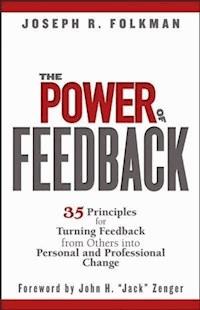
The power of feedback : 35 principles for turning feedback from others into personal and professional change / Joseph R. Folkman. p. cm.
Includes bibliographical references and index.
ISBN 13: 978-0-471-99820-4 (cloth) ISBN 10: 0-471-99820-6 (cloth)
1. Communication in organizations. 2. Feedback (Psychology) 3. Organizational change. I. Title.
HD30.3.F65 2006
650.1’3—dc22
2006005659
To my family, who continue to give me feedback and patiently wait for change.
Foreword
In 1798, Scottish poet Robert Burns wrote:
“O wad some Power the giftie gie us To see oursels as ithers see us! It wad frae mony a blunder free us . . .”
Burns clearly saw the need for people to develop more accurate views of their behavior, because it would free them from committing many of life’s mistakes. The solution that Burns’ poem suggests, however, is for some divine Power to provide that wonderful insight. As far as I can tell, that has not been happening for the great majority of us.
I would like to believe that Burns would rejoice to learn, some 200 years later, that people are seeing the same need he saw, but they are discovering powerful and practical vehicles to make that occur, without troubling the divine, cosmic Powers to take the responsibility. Burns probably could not have envisioned the day described in the book you are about to read. He would be amazed at the practical tools that have been created to help us shrink the gap between how we’re seen and how others see us.
Some books are worthy of being recommended simply because of their subject matter. Their topic is of such import that any treatise presenting new ideas and a useful way to frame the subject would be worth the investment of time and money to read. The topic of feedback fits that description. There is no greater force to improve the quality of human relationships or improve the way organizations function than to multiply the amount and improve the quality of feedback.
Other books are worthy of being recommended because their content is of great practical use, such as when an author takes an otherwise abstract, obtuse subject and turns it into an actionable, practical set of things to do. Joe Folkman has accomplished that task by presenting key findings from his long career in helping individuals and organizations to develop feedback-rich environments. He has devoted his career to the important issue of helping individuals and organizations change through the use of a variety of surveys and feedback instruments. But his message goes far beyond the creation of better instruments to address the more important issues of how such instruments are to be used and the degree to which dedicated follow-up should occur. Therein lies the truly important contribution of his book. Better yet, he presents compelling statistical evidence for what happens when these steps are taken.
Finally, some books contain information of high value, but the effort required to extract that information often exceeds the value derived. I predict that most readers will be entranced by the extensive illustrations and examples from Joe Folkman’s consulting background that clarify these principles and make them come alive. Ordinarily, employee surveys and feedback tools would rival macroeconomics for sheer lack of excitement, but in this case, the author has made this topic highly engaging and accessible.
So, here you have the best of everything—an important topic; a talented, entertaining, and highly qualified author; content that is practical, and a text written in an easily comprehended manner. Enjoy.
John H. “JACK” ZENGER
Acknowledgments
This book emerged as a result of the work I have done in assessing individual effectiveness over the past 30 years. Helping organizations to design, gather, and process feedback has provided an opportunity for me to see many people make significant and meaningful changes. Thousands of brave and courageous people over the years have contributed greatly to the content of this book. Their ideas, experiences, and feedback have been invaluable to me. To begin with, this book would not have been possible without the many supportive clients who provided a learning laboratory for testing and refining this change technology. To all those who worked with us and provided us with insights and new opportunities for learning: thank you.
Special thanks to Gene Dalton who wrote the Foreword to my earlier book, Turning Feedback into Change. Gene has since passed away, but his example and extraordinary work live on. Many of the new ideas in this book came out of research I did with John H. “Jack” Zenger presented in our recent book, The Extraordinary Leader. I have truly appreciated working with Jack and acknowledge his contributions. We enjoyed working together so much, we decided to create a firm to nurture and build on our original research.
I appreciate all my colleagues at Zenger | Folkman, our current firm, where many of the ideas in this book took shape. I also appreciate many friends and colleagues who have shared their experiences and learning throughout my career, which have contributed to this book.
I also express appreciation to Trent Price, for his work in editing the manuscript and to Jenny Gildea for her work preparing the manuscript. And I gratefully acknowledge Matthew Holt and Kate Lindsay at Wiley for their enthusiasm and support of this project.
Finally, thanks to my wonderful and supportive wife, Laura, and our five children, who continue to have unwavering faith in me and my abilities.
Introduction
Feedback can be very powerful. Those who look for and accept it position themselves to be more competent and capable. Those who resist, reject, or avoid it doom themselves to the limitations of their own personal insights—which may be right or wrong, but they will never know. They fail to see the power in feedback.
Without feedback we are flying blind. Others see things we can’t see. In performance assessments designed to measure individual effectiveness, it has been found that those who are the least effective at accurately predicting their strengths and weaknesses are the individuals themselves.
In an assessment looking at over 1,000 managers, we asked direct reports if their managers actively looked for opportunities to get feedback. Only 16 percent of managers had consensus from their teams that “actively looking for feedback” was a strength. Of 49 items assessing effectiveness, this item was one of the most negative. In another survey, we asked thousands of people if they regularly received feedback on their performance. Almost half of the respondents (46 percent) answered the question negatively or neutrally. Most people do not feel they lack feedback from others on how they could improve their performance at work, how they could be a better parent, how they could be a more considerate and caring spouse or friend, or simply how they could become a better person. For many people, the typical reaction to new feedback is to say, “So what, I’m too busy to do anything about it anyway.”
Lesen Sie weiter in der vollständigen Ausgabe!
Lesen Sie weiter in der vollständigen Ausgabe!
Lesen Sie weiter in der vollständigen Ausgabe!
Lesen Sie weiter in der vollständigen Ausgabe!
Lesen Sie weiter in der vollständigen Ausgabe!
Lesen Sie weiter in der vollständigen Ausgabe!
Lesen Sie weiter in der vollständigen Ausgabe!
Lesen Sie weiter in der vollständigen Ausgabe!
Lesen Sie weiter in der vollständigen Ausgabe!
Lesen Sie weiter in der vollständigen Ausgabe!
Lesen Sie weiter in der vollständigen Ausgabe!
Lesen Sie weiter in der vollständigen Ausgabe!
Lesen Sie weiter in der vollständigen Ausgabe!