


5,99 €
Mehr erfahren.
- Herausgeber: New Island
- Kategorie: Sachliteratur, Reportagen, Biografien
- Sprache: Englisch
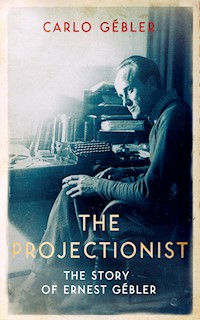
'Projection (Psychoanalysis). The unconscious process or fact of projecting one's fears, feelings, desires or fantasies onto other persons, things or situations, in order to avoid recognizing them as one's own and so as to justify one's behaviour.' Ernest Gébler, writer of such international bestsellers as The Plymouth Adventure and Call Me Daddy, which became the film Hoffman, led a turbulent and fascinating life. At the helm of one of Ireland's best-known literary families, his life was one of staggering complexity, elusiveness and immense talent that spanned a tumultuous century. In a book that is both biography and memoir, Carlo Gébler, Ernest's estranged son, tells the enthralling story of his father's life, covering his strange and alienated childhood, his disastrous family relationships, his marriage to writer Edna O'Brien, his staunch socialism and uncompromising disciplinary attitude, and his final heartbreaking struggle with Alzheimer's disease. Had the subject been given a choice, he would never have allowed the writer to tell his story. In The Projectionist, Carlo Gébler draws on a rich archive of previously undiscovered autobiographical notes, as well as his own personal memories. He explores and interprets his Ernest's life in the hope of understanding a father he barely knew, a life he didn't share, and a man who was both fascinating and fearful.
Das E-Book können Sie in Legimi-Apps oder einer beliebigen App lesen, die das folgende Format unterstützen:
Veröffentlichungsjahr: 2015
Ähnliche















THEPROJECTIONIST
The Story of Ernest Gébler
Carlo Gébler
THE PROJECTIONIST: THE STORY OF ERNEST GÉBLER
First published in 2015
by
New Island Books,
16 Priory Hall Office Park,
Stillorgan,
County Dublin,
Republic of Ireland.
www.newisland.ie
Copyright © Carlo Gébler, 2015. Carlo Gébler has asserted his moral rights.
PRINT ISBN: 978-1-84840-457-1
EPUB ISBN: 978-1-84840-458-8
MOBI ISBN: 978-1-84840-459-5
All rights reserved. The material in this publication is protected by copyright law. Except as may be permitted by law, no part of the material may be reproduced (including by storage in a retrieval system) or transmitted in any form or by any means; adapted; rented or lent without the written permission of the copyright owner.
British Library Cataloguing Data.
A CIP catalogue record for this book is available from the British Library.
Every effort has been made to trace the copyright holders and to obtain their permission for the use of copyright material. We would be grateful to be notified if any corrections should be incorporated into future reprints or editions of this work.
Supported by the Arts Council of Northern Ireland.
For my mother
‘There is properly no history; only biography.’
– Ralph Waldo Emerson
Projection. Psychoanalysis. The unconscious process or fact of projecting one’s fears, feelings, desires or fantasies on to other persons, things or situations, in order to avoid recognizing them as one’s own and so as to justify one’s behaviour.
– O.E.D.
Contents
Family Tree
Chronology
A Note
Beginnings
Adolf’s Arrival, Dublin
Adolf and Rita’s Meeting
Rita’s Side
Courtship
Marriage
Birth
Adolf’s Homecoming
A Psychological Audit
After the War
Germany
Back
May Geraghty
The Misses Ashley-Ryder
An Incident
Miscellaneous
Tramore One
Tramore Two
England
Apprenticeship
The Letter
The Early Thirties
My Father’s Scheme
A Rocky Start
Books
Developments
Into the World
Home
Unhappiness
The Emergency
A Friendship
Sally Travers
Publication
London
Family
His Inner Life
She Sits Smiling
Success
Leatrice
The End of Adolf’s Marriage
The Plymouth Adventure
Marriage to Leatrice
California
A Confession
An Exchange of Letters
Divorce
After Leatrice
Fissures
Second Marriage
Rita’s Death
Rita’s Inquest
After the Inquest
Move to Morden
Turbulence
A Cold Neutrality
The Helmet
Camilla
Phyllis ‘Jane’ Innot
Custody
J. R. Ackerley
Hoffman
The 1970s
The Early 1980s
A Rupture
Marianna
A Turn
The Book he Wanted to Write
Decline
My Diary
A Resolution
Acknowledgements
Chronology
1848
Wilhelm Gébler born in western Bohemia (Austria-Hungary).
1850
John Wall born in County Wicklow.
1851
Margaret Wall (née Russell) born County Tipperary.
1859
Maria Gébler (née Zräly) born in northern Bohemia (Austria-Hungary).
1880
Margaret Wall gives birth to Bridget (‘Bee’).
1882
Margaret Wall gives birth to Margaret (‘Rita’).
1889
Hermann Gébler born in Bohemia.
1890
Adolf Gébler born in Bohemia.
1905
Marianna Gébler (née Blaschitz) born in Pellau, Austria.
1906
Adolf graduates from the Prague Conservatory and begins work in the Algiers Opera House.
Joe Armstrong born in Little Mary Street, Dublin.
1907
Rita works as a model at the Irish International Exhibition, Dublin.
1908
Adolf arrives in Dublin, plays at the first night of
The Merry Widow
, and meets Rita. She takes him to her family home, 26 Marguerite Road, Glasnevin.
1911
Adolf performs with the Dublin Orchestral Society at the Antient Concert Rooms, Dublin. The UK census lists him as a boarder at 26 Marguerite Road.
1912
Adolf and Rita marry at St Columba’s Church, Dublin. The newly married couple start their life together at 119 Royse Terrace, Phibsborough Road.
Wilhelm Gébler dies in Westphalia, Germany. Margaret Wall (Rita’s mother) dies in Dublin.
1913
Birth of Rita’s and Adolf’s first child, Adelaide (‘Ada’) Armstrong (née Gébler).
1914
Adolf begins working at The Bohemian Theatre, Phibsborough (a cinema).
Adolf is arrested and sent first to County Tipperary and then to Oldcastle Aliens’ Camp in County Meath.
Ernest Gébler born.
1915–1916
Rita and children move to 43 Botanic Avenue, Glasnevin.
1916
Charles Gébler (Adolf’s revered older brother) enlists in the French Army.
1917
Charles Gébler wounded on the Western Front and found to have TB.
1918
Adolf transferred to Knockaloe Aliens’ Camp, Isle of Man.
1919
Rita Gébler registers with Dublin Metropolitan Police as an Austrian citizen. Adolf signs an ‘Undertaking of Neutrality’ in order to return to Dublin, where he meets his son, Ernest, for the first time.
1920
Charles Gébler dies in France.
Mary Louise Breen (née Gébler) is born in Londonderry.
The Géblers move to Germany. Adolf plays with the Berlin State Opera Orchestra while Rita and the children live in Düsseldorf.
1922
The Irish Public Record Office in the Four Courts, Dublin is destroyed. The Gébler family leave Germany and return to Ireland.
Olive Davies (née Gébler) born (probably at 43 Botanic Avenue).
The Géblers move to Sea View Cottage, Rosslare, County Wexford.
1923
Iris (Irene) Hendry (née Gébler) born in Rosslare, County Wexford.
The family move to Church Villa, Tramore, County Waterford, where they are joined by Adolf’s elder brother, Hermann.
1924
Adrian Gébler born Tramore, County Waterford.
Leatrice Gilbert, Ernest’s future first wife, born in California, USA.
1925
Adolf starts work at the Scala Cinema, Wolverhampton, England, as an accompanist. He later moves to Agricultural Hall Cinema, Snow Hill, Wolverhampton.
Rita and children (Adelaide, Ernest, Louise, Olive, Irene and Adrian) move to England. Adolf secures a council house on the Low Hill Estate, and later buys a house on Old Fallings Road, Bushbury, Wolverhampton. Adolf names the house ‘Villa Bohème’.
1928
Ernest Gébler, aged thirteen, begins an apprenticeship as a trainee projectionist at the Agricultural Hall Cinema.
1929
Wolverhampton’s first ‘talkie’,
The Singing Fool
, opens at the Agricultural Hall Cinema.
Adolf loses Villa Bohème and returns with his family to live on the Low Hill Estate. He takes a grocer’s shop and goes bankrupt.
1931–1932
Adolf and Rita, along with Adelaide, Louise, Olive, Irene and Adrian, return to Dublin and live temporarily in Drumcondra.
Ernest remains in Wolverhampton and continues his apprenticeship, lodging with his aunt Judy and her husband, Frederick Dack, at the Rose & Crown public house in Walsall.
In Dublin, Adolf plays with the 2RN Orchestra but fails to secure a permanent position there. He becomes bandmaster at the Irish Transport & General Workers’ Union.
1932
Gaumont Palace Cinema opens on the Agricultural Hall Cinema site. Ernest resumes his apprenticeship.
1933
Ernest is sacked by the management at Gaumont Palace Cinema, returns to Ireland and rejoins the family, who are now back living at 43 Botanic Avenue.
1934
Adolf and family are allocated a corporation house, 2 Offaly Road, Cabra, Dublin.
Adolf takes Ernest to meet Hilton Edwards and Micheál Mac Liammóir, proprietors of the Dublin Gate Theatre, beginning Ernest’s long association with the Gate.
Ernest secures a position as projectionist at the Camden Cinema, Dublin.
1936
Adolf buys 3 Cabra Grove, Dublin on a long lease.
Adelaide meets Joe Armstrong. They move to Bray, County Wicklow, and start to live together.
1938
Following an argument with Adolf, Ernest leaves 3 Cabra Grove and moves to the outskirts of Dublin.
1940
Adelaide’s son, John Armstrong, is born in Bray.
1942
Adelaide’s daughter and second child, Ann, is born in Bray.
On his way to visit his sister and her new baby, Ernest meets Rudolf Jones (born 1917), who publishes under the pseudonym ‘John Ross’.
1946
The Irish state issues Hermann Gébler a Certificate of Naturalization, and he becomes an Irish Citizen. Irma, who has been working in Frankfurt, Germany since Hermann left for Ireland in 1923, joins her husband in Ireland.
Sampson Low, Marston & Company publish Ernest’s first novel,
He Had My Heart Scalded
.
Ernest resigns from the Camden Cinema.
Marianna moves to Dublin to work, where she meets Adolf.
1947
Ernest is issued with an Irish passport and a visa to enter the UK.
Ernest travels to London where he joins Micheál Mac Liammóir’s niece, Sally Travers, whom he had known at the Gate. They live together at 2 Palace Gardens Terrace, Notting Hill Gate, and later at 51 Colet Gardens, Hammersmith, London.
1948
Olive marries Max Davies.
1949
The Abbey Theatre rejects Ernest’s play
She Sits Smiling
.
She Sits Smiling
is broadcast on the BBC Home Service.
Ernest returns to Dublin for a holiday, leaving Sally Travers in London.
1950
In early January, instead of returning to London and Sally, Ernest decides to stay in Dublin with Leatrice Gilbert, who is sick. Later, Ernest and Leatrice move to a cottage at Ballinabrocky, Glendalough, County Wicklow.
Rita leaves 3 Cabra Grove and Adolf, and moves in with her married daughter Olive Davies. Marianna moves into 3 Cabra Grove to work as Adolf’s housekeeper.
Ernest’s novel
The Plymouth Adventure
is published in New York.
In the autumn Ernest and Leatrice travel to New York separately. On 12 December Ernest and Leatrice marry.
1951
Irene marries Jim Hendry in London.
Ernest buys Lake Park, Roundwood, County Wicklow at auction, and shortly thereafter Ernest and Leatrice move in.
John Karl Gébler (later known as John Fountain) born at Lake Park in July.
1952
Ernest, Leatrice and John Karl set sail for America. In March, Ernest, Leatrice and John Karl enter the US at San Pedro, California. In mid May, Ernest, having agreed to sell Lake Park and wind up his affairs in Ireland, leaves the US and returns to Ireland.
Leatrice writes to Ernest in June informing him that John Karl is not his son and that she plans to divorce him.
Leatrice is granted a divorce from Ernest by a court in the USA in October. She marries John Fountain on 10 November. On 14 November the film
The Plymouth Adventure
, based on Ernest’s novel and starring Spencer Tracy, opens in the US.
Ernest meets Edna O’Brien.
1954
Ernest and Edna marry in July, and Carlo Gébler is born in August.
1956
Ernest sells Lake Park and buys 29 Garville Avenue, Dublin.
Sasha Gébler is born.
In October Rita returns from her daughter Louise Breen’s, where she has been living, to 3 Cabra Grove, where she is nursed by Adolf and Marianna.
Rita dies in December. Louise, encouraged by Adelaide, alleges that Rita has died of unnatural causes. A post-mortem on Rita’s body follows. Adolf and Marianna are interrogated by the police.
1957
A public inquest concludes that Rita was not poisoned by her husband and his housekeeper as was alleged but died of natural causes.
Adolf and Marianna marry in April.
A dramatization of
The Plymouth Adventure
is broadcast on the BBC Home Service.
Adolf and Marianna emigrate to the US in December.
1958
Adolf and Marianna arrive in San Francisco in January.
A Week in the Country
by Ernest Gébler is published.
Ernest, Edna, Carlo and Sasha move from 29 Garville Ave to 257 Cannon Hill Lane, Morden, London, SW20.
1960
The Country Girls
by Edna O’Brien is published.
1961
The Love Investigator
by Ernest Gébler is published.
1962
The Lonely Girl
(renamed
The Girl with Green Eyes
) by Edna O’Brien is published.
Edna O’Brien is obliged to quit the matrimonial home in September.
1963
Irma Gébler (Hermann’s wife), dies in Waterford.
Adolf Gébler dies in San Francisco, USA in July.
Edna O’Brien buys 9 Deodar Road, Putney, after which Carlo and Sasha divide their time between their parents’ houses.
1964
Edna O’Brien buys 87 Deodar Road, Putney.
Ernest and Phyllis ‘Jane’ Innot meet and begin a relationship.
1965
August is a Wicked Month
by Edna O’Brien is published.
Edna O’Brien is granted full custody of her sons.
1966
Ernest’s TV play
Why Aren’t You Famous?
is broadcast in February and repeated in August.
Ernest’s TV play
Where Shall I Find What Will Change My Life?
is broadcast.
1967
Ernest’s TV play
Call Me Daddy
is broadcast.
Ernest is granted a decree nisi.
1968
Call Me Daddy
wins the 1968 American Academy of Arts and Science Award, the Emmy, for the Best Entertainment Programme in the International Division.
Ernest’s TV play
Women Can Be Monsters
is broadcast in November.
1969
Peter Sellers agrees to star in
Hoffman
, the film version of
Call Me Daddy
. Ernest is offered £21,000 for the
Hoffman
rights and the script.
Shall I Eat You Now?,
his novelization of
Call Me Daddy
,is published in the UK and in the US.
Hoffman
is filmed in September. Ernest is banned from the set.
1970
Ernest sells 257 Cannon Hill Lane in January.
Ernest and Jane arrive in Dublin in March, intending to settle in Ireland.
Ernest buys
Cnoc Aluin
(92 Coliemore Road, Dalkey) in April. He and Jane move into the house in May.
1972
Adelaide Armstrong dies.
1975
Ernest’s stage play
A Cry For Help
is produced on the Peacock Stage at the Abbey Theatre.
1977
Ernest buys 5 Leslie Avenue, Dalkey, at auction.
1980
Louise Breen dies.
1982
Hermann dies in Waterford, aged ninety-three.
1983
Jane moves out of the bedroom she shared with Ernest.
1985
Ernest finishes his last novel,
Not The End Of The World
. It is rejected by the London agent, Christine Green, and Doubleday in New York.
Irene Hendry dies in New Zealand.
1986
Sally Travers dies in London. Jane leaves Ernest, goes to England and takes a job in a school in Highgate, London. Ernest commences work on his ‘Autobiog’.
1987
Jane returns to Ernest in Dublin.
1989
Ernest agrees to marry Jane. On 5 May, Jane suffers a brain haemorrhage in the garden of
Cnoc Aluin
, dying on the following day.
1991
Ernest enters the Grove Nursing Home and
Cnoc Aluin
is sold.
1995
John Fountain (née John Karl Gébler) visits Ireland and meets Ernest, whom he has not seen since 1952. He subsequently changes his surname back to Gébler and moves to Ireland.
1998
Ernest dies.
2000
Father & I
by Carlo Gébler is published.
2015
Leatrice Gilbert Fountain dies.
A Note
This is an unauthorized life. Readers should bear in mind that had the subject (my father) been given a choice he would never have allowed the writer (his estranged son) to tell his story.
Many of the characters in this story either spelt their names in different ways or had several names. For clarity’s sake I’ve opted for one preferred name and used this throughout. Some names have also been changed. This is the limit of my inventions, and otherwise I’ve only included what I believe to be true. Of course I’m sure that inaccuracies and even lies must have slipped in without my realizing. How could they not?
The O.E.D. describes a story as ‘A recital of events that have or are alleged to have happened.’
What follows is just that. It is a recital of the events of my father’s life that have or are alleged to have happened.
1.
Beginnings
I
I’m fortunate that a photograph of my Gébler forebears has come down to me. It’s black and white. It was taken, I’d guess, in 1908 or 1909. I don’t know where. A studio in Prague perhaps, or a provincial Bohemian or south German town. Whatever the location, the setting is unmistakably middle European, high bourgeois. On the floor in front of clan Gébler there’s a hideous fur rug (of the kind you might see in a 1960s’ German porno, a couple writhing atop it, a fire burning merrily behind, the firelight reflecting off their oiled limbs). On either side of the Géblers there are fussy tables with doilies and flowers. Behind them are heavy drapes and a kitsch landscape (add a naked nymph and it too could be in a porno).
There are ten in the picture – my two paternal great-grandparents and their eight children: going from left to right they are Helen, Julius, Adolf, Gretel (or Greta), Hermann, Ernst, Charles and the eldest, Erna – and they are posed in two semicircles. In the one at the rear stand the four hulking older Gébler men: Julius, Adolf (my grandfather), Hermann and Charles. They’re all in suits and collars and ties, though my grandfather, in evidence of his theatrical leanings, also sports a brocade waistcoat. The other thing that strikes is the posture adopted by Charles (the second eldest, a violinist, a pianist, and I think a medical doctor): he has his arms crossed, and he stands slightly apart from everyone else. He looks semi-detached.
In a semicircle in front of the hulking sons are the other family members, seated. These are the three Gébler daughters (two, like Romanov princesses, wear white summer dresses and sport matching white bows in their hair, while the third is in sombre black), the baby, Ernst (his head shaved, he looks like a manikin), and the parents of the eight children the picture features. My great-grandfather looks like a middle European patriarch as supplied by Central Casting: he has a big head and a white beard. His wife, my great-grandmother, wears a white blouse and (I think) a locket around her neck, the sober dress of a sober hausfrau. She also looks older than her husband, when actually she’s younger. She looks sad too, like she’s been through the mangle.
The faces that look back at me from this photograph all seem familiar. It’s partly that I see the Gébler family look (big noses and high foreheads) in these faces (though perhaps I see this because I want to and not because it’s actually there), and partly because these faces remind me of the faces that look back at me from the photographs taken by that great contemporary documenter of everyday German life, August Sander (1876–1964). But then that’s hardly surprising: these Géblers were just the sort of solid, provincial, resolute and absolutely rooted people Sander photographed.
My father’s grandfather, Wilhelm Gébler (he of Central Casting), was born on 2 May 1848 in Schluckenau, a town located inside a little hook of Bohemia (then Austria-Hungary) that pokes up provocatively into Saxony. His ancestors were Armenians who settled in German speaking Bohemia, which later become Sudetenland before reverting to Czechoslovakia.
My father’s grandmother and Wilhelm’s wife (she of the sad face) was Maria Gébler, née Zräly. She was born on 21 May 1859 in Königinhof in eastern Bohemia, also in Austria-Hungary. The Zrälys were teachers and professors and Slav patriots, and did not like the Germans or Austrians. Severin Zräly, a relative of Maria’s, hacked off his firing fingers so he would not have to serve in the Austro-Hungarian Army. He pretended it was an accident, but he was found out, put in a fortress for several years, and afterwards emigrated to the US, where he got into shipping and made a fortune. Maria asserted her Czech identity more gently by insisting that the Czech feminine of her married name, Géblerova, was used in all communications. As a person, she was supposedly not melancholy (as she seems to be in the family portrait) so much as chilly, even severe. Of course, this may have just been how mothers were at the time, and in this she was not alone. Ultimately, I do not know.
II
According to some reports, Wilhelm was a gynaecologist, and according to others he was a tax collector or an accountant. He probably lived and worked in Teplice-Šanov in western Bohemia, close to Germany, and at some stage he acquired part-ownership of a musical instrument factory in Markneukirchen, a German town just over the border in Saxony, where something like 80 per cent of the world’s instruments were made by 1900. According to family lore, Wilhelm won his share in a game of cards.
The factory made woodwind instruments (oboes, flutes, clarinets), and most of the factory’s output was sold either in Germany or Austria-Hungary. Because their market was so German, and he was now an entrepreneur with manufacturing interests, Wilhelm reconfigured his half-Czech family as a wholly German one, and insisted that everyone embrace German language and culture. Perhaps this was why Maria Géblerova looked so sad when her photograph was taken: it was a sacrifice to renounce her Slav identity. As part of this process my father’s father, who was born on 2 April 1890 and who was named Adolphe or sometimes Adolphus, became Adolfe, and finally Adolf.
At first he didn’t mind. He was young. He was flexible. His father was right, he thought. He saw that this embrace of things German was good for business. He saw how the factory prospered, and as it prospered he saw how wealth was generated, and as wealth was generated he saw that the family’s place within the bourgeoisie was secured and enhanced.
As Adolf grew older, however, his acquiescence was challenged by his elder brother, the outlier in the group photo. Charles was a Slav nationalist, and believed in an independent Czech state where Czech was the state language. He also believed that the Géblers were the worst sort of Czechs because they forfeited their ethnicity and linguistic identity for social and material advantage. The rewards of the switch to German were huge, but according to Charles these did not compensate for what was lost. As he had it, to surrender one’s authentic Czech nature and assume German identity was a terrible mistake.
As he grew older, Adolf, who worshipped Charles, began to adopt his elder brother’s beliefs as his own, and inevitably his identifying with the Czech cause entailed an amount of anti-German sentiment. This was why, later, when Adolf was in Ireland, whenever someone assumed he was German (hearing him speak in his appalling heavily accented English, this was an easy assumption to make), he always threw back at them the same mangled corrective: ‘No German, no! Czech … Bohemia … Bohemia … Czech.’ But this was in the future.
III
Adolf was sent to the Prague Conservatory in his teens, a school for the musically gifted that offered a rounded, and by contemporary standards, exemplary, education. At the conservatory, as well as his French and Italian and general education lessons, plus his composing, arranging, music theory and conducting classes, it was compulsory to study and master three instruments. Most students opted for three complementary instruments – violin, viola and cello were a typical combination. Adolf, however, opted for clarinet, piano and violin, which was much harder because the instruments were not complementary. He also played in the conservatory’s orchestra and other ensembles.
Adolf graduated in 1906 when he was sixteen, although typically students didn’t graduate until they were seventeen at the earliest, with a high commendation for his clarinet technique and high grades in composition and music theory. In recognition of his son’s precocity and talent, Wilhelm gave him a gold pocket watch of the kind that’s worn with a chain in a waistcoat pocket. It was a Hunter with a glass porthole in the lid, which allowed the time to be read without releasing the cover. In time this watch would assume heirloom status.
With his qualification he secured work as a clarinettist on a production of Puccini’s Tosca in Algiers, and travelled to the North African city, then under French control. Two things so impressed him that he never forgot them. One was the reek of coffee in the hot streets. The other was the girls he saw everywhere, plump, shy, olive-skinned, their eyes large, dark and alluring. This North African port city was very different to the places he knew, Bohemia and Prague, and it was thrilling.
Rehearsals began in the Algiers Opera House in Place Bresson. He attended and he was diligent, but he did not experience the emotional power of the music. It didn’t touch him.
Then came the first night. During the scene in Act 2 when Tosca, in Scarpia’s apartment, hears her lover, Caravadossi, being tortured in the nearby cell, quite unexpectedly Adolf began to cry, and he had to play on with tears running down his face. Fortunately, he knew the music off by heart.
Later in the run, his emotions now mastered, it was the glittering women up on the stage that engaged him. In performances, during those bars when he didn’t play, he didn’t rest his eyes like the other orchestral players on the score as he waited for his cue: he rested them on the women on stage instead. Their beauty amazed him, though he knew that their allure was mostly the product of lighting and make-up. He never approached or spoke to any of them, however, although as a member of the company he might have. He did not think he was attractive, and never would, which was perhaps why he settled for what he got.
IV
The next part of Adolf’s life was complex and elusive, but there is one bright thread that can be got hold of, and that is Franz Lehár’s The Merry Widow, a heady, even saucy, opera about middle-aged love that in the years before the outbreak of the First World War was all the rage in Europe.
The Merry Widow had been running in Daly’s Theatre, London, since 1907, with Lily Elsie in the role of the widow, Sonia Sadoya, which was the idea of Daly’s manager, George Edwardes. The role made Lily Elsie a star, and was her greatest success. Edward VII came to see her four times.
Sometime in 1908, Edwardes agreed to bring the production, with Lily Elsie in the widow role, to the Gaiety Theatre in Dublin during Horse Show Week. A genius at marketing, he warned the Gaiety’s management to issue their usherettes with smelling salts for the duration of the run in order to revive the numerous women who, he predicted, ravished by Lehár’s music, would faint and need reviving.
Adolf was contracted to play first clarinet during the Gaiety run. Whether he’d had any part in the London performances isn’t clear, but the Gaiety job is a fact. But then (the best laid plans, et cetera) he had an accident in Paris. The door of a railway carriage got closed on his right hand, crushing the tip of his index finger. Without a functioning right forefinger he could not play the clarinet. The injury also affected his ability to play the piano. For a musician, it was a disaster.
Adolf went to a doctor. The medic washed his forefinger in disinfectant, but that was all. The doctor thought, though he didn’t know for sure, that the bone tip might be splintered. He wouldn’t undertake to fix the finger, and advised his patient to seek specialist help.
Adolf’s people in Bohemia sent him money.
He returned home.
His father, Wilhelm, took his son to a specialist. This doctor said that he could get the bone to reattach and grow back with a regime that included daily massages and simple hydrotherapy – immersion of the injured finger in hot and cold water – and that it would be painful. Adolf agreed to the treatment – what alternative did he have? The work to restore his finger began.
2.
Adolf’s Arrival, Dublin
I
There was a dress rehearsal of The Merry Widow in the Gaiety Theatre in Dublin on Monday 23 August 1908. Adolf wasn’t at it because he missed his train connection (Paris again), and it was not until Tuesday 24 August, the day The Merry Widow opened, that he got to Liverpool Docks, from where he would catch the boat to Ireland. He was not worried that he had missed the dress rehearsal – the confidence of youth, perhaps – plus he knew his part, and his sight-reading was exemplary. What worried him was his finger, which was not yet completely right.
He boarded the Dublin packet. He had two suitcases: one held his boiled shirts and evening dress, the other his two clarinets. The vessel cast off and steamed out onto the Irish Sea. A few months earlier he may never have heard of Dublin, but because he was heading there he had decided to read up on this city. He had brought along a clipping from a German newspaper, and he read it as the vessel lurched westwards. The article comprehensively described Dublin’s history, from its foundation in the ninth century by Vikings, through its incorporation into the English Crown as the Pale, its centuries as the most faithful of English settlements in Ireland, right up to the present, when it was known as the United Kingdom’s second city.
The packet entered Dublin Bay. He took himself to the prow to get a look at where he was headed. He saw a thin green slip of land, and behind that he saw mountains, dark, lovely and graceful. Something in his psyche shifted. He was not to know it at the time, but a love affair had just begun.
II
The packet tied up in the harbour of Kingstown – as Dun Laoghaire was then known. He had to get to the theatre before the curtain went up. He hurried down the gangplank, along the pier and into the Kingstown Railway Station. He had ‘Yes’, he had ‘No’, and perhaps he had a few rudimentary English phrases, but nothing more.
As he entered the booking hall he extracted from his pocket the piece of paper on which he’d written ‘Gaiety Theatre’ in his looping German script, and when he reached the grille, which separated ticket buyer from ticket seller, he proffered this paper to the clerk in his railway livery on the other side. The clerk glanced at the paper, issued a single ticket to Westland Row, took the stranger’s money and directed him to the ‘up’ or city platform.
Adolf followed the directions.
A train belonging to the Dublin and South Eastern Railway (DSE) appeared, and he boarded. The carriage was crowded with boisterous people, and there was a strong smell, half saline, half human. His train arrived at Westland Row. Passengers swarmed off, and he followed. He found his way out into Westland Row itself. Like the train, the street was crowded, the atmosphere febrile. As James Joyce wrote:
There is one gay week every year in the Dublin calendar, the last week of August, in which the famous Horse Show draws to the Irish capital a vari-coloured crowd, of many languages […] For a few days the tired and cynical city is dressed like a newly-wed bride. Its gloomy streets swarm with feverish life, and an unaccustomed uproar breaks its senile slumber.1
He realized that the city was so crammed it might be difficult to find digs later, but there was no time to worry about that now. He had toget to the theatre.
He showed his piece of paper to someone. He was directed along Nassau Street, up Grafton Street and down Tangier Lane, a malodorous entry that delivered him right to the stage door of the Gaiety.
He went in, and found the stage door keeper in his little room behind the stage door. Adolf waved his clarinet case or pronounced ‘Merry Widow’, and was directed to the green room set aside for the orchestral players. He changed into evening dress.
The audience filed into the auditorium. It was not only a first night, but alsothe very first night that Dublin would see this risqué confection, and the crowd had high expectations. There was a full house.
Bells sounded backstage and stage managers shouted. ‘The performance will begin …’. Adolf took his seat in the orchestra pit. He warmed up his clarinet. His reed had been pared with a razor to the perfect thickness and broken in. He played a few scales. The sound he made was warm and rich. He felt a twinge in his finger.
The house lights dimmed. The auditorium fell quiet. The baton rose in the pit. The conductor surveyed his players’ ghostly faces, then moved his head, and the first note sounded. Adolf’s first cue arrived and he started to play. Yes, he felt some pain, but he played on. After all, he was a professional.
The interval. The audience rose. Adolf massaged his finger backstage, or perhaps he went to Neary’s public house on the other side of Tangier Lane. It was traditional for Gaiety musicians to drink during the interval in Neary’s, and Adolf did drink, so my guess is that he respected tradition.
The musicians returned to their places in the pit, and the audience to their seats. The lights dimmed, the baton rose again, and The Merry Widow resumed. Adolf’s finger still hurt, but he played on to the end. The curtain fell.
Though no women were reported to have swooned, and the smelling salts, if ever issued, had turned out not to be needed, the audience, overwhelmed by the sentimental conviction of the story, smitten by Lily Elsie’s singing and intoxicated by Lehár’s music, applauded heartily. Then the house lights came up and everyone rose from their seats and flowed into the aisles, heading for the exits like a tide going out.
III
Upstairs in the Gaiety, some of the dress circle audience drifted into the dress circle bar for a final nightcap. Here, the barmaid, Margaret Wall, known as Rita, a thin, light, small-breasted woman with a nice face, grey eyes, light-brown hair, pale, clear skin and a wide brow, served them deftly. Her look was a delicate late-Victorian one, and everyone liked her, particularly men. She had a way of making them feel that they should protect her. Her take-home pay was ten bob a week, plus tips.
Back in the orchestra pit, Adolf disassembled, cleaned and put away his clarinet. He tidied away his sheet music. He went back to the green room and changed out of his evening dress and in to his travelling suit. He’d nowhere to sleep, but in Europe it was customary for musicians, if they’d no alternative, to overnight in a theatre box. That was now his plan.
In the dress circle bar, now empty, all customers having left, Rita Wall washed glasses, wiped down surfaces, and positioned tables and chairs. This bar was really a set, and it needed to be dressed for the next performance. That job done, she began to count the evening’s takings. It had been a busy night.
The theatre was quiet now. The main lights were off, and the small fire-regulation lights, which had to be on by law whenever everything else was off, were on, and everything touched by their yellow light looked ghostlike.
In the green room Adolf judged it was now safe to make his move. He took his suitcases and padded quietly from backstage to the foyer. Here were the stairs. He began to climb. At the top was the circle. The boxes were off the circle.
He got to the top, stopped, peered ahead, let his eyes adjust, pointed himself towards the boxes and set off again. According to family lore it was the royal box with its abundance of silken cushions that was his intended sleeping spot. To me that sounds like an invention.
In the circle bar, meanwhile, Rita was at the till. The evening’s takings had gone down to the manager, and she was checking the next day’s float. When she had the money totted up she put it in the till, then locked it.
The bar’s doors were open, giving her an unimpeded view of the landing outside. Whether she was actually looking out at the moment Adolf padded past, or whether she noticed movement out of the corner of her eye and was surprised because nobody should have been moving around up there at this time and so looked up, I don’t know. But, whatever the case, she hurried after the stranger and stopped him. This was the moment when, according to family mythology, he met his doom and she met hers.
1 Joyce’s article (entitled ‘La Battaglia fra Bernard Shaw e la Censura’ – ‘Bernard Shaw’s Battle with the Censor’) is reprinted in The Critical Writings of James Joyce, ed. Ellsworth Mason and Richard Ellman (1959).
3.
Adolf and Rita’s Meeting
I
So what happened? He was a Bohemian who spoke German. She was a Dubliner who spoke English. A nice situation: both spoke the languages of their country’s powerful neighbours, some would say oppressors, but not each other’s. They couldn’t talk to each other. Not a hope. But Rita had the advantage. This was her town, her theatre, not his. She was also twenty-six to his eighteen.
I imagine that a lot of gesticulating and pointing followed. Rita spoke her northside English, Adolf spoke his pitiful pidgin. Rita noticed the cases Adolf carried and pointed to them. They identified him as being of no fixed abode. Adolf grasped her meaning. He pressed his hands together then folded his head onto them, as onto a pillow, the universal symbol of sleep, and then he pointed in the direction of the theatre’s boxes. Rita understood. She shook her head, ‘No, no.’ She was emphatic. He couldn’t sleep in a box, she explained – out of the question.
She took his arm, and he let her lead him down the stairs, through the theatre and all the way to the stage door, where the stage door keeper sat in his little office. He was in charge. He would settle this matter.
Rita explained. She’d found the young man beside her in the circle heading for a box. He was going to sleep in it.
‘No, no,’ said the stage door keeper. No one was allowed to sleep overnight in the theatre. It was against fire regulations.
The next bit of the story was awkward. Adolf was told to go, and Rita was ready to go. Both went out into Tangier Lane. Rita, one imagines, went quickly, she wanted to be off, and Adolf went slowly.
Rita, who had to get home, now strode towards Grafton Street, where the tram stops were. At the top of Tangier Lane she stopped and looked back at the stage door, where Adolf stood pondering. She wondered if he would be able to get a bed. No, she thought, which meant the street for him, and if she hadn’t intervened he might be snoozing in a box at that moment, and would that really be so terrible?
She walked back to him. She pressed her hands together and laid her head on them, reprising the universal symbol of sleep. She would take him back with her, she said, to the family home on the northside. Adolf understood her mime, if not her words. He accepted. What else was he to do?
They caught her tram to Nelson’s Pillar in the middle of O’Connell Street and then a second to Glasnevin. They got out at her stop. She offered to carry one of his bags, and he gave her the case with his clarinets as it was the lightest. They walked through the gaslit streets to 26 Marguerite Road, home of the Wall family. She opened the door and ushered him forward. He went in. She followed and closed the door behind them.
II
A minute or two later, introductions completed, the parties took the measure of each other.
This was what Adolf saw:
Rita’s father was a patriarch with a beard, and looked a bit like the recently dead King, Edward VII. Rita’s mother looked old to him, but friendly.
Bridget (‘Bee’), Rita’s eldest sister, had a wide face, a wide mouth, dark eyes and a swarthy complexion, and didn’t look remotely like her. But the other two, Mary Anne and Julia, who were younger than Rita, both dainty, frail and bird-like girls, did. Adolf was told (though he didn’t necessarily follow) that Bee was a waitress at the Red Bank Restaurant, where she had good tables, so got good tips, and besides her wage, got eggs and bacon every Saturday to take home, and that Mary Anne and Julia also worked. John Wall insisted. There were no slouchers allowed in his house.
And this was what the Wall family saw:
A youth, eighteen years old. He was five feet ten and a half in his socks. He had an athletic body. His face was a bit bulbous, even pudgy, as Slavic faces often were. His nose was flattened a little and turned down. This was because of an accident when he was younger. He had splendid white teeth, something all of them envied. His skin was sallow. He blushed easily. Already this was obvious, and charming. His hair was very black and brushed back off his forehead. He had black-brown doleful eyes. He had beautiful hands. It was Bee who noticed that.
They also saw a bachelor, but one who was already spoken for. Rita it was who captured him alive in the Gaiety, helpless and unable to speak English, and brought him back to the family home, so that was her claim staked. He was hers. All in all, they concluded, a very innocent nice young man.
Now they’d assessed one another, the evening could begin. The Walls asked their guest where he was from. Adolf wrote ‘Moravia’ on a corner of the newspaper that Mr Wall had been reading. Since medieval times, Moravia and Bohemia had shared a common history. At home in Markneukirchen everyone would have understood what he meant, but his Irish listeners did not know what or where Moravia was. Adolf tried again. He wrote ‘Bohemia’ on the newspaper. Old Mr Wall spelt the word out and said, ‘Germany?’
‘No, no,’ Adolf said indignantly, speaking of himself and his people. ‘Not Germany, not Germans.’
His English was clearly deficient. The Wall sisters wanted their visitor to talk to them and they wanted to talk to their visitor, and on the spot they decided to teach him to speak English like they did – properly, and with a better class of accent.
So they began. They threw him words and phrases, and he threw them back, mangled and mutilated. At the end of the night he sat at the upright piano in the front parlour and played some popular songs of the day, then the Walls made requests, and he obliged. They only had to hum a refrain or sing a line and he could play it. This was incredible. The Walls were impressed. He was quite a catch, this strange man Rita had brought home on a whim.
The end of the evening came. Mrs Wall made up a bed for Adolf on the horsehair sofa in the front parlour, and offered to wash and starch the dress shirt he would need for the following night’s performance. He handed his shirt over and got between the blankets. Creaks and fragments of girlish talk drifted down through the ceiling. The parlour windows had lace curtains, and the light from the gas lamp in the street leaked in palely through the spaces in the stiff material. As he fell asleep, perhaps he began to feel at home. The last thing he noticed was his finger. It throbbed still, but he’d done it. He’d played through.
4.
Rita’s Side
I
Here are the scanty details on the Walls that have come down to me.
Rita’s father was John Wall. He was born in County Wicklow in 1850. This made him fifty-nine on the night of Adolf’s arrival. He was a bossy, lazy, overweening man who liked nothing better than to set others, such as his daughters, to work.
Rita’s mother, Margaret Wall (née Russell), was born in 1851 in County Tipperary.
When and how John and Margaret met is not known to me. Perhaps John’s work on the railways brought him to Tipperary? But meet they did, somehow, some way, and they were a natural fit. They both spoke well. They both dressed well. They were both rural, literate and Roman Catholic, though they both tried to look Protestant. They both wanted to live in a rented red-brick house with lace curtains in the windows and a garden at the front, and they both wanted, one day, to have at least one daughter married to a man in the British Army (anything above a sergeant), and oh please God to have one son a lawyer, if they ever had a son that is, (which they didn’t). They also shared an idea of themselves as superior to the ordinary Irish person, whom they viewed as only ‘good enough to dig holes in the road and to give a cup of tea to in the hand and without a saucer.’2 The price they paid for this belief in themselves as elevated Hibernians, of course, was that they were terrifically frightened of falling into poverty and ending up in the workhouse. In their eyes there was no fate worse than being forced to join their compatriots at the bottom.
II
John and Margaret married in 1881. He was twenty-one; she was twenty. John was a railway guard employed by the Midland Great Western Railway. He worked at MGWR stations in the country, and at some point he and his wife came to Dublin, where he worked at Broadstone Station, the MGWR terminus. Margaret wanted a son, a not uncommon want. She got pregnant; she gave birth. It was a son, but the baby was stillborn. There was a second pregnancy and a second son, but this too was a stillbirth.
After the two ‘lost boys’ came four daughters. They were Bridget, born on 14 January 1880, known variously as Bee, Bridie, and Beatrice; then Rita, born on 4 August 1882; then Mary Anne, known as Polly; and finally Julia, who was known as Judy. The younger daughters’ birthdates are unknown to me.
Mrs Wall was twenty-nine when she had Bee, and in her late thirties when she had Judy. By Victorian standards she came late to maternity, and carried on having babies to an advanced age. She went on as long as she did because she wanted a son, but after Judy she accepted that she wasn’t going to get one, despite her prayers. ‘God says No!’ she exclaimed when announcing that she would no longer try for a boy. Hearing this, John Wall immediately vacated the marital bedroom and moved into the box room, and there he slept for the rest of his life.
III
My father’s notes on Rita emphasize two qualities. One, she was small and energetic, a dynamo, indefatigable and persistent. Two, her accent was not demotic Dublin but ‘better class’. There was Dublin in it, of course, but it was refined, anglicized. The Walls were most emphatically not tenement people; they were red-brick semi people. And this accent-improvement lark was ‘a family thing’. All the sisters spoke in the same way. They also shared an extrovert bent and a tendency to show off, which expressed itself in Rita’s case as an interest in the theatre and acting.
In 1907 she secured a modelling job at the Irish International Exhibition in Herbert Park, Ballsbridge. It was a World’s Fair, intended to improve the trade in Irish goods, and was opened by the Lieutenant of Ireland, Lord Aberdeen, with great pomp, on 4 May 1907. For this job she wore traditional Irish national costume – shawl, three-quarter-length skirt, coloured petticoats and Bo Peep shoes – and had her hair dressed and gathered and held by a band of Irish lace, and a photograph has survived that shows her magnificent hair held in its lace band. There are no details of what exactly she did at the exhibition – perhaps she worked as a greeter and guide, or manned a commercial stand – but her six months at the fair, which was attended by over two million visitors before it closed on 9 November, was the great event of Rita’s life. Its only rival was a ball in Dublin Castle, the centre of British authority in pre-partition Ireland, which she attended with her sister Bee, and at which she rubbed up against ‘the quality’, of whom she apparently thought very highly indeed.
The Walls, it seems, were that now most derided of types, the Castle Catholic. The kind of Catholic, that is, who was happy with the status quo, who didn’t rock the boat, who went along with British authority and, worse, was willing and indeed happy to support that alien foreign authority because of the material benefits that flowed because of the connection. Fenians, IRB types or anyone who lauded insurrection or talked loudly about Irish freedom made them nervous, and in the family home there was no seditious talk about breaking the union and Ireland becoming an independent nation. If they were anything politically, I’d guess the Walls were pragmatists. Oh yes, in oh so many ways, with their habits of conformity and their readiness to adapt to circumstances for personal advantage, the Walls really were very like the Géblers of Teplice-Šanov.
2 All quotes are from my father’s ‘Autobiog’ (as he called them) notes and papers unless otherwise stated. He collated his Autobiog notes and papers at the end of his life.
5.
Courtship
I
On Wednesday 25 August 1908, Adolf woke for the first time in Glasnevin. Mrs Wall gave him breakfast: stewed tea, dark and brown, and bread, probably smeared with dripping. His shirt was out on the line, she told him, and he thanked her. She then confirmed the arrangements agreed the previous evening.
Because of the Dublin Horse Show, accommodation was either too pricey or not available in Dublin, so for the duration of The Merry Widow’s run he’d stay at 26 Marguerite Road. He could spend his days practising or resting or doing whatever it was musicians did, and then he could go into town on the tram with Rita in the afternoon and return to Marguerite Road at the end of the evening.
The architect of this plan was Mrs Wall. She had never lost her son-hunger, and now here was an eighteen-year-old flesh-and-blood man-child, and she wanted him in her house. Adolf was happy to accept: the prospect of being kept and pampered, as he knew he would be, delighted him. As much as Mrs Wall needed a son, he needed a mother like her: warm, loving, caring, his own, according to family lore, being a bit of aTartar.
I have no idea if the complementary needs of Adolf and his future mother-in-law were what kept him in 26 Marguerite Road, but in the absence of romantic love (and there is no mention of love in the notes that have come down to me, or in the notes that my father later made about his life), this was what my father believed had happened. A sonless older woman became obsessed with a young man who was happy to take her attention because his own mother was so cold and hard. Of course there was another explanation that my father didn’t consider, for the simple reason that his own childhood was so awful he was incapable of imagining parental altruism: Mrs Wall insisted Adolf stay for Rita’s sake. Mrs Wall did it all for her daughter. I suspect that was the truth.
II
On Wednesday evening Adolf played another performance. Every time he pressed his right finger down, it still hurt. It was the same every night for the rest of the run, and in the years that followed when he remembered this period that was what he recalled, though mingled with those memories of pain were memories of his discovery of this new city, which he walked around every day in order to study her joyous, raucous, good-tempered and belligerent inhabitants, her crowded, traffic-clogged streets and her architecture. What particularly caught his eye were the military buildings: there were barracks simply everywhere, and inevitably there were a lot of soldiers marching around or roistering about everywhere, and from what he saw he drew the inevitable conclusion: British military power was quite something.
Sunday 29 August loomed – almost the end of summer. The Wall sisters proposed a jolly to the seaside. Adolf accepted, and what followed, he would later say, sealed his fate.
On Sunday morning, at Westland Row, Adolf and the sisters boarded a southbound DSE train. A whistle blew, and the train juddered out of the glass-covered station and into the light as it followed the rails south. Through the carriage window Adolf saw the backs of inner-city houses (dark, crowded, miserable places), dank yards, lines heavy with sooty washing, then streets with trams and cabs and omnibuses and horses and children, and then, once the train had passed out of the city and into the suburbs, he saw the pewter-coloured sea, boats with funnels, smoke plumes, piled-up clouds and, in the distance, the green, rounded, breast-like Hill of Howth. In Bohemia there were no vistas like this – Bohemia was a landlocked land within a landlocked Empire. The Irish sights made quite an impression.




