


9,99 €
Mehr erfahren.
- Herausgeber: The History Press
- Kategorie: Geisteswissenschaft
- Sprache: Englisch
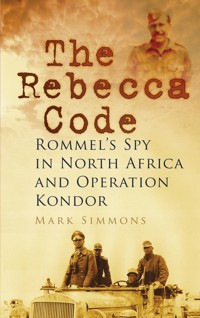
John Eppler thought himself to be the perfect spy. Born to German parents, he grew up in Egypt, adopted by a wealthy family and was educated in Europe. Fluent in German, English and Arabic, he made the Hadj to Mecca but was more at home in high society or travelling the desert on camelback with his adopted Bedouin tribe. After joining the German Secret Service in 1937, in 1942 he was sent across the desert to Cairo by Field Marshal Rommel. His guide was the explorer and Hungarian aristocrat Laszlo Almasy, a man made famous by the book The English Patient. Eppler's mission was to infiltrate British Army Headquarters and discover the Eighth Army's troop movements and battle plans. In The Rebecca Code, Mark Simmons reveals the story of Operation Condor and its comedy of errors and how it was foiled by Major A.W. 'Sammy' Sansom of the British Field Security Service. It is a tale of the desert, of the hotbed of intrigue that was 1940s Cairo, and the spy who was to send his reports using a code based on Daphne du Maurier's novel Rebecca.
Das E-Book können Sie in Legimi-Apps oder einer beliebigen App lesen, die das folgende Format unterstützen:
Veröffentlichungsjahr: 2011
Ähnliche



















Acknowledgements
Like many people my interest in the German use of the Rebecca Code during the Abwehr Operation Kondor, began with reading Michael Ondaatje’s 1992 Booker Prize winning novel The English Patient. I was further inspired by the late Anthony Minghella’s 1996 Oscar winning film of the same name. Much is to be admired in both, at the heart of which is a love story between the desert explorer Count László Almásy and the English woman Katherine Clifton.
Most readers I trust will be familiar with the book and/or the film of The English Patient, so there is no need to relate it here, other than to say much of the background of the Western Desert and Cairo was the setting for real events. Also the character of Almásy depicted in book and film is a marked distortion of the real man, and his end was in real life very different. Many of the other characters in the real story are discounted, no doubt for good reason in that fictional account.
The English Patient was not the first attempt in fiction to tell this story. The first book to cover the Kondor mission was by war correspondent Leonard Mosley in his 1958 publication The Cat and the Mice. Mosley was in Cairo at the time the events took place and he interviewed the German spies John Eppler and Peter Monkaster (Heinrich Gerd Sandstette) in prison. He also kept in touch with Eppler after the war. However in view of the later accounts, one written by Eppler, and later firm evidence, it is certain that Eppler strung him along to a degree in order to embellish his own image as some sort of James Bond. The 1960 film Foxhole in Cairo was based on Mosley’s book, the film poster calling it ‘the greatest spy story of the desert war’. That is true, but the film has little else to recommend it. In the film James Robertson Justice plays the British intelligence officer, a naval commander, tasked with catching the spies, and Michael Caine is seen in one of his early roles as a German W/T operator.
Other writers also used the bones of the Kondor story in fiction, Ken Follett in The Key to Rebecca (1980) which was filmed in 1989, and Ken Deighton in City of Gold (1992). Both books relied heavily on personal accounts. Also Anwar Sadat’s Revolt on the Nile (1957), A.W. Sansom’s I Spied Spies (1965) and John Eppler’s Rommel Ruft Cairo (1960) published in English as Operation Condor Rommel’s Spy (1977). It is doubtful if they would have used Almásy’s Rommel Senegenal Libyaban (1943), translated into English by Gabriel Francis Horchler as With Rommel’s Army in Libya (2001). Or for that matter come across Almásy’s diary of Operation Salam, held by the Imperial War Museum in the Lloyd Own Papers.
The Secret MI6 files were closed in 2003 and released to the public in 2006. It was my aim, therefore, to bring the four eyewitness accounts by Almásy, Eppler, Mosley and Sansom together with the official files and tell the true story of the Rebecca Code and Operation Kondor.
Secondary sources that have been useful include Hans-Otto Behrendt, Rommel’s Intelligence in the Desert Campaign (1980). John Bierman’s The Secret Life of László Almásy (2004), Paul Carell’s The Foxes of the Desert (1958), Christer Jorgensen’s Hitler’s Espionage Machine (2004) and Saul Kelly’s The Lost Oasis (2002).
I am grateful to the staff at Bletchley Park, the Imperial War Museum, the Intelligence Corps Museum, the Public Records Office, Royal Geographical Society, AKG Images, Hunt Library, US National Archives, Hungarian Geographic Museum, Bookends of Fowey, and the Forest Park Hotel Cyprus.
I am also hugely indebted to the following people: Shaun Barrington my Editor at The History Press for his enthusiastic support for this project right from the start. Group Captain L.E. (Robbie) Robins AEDL, another enthusiastic supporter, for free use of his extensive library, his hospitality, and for reading an early draft making many excellent comments and suggestions. My late Aunt Olive Hard for her illustrations of Egypt during the war years. To Ann Willmore, book dealer at her shop Bookends of Fowey and an expert on the work of Daphne du Maurier, who supplied a wealth of information on the publishing history of the novel Rebecca.
Finally my wife Margaret as always gave her whole hearted support in the nuts and bolts of building a book, with proof reading, index building etc. Thanks to all.
Contents
Title
Acknowledgements
Prologue
Part I
The Characters
1
Johannes Eppler, Beirut May 1937
2
Eppler, Athens and Berlin, July–August 1937
3
László Almásy
4
Alfred Sansom
Part II
The Scene
5
Cairo, Spring 1941
6
The Western Desert
7
Tripoli, March 1941
Part III
Operations
8
The Troublesome General
9
Exit Ritter
10
Under the Pagoda Tree
11
The ‘Good Source’
12
Interview with the Führer
Part IV
Kondor
13
Planning
14
The Rebecca Code
15
False Start
16
Operation Salam
17
Assiut
18
The Flap
19
Kondor Calling
20
The Ring Tightens
21
Currency Matters
22
The Raid
23
Rommel at Bay
24
Interrogation
25
The Riddle of Alam Halfa
Epilogue
Dramatis Personae
Bibliography
Glossary
Plates
About the Author
Abbreviations to Notes
Copyright
Prologue
Troodos Mountains, Cyprus, September 1936
It was not someone ‘Sammy’ Sansom expected to come across on the descent from Mount Olympus in a small Ford saloon. A young fair-skinned woman was being sick beside the road. She was sat on a fallen pine tree, in the shade of the trees, her head between her knees unaware of the car’s approach. Or not caring.
Sansom had to stop. Here was a lady in distress, a European. But more important to him it was the right action to take.
‘Excuse me Miss, can I help?’ Sansom climbed out of the car and brushed off his clothes although there was no need. He was a dapper man.
‘Oh dear’ she said looking up at him, ‘I must look a sight.’ Her eyes were startlingly clear blue. She shook her dark hair away from her face. She noted the lightweight suit and knew instantly the type, a colonial been here for years. ‘I’m not a Miss, but Mrs Browning.’
‘Are you ill Mrs Browning?’
‘No, other than being pregnant and suffering morning sickness. Perhaps I was foolish to try to walk to Mount Olympus.’
‘In this heat, which is deceptive in the mountains even early in the morning, maybe it was not wise. Where are you staying Mrs Browning?’
‘The Forest Park hotel.’1
‘Yes I know it, near Platres, would you care for a ride back to the hotel? I am Alfred Sansom, but call me Sammy, insurance salesman for the Gresham Life Assurance Society from the Egypt office.’2
‘That would be kind Mr Sansom; I doubt this is going to pass quickly. It really is tiresome, something you men are lucky not to suffer.’ He was strikingly handsome, with the fashionable moustache that all men seemed lost without. And his eyes were dark pools, inscrutable but his smile was friendly and not condescending.
Sansom nodded and waited until Mrs Browning got up in case she felt faint. Her slim angular face was pale but she was steady on her feet, and strode with purpose to the car. She caught him by surprise with her height and speed of her walk, but he reached the passenger car door in time to open it for her.
‘A reader I see Mr Sansom’ she said, picking up the book Sansom had left on the passenger seat. ‘My goodness’ she said reading the title, ‘how strange, The Loving Spirit, one of mine.’
‘You are Daphne Du Maurier?’
‘That’s my maiden name.’ She opened the book to the page marked by a scrap of neatly folded paper and read: ‘Chapter fourteen. For five years Joseph Coombe was an inmate of the Sudmin Asylum.’3 ‘What do you think Mr Sansom? It’s not often I meet a reader.’
‘I like it; it inspires me to visit Cornwall one day.’
‘Oh do, how I wish I was there now. Mind you,’ she added quickly ‘I find Cyprus invigorating away from the heat and multitudes of Alexandria, my husband’s in the army there.’
She handed Sansom the book and climbed in. It was only a short drive to Platres and the hotel. The air fresh with the scent of pine and cypress trees was cooling which did much to restore her. By the time Sansom opened the door for her the colour had returned to her face.
‘Would you like me to dedicate the book Mr Sansom?’
‘That would be kind.’ He retrieved the book for her and handed her a pen from his briefcase. ‘Sign it to Sammy please.’
Sansom smiled at the dedication on the title page and read. ‘To my saviour Sammy in Cyprus, Daphne Du Maurier.’ He closed the book. ‘Thank you. Are you working on another book Mrs Browning?’
‘Yes Sammy, another Cornish novel about a great house, haunted by the dead wife of the owner. I will call her Rebecca.’
‘Good I will look forward to that.’ Sansom gave her a slight bow, climbed into the car and drove away.
Inscrutable she thought, but she did not understand the British, the Empire builders that is, who could live out here, probably only ever going home to school as a child. Yet he had been a godsend that morning.
Sansom was 26 and Daphne was 29 that day.*
Notes
See here for a list of abbreviations used in the below notes
* The pregnant Daphne du Maurier did stay on the island of Cyprus in 1936, writing her novel Rebecca published by Gollancz in 1938. There is no evidence she met Alfred Sansom. This is fiction; however everything that follows did happen.
1 Forster, M., Daphne du Maurier p.127–128
2 Sansom, A.W., I Spied Spies p.11
3 Du Maurier, D., The Loving Spirit p.191
Part I
THE CHARACTERS
1. Johannes Eppler, Beirut, May 1937
SPRING WAS A GOOD TIME to be in Beirut before the heat in July and August became oppressive on account of the excessive humidity, driving people inland to seek the more agreeable conditions of the mountains.1
Johannes Eppler was 23 in May 1937 when he went ashore from the luxury of the Khedive Ismail passenger ship that had brought him from Alexandria to Beirut. He had travelled on the ship many times, which sailed between Piraeus, Famagusta Cyprus, Beirut and Alexandria. Eppler was small, on the thin side, with a square, handsome face, small moustache and blue eyes, unusual amongst Egyptians but not unknown, even going back to the time of the Pharaohs. He looked what he was, a young wealthy Egyptian, playboy/man-about-town.2
His Egyptian name was Hussein Gaafar but his parentage was German. His mother had inherited a small hotel in Alexandria to which the family moved and she managed. His father died soon afterward and his mother later married the wealthy Egyptian lawyer Salah Gaafar who adopted her son. Johannes becoming Hussein Gaafar, holding joint nationality. He became fluent in Arabic, German and English, the latter learnt while attending English-speaking schools in Alexandria and Heliopolis. He was baptised Roman Catholic; his mother had come from the Catholic south of Germany. As a young man he also made the pilgrimage to Mecca.
The German embassy in Cairo had contacted him, acting on orders from the Abwehr headquarters in Berlin, to find likely people with German connections abroad. This clandestine meeting seemed melodramatic to Eppler. He was to meet a Herr Haller, a stranger who would have a half page, number 145, of Juliette Adams’ book L’Angleterre en Egypte, to match the half given to Eppler. They would meet at the Saint George Hotel where he would stay.3
He arrived the day before the meeting and that night picked up a woman, a Hungarian, Ilona, in the hotel. The bars and dance floor of the Saint George were often buzzing with all sorts of people of many nationalities. He spent the night in her arms in his room.
Eppler rose early on 15 May for a swim; he hoped Ilona would be gone by the time he returned. The meeting with Haller was not until the evening. He swam out into the bay from the diving jetty of the Saint George. Swimming was an exercise he was fond of having been brought up in Alexandria where trips to the beach and swimming were part of daily life. He swam far out for perhaps a mile into the sea. A fast motor launch passed nearby, swamping him with its wash. He surfaced, choking, to see a pretty blonde girl waving at him from the stern. He did not take it as an ill omen; he was looking forward to the clandestine meeting.4
Returning to the hotel there was little to do but wait. He had a whisky and soda down on the bar terrace. He had never been a devout Muslim and he enjoyed alcohol. He found Islam to be radical, like the desert extremes of hot and cold. Not suited to his free spirit.5
After a siesta in his room, at about 8.00pm he began to dress for the meeting. At 8:20pm the reception desk phoned to inform him someone was waiting to see him.
Soon there was a knock on the door. Opening it Eppler saw a tall, fair, blue-eyed man. Smiling he presented his half page and said ‘Haller.’ The two half pages fitted. Eppler was not impressed. Was Haller trying to unsettle him? And how could they send such an obviously northern European man for a secret meeting in the Middle East?
They went down to the bar and found a secluded corner. Both ordered whisky.
‘You know,’ began Haller, ‘that we don’t think it’s of any importance for you to do two years of military service with the army proper.’6
Eppler was glad to hear this but did not interrupt.
‘It is for this reason that the Attaché in Cairo arranged this meeting. We have other things in mind for you.’
Eppler, irritated, informed Herr Haller he did not like people arranging his life, but was open to suggestions.
It made little difference to Haller who continued with what seemed to be a prepared speech. ‘Since you are German and born in 1914, you must serve your two years with the forces. That is a decree of the Führer’s which you must obey, like anybody else. But we are reasonable people, we are prepared to talk, especially in the case of Germans living abroad, like yourself, and there are always possibilities.’
Eppler began to feel bored and wished Haller would get to the point. He was hungry, so took Haller into the big hotel restaurant where he had reserved a table. There he showed Haller his Egyptian passport. Haller was surprised by the number of stamps and visas.
‘When I am in Germany from time to time, I have found it useful to have my German passport with me, otherwise it is more convenient to use this one.’ Eppler explained that he had found the authorities suspicious in Germany.
‘No need to be offensive.’
‘It is only an observation, no judgement.’ Eppler found Haller’s manner insolent, but stayed silent. It was them that wanted him; after all they had paid for all this. And he felt hopeful it might help in his quest for adventure. He waited for Haller to show his hand.
Haller continued. ‘I need hardly tell you that we are fully informed about you, down to the smallest detail. We know precisely with whom we are dealing.’ He then concentrated on the wine, finding the 1931 Chateau latour Bellegarde first class.
Eppler was uneasy; he later wrote that he found Haller to be ‘aggressively Aryan’ and did not like the ‘supercilious bastard’. If he had to deal with Herr Haller very much his Abwehr career would never get off the ground.
‘My colleague Rohde will be here in a quarter of an hour, said Haller.
‘This Rohde, would he be your chief?’
Haller acknowledged this, and that Rohde was responsible for the Middle East.
The meeting took a turn for the better with the arrival of Rohde. He was of medium height and build, and was tanned after many years in the east, well-dressed with impeccable manners. A man from the old Germany. Straightaway he began to chat in an informal, engaging manner. Haller however remained silent for most of the rest of the evening, much to Eppler’s relief.
‘It would be a waste of time,’ said Rohde, coming to the point, ‘to make a little speech about the Fatherland, a sense of duty and service to the people. I really can’t expect you to feel such things. The gap between you and the new Germany is too great. You live in a different world.’
Eppler agreed eagerly that ‘philosophising’ with him was pointless, but said that he was keen on ‘anything that smacks of adventure’.
Rohde continued, outlining the nature of the work of a secret agent. They needed information about the military of other countries, but as a Military Attaché in Greece and Turkey, his own freedom of movement was limited.
Thus he needed ‘trusted men who were at home in the Levant.’ He felt Eppler fitted their requirements. But he warned him that Secret Service work was ‘no picnic’ and was ‘dangerous’, requiring great courage and intelligence. The agent was on his own most of the time. He wanted relations between them to be clear from the start, and should they fail to reach an agreement they would go their separate ways as if nothing had happened.
Eppler liked his frankness and felt he could work with this man. He told him he was not acting out of patriotism and that he felt more Egyptian than German; they were lucky that Egypt was basically a British colony and he wanted to see the back of the British. Rohde pointed out that Egypt had been independent since 1922, but admitted that the British had certain ‘privileges’. Eppler agreed this was the case but that Egyptian independence was a sham, conditional on guaranteeing lines of communication to the British Empire. The British also had ‘suzerainty of the Sudan’ as well.
‘Otherwise, Herr Rohde, we are quite independent.’ Rather, in fact, Egypt was just Britain’s ‘Lancashire cotton plantation’. Certainly Egypt’s plight would affect his decision. He pointed out he would not be bought; money was of no consideration.
Rohde advised Eppler to sleep on it and they would have a more private meeting the next day. And now they should ‘enjoy themselves’ with the cabaret. There was an interesting belly dancer gyrating in the spotlight on the dance floor that they should investigate. They agreed to meet at the Hotel Metropole where Rohde was staying – without Herr Haller – the next day.
The next morning after his swim Eppler rang Rohde, changing the meeting place to his room at the Saint George. The Metropole was known to be ‘German’ and watched by the French Secret Service. Rohde agreed. At their second meeting Eppler accepted the German’s proposal. An appointment was made to meet again, in July in Athens, where he could sign on with the Abwehr.
During the intervening weeks between the meetings in Beirut and Athens, Eppler returned home to Alexandria. In June 1937 the city was still very cosmopolitan with large Greek and Italian populations. He did not waste time and arranged a meeting with the leader of the Muslim Brotherhood. He himself was a fringe member of the Brotherhood. Odd given his playboy lifestyle and the wealthy pro-British background of his adopted family but he felt new ideas were overdue and would take off in Egypt; he wanted to be part of it. The Brotherhood’s aim was to rid the country of foreign rule. More important for Eppler, he knew it had a secret intelligence branch. He was already thinking how he might help his potential new masters. Could he instigate contact between the Brotherhood and the Abwehr, and would it be useful to the Brotherhood? He needed a meeting with its leader, Hassan el Banna.
A distant cousin and member of the Brotherhood’s inner circle took him along to meet Banna at the Mosque of el-Khalid Ibrahim. Eppler found Banna more like an old Turk; he was a fanatic and ‘fanatics were dangerous’.7 In private, Eppler asked his questions but Banna did not answer for a while, looking him straight in the eye almost unblinking. When he did speak, it was slowly. He told Eppler that he was not the first to ask such questions. The Italians were putting feelers out; Mussolini had become the self-appointed ‘Protector of Islam’. They were trying to infiltrate Egyptian Nationalist organisations.
Eppler interrupted the flow. ‘At the moment, I am not trying to do anything, Hassen bey, nothing at all. No one has sent me.’
‘Good. We are first and foremost an Arab and a religious movement.’ Banna pointed out that he was willing to use the Europeans of all types for his own aims; however he could not compromise on the supremacy of Islam in Egypt, which the Europeans were against, be they British, Italian or German. But he was not against contact if Eppler could provide it.
It struck Eppler after this meeting that he had reached a crossroads: either he worked for the Abwehr and kept the meeting with Rohde, or went back to his old lifestyle. However, he did not want merely to become a German lackey. He kept making contacts, the next being the ‘Greenshirts’, Egyptian Nationalists. The organisation had grown out of a disaffection with the Anglo-Egyptian Treaty, and was extremely anti-British. He vaguely knew its leader, Ahmed Hussein, who months before had sought his advice on a trip to a Nuremberg Nazi Party rally. He did not like the man but was willing to cultivate him.
In the coffee houses of Alexandria he found out that Ahmed Hussein was in Tanta. The city was 80 miles southeast of Alexandria, the centre of the cotton ginning industry and the rail hub of the Nile Delta region. It was an ideal opportunity to try out his new Lancia sports car on a long run. The journey proved to be frustrating at times, as he weaved through the slow traffic of donkeys, camels and carts that were in no hurry to make way for the speeding car, even when he used the horn.
Hussein was at prayer in the Sheikh Said el-Badawi mosque. Reluctantly Eppler joined the prayers but felt ‘I would rather have a decent meal than spend time in prayer.’ Then he spoke with Hussein who agreed to help Eppler if he could.
Eppler did not stop there but went on to cultivate other nationalists, particularly in the Egyptian Army, where many of the young officers were ‘fellow travellers’. One who was trying to organise a cell was Hussein Sabri Zulfikar. Eppler flew down to Cairo to see him. Like many wealthy young Egyptians, Eppler had learnt to fly on a Tiger Moth at a British-run flying club.
He met Zulfikar at the army officers’ club in Zamalek for a game of squash, and to sound him out about how things stood in the army. He already knew many officers sympathised with the Brotherhood, but would they act? After the game they found a coffee house where Eppler asked Zulfikar whether he would be willing to help him, which he warned could be risky. Zulfikar agreed instantly.
During this busy time Eppler got married, revealing the impulsive side of his nature. Sonia was a Danish national with a touring ballet from Copenhagen. Eppler first saw her in a nightclub. ‘I shall never forget her entrance. She was stunningly beautiful, with hair the colours Titian loved to paint, dark red with glints of gold.’8
After two weeks they were married at the Danish Consulate in Cairo on 25 June, much to the vexation of his stepfather, Salah Gaafar. He called Sonia ‘the acrobat’ and refused to see her. He informed his stepson, ‘You’ll have to manage on what you get.’ While he made no increase to his allowance however, he did not cut him off.
Thus, unwittingly, the pro-British Salah Gaafar helped push Eppler toward the Germans, although really his impulsive stepson needed little encouragement.
Sonia had to stay with the Danish ballet company but agreed to meet her husband in Athens once the tour was over. Provided Eppler was taken on by the Abwehr they would travel on to the World’s Fair in Paris and then visit Denmark, before he went on alone to Berlin.
Notes
See here for a list of abbreviations used in the below notes
1 Denham, H.M., Southern Turkey the Levant and Cyprus p.70
2 KV/2/1467 small moustache, light coloured eyes
3 Eppler, J., Operation CondorRommel’s Spy p.31
4 Mosley, L., The Cat and the Mice p.16
5 Eppler, p.32
6 ibid, p.37
7 ibid, p 42
8 ibid, p.49
2. Eppler, Athens and Berlin, July–August 1937
Eppler arrived in Athens on 20 July 1937, a Tuesday. He obeyed his instructions to telephone Rohde when he arrived, doing so from the luxurious King George Palace Hotel, a fairly new establishment with an uninterrupted view of the Acropolis. A meeting was arranged and Eppler met Rohde’s driver in the hotel lobby. After a short drive Rohde greeted him at the door of a large villa ‘that could just as well have been in Munich, if it had not been for the Acropolis visible over the roof.’1
Rohde took him to the study, which overlooked ‘the sundrenched garden’; the room was ‘tastefully furnished’ and ‘immaculately clean’. The building was quiet and appeared deserted, the only sound being the faint murmur of traffic noise from the road.
After brief pleasantries Rohde went over the offer he had made Eppler in Beirut.
‘So that there can be no misunderstandings. You know I prefer to work without complications. If you have any doubts left, please tell me frankly.’ Eppler did have questions but did not interrupt, instead lighting a cigarette. The air was soon thick with Turkish tobacco smoke as both men smoked.
Rohde told him he would have to go to Germany for training, and on his return Rohde himself would be Eppler’s boss. In time he might work for others or on his own.
‘We’ve thought it over, you realise. I am only a link in the chain, and it has been decided to establish you firmly in the Middle East. After your training period has ended, that is where you will begin your work, provided of course the political situation remains what it is today.’
His cover was first class, his job was ‘exclusively’ to collect military intelligence. He was to keep out of politics. ‘We are soldiers, not politicians.’
Eppler told him he had recently got married; Rohde knew already. He admitted he was surprised. It would have been better if Eppler was not married, as with any agent, but it changed little. They would give Sonia a monthly allowance, an amount to be decided in Berlin. Eppler of course would be paid, and have expenses; the latter would be decided by Rohde once Eppler was in the field, and they could be generous.
Eppler told Rohde of the groundwork he had begun in Egypt. He was pleased with this; it was something he could build on later. Eppler emphasised that he would not work against the interests of Egypt or Denmark, Sonia’s country. They went on to discuss pay, which would start at 1500 marks a month. Eppler also asked for a contract.
‘You will have to discuss that in Berlin. They’ll fall about with laughter when you tell them; they’ll never have heard of anything like that.’ However the two men did reach an agreement after more bargaining. Eppler found Rohde ‘obstinate but not unreasonable’.
Later they went out for lunch to the Alex restaurant, at the Third Reich’s expense. The Alex served Egyptian and Greek cuisine and Eppler found the food good. He felt reassured to be dealing with someone with such obvious good taste.
After a leisurely lunch they returned to the villa where once again Rohde did most of the talking. Eppler was sure someone was listening in on their conversation, perhaps even noting every word that was said, but he was not concerned. Rohde told him about the course he would attend in Germany, which would give him ‘the final polish for this profession, hard work is the only way. Without the technical skills acquired during the training period, no agent can get by these days.’
He told Eppler to trust no one – even within his own department, because it was an organisation riven by ‘jealousy’, a dangerous enemy. ‘Trust no man, use him, but never trust him, or he will let you down.’ Eppler found this somewhat alarming. But the attraction to remain was overwhelming. Especially when he heard Rohde’s next words.
‘The name of your most dangerous adversary is the British Secret Intelligence Service. Its various departments and missions will be something you’ll have to spend a lot of time over during your training course.’ Rhode explained that it was more than likely that Eppler’s first enemy contact would be with British Naval Intelligence. Their Section South 3 covered the Levant, Arabia and Persia. MI6 would be the field operatives. ‘They are tenacious, these boys, once they have picked up the trail, they will not give up the chase.’ He suggested the best course was ‘not to draw attention to yourself’.
The most valuable aspect of the espionage course would be the acquisition of technical skills. ‘These things will be of the greatest possible value to you.’ Rohde also told Eppler to put maximum effort into the military training course. ‘Take it seriously and go through with it.’ By the end he would be fully trained and have ‘everything a good agent needs’.2
On the day the Epplers were due to leave Athens they both met Rohde for lunch at the Alex, at his invitation. They spent three hours there before Sonia went off to do some shopping. Meanwhile Rohde took Eppler to his house to give him his final instructions concerning where and when to report to Abwehr headquarters.
On 15 August, Eppler arrived at 76/78 Tirpitz Ufer, named after Grand Admiral Alfred Von Tirpitz, on the Bendlerstrasse, the home of the Abwehr. It had rained early that morning but the sun had dried the roads and pavements, although the day remained cloudy. He felt Paris was certainly more alluring and more fun but Berlin was ‘an attractive and friendly city’.3
The Abwehr HQ (Abwehr meaning ‘defence’) was a four-storey building, part of the Bendler block that also housed the Reich Navy offices; it overlooked the Landwehr Canal, brown and languid. It reminded Eppler of a ‘low court’, a ‘depressing’ building. At the entrance the commissionaire took his name and made a call, told him he was expected and directed him into the bowels of the building. The quarters were cramped, with small offices and a dark corridor, for the HQ was made up of two town houses.4
A smart young lieutenant conducted the initial interview, checking Eppler’s details. Then he was handed on to a Major Maurer from Section 1 Secret Intelligence. Within hours he started training, studying large scale maps of the Middle East.
Training in earnest took place in the River Havel area, 40 miles west of Berlin at the Wehrmacht Special Training School of Quenzgut near Lake Quenzsee. Eppler was placed with Helmut Mutze, a man of about his own age, who would stay with him throughout his training and report on his progress.
Eppler was put through his paces for two weeks in hot and humid weather, which he did not altogether appreciate. He was either soaking wet or sweating ‘like a pig’ and every bone in his body ached. He seemed to have to crawl or run everywhere.
He learnt about the use of explosives and how to use them against railways and bridges. Much time was spent on the rifle ranges with a variety of weapons. Parachute training he found difficult. ‘I was frightened out of my life by being thrown off a 5m high board into a pile of sawdust and then bullied through a series of ground exercises. Forward rolls, backward rolls; a whole afternoon of nothing but somersaults – how I got to hate somersaults.’ He came to loathe his parachute instructor, Sergeant Schafer, who called him a sack of potatoes, always qualified with a barked ‘Sir.’ Schafer had a roly-poly frame, more sack-like than Eppler, but was able to touch the ground ‘as softly as a feather’, making Eppler green with envy.
He was sure that his companion Mutze was reporting on his progress – or lack of progress – all the time, that he was some sort of minder. They went out together socially and eventually Mutze admitted his role. ‘At each stage of your training I am supposed to make out a report of your aptitude, both physical and psychological. I must describe your general attitude, official as well as private, your relations with the opposite sex and your ability to hold your liquor.’
Eppler told Mutze he could put in his report, that he, Eppler, had had enough of parachute jumping and blowing things up; ‘I am no anarchist, let them blow things up. I was told all I needed was a rough idea, and I’ve got that now.’ Mutze told him not to worry, to calm down; he would soon be back in the Middle East and more than likely working under Rohde, who held him in high regard.
Shortly afterwards they both left for Striegau in Lower Silesia, East Prussia, and the Abwehr training school not far from the Gross-Rosen concentration camp. Here Eppler was schooled in the mysteries of coding and decoding, ciphers and radio work. It was a two-week concentrated course, but Eppler still managed to get into the city of Breslau for some recreation.
In his account written after the war Eppler had little to say about the Germany he visited in 1937, although it was of course undergoing massive upheaval. Breslau, capital of Silesia, was a city with a large Nazi faction; in the 1932 election the party had received almost half the city’s popular vote. Jewish persecution was well under way; the city once had a large Jewish community, the sixth largest in the country. The small Polish community was also being persecuted, and one could be arrested for speaking Polish in public.5
After a month of training, Eppler was ordered back to Berlin. An interview with Admiral Canaris, head of the Abwehr, was scheduled.
Wilhelm Franz Canaris was 50 in 1937. He was born in the small mining town of Aplerbeck near Dortmund Westphalia, the son of the wealthy industrialist Carl Canaris. In his youth Wilhelm convinced himself he was related to the Greek Admiral and freedom fighter Constantine Kanaris. This is said to have influenced his desire to join the navy, but it brought him into direct conflict with his father, who told him if he wished to join the armed forces, which was not a family tradition, he would join the cavalry and a commission was sought in a Bavarian Regiment. Fate intervened, his father dying of a stroke in 1904. Canaris’ mother, Auguste, allowed her son to choose his own future. He passed his high school exams with high marks, and due to his linguistic skills – he spoke three languages – he sailed through the entrance exam for the navy. He joined the Imperial Navy Academy on 1 April 1905, where a military infantry course was followed by nine months of naval training. A fellow cadet found him ‘slow to speak but quick to listen’. He was tough but displayed a good sense of humour.6
By the time of the First World War, Canaris was serving in the South Atlantic on the light cruiser SMS Dresden as an intelligence officer. He had already gained a reputation for being reliable and competent. The Dresden had been part of Admiral Maximilian Graf Von Spee’s squadron that had sunk the British Pacific Fleet at Coronel, the first defeat for the Royal Navy in over a century, with the loss of two armoured cruisers and nearly 1600 men. For three months the Germans had been masters of the South Pacific but too late, with British forces closing in, decided to run for home via the South Atlantic. The Admiralty had despatched a powerful fleet under Admiral Frederick Charles Doveton Sturdee, which caught up with Spee’s force off the Falkland Islands. On 8 December 1914 the powerful battle cruisers Inflexible and Invincible trapped the German force and sent them to the bottom of the Atlantic.
Only the Dresden survived the Battle of the Falklands owing to her superior speed. For several months she played a game of hide-and-seek with the British fleet, much to the chagrin of the Admiralty in London. Canaris was instrumental in arranging clandestine meetings with supply ships. However, the Dresden was finally cornered near Chile by HMS Glasgow, which opened fire although both ships were in neutral waters. Here Canaris showed his guile and a degree of courage by going over to the British ship – which was still firing although a white flag had been raised – to parley. Meanwhile his colleagues opened the sea cocks and lay charges to scuttle the ship, which blew up while Canaris was still on board the Glasgow.




