


Erhalten Sie Zugang zu diesem und mehr als 300000 Büchern ab EUR 5,99 monatlich.
- Herausgeber: The History Press
- Kategorie: Sachliteratur, Reportagen, Biografien
- Sprache: Englisch
ELYESA BAZNA WAS THE HIGHEST-PAID SPY IN HISTORY. Working for the British ambassador in Ankara in 1943, Bazna photographed top-secret documents and sold them to the Nazis. So started his career as a 'walk-in', a freelance spy whose loyalties lay with the highest bidder. His codename was Cicero. But a beautiful woman was to end it all. Cicero was compromised by an American-controlled agent working at the German Embassy, who obtained his codename and discovered that he was working at the British Embassy. He fled and narrowly avoided being captured by the tipped-off British. Finally free, he realised his money was worthless – most of it was counterfeit, produced by the Nazi scheme Operation Bernhard. In Agent Cicero: Hitler's Most Successful Spy, Mark Simmons weaves together personal accounts by the leading characters and information from top-secret files from MI5, MI6 and the CIA to tell this astonishing story.
Sie lesen das E-Book in den Legimi-Apps auf:
Seitenzahl: 324
Veröffentlichungsjahr: 2014
Das E-Book (TTS) können Sie hören im Abo „Legimi Premium” in Legimi-Apps auf:
Ähnliche
















Other books by Mark Simmons:
A Crack in Time: A Search for the Echoes of the American Civil War (2004)
From the Foam of the Sea (2007)
The Serpent and the Cross (2010)
The Battle of Matapan 1941: The Trafalgar of the Mediterranean (2011)
The Rebecca Code: Rommel’s Spy in North Africa and Operation Kondor (2012)
Room 39 and the Cornish Legacy (2013)
Dedicated to the memory of that consummate actor,James Mason.
‘What is morally wrong can never be advantageous, even when it enables you to make some gain that you believe to be to your advantage. The mere act of believing that some wrongful course of action constitutes an advantage is pernicious.’
‘The enemy is within the gates; it is with our own luxury, our own folly, our own criminality that we have to contend.’
‘Memory is the treasury and guardian of all things.’
Marcus Tullius Cicero, 106 BC–43 BC
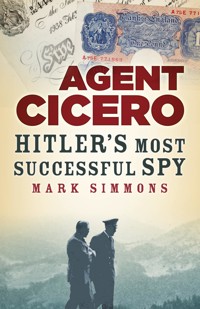
Front cover illustration: Von Papen and Hitler in conversation at Berchtesgaden.
First published 2014
This paperback edition first published 2023
The History Press
97 St George’s Place, Cheltenham,
Gloucestershire, GL50 3QB
www.thehistorypress.co.uk
© Mark Simmonds, 2014, 2023
The right of Mark Simmonds to be identified as the Author of this work has been asserted in accordance with the Copyright, Designs and Patents Act 1988.
All rights reserved. No part of this book may be reprinted or reproduced or utilised in any form or by any electronic, mechanical or other means, now known or hereafter invented, including photocopying and recording, or in any information storage or retrieval system, without the permission in writing from the Publishers.
British Library Cataloguing in Publication Data.
A catalogue record for this book is available from the British Library.
ISBN 978 0 75095 729 8
Typesetting and origination by The History Press
Printed and bound in Great Britain by TJ Books Limited, Padstow, Cornwall
eBook converted by Geethik Technologies
CONTENTS
Acknowledgements
Dramatis Personae in Brief
Glossary and Acronyms
Officer Ranks
Prologue
1First Contact, October 1943
2Elyesa Bazna
3Berlin Decides
4Second Meeting
5They Called Him Cicero
6Who is Cicero?
7Around Ankara
8Andreas to Bernhard
9December 1943
10Churchill’s Folly
11The Turkish Labyrinth
12A Transfer of Affections
13To Catch a Spy
14Defections
15Cicero’s Later Period
16Another Spy
17Two Spies Bow Out
18The Fallout
19The Longest Day
20War’s End
21Trial and Revelation
22Stellar Spy
23Cicero in Fiction
Dramatis Personae
Filmography
Bibliography
Notes
ACKNOWLEDGEMENTS
The story of Germany’s most successful spy came to my attention again, after many years, while engaged in research for my previous non-fiction book, The Rebecca Code: Rommel’s Spy in North Africa and Operation Condor (The History Press, 2012). In the book, two German spies, Johannes Eppler and Heinrich Sandstette, are taken by the famed explorer Count László Almásy across the Western Desert and into Cairo to spy on the British Eighth Army HQ. To fund their mission, the Abwehr agents are supplied with thousands of pounds sterling, although, unbeknown to them, it is all counterfeit. The Albanian Elyesa Bazna, who later became Agent Cicero, was paid with the same forged money, to the tune of some £300,000, all coming from the Nazi counterfeiting scheme named Operation Bernhard. The Cicero case was something I felt needed looking at again for several reasons.
It had first come to my attention with the feature film Five Fingers, starring James Mason as Cicero. I felt the character, portrayed so well by Mason, was a faithful depiction after we were told this was a ‘true story’. However, when I came to read L.C. Moyzisch’s book, Operation Cicero (1950), on which the film was loosely based, it was apparent that Five Fingers, as entertaining as it was, was a highly distorted version of the real story. Re-reading my battered 1952 Readers Union edition of Operation Cicero, it became obvious the story needed updating, as many secret British and American files on the subject are now open to the public.
Moyzisch’s book was the first to tell the story; he had been the main link between the Germans and agent Cicero. He is at times guilty of overstating his position and denying mistakes, but then this is a very human frailty. In a postscript to later editions, Franz Von Papen, German ambassador in Turkey and once chancellor of Germany, supports his account.
Five Fingers was brought out in 1952 and Von Papen released his memoirs that same year; it has a whole chapter on the Cicero case and much else that bears on it. Elyesa Bazna was the last to release his account in 1961, in a veiled attempt to embarrass the German government into compensating him for the Nazi regime’s fraud of having paid him with counterfeit money. He does exaggerate his abilities at times, often wildly, and is guilty of other flights of fantasy.
The British MI5 and MI6 files were released to the public in 2006, while the American CIA released their secret ‘Footnote to Cicero’ rather earlier in 1994. It was my aim, as it had been with The Rebecca Code, to bring together these three eyewitness accounts by Moyzisch, Von Papen and Bazna, along with the official files, and tell the true story of Operation Cicero.
Secondary sources that have been most useful include Sir Hughe Knatchbull-Hugessen’s memoirs, Diplomat in Peace and War (1949), although, due to the British Official Secrets Act, Knatchbull-Hugessen does not mention Cicero. However, it does provide a portrait of the times and much pertinent information on the delicate situations he was handling.
Walter Schellenberg’s The Memoirs of Hitler’s Spymaster (2006), first published as The Schellenberg Memoirs: A Record of the Nazi Secret Service (1956), covered his involvement in the Cicero case, and provided a broader view of the world of Nazi intelligence services and the German High Command.
Anthony Cave Brown’s impressive Body Guard of Lies (1975) gave me a flavour of much good background material, although without the benefit of secret files his conclusions are questionable.
David Kahn’s The Code Breakers (1968) and Hitler’s Spies (1978) supplied many more details.
Richard Wires’ The Cicero Spy Affair (1999) is one of the few books entirely devoted to the Cicero case, and is an excellent academic treatment.
Adrian Weale’s The SS: A New History (2010) is a good guide on details of the SS, which he has made his speciality.
I was particularly pleased to obtain a copy of Adolf Burger’s book, The Devil’s Workshop: A Memoir of the Nazi Counterfeiting Operation (2009), and even more so to find it was signed by the author: a clear link to the past and the Cicero case.
I am grateful to staff at Bletchley Park, and even more so to see a room now devoted to the Battle of Matapan after I had written a book on the subject, The Battle of Matapan (2011). I thank the staff of the Public Records Office; Dorothy J. Heatts at the Central Intelligence Agency Library; the United States National Archives and Records Administration; the United States Navy Historical Department; the Imperial War Museums; and the Opel Centre, Berlin.
I am hugely indebted to the following people who have given freely of their time: Shaun Barrington, my commissioning editor at The History Press, for his enthusiastic support for the project; the late Group Captain L.E. (Robbie) Robins CBE AE** DL, another grand supporter, for reading an early draft and making many excellent comments and suggestions; John Sherress, fellow author and good crutch when the going got tough; and my magazine editors, Iain Ballantyne, John Mussell and Flint Whitlock, for continued support.
Finally, as always my wife, Margaret, gave her wholehearted support in the nuts and bolts of building a book, with proofreading, index-compiling, work on the maps, and finding her way through the labyrinth of strange and unfamiliar names, and my creative misspelling of them. Thanks to all.
DRAMATIS PERSONAE IN BRIEF
Bazna, Elyesa – Albanian/Turkish valet at the British Embassy in Ankara, sometimes known as Diello/Ilya. Spied for the Germans under the code name ‘Cicero’.
Dulles, Allen Welsh – American OSS agent in Switzerland. Later director of the CIA.
Garcia, Juan Pujol – Spanish double agent under the British code name ‘Garbo’ and Abwehr code name ‘Arabel’.
Kaltenbrunner, Ernst – German SS General. Chief of the RSHA.
Kapp, Cornelia – German translator/secretary, also known as Nele or Elisabet. Spied for the OSS at the German Embassy in Ankara.
Knatchbull-Hugessen, Sir Hughe – British ambassador in Ankara.
Menzies, Sir Stewart Graham – British head of SIS/MI6, also known as ‘C’.
Moyzisch, Ludwig Carl – German commercial attaché/SD officer at German Embassy in Ankara.
Von Papen, Franz Joseph – German ambassador in Ankara.
Ribbentrop, Joachim – German Foreign Minister.
Schellenberg, Walter Friedrich – German intelligence officer with the SD, later head of the RSHA.
GLOSSARY AND ACRONYMS
Abwehr
German secret service, meaning ‘defence’ in German.
AO
Abwehr officer.
Bupo
Bundespolizei, the Swiss secret police.
‘C’
Head of British Secret Intelligence Service (SIS) MI6.
Camp 020
British interrogation centre in Richmond, Surrey.
CIA
Central Intelligence Agency, replaced OSS, USA.
CID
Committee of Imperial Defence, British.
cobbler
Abwehr slang for a forger.
DCI
Director of Central Intelligence, USA.
Emniyet
Turkish secret service.
Enigma
German code machine system.
FBI
Federal Bureau of Investigation, USA.
FHW
Fremde Heere West, intelligence branch German High Command.
FO
Foreign Office, British.
Funkabwehr
German radio security service.
GC & CS
Government Code and Cypher School, Bletchley Park.
GCHQ
Government Communications Headquarters.
Gestapo
Geheime Staatspolizei, German secret state police.
GRU
Soviet military intelligence.
KGB
Soviet intelligence service.
LRDG
Long Range Desert Group, British.
MI5
Military Intelligence section 5. British counter-intelligence service.
MI6
Military Intelligence section 6. British espionage service, often known as SIS.
NID
Naval Intelligence Department, British.
NKVD
Narodnyy Kommissariat Vnutrennikh Del, Soviet secret police.
NSA
National Security Agency, USA.
OKH
Oberkommando des Heeres, German High Command.
OKW
Oberkommando der Wehrmacht, German Armed Forces High Command.
OSS
Office of Strategic Services, replaced by CIA, USA.
RFO
Reich Foreign Office.
RSHA
Reichssicherheitshauptamt, supreme state security department. Set up in 1939 to supervise the Gestapo and SD.
SA
Sturmabteilung, or ‘Brownshirts’. Paramilitary wing of the Nazi party, replaced by the SS.
SBS
Special Boat Service, British.
Section D
SIS sabotage section.
SD
Sicherheitsdienst, secret service branch of the SS.
SIM
Servizio Italiano Militare, Italian Military Intelligence Service.
SIPO
Sicherheitspolizei, security police of the Gestapo and SD.
SIS
Secret Intelligence Service, British, also known as MI6.
Smersh
‘Death to spies’, counter-intelligence service of the Red Army.
SOE
Special Operations Executive, British Section D of SIS.
SS
Schutzstaffel, or ‘protection squad’. The original title for Hitler’s bodyguard.
Station X
GC & CS, Bletchley Park.
Ultra
Ultra decodes encrypted Axis radio communications classified ‘Ultra Secret’.
Waffen-SS
Military arm of the SS.
Walk-in
Agent as a stranger, freelance, offers services to a particular government often not his own.
OFFICER RANKS
Waffen SS
German Army
British/USA Army
SS-Untersturmführer
Leutnant
Second Lieutenant
SS-Obersturmführer
Oberleutnant
Lieutenant
SS-Hauptsturmführer
Hauptmann
Captain
SS-Sturmbannführer
Major
Major
SS-Obersturmbannführer
Oberstleutnant
Lieutenant Colonel
SS-Standartenführer
Oberst
Colonel
No equivalent
No equivalent
Brigadier
SS-Brigadeführer
Generalmajor
Major General
SS-Gruppenführer
Generalleutnant
Lieutenant General
SS-Obergruppenführer
General
General
SS-Oberstgruppenführer
Generalloberst
No equivalent
No equivalent
Generalfeldmarschall
Field Marshal/General of the Army
PROLOGUE
Bovingdon Airfield, England, 11 May 1945
The Douglas C-47 Skytrain of the US Army Air Force (USAAF) made its approach to Bovingdon’s main runway from the north-east. The weather was fine on that spring morning, with mist and fog clearing; later it turned cloudy and light rain began to fall. With a screech of tyres on concrete, the great workhorse of the Allied air forces, known affectionately by the Royal Air Force (RAF) as the Dakota, was down.
On board were mainly US personnel beginning their long trip home, starting from Weimar in Germany. Field Marshal Wilhelm Keitel had signed Germany’s final act of capitulation only a few days before, and the war in Europe was over. With the GIs and USAAF flyers were a few German nationals who were of sufficient interest to Allied intelligence to warrant being flown to Britain and interviewed in London. One of these was 23-year-old Maria Clara Mathilde Molkenteller, a bright, intelligent young woman who had come to the attention of the Americans.
During her protracted interrogation, Maria insisted she had volunteered; however, the US Army report says she was ‘picked up by Halle CIC as a result of information given by an informant’.1 Both accounts may well be true in the flux that then existed in Germany. Once she was aware the Allied authorities knew of her existence, she may well have come forward of her own volition. The town of Halle is situated in the southern part of Saxony-Anhult on the Saale River, and was in the path of the advancing Red Army; in Allied hands she would be safe and fed, away from the horrors that might await any young German woman.
On 31 March 1945, and again a few days later, Halle was bombed by the Allied air forces, resulting in the deaths of over 1,000 people and the destruction of large areas of the town. As a consequence, it resembled many of the devastated towns and cities of the Third Reich when, on 17 April, Halle was occupied by American troops. The Americans sent Maria to British intelligence, knowing that her story, and the revelation of an agent called Cicero, would be of great interest.
The country Maria arrived in was a total contrast to the country she had left: Britain was consumed by wild celebrations of Victory in Europe, while Germany lay in smouldering ruins. The train journey from Hertfordshire to London would have passed through villages and towns in the throes of jubilation and not devastated by warring armies. The day after her arrival at the female interrogation centre on Nightingale Lane, the city went mad: it was festooned with national flags, fireworks and floodlights illuminating the night sky; Whitehall and the Mall were packed with thousands of people; and even though nothing had been officially announced, the rumour spread that the Jerries had thrown in the towel. As Big Ben struck 3 p.m., Prime Minister Winston Churchill spoke over loudspeakers relayed by outside radio broadcasts to the nation and the British Empire, telling the people that the war in Europe would end at midnight. Maria may or may not have witnessed these scenes, but in London she must have seen areas of damage inflicted by the Luftwaffe and the V1 and V2 rockets; however, it was far from the scale her homeland had suffered. Hitler’s speeches about the damage inflicted on London were greatly exaggerated.
It was a few days later that her interrogation, led by Captain F. Basett, started. He found out that Maria was born in Naumburg, on the Saale River in Saxony, in 1922. Her father, Otto, was a clergyman who was partially blind all his life. Her mother, Elfrieda, was a native of Halle and the daughter of an engineer. Maria was educated at home and, in 1940, she went to Leipzig University to study modern languages; by early 1942 she had passed her ‘interpreter’s diploma’ in English and Spanish.
There is no evidence to suggest any of the Molkenteller family were Nazi Party members. However, Maria’s father managed to obtain a position for her in a government department in Berlin through a family friend called Mylius. Her mother went with her on that first trip to the capital, and the two women called at the address they had been given just off Nothendarg Platz. Maria was surprised to find the offices guarded by the SS, Hitler’s bodyguard, and even more so to find Mylius was an SS-Sturmbannführer (major); however, he allayed their fears by saying that the work she would undertake was ‘not political’.2
In April 1942 Maria began work at the office known as Amt VII of the RSHA, the Reichsicherheitshauptamt (Reich Main Security Office), and her ultimate boss was Heinrich Himmler. She worked there for the first six months, spending most of her time reading and translating British and American newspapers. In November 1943, all the departments were moved to ‘a hamlet near Glwqau in Silesia’ after their offices in Berlin were burned out.3 It was here she was moved to Amt VI for translation work on documents. She worked under a Dr Graefe, who looked after the Turkish section, among others; she was told that the slightest mistake there and she would be discharged.
Over the next six months Maria estimated she translated some 120–150 documents supplied by the commercial attaché, a sturmbannführer, at the German Embassy in Ankara. These documents he had obtained, in film form, from the chauffeur of the British ambassador in Turkey, Sir Hughe Knatchbull-Hugessen. The sturmbannführer was said to have paid the Turk enormous sums of money, and the films of the documents were exchanged for cash at various meeting places in Ankara.
It was Dr Graefe who told Maria the spy’s cover name was ‘Cicero’. The documents fell into various categories, eight in total, which she listed and explained for the British in her ‘neat hand’:
1 The attitude of Turkey towards England and Germany.
2 Preparations for Turkey’s entry into the war.
3 Allied conferences at Adana, Teheran and Cairo.
4 Operations ‘Overlord’, ‘Olympia’ and ‘Saturn’.
5 Economic co-operation of Turkey with England and Germany.
6 Internal Embassy affairs.
7 Sundry matters.
8 Untranslatable material (there was little of this).
Maria indicated several copies were made for various departments, one even going to the Führer himself.
The word ‘Overlord’ must surely have leapt out at the interrogation officer: what had they known of that? Also, all the minutes of the first and second Cairo conferences are double underlined, maybe by a later reader.4 Equally there were items of little value, embassy affairs such as the ‘List of Christmas boxes 1943’ and a report on one of the women staff who was going ‘to have an illegitimate child’.5
After days of interrogation, which appeared to delight Maria, Captain Basett passed his report, dated 23 May 1945, to his superior Colonel H.L.A. Hart, who then wrote a note on the subject to MI6:
I am sending you now two copies of the interrogation of Maria Molkenteller at Nightingale Lane. You will no doubt look after the Foreign Office interest in this matter, but we would certainly like to know what their comments are after reading this astonishing story.6
One can almost hear him laughing and saying, ‘My goodness if this gets out we will be a laughing stock’. It was some weeks later in July that the file of one Ludwig Moyzisch would also cross Colonel Herbert Hart’s desk.7
1
FIRST CONTACT,OCTOBER 1943
The insistent ringing of the telephone brought Ludwig Moyzisch quickly back from the sleep he needed so badly. It was 26 October and he had gone to bed just after ten, reading for a while before switching off the light.
Moyzisch was of slim build, with dark hair; he was a quiet and conscientious man. He was not overly annoyed because the telephone, his line to the outside world, had not been working for days. This happened often in Turkey, and was a point he had discussed with his wife before going to bed.1
He was still half asleep when he answered the call: it was Inge Jenke, the wife of Albert Jenke, who was first secretary at the German Embassy.
‘Would you please come round to our flat at once? My husband wants to see you.’ There was tension in her voice.
Moyzisch asked what the problem was.
‘It’s urgent. Please come immediately.’2
Moyzisch got up and dressed. The call had woken his wife as well, and both felt that, whatever it was, it could probably have waited until morning. However, Inge Jenke was the sister of Joachim Von Ribbentrop, the Reich’s Foreign Minister, and she is described as a ‘nervous, ambitious woman in her middle forties’. It was therefore wise to humour her.3
It was a short drive from where Moyzisch lived to the German Embassy compound in Ankara, known by the Turks as the Alman Koy, the German village. The Turkish caretaker opened the gate to allow him in, before Frau Jenke opened the front door of their apartment. She was sorry for having to call him from his bed, and told him that her husband had now retired for the night, but would see him in the morning.
‘There’s a strange sort of character in there,’ she said pointing at the drawing room door. ‘He has something he wants to sell us. You’re to talk to him and find out what it’s all about. And when you go, do please remember to shut the front door after you. I’ve sent the servants to bed.’4
It is odd that, in Moyzisch’s account at that time, Inge Jenke did not reveal she knew the character behind the door prior to the visit that night, and that he had worked for the Jenkes, although this fact was revealed to him by the Jenkes the next day.5 Maybe they did not wish to unduly influence Moyzisch in any way on that first meeting.
Franz Von Papen, the German ambassador, commented:
The whole business began in a rather puzzling way. Herr Jenke, one of my two ministers, came to me one day to say that a man-servant whom he had employed at one time had rung him on the telephone with an offer to provide us with important information.
At first Von Papen turned down this offer, feeling any spy worth his while would not approach potential employers on the telephone. However, the man first known as Diello by Von Papen ‘… became insistent, so I gave instructions for Moyzisch to look into the matter’.6
Moyzisch entered the room; the curtains were drawn and two table lamps provided light. In an armchair next to one of the lamps sat a man. He got up and spoke in French, asking who Moyzisch was and whether he had been told of his proposition.7 Moyzisch shook his head and did not reveal his name. The man before him appeared about 50, with thick black hair swept back from a high forehead, already showing signs of balding. His eyes were dark and ‘nervous’, darting around at every sound in the sleeping house, and below the eyes was a bulbous nose above a firm chin.8 While the half shadows of the room gave his face a darker complexion, Bazna says he was 38 in April 1943, although Moyzisch never seems to have revised his estimate.9
Moyzisch sat down, inviting the man to do the same. Instead, rather theatrically, he went to the door and put his ear to it for a moment, before jerking it open. The hall was empty. He shut the door and returned to his seat. Then, before outlining his proposal, he first insisted Moyzisch should give his word that, whatever the result of their meeting might be, what was said would go no further than his chief. Moyzisch agreed, but, becoming irritated, he made a show of consulting his wristwatch, doubting the man before him had much to offer.
The man took in the gesture and asserted that, once he knew why he was there, he would have plenty of time for him:
I can give you extremely secret papers, the most secret that exist. They come straight from the British Embassy. That would interest you, wouldn’t it?
In spying terms, the man was a ‘walk-in’ – an informant or agent who, without prompting, contacts an intelligence organisation with the offer of information. Moyzisch remained non-committal, still feeling he was dealing with a petty crook.
The man carried on that he would want a lot of money for the documents; after all, he pointed out, the work was extremely ‘dangerous’. He wanted ‘twenty thousand pounds. English pounds Sterling’. Moyzisch responded that it was ‘quite out of the question’. The embassy did not hold such sums of sterling, and the documents would have to be exceptional to command such a price. He would have to see the documents first. Did he have them with him?
‘I’m not a fool,’ said the man, a superior smile spreading across his face; Moyzisch was annoyed, but remained silent. The man continued by saying that he had spent years preparing for this. They would meet his terms or, he pointed toward the window, he would take the documents to the Soviet Embassy.
‘You see I hate the British,’ he said.10
He then continued to outline his proposal, but still not did not reveal his name. He would give them time to consider his offer, since Moyzisch would need to consult his superiors. He would phone him at 3 p.m. on 30 October in his office and would call himself ‘Pierre’: if they turned him down, there would be no further contact; if they agreed, he would come and see him at 10 p.m. that same day, at an arranged meeting place, where he would supply two rolls of film of photographed ‘Top Secret’ British documents, for which they would pay him £20,000. Should they be pleased with what he supplied, they could have more, with each additional film costing them £15,000.
The ball was now in Moyzisch’s court, and he was ‘inclined’ to think the ‘offer might be genuine’. They seemed to have little to lose, although it might be a British trick. Moreover, he had doubts his superiors would pay the high price demanded and felt ‘the offer would be turned down’. He agreed to what the visitor had outlined and, should the offer be approved, they would meet that night near the gardener’s tool shed in the embassy garden, where it was dark and secluded.
At the visitor’s request, Moyzisch switched out the lights as he saw the stranger out. As he passed by him, the unknown man gripped his arm and whispered close to his face: ‘You’d like to know who I am. I’m the British ambassador’s valet.’ Thus ended the first meeting.11
After leaving the Jenkes’ flat, Moyzisch left his car in the embassy compound and walked home. It was a pleasant, cool autumn night, and no doubt he wanted the time to think over what had happened.
The month before he had been in Berlin and had found the capital a grim place. So far it had not suffered greatly in air raids, but the mood was tense and people were apprehensive. The war was going badly: Sicily had fallen, the Allies were now on the Italian mainland, and the situation was critical on the Eastern Front. It would seem that Moyzisch was there for some sort of dressing down. The meeting included those working in foreign embassies for the RSHA, headed by SS Obergruppenführer Ernst Kaltenbrunner, under Himmler, and operating under the control of Amt VI. Their job was to gather foreign intelligence. Moyzisch’s immediate superior was Walter Schellenberg of the Sicherheitsdienst (security service), the SD.12 It was pointed out they had failed to identify the Allied landings in North Africa or the Italian collapse, and their role in the embassies was a waste of time. They had to start supplying good information – ‘hot stuff’ – and not merely living the good life in foreign cities, or they would be sent to a fighting front.
Just before he left, Moyzisch was given a ‘pep talk on all the secret weapons that were being built’, and that these would soon restore the fortunes of the Reich. However, he felt such talk would not impress the Turks, and he returned to Ankara full of foreboding for the fate of his homeland.13
The Ankara that Moyzisch walked home through on that starlit night had only been capital of Turkey for some twenty years. German and Austrian architects had designed the great boulevards and squares of the city in a Fascist style, while it was the energy of Kemal Ataturk, father of the nation, that had ensured its development.
In the First World War, Ankara had not existed; at that time it was still known by its Byzantine name of Angora, from the Slav word ‘gora’. It was a hill town of a few thousand inhabitants: a poor watering hole on the main road east across Anatolia into Asia; an oasis town on a bone-dry empty plateau, very different from the old capital of Istanbul, influenced so much by the western Greeks. A ruined Byzantine fortress overlooked the town from its hilltop perch. Its only claim to fame had been the famous breed of cat named after it.14
It had been known better in ancient times: Alexander the Great had come this way in 333 BC on his way to conquer the known world; he had cut the Gordian Knot nearby. Julius Caesar also paused there in 74 BC. Even before these illustrious visitors, the Hurrians and the Hittites had used the citadel. In 1414, the Ottomans made it part of their empire.15
In 1943, Ankara marked the contrast between the old Turkey and the new. A walk along Ataturk Boulevard, the main thoroughfare of the New City, would pass grand embassies, the new buildings of the Turkish Parliament and the various ministries, luxurious hotels, restaurants and well-stocked shops. However, at the end of the street, the walker would enter the old town, taking a market street toward the Citadel, where it is once more an Anatolian town. Winding lanes would be thronged with peasants, dressed in clothing of another time and place, more Asian than European. Here, transport might be a black donkey or a cart; flocks of sheep were still driven through the town to market.
Ankara had a harsh climate: the summers were burning hot, while the snow in winter could be as deep as in his native Austria, and could often be found hanging on into March. Autumn was cool and pleasant but, arriving back home, Moyzisch found everyone asleep: ‘… but try as I might, I could not get to sleep again myself’.16
Moyzisch was well known to his boss in the SD, Walter Schellenberg, who had visited Turkey earlier in 1943. Trade relations between Germany and Turkey had reached a sticky patch over Turkish deliveries of chromium ore to Germany and, as Schellenberg put it: ‘I thought that a little pressure might easily put things right. I also intended to carry out an inspection of our secret service organisation in Turkey.’
After arriving in Turkey he was driven to Therapia, where Von Papen had his summer residence. Special envoy Jenke and his wife, Ribbentrop’s sister, received him. After three days at Therapia, where he met and talked with Von Papen, he flew to Ankara to have meetings with the Chief of the Turkish Secret Service, which he did together with Moyzisch.17
Later, Moyzisch took Schellenberg ‘duck-shooting’, where he ‘had an opportunity of observing the sombre beauties of this rugged and arid country, which looked to me like a lunar landscape.’ During his time in Ankara, Schellenberg ‘spent a considerable amount of time with Moyzisch’s family, to whom he was devoted, and was so impressed by the sincerity and industry with which he tackled his work that I decided to increase his already considerable salary. I instructed him to keep Von Papen informed about his activities, for I felt that a relationship of confidence between them was emphatically necessary.’18
2
ELYESA BAZNA
Eric Ambler once wrote dismissively of the idea that chance was a nickname for providence:
It is one of those convenient, question-begging aphorisms coined to discredit the unpleasant truth that chance plays an important, if not predominant, part in human affairs. Yet it was not entirely inexcusable. Inevitably, chance does occasionally operate with a sort of fumbling coherence readily mistakable for the workings of a self-conscious Providence.1
The man that Ludwig Moyzisch met in the Jenkes’ flat was Elyesa Bazna. Bazna was born in 1904 from Albanian stock at Pristina, now in Kosovo, then part of the Ottoman Empire. As the Empire shrank, the Bazna family moved to Salonica, where they lived not far from the birthplace of Kemal Ataturk. However, the first Balkan War (1912–13) was a disaster for the Empire and it lost almost all its European territories. Salonika fell to the Greeks, along with the Aegean islands. Ataturk scolded a friend over the city’s loss: ‘How could you leave Salonica, that beautiful home-town of ours?’2
The family moved again, this time to Istanbul, but Elyesa did not settle well at school and was soon expelled. Then, with Turkey finding itself on the losing side of the First World War, Istanbul was occupied by the Allies. He found work with a French transport unit that fuelled his ‘passion for cars’, but he soon lost that job after wrecking a truck.3 Various other jobs resulted in more run-ins with the authorities. He may even have been a petty thief at this time, and was known to have stolen a motorbike. He says that once, while arrested by the British, he was beaten and badly treated, and claimed to be some sort of patriot, but later admitted that he simply hated ‘ordinary order and discipline’. Finally running afoul of the French occupation forces, he was sentenced to three years in a penal labour camp in France, learning the language in the process.4
On his release, he stayed in France and worked for the Berliet vehicle manufacturer, which built trucks for the French Army. He was employed at the Marseilles plant, where he also learned the skills of a locksmith. Finally, he returned to Istanbul where he worked for the city’s transport department and fire brigade.
Then, as now, the city of Istanbul was unique: a vast turbulent metropolis which appears beyond control at times. Procopius, court chronicler in the reign of Emperor Justinian the Great, described his beloved city as being surrounded by a garland of waters. The city has changed in the fifteen centuries since he wrote his eulogy of praise for it, even the name (from Constantinople to Istanbul). Yet the waters still flow: the Bosphorus, which travels from the Black Sea to the Sea of Marmara, separates the main European city from its Asian suburbs, and at its southern end the Bosphorus is joined by the Golden Horn. The historic stream which flows seaward from Europe, the left bank of the Golden Horn, is formed from the Levantine port quarter of Galata, and on its right bank is the seven-hilled Imperial City, which some still prefer to call Stamboul.
James Pettifer saw it as:
… wild, often dissolute, with intersection centres and localities and suburbs, much more a labyrinth than any Greek city. It is the only famous Turkish city, the only place in the country that is not provincial.5
Later, with a loan from his father, Bazna bought a Studebaker car and became a taxi-driver. However, he failed to prosper and so became a chauffeur/servant to the Yugoslav ambassador, Jankovic, who he served for seven years. When the capital moved to Ankara, he moved with the diplomatic circle, and was employed as a kavass, one who serves foreigners. During this time he married and fathered four children, but his wife and children were in Istanbul, while he was in Ankara. In a few years the couple were estranged and the marriage ended in divorce.
During this period he developed his passion for music. Apparently the ambassador heard him singing while working and advised him he had a good voice and should take lessons to develop it. Finally, after several months of lessons with a German professor of music, he resigned his position to pursue his career in music. He gave a concert in Istanbul at the Union Française, the recital based on European opera music, and, although it got good reviews, it was not a success and left him in debt.
He had little choice but to return to his role as a servant. He found employment with the American military attaché, Colonel Class. However, he soon felt sexually attracted to the colonel’s wife, who was ‘young and pretty’, but he knew he meant nothing to her. Bazna felt he might not be able to control his feelings and ‘decided that it would be better for me to hand in my notice’.6
In late 1942 he was employed by Albert Jenke, then a prominent businessman who had been in Turkey many years and had been appointed to the staff at the German Embassy. In early 1943 Jenke was promoted to minister and assistant to the ambassador, Von Papen. He was the brother-in-law of Von Ribbentrop, German Foreign Minister. Bazna, when talking about his new job, said: ‘I did not shrink from poking my nose into my employer’s correspondence.’
He went so far as to photograph some documents to show off to his wife. However, he quickly fell under suspicion and found his room had been searched. He was dismissed shortly after by Jenke, who insisted it was for economic reasons. Bazna felt he ‘had been taken for a spy’. He did not consider himself one at the time, only that he was being nosey.7
Bazna says that it was while he was sitting in the lounge of the Ankara Palace Hotel – drinking coffee and reading the papers in the city’s best hotel was a pastime he much enjoyed – that he reviewed his life, which depressed him. He had failed in many things and wondered whether he would be a kavass at somebody’s beck and call forever. It suddenly struck him like some revelation that he had lost his last job for snooping because ‘the Germans had suspected him’. Here among all the warring powers who watched each other, he thought: ‘Why not set up as a spy? The idea fascinated me and would not let me go.’
At the same time, his eyes took in an advertisement in the paper, which read: ‘Driver wanted for First Secretary of British Embassy.’ It seems doubtful that he put these two things together so quickly, as opportunity would surely have been the greatest motive. Nevertheless, that opportunity would soon present itself, for it was not long before he was working for Douglas Busk of the British Embassy.8




