


48,99 €
Mehr erfahren.
- Herausgeber: John Wiley & Sons
- Kategorie: Fachliteratur
- Serie: Wiley Trading Series
- Sprache: Englisch
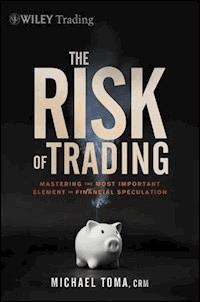
Develop the skills to manage risk in the high-stakes world of financial speculation The Risk of Trading is a practical resource that takes an in-depth look at one of the most challenging factors of trading--risk management. The book puts a magnifying glass on the issue of risk, something that every trader needs to understand in order to be successful. Most traders look at risk in terms of a "stop-loss" that enables them to exit a losing trade quickly. In The Risk of Trading, Michael Toma explains that risk is ever-present in every aspect of trading and advocates that traders adopt a more comprehensive view of risk that encompasses the strategic trading plan, account size, drawdowns, maximum possible losses, psychological capital, and crisis management. * Shows how to conduct a detailed statistical analysis of an individual's trading methodology through back-testing and real-time results so as to identify when the methodology may be breaking down in actual trading * Reveals why traders should think of themselves as project managers who are strategically managing risk * The book is based on the author's unique 'focus on the risk' approach to trading using data-driven risk statistical analytics Using this book as a guide, traders can operate more as business managers and learn how to avoid market-busting losses while achieving consistently good results.
Sie lesen das E-Book in den Legimi-Apps auf:
Seitenzahl: 400
Veröffentlichungsjahr: 2012
Ähnliche



















Contents
Cover
Series
Title Page
Copyright
Preface
WHY USE A DATA-DRIVEN APPROACH?
THERE WILL ALWAYS BE RISK
A BUILDING-BLOCK APPROACH
Acknowledgments
About the Author
Part I: Principles of Risk Management
Chapter 1: Foundations of Risk Management
A BRIEF HISTORY OF THE LEGISLATION
DEFINING RISK AND RISK MANAGEMENT
CLASSES OF RISK
SUMMARY
Chapter 2: Five Steps in the Risk Management Process
OVERVIEW
STEP ONE: RISK IDENTIFICATION
STEP TWO: RISK ASSESSMENT
STEP THREE: RISK CONTROL
STEP FOUR: MEASURING RISK
STEP FIVE: MONITORING YOUR RISK PROGRAM
SUMMARY
Part II: Managing and Measuring Risk
Chapter 3: Predictive Analytics Using Quantitative Analysis
WHAT IS QUANTITATIVE ANALYSIS?
THE DATA-DRIVEN RISK MANAGER
Chapter 4: Statistical Edge and Its Impact on Risk
FINDING EDGE
REDUCING VARIABILITY IN EMPIRICAL PROBABILITY
CRITERIA FOR DETERMINING EDGE
OBTAINING A VALID SAMPLE SIZE
PROBABLE EDGE VS. POSSIBLE EDGE
CHALLENGES WITH CONFIRMATION BIAS
INDICATORS THAT DETECT EDGE
LEVERAGING EDGE USING CONFLUENCE
SUMMARY
Chapter 5: Embracing a Culture of Analytics
RISK MANAGEMENT RULES FOR THE TRADER
THE DATA COLLECTION PROCESS
DATA ASSESSMENT
BASIC PRINCIPLES OF MEASURING DATA
PERFORMANCE MANAGEMENT: WHAT IS THE DATA TELLING ME?
DEVELOPING A TRADE JOURNAL
MEASURING SUCCESS THROUGH A KPI
TRADE REVIEW AND REPORTING ETHICS
BENCHMARKING
Part III: Qualitative Elements of Risk
Chapter 6: The Human Element: Psychological Risks of Trading
LOSS AVERSION
THE RISK OF REGRET
INTUITION TRADING
THE SUCCESS FORMULA AND DISCIPLINE
RISK ACCEPTANCE
MASTERING INCREASES IN SHARE SIZE
THE GRADUATION PLAN
SUMMARY
Chapter 7: Preparing for Risk and Loss
MASTERING RISK DURING A TRADE
THE NEED FOR PLAN COMPLIANCE
RISK PARTICIPATION AND LOSS ACCEPTANCE
PROCESS OF PREDEFINING RISK
TRADER EXPECTATIONS
BUILDING YOUR RISK TOLERANCE
POSSIBLE LOSS VS. PROBABLE LOSS
KNOWING YOUR RISK APPETITE
SUMMARY
Chapter 8: Business Risk Management for Traders
THE FIVE STEPS OF CRISIS MANAGEMENT
SCENARIO PLANNING AND TESTING
RESTORATION REQUIREMENTS
BUSINESS IMPACT ANALYSIS
VENDOR RISKS
PARTNERSHIP RISKS
SUPPORT RISKS
PERSONAL RISKS
CREATING A DEVELOPMENT PLAN
SUMMARY
Bibliography
Index
Founded in 1807, John Wiley & Sons is the oldest independent publishing company in the United States. With offices in North America, Europe, Australia, and Asia, Wiley is globally committed to developing and marketing print and electronic products and services for our customers’ professional and personal knowledge and understanding.
The Wiley Trading series features books by traders who have survived the market’s ever-changing temperament and have prospered—some by reinventing systems, others by getting back to basics. Whether you are a novice trader, professional, or somewhere in between, these books will provide the advice and strategies needed to prosper today and well into the future.
For a list of available titles, visit our Web site at www.WileyFinance.com.
Copyright © 2012 by Michael Toma. All rights reserved.
Published by John Wiley & Sons, Inc., Hoboken, New Jersey. Published simultaneously in Canada.
No part of this publication may be reproduced, stored in a retrieval system, or transmitted in any form or by any means, electronic, mechanical, photocopying, recording, scanning, or otherwise, except as permitted under Section 107 or 108 of the 1976 United States Copyright Act, without either the prior written permission of the Publisher, or authorization through payment of the appropriate per-copy fee to the Copyright Clearance Center, Inc., 222 Rosewood Drive, Danvers, MA 01923, (978) 750-8400, fax (978) 646-8600, or on the Web at www.copyright.com. Requests to the Publisher for permission should be addressed to the Permissions Department, John Wiley & Sons, Inc., 111 River Street, Hoboken, NJ 07030, (201) 748-6011, fax (201) 748-6008, or online at http://www.wiley.com/go/permissions.
Limit of Liability/Disclaimer of Warranty: While the publisher and author have used their best efforts in preparing this book, they make no representations or warranties with respect to the accuracy or completeness of the contents of this book and specifically disclaim any implied warranties of merchantability or fitness for a particular purpose. No warranty may be created or extended by sales representatives or written sales materials. The advice and strategies contained herein may not be suitable for your situation. You should consult with a professional where appropriate. Neither the publisher nor author shall be liable for any loss of profit or any other commercial damages, including but not limited to special, incidental, consequential, or other damages.
Charts were created using TradeStation. ©TradeStation Technologies, Inc. 2001-2011. All rights reserved. No investment or trading advice, recommendations, or opinions are being given or intended.
For general information on our other products and services or for technical support, please contact our Customer Care Department within the United States at (800) 762-2974, outside the United States at (317) 572-3993 or fax (317) 572-4002.
Wiley also publishes its books in a variety of electronic formats. Some content that appears in print may not be available in electronic books. For more information about Wiley products, visit our web site at www.wiley.com.
Library of Congress Cataloging-in-Publication Data:
Toma, Michael, 1966– The risk of trading : mastering the most important element in financial speculation / Michael Toma, CRM. pages cm. – (Wiley trading series) Includes bibliographical references and index. ISBN 978-1-118-10083-7 (hardback); IBSN 978-1-118-22376-5 (ebk); ISBN 978-1-118-26207-8 (ebk); ISBN 978-1-118-23710-6 (ebk) 1. Speculation. 2. Risk management. I. Title. HG6015.T66 2012 332.64′5–dc23 2011048577
Preface
From corporate offices to trading desk, the two words “risk management” together have long sparked curiosity, bewilderment, and even confusion. But recently, the profession has received more respect and recognition in our everyday business world and includes a much bigger scope than “those people in legal” or “that guy in charge of insurance policies.”
The Risk of Trading takes a holistic, or enterprise-based, approach that encompasses not only risks on a trade, but also for the trader and ultimately the business of trading.
WHY USE A DATA-DRIVEN APPROACH?
Anyone in the trading jungle knows that a comparison is often made between trading and gambling. This book looks deeply into this analogy and discovers the statistical principles are, in fact, quite similar. When I first mention a risk-based approach to stock, futures, or options trading to the casual investor, the words “risky” and “gambling” often follow. Using a mechanical method to trading supported by a statistically strict data-driven approach often invites even more questions.
“You really don't care where the market is going?” “Don't you want to beat the market?” “Isn't that a bit boring?” “Is that what you do all day?” My response to these alleged market-predictors is, “I don't find winning boring at all. I execute my plan when I have an edge. All the rules are in my plan. What I do is execute my plan with precision just like a project manager building a house or a homeowner mowing the lawn. I'm not concerned about beating the market. I just focus on executing winning trades, and I only execute when I have a better chance of winning than losing.”
There is a certain level of pride when so-called traders talk about their success in predicting market movements. Anyone can do it for a time without any charts, data, or trading experience. You have about a coin-flip chance of being right, and most just hype the few successful predictions over and over again. There's no pressure for them, of course, since most of the time there isn't any hard-earned capital at risk. Performing hours of analysis takes much more energy and certainly comes across as less sexy, if in fact data analysis can have such an alluring appeal. The casual investor tends to be resistant to any form of analytics, since the word itself is reflective of lots of work and analysis. When these methods are presented with simplicity, the better the chance that more will want to hear about them. Combining the conversation with success in trading the markets usually results in a captive audience.
Establishing a culture of trading analytics and metrics is about performing statistical analysis to shift the odds where one can be successful. There is a value proposition in using information and events that have occurred in the past to predict the probability of their occurring in the future under similar circumstances. Although sometimes associated with a geek dynamic, a data-driven approach is evident in many successful areas of business. Service industries currently use customer and vendor data to determine methods to improve quality of service. Internal risk control data generated from process improvement assessments can assist in improving product quality and efficiency. Data-driven decision making is even used to determine if a football quarterback should pass or hand off during certain situations. The book Bringing Down the House describes the MIT blackjack team's winning formula for beating the casinos using data-driven analytics. The book takes a microscopic approach to using data to manage risk and identify those opportunities that present an advantage. Simply put, past data and statistics that have provided positive results in your trading will tend to continue to do so in similar market conditions, thus providing you with the competitive advantage eagerly sought in trading. Combine this methodology with solid risk planning, and you now have access to one of the most powerful trading tools.
Mutual fund companies, hedge funds, and proprietary firms have used risk protocols for some time, but only recently has the average swing or day trader making a living from his or her basement computer had a risk component to trading. It is now commonplace to have a risk section appropriately titled in a trader's trading plan; or at least for those who in fact have created one.
The title of this book reflects the essential principles of the risk management concept required in trading stock, ETFs, futures, or other securities and derivatives. Any type of loss, financial, physical, and even loss of opportunity is a fact of life. If they were not, how we optimize the best use of the ways to minimize loss would be meaningless and unnecessary. One trader's work venue may be vastly different than another's in the same profession. One can perform his or her craft at a hedge fund, prop desk, or at the kitchen table. In this book, I take traders on an assessment journey of their trading business, regardless of venue. The principles of risk theory and the management and application of such ideologies are universal to all who place buy and sell orders for a living.
My personal objective is to build and transform your trading venture into a culture of analytics; simply put, using past performance and historical data to allow you to make decisions that over time will lead you to meeting your trading goals and objectives. While traditional risk management focuses on pure loss, enterprise risk management, or ERM, widens the scope to incorporate how a trader maximizes opportunity on the reward side. Your historical data are the key to gaining that edge required to be successful.
I often say, if you take away all my knowledge about the markets, I could probably be back on my feet in less than six months. Take away my data and I'm out of the business. For those concerned by being bombarded with information on variance, probability, statistical theory, and central tendency theorems, I understand your pain. Risk management conferences are filled with reinforcement of the driest of educational topics. Rather than put you through the pain and perhaps boredom of educating you on the latest and the greatest holy grail, these essential analytic principles are explained in a direct no-nonsense manner using examples that you can immediately use in your daily trading.
My first book, Trading with Confluence, focuses on data analytics where clusters of different data conclusions all lead to the same action. The Risk of Trading captures the essence of my first book and expands the confluence trading concept using data mining and trade data analysis. All this fun with data interwoven with the risk management process somehow has to be summarized in a format that can allow for new decisions to take root.
The objective of an enterprise risk management platform is to act as a repository for all direct and indirect exposures to losses associated with trading. While most focus on trade management and loss of a trade, a true risk manager is aware of all potential risks to his or her trading business, understands the potential impact of each, and has mitigation plans for those worthy of concern.
THERE WILL ALWAYS BE RISK
One of the most popular questions I receive is related to the relationship between risk management and stop-loss orders on a trade. The chapter on risk control deeply penetrates the stop-loss technique as a valid tool in one's risk management arsenal. My biggest concern, however, is the notion that the scope of risk management that protects one's trading account and livelihood, sadly, lies in the use of a simple bracket order feature provided free on a brokerage trading platform. My personal goal with this text is to widen the scope of this topic for traders who believe managing trade risk simply means using stops.
As long as we perform an activity, no matter how much we try to eliminate loss from anything we do, we face the fact that some form of loss could occur. Exposure can strike anyone or any business at any time. Businesses seeking a profit or a charitable organization seeking to provide services with a challenging budget both perform activities that are subject to loss. We perform activities that are subject to a form of loss every day in our lives, and it can interfere with our ability to achieve our desired objectives. As traders, we have ventured into a business where the chance of loss is one of the basic tenets of speculative activity, yet many ultimately find it impossible to accept.
Despite the vast opportunities and possibilities of loss that can occur, the risk management process exists to minimize the frequency and severity of such disruptions in a quest to reach our trading objectives. Being able to apply this process to your trading business is ultimately the goal of this text. Taking a risk management approach and applying the risk principles to trading decisions will allow you to effectively manage your trades and your business.
A BUILDING-BLOCK APPROACH
The goal of this book is to provide you with the fundamental and applicable knowledge required to implement risk management principles in your trading. Ultimately the objective is to see vast improvement in trading performance and management of your operation. In order to implement and apply a solid risk-based strategy, it is essential to have an advanced understanding of risk theory and to continuously apply the steps within the risk management process. The book is therefore structured in three parts that build upon one another.
Part I acts as a foundation course for the reader to understand how we define risk and to understand the risk management process. The book discusses this five-step process extensively, because it is essential to have a thorough understanding of the decision-making process before attempting to apply the principles to your trading. In addition, enterprise risk management models will also be introduced as an effective methodology to protect trade management as well as the entire pool of risks that can affect your trading business. Whether you are a sole-entity trader trying to make it big or a structured firm seeking to optimize operational efficiency, the use of ERM models in your trading plan can improve your key performance results in a relatively short period of time.
Once you have obtained a solid understanding of the risk management process, Part II advances toward the level of utilizing practical applications to manage and measure risk using data analytics. Here we go inside the mind of a risk manager as he or she tackles the upcoming trading day and learn how to leverage solid trading strategies within a culture of metrics. Chapter allows the reader to learn specific strategies that provide an advantage and to execute them within a variety of applicable risk-to-reward scenarios. You have undoubtedly heard that you must keep track of your trades in a trade journal. Chapter discusses what data to capture and how to convert your journal data into a profitable trading machine using key performance indicators. I'll take you by the hand during the reporting process to determine how best to marry results with key performance measures and benchmark them to a common standard. If you have experience in the information technology world, you may find the teachings on business intelligence quite familiar. Here we introduce our ERM framework using data analytics and allow it to breed new life within the vast assortment of business intelligence software once only available to large hedge funds.
Part III has a psychological overtone to it and discusses the human risk elements that challenge every trader. No matter how many trading plans or trade journals I have assessed in my work, greater than 90 percent of all risk deficiencies are connected to a psychological root cause. Comments such as “I changed my plan because …” or “I just felt that …” and “I didn't want to take the loss so I …” are quite popular comments in trade journals. I easily could have titled this section “Reality” due to the bold instruction of some of the not-so pleasant parts of the trading business. Managing losing streaks and drawdowns is one of many psychological topics covered. Chapter discusses how to manage your psychological risk capital and teaches how to use the appropriate share size for each trade. The “graduation plan” structure takes away the emotional decision making regarding size and effectively allows you to build your trading empire. The effective risk control and developmental techniques discussed can be applied immediately after reading this book.
Chapter provides the information on how to prepare for loss and how to position trade risk and reward models most effectively, allowing you to capture the most opportunity from each trade. Chapter dives deeper into the most overlooked risks that affect nearly every trader at some point during his or her career. Computer systems go down, data get corrupted, organizational structures change, personal conflicts arise, and sometimes traders gets a call from the school nurse saying little Britney caught a cold 10 minutes before a major Fed decision. They all involve decisions that need to be implemented to minimize loss, and we review how personal conflicts can impact your trading. Also discussed is how one assesses business continuity risks and how to minimize critical and often costly downtime as a trader. Understanding brokerage firm risks and the use of other vendors is also brought into the light in understanding their role in your day-to-day business planning, a must-read for those serious about becoming successful over the long-term.
You are on your way to exploring the avenues that guide you to being a more consistent and profitable trader. Whether you are trading as an individual or part of a trading firm, incorporating risk principles into your trading will strengthen the inner core of your venture and potentially provide that missing link for those who have the hunger but need more to succeed. I wish you all the best in your risk journey … and it begins now.
Michael Toma, CRM November 2011
Acknowledgments
One would think that a second book on trading would sail smoothly from draft to bookshelf. I've learned a lot about the writing and publishing business by taking the initial concepts and bringing them to life in print. This was not the case, however, with The Risk of Trading. This book is designed for a broad audience of new traders to the established trading firms. There was also a need to consider the international audience, who prefers a different writing style and content than their Western counterparts. In the end, the project was completed with the help and inspiration of many. Many thanks to the team at John Wiley & Sons for their expertise, commitment, creativity, and ability to continuously keep me razor focused on allowing the vision to become a reality. I am so honored to be a part of the Wiley family.
In the trading world, I am extremely grateful for the opportunity to work with the professionals at MoneyShow.com. Any individual with a different concept needs an audience to be heard. These online and tradeshow pros really know how to provide the best forum for an average person from New Jersey to have the opportunity to give back to the trading community; they provided me with the educational foundation to become the trader that I am today. The venues also provided me with the opportunity to develop my trader and corporate network that has led to other ventures in the trading and risk management arenas. Whether I'm writing articles, taping educational videos, or presenting at the national expos, I'll always have the team at MoneyShow.com to thank.
The opportunity to branch out into teaching risk management and trading needs more than just a stage. It requires a person who believes that you not only should be heard but can capture an audience that wants you to be heard. Tim Bourquin at Trader Interviews took a chance on me. The flywheel started turning, and it has never stopped since. From subsequent interviews to video interview segments at the expos, Tim has been not only the quintessential business leader but an ethical professional who was willing to give an unknown a chance well before becoming one of the “young guns” on the expo circuit. I promise I will pay it forward.
I've crossed paths with many traders in my career, but one that has stood out as a great colleague and teacher is market profile expert Rick Vinecki. He is a master of market profile, and the trading concept has allowed many a paid vacation ever since. He is the ultimate pro in a business that needs more of his ethical professionalism and trading talents he brings to his students each trading day.
All the paths that have led me to this point would not have been available without The National Alliance group, which founded and supports the Certified Risk Management program. I am honored to hold such a prestigious designation and am well aware that the opportunities that I have been blessed with would not have been possible without their assistance. I look forward to working with you and continued writing through the Research Academy program for years to come.
In order to fulfill such dreams of being a writer, speaker, and educator, I needed the core professional competencies and mind-set required to allow the ability to succeed. I thank John Oliveira for providing the encouragement to always be thinking outside the box and to expand the limits of my destiny. This wisdom and spirituality has not only allowed me to become a better-rounded professional, but also a better giving person. Thanks to you, my journey is measured only by the number of lives I can enrich.
My family certainly deserves many thanks for their kindness and support during the writing journey. There was always a fresh pot of coffee on whenever I called up and said I needed a break from the book. My parents may not completely understand the concepts of such “a very involved book,” but their telling me they are proud is more than enough fuel to allow me to complete such a challenging project.
Finally, thanks most of all to my darling wife, Nancy. Her encouragement for me to accept such an opportunity during some very long trading weeks will always be appreciated. Her sacrifice of sitting home during some beautiful summer weekends in New Jersey or editing a chapter or two in Shanghai just so I can complete this book will never be forgotten. Having your encouragement makes me believe that I can accomplish anything. Thanks to your love and support, I can truly say I've only just begun.
About the Author
Michael Toma is a corporate risk manager and specialist in trading the equity index and futures markets in the United States. A Certified Risk Manager, Toma is a frequent speaker on the industry trading conference circuit. His first book, released in 2010, titled Trading with Confluence (Outskirts Press), provides a first-hand perspective of risk-based trading and the challenges that new traders are forced to overcome. In addition to managing his own international risk management consulting firm, he is an active member of several risk management organizations and research academies that promote corporate ethics and risk management educational programs.
PART I
Principles of Risk Management
CHAPTER 1
Foundations of Risk Management
The golden age of corporate and accounting scandals during the Enron era placed risk management on the lips of the average corporate employee. In an attempt to mitigate future scandals, the U.S. government passed the Sarbanes-Oxley Act in 2002. The U.S. Senate called it “The Public Company Accounting Reform Act,” and the House called it the “Corporate and Auditing Accountability and Responsibility Act.” I'll refer to it by its simple hybrid name, SOX. This legislation is at the heart of risk management today, so it's vital to begin any discussion with a little history. The goal of Chapter 1 is to provide an introduction to risk principles, which you will use in your day-to-day trading activities.
Lesen Sie weiter in der vollständigen Ausgabe!
Lesen Sie weiter in der vollständigen Ausgabe!
Lesen Sie weiter in der vollständigen Ausgabe!
Lesen Sie weiter in der vollständigen Ausgabe!
Lesen Sie weiter in der vollständigen Ausgabe!
Lesen Sie weiter in der vollständigen Ausgabe!
Lesen Sie weiter in der vollständigen Ausgabe!
Lesen Sie weiter in der vollständigen Ausgabe!
Lesen Sie weiter in der vollständigen Ausgabe!
Lesen Sie weiter in der vollständigen Ausgabe!
Lesen Sie weiter in der vollständigen Ausgabe!




