


14,39 €
Mehr erfahren.
- Herausgeber: Luath Press
- Kategorie: Geisteswissenschaft
- Sprache: Englisch
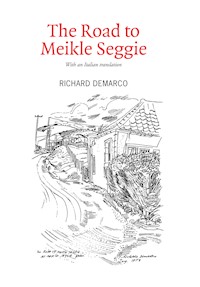
To travel the road to Meikle Seggie is to undertake any journey which offers unexpected opportunities for intellectual growth and self-discovery. In the 1970s, Richard Demarco embarked on a series of journeys, starting in Edinburgh, to recover a sense of our living culture in the environments around us. These radiated out across Europe, underpinning the internationalism of this unique Scottish-Italian artist's own extraordinary journey. Forty years later, the journey is renewed with this reproduction of Demarco's original artwork and his first Meikle Seggie essay, along with a new translation into Italian and a new introduction.
Das E-Book können Sie in Legimi-Apps oder einer beliebigen App lesen, die das folgende Format unterstützen:
Seitenzahl: 136
Veröffentlichungsjahr: 2020
Ähnliche



















RICHARD DEMARCO was born in Edinburgh in 1930. He is an artist and patron of the visual and performing arts. He has been one of Scotland’s most influential advocates for contemporary art through his work at the Richard Demarco Gallery and the Demarco European Art Foundation. He has attended every Edinburgh Festival since its inception in 1947, and he was a cofounder of the Traverse Theatre in Edinburgh in 1963. He is Professor Emeritus of European Cultural Studies at Kingston University, London.
DONALD SMITH was Director of the Netherbow Arts Centre in Edinburgh’s Old Town from 1982, and founding Director of the Scottish Storytelling Centre. He is a well-known author and storyteller, and a frequent cultural commentator on the changing face of contemporary Scotland.
SILVANA VITALE is an Edinburgh-based Italian translator with over 10 years’ experience and a solid academic background. Her previous translations include Ron Butlin’s The Sound of My Voice and Alexander Trocchi’s Young Adam.
RICHARD DEMARCO è nato a Edimburgo nel 1930. Artista e attivo patrocinatore delle arti visive e dello spettacolo, è stato uno dei più influenti sostenitori dell’arte contemporanea in Scozia, attraverso il suo lavoro alla Richard Demarco Gallery e alla Demarco European Art Foundation. Ha partecipato a ogni edizione del Festival di Edimburgo sin dalla prima edizione nel 1947 ed è stato cofondatore del Traverse Theatre di Edimburgo nel 1963. È Professore Emerito di Studi culturali europei della Kingston University, Londra.
DONALD SMITH è stato direttore del Netherbow Arts Centre, nella Old Town di Edimburgo, sin dal 1982, diventando successivamente fondatore dello Scottish Storytelling Centre. Autore e storyteller affermato, è una delle voci culturali più note sul tema del mutevole volto della Scozia contemporanea.
SILVANA VITALE è una traduttrice italiana con un’esperienza decennale e un solido background accademico. Tra i suoi lavori precedenti figurano le traduzioni italiane di Ron Butlin, Il Suono della Mia Voce e Alexander Trocchi, Giovane Adamo.
First published 1978
to coincide with an Exhibition of drawings by
Richard Demarco at the Henderson Gallery, Edinburgh
New edition 2015
ISBN: 978-1-908373-98-4 (hardback)
eISBN: 978-1-913025-97-7
The publishers acknowledge the support of
towards the publication of this volume.
The paper used in this book is recyclable. It is made
from low chlorine pulps produced in a low energy,
low emissions manner from renewable forests.
Printer and bound by
Martins the Printers, Berwick upon Tweed
Typeset in 12 point Quadraat by 3btype.com
The author’s right to be identified as author of this work under the Copyright, Designs and Patents Act 1988 has been asserted.
Artwork and text © Richard Demarco and the
Scottish Storytelling Forum, 1978, 2015
Italian translation by Silvana Vitale
Traduzione italiana a cura di Silvana Vitale
Contents
Acknowledgements
Foreword
Stefania Del Bravo
Richard Demarco – The Road Goes On
Donald Smith
Dedication
Introduction to The Road to Meikle Seggie (1978)
Thomas Wilson
THE ROAD TO MEIKLE SEGGIE
Richard Demarco
The Road to Meikle Seggie Begins in Edinburgh
The Road to Meikle Seggie Continues Through the Kingdom of Fife
The Road to Meikle Seggie within the Edinburgh Arts Journey Investigating the Cultural Origins of Europe
Postscript: The Road to Meikle Seggie, Sunday 7 April 1973
Italian Translation
Acknowledgements
The Scottish Storytelling Forum and Luath Press wish to acknowledge the co-operation and commitment of Richard Demarco and The Demarco European Art Foundation in the re-publication of this book, and in the accompanying exhibition. The artwork in this book combines some reproductions of drawings from the original catalogue of 1978, and images from Richard Demarco’s new suite of ‘Road to Meikle Seggie’ drawings and prints.
The Forum is also grateful to the European ‘Seeing Stories’ landscape narrative project for its assistance in the preparation of ‘The Road to Meikle Seggie’. ‘Seeing Stories’ is supported by the EU Cultural Programme, funded by the European Commission. The content of this book however reflects only the views of its author and editors, and the information and its use are not the responsibility of the European Commission or any other cited source, but of the Scottish Storytelling Forum.
The Scottish Storytelling Forum further acknow ledges the support of The Italian Institute, Edinburgh, in this project, especially its bi-lingual aspect. We are in particular grateful for the friendship and enthusiasm of the Institute’s Director, Stefania Del Bravo.
Foreword
As Director of the Italian Cultural Institute in Edinburgh, it is a real privilege for me to take an active part in this new edition of Richard Demarco’s The Road to Meikle Seggie which will also be translated into Italian.
The idea of a journey as the central experience of our lives, the spur for new experiences and discoveries, the search for a dialogue and interchange with ‘the other, the different from me’ are – I strongly believe – the deepest sense and message of any culture.
The same concept fruitful interaction is the core mission for people who – like me – are institutionally engaged in the promotion of culture, of my native culture.
That’s why I accepted with enthusiasm the invitation to be involved in this very special project and to support it.
Of course all my gratitude goes to the Edinburgh International Storytelling Festival and its Director Donald Smith for his idea – absolutely brilliant – to include an initiative focused on Richard Demarco’s book in the program of the Storytelling Festival 2014, and to the author of this unique book which – I am sure – will be enjoyed by a large public of readers in Scotland and Italy.
Stefania Del Bravo, Director, Italian Cultural Institute
Richard Demarco – The Road Goes On
Richard Demarco was born in Edinburgh in 1930. His parents were Italian immigrants to Scotland, his father from the small mountain village of Piciniso in Provincia Frosinone sixty miles south of Rome, in the world of St Benedict’s Abbey of Monte Cassino. His mother came via Bangor, County Town from Barga, a Tuscan hill town close to Lucca.
The family were part of a movement of people out of Italy in the late nineteenth and early twentieth century, which was to greatly enrich Scottish life. The Italian Scots were hardworking, community minded and endowed with more than their share of musical and artistic talent. The Demarcos prospered in Scotland, and their son Richard was in due course to benefit from an excellent education culminating in his studies in printmaking, illustration, typography and mural painting at Edinburgh College of Art.
At the same time Demarco’s childhood was overshadowed by the political difficulties in Italy leading to the rise of fascism, Mussolini’s dictatorship, and the World War II Axis against Britain. Italian youngsters were the butt of bullying at school, and on the outbreak of hostilities many Italian men were interned. One tragic outcome of this was the death of many of the Scottish internees when in 1940 the ship carrying them to Canada, the Arandora Star, was sunk by a German submarine. Many in the Edinburgh community were tragically affected including some Demarco relations.
The immediate Demarco family were fortunate that Carmino, Richard’s father, was not interned but nonetheless life became much harder. Carmino’s flourishing and stylish ‘Maison Demarco’ on Portobello Promenade had to close, and Richard himself was subjected to name calling, stone throwing and a nasty assault in the showers at Portobello Baths. These attacks combined anti-Italian sentiment with protestant sectarianism. Later, Richard was to recall his depression about Edinburgh and Scotland and his desire ‘to get the hell out’, to somewhere in which higher aspirations prevailed.
The postwar world by contrast was a welcome and exciting one for the young Richard Demarco. He was able to travel in Europe, going to Paris in 1949, and with his father to Rome in the Holy Year of 1950. These visits fed Demarco’s hunger for firsthand artistic experience, and nurtured his sense of a common European culture. All of this coincided with the emergence of the Edinburgh International Festival which began in 1947 with the conscious purpose of rebuilding the war ravaged continent’s sense of cultural unity. The Demarcos were enthusiastic supporters of this post war Risorgimento, and for Richard himself the Festival’s advent was life-changing. Europe had come afresh to Edinburgh offering inspiration and focus for the emergent artist. Demarco’s later passion for the Festival, and his angry critique of commercialised approaches to the arts, must be seen in the context of his formative self-discovery and renewal at this time.
Demarco’s upbringing was grounded in a strong ethos of family, religion and cultural tradition. This has remained important throughout his later career, though balanced by his quest for innovation and experiment. These things however need not be seen as opposites, since for Demarco the burgeoning artistic avant garde was itself part of Europe’s dynamic cultural renewal. His refusal for example to separate visual art from performance draws on his innate understanding of religious ritual in all its visual and dramatic dimensions, as well as his determination to foster radical artistic experiment in his home city. Richard Demarco was richly prepared for this personal path by his dual Italian and Celtic heritage. In conversation, Richard often brackets Italian Renaissance and Scottish Enlightenment as aspects of the same pan-European creative, intellectual and spiritual process.
Demarco was working as an art teacher at Duns Scotus Academy, when his breakthrough moment came with the emergence in the early sixties of the Traverse Theatre. The American cosmopolite Jim Haynes was the catalyst, on the back of the explosive Writers Conference in the 1962 Edinburgh Festival, but Demarco was a key fellow instigator and provided a visual arts dimension for the new venue. The Richard Demarco Gallery followed in 1966 as part of the ferment that was created by birthing the Edinburgh Festival’s internationalism in Edinburgh year round. To begin with the Gallery was physically part of the first Traverse, which was in St James Court off the Lawnmarket in the Royal Mile.
This location was significant for Richard Demarco as he sensed that art, not least that which emerged from collaboration across conventional boundaries, happens where there is an intense multi layered environment that has itself been the home of previous creative endeavour. This concept is another connection between the Italian context and Demarco’s Edinburgh. After a fruitful period in the New Town’s Melville Terrace, its first independent base, the Richard Demarco Gallery moved back to the Old Town. Here it took root in Monteith Close, near the medieval Netherbow Port which despite its 18th century demolition has left a honeycomb of lands, courts and closes around its original site. The Gallery was later located in nearby Jeffrey Street and subsequently in Blackfriars Street.
The Demarco Gallery had become in its turn a powerhouse of international exchange and artistic adventure. Beginning with his St Ives School and Italian art world contacts, Richard Demarco soon branched out across the continent, forging alliances with artists and curators south, east, west and north. As the steady output of exhibitions and projects grew, the Demarco network was to embrace other parts of the world as well. All of this was driven by the fixed resolve to establish an international art scene in the city, just as the Traverse had made it a centre of theatrical innovation. At the same time Demarco’s interest in the other arts also flourished with Festival programmes embracing music, drama and literature. Of the many outstanding figures that Richard Demarco brought to Edinburgh, Tadeusz Kantor, Paul Neagu and Joseph Beuys stand out because of their commitment to creating a totally immersive imaginative experience by defying conventional genre demarcation. Demarco was par excellence a creative entrepreneur without demarcation!
Richard Demarco has produced his own illustrated account of the Gallery’s initiatives and successive Festival programmes in Richard Demarco: A Life in Pictures (1995), which details the different locations and phases of its work. Yet this has not prevented popular misunderstanding of his overall purpose and achievement. For many Richard Demarco is defined by his inter national Festival programming, so ignoring his lifelong commitment to arts education and to the creative wellbeing of society as a whole.
To understand Richard Demarco better you must turn paradoxically to his most mysterious and personal artistic endeavour, ‘The Road to Meikle Seggie’, which began in the early seventies. By this time Demarco had been a transformational doer in Scottish culture for more than a decade. He had been multi-facetted and hugely energetic in connecting Scotland with the international arts scene. But this fresh impetus took a more reflective turn. Demarco embarked on a series of journeys with organised groups of artists and activists, which were in themselves a form of creative happening or exploration.
‘The Road to Meikle Seggie’ began in Edinburgh’s Old Town, moving into its rural environs, then into a wider Scotland, and finally ranging across Europe. Meikle Seggie was a remote farm steading on the western flank of the Ochil Hills, almost impossible to find and easily missed when one arrived. It was in a sense nowhere and everywhere. Nonetheless these journeys became the principal expression of a new Demarco venture in synthesis, Edinburgh Arts. This began in 1972 as a dynamic international summer school, not unlike the Summer Meetings inspired by Patrick Geddes during an earlier cultural revival in Edinburgh.
Writing in 1978, Richard Demarco gives his own account of the beginning of the journey, characteristically merging the precisely real with the fabulous or mythic.
In 1974 the preliminary approach to the world of Meikle Seggie was made around the sacred hill of King Arthur-Arthur’s Seat, ‘The Magic Mountain’. In 1975 as the Demarco Gallery had moved to the old medieval city, the journey actually began at the Gallery’s front door, at that part of the Old Town where the High Street joins the Canonagte, at that precise section where the City Gate stood marking ‘The World’s End’… The Meikle Seggie Road will only be found by those prepared to make proper use of all the signs and symbols which lie outside the front door of the Gallery, and particular attention should be paid to the existence of an ancient well, almost the first significant thing to be seen outside the Gallery’s entrance
Travelling ‘The Road to Meikle Seggie’ was about reconnecting the contemporary arts with the environment and with the culture layered through it, which was already the product of generations of human life. But Richard Demarco was also seeking to reshape ‘the arts’ in a wider non-metropolitan and spiritual crucible. ‘My instinct tells me to make drawings and paintings of the Road to Meikle Seggie,’ he writes, and the drawings made on these journeys are a remarkable legacy in their own right. But walking, seeing and drawing also inspired a significant commentary, as Demarco came to feel that these often ancient routes were simultaneously mythic and ordinary.
I can draw or paint the tangible and observable markers, tracks and trails they leave behind them when they travel in harmony with The Goddess, so my drawings are about what I see in the real world all around me. They are about the magic in all things we recognise as normal. They are not about the paranormal. They are about ordinary roads, and the ordinary things we see on roads – stone walls, farm gates, hedges, telegraph poles, signposts, wayside shrines, trees, grasses, plants, flowers and weeds and how the road moves forward incorporating all of these ‘normal’ things together with the ‘normal’ movements of animals and birds, and the wind and the weather they encounter and the movements of clouds and rain storms and shafts of sunlight. They are about ordinary houses and farm buildings, and in the villages and towns they are about paving stones and street corners, drainpipes, gutters, chimney pots, windows, doors, washing hanging out to dry, balconies and all forms of useful street furniture. The road does not concentrate on castles, palaces and cathedrals, or grand and historic buildings. It is governed more by small apparently insignificant details and hidden forces, by underground ‘blind’ springs and the ever changing movements of shorelines, rivers, and of moonrises and sunsets.




