


14,99 €
Mehr erfahren.
- Herausgeber: John Wiley & Sons
- Kategorie: Fachliteratur
- Sprache: Englisch
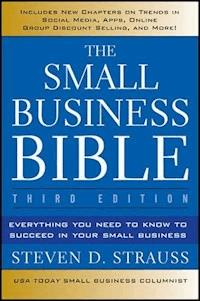
An updated third edition of the most comprehensive guide to small business success
Whether you're a novice entrepreneur or a seasoned pro, The Small Business Bible offers you everything you need to know to build and grow your dream business. It shows you what really works (and what doesn't!) and includes scores of tips, insider information, stories, and proven secrets of success. Even if you've run your own business for years, this handy guide keeps you up to date on the latest business and tech trends. This Third Edition includes entirely new chapters devoted to social media, mobility and apps, and new trends in online discounting and group buying that are vital to small business owners everywhere.
New chapters include:
- How to use Facebook, Twitter, and other social media tools to engage customers and potential stakeholders
- How to generate leads and win strategic partnerships with LinkedIn
- How to employ videos and YouTube to further your brand
- What you need to know about Groupon and group discount buying
- What mobile marketing can do for your business
Give your small business its best shot by understanding the best and latest small business strategies, especially in this transformative and volatile period. The Small Business Bible offers every bit of information you'll need to know to succeed.
Sie lesen das E-Book in den Legimi-Apps auf:
Seitenzahl: 797
Veröffentlichungsjahr: 2012
Ähnliche

















Contents
Cover
Praise for The Small Business Bible
Title Page
Copyright
About the Author
Acknowledgments
Preface
Section I: Starting Your Business
Part I: Genesis
Chapter 1: In the Beginning
Assessing Your Strengths
Risk Tolerance
The Next Step
Chapter 2: Choosing the Right Business
If You Do What You Love, Will the Money Really Follow?
In Love with Entrepreneurship
Chapter 3: Buying an Existing Business
First Steps
How Much Can You Expect to Make?
Business Valuation 101
Getting Ready to Close
Chapter 4: Understanding Your Potential Market
The Need for Market Research
Find a Need and Solve It
Is Your Idea Feasible?
Where to Find the Information You Need to Know
Putting It All Together
Chapter 5: Calculating Your Start-up Costs
Assumptions
Finding the Money
Chapter 6: Writing a Winning Business Plan
The Road Map
Business Plan Elements
The Bottom Line
Chapter 7: Structuring Your Business
Sole Proprietorships
Partnerships and Limited Partnerships
Corporations and the Limited Liability Company (LLC)
Chapter 8: Get Your Business Funded
The Usual Suspects
Credit Cards
The Friends and Family Plan
Banks and Credit Unions
The Four Cs
SBA Loans
Equity Financing
Angel Investors
Venture Capital
Dealing with Investors
Creative Financing
Chapter 9: Getting Help
Small Business Administration (SBA)
SCORE
Small Business Development Centers
Mentors
MrAllBiz.com, TheSelfEmployed.com, and Other Websites
Magazines and Television
Part II: Opening Up Shop
Chapter 10: Location, Location, Location
Not All Locations Are Created Equal
Negotiating the Lease
Important Lease Issues
Chapter 11: Branding 101
Brand New
Creating a Brand They'll Remember
Extending Your Brand
Branding Secrets
Chapter 12: Products and Inventory
It's All in the Buying
Finding the Right Suppliers
Meet the Reps
Inventory Control
Chapter 13: Savvy Pricing Strategies
The Psychology of Price
Gas War!
The Loss Leader
Part III: Franchises
Chapter 14: Selecting the Right Franchise
Franchise Basics
Researching the Franchise
Narrowing Your Choices
Fees
The Final Decision
Chapter 15: Secrets of Franchise Success
Survey Says
Other Factors
Part IV: Home-Based Businesses
Chapter 16: The Home-Based Business
Making the Decision
Taking the Plunge
Chapter 17: Successful Home-Based Business Strategies
Balancing Act
Growth Strategies
Get Paid What You Are Worth
Part V: Business on a Shoestring
Chapter 18: The Shoestring Entrepreneur
The Right Stuff
Other People's Money
Grand Opening
Inventory
Buying a Business with No Money Down
Chapter 19: Marketing on a Shoestring
The Shoestring Ground Rules
Major Media Methods
Print Techniques
Actions
Examples
Section II: Running Your Business
Part I: Small Business in the Twenty-First Century
Chapter 20: Our Flat World
Globalization and Small Business
The World Is Flat
Risks and Rewards in the New World
The World Entrepreneurship Forum
Succeeding in a Flat World
Chapter 21: The Green Business
Green Business Overview
Greening Your Business
Reduce Your Paper Consumption
Tapping the Green Marketplace
The Green Consumer
Chapter 22: The New Consumer
The Aging Boomer Consumer
Generations X and Y
Part II: Money
Chapter 23: Accounting Ease
Accounting Basics
Budgeting
Cash Flow
Hiring an Accountant
Chapter 24: Making a Profit
Computing Your Profitability
Pricing
Increasing Your Profit
Paying Yourself
Chapter 25: Insurance
Types of Insurance
Buying Insurance
Exclusions
Making a Claim
Chapter 26: Get a Handle on Taxes
Tax Basics
Tax Tips
Surviving an Audit
Part III: Management
Chapter 27: Hiring and Firing
Employee or Independent Contractor?
Hiring Employees
New Employees
Learning from New Employees
“It Just Isn't Working Out”
Chapter 28: Pay and Benefits
What Is Required?
Bonuses
Stock Options and Ownership
Other Retirement Plans
Health Insurance
Holidays, Sick Leave, and Vacation
Chapter 29: Training and Motivating Your Staff
Training
Motivation
Creating an Exceptional Culture
Chapter 30: Exemplary Customer Service
Customer Service
Dealing with Bad Customers
Chapter 31: Negotiate Like a Lawyer
Negotiation Strategies
Negotiation Tactics
Chapter 32: Legal-ase I
Contracts
Negligence and Liability
Product Liability
Intellectual Property
Chapter 33: Legal-ase II
Employment Discrimination
Sexual Harassment
Unfair Trade Practices
Finding a Good Attorney
Part IV: Technology
Chapter 34: Managing Your Technology
Top Tech Terms
Adopting New Technology
Security
Tech Support
Top Five Tech Mistakes
Chapter 35: Mobility I: Small Office Mobility
Mobility Basics
Your Wireless Network
Mobility Tools
Chapter 36: Mobility II: Mobile Mania
Getting Started
Running Your Business with Your Smartphone
Creating an App for Your Business
Mobile Marketing Campaigns
Chapter 37: Small Business Software
Office Suites
Business Contact Management Software
Tax Software
Accounting Software
Business Planning Software
Antivirus, Antispam, and Antispyware Software
Blogging Software
E-Commerce Solutions
Section III: Growing Your Business
Part I: Advertising and Marketing
Chapter 38: Basic Advertising Strategies
The Process
Brainstorming
Choosing the Right Medium
Creating a Winning Ad
Testing the Ad
Rolling It Out
Chapter 39: Marketing Muscle
Marketing Overview
The Marketing Plan
Tools You Can Use
Chapter 40: Advanced Marketing and Advertising
Advanced Marketing
Successful Advertising
Newspapers
Magazines
Radio
Television
Direct Mail
Creative Ad Placement
Part II: Your Website
Chapter 41: Creating Your Website
Preliminary Considerations
Creating your Site
A Few Last Tips
Chapter 42: E-Business Essentials
Search Engine Optimization
Understanding SEO
E-commerce Essentials
Drop Shipping
eBay
Chapter 43: Advanced E-Marketing
What Works Online?
Growth Strategies
Part III: Social Media
Chapter 44: Social Media Overview
Social Media Overview
Social Media Marketing
Chapter 45: Facebook for Business
Getting Started
How to Engage
Advertising on Facebook
Chapter 46: Twitter and You
Twitter 101
Chapter 47: Link in with LinkedIn
Chapter 48: Videos and YouTube
Six Ways to Use Video in Your Business and on Your Website
How to Create a Great Small Business Video
Video, YouTube, and Your Business
Videos and Search Engine Optimization
Chapter 49: Groupon and Other Deal-of-the-Day Websites
Overview
The Good News
The Bad News
Part IV: Growth Strategies
Chapter 50: Developing New Channels and Multiple Profit Centers
Preliminary Considerations
Multiple Profit Centers
Selling Your Product to Big Stores
Selling Your Service to Big Business
Chapter 51: Secrets of Sales Superstars
Sales Secrets
Even More Sales Secrets
Chapter 52: Small to Big
First, a Caveat
Going Big
Chapter 53: Exodus
Succession Planning
Selling Your Business
Bankruptcy
Part V: Strategies for Small Business Success
Chapter 54: Small Business Success Secrets
Swimming with the Big Fish
Breakthrough Companies
The System
Yes
Chapter 55: The Visionary Small Business
The Best Businesses
The Competitor Is You
Appendix A: How I Became an Entrepreneur
To Peter Clevenger, Wherever You Are
Appendix B: Sample Business Plan
Index
Praise for The Small Business Bible
“A true encyclopedia of all things you need to know about your small business. Keep it close!”
—Michael Gerber, Author of New York Times bestseller,The E-Myth and Chief Dreamer,In The Dreaming Room LLC
“The Small Business Bible is packed with extensive, relevant information for today's entrepreneurs. Steve has provided a comprehensive look at every facet of small business, including up-to-date research on technology, e-commerce, and other growth strategies. Rule #1 for every successful entrepreneur is to put this book on the shelf!”
—Phil Town, Author of #1 New York TimesBest-seller, Rule #1
“Excellent! Nothing was left out of this definitive guide on how to start and build a successful small business. Whether you are brand new to small business or a seasoned entrepreneur, you can learn something from this book!”
—Hector Barreto, Former Administrator of the Small BusinessAdministration and Chairman of The Latino Coalition
“You might read this book once, but you will reference it for years to come! Steve has done a wonderful job laying out what might otherwise be dry information in an easy-to-understand, lively format. Whatever your business, there is no shortage of actionable, useful ideas in this great book.”
—Barbara Corcoran, Founder, The Corcoran Group,and Today Show Contributor
“As the former president of three fast growth companies, I've learned what it takes to start and grow a small business. Steve Strauss' The Small Business Bible helps you understand what works and avoid what could be some ‘lessons learned the hard way.’ Whether you are starting or growing your business, The Small Business Bible is highly recommended!”
—Steve Little, The Business Growth Expert andAuthor of The 7 Irrefutable Rules of Small Business Growth
“Strauss has revamped his classic book with cutting-edge content—from how to green your business to utilizing technology to your advantage. This is a timely, practical, and readable resource!”
—Ken Yancey, Author, CEO of SCORE
“The Small Business Bible is required reading for any business owner looking to do things quicker and better. The Small Business Bible provides straightforward advice and profitable information for both the startup entrepreneur or the seasoned manager!”
—Gene Marks, Editor of Amazon's #1 Small Business Bestseller, The Streetwise Small Business Book of Lists
“Whenever Steve has appeared on our show, he has proven himself to be a knowledgeable, entertaining, lively, smart guest! His book has served as a great resource and I highly recommend this great compendium for anyone in the business of small business!”
—J. J. Ramberg, Host of MSNBC's Small Business Show,Your Business
Copyright©2012 by Steven D. Strauss. All rights reserved.
Published by John Wiley & Sons, Inc., Hoboken, New Jersey.
Published simultaneously in Canada.
No part of this publication may be reproduced, stored in a retrieval system, or transmitted in any form or by any means, electronic, mechanical, photocopying, recording, scanning, or otherwise, except as permitted under Section 107 or 108 of the 1976 United States Copyright Act, without either the prior written permission of the Publisher, or authorization through payment of the appropriate per-copy fee to the Copyright Clearance Center, Inc., 222 Rosewood Drive, Danvers, MA 01923, (978) 750-8400, fax (978) 646-8600, or on the web at www.copyright.com. Requests to the Publisher for permission should be addressed to the Permissions Department, John Wiley & Sons, Inc., 111 River Street, Hoboken, NJ 07030, (201) 748-6011, fax (201) 748-6008, or online at http://www.wiley.com/go/permissions.
Limit of Liability/Disclaimer of Warranty: While the publisher and author have used their best efforts in preparing this book, they make no representations or warranties with respect to the accuracy or completeness of the contents of this book and specifically disclaim any implied warranties of merchantability or fitness for a particular purpose. No warranty may be created or extended by sales representatives or written sales materials. The advice and strategies contained herein may not be suitable for your situation. You should consult with a professional where appropriate. Neither the publisher nor author shall be liable for any loss of profit or any other commercial damages, including but not limited to special, incidental, consequential, or other damages.
For general information on our other products and services or for technical support, please contact our Customer Care Department within the United States at (800) 762-2974, outside the United States at (317) 572-3993 or fax (317) 572-4002.
Wiley publishes in a variety of print and electronic formats and by print-on-demand. Some material included with standard print versions of this book may not be included in e-books or in print-ondemand. If this book refers to media such as a CD or DVD that is not included in the version you purchased, you may download this material at http://booksupport.wiley.com. For more information about Wiley products, visit www.wiley.com.
Library of Congress Cataloging-in-Publication Data:
Strauss, Steven D., 1958—
The small business bible: everything you need to know to succeed in your
small business / Steven D. Strauss. –3rd ed.
p. cm.
ISBN 978-1-118-13594-5 (pbk.); ISBN 978-1-118-22525-7 (ebk); ISBN 978-1-118-23877-6 (ebk);
ISBN 978-1-118-26339-6 (ebk)
1. Small business–United States–Management. 2. Small business–United States–Finance.
3. New business enterprises–United States. I. Title.
HD62.7.S875 2012
658.02 '2–dc23
2011042848
About the Author
Steven D. Strauss, often called “America's small business expert,” is an internationally recognized author, columnist, lawyer, and speaker. He is the senior small business columnist for USA TODAY and his column, Ask an Expert, is one of the most highly syndicated business columns in the world. Steve is a regular columnist for Yahoo!, SCORE, and many other sites, as well as being a popular blogger for the Huffington Post. He is also the author of 17 books.
A highly sought-after commentator and media guest, Steve has been on ABC, CNN, CNBC, Bloomberg Television, The O'Reilly Factor, and the BBC, among others. He often speaks to groups the world over, including a recent visit to the United Nations. He sits on the board of the World Entrepreneurship Forum and is also a speaker for the United States State Department, speaking in places such as the West Bank, South Korea, Bahrain, Japan, Mongolia, and Jordan. He is also often asked to be the small business spokesperson for companies that wish to reach the small business marketplace.
Finally, Steve is an entrepreneur. He is president of the Strauss Group, Inc., an interconnected group of businesses dedicated to offering cutting-edge content to everyone from small chambers of commerce to Fortune 100 corporations. Strauss Group generated blogs, columns, articles, videos, webinars, and more can be found both online and offline around the globe and, by being both informative and entertaining, are designed to be sticky. Steve's latest venture is the tech startup, TheSelfEmployed.com.
Steve graduated from UCLA, the Claremont Graduate School, and the McGeorge School of Law, and was a Coro Foundation Fellow in Public Affairs. If you would like to get in touch with him, have him speak to your group, or sign up for his free newsletter—Small Business Success Secrets!—please visit him at TheSelfEmployed.com.
Acknowledgments
I would first like to thank my excellent research assistant, Sydney. I would also like to thank my friends and editors at USA TODAY—Ray Goldbacher, Ed Brackett, and Matt Trott. As always, I am grateful to all of my pals at John Wiley & Sons for their support. Thank you also to my great brothers Larry and Bruddie. Finally, many, many thanks to my sweet wife, Maria, and my beloved girls, Jillian, Sydney, and Mara.
Preface
Starting, owning, and running a successful small business is one of the great joys in life. No, there are no guarantees, and yes, there are obstacles. But, if you do it right, if you start the right small business—one suited to your strengths, one that you are passionate about, one that epitomizes your highest dreams and values, and certainly one that allows you to make a nice profit—then there is no telling how far it can take you.
This book will show you how to get there.
But be forewarned: If what you are looking for is a book that will give you the underpinnings of small business theory and expository prose about business assumptions, this is the wrong book for you. Put it down. What you will get instead in these pages are tried-and-true, real-world business tips, skills, examples, and strategies that have been proven to help small businesses grow and that can help your small business grow. Written in a friendly, easy-to-understand manner, chock-full of interesting, actual examples, The Small Business Bible, Third Edition, contains everything you need to know to have a successful, fulfilling, profitable, and enjoyable entrepreneurial journey.
This third edition greatly expands and updates what was already a very comprehensive book. As we are living through a time when both work and business are changing rapidly, this book can be your guide to what might be some uncharted territory. In this third edition, you can learn what you need to know about important topics such as:
Social media marketing made easyTapping the growing use of smartphone and app technologyFacebook for businessGreen businessesE-commerce successMarketing and advertising todayCovering the simple to the complex, The Small Business Bible, Third Edition, allows you to easily and quickly get up to speed on any pertinent subject. Would you like to know how to create a memorable brand for your small business? It is in here. Unsure about small business accounting? Read on. Shoestring marketing? Yep, it is here, too. It is all here. The Small Business Bible covers everything you need to know, or might need to know, about starting or running a successful and enjoyable small business. It is not called The Small Business Bible for nothing.
As the longtime small business columnist for USA TODAY, I have the opportunity to interact with many small business owners. I hear their war stories and learn their secrets, and that is what I want to impart to you in this book: the best tips, hints, and ideas that I have come across. By helping you avoid mistakes, teaching you important and difference-making business strategies, and sharing what works, The Small Business Bible, Third Edition, is intended to be your one-stop shop for all things small business. If I have done my job right, yours just got easier because this book should become your indispensable business partner: a well-used, dog-eared friend that shows you the way. Thanks for taking it along with you on your entrepreneurial journey.
—Steve Strauss
Section I
Starting Your Business
Part I
Genesis
Chapter 1
In the Beginning
If one advances confidently in the direction of his dreams. . .he will meet with a success unexpected in common hours.
—Henry David Thoreau
It is a huge step. Deciding to go into business for yourself is one of the most important decisions you will make in your life. Ranking right up there with picking a partner and buying a home, becoming an entrepreneur is one of those life-altering events that will have repercussions for years to come. No, there are no guarantees, and yes, there will be obstacles. But do you know what? If you do it right, if you start the right small business—one that is suited to your strengths, one that you are passionate about, one that allows you to make a nice profit—then there is no telling how far you can go. John Nordstrom, founder of the eponymous department store, said of his roots, “I was not certain what I wanted to do. I started looking around for some small business to get into. Mr. Wallin the shoemaker suggested that we join a partnership and open a shoe store.”
Assessing Your Strengths
Not everyone is cut out to be an entrepreneur. Although there is a common perception that entrepreneurship is exciting, and indeed it is, many other words equally describe the life of the self-made small business person: nerve-wracking, liberating, difficult, challenging, time-consuming, overwhelming, fun, joyous, productive, uncertain—and that's just for starters. Any small business person could expand at length on any one of these adjectives, for all come into play to some degree or another in almost every small business, and often in the same day.
The question is not whether entrepreneurship is right for you, but rather, are you right for entrepreneurship? Can you handle the stress, the freedom, the lack of structure, the uncertainty, and the opportunity that await if you decide to start your own business? This really can't be stressed enough. There is no doubt that being in business for yourself can be great, but if you are not cut out for it temperamentally, it will be a tough road. There is no shame in this. Some people are artists and others are lawyers, some are athletes and others are homebodies, some are entrepreneurs and some are not.
Entrepreneur Defined
Various definitions of an entrepreneur:
Dictionary.com: “A person who organizes and manages any enterprise, esp. a business, usually with considerable initiative and risk.”The World Entrepreneurship Forum: “Creators of wealth and social justice.”One successful entrepreneur (and my favorite definition): “A person willing to take a risk with money to make money.”Which type of entrepreneur are you? To help you decide, take the following quiz. It will help you evaluate your qualifications. As you take the quiz, though, it is important to be perfectly honest. There is no point in answering the questions “right” if the answers are not true for you.
Test Your Entrepreneurship IQ
1. Are you a self-starter?
a. Yes, I like to think up ideas and implement them. (5 points)
b. If someone helps me get started, I will definitely follow through. (3 points)
c. Frankly, I would rather follow than lead. (1 point)
2. How do you feel about taking risks?
a. I really like the feeling of being on the edge a bit. (5 points)
b. Calculated risks are acceptable at times. (3 points)
c. I like the tried and true. (1 point)
3. Are you a leader?
a. Yes. (5 points)
b. Yes, when necessary. (3 points)
c. No, not really. (1 point)
4. Can you and your family live without a regular paycheck?
a. Yes, if that is what it takes. (5 points)
b. I would rather not, but I understand that may be part of the process. (3 points)
c. I do not like that idea at all. (1 point)
5. Could you fire someone who really needed the job your business provided?
a. Yes, I may not like it, but that's the way it goes sometimes. (5 points)
b. I hope so. (3 points)
c. I really can't see myself doing that. (1 point)
6. Are you willing to work 60 hours a week or more?
a. Yes, if that is what it takes. (5 points)
b. Maybe in the beginning. (3 points)
c. I think many other things are more important than work. (1 point)
7. Are you self-confident?
a. You bet! (5 points)
b. Most of the time. (3 points)
c. Unfortunately, that is not one of my strong suits. (1 point)
8. Can you live with uncertainty?
a. Yes. (5 points)
b. If I have to, but I don't like it. (3 points)
c. No, I like knowing what to expect. (1 point)
9. Once you put your mind to something, can you stick with it?
a. I do not let anything get in my way. (5 points)
b. Most of the time, if I like what I am doing. (3 points)
c. Not always. (1 point)
10. Are you creative?
a. Yes, I have a lot of good ideas. (5 points)
b. I can be. (3 points)
c. No, not really. (1 point)
11. Are you competitive?
a. To a fault. (5 points)
b. Sure, mostly. (3 points)
c. Not really, my nature is more laid back. (1 point)
12. Do you have a lot of willpower and self-discipline?
a. Yes. (5 points)
b. I am disciplined when I need to be. (3 points)
c. Not really. (1 point)
13. Are you individualistic, or would you rather go along with the crowd?
a. I like to think things through myself and do things my way. (5 points)
b. I am sometimes an original. (3 points)
c. I think strongly individualistic people are a bit strange. (1 point)
14. Can you live without structure?
a. Yes. (5 points)
b. Actually, the idea of living without a regular job makes me nervous. (3 points)
c. No, I like routine and structure in my life. (1 point)
15. Do you have many business skills?
a. Yes, I do, and those I don't have, I'll learn. (5 points)
b. I have some. (3 points)
c. No, not really. (1 point)
16. Are you flexible and willing to change course when things are not going your way?
a. Yes. (5 points)
b. I like to think so, but others may disagree. (3 points)
c. No, I have a fairly rigid personality. (1 point)
17. Do you have experience in the business you are thinking of starting?
a. Yes. (5 points)
b. Some. (3 points)
c. No. (1 point)
18. Could you competently perform multiple business tasks: accounting, sales, marketing, and so on?
a. I sure would like to try! (5 points)
b. I hope so. (3 points)
c. That sounds intimidating. (1 point)
19. Can you juggle multiple tasks?
a. Yes. (5 points)
b. I think so. (3 points)
c. I don't think so. (1 point)
20. Are you willing to hustle for clients and customers?
a. Sure. (5 points)
b. If I have to. (3 points)
c. I would rather not. (1 point)
21. How well do you handle pressure?
a. Quite well. (5 points)
b. It's not my strongest trait, but I can do it. (3 points)
c. Not well at all. (1 point)
Scoring
80–100: You have both the temperament and the skills to become an entrepreneur.
60–79: You are not a natural entrepreneur but may become one over time.
Below 60: You would be wise to think of another career besides self-employment.
So there you have it. Not only should this quiz help you understand your Entrepreneurship IQ, but also it should give you some insight into the traits and characteristics of a successful, self-employed businessperson: driven, hardworking, creative, energetic, resourceful, confident, and flexible.
Steve Jobs on Entrepreneurs
“I'm convinced that about half of what separates the successful entrepreneurs from the nonsuccessful ones is pure perseverance.”
If this describes you (or a close approximation of you), then the next question is, where do you go from here?
Risk Tolerance
The quiz that you just took was intended to help you gauge your Entrepreneurship IQ, as well as to show you the traits required to start your own small business. Yes, you will need some business savvy and self-confidence—that's a given. Being creative and hardworking are equally important. But of all the necessary traits, the one that you must have in abundance is a tolerance for risk, because starting your own small business is a risk.
Borrowing money, setting up shop, trying out new ideas—these are all tasks that, although fun and exciting, are also inherently risky. There are no guarantees that your idea or plan will fly. Certainly the goal of this book is to make sure it does, but no matter how much you study and learn, there will always be an element of risk in being an entrepreneur. Would you have it any other way? If your answer is “no,” then you definitely have the right stuff. If it is not, if the idea of taking a big risk scares you more than it excites you, then you need to consider carefully whether starting your own business is the best choice for you.
Throughout this book, I will be sharing with you the traits of exceptional small businesses so that you can see what the best of the best do. Here is the first one, and it is good news: great small businesses work to reduce their risk as much as possible. They work at covering every angle so that the risks they take are prudent, calculated risks. Here are a few ways to minimize risk:
Know your numbers. I can't tell you how many entrepreneurs I meet who are in over their heads because they had some idea or whim and dropped a bundle of money on an idea that was not fully vetted. A few years ago, I was involved in an enterprise in which one of the guys decided unilaterally, and impulsively, that the best thing the business could do was to commit to an ad campaign in a major magazine. The campaign was a bust, and the business was stuck with almost $50,000 in advertising debt. Look before you leap.Do your homework. Do your research. Test the waters. Think it through. Consider worst-case scenarios. Thoroughly analyzing an opportunity or idea before implementing it lessens the chance of investing too much time or money in a bad idea.Incorporate. If things go south, the corporate shield that protects your personal assets from corporate debts will make a huge difference. If you do not run your business as a corporation or an LLC (limited liability company), you put your personal assets at risk.Have enough insurance. Just as incorporating reduces your personal risk, so, too, does having adequate insurance.Bring in help. As entrepreneurs, we like to think we know it all, but we don't. Whether it's hiring someone to free up time for you to do what you do best, bringing in a strategic partner with contacts you don't have, or hiring consultants to figure out how you can improve, getting expert help reduces your risk and makes your life easier.The upshot of all of this is that great entrepreneurs know their strengths and weaknesses, think ahead, and plan accordingly. That is what you will need to do, too, if you start your own small business—take a prudent, calculated, intelligent risk with a high likelihood of payoff. Just know that risk, even when it is reduced, will still be present because it is the nature of the game.
Risks
“The policy of being too cautious is the greatest risk of all.
”—Jawaharlal Nehru
The Next Step
Sometimes the idea of starting your own business can be overwhelming. What kind of business should you start? Where will you get the money? How will you find customers? These are all legitimate concerns, and they will be addressed in detail in this book. At this point, however, understand that as you drive down the street, almost every business you see is a small business that is run by someone who, at some point, had never run a business before. But those business owners learned how, found the money, found some customers, and are still around. If they did it, so can you. To join their ranks, you must be willing to do your homework.
Education
The next step is to educate yourself. Most people go into business because they love something and want to do it every day: the baker wants to own her own bakery, the chiropractor wants to start his own practice, and so on. The problem the baker and the chiropractor have is that, although they may know a lot about baking and backs, if they are like most entrepreneurs, they know little about businesses and boardrooms. They may know their specialties, but they do not know everything else that it takes to start and run a successful business. And, problematically, that “everything else” will take up a lot of their time. Marketing and advertising, sales and income taxes, hiring and firing, and so on, have nothing whatsoever to do with baking and backs.
The next step, then, is to learn about business in general. Certainly this book will be enormously helpful, and down the road, you will see that nothing beats the trial and error of actually running your own venture. But before you can get to that point, you need to have a general idea of how businesses operate.
Small Business Sites
These sites can teach you a lot about small business:
www.usatoday.com/money/smallbusiness/front.htmSmall Business Online CommunityHuffington Post Small Businesswww.TheSelfEmployed.comBusiness Insiderwww.SBA.govwww.SCORE.orgBusiness on Mainwww.MrAllBiz.comEven if you passed the Entrepreneur IQ quiz with flying colors, it is probably safe to assume that, although you may have an entrepreneurial bent, you do not know everything you need to know to become successful—which is true for most self-employed people. Therefore, you should begin to brush up on both the subjects that seem interesting to you and the ones that scare you. If finances are not your strong suit, then dig in. As a small business owner, you will inevitably wear many hats. It is not uncommon, especially at the beginning, for the founder of a company to be the president, accountant, marketing wizard, and sales force, all rolled into one. For that reason, it helps to have a broad understanding of what it takes to run a business.
It would also be smart to start reading some business magazines every month. Periodicals such as Home Business magazine, Entrepreneur, and Inc. are chock-full of easy-to-understand articles that will help make you a success.
Free Help!
I would like to really encourage you to check out my website—MrAllBiz.com. There we have all sorts of tools dedicated to helping you succeed in your entrepreneurial journey—everything from courses and CDs to webinars and free e-newsletters.
Experience
Finally, no education would be complete without some practical, hands-on experience. This can take two forms. First, say you want to open an antiques store. You would be wise to start by working at someone else's. If you already have that sort of hands-on experience in your chosen industry, then skip the rest of this paragraph. But if you have never actually worked in a business like the one you want to start, you are strongly advised to do just that. Your entrepreneurial dream can wait six months while you gain the sort of experience that will make or break your new business. Working in a business like the one you want to create will teach you things that no book could impart. It is a critical step.
Second, you need to talk to some business owners in your desired field. But remember, if you seek out entrepreneurs in your potential industry in your own town, the going may be tough—they will likely view you as a potential competitor (rightly so) and thus be reluctant to share their insights with you. Therefore, it would be much smarter to go to a nearby town, find a few businesses similar to the one you want to start, take the owners out to lunch, and pick their brains. People love to talk about themselves. Find out everything you can about their businesses:
What do they like most about their business?What do they like least?What was the start-up cost?How much can you expect to make?Where do they advertise?If they were starting over, what would they do differently?No one knows this business (whatever it is) like the owners do. You would be hard-pressed to find better, more pertinent information than the insights you can get from these small business owners, who are already doing what it is you dream of doing.
This informal “MBA” can reap tremendous benefits. By the time you are ready to start your business, you will have a thorough understanding of the risks and rewards of the area you are getting into. Doing this initial research will take time, for sure, but if you follow this plan, you can be assured that when you finally open your doors, you will have reduced your risk as much as possible, and thus your chances of success will be much greater.
Chapter 2
Choosing the Right Business
The road to happiness lies in two simple principles: Find what it is that interests you and that you can do well, and when you find it, put your whole soul into it—every bit of energy and ambition and natural ability you have.
—John D. Rockefeller III
When it comes to choosing a small business, there are two types of entrepreneurs. The first is the person who is in love with the idea of starting a very specific business. This person may be a gardener who envisions opening a nursery or a chef who has long dreamed of owning a restaurant. The other potential small business person is someone who is also in love, not with a specific business but with the idea of being his or her own boss. As there are risks and rewards associated with each path, both warrant further discussion.
If You Do What You Love, Will the Money Really Follow?
There is a saying that goes, “Do what you love; the money will follow.” Although this is noble and possibly true, there is more to small business success than simply doing what you love. Don't get me wrong. Doing what you love is indeed the first prerequisite when choosing the right business, but it is just that—a first step.
Live with Passion
What is it that you love? In life, we tend to succeed and perform well when we are engaged in something that we really enjoy. Your business should be no different. Richard Branson did not start Virgin Music because he thought that music would be profitable but because he loved it.
Lesen Sie weiter in der vollständigen Ausgabe!
Lesen Sie weiter in der vollständigen Ausgabe!
Lesen Sie weiter in der vollständigen Ausgabe!
Lesen Sie weiter in der vollständigen Ausgabe!
Lesen Sie weiter in der vollständigen Ausgabe!
Lesen Sie weiter in der vollständigen Ausgabe!
Lesen Sie weiter in der vollständigen Ausgabe!
Lesen Sie weiter in der vollständigen Ausgabe!
Lesen Sie weiter in der vollständigen Ausgabe!
Lesen Sie weiter in der vollständigen Ausgabe!
Lesen Sie weiter in der vollständigen Ausgabe!
Lesen Sie weiter in der vollständigen Ausgabe!
Lesen Sie weiter in der vollständigen Ausgabe!
Lesen Sie weiter in der vollständigen Ausgabe!
Lesen Sie weiter in der vollständigen Ausgabe!
Lesen Sie weiter in der vollständigen Ausgabe!
Lesen Sie weiter in der vollständigen Ausgabe!
Lesen Sie weiter in der vollständigen Ausgabe!
Lesen Sie weiter in der vollständigen Ausgabe!
Lesen Sie weiter in der vollständigen Ausgabe!
Lesen Sie weiter in der vollständigen Ausgabe!
Lesen Sie weiter in der vollständigen Ausgabe!
Lesen Sie weiter in der vollständigen Ausgabe!
Lesen Sie weiter in der vollständigen Ausgabe!
Lesen Sie weiter in der vollständigen Ausgabe!
Lesen Sie weiter in der vollständigen Ausgabe!
Lesen Sie weiter in der vollständigen Ausgabe!
Lesen Sie weiter in der vollständigen Ausgabe!
Lesen Sie weiter in der vollständigen Ausgabe!
Lesen Sie weiter in der vollständigen Ausgabe!
Lesen Sie weiter in der vollständigen Ausgabe!
Lesen Sie weiter in der vollständigen Ausgabe!
Lesen Sie weiter in der vollständigen Ausgabe!
Lesen Sie weiter in der vollständigen Ausgabe!
Lesen Sie weiter in der vollständigen Ausgabe!
Lesen Sie weiter in der vollständigen Ausgabe!
Lesen Sie weiter in der vollständigen Ausgabe!
Lesen Sie weiter in der vollständigen Ausgabe!
Lesen Sie weiter in der vollständigen Ausgabe!
Lesen Sie weiter in der vollständigen Ausgabe!
Lesen Sie weiter in der vollständigen Ausgabe!
Lesen Sie weiter in der vollständigen Ausgabe!
Lesen Sie weiter in der vollständigen Ausgabe!
Lesen Sie weiter in der vollständigen Ausgabe!
Lesen Sie weiter in der vollständigen Ausgabe!
Lesen Sie weiter in der vollständigen Ausgabe!
Lesen Sie weiter in der vollständigen Ausgabe!
Lesen Sie weiter in der vollständigen Ausgabe!
Lesen Sie weiter in der vollständigen Ausgabe!
Lesen Sie weiter in der vollständigen Ausgabe!
Lesen Sie weiter in der vollständigen Ausgabe!
Lesen Sie weiter in der vollständigen Ausgabe!
Lesen Sie weiter in der vollständigen Ausgabe!
Lesen Sie weiter in der vollständigen Ausgabe!
Lesen Sie weiter in der vollständigen Ausgabe!
Lesen Sie weiter in der vollständigen Ausgabe!
Lesen Sie weiter in der vollständigen Ausgabe!
Lesen Sie weiter in der vollständigen Ausgabe!
Lesen Sie weiter in der vollständigen Ausgabe!
Lesen Sie weiter in der vollständigen Ausgabe!
Lesen Sie weiter in der vollständigen Ausgabe!
Lesen Sie weiter in der vollständigen Ausgabe!
Lesen Sie weiter in der vollständigen Ausgabe!
Lesen Sie weiter in der vollständigen Ausgabe!
Lesen Sie weiter in der vollständigen Ausgabe!
Lesen Sie weiter in der vollständigen Ausgabe!
Lesen Sie weiter in der vollständigen Ausgabe!
Lesen Sie weiter in der vollständigen Ausgabe!
Lesen Sie weiter in der vollständigen Ausgabe!
Lesen Sie weiter in der vollständigen Ausgabe!
Lesen Sie weiter in der vollständigen Ausgabe!




