


24,30 €
Mehr erfahren.
- Herausgeber: John Wiley & Sons
- Kategorie: Geisteswissenschaft
- Sprache: Englisch
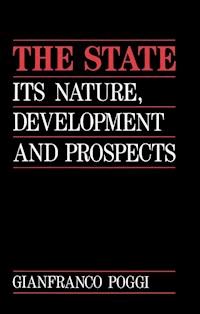
This book offers a fresh, accessible and original interpretation of the modern state, concentrating particularly on the emergence and nature of democracy.
Poggi presents an extensive conceptual portrait of the state, distinguishing its early characteristics from those which have developed subsequently and are apparent in contemporary states. He reviews the 'historical career' of the state, from the dissolution of feudal forms of rule to the advent of modern, liberal-democratic systems. Poggi also discusses the nature of liberal-democratic regimes, and the distinctive features of the Soviet one-party system. Finally, the chapter discusses the challenges set to the state by contemporary developments in military affairs, in the international economy, and in the ecological sphere.
Sie lesen das E-Book in den Legimi-Apps auf:
Seitenzahl: 442
Veröffentlichungsjahr: 2013
Ähnliche




















The State
Its Nature, Development and Prospects
Gianfranco Poggi
Polity Press
Copyright © Gianfranco Poggi 1990
First published 1990 by Polity Pressin association with Basil Blackwell
Reprinted 2004, 2007
Polity Press65 Bridge StreetCambridge, CB2 1UR, UK
Polity Press350 Main StreetMalden, MA 02148, USA
All rights reserved. Except for the quotation of short passages for the purposes of criticism and review, no part of this publication may be reproduced, stored in a retrieval system, or transmitted, in any form or by any means, electronic, mechanical, photocopying, recording or otherwise, without the prior permission of the publisher.
Except in the United States of America, this book is sold subject to the condition that it shall not, by way of trade or otherwise, be lent, re-sold, hired out, or otherwise circulated without the publisher’s prior consent in any form of binding or cover other than that in which it is published and without a similar condition including this condition being imposed on the subsequent purchaser.
ISBN: 978-0-7456-6819-2 (Multi-user ebook)
British Library Cataloguing in Publication DataA CIP catalogue record for this book is available from the British Library.
Typeset in 10 on 12pt Timesby Colset Private LimitedPrinted and bound in Great Britain by Marston Book Services Limited, Oxford
For further information on Polity, visit our website: www.polity.co.uk
To the teachers, students and secretariesin Tom Burns’s Departmentat Edinburgh University, 1964–1988
Contents
Preface
PART I
1 Social Power and its Political Form
2 The Nature of the Modern State
3 The Development of the Modern State (1)
4 The Development of the Modern State (2)
5 Controversies about the State: Attempting an Appraisal
6 Controversies about the State: Attempting an Explanation
PART II
7 Liberal Democracy in the Twentieth Century (1)
8 Liberal Democracy in the Twentieth Century (2)
9 A New Type of State
10 Contemporary Challenges to the State
Notes
Index
Preface
Over ten years ago I published The development of the modern state (Stanford, 1978). That book is still in print, and I hope it will remain so, for the one the reader is now holding is a new and different book.
As its subtitle indicates, it reconsiders the question of how the state came to be and attained its contemporary form(s); but whereas my treatment of that question accounted for most of the previous book, it is now treated only in chapters 3 and 4; and, while the two books share a typological approach to that theme, they conduct somewhat different arguments.
As to the rest of this book, it mostly deals with topics not discussed in the previous one. I start from the notion that there exists a plurality of forms of social power, one of which – political power – constitutes the institutional content of the notion of the state itself (chapters 1 and 2). After reviewing the ‘story’ of the state, I confront the question of how one might evaluate it and explain it (chapters 5 and 6). My treatment of the contemporary liberal-democratic state is more extensive in this than in the previous book, and considers different aspects of this topic (chapters 7 and 8). In chapter 9 I offer a summary discussion of the communist party-state, which Development had not even mentioned – a discussion made rather more tentative by the fact that between the time I first drafted it and the time I wrote its final version, the Soviet and East European political scene witnessed unforeseen developments of great significance. I mention these, but do not even seek to suggest what their final import might be. Finally, my last chapter presents a number of arguments to the effect that ‘the state of the state’ is not a healthy one today, but ends up with a timid two cheers for the old beast.
As has been the case with all my previous books, this one has also arisen out of my teaching practice, for its content has been developed within courses I have taught at the University of Sydney in 1984, at the University of Edinburgh in 1986, and at the University of Virginia in 1989. I thus owe a great deal to the audiences of those courses for the contributions they made to my thinking on my subject.
Desmond King, a colleague at Edinburgh, read drafts of all the first few chapters and offered a number of helpful criticisms on them. Other such criticisms have been offered by John Meyer, of Stanford University, and by my old friend Beppe Di Palma, of the University of California (Berkeley). Victor Zaslavsky’s comments on my chapter on the Soviet party-state put me further in his debt. Tony Giddens followed the progress of my writing patiently – for the manuscript took much longer to write than either he or I expected – and commented thoughtfully on successive drafts. Both my daughter and my wife read the penultimate version of the book and sought to improve the final one.
I am very grateful to the Center for Advanced Study in the Behavioral Sciences, of which I am currently a Fellow, for allowing me to complete this book in a most supportive and friendly setting; and to the Center for Advanced Study of the University of Virginia for the financial support provided by the National Science Foundation under grant BNS87-00864.
Center for Advanced Study in the Behavioral Sciences,Stanford, California1 December 1989
Part I
1
Social Power and its Political Form
I
What is social power?
Our effort to understand ‘the modern state’ may begin with a brief discussion of a much wider, more basic concept – that of social power. Unfortunately, this not a matter of starting out from a notion that is simple and unproblematic; on the contrary, ‘social power’, and indeed ‘power’ itself, are also complex and controversial notions.1 We may, however, disregard the attendant complexities and controversies, and seek to convey straightforwardly the universally significant, raw phenomenon, to which the notion of social power points.
That is: in all societies, some people clearly and consistently appear more capable than others of pursuing their own objectives; and if these are incompatible with those envisaged by others, the former manage somehow to ignore or override the latter’s preferences. Indeed, they are often able to mobilise, in the pursuit of their own ends, the others’ energies, even against their will. This, when all is said and done, is what social power is all about.
Yet we may feel that we are going overboard in our willingness to accept a rough-and-ready understanding of the phenomenon in question; that, in particular, the word ‘somehow’, used above, is too generic to be of much use. We might then seek to differentiate somewhat the notion of social power, by asking ourselves how, on what grounds, the favoured people manage the feat in question.
Three forms of social power
We might give first, again, a generic answer, to the effect that social power rests on the possession by those people of some resources which they can use to have their own way with others. Our question then becomes – what are these resources?
Most answers to this question2 (in this formulation or others) end up by distinguishing three forms of social power. Here, for instance, is the version of this distinction offered by the Italian political philospher Bobbio:
We may classify the various forms of power by reference to the facilities the active subject employs in order to lay boundaries around the conduct of the passive subject … We can then distinguish three main classes of power: economic, ideological and political. Economic power avails itself of the possession of certain goods, rare or held to be rare, in order to lead those not possessing them to adopt a certain conduct, which generally consists in carrying our a certain form of labour … Ideological power is based upon the fact that ideas of a certain nature, formulated … by persons endowed with a certain authority, put abroad in a certain manner, may also exert an influence upon the conduct of associated individuals … Political power, finally, is grounded in the possession of facilities (weapons of all kinds and degrees of potency) by means of which physical violence may be exerted. It is coercive power in the strict sense of the term.3
Except for characterising as ‘normative’ the form of power Bobbio labels ‘ideological’ – a term which is too laden with potentially misleading connotations – I subscribe to this tripartite distinction.
The role of coercion
The state, our object of concern throughout this book, is a phenomenon principally and emphatically located within the sphere of political power. Thus we may from now on in this chapter, limit ourselves to this form of social power – and notice how Bobbio’s definition of it (but not only Bobbio’s) connects it, starkly and perhaps shockingly, with weapons, violence, coercion. Shockingly, I suggest, because on the strength of this definition the bandit, who makes people hand over their possessions at gunpoint, may appear as the prototypical political figure.
A bandit, however, normally threatens, and thus has his way with, a few individuals, for a strictly limited time, and can compel them to perform only few, narrowly circumscribed activities. If we concern ourselves instead with manifestations of power which affect larger numbers of people, encompass a large range of activities (and inactivities) and do so for longer periods of time, this disqualifies the bandit from consideration. It does not, however, exclude the reference of the phenomena we are concerned with to violence and coercion; at most, we might say, we can redefine the prototypical political figure as not so much a bandit as a warrior, availing himself of the military superiority he and his retinue enjoy over an unarmed, military ineffective population, not just to terrorise the latter but to rule over it.
Lesen Sie weiter in der vollständigen Ausgabe!
Lesen Sie weiter in der vollständigen Ausgabe!
Lesen Sie weiter in der vollständigen Ausgabe!
Lesen Sie weiter in der vollständigen Ausgabe!
Lesen Sie weiter in der vollständigen Ausgabe!
Lesen Sie weiter in der vollständigen Ausgabe!
Lesen Sie weiter in der vollständigen Ausgabe!
Lesen Sie weiter in der vollständigen Ausgabe!
Lesen Sie weiter in der vollständigen Ausgabe!
Lesen Sie weiter in der vollständigen Ausgabe!
Lesen Sie weiter in der vollständigen Ausgabe!
Lesen Sie weiter in der vollständigen Ausgabe!




