


17,99 €
Mehr erfahren.
- Herausgeber: John Wiley & Sons
- Kategorie: Fachliteratur
- Sprache: Englisch
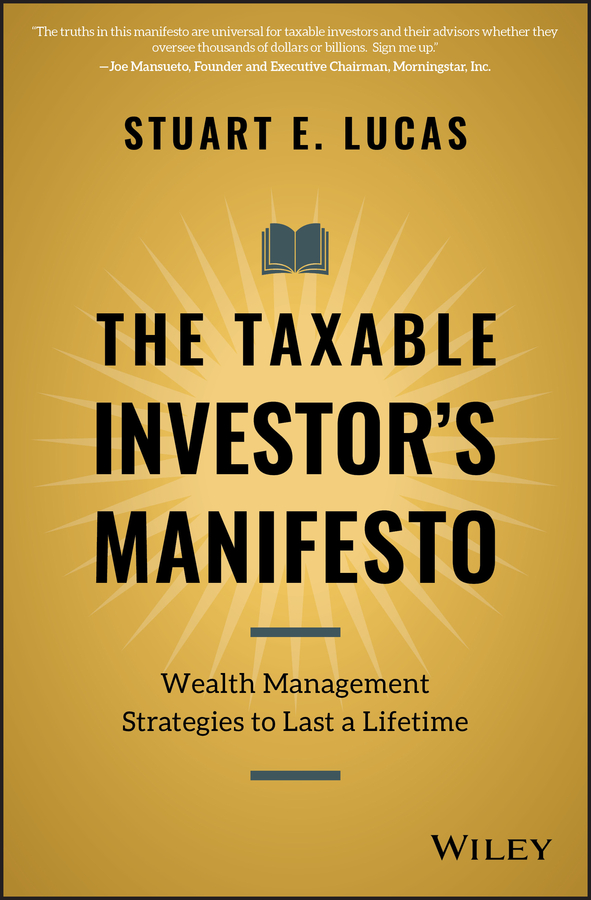
The Taxable Investor's Manifesto: Wealth Management Strategies to Last a Lifetime is written for every investor with taxable wealth and every advisor who serves them. The Taxable Investor's Manifesto guides readers through a series of related topics, bringing clarity to complexity with an economy of words, while providing valuable and actionable advice at every turn. This remarkable book combines the deep industry knowledge of a seasoned practitioner with the communication skills of a leading educator. Author Stuart E. Lucas is the founder and Chief Investment Officer of Wealth Strategist Partners, a firm that advises complex family enterprises, including his own. He also co-founded the University of Chicago's Private Wealth Management program, now in its fourteenth year. Most investment books only address pre-tax headline returns, but individuals pay taxes. The incentives and disincentives of our tax system can have a dramatic impact on actual investment time horizons and returns. The Manifesto sensibly folds tax incentives into investment strategy in ways that can add profound value over a lifetime to actual results. It includes guidance on: * How to keep a greater percentage of your profits with a higher probability of success and less effort * Why it's important to manage the intersection of investment, tax and estate planning * How to compete for better long-term investment returns against tax-exempt investors. Whether you're a young professional or entrepreneur, a mid-career manager, a senior business executive, or a retiree this book will give you tools to enhance your net worth considerably. If you are an advisor, studying and implementing Lucas's advice will strengthen your business and make your clients happier.
Sie lesen das E-Book in den Legimi-Apps auf:
Seitenzahl: 235
Veröffentlichungsjahr: 2020
Ähnliche


















Table of Contents
Cover
About the Author
Acknowledgments
Introduction
CHAPTER ONE: Taxable Investors Need to Think Differently
KEY CHAPTER TAKEAWAYS
CHAPTER TWO: Diversify at the Right Time and in the Right Way
KEY CHAPTER TAKEAWAYS
CHAPTER THREE: Generate Value from That Magical Liability: Deferred Tax
ALTERNATIVES TO SELLING
KEY CHAPTER TAKEAWAYS
CHAPTER FOUR: If You Want Wealth to Grow, Own Stocks
OVER TIME, STOCKS OUTPERFORM BONDS
GEOGRAPHIC DIVERSIFICATION
MANAGING SHORT-TERM VOLATILITY
ASSET LOCATION: TAXABLE, TAX-DEFERRED, OR TAX-EXEMPT?
KEY CHAPTER TAKEAWAYS
CHAPTER FIVE: Lengthen Time Horizon to Lower Risk and Enhance Returns
KEY CHAPTER TAKEAWAYS
CHAPTER SIX: Control Cash Flow to Perpetuate Purchasing Power
KEY CHAPTER TAKEAWAYS
CHAPTER SEVEN: Don't Be Misled by Performance
KEY CHAPTER TAKEAWAYS
CHAPTER EIGHT: Get Value from Active Management
TACTICS FOR IMPROVING SUCCESS WITH ACTIVE MANAGERS
KEY CHAPTER TAKEAWAYS
CHAPTER NINE: Approach Alternative Investments with Skill and Skepticism, or Not at All
HEDGE FUNDS ARE RARELY GOOD FOR TAXABLE INVESTORS
PRIVATE EQUITY AND VENTURE MAY BE BETTER
SCALE, STRUCTURE, AND TAX ARE IMPORTANT CONSIDERATIONS
ARE YOU PREPARED TO INVEST?
KEY CHAPTER TAKEAWAYS
CHAPTER TEN: Plan Your Estate: It Adds More Value Than Investing
KEY CHAPTER TAKEAWAYS
CHAPTER ELEVEN: Shift from Success to Significance
KEY CHAPTER TAKEAWAYS
CHAPTER TWELVE: Reinforce Positive Family Culture through Financial Design
KEY CHAPTER TAKEAWAYS
CHAPTER THIRTEEN: Evaluate the Risks to This Approach
KEY CHAPTER TAKEAWAYS
CHAPTER FOURTEEN: Select an Advisor with Strong Investment Skills, an Interdisciplinary Approach, and a Fiduciary Mindset
KEY CHAPTER TAKEAWAYS
APPENDIX Additional Books about Taxable Investing
Index
End User License Agreement
List of Illustrations
Chapter 1
FIGURE 1.1 A
FRAMEWORK
FOR
TAXABLE
INVESTING
.
Chapter 3
FIGURE 3.2
TO
SELL
OR
TO
HOLD
?
Chapter 4
FIGURE 4.2
LONG
-
TERM
ROLLING
REAL
RETURNS
FOR
STOCKS
AND
BONDS
.
Chapter 5
FIGURE 5.1
THE
EFFECT
OF
TIME
HORIZON
ON
STANDARD
DEVIATION
OF
REAL
RETURN
.
Chapter 7
FIGURE 7.1
GROWTH
OF
$100,
JANUARY
1, 1999,
TO
December 31, 2018.
Chapter 8
FIGURE 8.1
CONCEPTUAL
FRAMEWORK
OF
THE
RELATIONSHIP
BETWEEN
TRACKING
ERROR
A
...
FIGURE 8.2
SCREENING
MATRIX
FOR
TAXABLE
EQUITY
MANAGERS
.
Chapter 10
FIGURE 10.1
CREATE
VALUE
AT
THE
INTERSECTIONS
.
Guide
Cover
Table of Contents
Begin Reading
Pages
ii
iii
iv
v
vii
viii
xi
xiii
xiv
xv
xvii
xviii
xix
xx
xxi
xxii
xxiii
xxiv
1
2
3
4
5
6
7
9
10
11
12
13
14
15
17
18
19
20
21
22
23
24
25
26
27
28
29
30
31
32
33
34
35
36
37
39
40
41
42
43
44
45
46
47
49
50
51
52
53
54
55
56
57
58
59
60
61
62
63
65
66
67
68
69
70
71
72
73
74
75
76
77
79
80
81
82
83
84
85
86
87
89
90
91
92
93
94
95
96
97
99
100
101
102
103
104
105
106
107
108
109
111
112
113
114
115
116
117
118
119
120
121
122
123
124
125
126
127
128
129
130
131
132
133
134
135
136
137
138
139
140
141
142
143
144
145
Also by Stuart Lucas
Wealth: Grow It, Protect It, Spend It and Share It
Wealth: Grow It and Protect It
The Taxable Investor's Manifesto
Wealth Management Strategies to Last a Lifetime
Stuart E. Lucas
Copyright © 2020 by Stuart E. Lucas. All rights reserved.
Published by John Wiley & Sons, Inc., Hoboken, New Jersey.
Published simultaneously in Canada.
No part of this publication may be reproduced, stored in a retrieval system, or transmitted in any form or by any means, electronic, mechanical, photocopying, recording, scanning, or otherwise, except as permitted under Section 107 or 108 of the 1976 United States Copyright Act, without either the prior written permission of the Publisher, or authorization through payment of the appropriate per-copy fee to the Copyright Clearance Center, Inc., 222 Rosewood Drive, Danvers, MA 01923, (978) 750-8400, fax (978) 646-8600, or on the Web at www.copyright.com. Requests to the Publisher for permission should be addressed to the Permissions Department, John Wiley & Sons, Inc., 111 River Street, Hoboken, NJ 07030, (201) 748-6011, fax (201) 748-6008, or online at http://www.wiley.com/go/permissions.
Limit of Liability/Disclaimer of Warranty: While the publisher and author have used their best efforts in preparing this book, they make no representations or warranties with respect to the accuracy or completeness of the contents of this book and specifically disclaim any implied warranties of merchantability or fitness for a particular purpose. No warranty may be created or extended by sales representatives or written sales materials. The advice and strategies contained herein may not be suitable for your situation. You should consult with a professional where appropriate. Neither the publisher nor author shall be liable for any loss of profit or any other commercial damages, including but not limited to special, incidental, consequential, or other damages.
For general information on our other products and services or for technical support, please contact our Customer Care Department within the United States at (800) 762-2974, outside the United States at (317) 572-3993 or fax (317) 572-4002.
Wiley publishes in a variety of print and electronic formats and by print-on-demand. Some material included with standard print versions of this book may not be included in e-books or in print-on-demand. If this book refers to media such as a CD or DVD that is not included in the version you purchased, you may download this material at http://booksupport.wiley.com. For more information about Wiley products, visit www.wiley.com.
Library of Congress Cataloging-in-Publication Data
Names: Lucas, Stuart E., author.
Title: The taxable investor's manifesto : wealth management strategies to last a lifetime / Stuart E. Lucas.
Description: Hoboken, New Jersey : Wiley, [2020] | Includes index.
Identifiers: LCCN 2020004855 (print) | LCCN 2020004856 (ebook) | ISBN 9781119692034 (hardback) | ISBN 9781119691990 (ePDF) | ISBN 9781119692027 (epub)
Subjects: LCSH: Investments. | Finance, Personal. | Stocks. | Portfolio management. | Investments—Taxation.
Classification: LCC HG4521 .L86155 2020 (print) | LCC HG4521 (ebook) | DDC 332.6—dc23
LC record available at https://lccn.loc.gov/2020004855
LC ebook record available at https://lccn.loc.gov/2020004856
Cover Design: Wiley
Cover Image: © sorbetto/Getty Images modified by Wiley
To Becca, Camilla, and Sam
Author's Legal Information, Disclaimer, and Disclosure
The author, through his firm, Wealth Strategist Partners, LLC provides investment advice and functions as an outsourced Chief Investment Officer for taxable individuals and families. Any statements or information contained in this book are made in the author's personal capacity and are not affiliated with, or endorsed by, any investment adviser with which the author may currently, or in the future will, be associated.
The information and views contained in this material are as of the dates noted and are for educational and informational purposes only. Such views are subject to change without notice. Neither Mr. Lucas nor Wealth Strategist Partners have any duty or obligation to update the information in this book. The information presented does not constitute, and should not be construed as, investment advice or recommendations with respect to markets, asset allocation, funds, securities, or individual investments. Moreover, neither the information nor any opinions expressed constitutes a solicitation for the purchase or sale of any investment or security.
Readers should consider their personal circumstances and consult with their own qualified investment, tax, and legal advisors. Neither the author, nor Wealth Strategist Partners, LLC, nor the publisher can be held responsible for any losses or damages arising from any use of this information.
Certain information contained herein is based on independent third-party sources. The author believes that the sources from which such information has been obtained are reliable; however, he cannot ensure the information's accuracy and it has not independently been verified for accuracy, completeness, or the veracity of assumptions used.
Investment performance information should not be relied upon as the primary reason for making investment decisions. Historical investment performance is not a reliable predictor of future performance. The potential for profit also creates the possibility of loss. Tax rates change regularly, and such changes may have a material impact on the expressed views herein and the attractiveness of certain investments.
MORNINGSTAR, INC. DISCLAIMER
© 2020 Morningstar, Inc. All Rights Reserved. The information contained herein: (1) is proprietary to Morningstar and/or its content providers; (2) may not be copied or distributed; (3) does not constitute investment advice offered by Morningstar; and (4) is not warranted to be accurate, complete, or timely. Neither Morningstar nor its content providers are responsible for any damages or losses arising from any use of this information. Past performance is no guarantee of future results. Use of information from Morningstar does not necessarily constitute agreement by Morningstar, Inc., of any investment philosophy or strategy presented in this publication.
About the Author
Stuart E. Lucas is founder, Co-Managing Partner, and Chief Investment Officer of Wealth Strategist Partners, advisor to large complex families across financial, business, and cultural dimensions of their enterprises.
Stuart designed and is Co-Director of the University of Chicago Booth School of Business's Private Wealth Management continuing education program, which has served over 1,000 wealthy individuals and families in the 12 years since the course's inception. He is a speaker on topics of wealth management around the world. His first book, Wealth: Grow It and Protect It (FT Press), has been published on three continents. He is the author of numerous articles on investing and wealth management, most recently “The 50% Rule” and “Pick Your Battles” (Journal of Wealth Management), co-authored with Alejandro Sanz.
Stuart is chairman of the Investment Committee of National Public Radio in Washington, D.C., and is involved in various other philanthropic endeavors in education and media.
Previously, Stuart was the senior managing director of the Ultra-High Net Worth Group within Private Client Services at Bank One (now JP Morgan Chase); director of a multifamily investment office in Paris, France; general manager of European operations of Wellington Management Company in London, England; and assistant portfolio manager of a Forbes Honor Roll mutual fund.
He has a BA with honors from Dartmouth College, an MBA from Harvard Business School, and is a Chartered Financial Analyst. He has been married for more than 30 years to his wife, Susan, and they have three grown children.
Acknowledgments
Over the years, in my day job, in academia, in my role as chair of National Public Radio's Investment Committee, I am blessed to have built relationships, some spanning 40 years, with brilliant, committed investors. So much of what I have learned about leadership, about investing, about managing taxable wealth, is the result of shared inquiry and the desire to get better and better at our craft. As a result, my book has few ideas I can justifiably call my own. More powerfully, it is the product of that collective inquiry. Possibly the most original idea is simply to weave the insights of others into a hopefully coherent whole.
My journey started as a newly minted Dartmouth history major and aspiring equity analyst at Wellington Management Company. My experience at Wellington and three years of preparation to earn the CFA Charter holder designation gave me the conceptual frameworks to do my job well and defined the rigor with which I have approached my career ever since. The ethical precepts and the professional networks exemplified by both organizations are foundations of my investment worldview for which I am eternally grateful.
Those underpinnings and the relationships that developed with them led to over two dozen busy investment professionals, including Seth Masters, Rick Roeding, Bill Poorvu, Howard Marks, David Puth, Trent Sebits, Shirley Spence, David Jones, Gena Estenfelder Todd, Howard Stevenson, and others, graciously taking the time to read and provide detailed feedback on versions of this manifesto, some of you more than once. The value of your wise insights and honest feedback is priceless and the book's content and readability are infinitely improved as a result. I look forward to continuing our thought partnership in the years ahead.
I have a special group of thought partners that deserve acknowledgment too: my fellow faculty members in the University of Chicago's Private Wealth Management Program. We are now in our thirteenth year and John Heaton, Steven Kaplan, Sara Hamilton, and Howard Helsinger have co-taught every single program with me. I have learned a great deal from you, and a lot of that wisdom has found its way into the book. Steve has been a wise advisor on private equity and venture capital, as well as a personal mentor and advocate. Chapter 5 of this book would not have been written if John Heaton hadn't sensitized me to the power and the math of time horizons. I'd been a long-term investor for decades and understood intuitively the effects of horizon on risk, but John provided the gateway to the statistical analysis. Howard Helsinger's way of teaching estate planning, integrating highly nuanced legal strategies in an envelope of human values and empathy, is extremely impactful. Sara brings to PWM more than 30 years of experience serving family offices through her firm, Family Office Exchange. In the very first PWM program in 2007, I was approached by José Ramón Sanz to develop a parallel curriculum in Spain. Ever since, we have had a wonderful intellectual and business partnership as well as a great friendship that has sprung from teaching and learning from wealthy Spanish-speaking families. It's from José Ramón that I became particularly sensitized to the issues, challenges, and opportunities of being a business-owning family over multiple generations.
Over the last two decades my clients at Wealth Strategist Partners have trusted me to implement the strategies that are revealed in this book. Of course, working with them, deliberating their insightful questions, managing with them through periods of stress and market volatility, helping them transition through liquidity events and from one generation to the next, have all been great opportunities for me to learn. Numerous private investors and family office executives have provided additional analysis and practical advice born of experience. The lens of learning what works through experience has no replacement; I am grateful for the partnerships that have made that experience possible.
My colleagues and business partners push me every day. To one degree or another you have all contributed to the ideas, the writing, and the editing of this book. You also were patient with me when I have been distracted by the enormity of this project. Thank you.
Thank you also to competitors and investment managers whom I've reached out to for help. You've given me valuable feedback and helped me to dig up relevant research, encouraging me along this path, and distributing the finished product to your colleagues, clients, and friends.
Thank you all for sharing the ride with me and contributing to the development of any wisdom that may appear in these pages. This book is as much yours as it is mine, but I will take responsibility for all the points you disagree with and for any factual mistakes. I hope I've done you proud.
I also wish to thank my editor, Bill Falloon, and Wiley, my publisher. They have been great partners and supporters of this project, providers of constructive feedback, and they moved expeditiously to bring this book to life.
Lastly, thank you to my family. My father and my late mother raised me right and helped me to flourish. My siblings and their spouses, especially Boutie and Melissa Lucas, are willing collaborators in our family enterprise. Some are engaged every day; the others hold us accountable in thoughtful, constructive ways. My children, nieces, and nephews are making their own way in the world, developing their own careers, and making their parents proud. This book would not exist without them being the people they are.
The best decision I ever made was to ask Susan to marry me thirty years ago. We are only just getting started. In addition to being the love of my life and my partner raising our three wonderful children, she has also been my business partner for ten years. A compassionate wonderful human being, she is also a highly gifted leader and businessperson. She supports me emotionally; she is a fantastic thought partner and an excellent editor. Her hands are all over this book. I truly am the luckiest guy in the world.
Introduction
This is not a book about tax; it's about fomenting a quiet revolution. The Taxable Investor's Manifesto is your guide to maximizing profit from your financial assets over a lifetime and beyond. It's also a book about how to compete side by side against the majority of investors who don't pay tax. And it's about the skilled advisors who will help you manage your hard-earned wealth most effectively.
Taxable investors need to think differently. It's my experience; it's my mantra. It's the truth. And yet, try to find comprehensive guidance about personal finance that makes a serious stab at optimizing the combined effects of the money we earn, our investments, and the taxes we pay. It's darn near impossible, and I know where to look. I have spent 35 years in the investment and wealth management industries and received thorough academic and professional training.
The bottom line is that almost everyone who studies finance academically or advises us about our personal finances treats taxes as an afterthought, at best. It's very difficult for academics to access the diffuse data they would need to study our after-tax investment returns, so they don't. As a result, financial advisors haven't received sufficient training to optimize the returns to their taxable clients. In addition, the metrics that academia and the financial industry have developed to assess performance are designed without consideration of tax impact. When proper metrics don't exist, firms don't have the tools to monitor and incentivize their advisors to reduce our tax bill, and we have a hard time understanding what we are missing. These omissions are all rational given the current circumstances. But they come at a large cost. If academics, advisors, training program designers, and taxable clients all pull together, we can change the wealth management industry for the better.
Why should we care? For starters, the right advice is worth a great deal of money; to the tune of $5 million on an initial $1 million investment. That's good for clients and it's good for the fee base on which advisors earn their living. Let me explain. Unbeknown to me, a sophisticated investor who read a draft of this manifesto modeled the likely after-tax profit over 30 years on a $1 million initial investment under two scenarios. First, he modeled his existing portfolio of cash, fixed income, hedge funds, and actively managed equities. Roughly 60% of the portfolio was in equities. Second, he modeled a portfolio using the manifesto's strategy. With the same assumptions for market returns and for tax rates, using his current strategy the portfolio grew to about $4 million over 30 years; using the manifesto's strategy, $9 million, after tax. I was shocked by the difference. I knew it would be big, but until then I hadn't done the math. So I hired an analyst to build his own model. The answer was similar. A $5 million difference; that's why investors should care and that's why their advisors should care. Their interests are aligned to maximize after-tax returns. By the way, whether you start with $100,000 or $10 million, or even a billion dollars, the benefits are proportional. Is that potential impact worth a few hours of your time? Make your own assumptions. Do your own math. You will see the difference.
What are the underlying sources of that huge difference, and why is the difference so much larger than if a tax-exempt investor employed the same model? Shifting to a more equity-heavy portfolio benefits both types of investor, because over the long run equities have outperformed bonds, cash, and most hedge funds. But for the taxable investor the impact is much more profound. Because of the nature of our tax system, most of the profits on fixed income and hedge funds are taxed each year, and they are taxed at higher rates. Managing equities in a tax-efficient way enables investors to defer the payment of taxes for years and years, sometimes decades. A properly structured investment portfolio reduces tax drag and dramatically increases the power of compounding. The combination of equities, time, tax efficiency, and compounding can be worth millions.
Let me be clear. I firmly believe that it is the civic duty of every successful American to pay taxes; it's a responsibility and a privilege. Cognizant of the many benefits of living, working, and raising a family here, I am happy to pay my share. This manifesto simply advises that taxable investors should develop investment strategies with the tax and estate planning implications rigorously embedded in their design and management process. Doing so is common sense, if not commonly employed. Plus, it reinforces a healthy long-term perspective, a business-owning mindset, and, with a vibrant economy, a larger tax base.
For those of us who are trying to save for retirement and accumulate additional wealth through our careers, through employment income or by starting and growing businesses, the difference in asset accumulation, financial security, and lifestyle between average wealth management and good wealth management is huge. The manifesto's strategy becomes even more compelling when an investor is managing wealth multigenerationally. It is also a guide for navigating over much longer time frames and through a maze of estate and gift tax laws.
The quest to understand and manage taxable wealth is personal for me. My great-grandfather started the Carnation Company in 1899. After 86 years the company was sold and we shifted from being a business-owning family to a “financial family.” I've been lucky: lucky to be born into wealth, lucky to get a great education, lucky to get superb training as a professional investor, lucky to teach. All these experiences, all the learning, are crystalized in this manifesto. My goal in writing it and sharing it is to change the world in one small way: together, with common knowledge and resonant voices we can find a better way to manage taxable financial assets, secure financial futures, and provide higher-quality advice.
My previous book, Wealth: Grow It and Protect It, was published in 2006. Its goal is to help wealth owners to manage their wealth strategically and comprehensively across business, financial, and cultural dimensions. It all starts from establishing a purpose for their wealth, based on their core values. More than twelve years and a second edition later, the book is still in print. People are still buying it, reading it, implementing it, thanking me for writing it, and coming to me for further advice. With some frequency, readers show me their copy with 30 separate pages or more dog-eared and highlighted. It's incredibly gratifying to be able to help people in this way. Hopefully, The Taxable Investor's Manifesto will have similar impact and similar longevity.
In Wealth, I offer eight principles of wealth management. The very first one is: Take Charge. Over the last 35 years as the wealth strategist on behalf of my clients – including my family – and myself, I've learned that no one is in better position to optimize your wealth than you.
In writing The Taxable Investor's Manifesto, I've drawn from a lot of sources: from the wisdom of others, from experience gained from making mistakes with my own money, and from careful analysis across investing, tax, and estate planning disciplines to figure out how to do it better. What I've learned applies to every taxable investor, regardless of how much wealth he or she has been fortunate to accumulate. After reading and studying you will understand why taxable investors and their advisors need to think and act differently, and you will learn how to do so. Integrating the combined effects of investing, tax management, and estate planning is good financial management and good business. Good financial management leads to effective wealth management; doing it right will help you grow your assets faster and with less effort.
Managing taxable wealth well can be powerfully simple: lower friction costs, raise return potential, and extend your time horizon (in the context of this book, friction costs are the combined drag of fees and taxes). Armed with a few key tools for success – clear objectives, aligned interests with your advisors, a decent system of accountability, and the discipline to persist with your game plan – your money will work for you, not the other way around. Then you can focus most of your attention on what really interests you and what you're really good at. A straightforward strategy is the right answer for most people who have full lives, are leading rewarding careers, and whose careers, families, and other callings are deserving of full attention. This integrated approach to taxable investing is a step-change in thinking that can help you build a more secure future and a more meaningful livelihood in an uncertain world. Nevertheless, because inertia is powerful and people don't change easily, unless you push for change and remain vigilant, change won't happen.
You can also make wealth management really complex. Complexity can add additional value, especially when managing on a multigenerational basis. But the hunt for superior investment returns – the place where most investors and most financial advisors focus their attention – is an extraordinarily competitive zero-sum game. You are competing against, or trying to align with, hundreds of thousands of well-trained professionals, most of whom extract high fees for uncertain value. Those who extract high fees have the resources and incentives to craft highly persuasive marketing efforts.1 Is it their marketing or their skill that makes you think that by hiring them you will outperform? Can you tell the difference, especially after tax?
Adding to the challenge, good estate planning can create more value, more predictably, than investing. Good planning requires experienced, interdisciplinary talent and finely crafted strategy. Good estate planning also often leads to splitting assets into many small, legally distinct components and then needing to reassemble them to make the whole worth more than the sum of the parts. One friend calls it trying to put Humpty Dumpty back together again. Governance and administration become really complicated without good systems to manage all the disparate bits, individually and collectively. To pursue this complex path, it really helps to have large-scale, uncommon insight, shrewd hiring practices, and strong discipline. You will need help; the right help is essential.
In this book, I explore both the straightforward and the more complex path. Fortunately, any family investment office, business owner, successful career builder, or young professional, regardless of the size of their wealth, can achieve success using either path. They simply need to match skill with strategy, build the right support structure, and follow the guideposts in this manifesto. Either path creates multiple ways to add value and does so with high odds of success; neither one embraces the traditional “holy grail” of “beating the market,” upon which most wealth advisors market their wares.




