


139,99 €
Mehr erfahren.
- Herausgeber: John Wiley & Sons
- Kategorie: Geisteswissenschaft
- Sprache: Englisch
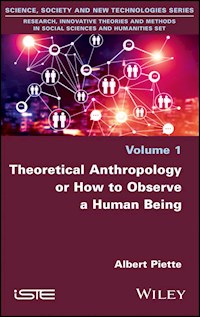
It may seem obvious that the human being has always been present in anthropology. This book, however, reveals that he has never really been a part of it. Theoretical Anthropology or How to Observe a Human Being establishes the foundations and conditions, both theoretical and methodological, which make it possible to consider the human being as a topic of observation and analysis, for himself as an entity, and not in the perspective of understanding social and cultural phenomena. In debate with both anthropologists and philosophers, this book describes and analyzes the human being as a "volume". To this end, a specific lexicon is built around the notions of volume, volumography and volumology. These notions are further illustrated and enriched by several drawings.
Sie lesen das E-Book in den Legimi-Apps auf:
Seitenzahl: 390
Veröffentlichungsjahr: 2019
Ähnliche



















Table of Contents
Cover
Preface
Introduction
1 Theory: Observing the Human Volume
1.1. Volume and voluments
1.2. The entirety of a volume and the density of presence
1.3. Difference and separation
1.4. Volumuation and continuity
1.5. Lessereity
2 Illustrating: Drawings of Theory
2.1. Drawings and contraspective
2.2. Focusing on the human figure
3 Debates: Anthropology and the Human Entity
3.1. Experience and existence
3.2. Going beyond, wrenching and eccentricity
3.3. Lines and flow
3.4. Intersubjectivity
3.5. Perspections of the individual
4 Further Development: Structural Existantism
4.1. Lévi-Strauss and the difficult ambition of anthropology
4.2. A structural approach and the human volume
Conclusion
Bibliography
Index
End User License Agreement
Guide
Cover
Table of Contents
Begin Reading
Pages
ii
iii
iv
v
vii
viii
ix
x
xi
xii
xiii
xiv
xv
xvi
xvii
xviii
xix
xx
xxi
xxii
xxiii
1
2
3
4
5
6
7
8
9
10
11
12
13
14
15
16
17
18
19
20
21
22
23
24
25
26
27
28
29
30
31
32
33
34
35
36
37
38
39
40
41
42
43
44
45
46
47
48
49
50
51
52
53
54
55
56
57
58
59
60
61
62
63
64
65
66
67
68
69
70
71
72
73
74
75
76
77
79
80
81
82
83
84
85
86
87
88
89
90
91
92
93
94
95
96
97
98
99
100
101
102
103
104
105
106
107
108
109
110
111
112
113
114
115
116
117
118
119
120
121
122
123
125
126
127
128
129
130
131
132
133
134
135
136
137
138
139
140
141
142
143
144
145
146
147
148
149
151
152
153
154
155
156
157
159
160
161
162
163
164
165
166
167
168
169
171
172
173
175
176
177
178
179
181
For Catherine Beaugrand
Research, Innovative Theories and Methods in Social Sciences and Humanities Set
coordinated by
Albert Piette and Emmanuelle Savignac
Volume 1
Theoretical Anthropology or How to Observe a Human Being
Albert Piette
First published 2019 in Great Britain and the United States by ISTE Ltd and John Wiley & Sons, Inc.
Apart from any fair dealing for the purposes of research or private study, or criticism or review, as permitted under the Copyright, Designs and Patents Act 1988, this publication may only be reproduced, stored or transmitted, in any form or by any means, with the prior permission in writing of the publishers, or in the case of reprographic reproduction in accordance with the terms and licenses issued by the CLA. Enquiries concerning reproduction outside these terms should be sent to the publishers at the undermentioned address:
ISTE Ltd27-37 St George’s RoadLondon SW19 4EUUKwww.iste.co.uk
John Wiley & Sons, Inc.111 River StreetHoboken, NJ 07030USAwww.wiley.com
© ISTE Ltd 2019
The rights of Albert Piette to be identified as the author of this work have been asserted by him in accordance with the Copyright, Designs and Patents Act 1988.
Library of Congress Control Number: 2019931844
British Library Cataloguing-in-Publication Data
A CIP record for this book is available from the British Library
ISBN 978-1-78630-413-1
PrefaceThe Quest of Anthropologicality
I am learning how to see. I’m starting. It’s still not going well. But I want to make the most of my time.
Rainer Maria RILKE
I come to one of the memoir writers’ difficulties—one of the reasons why, though I read so many, so many are failures. They leave out the person to whom things happened. The reason is that it is so difficult to describe any human being. So they say: “This is what happened”; but they do not say what the person was like to whom it happened.
Virginia WOOLF
Perhaps we are too well aware that an enormous stock of facts and theories has been amassed, and that in thumbing through the encyclopedias we may find hundreds of names and words that represent this potential wealth; and we are too sure that we can always find someone somewhere who, if only to impress us, will be glad to enlighten us on any subject whatsoever. And we promptly withdraw our attention from most of the things that begin to arouse it, thinking of the learned men who must have explored or disposed of the event that just stirred our intelligence. But such caution is sometimes laziness; and moreover, there is no proof that everything has really been examined, and in all its aspect.
Paul VALÉRY1
Several years ago, in preparation for my doctoral thesis, I observed some carnival parades in Belgium. It was mostly the differences in body language or gestures among the participants that caught my attention. Afterwards, I criticized the ethnographic approach as a series of steps that lost first the details and ultimately the human being. When I later understood the significance of considering an individual, one at a time, I observed a priest for a week in Normandy in order to understand some modalities with which humans are present in a situation or move on to another. Subsequently, I slowly understood that an anthropological specificity of research should only concern human beings as they are human beings and not because they play a specific role, carry out a specific activity, or are situated in a given context, and even less so because they belong to a specific culture or social group. Along the way, in several books in debates with Malinowski, Goffman, ethnomethodology, Bourdieu, Latour, but also the “ontological turn”, I kept thinking critically – a reflection which I will not refer to here – about the holistic, relationist and interactionist angle of the social sciences and social anthropology in particular2.
It became even clearer to me that the human beings presented in these terms are or should be the focus of anthropology when, on January 19, 2016, Catherine Beaugrand and Samuel Dématraz filmed me uninterruptedly for nearly 12 hours, and I later watched and re-watched the complete and unedited video. This seems very important to me: I would not have written this book and elaborated the theory that readers will discover without the heuristic force of this video or if I had not been struck by what the series of those images showed, even if this book is not directly related to this film. The risk of losing the human entity is ever present as we carry out research, from the choice of the subject to the final draft. An uninterrupted film that focuses on one individual and the description of a series of instants represent a radical way of not losing him3 and grasping him in his entirety and in the abundance of details. Such is my fascination with “anthropo-logy” and its ambition, namely the human being, which it occasionally expresses but does not really carry out until the very end. The intuition that lies in presenting a human being as a “volume” in his entirety, as we will see, with this anthropological aim dates back to a few years before this filmic experimentation.
I am writing these sentences after teaching a class called “Anthropology of daily life” in the department of anthropology of the University of Paris Nanterre. I explained to my students that these three words should be synonymous. There is nothing that is not daily life. Besides, I prefer the word “existence” to “life”. As I tell my students, our existence is a series of instants, moments and situations. Something seems to be a principle for a work of this kind: an observer observes only an individual at a time, in a situation, then in another, meeting people, then leaving them and meeting other people, and then leaving them too. Thus, existence is the existence of necessarily separate individuals, which anthropologists should prioritize over what happens to them or surrounds them.
However, anthropology, with its history and institutions, does not lie here. Anthropology is not volumological, if I may say, and it does not consider human beings in a radical manner. The game of synonyms does not work. Anthropology is especially concerned with situations that are thematically chosen and shared by individuals who carry out religious, political, or technological activities, etc. Or it looks for topics that overlap several situations. It is first interested in actions, interactions, relations and cultures. A strong trend, still ongoing in anthropology, involves regarding humans as individuals who share social or cultural characteristics. For example, when anthropology focuses on an individual or on one of his specific activities or experiences, it actually “runs through” him to bypass him, leave him and especially to grasp other things, for example interactions, political systems and social life.
Look at a human being himself, and learn to see him. This is what I tell my students time and again. As I taught, my students shared things: a university application to the department of anthropology, a skill concerning what is appropriate in class. However, they are all different. Is this obvious? For each, these shared things naturally do not represent the whole volume, as they are mixed to some other dimensions. Before leaving, I told my students that the following week they would be the same, or nearly the same, and that they would come across other volumes, see, listen and be affected, but only a little. Everyone is in a continuity that makes him remain nearly the same after each moment or situation. It took me a long time to understand this properly. I think that this element, which may seem obvious, has significant consequences on the descriptions and analyses of anthropologists.
This book is presented as a “treatise” that includes a series of paragraphs and subparagraphs preceded by numbers. I chose this structure to allow readers to read slowly and hierarchically, so that they could proceed point by point. This book includes seven parts of different lengths. The first is this presentation to the reader. The second is an introduction. There, I present the common thread of this book, i.e. an “anthropological reversal” operation that involves foregrounding human entities in their entirety, namely modifying the way in which anthropology structures in most cases its research, as it fragments the human being, focusing on his parts, and dilutes him in social relations and contexts. Thus, I attempt to present the human volume as the very focus of anthropology and, in fact, its very scale. This introduction represents in a sense the theory of this book. The third part, that is, the first chapter, constitutes its theory. This is the development of the thesis, which describes the reality of a volume, considered and simultaneously theorized by the anthropologist, who recalls that the Greek verb théôréô means to look, to examine and to contemplate. This is the very question tackled by “theoretical anthropology”, which attempts, according to the meaning of these two words, to consider a human being and to represent a human science that targets human beings. A volume is presented as an individual unity separate from the others. As a separate unit, he is not necessarily closed, but simply in “attempts” of relations with others. By focusing on a volume in and of himself, let us say the anthropological volume, I try to retrieve his constitutive elements, as their combinations characterize moments of presence. Just as I point out how relevant it is to incorporate into a whole volume as many of his components as possible, specifically both those that define his active part and those that define his passive part, I debate those theories based in most cases on a specific element and the difficulty they pose for any description of the complexity of moments of presence. In a volume, there are two other very significant elements: consistency and continuity. Specifically, based on the “style” and stylistic expressions that accompany actions, words or emotions, I will try to show how these are “retained” in and by a volume. This is a point that contradicts the schools of thought – which often inspire anthropologists – that emphasize the idea of freedom, invention or constantly emerging flow. The other element is lessereity as the ability of a volume to decrease and reduce what happens, and therefore “appropriate” it. I consider lessereity, which I present in its different forms, as a key principle that governs the human volume. In the fourth part, that is, the second chapter, I introduce some drawings, or rather some sketches or outlines, with the aim of illustrating what a human volume is and showing more instructively what it means to consider a human being as a volume. Readers will come across the theoretical elements of the first part. In the fifth part (the third chapter), I will discuss some anthropological and philosophical stances which could resemble a description of or reflection on the human being, and I will consider their opposition or the impossibility to adhere to this anthropological goal. I needed to take into consideration the ways in which a volume is theorized to identify the points that confused me in these anthropological stances and find out what prevents them from radically focusing on the human volume. It is mostly through some approaches of social or cultural anthropology that I want to start a debate, since – besides being the field of study I teach and in which I do my research – it has always displayed a strong empirical interest in the human dimension, while also bypassing it for several theoretical and methodological reasons. It is within this conceptual framework that I prefer referring to, as I will state, existantial4 anthropology rather than existential anthropology. In fact, it is because I am dissatisfied with the directions of phenomenology and existentialism that I am led in the sixth part (the fourth chapter) to re-read Lévi-Strauss, redefine his anthropological aims and use a structural approach to support and scrutinize the anatomy of volumic unity. I will then confirm the notion of “structural existantism”. By way of conclusion and as an opening towards other ways of thinking about the topic, I will suddenly move on to a different field by briefly using the ideas that some artists, specifically Rodin and Giacometti, had about the act of looking. This will allow me to present art as a paradigm for anthropology or as an example that may help it question its way of observing, perceiving and targeting the singularity of beings. These chapters should be read as different expressions of a goal that involves introducing human beings themselves as a topic in anthropology and learning to look at them, describe them and understand them as entities. Some points will become clearer and more complete chapter after chapter. Readers will also find some methodological clarifications and empirical questions that encourage comparative observations.
The three quotes above, which I used as epigraphs, aptly indicate the content of this book: adopting a new perspective, specifically oriented towards the human being; not separating actions from the whole of which they constitute merely a part; trying to think about the human being and continuing to do so as we realize that he is always replaced by other concerns in anthropology. Looking at a human being, at each human being: this is where I find the anthropologicality of anthropology, its fundamental level and even its essence, if we dare use this word. It seems to me that this first level, that is, human beings, rather than cultures, actions, or relations should be radical, clearly defined and established as the foundations of a discipline, if cross-disciplinary connections are then to be conceived.
This book owes much to my regular conversations with Catherine Beaugrand. We both know what came out of them. I thank her very much. I would also like to thank Étienne Bimbenet, Camille Chamois, Jan Patrick Heiss, Emmanuelle Savignac and Yann Schmitt for reading this book either in part or cover to cover. My discussions with Benoît Haug, Marine Kneubühler, Stefano Montes, Jean-Michel Salanskis, Gwendoline Torterat, Huon Wardle and She Zhenhua allowed me to make some points clearer. I also want to mention my daughters, Manon and Charlotte, who, thanks to their fields of study (philosophy, psychology and biology), regularly helped me in understanding various aspects of the human volume.
Albert PIETTE
February 2019
1
Quotes drawn from French books or articles have been translated by the author, in cases where they have not already been published in English.
2
I have elaborated on these thoughts in several works in French [PIE 96, PIE 14a]. They can also be found in
Existence in the Details
and
Separate Humans
[PIE 15, PIE 16].
3
The use of the male pronoun in this work is intended to be personal but not gender-specific, and should be read as “he or she” and “him or her” throughout.
4
The “a” is especially relevant in French since the word
existant
(in French) designates the beings who exist.
IntroductionThe Common Thread of this Book: The Anthropological Reversal
1. It may seem at first that the human being, or the individual, has represented and still represents a constant in anthropology. Thus, introducing the human being as a topic into the anthropological field could appear naïve. However, I think that the human being has never really been considered in anthropology. The goal of this book is to conceive the foundations or conditions, both theoretical and methodological, that will allow us to consider the human being as an empirical entity and as a topic for observation and analysis. This book does not concern a specific “field”. However, it is not a philosophical book either. It is a book that focuses on theoretical anthropology in the etymological sense of the word: its aim is to present a way of looking at the human being or, as I should say, a human being.
2. Despite remaining the main variable and the criterion for fieldwork in anthropological research, culture as a focus has been significantly questioned for quite a few years in favor of action, practices or experience. I am not interested in culture, society, a group, a social class or representations. However, I am also not interested in a situation, a relation or an interaction, with their specific dynamics and rules, or in an action, a practice, an activity or an experience. I do not want to focus on a human being either as part of a group or as he interacts, carries out a specific action, or lives a certain experience and social situation. In their own way, such starting points, such as those based on culture or any other macroentity, are mechanisms that bypass the human being.
2.1. What is going on and what is the issue? What does it mean “to fragment the human unity”? I want to show that, through this operation, this unity is associated with and reduced to a specific dimension, to some kind of partial “in the capacity of” (e.g. carrying out an action, moving, speaking, belonging to a group, having emotions or a subconscious, carrying out a moral action, undergoing a cognitive process) and possibly to specific subjects or specialties in anthropology. Therefore, this operation implies highlighting parts, extracting them from the volumic entity and in a certain way forgetting this entity itself as well as, in some cases, forgetting that it has been forgotten when we think that the “in the capacity of” we choose, for example the social sphere, subjectivity or other dimensions, represents the whole entity. In anthropology, this fragmentation or reduction process often happens alongside another operation: these competences are observed in relations, social situations, social phenomena, social systems, cultural groups and contexts that define the focus of a researcher, guide his approach and often become the explicit themes at the center of the analysis or the topics that the researcher attempts to clarify. In this case, fragmentation is accompanied by a type of dilution of the unity itself, which is placed in groups with other humans. This operation is typical of the social sciences. According to the dictionary, dilution implies a mixture, an attenuation, a decrease in strength and a gradual disappearance. This is exactly what happens. Thus, anthropology is not emancipated from sociological, ethnological or culturological studies. To tell the truth, presenting the human being in relation to other human beings or the environment, in a given social or cultural context, involves simultaneously fragmentation and dilution. In addition, it is often underpinned by the idea that every entity has then been considered, whereas in reality it is merely fragmented and diluted.
2.2. Thus, fulfilling the anthropologicality of anthropology must involve a reversal or an inversion. Using the human volume as central focus is the opposite, on the one hand, of fragmentation, which highlights a fragment or an aspect of the human being (which is then pushed into the background) and, on the other hand, of social contextualization as dilution, which also relegates and subordinates the human being. I do not mean to say that a human being is not part of one group and then of another group, in one situation and then in another situation, or that he does not carry out a series of actions and does not live a series of experiences. This does not mean that an action, a practice and experience leave no traces. Learning to consider a human being and to look “straight” into his existence means learning to separate him from these different frameworks that, according to the interpretations used in the social sciences, prevail over him. Choosing to work on human unity means highlighting this unity and considering that both the different fragmentations into actions, activities, experiences, relations and the different frameworks in a situation, event or society are enabled only because of the presence of entities and whole volumes, as it were. Have we ever seen an action, experience or group without a human entity that carries it out or lives it? The human being is empirically and ontologically necessary for there to be what is the usual focus of the social sciences. Thus, through this reversal, human unity, which is usually relegated to the “background”, even in the anthropological tradition, becomes the central “figure”, whereas situations, cultures, relations, actions, activities, experiences and environments become secondary. All of this is still there, and it concerns a human being, but it is the human being as unity that represents the observation and comprehension target. Thus, I can rephrase my topic: a human being who is in interaction; a human being who is in interaction; or a human being, who is in interaction (and who is more than that). Interaction may be replaced by relation, action, activity, experience, cultural belonging, etc. Based on the words in italics, we are not considering and thinking about the same thing. In the first two cases, there is a qualification, a restriction imposed immediately by the relative clause. The issue is then to consider the human being as he is in interaction, or even to consider the interaction itself with its rules. In the third case, the relative clause specifies one mode (one of many) of the human being who constitutes the focus. This is the meaning expressed by the comma in the third phrase, which highlights “a human being”. Once we focus on several human beings in interaction, it is difficult not to consider the second case, which involves thinking about interactions or relations. In a letter he sent to Henri Fantin-Latour, Édouard Manet mentioned the Pablo de Valladolid, a painting by Diego Velázquez that he had seen at the museum in which it was displayed in Madrid: “[It is] the most astonishing piece of painting ever done… the background disappears: it is air which surrounds the fellow, dressed all in black and full of life.” After discovering this painting, Manet painted The Fifer as a whole human being, seemingly detached from the world. I do not mean to say that the context becomes completely absent, but that it becomes in fact secondary. It appears in a volume himself, as shown by the fifer, while also imposing its presence to the observer. However, when I remove a human being from his connections to other human beings and his contexts, I do not do so to reconsider him at once and mostly alongside other human beings and in specific situations. Contrary to what Merleau-Ponty wrote, I do not take a step back, with the “intentional threads which attach us to the world” in order to bring them to “our notice” [MER 05, p. xv].
3. Thus, I attempt to turn the human being, a human being, into a “field” study like any other entity, be it a city, a religion, hierarchical relations, the psyche, a cell or neuronal connections. No entity, including the human being, is independent of what surrounds it. Just like a city depends on its inhabitants, region and country, so a brain is part of a body, neurons are part of a brain, etc. However, considering an “object” detached from its background and finding a type of singularity is an ordinary scientific operation. Otherwise, each researcher would have had to take into account all of the planet and the whole universe since the dawn of time. This should be all the more simple as the human being represents a perfectly delimited entity from the beginning of his existence to his end and perceiving or structuring this object is not as hard as the examples I have just mentioned, for example a religion, a city or hierarchical relations. Perhaps, the obvious nature of this outline is seen as a trap, and we would reasonably prefer to reduce the human being to an aspect, combine him with other human beings, or mention cultural representations that may disqualify him from being an entity. Yet, this would mean losing what could be, at least etymologically, the object of anthropology, namely the human being. The live and detailed observation of one human being at a time in the continuity of moments represents for me the typical work of an anthropologist, and so does comparing such observations. If we accept that the variety of cultures or social situations is not self-evidently – except for historically and institutionally – the primary object of anthropology, then how can we place this human being as the central focus of a field of research?
3.1. It is here that the answer I suggest comes into play: the “volume”. This represents a notion or a concept but also a reality, since a human being is a volume. From an anthropological perspective, I think that this idea is quite powerful and has a more defined heuristic effect than some words that may be related to it, such as “individual”, which is occasionally pejorative, ideologically charged and unable to define the consistency of a being itself as clearly, or “person”, which is often mixed with interpretations in terms of sociocultural representation or moral issues and the question concerning the criteria that establish when this term should be assigned. Nor would I favor the notion of organism or life, which may correspond to a biological and physiological dimension. I would also say that the body is merely an element of a volume. The notion of existence is widely used in the social sciences and assigned to numerous entities1. With the qualifying word “human”2, the notion of existence, considered in several philosophical senses, may seem too “slippery” and unstable. In any case, I only regard it as the concrete succession of instants. In my opinion, the notion of volume, associated with that of existence, is quite important if we want to identify and adopt an empirical focus on the human being himself while also clarifying this anthropological reversal. To this end, the actual volume, a human being, goes hand in hand with the concept of volume, namely a theoretical representation associated with a set of characteristics that the anthropologist has theorized or, in other words, observed and turned into concepts. The word “volume”, which I employ, results then from bringing together what a volume is in common parlance, that is, the fact that a human being is actually a volume and can be recognized as such, and its anthropological explanation. This volume is a volume of being or a human volume. Let us say that it is an anthropological volume. I use these expressions, including the word “volume” on its own, as synonyms.
3.2. Looking at a volume does not mean simply looking in a general way. The goal of the idea of volume is to directly focus on the empirical unity that a human being constitutes in his entirety and that emerges against the background of a context that has become secondary. Considering the human being as a volume may help us “grasp” him, as he tends to slip away and be overlooked. This is a way of “seizing” him. Thus, a volume is separate from all others and can be outlined, in every part of the world, regardless of the ways in which he is represented and perceived. This volume of being thus becomes the observed entity, in his consistency and density together with the components that he expresses or contains, for example an emotion, an action, a word, a thought or a skill. However, in these cases, an anthropologist conceives these as interrelated and as elements of the whole, which are not removed and cannot be separated from the unity of the whole. Presenting and describing a human being as a volume implies integrating at all times these various dimensions (as well as others) without neglecting the volumic unity, as these dimensions represent in most cases, as we have observed, the objects of fragmented analyses. Thus, the goal is to encourage this theoretical approach that has the potential to unify a human being, to regard and consider him as an entity, and, therefore, to identify what I think is the observation and analysis work that needs to be carried out by anthropology. The idea of volume involves a way of looking and discovering. It is in this sense that it is a “theory”.
3.3. Introducing the notion of “volume” does not simply involve a way of considering and conceiving a human being. As I have said, this human being is a volume, all of us are one, and we all differ from one another. Altogether, everyone is a volume, whereas partially everyone is merely consciousness, subjectivity, intention, relation and action. This is what a volume indicates, always encouraging us to put aside any perspective that has a specific target. Choosing a type of reading that focuses, for example, on subjectivity or action means neglecting elements that do not correspond to it and which could not fit in this or that particular dimension. A volume always includes other things: what is left by each possible interpretation and even by different combined interpretations.
4. The social sciences, cognitive science, psychology, neuroscience and biology constitute scales or scientific approaches that differ from those employed by the anthropology of volume. The issue faced by the latter is simple: there is a gulf between, on the one hand, the observation and knowledge of volumes considered separately in the continuity of their existence and, on the other hand, the observation and knowledge of individuals considered together or fragmented. It is this gap that anthropology as I intend it should try to bridge in order to fulfill what I think should be its primary role: to be a science that deals with the human being, namely to be a volumology that does not slide him towards these other scales.
4.1. The following words are drawn from a recent article, published in the journal L’Homme, which advocates the interrelation of biological and ethnological knowledge in order to pursue a general type of anthropology:
A fundamental research field, as a general type of anthropology should be, cannot be revitalized by simply searching for new objects: there is significant potential in renewed approaches that take into consideration the technical developments of related fields of study on key topics, such as kinship, body techniques, communication, cooperation, religions, the imagination, nutrition, or domestication. [BOC 17, p. 240]
I notice that the human being is not mentioned – nor is the living being – as the goal of a general type of anthropology presented as a cross-disciplinary dialog, especially with natural sciences, from the study of social phenomena. This is my finding of this paper: no human beings, and no anthropology as a specific field of study. According to this quote, anthropology is either social3 or an unequal blend of different types of knowledge. In any case, even if we include what we call “general anthropology”, the human being is still bypassed, and actually mixed and fragmented, within and by “societies” and also “environments”, which are often considered important in this cross-disciplinary structure. I would like to see a radical anthropology that considers the human being and the entity he constitutes to have its own scale, which differs from that of sociology or biology, and to propose its own terminology, without representing a juxtaposition, integration or unification of different sciences4. It is only after such an anthropological stance, which is centered on the human being, studied in depth while remaining separate from “natural” as well as “cultural” sciences, that anthropology could in a second phase proceed to carry out methodologically structured cross-disciplinary operations, for example, in collaboration with neuroscience. I am thinking about a twofold uninterrupted observation, that is, of the human volume, whom I would consider on an anthropological scale, and at the same time of neurons or neuronal connections. In this case, the notion of “biology” would take on a precise meaning that refers to a specific scale5. Naturally, it is also possible to adopt prehistoric and evolutionary perspectives6. Similarly, comparisons between beings and volumes, whether human or not (rather than merely their activities), which are quite rare, play a significant part in an approach that aims to understand the human volume. It is important to point out that, on the contrary, present-day “zoocentrism”7 or “eco-centrism”, when they emerge in anthropology through an increasing interest, under different expressions and intellectual affiliations, in “human-animal” relations, ecological issues or “environmental humanities”, and more generally in the topic of “non-humans”, constitute an additional way of bypassing the human being, following the aforementioned detours.
4.2. What do I mean to say? The human volume is a whole that includes all of his components and a way of structuring. Thus, to consider him properly, we should then avoid losing him in collective phenomena and different relations, by refusing to fragment him in a biological or psychological dimension and turn anthropology into a cross-disciplinary or general discourse. This is to me what anthropology should be. In my opinion, it is very important for anthropology to have its own topic, strictly speaking the human being, and for research to include an indisputable anthropological dimension. However, this is not a plea for a return to an “anthropocentric” paradigm, I mean one centered on the human being in the human and social sciences, given that the human being has never been, as I pointed out, their epistemological center. No epistemological “exceptionalism” has been assigned to the human entity in the history of anthropology which, through its theories, methodologies and topics, has always targeted and continues to target other entities. Rather, the issue is to lay foundations to this end and to create the conditions for a type of anthropology associated with an objective anthropologism. Therefore, it is astonishing to read that the social sciences in the last few years, specifically by highlighting the non-human sphere, have managed to shift their focus away from the human being and that they are experiencing an epistemological revolution through their emphasis on relations. However, the social sciences, sociology or social anthropology, have been deeply relationist in different ways since they were established, as they try to understand and explain individuals with and through other individuals, cultures and interactions. Anthropology could greatly benefit from distancing itself from this approach in order to build an autonomous type of epistemology that makes it possible to refer to the human being as an entity situated at the center and in the foreground, as a volume whom we see continue and live on instant after instant. Unlike what we may think, this type of perspective breaks with a type of epistemology that has always found arguments and, as it were, alibis, which were occasionally combined, to avoid focusing on the human being: cultural diversity, social relations, intersubjectivity, the non-human dimension or ecology.
4.2.1. The gap between the volumology that I have just outlined and the monadology put forward by Tarde is equal to the one that may separate anthropology and sociology. Tarde’s works significantly emphasize individuals:
This world would not exist without them; without the world, conversely, the elements would still be something. The attributes which each element possesses in virtue of its incorporation into its regiment do not form the whole of its nature; it has other tendencies and other instincts which come to it from its other regimentations; and, moreover (we will shortly see the necessity of this corollary), still others which come to it from its basic nature, from itself, from its own fundamental substance which is the basis of its struggle against the collective power of which it forms a part. [TAR 12, p. 47]
This last point is especially significant. The complexity of the individual entity ready to move constitutes a strong principle of Tardean sociology: starting from what is small, from details and from differences. However, from this starting point, the explicit “renewed monadology” project [TAR 12, p. 26] turns into a consideration of the “tendency of monads to assemble” [TAR 12, p. 34]. Naturally, there are “men who speak, each with a different accent, intonation, voices, gestures”, but this heterogeneity gives rise to habits, associations and rules whose social laws about imitation, transmission and propagation should be sought, according to Tarde. Therefore, through their active force and their eagerness, monads constitute indispensable means which, however, should be employed to consider mutual ownership as well as power and resistance relations. Thus, activity, action and relation re-emerge as objects at the center of this sociological analysis. Finally, society is regarded as a “mental communion”, which is certainly imperfect, or as a “web of inter-spiritual actions and mental states affecting one another” [TAR 02, p. 11]. In short, a theoretical approach to relation, connection and association, such as we can see it in Bruno Latour’s work, which often acknowledges its Tardean inspiration, seems to have replaced the way of conceiving the entire volume as observed now and instant after instant. Thus, the shift involved in the volumological principle seems radical to me.
4.2.2. I would like to clarify something. We may say that a human being is quite negligible when compared with the planet and the time of the universe. This is true. However, he represents the topic on which anthropology focuses. Aiming to describe the human being does not correspond specifically to a humanistic perspective, but it is an anthropological act that does not imply that the human being should be considered as a “wonder” or “the wonder of wonders”, as Groethuysen claims when he presents Ficino and Pico della Mirandola’s philosophy [GRO 80, p. 150]. Besides, I would like to acknowledge that there is a touch of pathos in a type of anthropology that describes fleeting individuals. Let us say that there are at least four reasons why anthropology should learn to develop its interest in human beings or, better, in human volumes. We could first consider the range of evolutionary change, over several hundred thousand years, which assigned to humans the place and role we know. What happened to the human being then? This question is enough to justify compared observations of volumes, including other similar species. Furthermore, the evolutionary specificities of the human being could encourage anthropology to focus on “individuals” and describe them as directly concerned by the succession of instants following one another. These individuals are especially concerned since, based on complex learning, memorization and linguistic processes, humans are like “extreme individuals” [PRO 12, p. 148], each of them attached in a specific manner to their individuality and aware that as time passes they inch closer to their disappearance. Naturally, this has nothing to do with a contemporary kind of individualism. Then, it is easy to see that in most cases humans have socalled feelings of friendship and love towards other human beings which, with very few exceptions, they do not feel towards other species. Everyone, indeed, pairs with his or her own “fellows”. A science called anthropology and practiced by humans is interested directly in the human being and seems self-evident. Moreover, human beings are also the ones who hurt other humans the most and who wound, murder and carry out atrocious acts that seem intolerable, unacceptable and unbearable to most other beings. This may lead us to think that there are (more) things to learn and consider about humans or, better, to understand in detail about these volumes.
5. This book will constantly deal with “volumes”. Readers will come across the points mentioned in this introduction and find, now and again, volumes as seen from various perspectives. With anthropological reversal as a goal, considering the human being as a volume involves at least three significant actions: focusing on the volumic entity in its unity and continuity; understanding the volume himself first and not based on others, the context, or the external origin of the elements that constitute him; and paying heed to the details of the volume, and more specifically to the leftovers forgotten by other types of interpretations. This assigns a great descriptive role to anthropology. The notions and concepts I suggest are in line with this goal, namely observing and grasping a human being, the volume observed by an anthropologist, as closely and precisely as possible. Based on this focus on the human being, I move on to what may seem a completely different topic. Luke Howard, at the beginning of the 19th Century, gave different names to clouds – cumulus and stratus clouds, cirrus and nimbus clouds – so that we can now observe and recognize them. He spelled out their shapes, appearances and structure; their ability to change and grow bigger or smaller; their density and density variations; their altitude, their expansion and retraction degree; as well as their indetermination, transition and their dynamic between stability and change. I want to keep in mind this extraction through which Howard created an object, clouds in their own right, while removing them from all the elements moving across the sky [WEB 16]. Goethe, who commented on Howard, wrote keeping in mind “morphology” as a goal:
The man of science has always evinced a tendency to recognize living forms as such, to understand their outwardly visible and tangible parts in relation to one another, to lay hold of them as indicia of the inner parts, and thus, in contemplation, to acquire a degree of mastery over the whole. [GOE 52, p. 88]
1
For my point of view on the ontological turn, see [PIE 16, pp. 20–25, p. 51 and
sq
.] and [KNE 19]. I think that the requirements of ontology should encourage us to choose how we apply the notion of existence and not to use it broadly, as is the case today in the publications of several anthropologists, and moreover without any focus on the human being.
2
I referred specifically to this point in [PIE 15] and [PIE 16]. The issue is less to reject this notion than to strengthen it because of the idea of volume.
3
It may also be called “linguistic” or “biological”, but this has no effect on the argument about the status of the human being.
4
Concerning this debate about the “human science” as interrelation of different types of knowledge, we can refer, for example, to François Azouvi’s introduction to his book on Maine de Biran [AZO 95]. For some historical and fairly theoretical goals of “human sciences”, see [CAR 13].
5
This is not the case in all the arguments – occasionally somewhat vague – concerning the “biological dimension”, for example [PAL 13a, p. 40].
6
This is what I did in previous books such as
Anthropologie existentiale
[PIE 09] or
L’Origine de la croyance
[PIE 13a].
7
For this critique of zoocentrism, see [BIM 17].




