


Erhalten Sie Zugang zu diesem und mehr als 300000 Büchern ab EUR 5,99 monatlich.
- Herausgeber: Sallux Publishing
- Kategorie: Geisteswissenschaft
- Sprache: Englisch
Eating is never a solitary act; each meal connects us profoundly to food chains, precious resources, human effort, a global ecology and graced provision. How does the food we eat affect the planet? What is a biblical response to environmental degradation, and how can we eat in a way that honours God? This book addresses the high environmental and social costs of modern food systems and provides theological reflections on the interconnected relationships between God, humanity and the non-human creation. By developing an extensive theology of food and eating, it suggests practical applications for individuals, organisations and policymakers, and proposes a framework for thoughtful eating so that we can learn to eat joyfully, relationally and sustainably. This book is widely and carefully-researched, biblically-rooted, judiciously balanced and yet will challenge you to re-evaluate what and how you eat. Food is not just fuel, but spiritually, socially and ecologically laden with meaning. A renewed relationship with food can transform our relationships with ourselves, our neighbours, the wider creation and even with God. Reading this will show you how. Dave Bookless, Director of Theology, A Rocha International
Sie lesen das E-Book in den Legimi-Apps auf:
Seitenzahl: 202
Veröffentlichungsjahr: 2023
Das E-Book (TTS) können Sie hören im Abo „Legimi Premium” in Legimi-Apps auf:
Ähnliche




















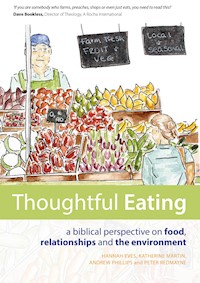
Thoughtful Eating
Food, relationships and the environment from a biblical perspective
SAGE Research Report no. 1
Hannah Eves
Katherine Martin
Andrew Phillips
Peter Redmayne
Colophon
Thoughtful Eating; Food, relationships and the environment from a biblical perspective
SAGE Research Report no. 1
Hannah Eves
Katherine Martin
Andrew Phillips
Peter Redmayne
©2019 JubileeCentre.Allrightsreserved.Nopartofthispublicationmaybereproduced, storedinaretrievalsystem,ortransmitted,inanyformorbyanymeans,electronic, mechanical, photocopying, recording or otherwise, without the prior permission ofthe publisher.
ThepublicationofthisbookhasbeencarbonoffsetwithClimateStewards,whosupport communityforestry,waterfilterandcookstoveprojectsinUganda,Kenya,GhanaandMexico. Calculateandoffsetyourowncarbonfootprintat:http://www.climatestewards.org/offset/
Cover illustration: Hannah Eves
Unless otherwise stated, scripture taken from The Holy Bible, New International Version® (Anglicised), NIV®. Copyright © 1979, 1984, 2011 Biblica, Inc. UsedbypermissionofHodder&StoughtonLimited,adivisionofHachetteUK.Allrights reservedworldwide.“NewInternationalVersion”and“NIV”areregisteredtrademarksof Biblica, Inc. Used bypermission.
Contact data:
Sallux Publishing
EPub format: ISBN 978-94-92697-34-9
Since2011,theactivitiesofSalluxhavebeenfinanciallysupportedbythe EuropeanParliament.Theliabilityforanycommunicationorpublication bySallux,inanyformandanymedium,restswithSallux.TheEuropean Parliament is not responsible for any use that may be made of the information containedtherein.
About Sallux & Jubilee Centre
Sallux | ECPM Foundation
Bergstraat 33
3811 NG Amersfoort The Netherlands [email protected]
Sallux is the political foundation for the European Christian Political Movement (ECPM). Sallux means “Salt and Light” and we want to spark a salted debate where needed and shed light on the issues we face. We present solutions by organising events and distributing relevant publications, and will not stay on the safe side of the status quo.
Since 2011, the activities of Sallux have been financially supported by the European Parliament. The liability for any communication or publication by Sallux, in any form and any medium, rests with Sallux. The European Parliament is not responsible for any use that may be made of the information contained therein.
Jubilee Centre
59 St Andrew’s Street Cambridge CB2 3BZ [email protected] www.jubilee-centre.org
The Jubilee Centre offers a biblical perspective on social, economic and political issues, and equips Christians to be salt and light in the public square.
We believe the Bible describes a coherent vision for society that has enduring relevance for the UK and the world in the twenty-first century. At the heart of this social vision is a concern for right relationships. We seek to study, disseminate and apply this vision in order to provide a positive response to the challenges faced by individuals, communities and policy makers.
Acknowledgements
Along the way many people have helped to shape these ideas, particularly Dave Bookless, Andy Lester, Matt Williams, Hilary Marlow, Jeremy Lindsell, Jonathan Tame and Philip Powell who have provided advice and detailed feedback on various drafts of Thoughtful Eating. A special thank you to Jonathan Chaplin for writing the foreword, Charlee New for designing, formatting and proofing the final draft, and Mercedes McGuire for supporting us throughout this process.
Foreword
‘You are what you eat’ – so the saying goes.
This is obviously true in a bio-physical sense: our bodies are sustained largely out of the food we eat, which comes from plants and animals. They are also damaged by how and what we put into our bodies.
It’s also profoundly true in a relational sense: food forms us, and is formed by us, socially, culturally, economically, politically and spiritually. Behind every mouthful is a wide-ranging web of relationships involved in producing, harvesting, distributing, buying, selling, processing, packaging, preparing and serving food – and disposing of food waste.
Each of these relationships implicates us in ethical and spiritual choices. Yet for most of us in the over-fed West, such relationships are invisible – we never examine their far-reaching relational impacts. These impacts are frequently damaging to the human consumers and producers of food and to the natural ecosystems on which food systems depend.
The many relational abuses revealed by these systems testify to a deeper spiritual malaise afflicting our entire western culture – our contempt for creation as God’s gift, our selfish exploitation of creation’s productive resources and our breaching of the human task of trusteeship for the earth.
This excellent and timely report confronts these issues head on and offers a way forward. It is wide-ranging, thoroughly researched, packed with fascinating and disturbing information, full of practical suggestions and written with admirable clarity. It invites and challenges us to engage in ‘thoughtful’ eating – seeing food through a radically biblical and relational lens. It shows us that eating more ‘thoughtfully’ will also be eating more ‘faithfully’ – and more joyfully!
The report’s young authors represent those who will have to confront and respond to the deep relational flaws of our food systems and the broader ecological crises of which they are a telling symptom. My generation’s ignorance and greed created these crises. This report gives grounds for hope that, by God’s grace, the next generation might be better trustees of the earth than we have been.
Jonathan Chaplin
Member of the Divinity Faculty, Cambridge University, and Theos Research Associate Co-editor of In Search of Good Energy Policy (Cambridge University Press, 2019)
Preface
This SAGE research report, Thoughtful Eating: Food, Relationships & the Environment is the first of its kind.
In October 2018, we began our first ten-month leadership development programme for young Christian graduates. Andrew, Peter, Hannah and Katherine were going to live in shared accommodation and spend four days a week at the Jubilee Centre following the SAGE programme. The goal of the programme is to train leaders to think biblically about the world and engage public life to promote Christian social reform.
Part of the programme included training the ‘SAGEites’ to develop the skills and competencies to conduct an in-depth group research project. At the Jubilee Centre we believe that good research is the backbone for any public engagement and campaign for change. Without biblically-grounded, theologically-informed research, Christians who are zealous to make change happen can get swept along by the latest ‘fads’—and these are often informed by secular thinking that does not properly account for human sin and structural evil. Finally, without proper research we won’t be able to engage with those who resist the change we envision, nor shift the thinking of honest sceptics who are mostly indifferent to the issues we care about. High-quality biblical research is profoundly important for achieving social reform.
The four authors can rightly be proud of this in-depth report (there are over five hundred footnotes…) which offers high quality biblical research around the question of the food we eat and the major environmental and social impact of our food and farming systems. It provides an excellent reference for any Christian wanting to think through ways of responding to the pressing environmental challenges which we face, whether at the individual, organisation or government level. At the end of the day, I hope that you will also be challenged to look again at the food on your table, and perhaps your own eating habits might change as a result of reading this report.
Philip Powell
SAGE Programme Leader
Cambridge, July
Introduction
Consider the humble brownie.
Abrownieisacollectionoffairlycommonhouseholdbakingingredients– flour,eggs,milk,cocoapowder,butterandchocolate,mixedtogether,and thenbaked.Abrowniemightbeenjoyedoverconversationinacoffeeshop; oratyourdeskasatreatafterlunch;orservedwarm,freshandgooeystraight fromtheoven.Thebestbrowniesaredenseandsweet,withchunksofextra chocolateorcrunchynutsaddedfortextureandflavour.Butthebrownie hasamoreprofoundstorythanweoftenrealise,astorywhichincludesthe barista,themanufacturer,thesupermarketworker,thehome-baker.Thestory goesstillfurther:fromthesoil,toplants,toanimals,andtopeople.Yeteating food,evenadeliciousbrownie,canoftenseemmundaneorordinary–an everyday, unimportantactivity.
But a pause for reflection and contemplation reveals more of thewonder offoodandeating.Itisaphysical,corporealnecessity,yetitbringsusjoy. Ourmouthsandsensesdonotjustconsumefood,butsavourit.Toshare food with others is a significant way to experience relational connection, throughcelebrationsandhospitality,infellowshipandcommunity.Abrownie isaproductofasetofprocessesbywhichrawingredientsareturnedinto somethingdelicious.Thoseingredientsthemselvesallhavetheirownstories– theflourmilledfromgraingrowninsoil,thesugarextractedfromsugarbeet, theeggslaidbychickens,thebutterandmilkfromthecow.Thecocoabeans weregrownincountriesfaraway,bypeoplewewillneverknow,andwere importedviaglobaltradenetworks.Thinkofallthepeopleinvolvedinthe process–thosewhohaveplanted,farmed,harvested,processed,packaged, shipped,distributedandsoldallthedifferentingredients.Whenwebiteinto abrownie,weenteravastwebofrelationshipsbetweenallthesepeople involvedinthesupplychain.Andbeyondthat,weenterintoarelationship withtheenvironment:weenjoygrains,vegetables,anddairyproducts,which areallresultsofincrediblycomplexnaturalprocesses.Werelyeverydayon soil,air,water,seeds,insects,birds,animals,bacteria–wholeecosystems whichsustainourlifethroughfood.Yetweoftenfailtoeatthoughtfully: insteadwerush,wehurry,weconsume,weeatmindlesslyandthoughtlessly.
Humanity has become increasingly aware of the damage inflicted on the environmentbyourcollectiveactions.Thisisparticularlytrueofglobalfood systems,whichareoftenresponsibleforenvironmentaldegradationona hugescale.Asaresult,thereisincreasingmediaandculturalinterestinfood systems’environmentalimpact,withcallsforlargescaledietarychangesanda transformationoffoodandeating.Thisbookseekstoaddresssomeofthese issues,andarguesthatthefundamentalneedisachangeofmindset:from eatingwithoutthoughtforthecontext,relationshipsandimpactofourfood to thoughtfuleating.
ThefourauthorsarefromtheUKandIreland,andwehaveparticularlyaddressed theUKcontext,althoughwealsoexaminetheglobalnatureofmodernfood systems.WewritefromaChristianperspective,andconsequentlythroughout thisbookwedrawontextsfromtheBibleforinspirationandguidance.Inthis process,twoimportantandinter-relatedconceptshaveinfluencedourwriting. ThefirstoftheseisRelationalThinking(RT),whichdrawsonJudeo-Christian traditions,andemphasisestheimportanceofrelationships,inpublicaswellas privatelife1. RThasbeendevelopedbytheJubileeCentreandhasprovided ausefulparadigmforapplyingbiblicalprinciplestothecontemporaryissues weexamineinthisbook.Thesecond,complementaryconceptistheologian ChristopherWright’s‘triangleofrelationships’betweenGod,Humanity,andthe Earth2.AccordingtoRichardBauckham,‘thebiblicalmetanarrativeisallabout therelationshipbetweenGod,humanbeings,andthenon-humancreation’3.ByplacingGodatthetopofthetriangle,Godisunderstoodtobethecentre andsourceofeverything(theocentrism),asopposedtotheperspectiveof anthropocentrism(humanityatthecentre)orecocentrism(earth/environment at the centre)4.This relational model exemplifies the theocentric orientation of the Bible, and also visually presents the interconnected nature of the relationships, interacting with eachother5.
This book primarily aims to examine the connections between food, relationshipsandtheenvironment.Bynecessity,thismeansweexcludeother importanttopics,whichwecannotadequatelycoverhere.Inparticular,inthe context of the relational model we employ, the interactions betweenhumans andanimalsareakeypartoftherelationshipbetweenhumanityandthe non-humancreation.However,thescopeofthebookdoesnotallowusto includeadetaileddiscussionofanimalwelfare,particularlyregardingthe ethicsofeatingmeatandanimalproducts,andthetreatmentofanimalsin livestockproduction.Sixfurtherrelatedissuesthatwedonotexaminein detailarefishing,foodandhumanhealth,biotechnology,eatingdisorders, foodpackaging,andtreatmentofworkers,althoughwedotouchonsome ofthesetopicsinbriefthroughoutthebook.Amoreexpansivetreatment offood,relationshipsandtheenvironmentwouldconsiderthesetopicsin furtherdetail.
Overview
Inchapter1,weprovideadetailedanalysisoftheenvironmentalimpacts ofcurrentfoodsystems,focusingonbiodiversityloss,landuse,wateruse, pollutionandsoildegradation,climatechange,andfoodwaste,alongwiththe related issues of global supply chains, food security, and population growth. Wealsoconsiderthesocialconsequencesofenvironmentaldegradationand unjustfoodsystems.Thepicturethatemergesisofawayofeatingthatis graduallydestroyingtheenvironmentonwhichhumanityrelies.
Inchapter2,weprovidetheologicalreflectionsonhumanity’srelationship totheenvironment.Wesuggestthathumanity’svocationistocareforthe environment. Secondly, we consider contemporary theological reflections on foodandeating.Weproposetwokeythemeshere,delightinginGod’sgiftof foodgiventhroughcreation,andsharingfoodwithothers.
In chapter 3, we suggest applications for individuals, organisations and policymakerstoadoptinlightofthefirsttwochapters.Wearguethatfood systemsneedtobetransformed,withtheultimategoalthattheycontributeto both environmental sustainability and socialjustice.
Thefollowingillustrationshowshowwehaveorganisedourthinkingonthe subject:
Chapter1
Socialimpacts
Chapter2
Sharing food with others
Chapter3
Environmental
sustainability
Socialjustice
Delighting in food
and creation
Environmental
impacts
Although the scale of the challenge may seem daunting, we hope that readers will also be encouraged that every individual can contribute to transforming food systems – because the starting point is a change of perspective, away from food as fuel, toward a deeper, relational appreciation of what eating represents. Food, from this perspective, is far more than a collection of nutrients: in the words of theologian Norman Wirzba, food can be understood as ‘God’s love made nutritious and delicious, given for the good of each other’6.
Chapter 1 Totillandtotend:agricultureandthe environment
All food production is reliant on, affects and is affected by the environment. Many elements of global food systems are contributing to a range of unsustainable environmental impacts which threaten animals, plants, the land, and whole ecosystems. We begin this book by considering a range of environmental impacts caused by arable farming and livestock production, as well as examining the social and human consequences of environmental degradation. The related issues of global supply chains, food security, and population growth require consideration in any discussion of food systems, and therefore they are also examined here. We find that livestock production has the greatest adverse environmental impacts across a range of indicators, particularly since large amounts of crops are grown as feed for animals.
Although we write with a particular focus on the UK, since modern food systems are global, we look at environmental and social impacts across the world. An acknowledgement of individual, organisational, national and international complicity in food systems’ contribution to the environmental crisis is an important precursor to considering how a theocentric perspective on food and eating can encourage individuals to think and act more thoughtfully7.
Biodiversity loss
One of agriculture’s most serious environmental impacts is the effect on biodiversity8.Food production systems are thought to be the single most significant threat to biodiversity, mainly due to habitat loss and fragmentation from agricultural land use, and the damage caused to on-farm biodiversity by intensive agriculture9. This has contributed to a ‘mass extinction’ of species, from even as recently as 197010.Significant amounts of forest and rainforest have been cleared for agriculture, which severely damages biodiversity in those areas. Analysis of eleven areas experiencing deforestation ‘found agriculture to be a large, usually the largest, driver of change’11. Globally, an estimated 27% of forest loss is due to commodity production (predominantly agriculture), with a further 24% due to shifting subsistence farming12.In tropical forests in Brazil and Southeast Asia, which are very rich in biodiversity, clearance for agriculture is the dominant cause at an estimated 80%13.
Once land has been converted to farmland, however, determining how farming affects biodiversity is complicated by the fact that there are different levels of farming intensity, which have varying impacts. On a theoretical continuum, the two opposite approaches which produce the same quantity of food would be (1) farming which aims to maximise yields, is often less biodiverse, but uses a smaller amount of land, and (2) farming which aims for the greatest possible on-farm biodiversity, is therefore often lower yielding, but uses a higher amount of land14. In reality most farming methods will fall somewhere along this continuum, but these two theoretical approaches are often known as ‘land sparing’ and ‘land sharing’ respectively (see glossary for a fuller explanation)15. Within the bounds of a farm, the intensive approach is often more harmful to biodiversity as it leaves less physical space for flora and fauna, and if fertilizers, pesticides and herbicides are used, these can harm non-target species. However, at a landscape level, combining high-yielding farming on a small land footprint with land set aside specifically for wildlife and plant life (such as in national parks) is an approach that may allow for greater biodiversity than farming the whole landscape using a low-yielding method (hence ‘land sparing’)16. This is particularly true for specialist species, which struggle to survive on farmed land and make up the majority of wildlife species17. Generalist species, which can cope in different habitats, are less affected by low-yielding agriculture. The majority of scientific opinion is in favour of land sparing with respect to biodiversity18, but this must be balanced with some ideas of the ‘sharers’, such as the need for some farmland to be environmentally managed in order to provide land corridors that permit free movement of wildlife. The concept of land sparing has been criticised for focusing excessively on food production quantity alone, without taking into account other aspects of food systems such as food security, food waste, and diets, changes to which could also contribute to sparing land19. It should be noted that advocates of land sparing also recognise the need for alternatives to current systems of intensive agriculture20. The concept of increasing yields while simultaneously reducing environmental impacts such as biodiversity loss is known as sustainable intensification (see chapter 3). Further research is required to determine the appropriate balance between land sparing and land sharing which would allow for greater biodiversity across a range of contexts21.
Agricultural biodiversity (agrobiodiversity) is also an important factor to consider. Although an estimated 6,000 plant species have been cultivated for food, the world has become increasingly reliant on a very small number of crops: just nine accounted for 66% of total crop production in 201422. Since the 1960s, global per capita calorie intake has increased, but this has been accompanied by increasing global homogenisation, as a few key crops (particularly wheat, rice and maize) have come to dominate global diets. This phenomenon has been called the ‘Global Standard Diet’23.Relying on such a small number of species poses a potential threat to the future of food from pests or diseases, or reductions in crop yields due to climate change24.Moving toward greater agrobiodiversity would reduce this risk, as well as benefitting ecosystem biodiversity in general.
A key social impact of biodiversity loss is reduced food security due to increased vulnerability to pests and diseases and reduced fresh water supply25. This latter point is the case because healthily functioning ecosystems regulate the quality of fresh water26.When they are unbalanced through species removal or pollution, the negative consequences affect everyone. A further key social impact is on medicines. As the World Wildlife Fund note, humans use ‘an estimated 50,000-70,000 plant species for traditional and modern medicine worldwide27.’ All these benefits which humanity receives from biodiversity and the natural word can be described as ‘ecosystem services’. This is a concept frequently used in environmental science which – though imperfect, as we argue in chapter 2 – can be helpful in highlighting the costs to humans of environmental damage. The benefits of these ‘ecosystem services’ are estimated to be worth almost £25 trillion per year28.By neglecting biodiversity in the pursuit of agricultural expansion, societies risk impoverishment through the depletion of natural resources.
Land use
Land use and land-use change are crucial factors to consider when assessing the environmental impact of food production systems. Although there are a variety of reasons for land-use change, ‘food production is the largest driver of land use and land-use change, mainly through clearing of forests and burning of biomass29.’ Land-use change in general, and deforestation in particular, are major contributors to biodiversity loss, and to GHG emissions which contribute to climate change30.
One important crop which has been closely linked to land-use change, especially deforestation, is soybeans. Since the 1950s, the global soybean production rate has increased by fifteen times with 80% of all production in the USA, Argentina and Brazil31. This is largely due to the increase in demand for livestock feed, as 75% of soybeans worldwide are used for this purpose32. This has meant that in South America, land devoted to soybean production grew from 42 million acres in 1990 to 114 million acres in 2010, mainly on land converted from natural ecosystems33.
A significant factor affecting the perceived need to expand agricultural land is the land required for livestock production, both pasture and arable34. Globally, almost 80% of agricultural land is used as grazing land and cropland producing animal feed35,and approximately a third of all grain is used to feed livestock36. In the EU, an estimated 63% of land is used to grow arable crops for livestock37. Although overall ruminant livestock (cattle and sheep) are the most GHG intensive, monogastrics (pigs and poultry) use a similar or greater amount of cropland because they are fed grains38.Using land for animal feed that could otherwise be used to grow crops for human consumption is very inefficient, and therefore a reduction in the consumption of animal products has the potential to increase the supply of food for humans and/or to reduce agricultural land use39. A ‘livestock on leftovers’ approach – avoiding using crops for animal feed that could be eaten by humans, and only keeping livestock on land unsuitable for growing arable crops – has been proposed40. Due to the environmental degradation associated with land-use change, the EAT-Lancet Commission recommended the adoption of a ‘Half Earth’ strategy whereby 50% of the planet is protected; this requires net zero expansion of agricultural land globally41.
Water use
Water is important to maintaining ‘an adequate food supply and a productive environment for the human population and for other animals, plants, and microbes worldwide’42. The growing population and corresponding growing global demand for food has impacted freshwater supplies and consequently the food supply, as well as posing real challenges to biodiversity and water quality. Water use and water scarcity are primarily regionally specific issues, but have global implications due to the interconnected nature of globalised food systems.
In the analysis of water use, a distinction is made between green water (primarily rainfall) and blue water (also called freshwater, that is water sourced from surface or groundwater resources, for example through irrigation) 43. Blue water is usually the focus of sustainability studies, because human use depletes blue water sources, which can have negative consequences such as contributing to water scarcity or harming ecosystems44




