


48,99 €
Mehr erfahren.
- Herausgeber: John Wiley & Sons
- Kategorie: Fachliteratur
- Serie: Wiley Trading Series
- Sprache: Englisch
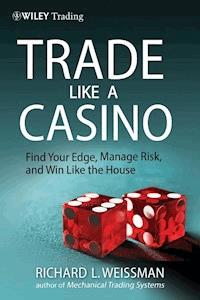
A detailed look at the common characteristics found in mostsuccessful traders While there are a variety of approaches to trading in thefinancial markets, profitable traders tend to share similarunderlying characteristics. Most have a methodology that theybelieve will prove profitable over the long run and are willing toendure short-term setbacks. If you're looking to make the most ofyour time in today's markets, you need to understand what separatesthe best from the rest. And with Trade Like a Casino, you'llgain the knowledge needed to excel at this challengingendeavor. Engaging and informative, this reliable guide identifies andexplains the key techniques and mental processes characteristic ofsuccessful traders. It reveals that successful traders operate verymuch like a casino in that they develop a method that gives them"positive expectancy" and they unflappably implement the method inthe face of changing, and oftentimes volatile, market conditions.Page by page, the book explores the intricacies of methodology,mental control, and flexibility that allow traders to develop andmaintain the casino-like edge. * Reveals how many successful traders tend to follow the samegeneral principles, even if their approach to trading maydiffer * Explores how to account for the risk of being wrong and themarket moving against you * Discusses how to develop an approach that combines tradeselection with sound risk management, avoids emotional attachmentto positions, exploits volatility cycles, and focuses on marketaction Regardless of how you approach markets, the insights found herewill help improve the way you trade by putting you in a betterposition to distinguish the differences between successful andunsuccessful traders.
Sie lesen das E-Book in den Legimi-Apps auf:
Seitenzahl: 351
Veröffentlichungsjahr: 2011
Ähnliche



















Contents
Cover
Series
Title Page
Copyright
Dedication
Preface
Acknowledgments
Part I: The Casino Paradigm
Chapter 1: Developing Positive Expectancy Models
WHY TECHNICAL ANALYSIS HELPS
THE INEFFICIENT MARKET
IF IT FEELS GOOD, DON'T DO IT
“JUST MAKE THE MONEY”
FINAL THOUGHTS
Chapter 2: Price Risk Management Methodologies
ONE SURE THING
BASE OF PYRAMID
MIDDLE OF PYRAMID
APEX OF PYRAMID
PROS AND CONS OF THE RISK MANAGEMENT PYRAMID
PUTTING IT ALL TOGETHER: A CASE STUDY
FINAL THOUGHTS
Chapter 3: Maintaining Unwavering Discipline
DEFINING DISCIPLINE
DISCIPLINE AND THE POSITIVE EXPECTANCY MODEL
TYPES OF TRADERS
DISCIPLINE AND PRICE RISK MANAGEMENT
PATIENCE AND DISCIPLINE
FINAL THOUGHTS
Part II: Trading Tools and Techniques
Chapter 4: Capitalizing on the Cyclical Nature of Volatility
THE ONLY CONSTANT
DEFINING VOLATILITY WITH TECHNICAL INDICATORS
BUILDING POSITIVE EXPECTANCY MODELS WITH VOLATILITY INDICATORS
FINAL THOUGHTS
Chapter 5: Trading the Markets and Not the Money
TEN THOUSAND DOLLARS IS A LOT OF MONEY!
BABY NEEDS A NEW PAIR OF SHOES
TRADING WITH SCARED MONEY
TIME IS MONEY
FINAL THOUGHTS
Chapter 6: Minimizing Trader Regret
THE SOFTER SIDE OF DISCIPLINE
ISSUES FOR TREND FOLLOWERS
ISSUES FOR MEAN REVERSION TRADERS
FINAL THOUGHTS
Chapter 7: Timeframe Analysis
TRADITIONAL TIMEFRAME ANALYSIS
TIMEFRAME CONFIRMATION TRADING
TIMEFRAME DIVERGENCE TRADING
FINAL THOUGHTS
Chapter 8: How to Use Trading Models
MECHANICAL TRADING SYSTEMS
NONMECHANICAL MODELS
EQUITY TRADING MODELS
FINAL THOUGHTS
Chapter 9: Anticipating the Signal
ALWAYS TRADE VALUE, NEVER TRADE PRICE
SUPPORT (AND RESISTANCE) WERE MADE TO BE BROKEN
DON'T ANTICIPATE, JUST PARTICIPATE
FINAL THOUGHTS
Part III: Trader Psychology
Chapter 10: Transcending Common Trading Pitfalls
CHARACTERISTICS OF MARKET BEHAVIOR
OBSTACLE MAKERS TO GROWTH AS A TRADER
FINAL THOUGHTS
Chapter 11: Analyzing Performance
A DUE DILIGENCE QUESTIONNAIRE
TRADING JOURNAL
FINAL THOUGHTS
Chapter 12: Becoming an Even-Tempered Trader
THE “I DON'T CARE” GUY
THE MASTER TRADER
REPROGRAMMING THE TRADER
FLEXIBILITY AND CREATIVITY
MEDITATION
VISUALIZATION
SOMATIC EXERCISES
FINAL THOUGHTS
Notes
PREFACE
CHAPTER 1 DEVELOPING POSITIVE EXPECTANCY MODELS
CHAPTER 2 PRICE RISK MANAGEMENT METHODOLOGIES
CHAPTER 3 MAINTAINING UNWAVERING DISCIPLINE
CHAPTER 4 CAPITALIZING ON THE CYCLICAL NATURE OF VOLATILITY
CHAPTER 6 MINIMIZING TRADER REGRET
CHAPTER 7 TIMEFRAME ANALYSIS
CHAPTER 8 HOW TO USE TRADING MODELS
CHAPTER 10 TRANSCENDING COMMON TRADING PITFALLS
CHAPTER 11 ANALYZING PERFORMANCE
CHAPTER 12 BECOMING AN EVEN-TEMPERED TRADER
Bibliography
About the Author
Index
Founded in 1807, John Wiley & Sons is the oldest independent publishing company in the United States. With offices in North America, Europe, Australia, and Asia, Wiley is globally committed to developing and marketing print and electronic products and services for our customers’ professional and personal knowledge and understanding.
The Wiley Trading series features books by traders who have survived the market’s ever-changing temperament and have prospered—some by reinventing systems, others by getting back to basics. Whether a novice trader, professional, or somewhere in between, these books will provide the advice and strategies needed to prosper today and well into the future.
For a list of available titles, visit our Web site at www.WileyFinance.com.
Copyright © 2011 by Richard L. Weissman. All rights reserved.
Published by John Wiley & Sons, Inc., Hoboken, New Jersey. Published simultaneously in Canada.
No part of this publication may be reproduced, stored in a retrieval system, or transmitted in any form or by any means, electronic, mechanical, photocopying, recording, scanning, or otherwise, except as permitted under Section 107 or 108 of the 1976 United States Copyright Act, without either the prior written permission of the Publisher, or authorization through payment of the appropriate per-copy fee to the Copyright Clearance Center, Inc., 222 Rosewood Drive, Danvers, MA 01923, (978) 750-8400, fax (978) 646-8600, or on the Web at www.copyright.com. Requests to the Publisher for permission should be addressed to the Permissions Department, John Wiley & Sons, Inc., 111 River Street, Hoboken, NJ 07030, (201) 748-6011, fax (201) 748-6008, or online at http://www.wiley.com/go/permissions.
Limit of Liability/Disclaimer of Warranty: While the publisher and author have used their best efforts in preparing this book, they make no representations or warranties with respect to the accuracy or completeness of the contents of this book and specifically disclaim any implied warranties of merchantability or fitness for a particular purpose. No warranty may be created or extended by sales representatives or written sales materials. The advice and strategies contained herein may not be suitable for your situation. You should consult with a professional where appropriate. Neither the publisher nor author shall be liable for any loss of profit or any other commercial damages, including but not limited to special, incidental, consequential, or other damages.
Charts in the book are used courtesy of CQG, Inc. © 2010. All rights reserved worldwide.
For general information on our other products and services or for technical support, please contact our Customer Care Department within the United States at (800) 762-2974, outside the United States at (317) 572-3993 or fax (317) 572-4002.
Wiley also publishes its books in a variety of electronic formats. Some content that appears in print may not be available in electronic books. For more information about Wiley products, visit our web site at www.wiley.com.
Library of Congress Cataloging-in-Publication Data:
Weissman, Richard L. Trade like a casino : find your edge, manage risk, and win like the house / Richard L. Weissman. p. cm. — (Wiley trading series) Includes bibliographical references and index. ISBN 978-0-470-93309-1 (cloth); ISBN 9781118137949 (ebk); ISBN 9781118137956 (ebk); ISBN 9781118137963 (ebk) 1. Speculation. 2. Investment analysis. 3. Risk management. 4. Portfolio management. I. Title. HG6015.W346 2011 332.64′5—dc22 2011016573
For my wife, Pamela Nations-Weissman, who laughed
when I swore I would never write another book.
Preface
You cannot beat a roulette table unless you steal money from it.
—Albert Einstein
A year ago, I was talking with a struggling trader about the profession of speculative trading. He asked a question that ultimately culminated in the publication of this book. That question was “Can someone really earn a living as a speculator?” This person was putting his life's savings on the line every day and yet did not know for certain whether anyone could actually earn a living through speculative trading. Then, on thinking back to my own start in this business, it occurred to me that I had done the same thing. If you have picked up this book and have been asking yourself that same question, there is good news and bad news. The good news is that the answer to the question is “Yes.” Yes, professional speculative trading is a valid career path. Yes, not only can it be done, but it has been, and continues to be accomplished by many professional traders. It is not a matter of luck or chance. The bad news is that it is one of the most difficult careers known to humankind. It is difficult because it requires us to consistently do that which is psychologically uncomfortable and unnatural (we revisit why trading is so difficult in great detail throughout the course of this book).
So how do we transform the dicey game of speculative trading into a valid career path? We do not start from scratch. No need to reinvent the wheel. No need for luck, chance, or even prayers. Instead, what is required is the adaptation of an existing successful business model to the career of speculation. That model is the casino paradigm.1 How do casinos make money? Although each and every spin of a roulette wheel is random, the casino remains unconcerned because probability is in their favor. In trading, we call this the development of positive expectancy trading models. Positive expectancy means that after deducting for liquidity risk—for example, the risk of price differences between our model's hypothetical entry or exit price and the actual entry or exit price—and commissions, our model is profitable.
But what if some multibillionaire walks into the casino with a cashier's check for a billion dollars? She finds the cashier quite happy to change her check into chips … no questions asked. But when she walks her wheelbarrow of chips over to the roulette wheel and tells the croupier, “Put it all on red,” she is politely told that there is a maximum table limit bet size of $10,000 per spin of the roulette wheel. Why does the casino need table limits if probability is skewed in their favor? Because they know that despite the odds being in their favor, on any particular spin of the wheel it could come up red, and if it did, our multibillionaire would own their casino. By using table limits, they force the player to limit her bet size, thereby ensuring that as they keep playing, the casino's probability edge will eventually swallow up the entire billion dollars. In speculative trading we call table limits price risk management.
The final prerequisite to the casino model was actually implicitly stated in both of the preceding paragraphs. The specific sentence that addressed this third prerequisite most clearly was “… the casino remains unconcerned because they have probability in their favor.” Casino owners do not become despondent or close the casino when players win. Instead, they continue playing the probabilities and managing the risk. They adhere to this paradigm 24 hours a day, seven days a week, and 365 days a year. They never abandon the paradigm irrespective of how good or how bad their results are on any given day, week, or month. In trading, we call unwavering adherence to positive expectancy trading models and price risk management trader discipline.
Of course, the model for successful speculative trading is more complex than the casino paradigm and throughout this book we explore these various complexities in great detail. Nevertheless, now the book's title makes more sense. Successful traders can walk under ladders, have trading accounts ending in the number 13, you name it … it makes absolutely no difference because successful speculation has nothing whatsoever to do with luck. Luck is what the gamblers hope for. By contrast, professional speculators consistently play the probabilities and manage the risk.
This book progresses in a linear fashion from basic, rudimentary concepts to those of greater complexity. Chapter explores the casino paradigm of trading with respect to the development of positive expectancy models in exhaustive detail. First, we look at why technical analysis helps in the development of positive expectancy trading models as well as the flaws in fundamental analysis as a standalone methodology for the development of positive expectancy models. Then we examine the limitations of technical analysis and how fundamental analysis can be used to minimize these limitations.
Chapter examines the casino paradigm of trading as it relates to price risk management. This chapter specifically introduces the reader to what I call the risk management pyramid. The base of the risk management pyramid includes traditional tools of price risk management such as stop loss placement and volumetric position sizing. Within the middle tier of the pyramid are tools used by the portfolio school of risk management, value-at-risk and stress testing. At the pyramid's apex is qualitative analysis by experienced risk managers that I call management discretion.
Chapter concludes our introduction to the casino paradigm with an in-depth exposition of trader discipline. It begins by defining discipline as it relates to speculative trading and explaining why adherence to a disciplined approach is difficult. Then we see how discipline relates to developing, implementing, and adhering to positive expectancy trading models and price risk management. Next is an examination of how the lack of discipline can undermine a positive expectancy trading model. No matter how robust a model is, there are times when the odds do not favor that model's employment. Standing aside during such periods requires patience and discipline, specifically the discipline not to trade until the market again displays the kind of behavior in which the odds are in our favor. The chapter concludes by looking at various types of market action that traders can exploit, as well as pitfalls to avoid in attempting to capitalize upon that type of action.
Chapter explores the best-kept secret in trading, the cyclical nature of volatility. No one can guarantee whether markets will trend, revert to the mean, go up, or go down. The only guarantee is that they will cycle from low volatility to high volatility and vice versa. This chapter examines all of the commonly employed tools for measuring volatility as well as showing how to incorporate them into a comprehensive variety of positive expectancy trading models.
Chapter looks at a problem that can undermine even the most robust of positive expectancy trading models. I call it trading the money. Inexperienced traders are always thinking about the money. In 2008, when crude oil dropped from $147 a barrel to $135 a barrel, that was a $12, or $12,000, move per contract. Traders who were thinking about the money took profits and then watched from the sidelines as the market moved another $100,000 per contract over the course of a couple of months. Trading the market and not the money means forcing the dynamics of the price action to dictate decisions to close out trades instead of making emotional decisions based on how much money you are making or risking.
Chapter focuses on different techniques to minimize emotions of regret. The greatest feelings of regret occur when we allow significant unrealized profits to turn into significant realized losses. We minimize these feelings of regret by not allowing unrealized profits to turn into realized losses and by taking partial profits at logical technical support or resistance levels. The other major source of regret for the trader is taking small profits only to see the market make huge moves. We minimize this feeling of regret by taking partial profits at logical support or resistance levels and allowing the remainder of the position to be held through the use of trailing stops.
Chapter discusses the importance of timeframe analysis. First, we look at the traditional approach to this analysis, namely, the simultaneous examination of multiple timeframes to better understand the market's trend, as well as multiple levels of technical support and resistance. Next is an introduction to one of the most valuable tools used by professional speculators, which I call timeframe divergence. Timeframe divergence occurs when shorter-term timeframes are out of sync with longer-term timeframes, and it enables traders to enjoy a low risk–high reward entry point in the direction of the longer-term trend. This chapter helps readers use technical analysis so they can better identify these trading opportunities.
Chapter examines a wide array of positive expectancy trend-following and mean reversion trading models. It also explores hybrid models that combine mean reversion technical indicators with longer-term trend-following tools, so that traders can enjoy low risk–high reward entry points taken in the direction of the longer-term trend.
Chapter introduces the reader to another psychological trap that can derail positive expectancy trading models. I call it anticipating the signal. Anticipating the signal occurs because traders tend to focus on selling at a high price—or buying at a low price—as opposed to selling only after there is evidence that a market top is in place (or buying only after there is evidence that a bottom is in place). In contrast to anticipating the signal, this chapter shows the benefits of waiting for evidence that it is time to sell or time to buy and explores some simple technical tools to help traders avoid this costly mistake.
Chapter examines common trading pitfalls and how to transcend them. By exploring characteristics of market behavior, the chapter offers traders techniques to aid in systematically stripping away delusional beliefs that can derail or impede performance. Then it explores various emotional states that can subvert or limit success in trading, and helps speculators develop a wide array of techniques to overcome various irrational trading biases.
Chapter offers a wide variety of techniques for analyzing and improving trader performance. The chapter begins with a comprehensive questionnaire to aid in highlighting strengths and weaknesses of speculators in areas such as trading edge identification, performance record analysis, trading methodologies, risk management methodologies, and trade execution considerations as well as research and development. Then I present one of the most powerful and underused tools for improving trader performance, the creation and maintenance of a trading journal.
Chapter explores the psychological mindset required to succeed with a positive expectancy model. I call it even-mindedness. Successful traders shouldn't care about the result of any specific trade because they consistently employ positive expectancy models combined with robust risk management techniques. Since that is the case, if they do care, then they (a) haven't done enough research to be certain that it is a positive expectancy trading methodology, (b) are not managing the risk, (c) are letting previous negative trading experiences sabotage their edge, or (d) are addicted to the gambler's mentality of needing to win as opposed to knowing that they will succeed.
In this final chapter, we look at various tools and techniques to get traders off the emotional euphoria-despondency roller coaster.
Richard L. Weissman
Acknowledgments
I believe that all of an individual's accomplishments are integrally linked to the totality of his or her life experiences. As such, all acknowledgments necessarily fall short of their goal. Having said this, I would like to thank family, friends, and colleagues for their support and encouragement in the writing of this book.
In addition, I would like to thank my wife, Pamela Nations-Weissman; Richard Hom, who continues to act as an unparalleled sounding board for many of my trading ideas; my friends and colleagues Dr. Alexander Elder, Konchog Tharchin, and James W. Shelton III; Stan Yabroff and Doug Janson at CQG; Stephen Gloyd, J. Scott Susich, Dominick Chirichella, and Salvatore Umek of the Energy Management Institute, who are tremendous advocates and supporters of my work; and my editorial team at John Wiley & Sons, Kevin Commins and Meg Freeborn.
I also wish to acknowledge my indebtedness to all the authors listed in this book's reference list. If this book has added anything to the fields of trading system development, trader psychology, risk management, and technical analysis, it is a direct result of their work. Finally, I would like to acknowledge the depth of my gratitude to my friend and teacher, Drupon Thiley Ningpo Rinpoche, and his teacher, His Holiness Drikung Kyabgon Chetsang Rinpoche, whose works have inspired and transformed my work and my life.
R. L. W.
Part I
The Casino Paradigm
Chapter 1
Developing Positive Expectancy Models
In the case of an earthquake hitting Las Vegas, be sure to go straight to the keno lounge. Nothing ever gets hit there.
—An anonymous casino boss
There are some prerequisite elements that are common to all successful trading programs. This and the next two chapters that follow will cover such elements: This chapter is on developing positive expectancy trading models, the second on implementing robust risk management methodologies, and the third on trader discipline. Let's get started.
WHY TECHNICAL ANALYSIS HELPS
Technical analysis is perhaps the single most valuable tool used in the development of positive expectancy trading models. According to technicians, the reason that technical analysis helps in the development of such models is due to the notion that “price has memory.” What does this mean? It means that when crude oil traded at $40 a barrel in 1990, this linear, horizontal resistance area would again act as resistance when retested in 2003 (see ). This reality drives economists crazy because, according to economic theory, it makes absolutely no sense for crude oil to sell off at $40 a barrel in 2003, since the purchasing power of the U.S. dollar in 2003 is different from its purchasing power in 1990. Nevertheless, according to technical analysis, the selloff at $40 a barrel in 2003 made perfect sense because price has memory. Price has memory means that traders experienced pain, pleasure, and regret associated with the linear price level of $40 a barrel. Let's look at this in greater detail.
Lesen Sie weiter in der vollständigen Ausgabe!
Lesen Sie weiter in der vollständigen Ausgabe!
Lesen Sie weiter in der vollständigen Ausgabe!
Lesen Sie weiter in der vollständigen Ausgabe!
Lesen Sie weiter in der vollständigen Ausgabe!
Lesen Sie weiter in der vollständigen Ausgabe!
Lesen Sie weiter in der vollständigen Ausgabe!
Lesen Sie weiter in der vollständigen Ausgabe!
Lesen Sie weiter in der vollständigen Ausgabe!
Lesen Sie weiter in der vollständigen Ausgabe!
Lesen Sie weiter in der vollständigen Ausgabe!
Lesen Sie weiter in der vollständigen Ausgabe!
Lesen Sie weiter in der vollständigen Ausgabe!
Lesen Sie weiter in der vollständigen Ausgabe!
Lesen Sie weiter in der vollständigen Ausgabe!
Lesen Sie weiter in der vollständigen Ausgabe!
Lesen Sie weiter in der vollständigen Ausgabe!




