


59,38 €
Mehr erfahren.
- Herausgeber: John Wiley & Sons
- Kategorie: Geisteswissenschaft
- Sprache: Englisch
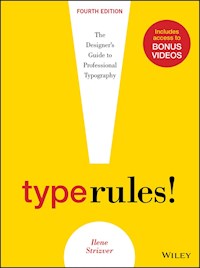
Type Rules!, Fourth Edition is an up-to-date, thorough introduction to the principles and practices of typography. From the fundamentals to cutting-edge applications, this edition has everything today's serious designer needs to use type effectively. Dozens of exercises reinforce authoritative coverage on such topics as how to select the appropriate type for the job, how to set type like a pro, and how to design a typeface, as well as how to fully harness the power of major design packages including the Adobe Creative Suite.Includes video clips showing examples of projects discussed in Chapter 11- Type on the Web and Chapter 12- Type in Motion
Sie lesen das E-Book in den Legimi-Apps auf:
Seitenzahl: 384
Veröffentlichungsjahr: 2014
Ähnliche



















CONTENTS
Cover
Title page
Copyright page
Dedication
Acknowledgements
Preface
Introduction
Chapter One: A Brief History of Type
Sounds to Symbols
Gutenberg and Movable Type
The Industrial Revolution and the Mechanization of Type
Photocomposition
Into the Digital Age
Exercise
Chapter Two: From Metal to MAC
What is a Font?
Font Formats
Hinting
Font Management Utilities
Exercise
Chapter Three: What Makes a Typeface Look the Way it Does?
Parts of a Character
Type Categories
Exercise
Chapter Four: Selecting the Right Type for the Job
Factors to Consider
What Makes a Good Typeface?
Text vs. Display
Type Super Families and Systems
Script, Calligraphic, and Handwriting Fonts
When the Best Font for the Job isn’t a font
Typographic Illustration
Mixing it up
Dos and Don’ts
Exercise
Chapter Five: Formatting your Type
Type Size
Line Length
Line Spacing (Leading)
Alignment
Indents and Other Paragraph Separators
Exercise
Chapter Six: Typographic Hierarchy and Emphasis
Typographic Hierarchy
Techniques for Emphasis
Exercise
Chapter Seven: Fine-Tuning and Tweaking your Type
Punctuation
Visual Alignment
Rags
Widows and Orphans
Exercise
Chapter Eight: Spacing Considerations
Tracking
Kerning
Word Spacing
Exercise
Chapter Nine: Finessing your Type
Small Caps
Initial Letters
Swash Characters
Alternate Characters
Type and Color
Exercise
Chapter Ten: Figures, Fractions, Signs, Symbols, and Dingbats
Figures
Fractions
Bullets
Registered, Trademark, and Copyright Symbols
Accents and Accented Characters
Parentheses, Brackets, Braces, and Angled Brackets
Euro
Ellipses
Dingbats and Ornaments
End Marks
Exercise
Chapter Eleven: Type on the Web (and other Digital Formats)
Characteristics of Type on the Web
Web-Safe Fonts
Web Fonts
Smart Punctuation on the Web
Cascading Style Sheets
Type as Graphic
Typographic Hierarchy on the Web
Dos and Don’ts
Smartphones, Tablets, E-Readers, and Other Devices
Exercise
Chapter Twelve: Type in Motion
Combining Type and Motion
Basic Guidelines
How to Get Started
Dos and Don’ts
Exercise
Chapter Thirteen: Designing your own Typeface
Handwriting Fonts: A Good Place to Begin
Three Approaches to Designing a Typeface
Professional Guidelines
Exercise
Appendix
Digital Font Foundries and Distributors
Web-Font Services
Typographic Resources
Glossary
Bibliography
Picture Credits
Index
Copyright © 2014 by Ilene Strizver. All rights reserved.
Published by John Wiley & Sons, Inc., Hoboken, New Jersey.
Published simultaneously in Canada.
No part of this publication may be reproduced, stored in a retrieval system, or transmitted in any form or by any means, electronic, mechanical, photocopying, recording, scanning, or otherwise, except as permitted under Section 107 or 108 of the 1976 United States Copyright Act, without either the prior written permission of the Publisher, or authorization through payment of the appropriate per-copy fee to the Copyright Clearance Center, 222 Rosewood Drive, Danvers, MA 01923, (978) 750-8400, fax (978) 646-8600, or on the web at www.copyright.com. Requests to the Publisher for permission should be addressed to the Permissions Department, John Wiley & Sons, Inc., 111 River Street, Hoboken, NJ 07030, (201) 748-6011, fax (201) 748-6008, or online at www.wiley.com/go/permissions.
Limit of Liability/Disclaimer of Warranty: While the publisher and author have used their best efforts in preparing this book, they make no representations or warranties with the respect to the accuracy or completeness of the contents of this book and specifically disclaim any implied warranties of merchantability or fitness for a particular purpose. No warranty may be created or extended by sales representatives or written sales materials. The advice and strategies contained herein may not be suitable for your situation. You should consult with a professional where appropriate. Neither the publisher nor the author shall be liable for damages arising herefrom.
For general information about our other products and services, please contact our Customer Care Department within the United States at (800) 762-2974, outside the United States at (317) 572-3993 or fax (317) 572-4002.
Wiley publishes in a variety of print and electronic formats and by print-on-demand. Some material included with standard print versions of this book may not be included in e-books or in print-on-demand. If this book refers to media such as a CD or DVD that is not included in the version you purchased, you may download this material at http://booksupport.wiley.com. For more information about Wiley products, visit www.wiley.com.
Library of Congress Cataloging-in-Publication Data:
Strizver, Ilene, 1953- Type rules! : the designer’s guide to professional typography / Ilene Strizver. -- Fourth edition. pages cm Includes bibliographical references and index. ISBN 978-1-118-45405-3 (pbk.); ISBN 978-1-118-74869-5 (ebk.); ISBN 978-1-118-75866-3 (ebk.) 1. Type and type-founding. 2. Graphic design (Typography) 3. Graphic design (Typography)--Computer programs. I. Title. Z250.S92 2014 686.2’21--dc23 2013018923 978-1-118-45405-3
DEDICATION
This book is dedicated to my father, Leonard Strizver, who taught me to believe in myself and that the sky was the limit to what I could accomplish. Unfortunately he did not live long enough to see his words take shape in my life.
I hope I have made you proud, Dad.
ACKNOWLEDGMENTS
As someone whose academic beginnings focused on music and fine art, I was extremely lucky to have crossed paths with some of the most openhearted and talented individuals in the world of typography and graphic design, almost in spite of myself. Aaron Burns, Ed Benguiat, Herb Lubalin, Bob Farber, and Allan Haley permanently altered my life’s path, and I will be forever indebted to them. Their creative brilliance coupled with their incredible generosity of spirit ignited within me a passion for type that will never be satiated.
Through the years, there have been countless graphic designers, type designers, typographers, and other creative professionals who have unselfishly shared their knowledge and passion for type and design with me. To all of them I offer my deepest thanks, for without them, this book never would have come to be.
I want to extend a heartfelt thanks to my typographic “partners in crime,” James Montalbano, Mark Jamra, Ken Barber, Otmar Hoefer, Thomas Phinney, and David Lemon, who have generously and willingly shared their expertise and resources.
A very warm thanks to my special friends Maxim Zhukov, Christopher Slye, Fred Brady, and Nat Brockman, who have so very graciously offered their time and professional assistance to help make this a better book.
In addition, a very special thanks goes out to Charles Nix, Scott Fisk, Brian Lucid, Heather Shaw, and Jakob Trollbäck, whose knowledge of today’s digital technology helped make Type Rules! a more useful, up-to-date tool for today’s graphics designers and students of design.
I would also like to extend my deepest gratitude to all the instructors who willingly shared their teaching methods and assignments with me and, as well, to the students who allowed the use of their assignment solutions for publication.
I could never express enough appreciation to all my students and workshop attendees. They continue to keep me on my toes; push me to learn newer and better methods, technique, and software; and challenge me to offer a better explanation. Their talent, enthusiasm, and passion for learning inspire me to be the best I can be.
And last but not least, a very special thanks to my editor, Margaret Cummins, whose unwavering belief in me and in this book, combined with her own vision of what it could be, inspired me to new heights.
PREFACE
This fourth edition of Type Rules! has been revised and expanded in a number of ways. The content has not only been updated to reflect current standards and practices in typography, design, and technology, but also significantly expanded to include the most up-to-date information on type on the web, type in motion, and type on other digital devices. All chapters have updated Techtips and Typetips, as well both new and tried-and-true Exercises, many of which include some very exciting student solutions.
* * * * *
This fourth edition has been expanded with the addition of bonus videos to accompany Chapters 11 and 12. When you see the video icon , visit http://www.wiley.com/go/typerules and enter the access code located at the back of this book to view the video content.
INTRODUCTION
Type is all around us, in everything we read, from product packaging in the grocery store to television commercials, from greeting cards, books, and magazines to movie credits and storefront signs. Learning to read and write the alphabet is one of the first things we are taught in school, and that process often begins before nursery school with television shows and videos intended for the hungry and curious minds of two- and three-year-olds.
Type and printed matter not only communicate information to us but also influence decisions we make on a daily basis. Whether we realize it or not, type and the way it appears affects which CD or book cover catches our eyes, which detergent we think might make the whites whiter, and which movie seems like it might be the scariest or most romantic. Much of this process goes on unconsciously, which is why the art and craft of typography is so invisible to the average person. But its unseen nature by no means diminishes the importance and influence type has on the quality and substance of our daily lives.
Type Rules! is intended for anyone interested in typography, be they a professional graphic designer, an instructor, or a novice computer user. There is something here for everyone, whether you know a little or a lot about type. This book does not have to be read front to back; you may thumb through the chapters and stop wherever something sparks your interest, or you may read it chapter after chapter, cover to cover. This book will stimulate and satisfy the neophyte’s interest in type as well as offer advanced information and techniques to professional graphic designers who want to improve their work.
Typography is not taught (or taught effectively, in my experience) in every design school, as it should be. When it is, the focus is often on typographic design in its broadest sense, not the nuts and bolts of how to set type tastefully and effectively; addressing this void is my primary objective. This book is intended to help you learn how to communicate effectively and professionally with type, no matter what the medium, device, or platform.
* * * * *
I can trace my interest in type and letterforms back to the posters I drew for my junior high school elections. I remember spending hours on the lettering: measuring out the strokes of each character, the spaces between each letter, and the spaces between the lines. Those posters would appear extremely crude by professional standards, but my interest in the geometry of letters and the relationships between their positive and negative spaces was evident even then.
After studying music and then fine art in college, I was lucky enough to land a seat in Ed Benguiat’s lettering class at the School of Visual Arts in New York City; my life was never the same again. Ed instilled in me the passion for type that I have today and with which I will attempt to infect you. The bad news is that if I succeed, there is really no cure for it; the good news is that “catching it” will open your eyes to many exciting things you have never seen before and allow you to enjoy and appreciate the world around you in a completely new way.
CHAPTER ONE
A BRIEF HISTORY OF TYPE
The story of type doesn’t begin with type per se, rather it starts with the beginning of mankind and civilization. Type has only existed for about 560 years, but its beginnings are rooted in the life of the caveman himself, as it was his developing needs and habits that led civilization on a path toward the evolution of the alphabet and subsequently the invention of type and printing. It is certainly possible to learn to use type effectively and tastefully without knowing its roots, but to fully understand and appreciate type today, it is important to know something of the past.
Milestones in the history of type are highlighted throughout this chapter. Some of the dates, chronology, and details vary from source to source, but the spirit of the events remains the same. These events have taken mankind on a glorious ride from the crudest cave drawings to the bits and bytes of type in the digital age.
SOUNDS TO SYMBOLS
For many years, early humans communicated purely with sound. Verbal language—which is heard and not seen as opposed to visual language (or visible language, as it is often called)—has many limitations: it is gone the instant it is spoken and heard, and it is therefore temporary. Stories, history, and other information could not be passed from generation to generation in a permanent way, only by direct word of mouth.
The earliest attempts to record stories and ideas were through cave drawings; the first known is dated around 25,000 BC. These drawings, or pictographs, were very simple representations of people, places, and things, and for this reason, they were relatively easy to learn and understand. Although this was a very simple form of written communication, it was certainly more permanent than sound, and much of it has survived the ravages of time and still exists today. (Fig. 1-1)
Figure 1-1 This Aboriginal rock painting (c. 13,000 BC), located in a cave in Queensland, Australia, is a distinctive example of the earliest form of written communication.
Lesen Sie weiter in der vollständigen Ausgabe!
Lesen Sie weiter in der vollständigen Ausgabe!
Lesen Sie weiter in der vollständigen Ausgabe!
Lesen Sie weiter in der vollständigen Ausgabe!
Lesen Sie weiter in der vollständigen Ausgabe!
Lesen Sie weiter in der vollständigen Ausgabe!
Lesen Sie weiter in der vollständigen Ausgabe!
Lesen Sie weiter in der vollständigen Ausgabe!
Lesen Sie weiter in der vollständigen Ausgabe!
Lesen Sie weiter in der vollständigen Ausgabe!
Lesen Sie weiter in der vollständigen Ausgabe!
Lesen Sie weiter in der vollständigen Ausgabe!
Lesen Sie weiter in der vollständigen Ausgabe!
Lesen Sie weiter in der vollständigen Ausgabe!
Lesen Sie weiter in der vollständigen Ausgabe!
Lesen Sie weiter in der vollständigen Ausgabe!
Lesen Sie weiter in der vollständigen Ausgabe!




