


230,99 €
Mehr erfahren.
- Herausgeber: John Wiley & Sons
- Kategorie: Fachliteratur
- Sprache: Englisch
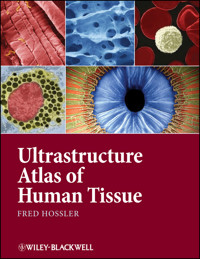
Ultrastructure Atlas of Human Tissues presents a variety of scanning and transmission electron microscope images of the major systems of the human body. Photography with the electron microscope records views of the intricate substructures and microdesigns of objects and tissues, and reveals details within them inaccessible to the naked eye or light microscope. Many of these views have significance in understanding normal structure and function, as well as disease processes. This book offers a unique and comprehensive look at the structure and function of tissues at the subcellular and molecular level, an important perspective in understanding and combating diseases. * Presents the major systems of the human body through scanning and transmission electron microscope images * Has images prepared almost exclusively from human tissues * Includes electron micrographs of common pathologies such as fibrotic and emphysemic lung, kidney stones, sickle cell anemia, and skin parasites * Contains sets of 3D images in most chapters
Sie lesen das E-Book in den Legimi-Apps auf:
Seitenzahl: 567
Veröffentlichungsjahr: 2014
Ähnliche



















ULTRASTRUCTURE ATLAS OF HUMAN TISSUES
Fred E. Hossler, PhD
Professor Emeritus of Biomedical Sciences J.H. Quillen College of Medicine East Tennessee State University Johnson City, Tennessee, USA
Copyright © 2014 by John Wiley & Sons, Inc. All rights reserved.
Published by John Wiley & Sons, Inc., Hoboken, New Jersey Published simultaneously in Canada
No part of this publication may be reproduced, stored in a retrieval system, or transmitted in any form or by any means, electronic, mechanical, photocopying, recording, scanning, or otherwise, except as permitted under Section 107 or 108 of the 1976 United States Copyright Act, without either the prior written permission of the Publisher, or authorization through payment of the appropriate per-copy fee to the Copyright Clearance Center, Inc., 222 Rosewood Drive, Danvers, MA 01923, (978) 750-8400, fax (978) 750-4470, or on the web at www.copyright.com. Requests to the Publisher for permission should be addressed to the Permissions Department, John Wiley & Sons, Inc., 111 River Street, Hoboken, NJ 07030, (201) 748-6011, fax (201) 748-6008, or online at http://www.wiley.com/go/permission.
Limit of Liability/Disclaimer of Warranty: While the publisher and author have used their best efforts in preparing this book, they make no representations or warranties with respect to the accuracy or completeness of the contents of this book and specifically disclaim any implied warranties of merchantability or fitness for a particular purpose. No warranty may be created or extended by sales representatives or written sales materials. The advice and strategies contained herein may not be suitable for your situation. You should consult with a professional where appropriate. Neither the publisher nor author shall be liable for any loss of profit or any other commercial damages, including but not limited to special, incidental, consequential, or other damages.
For general information on our other products and services or for technical support, please contact our Customer Care Department within the United States at (800) 762-2974, outside the United States at (317) 572-3993 or fax (317) 572-4002.
Wiley also publishes its books in a variety of electronic formats. Some content that appears in print may not be available in electronic formats. For more information about Wiley products, visit our web site at www.wiley.com.
Library of Congress Cataloging-in-Publication Data:
Hossler, Fred E., author. Ultrastructure atlas of human tissues / Fred E. Hossler. p. ; cm. Includes bibliographical references and index. ISBN 978-1-118-28453-7 (cloth) I. Title. [DNLM: 1. Histology–Atlases. 2. Tissues–ultrastructure–Atlases. 3. Microscopy, Electron–Atlases. QS 517] QM557 611′.018–dc23
2013042704
Cover image: © Fred E. Hossler Cover design by Nicole Teut
This atlas is dedicated to my parents, Leroy E. and Mildred E. Hossler, who taught me to appreciate the beauty of living things and the value of fine, detailed images of them. Mildred was a well-known water color artist and school teacher in Hamburg, Berks County, Pennsylvania.
CONTENTS
Preface
Acknowledgments
Note to Readers
I. CELLULAR ORGANELLES AND SURFACE SPECIALIZATIONS
A. NUCLEI AND NUCLEOLI
B. MITOCHONDRIA
C. GOLGI COMPLEX
D. ROUGH ENDOPLASMIC RETICULUM AND SMOOTH ENDOPLASMIC RETICULUM
E. LYSOSOMES
F. CYTOPLASMIC INCLUSIONS
G. PLASMA MEMBRANE JUNCTIONS
H. MICROVILLI
I. CILIA AND CENTRIOLES
J. PLASMA MEMBRANE INFOLDINGS
II. BLOOD CELLS
A. BLOOD COMPOSITION
B. RED BLOOD CELLS
C. SICKLE CELL ANEMIA
D. GRANULAR LEUKOCYTES— NEUTROPHILS, EOSINOPHILS, AND BASOPHILS
E. NONGRANULAR LEUKOCYTES— LYMPHOCYTES AND MONOCYTES
F. BLOOD PLATELETS—BLOOD CLOTS
III. CONNECTIVE TISSUES
A. COMPOSITION
B. RESIDENT CELLS—FIBROBLASTS, ADIPOCYTES, MAST CELLS
C. BLOOD CELL DERIVATIVES— NEUTROPHILS, EOSINOPHILS, LYMPHOCYTES, MACROPHAGES, AND PLASMA CELLS
D. LOOSE CONNECTIVE TISSUE EXAMPLE: LAMINA PROPRIA
E. DENSE IRREGULAR CONNECTIVE TISSUE EXAMPLES: DERMIS AND CAPSULES OF ORGANS
F. DENSE REGULAR CONNECTIVE TISSUE
G. CARTILAGE—HYALINE CARTILAGE AND FIBROCARTILAGE
H. BONE—COMPACT BONE AND CANCELLOUS BONE
IV. MUSCLE TISSUES
A. OVERVIEW
B. SMOOTH MUSCLE—WALL OF COLON, BRANCHED FIBERS IN WALL OF URETER, WALLS OF BLOOD VESSELS
C. SKELETAL MUSCLE
D. CARDIAC MUSCLE—ATRIUM
V. NERVE TISSUES
A. OVERVIEW
B. PERIPHERAL NERVES—OPTIC NERVE, SCIATIC NERVE, NERVE IN WALL OF COLON, MYELINATED AND UNMYELINATED NERVES
C. CENTRAL NERVOUS SYSTEM—CEREBRUM
VI. CARDIOVASCULAR SYSTEM
A. OVERVIEW
B. ARTERIES
C. VEINS
D. CAPILLARIES
E. HEART-ATRIUM
VII. LYMPHATIC TISSUES
A. OVERVIEW
B. SPLEEN
C. THYMUS
D. LYMPH NODES, LYMPH NODULES/DIFFUSE LYMPHATIC TISSUE
E. TONSILS
VIII. GASTROINTESTINAL TRACT
A. ORAL CAVITY
B. OVERVIEW OF THE ALIMENTARY CANAL
C. ESOPHAGUS
D. STOMACH
E. SMALL INTESTINES— DUODENUM, JEJUNUM, AND ILEUM
F. LARGE INTESTINE (COLON) AND APPENDIX
IX. LIVER AND GALL BLADDER
A. LIVER
B. GALL BLADDER
X. PANCREAS
XI. RESPIRATORY TRACT
A. OVERVIEW
B. TRACHEA, BRONCHI, AND BRONCHIOLES
C. LUNGS
XII. URINARY TRACT
A. OVERVIEW
B. KIDNEY
C. URETERS, BLADDER, AND URETHRA
XIII. SKIN
A. OVERVIEW
B. EPIDERMIS
C. DERMIS AND HYPODERMIS
D. SKIN PARASITES
XIV. EYE
XV. EAR
A. OVERVIEW
B. MIDDLE EAR
C. INNER EAR
XVI. MALE REPRODUCTIVE SYSTEM
A. TESTIS AND EPIDIDYMIS
B. VAS DEFERENS
C. SEMINAL VESICLE
D. PROSTATE GLAND
E. BULBOURETHRAL GLANDS, GLANDS OF LITTRE, AND THE PENIS
XVII. FEMALE REPRODUCTIVE SYSTEM
A. OVERVIEW AND OVARY
B. OVIDUCT
C. UTERUS AND CERVIX
D. VAGINA
E. PLACENTA
F. MAMMARY GLAND (INACTIVE)
XVIII. THYROID, PARATHYROID, AND ADRENAL GLANDS—EXAMPLES OF ENDOCRINE ORGANS
A. THYROID GLAND
B. PARATHYROID GLANDS
C. ADRENAL GLANDS
References
Index
End User License Agreement
List of Illustrations
Chapter 1
FIGURES I-1.
and I-4.
I-1 Nucleus of epithelial cell from human jejunum. ×14 167. I-2 Nucleus of cell from human gall bladder. ×8409. I-3 Nucleus (N) of human kidney tubule cell. ×25 000. I-4 Nucleus of fibroblast from human kidney. ×20 521. N, nucleolus; E, euchromatin; H, heterochromatin.
FIGURES I-5.
and I-6.
I-5 Plasma cell from human colon. Note “spoke wheel” pattern of nucleolus (N) and heterochromatin (H). ×15286. I-6 Plasma cell cluster from human jejunum. Again note peripheral heterochromatin pattern in nuclei. ×2250. E, euchromatin; R, rough endoplasmic reticulum; H, heterochromatin.
FIGURES I-7.
and I-10.
I-7 Comparison of nuclei of fibroblast (F) and epithelial lining cells (E) from human colon. I-8 and I-9 Human fibroblasts demonstrating irregular nuclear shapes influenced by cell shapes. ×23 000 and ×21 585. I-10 Cells within a capillary in the wall of the human ureter demonstrate variations in nuclei. The lymphocyte (L) has a somewhat rounded and condensed nucleus, the neutrophil (N), exhibits a highly condensed, multilobed nucleus, while the red blood cell (R) has given up its nucleus. ×15 400.
FIGURES I-11.
and I-14.
I-11 Human lymphocytes showing rounded, somewhat indented, and condensed nuclei. ×34 367. I-12 Human neutrophil with extensive nuclear lobation. ×7600. I-13 Human skeletal muscle from the tibialis anterior. Skeletal muscle cells are multinucleated. Seen here are two adjacent muscle cells, each showing a single nucleus along its periphery. ×5106. I-14 Cardiac myocytes from the human atrium. Cardiac myocytes may contain one or two nuclei. The cell at the right center may have two nuclei or, more likely, the tissue section may have been cut along the edge of a single nucleus. ×5000.
FIGURES I-15.
to I-18.
Clusters of mitochondria from distal tubule cells in the human kidney. M, matrix space; C, cristae. ×45 625, ×61 818, ×81 820, and ×53 500.
FIGURES I-19.
to I-20.
I-19 Golgi complex in chief cell of human fundus. ×15 000. I-20 Golgi complex in chief cell of human fundus. ×26 700. G, Golgi complex; F, forming face of Golgi; M, maturing face of Golgi; R, rough endoplasmic reticulum; SV, secretory vesicle.
FIGURES I-21.
to I-24.
I-21 Golgi complex in distal tubule cell of human kidney. ×55 652. I-22 Golgi complex in epithelial cell in human gall bladder. ×7800. I-23 Epithelial cell in human colon. ×11 923. I-24 Epithelial cell in human gall bladder. ×13 000. G, Golgi complex; F, forming face of Golgi complex; M, maturing face of Golgi complex; SV, secretory vesicles; S, smooth endoplasmic reticulum; R, rough endoplasmic reticulum.
FIGURES I-25.
to I-26.
I-25 Human hepatocyte. I-26 Epithelial cell in human ileum. N, nucleus; R, rough endoplasmic reticulum; arrows, ribosomes.
FIGURES I-27.
to I-30.
I-27 to I-29 Rough endoplasmic reticulum in human pancreatic islet cells. ×40 000, ×50 000, and ×40 000. I-30 Rough endoplasmic reticulum in a human hepatocyte. ×24 000. N, nucleus; M, mitochondria; arrows, ribosomes.
FIGURES I-31.
to I-32.
I-31 Neutrophil within a capillary in the human lung. ×18 139. I-32 Active macrophage in the lamina propria of the human ileum displaying unusually large lysosomes. ×18 750. N, nucleus; arrows, lysosomes.
FIGURES I-33.
to I-34.
I-33 Human hepatocyte. ×6923. I-34 Fibroblast in the lamina propria of the human colon. ×23 000. N, nucleolus; R, rough endoplasmic reticulum; L, lipid droplets.
FIGURES I-35.
to I-38.
I-35 Adipose tissue from human dermis. ×77. I-36 Fat cells from human dermis. ×500. I-37 Fat cells from human dermis. ×580. I-38 Cross section of edge of a fat cell from human dermis. ×2500. N, nucleus; F, fat deposit; C, collagen fibrils.
FIGURES I-39.
to I-42.
I-39 Human liver cell. I-40 Human liver cell. I-41 Keratinocyte from human skin. ×11 600. I-42 Details of cytoplasm of keratinocyte from human skin. ×16 000. G, glycogen; M, mitochrondria; R, rough endoplasmic reticulum; N, nucleus; P, melanin granules; arrow, desmosome.
FIGURES I-43.
to I-44.
I-43 Apical junction between two epithelial lining cells in the human jejunum. ×39 000. I-44 Apical junction between two epithelial lining cells in the human jejunum. ×92 308. A, adhering junction; D, desmosomes; M, microvilli; T, tight junction; W. terminal web.
FIGURES I-45.
to I-48.
I-45 Details of the junctional complex at the apical borders of two epithelial cells in the human jejunum. ×173 077. I-46 A desmosome along the lateral borders of two epithelial cells in the human jejunum. ×133 000. I-47 Two desmosomes joining the adjacent lateral plasma membranes of two epithelial cells in the human jejunum. ×73 000. I-48 Desmosome joining the adjacent lateral plasma membranes of two epithelial cells in the human jejunum. ×74 193. A, adhering junction; D, desmosome; T, tight junction; K, keratin filaments; P, free polysomes; W, terminal web; arrowheads, keratin filaments.
Lesen Sie weiter in der vollständigen Ausgabe!
Lesen Sie weiter in der vollständigen Ausgabe!
Lesen Sie weiter in der vollständigen Ausgabe!
Lesen Sie weiter in der vollständigen Ausgabe!
Lesen Sie weiter in der vollständigen Ausgabe!
Lesen Sie weiter in der vollständigen Ausgabe!
Lesen Sie weiter in der vollständigen Ausgabe!
Lesen Sie weiter in der vollständigen Ausgabe!
Lesen Sie weiter in der vollständigen Ausgabe!
Lesen Sie weiter in der vollständigen Ausgabe!
Lesen Sie weiter in der vollständigen Ausgabe!
Lesen Sie weiter in der vollständigen Ausgabe!
Lesen Sie weiter in der vollständigen Ausgabe!
Lesen Sie weiter in der vollständigen Ausgabe!
Lesen Sie weiter in der vollständigen Ausgabe!
Lesen Sie weiter in der vollständigen Ausgabe!
Lesen Sie weiter in der vollständigen Ausgabe!
Lesen Sie weiter in der vollständigen Ausgabe!
Lesen Sie weiter in der vollständigen Ausgabe!
Lesen Sie weiter in der vollständigen Ausgabe!
Lesen Sie weiter in der vollständigen Ausgabe!
Lesen Sie weiter in der vollständigen Ausgabe!
Lesen Sie weiter in der vollständigen Ausgabe!
Lesen Sie weiter in der vollständigen Ausgabe!




