


17,99 €
Mehr erfahren.
- Herausgeber: John Wiley & Sons
- Kategorie: Geisteswissenschaft
- Serie: Key Contemporary Thinkers
- Sprache: Englisch
This book provides a comprehensive introduction to the work and thought of Umberto Eco - one of the most important writers in Europe today.
Das E-Book Umberto Eco wird angeboten von Polity und wurde mit folgenden Begriffen kategorisiert:
work; umberto; writers; important; eco; introduction; book; comprehensive; bestselling; worldfamous; became; rose; novel; name; decades; fields; writings; influential; many; several; studies; literary; ecos; theory; art; aesthetics; medieval
Sie lesen das E-Book in den Legimi-Apps auf:
Seitenzahl: 432
Veröffentlichungsjahr: 2013
Ähnliche



















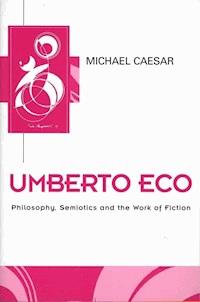
UMBERTO ECO
Philosophy, Serniotics and the Work of Fiction
Michael Caesar
Polity Press
Copyright © Michael Caesar 1999
The right of Michael Caesar to be identified as author of this work has been asserted in accordance with the Copyright, Designs and Patents Act 1988.
First published in 1999 by Polity Press in association with Blackwell Publishers Ltd.
Editorial office:Polity Press65 Bridge StreetCambridge CB2 1UR, UK
Marketing and production: Blackwell Publishers Ltd 108 Cowley Road Oxford OX4 1JF, UK
Published in the USA by Blackwell Publishers Inc. Commerce Place 350 Main Street Malden, MA 02148, USA
All rights reserved. Except for the quotation of short passages for the purposes of criticism and review, no part of this publication may be reproduced, stored in a retrieval system, or transmitted, in any form or by any means, electronic, mechanical, photocopying, recording or otherwise, without the prior permission of the publisher.
Except in the United States of America, this book is sold subject to the condition that it shall not, by way of trade or otherwise, be lent, re-sold, hired out, or otherwise circulated without the publisher’s prior consent in any form of binding or cover other than that in which it is published and without a similar condition including this condition being imposed on the subsequent purchaser.
ISBN 0-7456-0849-3
ISBN 0-7456-0850-7 (pbk)
ISBN 978-0-7456-6594-8 (ebook)
A catalogue record for this book is available from the British Library and has been applied for from the Library of Congress.
Typeset in 10 1/2 on 12 pt Palatino by Best-set Typesetter Ltd, Hong Kong Printed in Great Britain by MPG Books, Bodmin, Cornwall
This book is printed on acid-free paper.
Key Contemporary Thinkers
Published
Jeremy Ahearne, Michel de Certeau: Interpretation and its Other
Peter Burke, The French Historical Revolution: The Annales School 1929-1989
Michael Caesar, Umberto Eco: Philosophy, Semiotics and the Work of Fiction
Colin Davis, Levinas: An Introduction
Simon Evnine, Donald Davidson
Edward Fullbrook and Kate Fullbrook, Simone de Beauvoir: A Critical Introduction
Andrew Gamble, Hayek: The Iron Cage of Liberty
Phillip Hansen, Hannah Arendt: Politics, History and Citizenship
Sean Homer, Fredric Jameson: Marxism, Hermeneutics, Postmodernism
Christopher Hookway, Quine: Language, Experience and Reality
Christina Howells, Derrida: Deconstruction from Phenomenology to Ethics
Simon Jarvis, Adorno: A Critical Introduction
Douglas Kellner, Jean Baudrillard: From Marxism to Post-Modernism and Beyond
Chandran Kukathas and Phillip Pettit, Rawls: A Theory of Justice and its Critics
Lois McNay, Foucault: A Critical Introduction
Philip Manning, Erving Goffman and Modern Sociology
Michael Moriarty, Roland Barthes
William Outhwaite, Habermas: A Critical Introduction
John Preston, Feyerabend: Philosophy, Science and Society
Susan Sellers, Hélène Cixous: Authorship, Autobiography and Love
David Silverman, Harvey Sacks: Social Science and Conversation Analysis
Geoffrey Stokes, Popper: Philosophy, Politics and Scientific Method
Georgia Warnke, Gadamer: Hermeneutics, Tradition and Reason
James Williams, Lyotard: Towards a Postmodern Philosophy
Jonathan Wolff, Robert Nozick: Property, Justice and the Minimal State
Forthcoming
Maria Baghramian, Hilary Putnam
Sara Beardsworth, Kristeva
James Carey, Innis and McLuhan
Thomas D’Andrea, Alasdair Maclntyre
Eric Dunning, Norbert Elias
Jocelyn Dunphy, Paul Ricoeur
Nigel Gibson, Frantz Fanon
Graeme Gilloch, Walter Benjamin
Espen Hammer, Stanley Cavell
Sarah Kay, Žižek: A Critical Introduction
Paul Kelly, Ronald Dworkin
Valerie Kennedy, Edward Said
Carl Levy, Antonio Gramsci
James McGilvray, Chomsky: Language, Mind, and Politics
Harold Noonan, Frege
Wes Sharrock and Rupert Read, Kuhn
Nick Smith, Charles Taylor
Nicholas Walker, Heidegger
Contents
Acknowledgements
Note on References
Introduction
1Form, Interpretation and the Open Work
On form and interpretation: from Croce to Pareyson
Art and rationality
The appearance of Opera aperta
The poetics of the open work
Beyond ‘openness’
2A Critical View of Culture: Mass Communications, Politics and the Avant-garde
The role of the avant-garde
Mass communications and theories of mass culture
Television and semiotic guerrilla war
Openness and structure
3Introducing the Study of Signs
Signals and sense
Ambiguity, self-reflexivity and the aesthetic message
The critique of iconism
Some provisional conclusions on the aesthetic message
4A Theory of Semiotics
From La struttura assente to A Theory of Semiotics
Communication, code and signification
Sign and sign-function
Sign production, iconism and the aesthetic message (again)
5Semiotics Bounded and Unbound
The boundaries of semiotics
The dynamics of semiosis
6Theory and Fiction
Readers and worlds
Texts
7Secrets, Paranoia and Critical Reading
8Kant, the Platypus and the Horizon
Notes
Select Bibliography
Index
Acknowledgements
I am grateful to Harvard University Press for permission to quote from the English translation of The Open Work (1989), to Harcourt Brace and Company for permission to quote from the English translations of The Name of the Rose (1983) and The Island of the Day Before (1995), and to Indiana University Press for permission to quote from A Theory of Semiotics (1976) and The Role of the Reader (1979), and to use the diagram from The Role of the Reader reproduced here on p. 129.
Every effort has been made to trace the copyright holders, but if any have been inadvertently overlooked, the publishers will be pleased to make the necessary arrangements at the first opportunity.
Note on References
The following forms of referencing are used:
A.Writings by Eco published in volume form (which include many essays first published elsewhere) are referred to by the initial letters of the title and page number. Full details are given in section A of the Select Bibliography, pp. 184-6. In the case of Eco’s theoretical works, reference is normally given to editions in both Italian and English, where the latter exists; exceptions to this norm are explained in the text.
B.Shorter writings by Eco not available in volume form: these are indicated by the author’s name, date of publication and short title. Full details are given in section B of the Select Bibliography.
C.Writings by authors other than Eco are referred to by the author’s name and short title. Full details are given in section C of the Select Bibliography.
Introduction
Umberto Eco was born in Alessandria (Piedmont) in 1932. He graduated in philosophy from Turin University in 1954 with a thesis on the aesthetics of Thomas Aquinas. After that his curriculum vitae starts to get complicated. His religious faith began to wane after a militant youth in Catholic Action; the middle and late 1950s were for him a period of religious and political crisis, which finally resolved into that sort of humanist secularism that has characterized his writing ever since (but nobody who has had such an education, he says, ever entirely loses a sense of the religious). It was also a period of professional and intellectual ferment. He was working for a time for the state television company and becoming involved in the artistic and cultural life of Milan at a particularly creative moment of its recent history. The outcome was two books that made Eco’s reputation in Italy and, within a short time, more widely in Europe too. Opera aperta (The Open Work), published in 1962, sought to establish an aesthetics of indeterminacy in modern art, particularly music and the visual arts. Apocalittici e integrati (‘Apocalyptic and Integrated Intellectuals’, 1964) was the first sustained attempt in Italy to understand how the messages transmitted by the media of popular culture actually work. Since the first edition of Opera aperta also included a book-length study of James Joyce, and Eco’s Joyce shared with his author a not inconsiderable interest in Aquinas, these publications of the early 1960s brought together three strong interests which on the face of it seemed well-nigh incompatible: medieval scholasticism, avant-garde art and contemporary popular culture.
Eco’s search for a philosophical discourse which would bring the objects of his research within a unified field took him beyond the post-Crocean aesthetics of his younger years through linguistics and information theory to structuralism and semiotics. The period from the mid-1960s to the mid-1970s was devoted to the construction of a theory of semiotics, of which the most visible outcome was the book of that title, first published in Italy in 1975. The works of the 1960s and 1970s involve a considerable effort of theoretical intensity, but it was never in Eco’s case detached from engagement with social praxis. What Eco was undertaking was the construction of a theory of semiotics which would be a theory of the constitution and understanding of human cultural phenomena, an enterprise which in his more tongue-in-cheek moments he cheerily accepted as ‘imperialistic’ in its scope and ambition. It was during the 1960s too that Eco began to obtain regular employment as an academic, first as a lecturer in aesthetics at Turin (1961-4), then teaching the semiology of visual communication in the Architecture Faculty at Florence (1966-9) and semiotics, again in Architecture, at the Milan Polytechnic (1969-71), before moving in 1971 to the University of Bologna, which has been his academic base ever since.
The itinerary sketched out above is described in greater detail in the first four chapters of this book, which follow Eco’s trajectory in broadly chronological sequence. Chapter 1 presents and analyses a series of pre-semiotic aesthetic positions which, though later incorporated into a wider vision, remain formative. Chapter 2 introduces the reader to Eco’s reflections on mass culture, reflections which gave the essential impetus to the construction of his semiotics. The principal aim throughout is to present Eco’s thought in as clear and accurate a manner as possible, and this aim is particularly evident in the two chapters (chapters 3 and 4) on the evolution of his systematic semiotics between 1967 and 1975: here more than anywhere else the discussion keeps closely to the order and argument of Eco’s own text, while essential contextual information is provided in a relatively condensed form.
Chapter 5 represents a transition in the book, as we move from an account of the arguments put forward in A Theory of Semiotics to a discussion of some of the more important objections to it and of Eco’s clarifications of semiotic issues (some of them in partial, and not always direct, response to his critics). After A Theory of Semiotics, three major lines are discernible in Eco’s work. Firstly, there is a continuing preoccupation with questions of logic and epistemology, often focused around Eco’s continuing reflection on the theories of C. S. Peirce, and with an increasing interest in the work of the cognitive sciences in recent years: Semiotics and the Philosophy of Language is an important staging-post in this journey and is discussed here in chapter 5. In the second place, Eco pays particular attention from the late 1970s on to text pragmatics and theories of narrativity (Lector in fabula and its English-language cousin The Role of the Reader both appeared in 1979); his semiotic concerns loop back here to issues first raised in Opera aperta and other essays from his early years, issues that have to do with the nature, scope and limits of interpretation (The Limits of Interpretation, 1990). And finally, it is during this same period that Eco conquers planetary fame as a novelist: The Name of the Rose was published in Italy in 1980, succeeded by Foucault’s Pendulum in 1988 and The Island of the Day Before in 1994, translations closely following in their wake.
chapters 6 and 7 examine the relation between the theory and practice of fiction from different points of view. The first discusses Eco’s views concerning the construction of model readers and fictional worlds and analyses the three novels together from a meta-textual stance; it resolutely refuses, however, to regard the novels as ‘applications’ of the theory. Chapter 7 raises two critical questions about the body of work produced between 1979 and 1994, asking how far Eco’s denunciation of ‘hermetic’ interpretation (in the name of limits) might be turned against his own theory, and whether his important distinction between the use and the interpretation of literary texts is adequate to a description of the reading process. The distant origins of this chapter in a public lecture may still be perceptible in the marginally more relaxed tone of its argument. The final chapter (chapter 8) introduces the substantial collection of philosophical essays which Eco published in late 1997 with the intriguing title Kant e l’ornitorinco (Kant and the Platypus); he particularly recommended it to readers of A Theory of Semiotics on the grounds that it contained a rethinking of some of his old positions. As well as giving a brief account of the major issues touched on in Kant, chapter 8 ends with a metaphor, perhaps appropriately for a thinker for whom the aesthetic text has always had particular resonance; the metaphor in question is one that is uniquely powerful in the more recent Eco. The reader of this book will, I hope, understand why any greater sense of closure than that would be entirely alien to a practice of thought that over some forty years has not ceased to evolve and deepen.
Eco is a prolific, and highly professional, writer. A study like this, which draws on the most public and monumental of Eco’s productions, particularly those in book form, cannot do justice even to all the books. Eco the medievalist, who has written extensively on medieval philosophy and aesthetics (Art and Beauty in the Middle Ages was translated into English in 1986), but also edited a lavishly illustrated Beato di Liébana for Franco Maria Ricci in 1973, is poorly represented here. So too is the player of experimental literary games (Vocali, 1991), the writer of children’s books with the painter Eugenio Carmi, the translator of Queneau (Esercizi di stile, 1983), the author of a student guide on how to write a degree thesis (Come si scrive una tesi di laurea, 1977 – still one of Eco’s best-selling books), the organizer and compiler of a CD-ROM on the seventeenth century, above all perhaps the journalist, cultural and social commentator and critic who has hardly ever missed his weekly (now fortnightly) column for L’Espresso and has recently started trying his hand at new arts, such as that of interviewing.
Still less can it do justice to the mobility, variety, yet interconnectedness of Eco’s writing. An anatomy of the body of his work would show the complexity of the system as a whole, at every level. What is striking is not just the big leap between ‘theoretical’ and ‘narrative’ writing, but also the way in which ideas are tried out and returned to and revised (and their temperature raised or lowered) in different kinds and at different levels of discourse (which often reappear in written form): seminar, lecture course, conference paper, scientific journal paper, newspaper article, dictionary or encyclopedia entry, foreword, preface, introduction, commentary, postface or afterword to other people’s books, interview, collection of essays, treatise, novel, word games, exercises de style. Mobility, variety and interconnectedness are features of Eco’s thought as well, which in this book we see in its most (relatively) settled form. Although he builds his semiotic model on firmly rationalist and humanistic grounds, he knows that it remains provisional, always to be verified. Having to decide whether semiotics is an ontology or a methodology, he plumps firmly for the latter, which leaves him, and the reader, with the maximum of flexibility – and responsibility.
Many friends and colleagues have helped me in the writing of this book, but I should first thank Umberto Eco who, whenever I have discussed it with him, or indeed talked about other things entirely, has always proved an informative and witty, but also tactful, interlocutor. Vita Fortunati and Giovanna Franci at Bologna provided the vital introduction. Members of the Italian Section at the University of Kent at Canterbury and of the Department of Italian Studies at the University of Birmingham have been supportive in every way, including enabling me to take sabbatical leave. I am grateful to Jean Petitot for inviting me to the ten-day conference devoted to Eco, with the participation of the author, at Cerisy-la-Salle in June-July 1996, and the British Academy and the Faculty of Arts at Birmingham for providing funds to allow me to go. The British Academy also generously supported a research visit to Rome in June 1994. John Thompson with Gill Motley at Polity Press have shown remarkable forebearance which I have deeply appreciated. The work done on Eco by two of my graduate students, Manuela Barranu and Ruth Glynn, and by another, Stephen Martin, on Peirce has helped me constantly to focus my ideas. I should particularly like to thank Ann Hallamore Caesar whose participation both in the inception of this project and in its completion was decisive.
1
Form, Interpretation and the Open Work
On form and interpretation: from Croce to Pareyson
Eco’s aesthetic was formed under the guidance of the Catholic philosopher Luigi Pareyson. Pareyson’s theory of ‘formativity’ was one of several lines of research in the 1940s and 1950s to challenge what for many had become the dogmatic and ultimately sterile idealism of Benedetto Croce. For the post-Crocean generation, there were vast tracts of the artistic and aesthetic landscape which Croce had not simply ignored, but had peremptorily decreed were no concern of the philosopher’s. His insistence on imaginative, or lyrical, intuition as the only valid component of the aesthetic experience – ’Let me say straight away, as simply as possible, art is vision or intuition’1 – entailed a number of explicit exclusions: art is not a physical fact, it is not a utilitarian act intended to produce pleasure, it is not a moral act. Translated into the perspective of his critics, these exclusions meant that Croce had displayed sovereign indifference to the materiality of the work of art, to the historical conditions of its production, to the processes of conceptualization through which the work of art came into being, to the positive role played by convention and rhetoric (dismissed by Croce as ‘precepts’, in a rearguard polemic with a long-dead classicism), and to the reception and consumption of the work. All this in spite of the fact that is evident to any reader of Croce that he was a superb historian, an acute reader of literary texts, even, perhaps especially, the most obscure, and a wonderful writer, whom Eco was later to describe, in a 1991 review of a new edition of Croce’s Estetica, with an adjective that might harbour some ambiguity, as ‘overwhelming’ (scrittore travolgente: KO, p. 387).2
As Eco’s horizons widened beyond his Turinese education in the middle and late 1950s, other alternatives to Croce came into view. From America, where the New Criticism appeared to perform a similar role to Crocean idealism, the pragmatism of John Dewey in Art as Experience offered a valuable antidote; already in 1957, on the other hand, Eco could use a review of Wellek and Warren’s Theory of Literature in Italian translation to regret its lack of interest in the ‘consumption’ of the work of art on the grounds that: ‘to think about the work of art in terms of consumption, extra-aesthetic consumption in and for daily life, is one sign that a given historical period is substantially healthy.’3 Later, other Italian critics and aestheticians such as Luciano Anceschi, Gillo Dorfles and Dino Formaggio would illuminate further aspects of the ‘making’ of a work of art – rhetoric, poetics, technique, the fact that it is above all a ‘work’ – which constitute the key facets of the turn against Croce; a distinctive contribution is made by the Marxist critique of intuitionism elaborated by Galvano Della Volpe in his rigorous polemics for the rationality of art, especially in Critica del gusto (1960). But Pareyson was particularly important for the young Eco. He was his teacher in the energetic Department of Philosophy at Turin, and looking back on Opera aperta nearly thirty years later Eco would acknowledge its debt to a ‘secularized’ version of Pareyson’s ideas on interpretation (LII, p. 20; cf. LIE, p. 50, which, however, omits the reference to ‘secularization’). It was Pareyson who at the time had proposed the most comprehensive aesthetic after Croce: his Estetica had appeared in instalments in the journal Filosofia between 1950 and 1954, and was published in book form in the latter year. Pareyson’s ‘theory of formativity’, where the word ‘formativity’ replaces the ‘ambiguous’ notion of ‘form’,4 emphasized the twofold dynamism of artistic form, as something that is made (or done – the Italian fare may cover both senses) and as something organic. This emphasis on the work of art as ‘production’ rather than ‘expression’ necessarily affects the mode of its reception: with Pareyson, neither ‘intuition’ nor ‘empathy’ plays a part in our response to the work; as readers or viewers or listeners, we ‘interpret’. By the same token, at the other end of the line that joins the ordinary reader to the theoretical aesthetician, Pareyson’s aesthetics is not ‘a metaphysics of art’, but ‘an analysis of the aesthetic experience’.5
Eco’s review of Estetica, which appeared in Lettere italiane in July 1955, was subsequently incorporated into a longer essay on ‘L’estetica della formatività e il concetto di interpretazione’ (DA, pp. 9-31), partially translated into English as ‘Form and Interpretation in Luigi Pareyson’s Aesthetics’ (OW, pp. 158-66), and at this point we may join Eco in his account of a theory of interpretation which is at the same time a mapping-out of the territory of aesthetics. The concept of interpretation, which is as central to Pareyson’s theory as is that of formativity, occasioned controversy in the 1950s in particular because it did not admit of any substantial difference between the normal appreciation of a work of art and specialized critical discourse. The theory developed as a critique of Croce’s views on theatrical and musical performance. Croce regarded the theatrical performance as a new work, as something different from the original text; musical performance, on the other hand, he regarded as a ‘re-creation’ of the original, thus assuming the continuity of the work in its performance, but denying any autonomy to the performer. Pareyson objected, first of all, in the name of the Crocean principle of the unity of all the arts, that the notion of performance (esecuzione) should be extended to them all. Notwithstanding the specific and material differences between the arts, Pareyson believed that ‘every kind of work requires a performance, even a purely inner one, one that makes it come alive again in the experience of the receiver’ (DA, p. 19). He also drew attention to the contradiction of Croce’s position, whereby the performance was either the faithful rendition of the work or it was the expression of the personality of the performer. Croce could not accommodate both the unity of the work and the multiplicity of its performances because, in his view, ‘the spirit neither interprets nor performs, for either it creates new works or re-evokes those which it has created’ (quoted DA, p. 20).
Pareyson, by contrast, puts forward a theory of knowledge which is intimately linked to the process of figuration. Knowledge is a continual exchange between the stimuli offered by reality as ‘cues’ and the hypotheses that the person puts forward in response to the cues in order to give them a shape and a meaning. The process of figuration leads to a form which is itself the occasion for successive interpretations. The process is actualized in form and this means that it is constantly open to the possibility of being re-interpreted, albeit from the position of the producer (‘to interpret means to assume the point of view of the producer’), in following the same tentative path that led to the work. Pareyson points to the gap between ‘work’ and ‘performance’. The two are identical, but at the same time the ‘work’ (which at this point seems close to an ‘idea’ of the work) transcends the particular form which the artist has finally achieved:
Just as the artist could intuit, in the intrinsic disorder of the cues, the outlines of a future order, so will the interpreter refuse to be dominated by the work as a completed physical whole, and will instead try to situate himself at the beginning of the process and to re-apprehend the work as it was meant to be. (DA, p. 26/OW, p. 163)
We may discern here germs, or more than germs, of future Echian positions. The dialectic between ‘order’ and ‘disorder’ will be a constant presence in Eco’s thinking from Opera aperta on;6 less immediately, the variable hierarchy suggested in the passage from artist to interpreter and back again may suggest the relation between ‘idiolect’ and ‘lexicon’ which will be explored in La struttura assente and discussed here in chapter 3. This is not to ignore the strongly personal and interpersonal nature of Pareyson’s aesthetics. For the latter the notion of interpretation is closely linked to his idea of style as a ‘way of forming’, that point at which the process of formation and the personality of the form-giver coincide. The only ‘knowledge’ which the artist necessarily establishes is that of his or her concrete personality which has become a ‘way of forming’. This position enables the sociological critic to approach the historical arena through the personality of the ‘form-giver’, and it is opposed to the ‘impersonality’ of the artist argued for by Eliot, Joyce and New Criticism. The permanence of the work in the infinity of its interpretations is made possible for Pareyson precisely by the polarity between the two personalities in play, that of the form-giver and that of the interpreter: ‘The work lives only in the interpretations that are given of it’ (DA, p. 30/OW, p. 165). Interpretation takes place in an atmosphere of ‘congeniality’, based on the fundamental oneness of different forms of human behaviour, but also on an act of trust and loyalty towards the work, and of openness towards the personality of the artist; a trust and openness, however, which are exercised by another personality, which would be excluded from interpretation if it were confronted by a work that was closed and defined for ever. The specificity of the personality, experience, likes and dislikes of the receiver is not a barrier to, but an opportunity for interpretation.
There is in Pareyson’s aesthetic a very close link between the genesis of the work, its formal properties and possible reactions on the part of the receiver; while the New Criticism formalists tend to keep these three distinct, and to concentrate on the second, they cannot be separated in the theory of formativity. ‘A work consists of the interpretive reactions it elicits, and these manifest themselves as a retracing of its inner genetic process – which is none other than the stylistic resolution of a “historical” genetic process’ (DA, p. 31/OW, p. 166).
Art and rationality
Unlike his teacher, Eco does not, at this stage at least, write an aesthetic. The numerous reviews, conference papers, catalogue presentations, articles and more substantial essays that he wrote for both academic publications and cultural periodicals aiming at a wider audience in the 1950s and the early 1960s (many of the ones specifically concerned with aesthetic questions being subsequently collected in Opera aperta and La definizione dell’arte) approach the problems of the definition of art and the role of aesthetics itself from a particular angle, through the eyes of the critic, the historian or the ordinary reader. Pareyson’s commitment to a description of artistic phenomena and processes that is as comprehensive as possible and stresses continuities rather than ruptures is evident also in Eco’s multi-directional activity of this period, though it is only later, in the elaboration of a theory of semiotics, that he will come close to the synthesis that Pareyson achieves, and then in substantially different terms. What particularly exercise him in the years leading up to the publication of Opera aperta in 1962 and immediately afterwards are the relationships between the work and the reader, stimulus and response, ambiguity and analysis.
As Croce is firmly taken leave of, Eco shores up the defences against a possible return, by himself dismissing the positivism against which Croce’s idealism had been (at least in Croce’s eyes7) such a powerful device. A sociology of art, for example, can only take us so far, as Arnold Hauser himself acknowledges; it has to be ‘completed’ by ‘an organic-structural explanation’ (DA, pp. 42-3), one, however, that takes full account of the insights already gained by the methods of sociology. A series of essays establishes Eco’s distance from the ‘positivism’ of Raymond Bayer,8 and he is equally sceptical of Léon Bopp’s search for an ‘objective’ critical methodology at which Bopp hopes to arrive by means of a statistical tabulation of sixty-six ‘values’ derived from Lanson’s (obviously historically limited) Histoire de la littérature française (DA, pp. 50-5).
In all of these cases, Eco probes the question of what it means to talk about a work of art ‘scientifically’. It does not mean, as Eco makes clear in his essay ‘Note sui limiti dell’estetica’ (a fusion of two reviews, dated 1956 and 1959, now in DA, pp. 48-61), simply to list a series of known facts about the work, for a work of art is clearly more than the sum of its parts, and this is acknowledged when people speak of the ‘openness’ or ‘ambiguity’ or ‘multiple meanings’ (polisegnicità) of a work of art: the work of art ‘constitutes a communicative fact which demands to be interpreted [Eco’s emphasis], and therefore completed by something that the user [fruitore] brings to it’ (DA, p. 48). To talk scientifically about a work of art may therefore mean a series of different and complementary operations, each of which represents a particular level of use (from pure enjoyment to the most complex critical elaboration). It might mean to see the thing for what it specifically is, an object produced by a person who has given it that distinctive seal which is the manner in which he has produced it (this is Pareyson’s formativity). It might mean to try not to resolve the observation into an appreciation that is unexpressed or vague, but rather to clarify one’s impression in a way that communicates to others; to see whether there are elements in the work that will persuade others that one’s impression is correct, and to make one suppose that the producer actually intended to produce an essentially analogous impression; and to show how he managed to do so. It might mean, finally, analysing the complex and multi-layered structure underlying this impression, which is both formally pleasing and practically efficacious (because it communicates). This approach, Eco concludes, may be considered ‘scientific’ provided that one accepts that what is in play are human, and often highly subjective, opinions, tastes and desires. The problem of the scientific attitude in relation to works of art is essentially one of balance, of not making ridiculous claims.
This description of ‘speaking scientifically about a work of art’ is directed precisely at the individual work of art, and what Eco is describing is the relationship between the intentions of the producer, so far as they are discernible, the response of the individual user, and his or her success in communicating this response to others and convincing them of its validity. It is a snapshot of the circulation of the work of art in an interpersonal context, from the group of friends discussing a film to the critic expressing and trying to justify a judgement in a more formal setting. The key figure here, however, is that of the critic (‘il fruitore per eccellenza’, the user par excellence: DA, p. 60); the underlying question is the proper definition of the relation between the multiplicity of tastes (which is an indisputable fact) and the status of aesthetic reflection (any claim that aesthetics may have to establish universal rules of taste, or a universal canon of beauty, appears to be undermined by the accepted fact of the multiplicity of taste). In fact, Eco argues, aesthetics, at least since Kant, is not concerned with setting universal standards by following which judgement may be reached, but with establishing the possibility of judgement, that is to say, focalizing the dialectic between the objective properties of the work and the variety of responses to it and identifying within that space the opportunities for judgement. The method by which this is shown is that of the user recounting his or her experience of understanding and interpreting the work and submitting that account to the scrutiny of others. The attitude towards the work should be that of critical understanding, not dogmatic judgement.
I have referred to this little-known essay at some length because it articulates a credo from which Eco will not deviate substantially, as well as being a classic example of his ability to mediate tensions within the culture (in this case between ‘science’ and ‘philosophy’, or between Croce and anti-Croce) and to establish a base for his own position within the very act of mediation. The principal features of Eco’s aesthetic universe are beginning to appear: the defining complexity, multi-facetedness, ‘openness’ of the work of art, which, however, must also ‘communicate’; the equally open, but analytical, non-judgemental, stance of the ‘user’; the constant, and progressive, interaction between user and work.
We shall shortly examine in more detail the crucial idea of ‘openness’, but first it is necessary to say a few more words on the transaction between user and work, and the choices which it implies. In a 1959 essay on serial music (‘Necessità e possibilità delle strutture musicali’, now in DA, pp. 171-93), in which for the first time Eco suggests an application of information theory to the study of contemporary composers, he addresses the dilemma posed historically to all aesthetics: whether to attempt to define art by its essence, or to do so by its structures. The difficulty in attempting to give an essentialist definition of art is that while art may be named or categorized in a certain way, the definition itself proves to be beyond explanation. The ineffability of art can be described in terms of its effects and the ways in which it might be brought about, but resists attempts to define it in itself. The indefinability of the idea of art becomes the indefinability of an idea of the idea of art in an infinitely regressive begging of the question. Both the desire to give such a definition and the blockage which then ensues are central to aesthetics. But so, Eco argues, reaching elegantly for the authority of a canonical example, is the practical solution adopted by the author of the treatise On the Sublime, who switches from definition by essence to a phenomenology of the means of communication and the consequent effects. By examining particular stylemes and devices, pseudo-Longinus establishes how a particular phrase or line can stimulate the reader in specific ways, and, in an early example of stylistic criticism, he analyses the ways in which certain rhetorical devices (the use of asyndeton in the tenth book of the Odyssey, the switch from past to present tense in Xenophon, or from third to first person in Hector’s speech to the Trojans in Book XV of the Iliad) create certain effects and impressions. Longinus’s study of the structures of the work provides us both with a key to the aesthetic emotion which it arouses and with the schema of a possible emotion. The ineffable is not in the texture of the analysed work; rather, it is the latter which provides us with the framework of a ‘machine for generating the ineffable’ (DA, p. 173).9
Eco believes that Longinus opted for the second horn of the dilemma facing the aesthetician who recognizes the need to address the problem of the definition of art; and faced with the same choice between defining the ineffable ‘by essence’ and analysing ‘the structures which generate the psychological impression of ineffability’ (DA, p. 173), he too plumps firmly for the latter. In so doing, he allows a certain technologizing rhetoric to seep into his own discourse, but more importantly calls into question the role of philosophy or aesthetics as traditionally understood in speaking about art. If art, that is to say, is only apprehensible through particular features or manifestations, which are themselves relativized historically, then it is difficult to see on what grounds a general statement about art can be made. The same is true for the individual work as for art in general. It is established that the reading of a work of art cannot be a question of the individual sensibility impacting with the art-object and producing a ‘poetic’ intuition of the work; poetry in this sense will always beg the question. But neither is the apprehension of the work a properly ‘scientific’ activity, since the conclusions reached can never be wholly verifiable. The activity of analysis and reconstruction which forms the basis of a formative transaction between work and user seems to occupy a third space, between ‘poetry’ and ‘science’. Nevertheless, the definition of art is, as Eco puts it (DA, p. 152), a ‘gesture’ that has to be completed, even at the moment that one recognizes the many ways in which the definition is determined and delimited, historically and culturally.
The reading (viewing, hearing etc.) of a work, then, is a conscious (and self-conscious), analytical process which addresses itself to structures rather than to an irreducible ‘thing’. But there may be a price to pay for this relativism, and that is the loss of the function of evaluation. In the important essay ‘Due ipotesi sulla morte dell’arte’, first published in Il verri in June 1963 (that is, after Opera aperta) and then in DA, pp. 259-77 (and in English as ‘Two Hypotheses about the Death of Art’ in OW, pp. 167-79), Eco explains that, if in his essays he does not evaluate particular works of contemporary art, it is because he is writing as a historian of culture, not as a critic. At the same time, he draws attention to another aspect of the problem. Does the reluctance to make judgements about the value of the work have something to do with the nature of the works in question? Does the replacement of an aesthetic evaluation with a description and justification of a ‘poetic’ mean simply that the analyst wants to talk about poetics, or does it mean that the works in question can only be understood as examples of a poetic?10
Eco’s response is twofold. Yes, there does indeed appear to be, in contemporary art, a precedence of ‘poetics’ over ‘poetry’, as was already apparent in the Symbolists, especially in Mallarmé. The ‘point’ of the work appears to be exhausted in the description of it, rather than in the enjoyment of the work itself. Eco refuses to be scandalized by such a development: it simply means that we are again in an age in which art is appreciated rationally, with the intellect, not intuitively. That was the rule in the Middle Ages, and in other periods too, so we should not be frightened of it. But alongside this strong affirmation of the rationality of art, Eco recuperates the concrete experience of reading, seeing and hearing. It is not true that we have fully enjoyed Finnegans Wake once we have ‘got the idea’ of it; the idea has to be realized, or ‘formed’. There is in fact
no contradiction in assuming both (a) that one must appreciate the whole structure of a work as the declaration of a poetics, and (b) that such a work can be considered as fully realized only when its poetic project can be appreciated as the concrete, material, and perceptibly enjoyable result of its underlying project. (DA, p. 272/OW, p. 176)
But, as Eco goes on to suggest,
to appreciate a work as a perceptible form means to react to the physical stimuli of the object, not just intellectually but also – so to speak – physically. Fraught with a variety of responses, our appreciation of the object will never assume the univocal exactitude characteristic of intellectual understanding and will be at once personal, changeable and open. (DA, pp. 272-3/OW, pp. 176-7)
Eco thus proposes a combination of a rationalist view of art, with an emphasis on the making of the work and on its structure, complemented by a view of contemporary art as inherently rationalist which allows in practice a synthesis or summary of the work of art (as argued by Della Volpe), with an idea of the reception of the work which maximizes the possibilities of variety, ambiguity and choice. Which, as a definition of the work of art, may be read as a skilful juggling of the pieces or, possibly, as an aporia.
The appearance of Opera aperta
In June 1962, Eco published Opera aperta, the book that made his name. The essays collected in it grew out of the same terrain that was nurturing the guiding principles of the aesthetics just described. Opera aperta has had three editions (1962, 1967 and 1976), each with important variations in content, and each furnished with a different, but always substantive, Introduction by the author. An important intermediate stage between the first and second editions is represented by the 1965 translation into French, published by Seuil, to which we shall return in due course; the English translation of 1989 both omits material from the Italian editions and adds some from elsewhere. The most striking difference between the 1962 edition (and the 1965 translation) and its successors was that, from the second edition on, the substantial essay on the poetics of James Joyce, which made up the whole of the second half of the original book, was omitted, having been published separately in 1966. Since then, in English as well as Italian, the other essays of Opera aperta and the essay on Joyce have led independent lives.11
Much of what Eco had been feeling his way towards in the essays written in the second half of the 1950s is here distilled into the metaphor of ‘openness’ around which the essays of Opera aperta are clustered.12 But ‘openness’ does not just denote a feature of art in general, or an aspect of particular importance in the elaboration of a general aesthetic. It is also a rallying cry. Opera aperta imposes itself on the public of 1962 as a statement that is imperiously contemporary. Eco writes about all art, but he also, especially, writes about modern art.
This gives rise to a fruitful tension in the book. At one level, it may be expressed as a tension between different senses of the term ‘openness’, and to this we shall return. At another, and it is important to pause here for a moment in order to contextualize the work, it is perceptible as a tension between a point of view that is somehow above the fray and one that is deeply embedded in the existing circuit of production and consumption of works of art. The first is far from foreign to aesthetics in general, and to idealist aesthetics in particular, and Eco, for all his commitment to the historicity and the practicality of the work of art, does not always resist it; indeed, he needs to be able to clamber to a position (which at this stage is assured more by key ideas and images than by the kind of systematic theory that will be provided by semiotics) from which it is possible to make authoritative general statements. But the second point of view, that of involvement, is far from alien to Eco either. The essays of Opera aperta (and others from the same period not included in the book) are intimately familiar with the milieux of contemporary artistic experimentation, especially in Milan, where Eco trained and worked as a producer of cultural programmes for the newly established state television service (RAI-TV) between 1954 and 1959. He struck up a productive and long-lasting friendship with the composer Luciano Berio, through whom he got to know the work of other contemporary composers as well as the composers themselves (Cage, Boulez, Pousseur) and to be involved with Berio and his then wife, the soprano Cathy Berberian, in experimentation with words and sound in the RAI’s electronic music studio (the Studio di fonologia, established in 1955) which would eventually lead to Berio and Berberian’s Thema (Omaggio a Joyce).13 In 1959 (back from his military service) Eco began to write for Il verri, the cultural magazine founded by Luciano Anceschi in 1956, distinguished for its close attention to contemporary art as well as for its nurturing (mainly thanks to Anceschi’s discriminating support) of a generation of notable young writers. Among these were Nanni Balestrini, Alfredo Giuliani, Elio Pagliarani, Antonio Porta and Edoardo Sanguineti (with whom Eco had been at university), who in 1961 brought out a group anthology, INovissimi, which made serious claims to mark a new departure in Italian poetry. Both of these experiences not only put Eco in daily contact with highly creative people, an exposure that was only made more frequent by the editorial work that he began, also in 1959, for the publisher Bompiani, but they also provided spaces in which Eco could express his own ideas in print. Although his main contributions to Il verri were for the sometimes playful, sometimes satirical ‘Diario minimo’ series (see chapter 2), the journal also published ‘serious’ reviews and essays of his, including the study of openness in ‘informal’ art which appears in OA as ‘L’opera aperta nelle opere visive’. Two of the Opera aperta essays also made their first appearance in Luciano Berio’s elusive magazine Incontri musicali14 – and the book itself, of course, was published by Bompiani.
The turn against representational realism in fiction and lyrical intimacy in poetry, renewed attention to the materials, methods and techniques of the arts (as opposed to the ‘message’ supposedly conveyed by their contents), the analysis of elements (as in Berio’s work on phonology or in the colour experiments of the ‘informal’ painters), the combination and remixing of genres, styles, registers, languages and media (from Balestrini’s early experiments with computer-generated poetry to Sanguineti’s multilingualism) – all these are part of the excitement of what within a few years will jell, perhaps fatally, into the Italian ‘Neo-avant-garde’. The experimentalism which they cultivate and celebrate, however, is very far from being purely formalistic. The problem of political and social responsibility, the relation between avant-garde art and ideology, the question of whether the avant-garde is ‘progressive’ or ‘reactionary’ and, more pressingly, of how to get out of the sterile opposition between those two terms was to dominate Italian discussions about the arts and the media throughout the 1960s. We shall return to them later in this study. Within the immediate context of Opera aperta, these questions are anxiously addressed in the Introduction to the first edition, and then more extensively in the essay written shortly after its appearance and added to the second, ‘Del modo di formare come impegno sulla realtà’ (‘Form as Social Commitment’). The direction of argument implicit in that title is already adumbrated in Eco’s Introduction: the priority of form, with the caveat that form (which is also forming, shaping, making) is not the same thing as formalism: ‘if art can choose as many subjects of discourse as it likes, the only content which matters is a certain way in which man places himself in relation to the world and resolves this attitude at the level of structures in a way of forming’ (OA, pp. 13-14). But with this quotation we have already entered into the question of what it is, in Eco’s theory, that constitutes openness.
The poetics of the open work
‘La poetica dell’opera aperta’, the opening essay in Opera aperta, brings three kinds of openness to the attention of the reader. There is, first, a particular kind of modern work which Eco describes as an opera in movimento, a ‘work in movement’. The examples are drawn from contemporary, post-Webernian, music and illustrate a very specific kind of openness, that in which the performer is required in some way to organize or complete what is left by the composer in a deliberately non-definitive state: in Stockhausen’s KlavierstückXI, for example, the composer presents the performer with a single large sheet of music paper with a series of note groupings, from amongst which the performer must choose, first the one to start the piece and then the successive units in the order which the performer chooses. Such works are ‘characterized by the invitation to make the work together with the author’ (OA, p. 60/OW, p. 21). Secondly Eco refers, on a wider level, to works which, ‘although organically completed’, are nevertheless ‘ “open” to a continuous generation of internal relations which the addressee must uncover and select in his act of perceiving the totality of incoming stimuli’ (ibid.). The examples range from the poetic ‘suggestiveness’ sought by the Symbolists to Kafka’s use of the symbol ‘as a communicative channel for the indefinite, open to constantly shifting responses and interpretative stances’ (OA, p. 41/OW, p. 9) to the multiplicity of perspective sought by Joyce in Ulysses and the ‘Einsteinian’ universe of Finnegans Wake and to Brecht’s use of defamiliarization in his theatre and the responsibility he puts upon the spectators to draw their own conclusions. Finally, Eco acknowledges an even more general sense of ‘openness’, according to which ‘every work of art, even though it is produced by following an explicit or implicit poetics of necessity, is effectively open to a virtually unlimited range of possible readings’ (OA, p. 60/OW, p. 21): the important example of a ‘poetics of necessity’ is Dante’s, which allowed four levels of reading, but only those.




