


223,99 €
Mehr erfahren.
- Herausgeber: John Wiley & Sons
- Kategorie: Fachliteratur
- Sprache: Englisch
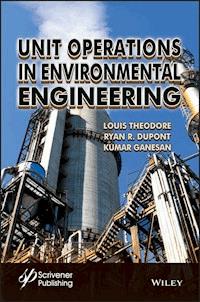
The book presents the principles of unit operations as well as the application of these principles to real-world problems.
The authors have written a practical introductory text exploring the theory and applications of unit operations for environmental engineers that is a comprehensive update to Linvil Rich's 1961 classic work, "Unit Operations in Sanitary Engineering". The book is designed to serve as a training tool for those individuals pursuing degrees that include courses on unit operations. Although the literature is inundated with publications in this area emphasizing theory and theoretical derivations, the goal of this book is to present the subject from a strictly pragmatic introductory point-of-view, particularly for those individuals involved with environmental engineering.
This book is concerned with unit operations, fluid flow, heat transfer, and mass transfer. Unit operations, by definition, are physical processes although there are some that include chemical and biological reactions. The unit operations approach allows both the practicing engineer and student to compartmentalize the various operations that constitute a process, and emphasizes introductory engineering principles so that the reader can then satisfactorily predict the performance of the various unit operations equipment.
"This is a definitive work on Unit Operations, one of the most important subjects in environmental engineering today. It is an excellent reference, well written, easily read and comprehensive. I believe the book will serve well those working in engineering disciplines including those beyond just environmental and chemical engineering. Bottom-line: A must for any technical library".
—Kenneth J. Skipka, CCM
Sie lesen das E-Book in den Legimi-Apps auf:
Seitenzahl: 1002
Veröffentlichungsjahr: 2017
Ähnliche














Contents
Cover
Title page
Copyright page
Dedication
Preface
Introduction
Part I: Introduction to the Principles of Unit Operations
Chapter 1: History of Chemical Engineering and Unit Operations
References
Chapter 2: Transport Phenomena versus the Unit Operations Approach
References
Chapter 3: The Conservation Laws and Stoichiometry
3.1 Overview
3.2 The Conservation Law
3.3 Conservation of Mass, Energy, and Momentum
3.4 Stoichiometry
3.5 Limiting and Excess Reactants
References
Chapter 4: The Ideal Gas Law
4.1 Overview
4.2 Other Forms of the Ideal Gas Law
4.3 Non-Ideal Gas Behavior
References
Chapter 5: Thermodynamics
5.1 Overview
5.2 The First Law of Thermodynamics
5.3 Enthalpy Effects
5.4 Second Law Calculations [2]
5.5 Phase Equilibrium
5.6 Chemical Reaction Equilibrium
References
Chapter 6: Chemical Kinetics
6.1 Overview
6.2 Chemical Kinetics Principles
6.3 Batch Reactors (BRs)
6.4 Continuously Stirred Tank Reactors (CSTRs)
6.5 Plug Flow Reactors (PFRs)
6.6 Catalytic Reactors
References
Chapter 7: Equilibrium versus Rate Considerations
7.1 Overview
7.2 Equilibrium
7.3 Transfer Process Rates
7.4 Chemical Reaction Process Rates
References
Chapter 8: Process and Plant Design
8.1 Overview
8.2 Preliminary Studies
8.3 Process Schematics
8.4 Material and Energy Balances
8.5 Equipment Design
8.6 Instrumentation and Controls
8.7 Plant Location and Layout [adopted from 8]
8.8 Plant Design [adopted from 9]
References
Part II: Fluid Flow
Chapter 9: Fluid Behavior
9.1 Introduction
9.2 Newtonian Fluids [2]
9.3 Strain Rate, Shear Rate, and Velocity Profiles
9.4 Non-Newtonian Fluids
References
Chapter 10: Basic Energy Conservation Laws
10.1 Introduction
10.2 Conservation of Energy
10.3 Total Energy Balance Equation
10.4 The Mechanical Energy Balance Equation
10.5 The Bernoulli Equation
References
Chapter 11: Law of Hydrostatics
11.1 Introduction
11.2 Pressure Principles
11.3 Buoyancy Effects: Archimedes’ Law
11.4 Manometer Principles
References
Chapter 12: Flow Measurement
12.1 Introduction
12.2 Manometry and Pressure Measurement
12.3 Pitot Tubes
12.4 Venturi Meters
12.5 Orifice Meters
12.6 Flow Meter Selection
Reference
Chapter 13: Flow Classification
13.1 Introduction
13.2 The Reynolds Number
13.3 Laminar Flow in Pipes
13.4 Turbulent Flow in Pipes
13.5 Flow in Open Channels
References
Chapter 14: Prime Movers
14.1 Introduction
14.2 Fans [1]
14.3 Pumps
14.4 Compressors
References
Chapter 15: Valves and Fittings
15.1 Introduction
15.2 Valves [2]
15.3 Fittings
15.4 Expansion and Contraction Effects
15.5 Calculating Frictional Losses due to Valves and Fittings
References
Chapter 16: Air Pollution Control Equipment
16.1 Introduction
16.2 Gravity Settlers and Cyclones
16.3 Electrostatic Precipitators
16.4 Venturi Scrubbers
16.5 Baghouses
16.6 Factors in Particulate Control Equipment Selection
16.7 Comparing Control Equipment Alternatives [4]
References
Chapter 17: Sedimentation, Centrifugation, and Flotation
17.1 Introduction
17.2 Sedimentation
17.3 Centrifugation
17.4 Flotation
References
Chapter 18: Porous Media and Packed Beds
18.1 Introduction
18.2 Definitions [1]
18.3 Flow Regimes
18.4 Applications of Porous Media and Packed Beds
18.5 The Carmen-Kozeny Equation
References
Chapter 19: Filtration
19.1 Introduction
19.2 Filtration Equipment
19.3 Describing Equations
19.4 Compressible Cakes
19.5 Filtration Unit Selection
References
Chapter 20: Fluidization
20.1 Introduction
20.2 Fixed Beds
20.3 Permeability
20.4 Minimum Fluidization Velocity
20.5 Bed Height, Pressure Drop and Porosity
20.6 Fluidization Modes
References
Chapter 21: Membrane Technology
21.1 Overview
21.2 Membrane Separation Principles
21.3 Reverse Osmosis (RO)
21.4 Ultrafiltration, Microfiltration, and Gas Permeation
21.5 Pervaporation and Electrodialysis
References
Chapter 22: Compressible and Sonic Flow
22.1 Introduction
22.2 Compressible Flow
22.3 Sonic Flow
22.4 Pressure Drop Equations
References
Chapter 23: Two-Phase Flow
23.1 Introduction
23.2 Gas (G)-Liquid (L) Flow Principles: Generalized Approach
23.3 Gas (Turbulent) Flow-Liquid (Turbulent) Flow, tt
23.4 Gas (Turbulent) Flow-Liquid (Viscous) Flow, tv
23.5 Gas (Viscous) Flow-Liquid (Viscous) Flow, vv
23.6 Gas-Solid Flow
References
Chapter 24: Ventilation
24.1 Introduction
24.2 Indoor Air Quality
24.3 Indoor Air/Ambient Air Comparison
24.4 Industrial Ventilation Systems
24.5 Describing Equations
References
Chapter 25: Mixing
25.1 Introduction
25.2 Mixing Impellers
25.3 Baffling
25.4 Fluid Regimes
25.5 Power Curves
25.6 Scale-up
25.7 Design of Mixing Equipment
References
Chapter 26: Biomedical Engineering
26.1 Introduction
26.2 Definitions
26.3 Blood
26.4 Blood Vessels
26.5 Heart
26.6 Plasma/Cell Flow
References
Part III: Heat Transfer
Chapter 27: Steady-State Conduction
27.1 Introduction
27.2 Fourier’s Law
27.3 Conductivity Resistances
References
Chapter 28: Unsteady-State Conduction
28.1 Introduction
28.2 Classification of Unsteady-State Heat Conduction Processes
28.3 Microscopic Equations
References
Chapter 29: Forced Convection
29.1 Introduction
29.2 Convective Resistances
29.3 Heat Transfer Coefficients: Qualitative and Quantitative Information
29.4 Flow in a Circular Tube
29.5 Convection Across Cylinders
References
Chapter 30: Free Convection
30.1 Introduction
30.2 Key Dimensionless Numbers
30.3 Describing Equations
30.4 Environmental Applications
References
Chapter 31: Radiation
31.1 Introduction
32.2 Energy and Intensity
31.3 Radiant Exchange
31.4 Kirschoff’s Law
31.5 Emissivity Factors
31.6 View Factors
References
Chapter 32: The Heat Transfer Equation
32.1 Introduction
32.2 Energy Relationships
32.3 Heat Exchange Equipment Classification
32.4 The Log Mean Temperature Difference (LMTD) Driving Force
32.5 Temperature Profiles
32.6 Overall Heat Transfer Coefficients
32.7 The Classic Heat Transfer Equation
References
Chapter 33: Double Pipe Heat Exchangers
33.1 Introduction
33.2 Equipment Description
33.3 Describing Equations
33.4 Effectiveness Factor and Number of Transfer Units
33.5 Wilson’s Method
References
Chapter 34: Shell and Tube Heat Exchangers
34.1 Introduction
34.2 Equipment Description
34.3 Describing Equations
34.4 The “F” Factor
34.5 Effectiveness Factor and Number of Transfer Units
34.6 Design Procedure
References
Chapter 35: Finned Heat Exchangers
35.1 Introduction
35.2 Fin Types
35.3 Describing Equations
35.4 Fin Effectiveness and Performance
35.5 Fin Considerations
References
Chapter 36: Other Heat Transfer Equipment
36.1 Introduction
36.2 Evaporators
36.3 Waste Heat Boilers
36.4 Condensers [9, 10]
36.5 Quenchers
References
Chapter 37: Insulation and Refractory
37.1 Introduction
37.2 Describing Equations
37.3 Insulation
37.4 Refractory
References
Chapter 38: Refrigeration and Cryogenics
38.1 Introduction
38.2 Background Material
38.3 Equipment
38.4 Materials of Construction
38.5 Insulation and Heat Loss
38.6 Storage and Transportation
38.7 Health and Hazard Risks, and Safety
38.8 Basic Principles and Applications
References
Chapter 39: Condensation and Boiling
39.1 Introduction
39.2 Condensation Fundamentals
39.3 Condensation Principles
39.4 Boiling Fundamentals
39.5 Boiling Principles
References
Chapter 40: Operation, Maintenance, and Inspection (OM&I)
40.1 Introduction
40.2 Installation Procedures
40.3 Operation
40.4 Maintenance and Inspection
40.5 Testing
40.6 Improving Operation and Performance
References
Chapter 41: Design Principles
41.1 Introduction
41.2 General Design Procedures
41.3 Other Design Considerations
41.4 Process Schematics
41.5 Purchasing a Heat Exchanger [7–8]
References
Part IV: Mass Transfer
Chapter 42: Equilibrium Principles
42.1 Introduction
42.2 Gibb’s Phase Rule
42.3 Important Phase Considerations
References
Chapter 43: Phase Equilibrium Relationships
43.1 Introduction
43.2 Raoult’s Law
43.3 Henry’s Law
43.4 Raoult’s Law versus Henry’s Law [7]
43.5 Vapor-Liquid Equilibrium in Non-Ideal Solutions [1]
43.6 Vapor-Solid and Liquid-Solid Equilibrium
References
Chapter 44: Rate Principles
44.1 Introduction
44.2 Fick’s Law
44.3 Early Rate Transfer Theories
44.4 The Operating Line
References
Chapter 45: Mass Transfer Coefficients
45.1 Introduction
45.2 Individual Mass Transfer Coefficients
45.3 Overall Mass Transfer Coefficients
45.4 Experimental Mass Transfer Coefficients
References
Chapter 46: Classification of Mass Transfer Operations
46.1 Introduction
46.2 Contact of Immiscible Phases
46.3 Miscible Phases Separated by a Membrane
46.4 Direct Contact of Miscible Phases
46.5 Mass Transfer Operations Selection
References
Chapter 47: Characteristics of Mass Transfer Operations
47.1 Overview
47.2 Unsteady-State versus Steady-State Operation
47.3 Flow Pattern
47.4 Stage Wise versus Continuous Operation
References
Chapter 48: Absorption and Stripping
48.1 Introduction
48.2 Description of Equipment
48.4 Plate Columns
References
Chapter 49: Distillation
49.1 Introduction
49.2 Flash Distillation
49.3 Batch Distillation
49.4 Continuous Distillation with Reflux
References
Chapter 50: Adsorption
50.1 Introduction
50.2 Adsorption Classification
50.3 Adsorption Equilibria
50.4 Description of Equipment
50.5 Regeneration
References
Chapter 51: Liquid-Liquid and Solid-Liquid Extraction
51.1 Introduction
51.2 Liquid-Liquid Extraction
51.3 Design and Predictive Equations
51.4 Solid-Liquid Extraction (Leaching) [2]
References
Chapter 52: Humidification
52.1 Introduction
52.2 Psychrometry
52.3 The Psychrometric Chart
52.4 The Humidification Process
52.5 Equipment
52.6 Describing Equations
References
Chapter 53: Drying
53.1 Introduction
53.2 Drying Principles
53.3 Describing Equations
53.4 Drying Equipment
References
Chapter 54: Absorber Design and Performance Equations
54.1 Introduction
54.2 Packed Columns [1,2]
54.3 Plate Columns
54.4 Stripping
54.5 Packed versus Plate Tower Comparison
54.6 Summary of Key Equations
References
Chapter 55: Distillation Design and Performance Equations
55.1 Introduction
55.2 Binary Distillation Design/The McCabe-Thiele Graphical Method
55.3 Constructing a McCabe-Thiele Diagram [6]
55.4 Packed Column Distillation
References
Chapter 56: Adsorber Design and Performance Equations
56.1 Introduction
56.2 Design and Performance Principles [1,2]
56.3 Design Methodology
56.4 Simplified Design Procedures
References
Chapter 57: Crystallization
57.1 Introduction
57.2 The Crystallization Process
57.3 Equipment
57.4 Describing Equations
57.5 Design Considerations
References
Chapter 58: Other and Novel Separation Processes
58.1 Introduction
58.2 Freeze Crystallization
58.3 Ion Exchange
58.4 Liquid Ion Exchange
58.5 Resin Adsorption
58.6 Evaporation
58.7 Foam Fractionation
58.8 Dissociation Extraction
58.9 Electrophoresis
58.10 Vibratory Screens
References
Part V: Case Studies
Chapter 59: Drag Force Coefficient Correlation
References
Chapter 60: Predicting Pressure Drop with Pipe Failure for Flow through Parallel Pipes
Reference
Chapter 61: Developing an Improved Model to Describe the Cunningham Correction Factor Effect
References
Chapter 62: Including Entropy Analysis in Heat Exchange Design
References
Chapter 63: Predicting Inside Heat Transfer Coefficients in Double-Pipe Exchangers
References
Chapter 64: Converting View Factor Graphical Data to Equation Form
Reference
Chapter 65: Correcting a Faulty Absorber Design
References
Chapter 66: A Unique Liquid-Liquid Extraction Unit
References
Chapter 67: Effect of Plate Failure on Distillation Column Performance
Reference
Appendix A: Units
A.1 SI Multiples and Prefixes
A.2 Conversion Constants (SI)
A.3 Selected Common Abbreviations
Appendix B: Miscellaneous Tables
B.1 Common Engineering Conversion Factors
B.2 Dimensions and Weights of Standard Steel Pipes
B.3 Dimensions of Heat Exchanger Tubes
Appendix C: Steam Tables
Appendix D: Basic Calculations
References
Index
End User License Agreement
Guide
Cover
Copyright
Contents
Begin Reading
List of Tables
Chapter 1
Table 4.1
Values of
R
in various units.
Table 4.2
Common standard conditions.
Chapter 13
Table 13.1
Average roughness of commercial pipes.
Chapter 14
Table 14.1
Typical fan multi-rating table.
Chapter 15
Table 15.1
Resistance coefficients, K, for open valves, elbows, and tees.
Table 15.2
Increased frictional losses for partially open valves.
Table 15.3
Summary of minor loss calculation methods.
Chapter 16
Table 16.1
Advantages and disadvantages of cyclone collectors.
Table 16.2
Advantages and disadvantages of ESPs.
Table 16.3
Advantages and disadvantages of wet scrubbers.
Table 16.4
Advantages and disadvantages of fabric filter systems.
Chapter 18
Table 18.1
Measurement units for standard particle sizes.
Table 18.2
Tyler standard screen and U.S. Sieve Size scales for particle size distribution analysis.
Chapter 22
Table 22.1
Speed of sound in various liquids.
Table 22.2
Values of
k
.
Chapter 23
Table 23.1
ϕ
tt
vs
X
tt
.
Table 23.2
X
tv
versus
ϕ
tv
.
Table 23.3
X
w
versus
ϕ
vv
.
Chapter 26
Table 26.1
Fluid flow analogies in biomedical engineering.
Table 26.2
The average radii and total numbers of conventional categories of vessels of the human circulatory system.
Chapter 27
Table 27.1
Thermal conductivities of three common insulating materials.
Table 27.2
Thermal conductivities for materials of different states.
Chapter 28
Table 28.1
Unsteady-state energy-transfer equation for stationary solids [4, 5].
Chapter 29
Table 29.1
Typical film coefficients.
Table 29.2
Film coefficients in pipes
a
.
Chapter 30
Table 30.1
Coefficients for Equation 30.14.
Table 30.2
Free convection equation in air.
Chapter 31
Table 31.1
Characteristic wavelengths [3].
Chapter 32
Table 32.1
Fouling coefficients (english units).
Chapter 33
Table 33.1
Reynolds number values versus type of flow.
Table 33.2
Representative fouling factors.
Chapter 35
Table 35.1
Fin metal data.
Table 35.2
Fin data.
Chapter 36
Table 36.1
Heat exchanger equipment.
Chapter 42
Table 42.1
Mass transfer scenarios.
Chapter 43
Table 43.1
Approximate Clapeyron equation coefficients*.
Table 43.2
Antoine equation coefficients*.
Chapter 44
Table 44.1
Diffusion coefficients.
Table 44.2
Liquid diffusivities at atmospheric pressure.
Chapter 45
Table 45.1
Controlling films for various systems.
Chapter 48
Table 48.1
Four Typical packings and applications.
Chapter 55
Table 55.1
Values of
q
and
f
for the five general feed conditions.
Table 55.2
Values of
q
-line slope and intercept for the five general feed conditions.
Table 55.3
Reflux ratio optimization multipliers.
Table 55.4
Recommended tray spacing.*
Chapter 56
Table 56.1
Adsorbent heat capacity values (ambient conditions Btu/ft
3
-°F).
Chapter 62
Table 62.1
Heated streams.
Table 62.2
Cooled streams.
Appendix C
Table C.1
Saturated Steam*
Table C.2
Superheated Steam.
Appendix D
Table D.1
Common systems of units.
Table D.2
English engineering units.
Table D.3
SI Units.
Pages
ii
iii
iv
v
xi
xii
xiii
xiv
xv
xvii
xviii
1
2
3
4
5
6
7
8
9
10
11
12
13
14
15
16
17
18
19
20
21
22
23
24
25
26
27
28
29
30
31
32
33
34
35
36
37
38
39
40
41
42
43
44
45
46
47
48
49
50
51
52
53
54
55
56
57
58
59
60
61
62
63
64
65
66
67
68
69
70
71
72
73
74
75
76
77
78
79
80
81
82
83
84
85
86
87
88
89
90
91
92
93
94
95
96
97
98
99
100
101
102
103
104
105
106
107
108
109
110
111
112
113
114
115
116
117
118
119
120
121
122
123
124
125
126
127
128
129
130
131
132
133
134
135
136
137
138
139
140
141
142
143
144
145
146
147
148
149
150
151
152
153
154
155
156
157
158
159
160
161
162
163
164
165
166
167
168
169
170
171
172
173
174
175
176
177
178
179
180
181
182
183
184
185
186
187
188
189
190
191
192
193
194
195
196
197
198
199
200
201
202
203
204
205
206
207
208
209
210
211
212
213
214
215
216
217
218
219
220
221
222
223
224
225
226
227
228
229
230
231
232
233
234
235
236
237
238
239
240
241
242
243
244
245
246
247
248
249
250
251
252
253
254
255
256
257
258
259
260
261
262
263
264
265
266
267
268
269
270
271
272
273
274
275
276
277
278
279
280
281
282
283
284
285
286
287
288
289
290
291
292
293
294
295
296
297
298
299
300
301
302
303
304
305
306
307
308
309
310
311
312
313
314
315
316
317
318
319
320
321
322
323
324
325
326
327
328
329
330
331
332
333
334
335
336
337
338
339
340
341
342
343
344
345
346
347
348
349
350
351
352
353
354
355
356
357
358
359
360
361
362
363
364
365
366
367
368
369
370
371
372
373
374
375
376
377
378
379
380
381
382
383
384
385
386
387
388
389
390
391
392
393
394
395
396
397
398
399
400
401
402
403
404
405
406
407
408
409
410
411
412
413
414
415
416
417
418
419
420
421
422
423
424
425
426
427
428
429
430
431
432
433
434
435
436
437
438
439
440
441
442
443
444
445
446
447
448
449
450
451
452
453
454
455
456
457
458
459
460
461
462
463
464
465
466
467
468
469
470
471
472
473
474
475
476
477
478
479
480
481
482
483
484
485
486
487
488
489
490
491
492
493
494
495
496
497
498
499
500
501
502
503
504
505
506
507
508
509
510
511
512
513
514
515
516
517
518
519
520
521
522
523
524
525
526
527
528
529
530
531
532
533
534
535
536
537
538
539
540
541
542
543
544
545
546
547
548
549
550
551
552
553
554
555
556
557
558
559
560
561
562
563
564
565
566
567
568
569
570
571
572
573
574
575
576
577
578
579
580
581
582
583
584
585
586
587
588
589
590
591
592
593
594
595
596
597
598
599
600
601
602
603
604
605
606
607
608
609
610
611
612
613
614
615
616
617
618
619
620
621
622
623
624
625
626
627
628
629
630
631
632
633
634
635
636
637
638
639
640
641
642
643
644
645
646
647
648
649
650
651
652
653
654
655
656
657
658
659
660
661
662
663
664
665
666
667
668
669
670
671
672
673
674
675
676
677
678
679
680
681
Scrivener Publishing 100 Cummings Center, Suite 541J Beverly, MA 01915-6106
Publishers at Scrivener Martin Scrivener ([email protected]) Phillip Carmical ([email protected])
Unit Operations in Environmental Engineering
By
Louis Theodore
R. Ryan Dupont
Kumar Ganesan
This edition first published 2017 by John Wiley & Sons, Inc., 111 River Street, Hoboken, NJ 07030, USA and Scrivener Publishing LLC, 100 Cummings Center, Suite 541J, Beverly, MA 01915, USA © 2017 Scrivener Publishing LLC For more information about Scrivener publications please visit www.scrivenerpublishing.com. All rights reserved. No part of this publication may be reproduced, stored in a retrieval system, or transmitted, in any form or by any means, electronic, mechanical, photocopying, recording, or otherwise, except as permitted by law. Advice on how to obtain permission to reuse material from this title is available at http://www.wiley.com/go/permissions.
Wiley Global Headquarters 111 River Street, Hoboken, NJ 07030, USA For details of our global editorial offices, customer services, and more information about Wiley products visit us at www.wiley.com.Limit of Liability/Disclaimer of Warranty While the publisher and authors have used their best efforts in preparing this work, they make no representations or warranties with respect to the accuracy or completeness of the contents of this work and specifically disclaim all warranties, including without limitation any implied warranties of merchantability or fitness for a particular purpose. No warranty may be created or extended by sales representatives, written sales materials, or promotional statements for this work. The fact that an organization, website, or product is referred to in this work as a citation and/or potential source of further information does not mean that the publisher and authors endorse the information or services the organization, website, or product may provide or recommendations it may make. This work is sold with the understanding that the publisher is not engaged in rendering professional services. The advice and strategies contained herein may not be suitable for your situation. You should consult with a specialist where appropriate. Neither the publisher nor authors shall be liable for any loss of profit or any other commercial damages, including but not limited to special, incidental, consequential, or other damages. Further, readers should be aware that websites listed in this work may have changed or disappeared between when this work was written and when it is read.
Library of Congress Cataloging-in-Publication Data
ISBN 978-1-119-28363-8
Dedicated toall the past, present, and future environmental engineering students, with whom may rest both the hopes and future of mankind.
Preface
Unit operations are several of the basic tenets of not only chemical engineering but also several other engineering disciplines, and contains many practical concepts that are utilized in countless industrial applications. One engineering curriculum that has embraced the unit operations approach is environmental engineering, and interestingly, a comprehensive “overview text” in the subject area is not presently available in the literature. Therefore, the authors considered writing a practical introductory text involving unit operations for environmental engineers. The text will hopefully serve as a training tool for those individuals pursuing degrees that include courses on unit operations. Although the literature is inundated with texts in this area emphasizing theory and theoretical derivations, the goal of this text is to present the subject from a strictly pragmatic introductory point-of-view, particularly for those individuals involved with environmental engineering.
As noted in the opening paragraph and in the title of this book - Unit Operations in Environmental Engineering - this work has been written primarily for environmental engineering students. But, who are environmental engineers and what is the environmental engineering profession? The answer, to some degree, depends on who one talks to since this profession has undergone dramatic changes over the last half century. The term environmental engineering came into existence in the mid-1960s when it displaced the perhaps politically incorrect term, sanitary engineering.
The reader should keep in mind that during the late 1900s, it was no secret that industry preferred to hire chemical engineers to address real-world environmental engineering problems. This was no doubt brought about because of the chemical engineer’s understanding, and the environmental engineer’s lack of knowledge, of unit operations, particularly those related to mass transfer operations.
Interestingly, the early sanitary engineering curriculum was almost exclusively based on primarily “water” topics, e.g., sewage, water supply and usage, sanitation, etc. The expansion of environmental engineering to include air, solid waste, noise, health risk, hazard risk, etc., evolved over time, all of which can today be viewed as a legitimate part of an environmental engineering curriculum. This book’s subject matter of unit operations is therefore only one, but perhaps the most important subject in any interdisciplinary discipline that includes environmental engineering.
This is a book on unit operations … well, sort of. The principles of unit operations were originally set forth soon after the birth of the chemical engineering profession at the turn of the 20th century and it remains the keystone course in the chemical engineering curriculum. A new kid on the block entered the engineering field around 1950, perhaps spearheaded by the adoption of a sanitary engineering program at Manhattan College, Bronx, NY. The program was later renamed “Environmental Engineering” around 1970. The College also later served as the host of several NSF-funded environmental engineering course development seminars that were directed by the one of the authors, Lou Theodore; and the college also served as home for Lou Theodore (as Professor of Chemical Engineering) for 50 years.
Converting the aforementioned chemical engineering principles/approaches/applications embodied in unit operations to environmental engineering in an optimum manner was not as difficult as the authors originally anticipated. This was, no doubt, due to the clear overlap between the two disciplines.
As noted above, this book is concerned with unit operations, fluid flow, heat transfer, and mass transfer. Unit operations, by definition, are physical processes although there are some that include chemical and biological reactions. The unit operations approach allows both the student and practicing engineer to compartmentalize the various operations that constitute a process. As such, it has enabled the engineer of yesterday and today (and tomorrow) to perform more efficiently. This approach has also allowed the environmental engineer to achieve considerable success in the environmental management field.
The authors’ approach in presenting unit operations material to environmental engineering students is to primarily key on introductory engineering principles so that the reader could then later satisfactorily predict the performance of the various unit operation equipment. In effect, the reader or instructor is provided the opportunity to expand chapter presentations. Although a chapter on Process and Plant Design is included in the introductory part (Part I) of the book, details on equipment design are treated superficially and the subject of plant design is rarely broached.
A comment on chemical reactions is also warranted. Chemical reactions have been defined by some as chemical unit processes. They serve as the backbone of the chemical process industries employing the batch, continuously stirred tank reactors (CSTRs), and tubular flow reactors. However, these chemical unit processes also find application in the wastewater treatment industry. Some of these chemical processes include oxidation, precipitation, neutralization, pH control, disinfection operations, certain coagulation operations, etc. Many of the chemical reactions involve chemicals such as calcium and sodium hydroxide, ferric and aluminum chloride, alum, ferric sulfide, etc. And, as one might suppose, these chemical unit processes are often operated in conjunction with physical unit processes (or unit operations).
Biological unit processes represent another class of chemical reactions that are important to the practicing environmental engineer. The major applications of these biochemical reaction pathways are in wastewater treatment and hazardous waste remediation. The principal biological processes used for wastewater treatment can be divided into two main categories: suspended growth and attached growth (or biofilm) processes. Their successful design and operation requires an understanding of the types of microorganisms involved, the specific reactions that occur, and the environmental factors that affect their performance, their nutritional needs, and their biochemical reaction kinetics.
The decision as to what units and notations to use was difficult. After much deliberation, the authors chose to use engineering - as opposed to metric/SI units, and chemical engineering notation - as opposed to those of other disciplines. This decision was based, to some extent, on the reality that a good part of the book’s content was drawn from the chemical engineering literature, some of which was written by the primary author, Lou Theodore.
The book is divided into five parts.
Part I - Introduction to the Principles of Unit Operations Part II - Fluid Flow Part III - Heat Transfer Part IV - Mass Transfer Part V - Case Studies
In addition to providing materials on the history of unit operations and a discussion of the relationship among the transport phenomenon/unit operations/unit processes approaches, Part I contains material on traditional introductory engineering principles. These include: thermodynamics, chemical reaction principles, equilibrium versus rate consideration, rate principles, and process and plant design. Part II - Fluid Flow - addresses such subject areas as: fluid classifications, flow mechanisms, flow in conduits, prime movers plus various valve and fittings, sedimentation and centrifugation, porous media and packed beds, filtration, fluidization, ventilation and mixing. Part III - Heat Transfer - contains material concerned with: heat exchangers, waste heat boilers and evaporators, quenchers, psychrometry, humidification, drying, and cooling towers. (Note that the subject of heat transfer was rarely (if ever) included in the environmental engineering curriculum in the early days. For example, in Rich’s classic “Unit Operations in Sanitary Engineering” text, only one of the 15 chapters in the text dealt with heat transfer. That has changed today because of the environmental engineer’s interest in energy, energy conservation, combustion, hazardous waste incineration, global climate change, radiation effects of the sun, etc. In effect, heat transfer has become the new kid on the block in the unit operations arena, and is a topic that every environmental engineer should be proficient in). Part IV of the book - Mass Transfer - covers such topics as: absorption and stripping, adsorption, distillation, liquid-liquid and liquid-solid extraction, and other mass transfer operations. The last part of the book, Part V - Case Studies - provides three applications in each of the three unit operations. An Appendix is also included. An outline of the topics can be found in the Table of Contents.
The reader will note that there is no separate section, part or chapter devoted to biological processes. Rather, they have been integrated into relevant material presented in Parts II and IV. Biological treatment processes (in alphabetical order) that receive treatment include:
Activated Sludge Aerated Lagoons Anaerobic Digestion Composting Enzyme Treatment Trickling Filters Waste Stabilization Ponds
Details on the above seven biological methods were provided earlier by Theodore and McGuinn in “Pollution Prevention,” Van Nostrand Reinhold, New York City, NY, 1992. An extensive analysis of these processes (plus many more) is also available in the work of Metcalf and Eddy, “Wastewater Engineering: Treatment and Reuse,” McGraw-Hill, 4th Edition, New York City, NY, 2004 and L. Rich, “Unit Operations of Sanitary Engineering,” John Wiley & Sons, Hoboken, NJ, 1961.
The authors cannot claim sole authorship to all of the essay material and examples in this text. The present book has evolved from a host of sources, including: notes, homework problems and exam problems prepared by several faculty for a required one-semester, three-credit, “Principles III: Mass Transfer” undergraduate course offered at Manhattan College; L. Theodore and J. Barden, “Mass Transfer”, A Theodore Tutorial, East Williston, NY, 1995; I. Farag, “Fluid Flow,” A Theodore Tutorials, East Williston, NY, 1994; I Farag and J. Reynolds, “Heat Transfer,” A Theodore Tutorials, East Williston, NY, 1995; J. Reynolds, J. Jeris, and L. Theodore, “Handbook for Chemical and Environmental Engineering Calculations,” John Wiley & Sons, Hoboken, NJ, 2004; and J. Santoleri, J. Reynolds, and L. Theodore, “Introduction to Hazardous Waste Management,” 2nd edition, John Wiley & Sons, Hoboken, NJ, 2000. Although the bulk of the material is original and/or taken from sources that the authors have been directly involved with, every effort has been made to acknowledge material drawn from other sources.
It is hoped that this book covers the principles and applications of unit operations in a thorough and clear manner. Upon completion of the text, the reader should have acquired not only a working knowledge of the principles of unit operations, but also experience in their application; and, the reader should find himself/herself approaching advanced texts, engineering literature and industrial applications (even unique ones) with more confidence. The authors strongly believe that, while understanding the basic concepts is of paramount importance, this knowledge may be rendered virtually useless to an environmental engineer if he/she cannot apply these concepts in real-world situations. This is the essence of engineering.
Last, but not least, the authors believe that this modest work will help the majority of individuals working and/or studying in the field of environmental engineering to obtain a more complete understanding of unit operations. If you have come this far and read through most of the Preface, you have more than just a passing interest in this subject.
The authors are indebted to the pioneers in the sanitary/environmental engineering field, including such notables as Don O’Connor, Linvil Rich, Wes Eckenfelder, Ross McKinney, Perry McCarty, etc. Pioneers in the environmental management field include James Fenimore Cooper, John Muir, Howard Hesketh, Charlie Pratt, Art Stern, Werner Strauss, etc.
Sincere and special thanks are extended to Haley Seiler of the Civil and Environmental Engineering Department at Utah State University for her invaluable help in the preparation of the draft of the text of this manuscript, and to Ivonne Harris of the Utah Water Research Laboratory for her assistance in preparing all of the figures for the text.
Louis Theodore East Williston, New York R. Ryan Dupont Smithfield, Utah Kumar Ganesan Butte, Montana March, 2017
NOTE: The authors are in the process of preparing an additional resource for this text. An accompanying website containing 15 hours of exams and solutions for the exams will soon be available for those who adopt the book for training and/or academic purposes.
Introduction
How are unit operations related to a unit process? Consider the flow diagram in the figure below. There are three unit operations, 1, 2, and 3. The combination of the three operations that reside in the dashed box is the process or what has come to be referred to as a unit process. Fluid flow, heat transfer, and mass transfer operations fit into the description/definition of unit operations. Chemical and biological operations are, in line with the accepted definitions of unit operations, not considered unit operations. As such, they are reviewed only superficially in this book since they are both treated extensively in the literature. The reader should note that many engineering activities can be classified as:
Physical unit processes,
Chemical unit processes, and/or
Biological unit processes.
Physical unit processes involve the application of physical forces, while chemical and biological unit processes are brought about by the addition of chemicals or chemical reactions, and biochemical reactions, respectively. Physical unit processes have come to be defined as unit operations, the subject title of this book.
The similarity of the physical changes occurring in widely differing industries led to the study of the many steps common to both industry and environmental applications/systems, as the aforementioned unit operations. The unit operations came to be regarded as special cases or combinations of fluid flow, heat transfer and mass transfer.
Figure I.1 Unit operations versus unit processes.
The chemical reactor is usually at the heart of many processes and it is here that the engineer may simultaneously utilize the principles of fluid flow, heat transfer, and mass transfer, as well as chemical kinetics and thermodynamics, to carry out desired transformations, whether it be for the production of materials or the removal of undesirable pollutants. However, reactions of a chemical or biochemical nature, and the associated equipment, have traditionally not been considered to reside in the unit operations domain.
Underlying nearly every step of a unit process are the principles of fluid flow and heat transfer; the fluid must be transported, and its temperature must be controlled. In a chemical process, where composition is a variable, the principles of mass transfer enter the design of separation and reaction equipment.
This book deals with physical processes, referred to as the aforementioned unit operations, which are common to many chemical and environmental systems. By examining these operations apart from a particular application, students are encouraged to concentrate on fundamental principles. The duplication of topic material normally encountered in “compartmentalized” curricula is avoided, and time should be available to consider a larger variety of operations. The unit operations approach has been employed in chemical engineering education for nearly a century with considerable success, and has recently become an integral part of the environmental engineering curricula.
The book has been written for students with a typical undergraduate background in engineering and the sciences. Comprehension requires only an understanding of freshman chemistry, engineering physics, calculus, and to a lesser extent, differential equations. Details of equipment design are discussed only briefly since several books already published treat this aspect of unit operations with thoroughness and clarity. References to these sources are commonplace in the text. Furthermore, several operations of a less complex nature have been omitted to make room for those ordinarily not considered in courses in environmental engineering but which are of growing importance in the field. As noted earlier, chemical and biochemical operations received minimal treatment.
The material used in this book was taken from both the environmental and chemical engineering field. The use of mixed notation can be confusing, and the choice then was between two alternatives, environmental notation or those of the chemical engineer. As noted in the Preface, the latter was chosen. The use of standard notation in chemical engineering is thought to better serve students in making them familiar with the standard notation used in the literature of the process engineering field. The decision on a unit convention can also be a problem, and the authors have chosen to use English (or engineering) as opposed to SI units as is the standard in much of the process and environmental engineering fields. Comprehensive conversion tables for units are included in the Appendix.
In conclusion, it must be emphasized that this book is not a treatise. Rather, it should be viewed as an introductory textbook dealing primarily with unit operations.
Part IINTRODUCTION TO THE PRINCIPLES OF UNIT OPERATIONS
The purpose of this Part can be found in its title. The book itself offers the reader the principles of unit operations with appropriate practical applications, and serves as an introduction to the specialized and more sophisticated texts in this area. The reader should realize that the contents are geared not only toward practitioners in this field, but also students of science and engineering. Topics of interest to all practicing engineers have been included. It should also be noted that the microscopic approach of unit operations is not covered here. The approach taken in the text is to place more emphasis on real-world and design applications. However, microscopic approach material is available in the literature, as noted in the ensuing chapters.
The chapters in this Part provide an introduction and overview of unit operations. Part I chapter content includes:
1. History of Chemical Engineering and Unit Operations
2. Transport Phenomena versus Unit Operations Approach
3. The Conservation Laws and Stoichiometry
4. The Ideal Gas Law
5. Thermodynamics
6. Chemical Kinetics
7. Equilibrium versus Rate Considerations
8. Process and Plant Design
Topics covered in the first two introductory chapters include a history of chemical engineering and unit operations, and a discussion of transport phenomena versus unit operations. The remaining chapters are concerned with introductory engineering principles.
Chapter 1History of Chemical Engineering and Unit Operations
A discussion of the field of chemical engineering is warranted before proceeding to some specific details regarding unit operations and the contents of this first chapter. A reasonable question to ask is: What is chemical engineering? An outdated, but once official definition provided by the American Institute of Chemical Engineers is:
Chemical Engineering is that branch of engineering concerned with the development and application of manufacturing processes in which chemical or certain physical changes are involved. These processes may usually be resolved into a coordinated series of unit physical “operations” (hence part of the name of the chapter and book) and chemical processes. The work of the chemical engineer is concerned primarily with the design, construction, and operation of equipment and plants in which these unit operations and processes are applied. Chemistry, physics, and mathematics are the underlying sciences of chemical engineering, and economics is its guide in practice.
The above definition was appropriate up until a few decades ago when the profession branched out from the chemical industry. Today, that definition has changed. Although it is still based on chemical fundamentals and physical principles, these principles have been de-emphasized in order to allow for the expansion of the profession to other areas (biotechnology, semiconductors, fuel cells, environment, etc.). These areas include environmental management, health and safety, computer applications, and economics and finance. This has led to many new definitions of chemical engineering, several of which are either too specific or too vague. A definition-proposed here is simply that “chemical engineers solve problems”. Unit operations is the one subject area that historically has been the domain of the chemical engineer. It is often present in the curriculum and includes fluid flow [1], heat transfer [2] and mass transfer [3] principles.
Although the chemical engineering profession is usually thought to have originated shortly before 1900, many of the processes associated with this discipline were developed in antiquity. For example, filtration operations were carried out 5,000 years ago by the Egyptians. MTOs such as crystallization, precipitation, and distillation soon followed. During this period, other MTOs evolved from a mixture of craft, mysticism, incorrect theories, and empirical guesses.
In a very real sense, the chemical industry dates back to prehistoric times when people first attempted to control and modify their environment. The chemical industry developed as did any other trades or crafts. With little knowledge of chemical science and no means of chemical analysis, the earliest chemical “engineers” had to rely on previous art and superstition. As one would imagine, progress was slow. This changed with time. The chemical industry in the world today is a sprawling complex of raw-material sources, manufacturing plants, and distribution facilities which supply society with thousands of chemical products, most of which were unknown only a century ago. In the latter half of the 19th century, an increased demand arose for engineers trained in the fundamentals of chemical processes. This demand was ultimately met by chemical engineers.
The first attempt to organize the principles of chemical processing and to clarify the professional area of chemical engineering was made in England by George E. Davis. In 1880, he organized a Society of Chemical Engineers and gave a series of lectures in 1887 which were later expanded and published in 1901 as A Handbook of Chemical Engineering. In 1888, the first course in chemical engineering in the United States was organized at the Massachusetts Institute of Technology by Lewis M. Norton, a professor of industrial chemistry. The course applied aspects of chemistry and mechanical engineering to chemical processes [4].
Chemical engineering began to gain professional acceptance in the early years of the 20th century. The American Chemical Society had been founded in 1876 and, in 1908, it organized a Division of Industrial Chemists and Chemical Engineers while authorizing the publication of the Journal of Industrial and Engineering Chemistry. Also in 1908, a group of prominent chemical engineers met in Philadelphia and founded the American Institute of Chemical Engineers [4].
The mold for what is now called chemical engineering was fashioned at the 1922 meeting of the American Institute of Chemical Engineers when A. D. Little’s committee presented its report on chemical engineering education. The 1922 meeting marked the official endorsement of the unit operations concept and saw the approval of a “declaration of independence” for the profession [4]. A key component of this report included the following:
Any chemical process, on whatever scale conducted, may be resolved into a coordinated series of what may be termed “unit operations,” as pulverizing, mixing, heating, roasting, absorbing, precipitation, crystallizing, filtering, dissolving, and so on. The number of these basic unit operations is not very large and relatively few of them are involved in any particular process … An ability to cope broadly and adequately with the demands of this (the chemical engineer’s) profession can be attained only through the analysis of processes into the unit actions as they are carried out on the commercial scale under the conditions imposed by practice.
It also went on to state that:
Chemical Engineering, as distinguished from the aggregate number of subjects comprised in courses of that name, is not a composite of chemistry and mechanical and civil engineering, but is itself a branch of engineering …
A classical approach to chemical engineering education, which is still used today, has been to develop problem solving skills through the study of several topics. One of the topics that has withstood the test of time is mass transfer operations (MTOs). In many MTOs, one component of a fluid phase is transferred to another phase because the component is more soluble in the latter phase. The resulting distribution of components between phases depends upon the equilibrium of the system. MTOs may also be used to separate products (and reactants) and may be used to remove byproducts or impurities to obtain highly pure products. Finally, they can be used to purify raw materials.
A time line of the history of chemical engineering between the profession’s founding to 2010 is shown in Figure 1.1 [4]. It can be seen from the time line that the profession has reached a crossroads regarding the future education/curriculum for chemical engineers. This is highlighted by the differences of Transport Phenomena and Unit Operations, a topic that is discussed in the next chapter.
Figure 1.1 Chemical Engineering time line [4].
References
1. Abulencia, P. and Theodore, L., Fluid Flow for the Practicing Chemical Engineer, John Wiley & Sons, Hoboken, NJ, 2009.
2. Theodore, L., Heat Transfer Applications for the Practicing Engineer, John Wiley & Sons, Hoboken, NJ, 2011.
3. Theodore, L. and Ricci, F., Mass Transfer Operations for the Practicing Engineer, John Wiley & Sons, Hoboken, NJ, 2010.
4. Serino, N., 2005 Chemical Engineering 125th Year Anniversary Calendar, term project, submitted to L. Theodore, Manhattan College, Bronx, NY, 2004.
5. Bird, R., Stewart, W., and Lightfoot, E., Transport Phenomena, 2nd Edition, John Wiley & Sons, Hoboken, NJ, 2002.
Chapter 2Transport Phenomena versus the Unit Operations Approach
The history of unit operations is interesting. As indicated in the previous chapter, chemical engineering courses were originally based on the study of unit processes and/or industrial technologies. However, it soon became apparent that the changes produced in equipment from different industries were similar in nature, i.e., there was commonality in the mass transfer operations in the petroleum industry and the chemical. These similar operations became known as unit operations. This approach to chemical engineering was promulgated in the 1922 Little report discussed earlier, and has, with varying degrees and emphasis, dominated the profession to this day.
The unit operations approach was adopted by the profession soon after its inception. During the more than 135 years (since 1880) that the profession has been in existence as a branch of engineering, society’s needs have changed tremendously and so has chemical engineering.
The teaching of unit operations at the undergraduate level has remained relatively unchanged since the publication of several early – to mid-1900 texts. However, by the middle of the 20th century, there was a slow movement from the unit operation concept to a more theoretical treatment called transport phenomena or, more simply, engineering science. The focal point of this science is the rigorous mathematical description of all physical rate processes in terms of mass, heat, or momentum crossing phase boundaries. This approach took hold of the education/curriculum of the profession with the publication of the first edition of the Bird et al




