


Erhalten Sie Zugang zu diesem und mehr als 300000 Büchern ab EUR 5,99 monatlich.
- Herausgeber: Spellmount
- Kategorie: Geisteswissenschaft
- Sprache: Englisch
Since the short and bloody war between Nepal and Britain in 1814-15, Gurkha volunteers, ever mindful of the their motto, 'It is better to die than be a coward', have fought and died for Britain, including in recent years in the Falklands, Afghanistan and Iraq. In the Second World War an astonishing quarter of a million Gurkhas fought aginst Germany and Japan. They have been awarded thirteen Victoria Crosses. Includes detailed appendices include all regimental changes and battle honours.
Sie lesen das E-Book in den Legimi-Apps auf:
Seitenzahl: 397
Veröffentlichungsjahr: 2016
Das E-Book (TTS) können Sie hören im Abo „Legimi Premium” in Legimi-Apps auf:
Ähnliche




















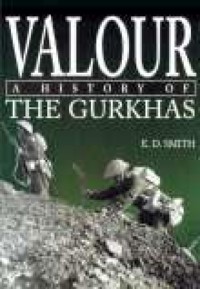
Valour A History of the Gurkhas
First published in the UK in 1997 by
Spellmount an imprint of
The History Press
The Mill, Brimscombe Port
Stroud, Gloucestershire. GL5 2QG
www.thehistorypress.co.uk
This ebook edition first published in 2016
All Rights Reserved
© E.D. Smith 1997, 2007
The right of E.D. Smith to be identified as the Author of this work has been asserted in accordance with the Copyrights, Designs and Patents Act 1988.
All photographs courtesy of The Gurkha Museum
Maps © Derek Stone 1997
This ebook is copyright material and must not be copied, reproduced, transferred, distributed, leased, licensed or publicly performed or used in any way except as specifically permitted in writing by the publishers, as allowed under the terms and condition under which it was purchased or as strictly permitted by applicable copyright law. Any unauthorised distribution or use of this text may be a direct infringement of the author’s and publisher’s rights, and those responsible may be liable in law accordingly.
EPUB ISBN 978 0 7509 8167 5
Typesetting and origination by NPI Media Group
eBook converted by Geethik Technologies
CONTENTS
List of Maps
Introduction and Acknowledgements
1
Nepal – Then and Now
2
How it All Began
3
The Brigade Earns its Spurs
4
The First World War
5
The Interlude
6
The Second World War
7
The Far East
8
The Last Days of the Indian Army Gurkha Brigade
9
Wars in Peace
Appendix 1
Changes in Titles of Gurkha Regiments
Appendix 2
Battle Honours of the Gurkha Brigade
Appendix 3
The Gurkha Welfare Trust
Bibliography
LIST OF MAPS
1.
Nepal
2.
India Before Independence
3.
The Afghan Wars 1835–1919
4.
Gallipoli
5.
Mesopotamia, 1914–18
6.
Egypt, Suez and South Palestine, 1917–18
7.
Coast of North Africa
8.
Italy
9.
Burma 1942–5
10.
Imphal Battles
11.
Malaya, 1948–60
12.
East Malaysia and Borneo
INTRODUCTION AND ACKNOWLEDGEMENTS
UNLIKE a more conventional regimental history, this book covers a truly wide canvas, beginning in 1815 and ending in 1995. For much of that time and certainly up to 1947 – when the Gurkha Brigade was split between the armies of independent India and Britain – there were ten regiments. During the period prior to 1914, many campaigns were fought which included the Indian Mutiny of 1857, the Afghan Wars and numerous forays against rebellious tribesmen on the North-West and North-East Frontiers of India. In all these campaigns, one or more battalions of the Gurkha Brigade took part: some of their stories can only be given in outline as, inevitably, I have had to be selective. For that, I alone take the responsibility, while apologising to those who feel that their regiment or battalion should have had a prior claim to the limited space available.
During both World Wars, the British-Indian Army Gurkha Brigade was expanded from twenty regular battalions to thirty-three (First World War) and forty-five (Second World War). Every man that came down from the hills of Nepal to enlist was a volunteer, coming from a small kingdom that was not part of the British Empire; truly a magnificent response to this country’s cry for help. It would be a monumental task, and would require an inordinately lengthy book, to cover the exploits of so many battalions in so many campaigns – in Europe, the Middle East and in South-East Asia. Despite that, I have tried to give some background to each of the campaigns, since otherwise the narrative would be unduly ‘bald’. For such a reason, the bibliography is fairly lengthy as, perforce, I have had to consult a great many sources during my research. After 1948, the narrative covers Britain’s Brigade of Gurkhas only, as to have included the six regiments that now serve in the Indian Army Gurkha Brigade would not have been possible without unduly increasing the size of the book.
‘Qui s’excuse, s’accuse’: enough of apologies! I could not have written this book or obtained the vast majority of the photographs without the unstinted help given by the Gurkha Museum, first under the curatorship of Major John Lamond, and now, Brigadier Christopher Bullock. As one of the Museum ‘volunteers’, Lieutenant-Colonel Mike Broadway has played a dual role in the production of this book. It has been he who has searched for and produced most of the photographs as well as acting as a proof-reader of the first rough draft. I must also pay tribute to the painstaking editorial efforts of Tony Buchan, whose copious notes helped me considerably – as well as giving my wife, Jill, the task of amending the final draft! I thank her, too. For the ready help they have afforded me, my heartfelt thanks are due to the Secretaries of the ten Gurkha Regimental Associations and the three Gurkha Corps.
To Mrs Gloria Tanner, my profound gratitude for typing and retyping drafts, as well as deciphering my intricate corrections, which must have tried her patience more than somewhat on numerous occasions.
To you all, ‘Dhanyabad’ (thank you).
E.D.S.
1
NEPAL –THEN AND NOW
NEPAL lies between the great alluvial plains of India and the cold, wind-seared tablelands of Tibet. On a map of the world, the small country is sandwiched between giant neighbours, India and China, something that the Nepalese have learnt to live with over the years. It is a land of great beauty, of high mountains and mighty rivers, a land that is crisscrossed by mountain tracks where generations of hillmen have moved over centuries past as traders, farmers or to tend flocks on high pastures. Truly the borne of the Gurkha warriors is a mountain kingdom.
With thousands of tourists now pouring into Nepal by land and air each year, it is difficult to imagine what the country was like in years gone by. Ever since the East India Company came into contact with the mountain kingdom 200 years ago, and until the late 1940s, when India was given her independence, the Nepalese Government saw to it that except for the tiny handful who were invited, from time to time, by the Court, foreigners were excluded from the country. The movements of those favoured few were confined to the Valley of Nepal and only on very special occasions was permission given them to travel elsewhere in the country. Nepal was a forbidden country as far as foreigners were concerned, even more inaccessible than its neighbour, Tibet, was at the time. The exclusion of Europeans was not only insisted upon by the Gurkha state but also by the British Government of India, in deference to Nepalese feelings and in order that the country should not suffer prematurely from contact with ‘modern civilisation’. Backward and primitive though the country was up to the end of the Second World War, most of the inhabitants living in the mountains were content with their simple circumstances and respected their rulers, the Maharajah and his Rana relatives, and knowing no other existence outside their country, there was no great desire for change.
There were no roads, no airports, while frontier posts existed to deter intruders rather than to welcome tourists into the country. But in 1947, with events moving with such speed in India as it gained its independence, inevitably there were bound to be repercussions in the little country of Nepal. The Indian-based Nepalese National Congress sponsored armed insurgents across the frontier from India and there were political strikes in the Terai, particularly at the mills of Biratnagar. Under pressure the Maharajah (who was also Prime Minister) in Kathmandu promised to introduce a measure of democracy but on all important matters decisions were still to be left in his hands. Moreover, the rights of the ruling Rana family to succession in the premiership were declared to be unalterable and inalienable for all time. In addition, although there was to be a National Chamber of sixty to seventy members, twenty-eight of these were to be nominated by the Maharajah who still retained power to veto any question or proposal made in the legislature which, in his opinion, was not in the public interest. Shortly afterwards, there were more riots and open unrest but it is fair to say that the hillmen in East Nepal, the Rais and Limbus, and the Magars and Gurungs in West Nepal, still continued their normal lives, untouched by the simmering political climate that was coming to the boil in Kathmandu and in the Terai Plain which runs along the border with India.
A typical bridge over a mountain torrent, East Nepal.
An aerial view of Kathmandu, taken in the 1960s.
The main tribes of the hillmen tended to live in their own areas in the mountains of Nepal: there was little mixing and intermarrying between tribes was rare. To reach villages meant walking along winding tracks, up ridges and down to steep valleys, over frighteningly slender bridges swaying above ice-cold roaring rivers: these tracks were the hill folk’s lifeline and many were the songs sung about them as porters toiled up the hillside or as relaxation when the day’s walking was over. Without roads, everyone and everything had to go up and down these tracks.
The hill people have bodies that could endure the backbreaking loads that had to be carried by all, including women and children as well as young boys and old men. Nature made the Gurkha villagers short and stocky, with thigh and leg muscles exaggerated in size and shape. Added to their physique there was a simple and strong sense of humour, deep pride in race, village and family; a people that asked little but the right to cultivate their little plot of land, build their own house and, when the work was done, to enjoy the occasional village party. Such a hardy and independent people remained masters in their own villages and sent thousands of first-class soldiers to the many parts of the world visited by the British and Indian Armies. Advisedly the past tense has been used but much of that description of life in the hills remains true today, albeit with certain modifications.
Although Nepal remained in virtual isolation from world forces until the end of the 1940s, the country’s rulers had seen portents of the future and began taking belated steps to liberalise their regime. In 1948 the Constitution Act was promulgated by the Maharajah which envisaged a form of government such as India had earlier in the century, with a Legislature and Council of Ministers, consisting of a mixture of nominated and elected members. The latter were to be returned by a system of indirect election, based primarily upon village and town ‘panchayats’ (councils of elders). The Maharajah, Padma Shamsher, in the eyes of his fellow Ranas was moving too fast; they pointed out that in the hills life went on as usual, as in some respects it does to this day. At that time the majority of the simple hillmen were not persuaded by the blessings of self-government and shared little enthusiasm for exercising their franchise, still less for standing for election. But Padma was not strong enough to cope with affairs and in April 1948 he retired voluntarily. Political agitation in Kathmandu contrived to keep the Valley in turmoil, with the police being used on several occasions to break up gatherings, while decrees were issued banning the pro-Congress Party as well as imposing a stringent censorship on the press. From years past there had always been a struggle between the King and his Maharajah, and now this was exploited by ambitious politicians. The Indian press played a big part and actively supported any movement opposed to the Rana regime. Towards the end of 1950 the Nepal border was crossed at nine points by the forces of the Indian-inspired Nepal Congress Party, and a few days later, India’s Prime Minister, Pandit Nehru, admitted that his government wanted progressive democracy in Nepal, adding that he officially recognised King Tribhuvana as the supreme authority in that land.
For a time there was no large or significant uprising in the Valley of Nepal, while the hillmen in West Nepal remained unruffled and quiet. However, in the east – where the quicker-tempered Limbus and Rais live – there were widespread outbreaks of violence and within a few weeks many of the main centres in East Nepal had been taken over by rebel forces. King Tribhuvana took matters into his own hands in February 1950 by proclaiming the termination of the hereditary premiership and transferring most of the Maharajah’s powers to himself. In December 1951 the last Maharajah retired to live in south India: his departure marked the end of Gurkha political supremacy in Nepal and heralded the final twilight of the Ranas.
Her Majesty Queen Elizabeth II with His Majesty King Mahendra on a state drive through Kathmandu during her visit to Nepal in March 1961.
Tribhuvana’s son, King Mahendra Bir Bikram Sah was crowned in May 1956 and until his death in 1972 he attempted to keep the panchayat system in being as he felt it was ideal for a backward country like Nepal. At least that method of government had the advantage of stopping the quarrelling among the politicians, but it allowed virtually no political expression as only people who actively supported the system were allowed to stand for election. In several places, it was corrupt, with local panchayats working the system to their own advantage. When Mahendra’s son, Birendra Bir Sah Dev, took over in 1972, like his father the new King affirmed his belief in the panchayat system but beneath the surface there were strong undercurrents which could not be suppressed for ever. In 1979 these came to the fore when serious riots erupted in Kathmandu involving clashes between students and the police; eventually the police lost control of the situation and order had to be restored by the Nepalese Army.
That was enough to spark the King into action and he announced that there would be a nationwide referendum to determine whether the citizens of Nepal wished to continue the existing system of government – under which party politics were forbidden – or to replace it with a multi-party system. The referendum showed that the panchayat system had won, with most of the rural areas clearly in favour while the towns, in general, voted for a party-political system. However, this referendum gained a short respite only and eventually in 1982 elections were held on political lines, with the King losing much of his power, although he was still regarded by many as a reincarnation of the Hindu god Vishnu. This factor alone ensures a measure of support for him, particularly in the mountain villages. The present political set up is involved and is constantly changing; suffice it to say that multi-party democracy has made an understandably faltering start in a country that, inevitably, is still backward.
Nepal is now open to the world, and tourism in 1997 brought in some £30 million a year into the kingdom. However, it must be remembered that a large portion of that sum is spent on importing luxury goods, foods and other items required to support an international tourist industry. Commendable strides have been made in education and in communications, the two major factors which in the past had helped to keep the country in the dark ages under the Rana regime. Foreign aid has poured in from donor countries and international organisations and is by far the greatest source of foreign currency. Nepal is a staunch member of the non-aligned group in the United Nations and is at pains to be friendly with all states but, inevitably, her greatest preoccupation must be with her big neighbours, India and China. Her policy is to be on good terms with both, although on several occasions since the Second World War relations with India have not been smooth, chiefly because there has been a tendency on the Government of India’s part to play the big brother and wield a heavy stick. Nepal’s landlocked position means that the bulk of her imports and exports have to pass overland through India; her giant neighbour is always in the position to strangle her economically, a hard fact of life which does not help to establish a cordial relationship between the two countries.
Outside the world of politics there are other major problems to resolve. Nepal’s population since 1958 has grown from just under 8.5 million to somewhere in the region of 19 million. With the improved communications, there has been a mass exodus from the hills down to the Kathmandu Valley, to the Plain of Pokhara in the west, and to the Terai in the south. In 1954, 71 per cent of the population were living in the hill regions, now it is only about 40 per cent. Many of the shanty towns in the Terai are dirty, dilapidated and unhygienic so that, at first, it is difficult to understand why so many people have abandoned the tidy hill villages and the cool, clean air of the mountains. However; life in the hills is burdensome with no modern facilities on the spot. Precious loads of water have to be carried in pitchers and buckets from springs up to the houses, just one of the many tiresome chores that women have to perform throughout the year. Cooking is done on firewood and the houses have to be heated in the same way during the winter months. This means a daily trek to the nearest copses and lone trees around the villages which inevitably has led to serious deforestation in many parts of the hills. In the monsoon the deluge causes landslides and turns rivers into raging torrents. Life in the hills is no fun for the old, the infirm, or the badly disabled, although these unfortunates are given as much help as possible by relatives and neighbours.
It is not altogether surprising that many hill people turn their backs on their old homes to seek easier conditions down in the Terai or in Kathmandu itself. Instead of backbreaking climbs for the women carrying heavy loads of water and firewood, piped water of a sort is usually available in the shanty towns along the Terai. The children can go to school by bus instead of meandering over mountain tracks, often walking for up to two hours each way. The surroundings may be more sordid but life is generally less stressful, especially for the women. Moreover, there are a handful of hospitals that can be reached by bus or taxi, instead of a sick person being carried by a porter in a huge basket on his back, over hill tracks during the rains, journeys that can be both dangerous and frightening. The exodus from the hills increases every year and the extensive roads which have been constructed by foreign countries – India, China, the USA and the UK – undoubtedly have sped up the process rather than inducing the hill tribes to stay put. The Nepal of today, with its thousands of tourists, its expanding roads and shanty towns and, most alarming of all, its ever-increasing population, has changed dramatically since the British and the Nepalese fought their war, way back in 1815.
When Nepal was a country forbidden to foreigners, British officers never saw the fields or mountains, the villages or their inhabitants, so that recruiting had to be carried out in a special way. Once permission had been given for Gurkhas to serve the East India Company and, eventually the Indian Army under British rule, up to the time of the Great Mutiny of 1857 no recruiting party was allowed to enter Nepal. As a consequence, recruiters had to haunt the border villages in the hope of enticing young men who, as porters, had carried loads down to India’s plains, into enlisting. A favourite time and place was a country fair where drink and other unaccustomed luxuries persuaded the hill youths to seek fame and fortune with ‘John Company’. Recruiters roamed far and wide in their search for likely lads, going to places where Gurkha families had resided after Nepal had spread beyond its borders in the eighteenth century. However, the aftermath of the Indian Mutiny led to much friendlier relations between those in authority in Kathmandu and the British Government of India, so that in the 1860s the military cantonment of Gorakahpore, conveniently near the Nepalese border, became the official centre for would-be recruits. From there, appointed recruiters, all of whom were ex-Gurkha soldiers, were allowed to return to their own villages and surrounding districts and shepherd volunteers down to Gorakahpore, journeys that could take several days, and on occasions, even weeks to accomplish. This system continued until the Rana regime collapsed after the Second World War, thus heralding the end of Nepal’s isolation when the doors were opened to tourists. Thereafter in 1957 Great Britain was allowed to establish recruiting depots on Nepalese soil, 140 years after the first Gurkha soldiers began serving the British Crown.
2
HOW IT ALL BEGAN
THE CONCEPT OF NEPAL as a nation is a comparatively recent one: the state which developed until today came into being under the vigorous leadership of Prithwi Narain of Gorkha, founder of the Gorkha nation. Before he died in 1774 Prithwi Narain had laid the foundations of the present nation. His successors continued his policy and a period of rapid expansion followed but, as has happened to other countries in modern times, the Nepalese overreached themselves. Using the highly efficient war machine created by Prithwi Narain, they conquered Sikkim, including Darjeeling, and parts of Tibet to the east as well as Garhwal and Kumaon in the west. Further incursions were made into the Dogra country around the fertile Kangra Valley. It was not long before the intruders began to come into conflict with the British Honourable East India Company; moreover, the boundary between the territories of Nepal and those of the Company was ill-defined, which tempted the Nepalese into exploiting the situation by seizing villages, as well as committing other crimes. Meanwhile, in Kathmandu, there was divided counsel about what to do with the East India Company, now on Nepal’s borders. Prime Minister and Maharajah Bhim Sen Thapa was a fire-eating advocate of expansion who failed to understand the power of the British. Addressing his young Rajah (King) in Kathmandu, he declared:
How will the British be able to penetrate into our hills? The small fort of Bhurtpore was the work of man, yet the English, being worsted before it, desisted from the attempt to conquer it. Our hills and fastnesses are formed by the hand of God and are impregnable.
To this end Bhim Sen instigated a deliberate policy of infiltration throughout the Terai, the narrow strip of plain adjoining India. Village after village was taken either in areas under dispute or within British territory itself. These incursions went on for seven years until open conflict became inevitable.
Not everyone in Kathmandu, was in agreement with Bhim Sen’s aggressive policy including the distinguished general Amarsing Thapa, who warned the Prime Minister not to stir up the British to the point at which they would resort to arms to settle their differences with Nepal. He wrote:
We have hitherto but hunted deer: if we engage in this war, we must be prepared to fight tigers ... The advocate of war [Bhim Sen] who proposes to fight and conquer the English has been brought up in court and is a stranger to the toil and hardships of a military life.
Not for the first time in history did the soldier advocate peace while his political master banged the drum, seeking glory in a war in which he would not have to face death or disablement. Bhim Sen continued to seek possession of the disputed villages along the frontier and as the revenue from those villages was passing into the hands of the Prime Minister’s family, Amarsing’s warning went unheeded. In May 1814 Gurkha soldiers, without warning, raided three frontier police posts in the Butwal district, killing eighteen policemen and putting the headman to death with singular brutality. In India the Governor-General of Bengal, Lord Moira (later first Marquess of Hastings), sent an ultimatum to Bhim Sen, whose response was, ‘If the English want war against the Gurkha conquerors, they can have it.’
Lord Moira set his army in motion to assemble at Dinapore, Benares, Meerut and Ludhiana, planning to split the force into four columns. From the Dinapore area General Marley, with the main force of 8,000 men, was to march on Kathmandu; from Benares, General Wood with 4,000 men was to move towards the frontier district of Butwal and thence into Palpa; from the Saharanpore area, Major-General Rollo Gillespie, also with 4,000 men, was to invade the valley of the Doon, thence to strike towards the capital of Garhwal, Srinagar; finally, Major General David Ochterlony, in command of 6,000 men and supported by 12 guns, was to move up the left bank of the River Sutlej and engage Amarsing’s main forces at Malaun.
This was the first mountain campaign in which the East India Company’s British Indian army had been engaged, and the country in which they fought favoured the defenders. The Company’s army, including its allies and detachments, amounted to some 30,000 men with 60 guns, while Bhim Sen had only some 12,000 men with which to engage this formidable expedition. Under Amarsing’s nephew, Balbahadur, the nation’s crack troops, 600 men of the Purana Gorakh Regiment, were to defend the small fort of Kalunga, which stood on a wooded hill, guarding the track to Garhwal, some 500 feet above the surrounding country. The Company’s army had a vast superiority in numbers and, moreover, their communications were far more efficient, so that the four main columns could be supplied and reinforced from the plains behind them. On the other hand, Amarsing had lines of communication stretching back to Kathmandu which were truly horrific, including a two-month walk over narrow winding mountain tracks.
The British strategy was to cut the Nepalese supply route, and to bring this about Gillespie was told to occupy the Doon Valley, thus forcing the Gurkha commander to retreat to the east, where he could be attacked and destroyed by the columns led by Ochterlony and himself. In the east, meanwhile, the other columns under Marley and Wood were to move towards Kathmandu and Palpa, taking full advantage of Gurkha preoccupation in the far west. Undoubtedly the country favoured the defenders, but fortunately for the British, Ochterlony was a born master of operational tactics, a highly efficient commander and one who was bold in spirit. He devised a stockaded post to protect his main body and was interested to discover, after the first brush with the Gurkhas, that his enemies conducted their defence in a similar manner. Not surprisingly, it was Ochterlony’s army that met with success; the other three columns forgot to fortify their outposts and were punished with unwelcome reverses.
The Gurkha soldiers who opposed the British were described as follows by Captain Hearsey, who knew the Nepalese well:
Their muskets are infamous and their gunpowder the same. They have little or no clothing and are very ill-paid. They are armed with a musket with or without a bayonet, a sword, and stuck in their girdles is a crooked instrument called a Kookuree ... They are hardy, endure privations and are very obedient. Under our Government they would make excellent soldiers.
They were an ill-equipped force, although a highly mobile one, while another disadvantage which the Nepalese suffered was that the countries they had recently conquered were quick to turn on them: it did not take very much persuasion or bribery by the British for those who had been subjugated by Nepal to take up arms against their recent conquerors.
From Lucknow on 1 November 1814, the Governor-General of India issued the formal declaration of war with Nepal. It was a conflict that was to change the relationship between the two nations from direct enmity into a warm friendship which has lasted until this very day. The four English columns advanced from their points of forward concentration in the late autumn of 1814, only to meet with severe checks along the line. The aged General Wood bumped into a stockade near Butwal and his force suffered casualties. To the disgust of his soldiers, he ordered them to withdraw just as the Gurkhas had begun to fall back after having attacked a force that was twice the size of their own. Seizing the chance the Gurkhas turned round and followed up the British, harassing them unmercifully. Marley’s column was no more successful, with its commander being so dumbfounded by the aggressive spirit shown by the Gurkha hillmen that he too ordered his men to move back. Before long, however, he found the responsibility of this operation too much for him, so, without telling a soul or arranging for anyone to act for him, quietly he rode away by night into a self-imposed retirement. Not surprisingly, the Governor-General placed this over-reluctant commander on the invalid list, an appropriate punishment for his irresponsible behaviour. He was not the only officer in this campaign to be sent on pension – on the Nepalese side, a commander called Bhagatsing had refused to attack Marley’s force on the grounds that he was opposed by an army that was ten times the size of his own. Bhim Sen ordered him back to Kathmandu where he had to face a court martial and attend an open ‘Durbar’,1 dressed in petticoats.
In the west there was a different story to tell where the gallant, though ageing, Gillespie, still as brave as a lion, seized Debra Dun, thus further isolating Amarsing Thapa from his supporting forces. Indeed, Amarsing was 400 miles from Kathmandu and forced to defend a wide front in recently subjugated territory, in country whose inhabitants were hostile to the Nepalese. Although the overall British strategy may have had its faults, in the long term it was a sensible one. But the most dramatic battle was fought in and around the stockade of Kalunga, where some 600 defenders under Balbahadur manned the walls, watching Gillespie’s formidable column, with its 4,000 men and its guns, as it moved towards them.
That night, 29 October 1814, a message offering terms came from the British commander. Balbahadur, remarking that he did not accept letters at that late hour, tore it up. Before daylight on the 30th, the British guns opened up on the stockade while the leading troops assembled for the assault. Gillespie, an impatient commander, gave the signal for the attack some hours before the time at which, previously, he had notified that it should be given, and as a result, the British and Indian regiments attacked piecemeal and were thrown back. Once more Gillespie tried, leading the assault in person but, again, this was defeated with severe loss.
At the height of the bombardment a Gurkha suddenly appeared, advancing through the shells and smoke, waving his hands. The firing ceased, whereupon he was welcomed into the British camp. His lower jaw had been shattered by a shot and he had come for treatment by the British surgeon. When discharged from hospital, he asked permission to return to his own army in order to fight the British again!
The Kalunga Memorial, Dehra Dun. The Memorial consists of two obelisks: one of these commemorates the British casualties, the other carries an inscription that pays tribute to Balbahadur, the Gurkha commander, and ‘his brave Gurkhas’.
The courageous Gillespie put himself at the head of his own regiment, the Royal Irish Dragoons, to lead a third assault on the fort. With him by his side was one lieutenant Frederick Young of the 13th Native Infantry, now commanding a company. Dashing towards the gate, Rob Gillespie was shot down thirty yards from the palisade and mortally wounded: he died in the arms of Lieutenant Young.
Again the attack failed, after which the British force waited for over a month until its siege train arrived from Delhi. Once more they assaulted, but with no more success than before. Every time a breach was made, the Gurkhas, with their women helping them, drove the assailants back using an assortment of missiles, including bullets, arrows, rocks and stones. Food and water were running out in the beleaguered, battered post, and the ranks of the defenders were thinning fast under the bombardment. Balbahadur was now in a desperate plight.
‘To capture the fort was a thing forbidden but now I leave of my own accord.’ Accompanied by his last seventy hale men, Balbahadur slipped away in the night of 1 December through the besiegers’ lines, and they saw him no more. When the British entered the place they found it empty save for the dead and the grievously wounded, among them women and children. They rescued the living, then razed Kalunga to the ground. Balbahadur had lost 520 men, his enemy 31 officers and 750 men. On the hillside at Kalunga, now known as Nalapini, are two small white obelisks, the one commemorating Gillespie and those who fell with him, the other ‘the gallant adversary’. ‘They fought in fair conflict like men, and in the intervals of actual combat showed us a liberal courtesy ...’ wrote a British historian.
The one British commander who understood how these brave mountain folk could be defeated was David Ochtertony. He was opposed by the experienced Nepalese commander in the west, General Amarsing Thapa, who had no more than 3,000 troops under his command. Amarsing, in his turn, could appreciate good generalship and in his despatches to Kathmandu he paid tribute to Ochterlony saying that he could never fight at the time and place of his own choosing against the wily British general. Ochterlony conducted a careful series of operations; step by step he brought his artillery forward to bear on Amarsing’s defences at Ramgarh. The gallant Gurkha commander found that his position was neatly turned so he had no option but to evacuate it and retreat to Malaun.
In spite of the occasional dashing s-attacks by the Gurkha warriors, Ochterlony’s force pursued a policy of attrition, probing forward to seize the advantages they needed. Indeed, the battle fought at Malaun was won before the actual fighting began, for Ochterlony found that two of the peaks, in the very centre of the Nepalese position, were not fortified, a gamble that Amarsing might have taken against any other British general but not when opposed by this one. After a night’s march, both points fell before daylight on 15 April 1815, and the Gurkha position was neatly bisected. In fury, Amarsing launched all he had, 2,000 men, against the key peak of Deothal.
The Gurkhas came on with furious intrepidity, so much so that several were bayoneted or cut to pieces within our works. Amarsing stood all the while just within musket range with the Gurkha colours planted beside him, while his nephew Bhagte was everywhere inciting the men to further efforts. 2
Gallant, but fruitless and disastrous; at the end of the day over 500 Gurkhas lay dead on the field of battle. Amarsing withdrew his remaining men into the fort of Malaun where he hoped to make a last stand but, realising the Ochterlony now surrounded his small garrison, he was forced to ask for terms. ‘In consideration of the bravery, skill and fidelity with which he defended the country entrusted to his charge: Ochterlony agreed that Amarsing should march out with his arms, colours and all his personal property. Courtesy after the battle was one thing, but in other matters the British general was definite and severe. Nepal was to cede to the British the Plain of the Terai and to hand back the districts which are today called Kumaon, Garhwal and Simla, to evacuate parts of Sikkim and, the bitterest pill of all, to accept a British Resident at the Court of Kathmandu. This last provision was the nearest Nepal ever came to accepting a modicum of control from the British but, as it turned out, it was a tenuous one. Moreover, they gave the British a site in a highly malarial part of Kathmandu so that life expectancy, in the early years, was often governed by the mosquito. The tombstones bear witness to the many young men who died in the nineteenth century as a result of malaria.
Major-General Sir David Ochterlony.
Back in Kathmandu, Bhim Sen faltered and evaded. Why should he surrender the Terai, the buffer region that afforded Nepal a high measure of security? Why should they be forced to have a British Resident? Inevitably negotiations broke down and the Prime Minister refused the terms. Once again a British force assembled, this time at Dinapore, and again under the inspiring leader ship of Sir David Ochterlony. In January 1816 14,000 regular soldiers, supported by irregulars and 83 guns, set off to capture Kathmandu. Once again the Gurkhas were outmanoeuvred and outwitted, being forced to pull back until their small force, under its leader, Ranjursing, stood at Makwanpore. The fighting was intense and bitter: a British subaltern wrote: ‘The havoc was dreadful for they still scorned to fly. On going round the hill afterwards, the dead bodies there astonished me.’ At the end of the day there were 500 dead Gurkhas around the British positions; the British and Indian losses were about half that number. It was the beginning of the end. Sensibly, Bhim Sen was determined that the British would not set foot in the Valley of Kathmandu so, in March 1816, he signed a treaty with Sir David Ochterlony. The latter said: ‘You take either a Resident or War,’ words which for years were resented in Nepal and made the Resident’s task no easier. The Treaty of Segouli was signed on 4 March, to end the hardest-fought campaign of all those that the East India Company had engaged upon since the first arrival of English merchants in India in the seventeenth century.
The short bloody war was to have a happy outcome as it was to precede a long and lasting friendship between the two countries. That war taught the British to respect the Nepalese highlanders, to such an extent that no attempt was ever made to colonise Nepal or coerce that country into becoming part of the Indian Empire. The respect and affection were not one-sided. Some years later, when Gurkha soldiers were being praised for their gallantry by British comrades, they returned the flattering partiality of the latter with the following characteristic remark: ‘The English are as brave as lions; they are splendid sepoys and very nearly equal to us!’
At the height of the campaign Ochterlony had recommended the enlistment of Gurkhas into the Company’s army, a novel idea at such a time in the middle of a war. Shortly afterwards Lieutenant Frederick Young was selected to raise and command an irregular force of 2,000 men for operations on Ochterlony’s inner flank. This band of irregulars met the Gurkhas who at once attacked them. Young and his handful of officers stood aghast while the irregulars fled, leaving them alone on the battlefield. The Gurkhas gathered round and asked why he did not run off with his men.
‘I have not come so far in order to run away,’ replied Young. ‘I came to stop,’ and he sat down.
‘We could serve under men like you,’ observed their leader, a prophetic saying as events were to transpire. Young was held as an honoured prisoner and treated well, so that he made friends with his captors who taught him their language. When he was released, he went to the prisoner-of- war camps in India to select an initial batch of recruits. When he sought permission to ask for volunteers to form a Corps of Gurkha soldiers, it was readily granted and, as he said afterwards: ‘I went there one man and I came out 3,000.’ From these volunteers he raised the Sirmoor Battalion which eventually became the 2nd King Edward II’s Own Gurkha Rifles. Frederick Young was then thirty years old: he had been commissioned in 1800 after appearing before a board in London, where he was asked his age and whether he was prepared to die for King and Country. He confirmed that he was fifteen years old and gave an affirmative reply to the second question. Young was granted a commission and remained Commandant of the Sirmoor Battalion for twenty-eight years, truly the father figure of that famous regiment.
A Gurkha officer and sepoys of the Sabarho Battalion in 1834. This was probably the Nusseree (Nasiri) Battalion based in Sabathu; it later became the 1st Gurkha Rifles.
Two more battalions, called the Nasiri, or Friendly, battalions were raised at Subathu, near Simla, which subsequently became one unit, and in the twentieth century were granted the title of the 1st King George V’s Own Gurkha Rifles. Meanwhile the Kumaon Battalion had been raised in 1815 at Almora in Kumaon: its personnel were not all Gurkhas but men from Nepal feudatory districts such as Kumaon and Garhwal. The battalion was to police the Nepalese border for forty years before the outbreak of the Indian Mutiny in 1857 summoned it to Delhi. It eventually became the 3rd Queen Alexandra’s Own Gurkha Rifles. There were no further Gurkha units raised for another forty years but during that interval the existing battalions more than justified themselves in a number of operations. (As the titles of all the Gurkha regiments changed several times during the nineteenth century, details are shown in Appendix I, pages 161–4.)
But what were these Gurkhas like, the men who enlisted under the British flag after 1816? Ensign John Shipp, himself renowned as being an extremely brave soldier, wrote in his memoirs:
I never saw more steadiness or bravery exhibited in my life. Run they would not; and of death they seemed to have no fear, though their comrades were falling thick around them, for we were so near that every shot told.
Brian Hodgson, who spent several years in Nepal, ending up as Resident in Kathmandu, wrote:
In my humble opinion they are, by far the best soldiers in India; and if they were made participators of our renown in arms, I conceive that their gallant spirit; emphatic contempt of madhesias [people residing on the plains] and unadulterated military habit might be relied on for fidelity.
A few years later, Doctor Oldfield in his book (1860) paid tribute to the Gurkha soldiers:
Their fighting qualities whether for sturdy unflinching courage or enduring elan are, ‘nulli secundus’ amongst the troops we enrol in our ranks from the varied classes of our Indian Empire and no greater compliment can be paid to their bravery than by quoting one of their sayings: ‘Kafar hone bhanda morne ramro’ (It is better to die than be a coward).
‘A Goorkha soldier of the Sirmoor Battalion.’ This battalion later became the 2nd Gurkha Rifles; the soldier on the right is a young Sikh.
Following 1816 the reputation of these newly raised Gurkha corps was to be enhanced by actions carried out in the years prior to the Indian Mutiny, which broke out in 1857. The first major action occurred in 1826 when men of the Nasiri and Sirmoor Battalions took part in the siege operations that preceded the storming of the great fort of Bhurtpore, where their behaviour under fire earned the warm commendation of the Commander-in-Chief, Lord Combermere. Other despatches after the battle paid generous tribute to these Gurkha soldiers. General Sir Harry Smith wrote: ‘The intrepid little Goorkas of the Naseree and Sirmoor Battalions in bravery and obedience can be excelled by none.’
Such praise was to be echoed twenty years later when both battalions took part in the great battles against the Sikhs at Aliwal and Sobraon during the first Sikh War of 1845–6. Here too, written reports after the battle were generous in their praise, with the Commander-in-Chief, General Sir Hugh Gough, writing in his despatches of
the determined hardihood and bravery with which our two battalions of Goorkas, the Sirmoor and Naseree, met the Sikh whenever they were opposed to them. Soldiers of small stature and indomitable spirit, they vied in ardent courage in the charge with the Grenadiers of our own nation and, armed with the short weapon of their mountains [the kukri] were a terror to the Sikhs throughout the great combat.
While these battalions of the original Corps were laying the foundations for the future, events both in Nepal and in India were to accelerate that process. From 1846 Nepal had a strong man at the helm, Jangbahadur Rana, whose rise to the dual post of Prime Minister and Commander-in Chief had been mercurial as well as blood stained. Jangbahadur, virtual dictator of Nepal until his death in 1877, was a great anglophile and the year he spent in the United Kingdom in 1850 induced him to take some long overdue steps towards modernising Nepal. His admiration for Queen Victoria and her country heralded a dramatic change in Anglo-Nepalese relations which was to come to the fore when the Indian Mutiny broke out.
In 1857 the flames of insurrection threatened to engulf the tenuous British hold over India.
With the passing of the years misconceptions about the Mutiny have grown, especially in the minds of modern Indian historians, supported by a few academics who seek to denigrate the British role in India. The temptation to present it as part of the struggle against the British beginning in 1857 and ending in 1947, has proved difficult to resist. Nevertheless, definitive and authentic accounts written during and immediately after the Mutiny show that it was in fact a rising parts of the Native Army as opposed to a national movement. (E. D. Smith, Johnny Gurkha, 1986.)
Apart from the province of Oudh –where there was an appearance of a national rising because affairs had been brought to a head by tactless handling of much-needed land reform by the British officials concerned – elsewhere it remained a military mutiny by discontented sepoys: although, for a variety of reasons, other Indians supported the disaffected soldiers in order to spread anarchy and destruction. The majority of Indian princes believed that the English could never win India back, but Jangbahadur was one of a handful who still felt that, in the end, the power of the British was bound to prevail. Having been to England, he realised that the few thousand British soldiers and administrators in India were but the tip of the iceberg. It is also worth remembering that he had pledged his faith to Queen Victoria during an audience at Buckingham Palace, which as a Gurkha he had not given lightly. Consequently, Jangbahadur threw the whole power of Nepal into the struggle on the British side, and among other things committed the East India Company to raising more Gurkha regiments, as a reward for his loyalty and help during the Mutiny.
The first of these to be raised was to become, in time, the 4th Prince of Wales’s Own Gurkha Rifles, but was known initially as the Extra Gurkha Regiment. Its first operational task was to hold the Kumaon Hills after the outbreak of the Mutiny, putting much reliance on a draft of experienced soldiers from the 1st Nasiri Battalion (later the 1/1st Gurkha Rifles).
The Maharajah Jangbahadur Rana, the Ruler of Nepal, 1845–77.
Lucknow soon after the Indian Mutiny. The buildings show the scene of the siege.




