


Erhalten Sie Zugang zu diesem und mehr als 300000 Büchern ab EUR 5,99 monatlich.
- Herausgeber: Luath Press
- Kategorie: Geisteswissenschaft
- Serie: Viewpoints
- Sprache: Englisch
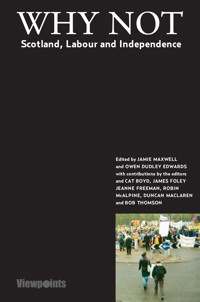
Is Scottish independence incompatible with 'Labour values'? Are 'Labour values' being realised within the Union? How much really divides Yes campaigners from Labour voters? Why Not? Scotland, Labour and Independence is a passionate and often personal appeal to Labour voters (and other progressive Scots) to consider the social, economic and political gains that could be won with Scottish self-government. Bringing together a range of diverse voices - some from within the Labour Party, some from within the SNP, some from the non-aligned Left - it presents the social justice case for a Yes vote and argues that independence offers the clearest route forward for socialist and centre-left Scotland. Urgent, original and provocative, Why Not? is a vital contribution to the independence debate - and essential reading for all Scots.
Sie lesen das E-Book in den Legimi-Apps auf:
Seitenzahl: 209
Veröffentlichungsjahr: 2014
Das E-Book (TTS) können Sie hören im Abo „Legimi Premium” in Legimi-Apps auf:
Ähnliche



















JAMIE MAXWELLis an Edinburgh-based political journalist. He writes regularly for theNew StatesmanandBella Caledonia, and has contributed to theSunday Herald, theScottish Review of Books, theScotsmanand theSunday Mail. Last year he editedThe Case for Left Wing Nationalism, a collection of his late father Stephen Maxwell’s essays. He is the co-author (with David Torrance) ofScotland’s Referendum: A Guide for Votersand is currently co-editing, with Pete Ramand,Old Nations, Auld Enemies, New Times, the selected essays of Tom Nairn.
OWEN DUDLEY EDWARDS FRSEis Hon. Fellow of the School of History, Classics and Archaeology, at the University of Edinburgh where he taught History from 1968, having been born in Ireland and studied in theUSA. His wife Bonnie is American and his three children are Scots. His most recent major monograph isBritish Children’s Fiction in the Second World War, his most recent collaborationTartan Pimps, and he has edited several books includingA Claim of Right for Scotland.
DUNCAN MacLARENis an Adjunct Professor of the Australian Catholic University where he lectured in international development studies and ethics. He was Executive Director ofSCIAF, the aid agency of the Scottish Catholic Church, and Secretary General of Caritas, one of the largest aid and development networks in the world. He is a lay Dominican.
JEANE FREEMAN OBEis a political analyst, chair of the Golden Jubilee National Hospital and a member if the Judicial Appointments Board for Scotland. Having served as senior political advisor to First Minister Jack McConnell in 2002 to 2005, she is now a leading figure in Women for Independence.
JAMES FOLEYis the author ofYes: The Radical Case for Scottish Independence. He is finishing his PhD on the Scottish economy at the University of Edinburgh and he lectures at Napier University.
ROBIN McALPINEis the director of the Jimmy Reid Foundation, a member of the Common Weal and the editor of theScottish Left Review. Having graduated from Glasgow University, he became Press Officer to George Robertson, then Shadow Secretary of State for Scotland and leader of the Scottish Labour Party. Returning to Scotland to work in policy development, Robin was also Public Affairs Manager for Universities Scotland for eight years. He is now one of the most well-known and influential voices for independence and social renewal in Scotland.
CAT BOYDis a leading Scottish trade union activist. She is co-founder of and campaigns for the Radical Independence Campaign and People’s Assembly Scotland. She is also a founder and Chair of Coalition of Resistance Scotland, and has previously held the position ofPCSYoung Members Officer. She has appeared as a speaker at the Radical Independence Conference 2013. Recently, she collaborated with Jenny Morrison on a manifesto entitledWomen and Scottish Independence: A Feminist Response.
BOB THOMSONworked as engineering draughtsman, then as trade union official, retiring as Associate Scottish Secretary,UNISON. He is a former member of the General Council of theSTUC. A Labour Party member for over 50 years and a past Chairman and Treasurer of the Scottish Labour Party, he served as a lay member of employment tribunals and the Employment Appeal Tribunal. Active in human rights organisations in theUKand Scotland including Scottish Human Rights Trust, he is currently Convener of the Jimmy Reid Foundation, a think tank and advocacy group, who have commissioned the Common Weal Papers which detail a blueprint for a fairer, more equal, more productive society in an independent or devolved Scotland.
Luath Press is an independently owned and managed book publishing company based in Scotland, and is not aligned to any political party or grouping.Viewpointsis an occasional series exploring issues of current and future relevance.
Why Not?
Scotland, Labour and Independence
Edited by JAMIE MAXWELL and OWEN DUDLEY EDWARDS
LuathPress Limited
EDINBURGH
www.luath.co.uk
First published 2014
ISBN (PBK): 978-1-910021-19-4
ISBN (EBK): 978-1-910324-24-0
The authors’ right to be identified as author of this work under the Copyright, Designs and Patents Act 1988 has been asserted.
© the contributors
To the memory of Michael Foot.
And of
Bob McLean
Contents
Acknowledgements
Introduction
CHAPTER ONE Realising Labour Values
Jeane Freeman
CHAPTER TWO War and Peace
Owen Dudley Edwards
CHAPTER THREE Britain, Global Development and Scotland
Duncan MacLaren
CHAPTER FOUR Backlash: The Political Economy of Voting NO
James Foley
CHAPTER FIVE The Meaning of Things
Robin McAlpine
CHAPTER SIX Ireland: The Real Elephant in the Room
Owen Dudley Edwards
CHAPTER SEVEN Thank you, Edwin Morgan, Thank you, J.K. Rowling
Owen Dudley Edwards
CHAPTER EIGHT Putting the Past to Work for the Future
Jamie Maxwell
CHAPTER NINE To Win Scotland for its People
Cat Boyd
CHAPTER TEN On Not Standing Still
Bob Thomson
Acknowledgements
Our deepest thanks are due to the National Library of Scotland, for their lovely café where this book was hatched, and especially to Gavin MacDougall of Luath, and his team, for services far beyond the norm. It is a privilege to work with them.
Introduction
THE BOOK TO READ ONScottish Independence is Stephen Maxwell’sArguing for Independence. We edited it for publication by Luath Press after the author’s death. He was Jamie’s father and Owen’s friend. We are still deeply conscious of how much we need him and our biggest criticism of the present book is that it doesn’t have his living guidance.
As we enter on the last weeks before the Referendum on Independence we are particularly conscious of the need to win YES votes from many people who don’t believe in Scottish nationalism and fear that voting YES would betray their allegiance to the Labour party or their belief that voting is a waste of time or some other reason, but who share all or most of the ideals and beliefs of YES voters. What is written here are things to think about. The Referendum is a means of fulfilling what many Scots want to happen although they have not all realised it.
In particular we think of the great back-breaking work carried out for so long by our fellow Socialists from its foundation and long before. YES is in the tradition of Robert Burns and Thomas Muir, Robert Owen and Hugh Miller, Robert Bontine Cunninghame Graham and James Connolly, John MacLean and James Maxton, Keir Hardie and Tom Johnston, John Wheatley and John McGovern, Hugh MacDiarmid and Somhairle MacGilleain, Hamish Henderson and John McGrath, Margo MacDonald and Anthony Ross, David Daiches and Lionel Daiches, Norman MacCaig and David MacLennan. Some lived too early to be in the Independent Labour Party or the Labour Party itself. Some were proud and great members of the Labour Party, some were never in it, some were intermittently in it. All were Socialists but not all gave themselves that label. Some were not for Scottish Independence in their time but what they thought, said and did helped to make those who vote YES on September 18.
And we do not claim the cause of Scottish Independence as purely Socialist. We do claim that it is the best and surest way of Scotland becoming Socialist. To put it in obvious maths, independent Scotland will be prevented by international law from having weapons of mass destruction since no country that has not had them is permitted to have them. Thousands died in Iraq because of the belief it had such weapons, although, it did not. It is horribly evident that all the Unionist parties at Westminster are determined to retain them, much as an alcoholic hangs on to his bottle despite all medical and moral evidence. If weapons of mass destruction are outlawed in Scotland, there will be much difficulty about putting them anywhere else and so the day may dawn when the fact may sink in that not only are they destructive, debasing and damnable, but they are more trouble than they are worth. And if we get their blood-money off our books, we will have the funds to maintain the welfare state for which Labour fought so hard and so well in times past. Above all we will be able to maintain the National Health won and begun by Aneurin Bevan, and ensure continued investment in education to reach the widest possible number as his wife, the Scottish Socialist Jennie Lee, sought in her great stewardship of the Open University now starved of the funds it needs.
But we also claim inheritance of another tradition, all the more in dedicating this book to the memory of Michael Foot, a friend of Owen’s for many years. Michael was a pioneer in the Aldermaston March in opposition to the ownership of nuclear weapons. He was a magnificent custodian of the Socialist tradition of these islands, and was proud that his name was given him partly in honour of the Irish nationalist and socialist, Michael Davitt, father of the Irish Land League and inspirer of the Scottish crofters’ revolt and the early Scottish Labour movement. Michael Foot had a genius for finding the value of ideas held by historical figures few would associate with Socialism. His literary masterpieceThe Pen and the Sword(1958) described and explained Swift’s destruction of The Warlord Marlborough from his own knowledge of political journalism above all as editor ofTribune, but he showed how profoundly Swift hated war, ridiculed and condemned it and passionately denounced the whole cult of it. He took up the cause of devolution not in some would-be Machiavellian spirit of frustrating political rivals, but because he believed that in both Scotland and Wales nationalism showed some qualities meriting respect, and winning allegiance for genuinely altruistic reasons. He saw that love of community fuelled nationalism and socialism. He loved the Labour movement but never saw politics as a battle-field to gain jobs for the boys and power for the greedy. He fought to win devolution for Scotland, regardless of being misunderstood by those outside the Labour party, and being betrayed by some of those in it. He had a splendid sense of humour, and was one of the kindest men Owen has ever known.
He was very proud of partnership with John Smith, whose integrity, wisdom and laughter were a great counterpart to Michael’s. We don’t claim either of them as YES men, since all that can be known about how the dead would feel about now is that they would feel dead, though it is impossible to think of two who were so splendidly alive, as dead. They had a breadth of mind, a readiness to reconsider views to which they had been opposed, a love of humanity shown in friendships with people of goodwill for beyond party bounds. Michael fought to gain a Welsh language TV when Gwynfor Evans threatened to die on hunger-strike if Thatcher continued to reject one, and in fact his intervention carried the day with the aid of William Whitelaw, and Gwynfor survived. John Smith was piped to his grave in Iona by his lifelong friend Neil MacCormick MEP, the greatest SNP intellectual of his time. The lesson of these men is to keep our eyes firmly fixed on the best future for our communities, to value the enrichment of the mind from all quarters, to be ready to laugh especially at ourselves. If you want to understand why the Labour party is dear to the hearts of so many people who are not in it, begin by thinking of Michael Foot and John Smith.
But, there are other Labour leaders, some of them still alive and officially (although not certainly) voting NO, yet whom we must salute and whose kinship we must claim. These are the founding fathers of the Scottish Parliament, those whose work began it, and whose stewardship sent it on its way. It is our Parliament and from it constitutionally arose our Referendum once the Scottish people had elected enoughMSPs pledged to seeking independence. But that Parliament suffered in its earliest days from unexpected blows: its costs were concealed from theMSPs and its cause was betrayed in a foolish reversal of policy from support to hostility of the then national newspaperThe Scotsman. Donald Dewar, Henry McLeish and Jack McConnell successively played major parts on all kinds of ways to get the ship of state launched on its maiden voyage, and every one of them deserves the gratitude and respect of their country. Politics are abrasive, journalists are iconoclastic and credit is seldom given save in the praise dished out by sycophants. Any worthwhile history must honour these men.
The cause of Independence is inspired by what was done by our first three First Ministers, but also by what they could not do. From the first it was clear that leadership of a Scottish Parliament would be self-destructive if the leader’s eye was fixed on promotion to Westminster, if in fact a seat in the House of Commons was deemed more desirable than one in Holyrood. All of these three wanted to lead Scotland, and to do so from Scotland. Others have sought to make Holyrood a stepping-stone to Westminster, and they have suffered accordingly. They may be prominent when they reach Westminster but their right to speak for Scotland is diminished once they cease to speak in Scotland, or, worse, to resurrect themselves on Westminster off-days in Scottish space with an air of a West End musical slumming in the provinces. However Unionists they may be, HolyroodMSPs have to show they love Holyrood more than Westminster, and that if Westminster wishes (which usually means Whitehall wishes) come first, it is because of the merit in that particular wish, not in the belief that Westminster comes first. It will usually be WestminsterMPs from Scottish constituencies (we need not bother with those whom Scots voters sent into legislative exile in England) who are most vehement in public and private that Scotland must always come second. So it was natural that Labour First Ministers found themselves in constant friction with Westminster and Whitehall comrades telling them to knuckle under. Naturally there was the continuation of Westminster/Whitehall historic manipulation of the Scottish parties, with A in London favouring Z as his favourite Scottish voice, B preferring Y, although such favouritism might be circumspect. In pre-Holyrood days even Margaret Thatcher had to show some civility to Malcolm Rifkind, however obviously preferring his mental and moral inferior Michael Forsyth.
And thus it is that the last Labour First Minister, Jack McConnell, while officially advocating NO, knows more reasons to vote YES than perhaps any other member of his party. He is loyal to his party, and he does not reject the merits of the system under which he rose. But he is also loyal to his Parliament, and clearly resented its subordination from time to time on the whim of Whitehall, and had done so before his leadership. The catastrophic death of Dewar, the unjust forced resignation of McLeish, pushed McConnell into office, as Parliament leader. His patience, his strength, his social conscience played their part in enabling him to gain respect and dignity for the Scottish premiership. But it’s not just that he knows the independent judgements by Scots are likely to be sounder on Scottish questions than those of non-Scots made far away. He himself has priorities well outside the limits of a devolved parliamentary leadership. He has, for instance, a passionate hatred of racism under which supposedly independent African countries in particular suffer so badly, however wrapped up in international moneyspeak it may be. He knows that from any standpoint (apart from loony racists’) Scotland needs more immigrants as an economic fact as well as a national idea. He is all too aware that on such a matter the Unionist parties in England will twist in the wind of electorally strong prejudice regardless of Labour traditions of humanity and Scottish necessities of economics. If in the end he votes NO, it will probably be No, BUT…
Two years ago, on 14 July 2012, Jack McConnell delivered one of the finest speeches of his life, at the funeral of Dr Bob McLean, his best man. He also wrote McLean’s obituary in theScotsmancalling him:
a big man, in every sense of the word. He had a big heart, a massive presence, a wonderful sense of humour, a huge intellect, and a burning passion for Scottish Home Rule. He was one of the most significant extra-parliamentary figures of late twentieth-century Scotland, and his skills placed him at the centre of the campaign to secure a Scottish Parliament. He was the beating heart of the devolution movement, inside and outside the Scottish Labour Party. He was patriotic, a socialist, a true friend…he inspired us, educated us and organised us into the generation that turned his dream into reality…Scotland will always be a better place for the time he spend with us here.
Owen had been Bob McLean’s supervisor at Edinburgh for his Ph.D, on the impact of Michael Collins’s memory on the ten years of Irish history after his death in 1922, Jack McConnell quoting him on Bob’s being a supervisor’s dream, a student with the mind of a pioneer. Bob cut his way through a jungle of concealments, reservations, proscriptions, denials of access to documents, reluctant interviewees, data supposedly sealed until God knows when and survivors who would speak to nobody. His greatness of heart enveloped others, so that what had seemed impossible suddenly seemed the obvious thing to do. He had been election agent for successive Midlothian LabourMPs and anMSP. And he was the living and large embodiment of the neglected truth that nuts and bolts party workers may be passionately interested in political ideas, all the more because they know the detail of where and how they are fighting. He knew, professionally the power of recent history on the minds of survivors.
None of us know how Bob McLean would have voted had we been lucky enough to keep him until September 18th 2014. He had been anSNPsupporter in his teens before they met, as had McConnell, both of them responsive to the nationalist Spring in the mid-1970s in which they and many of like mind went over to the Labour party during theSNPcivil wars which ended in the expulsion of Stephen Maxwell, Alex Salmond, Kenny MacAskill and others (later readmitted on legal technicalities). McConnell’s pre-eminence for the word ‘patriot’ to describe Bob McLean ways much of both of them: they would have denied theSNPthe right to question the patriotism of political opponents, but once, like many others of that generation, had, however briefly accepted the idea of Scottish independence. Jack McConnell organised a lecture in Bob’s memory and invited Trevor Phillips to give it. Phillips discussed pros and cons of Scottish independence, making it very clear that since he was not a Scot, and not a voter in the Referendum, he was not taking sides, but he made an exception in one aspect. He told us that if Scotland voted YES a policy of open doors to immigrants was essential, for the social health of a country as for its economic needs. Here, and here alone, he was prepared to say that Scotland gave him greater confidence than he could have in theUK. As for Jack McConnell, we can simply say that he showed himself a good friend, and a patriot.
Whatever the size of the YES vote, it will be have originated in far broader origins than any one, two or three political parties. We will take a final example of a great Scot who did not live as long as the Referendum. The Labour party and Left-wing leaders in general had actually differed greatly on devolution and some, such as Neil Kinnock and Robin Cook had been in the forefront against, in 1979, and for, in 1997. And there were some officially for, and actually against, such as James Callaghan and Tony Blair, while others such as Michael Foot, John Smith, and Gordon Brown, had worked themselves to the bone for it. In the larger Labour movement, the charismatic head of the Scottish miners had been Mick McGahey, a formidable Communist in combat, a genial one in private whether endowing historical research on the miners or exchanging memories with Ted Heath on their days as altar boys (Anglo-Catholic and Roman Catholic). The election of 1997 had been intended by Tony Blair to be a rejection of the Tories without Labour commitment to specific programmes, where possible, but by making it a mandate on devolution, John Major torpedoed that hope and with it, the Tory party in Scotland. Labour in Scotland headed by Donald Dewar had in any case tied itself to the demand for the strongest Parliament as yet on offer, in the Constitutional Convention of 1989 in the Hall of the General Assembly of the Church of Scotland (without whom we might never have had devolution). After his election in 1997 Blair therefore let it be known that while a victory in the Referendum for a Scottish Parliament was desirable (by this stage he had to be officially for it) the majority ought not to be too great. So little meetings were convened with little publicity. Once such happened at the old Royal High School towering over Edinburgh. It was presided over by one non-cabinet LabourMP, and at least one other was there. Everyone was very polite. It was rather like a mothers’ meeting in Morningside to discuss a children’s party with genteel pronouncements on preferable presents or prizes.
And then there arose from the body of the kirk Michael McGahey at whose appearance the organisers paled in the manner of the Sleeping Beauty’s parents when the wicked fairy appears at the christening. Not that Mick made any mention of magic needles, or any other extra-legal forms of persuasion. On the contrary, he was as bland and as enlightened as any eighteenth-century Scottish statesman. Almost flicking a speck of dust from the irreproachable Mechlin lace at his wrists, he beamed on the assembly and remarked with an abstracted air of a man trying to remember a punch-line of an irrelevant joke that the meeting had not been very well publicised and he himself had only heard of it when he was on a bus. It was, he knew, absurd to imagine the organisers would have been trying to keep its existence from him. The organisers, with a rather ghastly set of giggles, attempted to agree that it was absurd. The audience, which evidently knew better, gave vent to the first of many howls of delight and admiration. Mick McGahey then gave us a speech which may well have been the greatest of that Referendum. He told us of the reactionary shambles to which Thatcherism had reduced Scotland, and he told us of the Scotland that could will itself into being, and the greed it must destroy and the good that it must do. He had, after all, seen the cause of nationalism finally achieve reality inside the Communist world. Like many another leader of workers, he had remained in the party while countless others had left, but his continuing after 1990 in the Communist party of Scotland realised his increasing sense of Scottish Miners’ interests’ divergence from the showy confrontationalism of Arthur Scargill. He had been a leader in the Scottish miners’ strike in 1984–85 where they drank tea with the local Police until the London Met arrived with their Alsatians. He had sought Scotland’s right to decide whether it would strike. He had subscribed to the Constitutional Convention’s demand for a strong Scottish Parliament. And now he told us to believe in it, fight for it, and make a country with it. The crowd loved it, some of us risking necks to hug him when he finished. But he seemed to be looking far beyond the horizons of that Referendum. The cancer, which was devouring him as he spoke killed him eighteen months later.
We are very conscious of the speed of developments, some more unexpected than others. Peter Kilfoyle, of Liverpool, LabourMPfor 20 years and junior Minister for Defence under Blair, declared for the YES cause pointing out that its victory in Scotland would be a Godsend to England whose northern and western regions are starved of power and influence while London interests prospered. What he said makes sense and symbolically he makes sense as well. He has an original and independent mind. He is of Irish descent and Catholic belief. He is eleventh of 15 children, worked as a labourer for five years then qualified as a school teacher working for ten, and a passionate opponent of renewing Trident. His predecessor in his Liverpool Walton seat was the old Socialist warhorse Eric Heffer, a grand man for quoting Robert Burns but also a thunderous opponent of Scottish devolution. Kilfoyle shows us that Labour in England, Labour from Irish roots, Labour of cabinet credentials, Labour in Socialist heartlands can see the democratic victory awaiting England once Scotland has broken through. Scotland outlawing Trident could be very infectious. This magnificently reverses the old Labour cliché about Lanark having more in common with Liverpool than either could have with Moray or Nairn. Liverpool Labour has everything in common with Lanark, above all the democratic Socialist necessity for YES.




