


11,49 €
Mehr erfahren.
- Herausgeber: Atlantic Books
- Kategorie: Geisteswissenschaft
- Sprache: Englisch
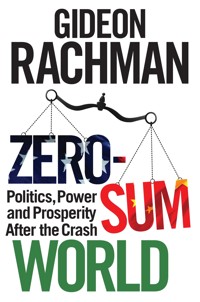
The economic crisis that struck the world in 2008 has drastically altered the logic of international relations. Globalisation no longer benefits all the world's superpowers and they face an array of global problems that are causing division between nations. A win-win world is giving way to a zero-sum world. Zero-sum logic, in which one country's gain looks like another's loss, has prevented the world from reaching an agreement to fight climate change and threatens to create a global economic stalemate. These new tensions are intensified by the emergence of dangerous political and economic problems that risk provoking wars, environmental catastrophe and ever-deeper debilitating economic crises. This timely and important book argues that international politics is about become much more volatile - and sets out what can be done to break away from the crippling logic of a zero-sum world.
Das E-Book können Sie in Legimi-Apps oder einer beliebigen App lesen, die das folgende Format unterstützen:
Veröffentlichungsjahr: 2014
Ähnliche




















ZERO-SUM WORLD
Gideon Rachman became chief foreign affairs columnist for the Financial Times in July 2006. He joined the FT after a fifteen-year career at The Economist, which included spells as a foreign correspondent in Brussels, Washington and Bangkok. He also edited The Economist’s business and Asia sections. His particular interests include American foreign policy, the European Union and globalization.
First published in 2010 in Great britain by Atlantic books, an imprint of Grove Atlantic Ltd.
This edition published in Great Britain in 2014 by Atlantic Books Ltd.
Copyright © Gideon Rachman, 2010 Foreword © Gideon Rachman, 2011
The moral right of Gideon Rachman be identified as the author of this work has been asserted in accordance with the Copyright, Designs and Patents Act of 1988.
All rights reserved. No part of this publication may be reproduced, stored in a retrieval system or transmitted in any form or by any means, electronic, mechanical, photocopying, recording, or otherwise, without prior permission both of the copyright owner and the above publisher of this book.
Every effort has been made to contact copyright holders. The publishers will be pleased to make goodany omissions or rectify any mistakes brought to their attention at the earliest opportunity.
eISBN 9780857891624
A CIP catalogue record for this book is available from the British Library.
Atlantic Books Ltd. Ormond House 26–27 Boswell Street London WC1N 3JZ
www.atlantic-books.co.uk
To Olivia, my companion in Cambridge, Washington, Bangkok and Brussels
CONTENTS
ForewordPrologue – Davos, 2009Part One: The Age of Transformation, 1978–91Introduction1China, 1978: Deng’s Counter-Revolution2Britain, 1979: Thatcherism3The United States, 1980: The Reagan Revolution4The European Union, 1986: Embracing the Market5The Soviet Union, 1985–91: Glasnost, Perestroika and Collapse6Europe, 1989: The Year of Revolutions7Latin America, 1982–91: The Triumph of Democracy and Markets8India, 1991: The Second Asian Giant Awakes9The Gulf War, 1991: The Unipolar MomentPart Two: The Age of Optimism, 1991–2008Introduction10Democracy: Francis Fukuyama and the End of History11Prosperity: Alan Greenspan and the End of Economic History12Progress: Bill Gates and the Triumph of Technology13Peace: Bill Clinton and the Win-Win World14The Optimistic East: Kishore Mahbubani and the Asian Century15Europe: Günter Verheugen and the European Dream16The Anti-Globalizers: From the Asian Crisis to 9/1117Power: Charles Krauthammer and the NeoconservativesPart Three: The Age of AnxietyIntroduction18The Crisis of the West19A World of Troubles20Global Government: The World as Europe21Axis of Authoritarianism: The World as Russia and China22Fractured world: The World as Pakistan23Zero-Sum World24Saving the WorldNotesBibliographic EssayAcknowledgementsIndexZERO-SUM WORLD
FOREWORD
Writing a book on contemporary politics is a hazardous exercise. All such works are vulnerable to unexpected shifts in world affairs that can make wise-sounding predictions suddenly seem foolish. I finished the first draft of Zero-Sum World in January 2010. In the following year, however, the central arguments of the book seem to me to have gained in strength.
What I call the ‘rise of zero-sum logic’ in international politics has become more visible in three vital areas: US-Chinese relations, the crisis inside the European Union, and global governance. Meanwhile, in early 2011 popular revolts across the Arab world – above all, in Egypt – have injected new uncertainties into global politics. These events, foreshadowed in my book, are still unfolding. Depending on how they turn out, they could end up either re-energizing the liberal narrative of the Age of Optimism or further heightening the uncertainties of the Age of Anxiety.
An increase in tensions between America and China was one of the most striking political developments of 2010. In the background was the growing sense that the financial crisis had marked an important shift in economic and political power from West to East. The US is still the world’s largest economy and its dominant power. But on both sides of the Pacific there is now a realization that China’s challenge is becoming much more real. The much-touted Goldman Sachs prediction that China would become the world’s largest economy by 2027 was made before the collapse of Lehman Brothers in 2008. In the aftermath of the Great Recession, new calculations moved the date forward. Projections by The Economist suggested that China might be the world’s largest economy by 2019.1
American anxiety about the rise of China was increased in 2010 by the knowledge that the US budget deficit was out of control. Towards the end of that year, Admiral Michael Mullen, the head of the Joint Chiefs of Staff, argued that America’s burgeoning national debt was now the single biggest threat to national security. He pointed out that some 50 per cent of the discretionary spending in the US budget goes on the military. Observing the deep cuts in military spending being made by cash-strapped European governments (including Britain), the admiral remarked, ‘I do worry that it won’t be too long before these kind of cuts will be part of our future as well, and that would be very dangerous.’2
The perception of an emerging threat to America’s military dominance of the Pacific was strengthened by China’s military build-up. Shortly before a trip to Beijing in January 2011, Robert Gates, the US defence secretary, expressed concern at China’s latest weapons developments. On arriving in Beijing, Mr Gates was greeted with the spectacle of the maiden flight of China’s first ever stealth fighter. To many observers, it looked like a deliberate and bellicose message from Beijing to Washington.3
It is not just the United States that worries about a more assertive China. Possibly emboldened by a sense that power was moving their way in the aftermath of the economic crisis, the Chinese government took a noticeably tougher line with its neighbours during the course of 2010. Talking to Indian officials, I found mounting alarm about what the government in New Delhi claimed was increasing Chinese pressure over the two countries’ unsettled territorial dispute over the Indian province of Arunchal Pradesh. The Indians also looked with alarm at China’s close strategic and economic ties with India’s neighbours – Sri Lanka, Pakistan and Burma.
China’s assertion that its territorial claims in the South China Sea were now a ‘core national interest’ alarmed many of its South-East Asian neighbours, in particular Vietnam. That led Hillary Clinton, the US secretary of state, to assert that America too has a national interest in developments in the South China Sea – a statement that was received with some hostility in Beijing.4 Japan was yet another Asian power to take fright at the spectacle of a more assertive China. A clash over a Chinese fishing boat that strayed into waters claimed by Japan became a major diplomatic incident in the second half of 2010 – and sent Japan hurtling back into the arms of Uncle Sam. Indeed, one of the biggest geopolitical shifts since I completed the first draft of this book has been Japan’s abandonment of its flirtation with a rapprochement with China. Following the fall of the Hatoyama government in June 2010, Naoto Kan, the new Japanese prime minister, shifted his country’s policy back in a more pro-American direction.
Inept and overassertive Chinese diplomacy during the course of 2010 handed the US a diplomatic opportunity in the emerging struggle for power and influence between the two nations. Increasingly disillusioned by its relationship with China, the US began to cultivate much warmer military and diplomatic ties with China’s neighbours – in particular India. In November 2010 President Obama visited India and lavished praise on the country, hailing its emergence as a great power.5 Indeed, just as the Indians worried about encirclement by allies of China, so China began to look anxiously at a network of powerful American allies surrounding the Middle Kingdom – including Japan, India, South Korea and Australia.
A battle to win friends and influence allies is clearly under way between the US and China. Some American strategists have argued that their country’s budgetary problems could be compensated for by the construction of a network of Asian alliances, in a policy of ‘soft containment’ of China. And yet many countries in the region face a strategic dilemma as their economic and security interests increasingly diverge. China is now the major trading partner of Japan, South Korea and Australia. But these countries’ key military relationship is with the United States. Unless China massively overplays its hand, these economic ties may end up mattering more in the long run, particularly amidst lingering questions about America’s staying power in the Asia-Pacific region. As Kishore Mahbubani, the Singaporean academic, put it to me in early 2011, ‘The countries of the region have to be careful. We know China will still be here in a thousand years, time. We don’t know if the United States will still be here in a hundred years’ time.’6 By the end of 2010 tensions between China and the US were so overt that President Hu Jintao, shortly before visiting Washington in January 2011, took it upon himself to warn against those promoting ‘zero-sum cold war thinking’.7 (I decided not to take this reproof personally.)
While security and strategic tensions between the US and China soared over the course of 2010, economic tensions continued to simmer. Shortly before the US mid-term elections of November 2010, the House of Representatives passed a law that would allow the US to raise tariffs in response to Chinese currency manipulation. Mike Rogers, a Republican from Michigan, put academic economists’ concerns into blunt political language, when he complained of the Chinese: ‘They cheat to steal our jobs.’8 But the Senate failed to pass the tariffs bill and – after the mid-terms – the steam seemed to go out of the drive for anti-Chinese tariffs. The fact that China’s currency was allowed to rise a little, in advance of President Hu Jintao’s visit to Washington in January 2011, helped to cool protectionist sentiment.
Yet it would be complacent to write off the chances of a resurgence in protectionism. With American unemployment still very high and the US trade deficit with China at near-record levels, the conditions for a rise in protectionist sentiment remain. In a worrying sign for the relationship, American business leaders are beginning to complain of an increasingly hostile investment climate in China. Jeff Immelt, the head of General Electric, questioned the very idea of a win-win economic relationship between the US and China, when he grumbled at a private dinner in 2010, ‘I’m not sure in the end they [the Chinese] want any of us to be successful.’9
While the US bemoaned Chinese currency manipulation, China made its own complaints about the American policy of ‘quantative easing’ (otherwise known as printing money), which China argued was a deliberate effort to drive down the value of the dollar. Third parties complained that they were being damaged by both Chinese and US currency policies that were making other countries’ goods uncompetitive. Guido Mantega, Brazil’s finance minister, charged that, ‘This is a currency war that is turning into a trade war.’10 But Brazil’s response – to impose controls on the free movement of capital – was seen by some as eating away at the fabric of a globalized world. It was a telling example of how the rise of zero-sum logic in the relationship between America and China – the world’s two largest economies – could infect international relations as a whole.
The crisis within the European Union that unfolded over the course of 2010 looked more like an internal European affair. Except that, with the EU as a whole ranking as the world’s largest economy and with troubled European banks plugged into the global financial system, the rest of the world knows that it is implicated in the continuing European drama.
As the crisis rolled from Greece to Ireland and then on to the Iberian Peninsula, so political tensions rose between EU nations and within individual European countries. There was immense bitterness in Ireland at what was regarded as high-handed pressure from Germany and the European Central Bank as the country’s banking system tottered. Many Irish commentators, as well as influential outsiders, regarded the terms of the bail-out forced on Ireland in 2010 as unfair and unsustainable. And yet German politicians were also under enormous political pressure at home, from a public and a judicial system that were deeply hostile to the idea of further bail-outs. Senior German and French politicians seemed to be united on the need for new rules and policies to pull Europe back together again. But the details remained dangerously vague and elusive.
Meanwhile, as the countries at the cutting edge of the European debt crisis struggled to cut back spending, so social and political tensions mounted. In Greece, Spain, Ireland and even Britain, unemployment shot up – with youth unemployment particularly high. Speaking at the World Economic Forum in Davos in January 2011, George Papandreou, the Greek prime minister, expressed worry that in Europe the rich continued to prosper, while the middle and working classes were being squeezed. This, he warned, was a formula for the rise of racist and nationalist political movements.
A troubled European Union is less and less able to promote the European model at a global level through the development of the G20. By the autumn of 2010 it was apparent that the G20 was becoming increasingly troubled. Approaching a new G20 summit in Seoul, arguments between China and the US over currency and trade were threatening to destroy the façade of big-power unity. Manmohan Singh, the Indian prime minister, spoke for many when he warned that, ‘We’ve lost consensus about how to tackle the situation. . . The G20 is in serious difficulties.’11 Those who bothered to check up on what had happened to previous promises made at G20 summits could only agree. The pledge to ‘take strong action to address the threat of climate change’ had not been acted upon. The promise to avoid ‘competitive devaluation’ was being ignored. Financial regulation was one area where there had been some progress. But, even there, the major issues – in particular tackling the problems of banks that were thought ‘too big to fail’ – had yet to be properly addressed.
Skilful diplomacy prevented an open row breaking out at the G20 summit in Seoul. But even the most ardent advocates of global governance were beginning to despair. Mark Malloch-Brown, once the number two at the United Nations and the author of a book arguing passionately for more global governance,12 was nonetheless bleakly realistic about where the world had got to. In a co-authored article, he lamented that, ‘International co-operation has stalled. From climate change and trade to nuclear proliferation and UN reform, macroeconomic rebalancing and development funding – and the list could go on – nearly every major initiative to solve the new century’s most pressing problems has ground to a standstill.’13
Amidst all this gloom and stagnation, the spread of revolutionary fervour across the Middle East in early 2011 is transforming the atmosphere of international politics. It took just six weeks for the arrest of a vegetable seller in Tunisia to spark a chain of events that led to the fall of a president in Egypt. As I write (in February 2011), unrest has spread to the Gulf states and across North Africa to Libya and Algeria.
Although it is fashionable to say that nobody could have predicted the uprising in Egypt, in fact, that was not the case. Many experts on North Africa and the Arab world had written that Egypt and its neighbours were potentially unstable countries. In the hardback of Zero-Sum World (published in late 2010), I wrote of Egypt that ‘there are clearly social and political pressures that make the country a pressure cooker’, and floated the possibility that ‘Egypt’s autocracy will be swept away by an Islamist-influenced revolution’. I also wrote that ‘the pressures visible in Egypt are replicated across North Africa’.
In the event, the early stages of the Egyptian revolution were not dominated or even strongly influenced by Islamists. On the contrary, the image of middle-class, English-speaking Egyptians – organizing a rebellion through Facebook and Twitter – could have been designed to appeal to a western audience.
Two rival narratives could now emerge from the turmoil of the Middle East. If the revolutions in Egypt and elsewhere in the Arab world succeed in establishing working democracies, it will be a triumphant re-assertion of many of the ideas of the Age of Optimism. The democratization of the Middle East will come to be seen as the latest example of the global advance of democracy, chronicled by Francis Fukuyama and others. The spread of political liberty in Western Europe in the 1970s was followed by the democratization of Latin America in the 1980s and of Eastern Europe, after the fall of the Berlin Wall in 1989. If democracy now takes root in the Middle East, the ‘Arab exception’ will have ended – which will seriously dent the confidence of the ‘axis of authoritarianism’ I describe in my book. The role of new technologies in spreading the revolutionary virus would also bolster the beliefs, expressed by Bill Clinton and others, that new technologies combined with globalization, will bring about political freedom.
There are, however, a great many ‘ifs’ in the preceding paragraph. It is entirely possible – probably likely – that the emergence of a new political order in the Middle East will be much more turbulent and unstable than the relatively smooth spread of democracy experienced in most of the former Soviet bloc.
A second story that could emerge from the turmoil in the Middle East would involve a long period of social and political instability, punctuated by violence and economic dislocation. From a western point of view, this would be accompanied by a loss of American power and influence in a strategically crucial part of the world. Just across the ocean from North Africa, the European Union would have the flow of immigrants to worry about and potential radicalization of Muslim immigrants in mainland Europe.
Ending this foreword perched precariously between optimism and pessimism about the Middle East is, perhaps, appropriate for a book that has struck some readers as excessively gloomy – and others as far too hopeful. In truth, there are elements of both optimism and pessimism in Zero-Sum World. My prognosis for the future of international politics over the next decade is undoubtedly bleak. The faith in the power of liberal political and economic values ultimately to prevail is a positive message.
At various seminars and talks that I gave in the weeks after the hardback was published, I found that I was frequently asked whether I was optimistic or pessimistic about the future of the world. The answer that I came up with is that I am ‘a medium-term pessimist and a long-term optimist’. That still seems to me about right.
Gideon Rachman London, 18 February 2011
1
‘Dating game’, The Economist, 16 December 2010.
2
Edward Luce and Daniel Dombey, ‘US military chief warns on spending’, Financial Times, 15 September 2010.
3
Kathrin Hille and Daniel Dombey, ‘Stealth test flight overshadows Gates trip’, Financial Times, 11 January 2011.
4
Geoff Dyer, ‘Power play in the South China Sea’, Financial Times, 9 August 2010.
5
James Lamont and Edward Luce, ‘Obama calls for top India role at UN’, Financial Times, 8 November 2010.
6
Conversation with the author, Davos, 26 January 2011.
7
‘Hu, China US must give up zero-sum cold war thinking’, Times of India, 18 January 2011.
8
James Politi and Daniel Dombey, ‘US Congress backs action on renminbi’, Financial Times, 30 September 2010.
9
Geoff Dyer and Guy Dinmore, ‘GE chief gives vent to frustration over China’, Financial Times, 15 July 2010.
10
Jonathan Wheatley and Joe Leahy, ‘Trade war looming, warns Brazil’, Financial Times, 9 January 2011.
11
Lionel Barber and James Lamont, ‘India warns on damage from G20 tension’, Financial Times, 19 October 2010.
12
Mark Malloch-Brown, The Unfinished Global Revolution (London: Allen Lane, 2011).
13
Richard Samans, Klaus Schwab and Mark Malloch-Brown, ‘Running the World, After the Crash’, Foreign Policy, January–February 2011, 80.
PROLOGUE
Davos, 2009
Every January political leaders from all over the world gather in a Swiss mountain valley. At the World Economic Forum in Davos, the assembled politicians agree to set aside their differences and to speak a common language. Closeted together in a ski resort, they restate their commitment to a single, global economy. They mingle cheerfully with the same multinational executives and investment bankers. They campaign to attract foreign investment and trade. For five days, the world’s leaders seem to agree on a narrative about how the world works. At Davos, even the most intractable political differences are temporarily smothered by the globalization consensus.
But at the Davos forum in 2009, it was clear that something had gone badly wrong. The meeting took place just four months after the collapse of Lehman Brothers had tipped the world into the biggest financial crisis since 1929. The international bankers, who normally strutted proudly around the Davos cocktail circuit, were in hiding, as their institutions reeled and public opprobrium mounted. The Obama administration – locked in desperate economic negotiations at home – was conspicuous by its absence. With the Americans out of the way, Wen Jiabao, the prime minister of China, was the star of the Davos show.
One late afternoon, an audience of the world’s leading businessmen crowded into a seminar room to hear his views on the gathering economic storm. With China now the world’s largest exporter and the biggest single buyer of American government debt, the audience had every reason to listen intently. There was nothing overtly charismatic about Wen. A slight man in a suit and spectacles, his style was that of a senior manager, reporting to the board. But towards the end of his talk, the Chinese premier dropped his bureaucratic manner and grew philosophical. In an effort to understand the crisis better, he said, he had been ‘re-reading Adam Smith’. Perhaps showing off a little, Wen made the point that the book he was consulting was the eighteenth-century economist’s The Theory of Moral Sentiments, rather than the much better-known Wealth of Nations. For anyone with a sense of history, it was a bizarre moment. A leader of the Chinese Communist Party was openly turning to the founding father of free-market economics for guidance.
But while a communist leader was coming to the support of capitalism in Davos, some of the leaders of the major capitalist powers seemed to be flirting with communism. In the immediate aftermath of the collapse of Lehmans, Nicolas Sarkozy, the president of France, had allowed himself to be photographed reading Marx’s Das Kapital, while Peer Steinbruck, Germany’s finance minister, observed that ‘certain parts of Marx’s thinking are not so bad’.1
This political and ideological confusion was understandable. The financial and economic crisis unleashed by the Wall Street crash of September 2008 threatened the globalization consensus that the leaders of the world’s major powers had all accepted. It created something close to panic in prime ministers’ offices and presidential palaces across the world.
Faced with the most serious economic upheaval since the thirties, politicians fearfully looked back to the politics of the interwar period. Ed Balls, a British cabinet minister and the closest ally of Gordon Brown, the country’s then prime minister, observed gloomily just after the Davos meeting of 2009 that the world was facing a financial crisis that was even more serious than that of the thirties, adding ‘and we all remember how the politics of that era were shaped by the economy’.2
Over the next twelve months the world suffered its deepest recession since the thirties. Yet fears of a return to a world of soup kitchens, political extremism and fascist marches did not materialize.
So was it all a bad dream? A scare story? Might it be possible to go back to international business as it was conducted before the crash of 2008?
It would be a mistake to believe that. It is the argument of this book that the international political system has indeed entered a period of dangerous instability and profound change.
Over the past thirty years the world’s major powers have all embraced ‘globalization’ – an economic system that promised rising living standards across the world and created common interests between the world’s most powerful nations. In the aftermath of the Cold War, America was obviously the dominant global power, which added to the stability of the international system by discouraging challenges from other nations.
But the economic crisis that struck the world in 2008 has changed the logic of international relations. It is no longer obvious that globalization benefits all the world’s major powers. It is no longer clear that the United States faces no serious international rivals. And it is increasingly apparent that the world is facing an array of truly global problems – such as climate change and nuclear proliferation – that are causing rivalry and division between nations. After a long period of international co-operation, competition and rivalry are returning to the international system. A win-win world is giving way to a zero-sum world.
Both as individuals and as a nation, Americans have begun to question whether the ‘new world order’ that emerged after the Cold War still favours the US. The rise of Asia is increasingly associated with job losses for ordinary Americans and with a challenge to American power from an increasingly confident China. The crash has heightened awareness of American economic vulnerability and the country’s reliance on continued Chinese and Middle Eastern lending. Of course, even after the crash, the United States remains the most powerful country in the world – with its largest economy, its most powerful military and its leading universities. But the US will never recover the unchallenged superiority of the ‘unipolar moment’ that began with the collapse of the Soviet Union in 1991.
Meanwhile, the European Union, the other main pillar of the western world, is going through its most serious crisis since its foundation in 1957. The steady progress towards ‘ever closer union’ in Europe over the past fifty years was built on a win-win logic. The nations of Europe felt that they were growing stronger and more prosperous by merging their fates. The creation of a single currency and the near doubling in the size of the Union between 2000 and 2007 fitted perfectly with the logic of globalization. Economic and political barriers between nations were being torn down. But the threat of contagious debt crises across Europe has provoked bitter recriminations within the Union, as countries like Germany worry that they will be dragged down by their neighbours. The process of European integration is threatening to unravel.
Zero-sum logic, in which one country’s gain looks like another’s loss, has led to a sharp rise in tensions between China and the United States. Zero-sum logic is threatening the future of the European Union, as countries squabble over the costs of managing a single currency. Zero-sum logic has prevented the world from reaching a meaningful agreement to combat global warming. The US, China, the EU and the major developing economies all hesitate to move first – for fear of crippling their domestic economies, and so boosting the relative power and wealth of rivals. A similar competitive rivalry blocks the world’s ability to find co-operative solutions to nuclear proliferation, as the major powers manoeuvre for advantage rather than acting decisively to combat a common threat. Zero-sum logic hovers over other big international challenges – such as shortages of energy, food and water, as the world’s biggest powers struggle to secure resources.
The emergence of a zero-sum world undermines the key assumptions of US foreign policy since the end of the Cold War. Both Bill Clinton and George W. Bush believed that it was in America’s interests to encourage the rise of major new powers, such as China, because globalization was bending history in America’s direction. In 1999 Bush captured the conventional wisdom of the age when he observed, ‘Economic freedom creates habits of liberty. And habits of liberty create expectations of democracy. . . Trade freely with the Chinese and time is on our side.’3 Clinton even came to believe that globalization was changing one of the oldest rules of international relations, the notion that rising and established powers would clash with each other as they jostled for power. His aide James Steinberg later recalled that the president ‘didn’t see that there had to be inherent competition among nations. The success of some was not threatening to others. It was their failure that was threatening.’4
Clinton’s belief in the possibility of a win-win world was not a personal eccentricity. One of the most influential political ideas of the thirty years between 1978 and 2008 was the theory of the ‘democratic peace’. The idea was that capitalism, democracy and technology would advance simultaneously – and global peace would be the end-product. In a world in which all the major powers embraced democracy and market economics – and globalization and high technology drew people together – war might become a thing of the past. Consumerism and connectivity would trump conflict. People would visit McDonald’s rather than fight each other. They would surf the internet rather than riot in the streets.
The notion of a win-win world did not seem incredible in the heyday of globalization, for this was also an Age of Optimism in much of Asia and in the European Union. Predictions that the Chinese miracle would be ended by the Tiananmen Square massacre of 1989 proved wide of the mark. Instead, Chinese growth was relaunched at an even faster pace after Deng Xiaoping’s ‘southern tour’ of the country’s manufacturing heartlands in 1992. Almost two more decades of rapid economic growth led the Chinese cheerfully to embrace the idea of a win-win world. Hu Jintao, China’s president, even used the phrase when he toured a Boeing plant near Seattle in 2006, saying that ‘Boeing’s co-operation with China is a vivid example of mutually beneficial co-operation and a win-win outcome.’5
By the mid-nineties it was clear that India too was growing rapidly, and the rise of the Indian IT industry became one of the clichés of globalization. Even the Asian economic crisis of 1997–8 – which temporarily devastated the economies of Thailand, Indonesia and South Korea – could not alter the sense that the rise of Asia was inexorable. The emerging Asian middle classes had reason to feel optimistic on a personal level for, as Kishore Mahbubani, a Singaporean intellectual, put it, Asia’s rise involved ‘the empowerment of hundreds of millions of individuals who previously had felt a total sense of powerlessness in their lives’.6
The years from 1991 until 2008 were also years of hope in Europe. The stability and prosperity of the EU proved a magnetic attraction to its neighbours. Between 1994 and 2007 the Union more than doubled in size – going from twelve to twenty-seven members, as it incorporated most of the countries of the old Soviet bloc, as well as some that had remained neutral during the Cold War. By the time of the crash of 2008, the European Union had almost 500 million citizens and – taken as a whole – was the largest economy in the world.
In 2007, the year before the crisis struck, optimism about the global economy hit new heights among the Davos crowd. Steve Forbes, a publisher and former US presidential candidate, exulted that ‘This is the richest year in human history. The best way to create wealth is to have free markets and free people, and more and more of the world is realizing it.’7 That same year, David Hale, an international economist (and, like Forbes, a fixture on the Davos circuit), wrote that ‘The world economy is currently experiencing a level of growth unsurpassed in human history.’ Better still, as Hale pointed out, this new global boom was far more inclusive than previous long expansions because ‘During the past twenty years, China, India, the former Soviet Union, Eastern Europe and Africa have rejoined the global economy.’8
The global economic crisis unleashed in 2008 ended this period of heady optimism. During the heyday of globalization – from 1978 until 2008 – successive American administrations were committed to the idea that globalization was good for America, good for China and good for the world in general. But when American unemployment rose sharply in the wake of the Great Recession, that belief began to crumble in the US. By the beginning of 2010, the basic rate of American unemployment stood at around 10 per cent – but it rose to 17 per cent once ‘discouraged’ workers and part-timers who would prefer full-time work were included. At the Davos meeting in January 2010, Larry Summers, President Obama’s chief economic adviser, told the assembled plutocrats that one-in-five American male workers aged between twenty-five and fifty-five was now unemployed. In the sixties, 95 per cent of the same group had been in work. Summers strongly implied that Chinese trade policies were partly to blame – and he was not alone in his diagnosis.9 Even mainstream American economists were beginning to blame Chinese ‘mercantilism’ for financial instability and job losses in America.
The return of economic growth to the United States in 2010 could not take the edge off these fears. It had been bought at the expense of a huge and unsustainable increase in deficit spending by the government. The surge in America’s national debt sharpened fears about the future, even as it softened the immediate economic crisis.
Rising economic tensions between America and China may well lead to a serious increase in trade protectionism in America. That, in turn, will feed Beijing’s paranoid fear that America is ultimately intent on blocking China’s rise – poisoning political relations between the world’s two most important powers, and so destabilizing the global system.
Europeans are also questioning the merits of the ‘new world order’ ushered in by globalization. Leaders like President Nicolas Sarkozy call for the EU to protect Europeans from ‘unfair competition’ from Asia. The European Union, as an institution, is also losing confidence. The whole construction of the EU was based on an effort to replace the ruinous and bloody rivalries of European history, with a new logic based around mutual economic interests. But in the aftermath of the crash of 2008, rising public debts in countries like Greece and Spain have cast doubt on the future of one of a united Europe’s proudest achievements – the single European currency that came into being at the beginning of the twenty-first century. Greek leaders, under pressure from Germany to cut spending, made dark references to the Nazis’ occupation of Greece during the Second World War – precisely the sort of terrible memories that European unity was meant to banish.10
Europe’s leaders have also taken to agonizing publicly about the continent’s declining importance in a world that looks set to be dominated by Asia and the Americas. European voters are reflecting this defensive new mood. They have turned against further enlargement of the Union and are increasingly voting for radical, anti-immigration parties.
The risks of new international tensions and conflict are heightened by the emergence of a new set of dangerous global political and economic problems that, if they remain unsolved, could provoke wars, environmental disaster and debilitating new economic shocks.
What are these dangers? President Obama gave a succinct summary in his first major address to the United Nations in September 2009: ‘Extremists sowing terror in pockets of the world. Prolonged conflicts that drag on and on. Genocide and mass atrocities. More and more nations with nuclear weapons. Melting ice caps and ravaged populations. Persistent poverty and pandemic disease.’11 President Obama’s list was alarming – but by no means comprehensive. To his list can be added a further set of perplexing global problems: the threat of new trade wars and the international political tensions they will foster; a rising number of failing states and the cross-border problems they spawn; the struggle between nations to gain control of natural resources, in particular oil and food; the renewed strength of authoritarian regimes and ideologies that threaten to clash with the democratic world; cross-border flows of refugees and illegal immigrants; the growing power of international organized crime in places such as Mexico and the Balkans.
Even if tensions between a wounded West and a rising Asia can be contained, the relative weakening of the United States makes it significantly less likely that the world will be able to find solutions to these festering international problems. In the aftermath of the financial crisis, there was much talk of the need for a ‘new Bretton Woods’ – a reference to the conference in 1944 that laid the foundations for the international architecture of the post-war period. But in the aftermath of the Second World War, America was powerful enough to design the world’s new institutions – and then to ensure that they were accepted. In today’s world, the US does not have the power to impose solutions to international political problems. Without a dominant power, multi-polar, multinational forums for negotiation and debate are liable to get bogged down and to fail – as the international climate-change talks have amply demonstrated. In this new world, the international problems referred to by President Obama are more likely to worsen than to be solved.
Phrases like ‘global economic imbalances’, ‘failed states’ and even ‘nuclear proliferation’ can sound abstract and even a little dull. But failure to deal with these problems effectively over the next decade could cause global political turmoil. Among the biggest risks is the danger of a major new war in the Middle East, provoked by a failure to rein in Iran’s nuclear programme. The debt crisis in Europe or trade wars, triggered by American anger at Chinese mercantilism, could plunge the world economy into a severe new downturn. The inability to stabilize failing states could see countries like Afghanistan and Pakistan slipping further into violent anarchy, with dangerous consequences for the rest of the world. Over the longer-term, a failure to deal with climate change could provoke the most serious international crises of all – leading to flooding, famine, mass migration and even war.
Crises such as these ultimately threaten the future of the whole world. Yet the world’s major powers are unable to deal with them cooperatively. That is because a damaged and dysfunctional world economy and the growth of new international rivalries – in particular, between the US and China – are increasingly trapping the world in a zero-sum logic, in which one country’s gain looks like another’s loss.
This dark new international mood contrasts sharply with the liberal dream of the past thirty years of a more prosperous and peaceful world, pulled together by the ineluctable forces of globalization, and regulated by markets and American power.
To understand the dilemmas facing today’s world’s leaders we need to understand this recent past. That is why the first two sections of this book are devoted to the international and intellectual history of the past thirty years.
Starting the narrative in 1978 may not seem obvious to all readers. Americans, in particular, have tended to regard the defining moments of recent history as the end of the Cold War and the al-Qaeda attacks on the United States. One of the best recent histories of US foreign policy is subtitled From 11/9 to 9/11 – the two dates in question marking the fall of the Berlin Wall and the start of the ‘war on terror’.12 But the collapse of the Soviet system and 9/11 were part of an even bigger story – the creation of a globalized world economic and political system. The two key events framing that story were the opening of China in 1978 and the 2008 crash.
I have divided this thirty-year epoch into two distinct periods. The first part of this book deals with the Age of Transformation that began in 1978 and explains how and why the world’s major powers all embraced globalization – and how this sparked the rise of China and India. Part Two is about the Age of Optimism, from the collapse of the Soviet Union in 1991, through to the near collapse of the international financial system in 2008. This explains how globalization created a win-win world that stabilized relations between the world’s most powerful nations. The final part is called ‘The Age of Anxiety’. It explains why international politics are about to get more dangerous and unstable – and what can be done to break away from the perilous logic of a zero-sum world.
PART ONE
The Age of Transformation
1978–91
INTRODUCTION
‘No power on earth can stop an idea whose time has come.’
MANMOHAN SINGH, INDIA’S FINANCE MINISTER, JULY 1991
The Age of Transformation began in December 1978 in Beijing at the third plenary session of the Eleventh Central Committee meeting of the Chinese Communist Party. It ended on Christmas Eve 1991, when the flag of the Soviet Union was lowered for the last time over the Kremlin.
In late 1978 Deng Xiaoping laid the foundations for the opening of China and his country’s emergence as an economic superpower. By contrast, the economic and political reforms initiated by Mikhail Gorbachev in the mid-eighties brought about the break-up of the Soviet Union. But while the domestic political effects of Russian and Chinese economic reforms were very different, their global significance was similar. At the beginning of the eighties it still made sense to speak of a socialist and a capitalist world. The Cold War was the defining principle of international politics, as it had been since 1949. By the end of the Age of Transformation, the world was no longer divided into two rival political and economic camps. The celebration of capitalism and wealth creation seemed all but universal. In the United States, Ronald Reagan insisted that ‘What I want to see above all is that this country remains a country where someone can always get rich.’ In China, Deng Xiaoping agreed: ‘To get rich is glorious,’ he famously proclaimed.
While the period was book-ended by events in the Soviet Union and the People’s Republic of China, it was not just the communist world that was transformed between 1978 and 1991. In the United States and Britain, the Reagan revolution and Margaret Thatcher’s radical reforms heralded a resurgence of free-market ideas and private enterprise, and a rethinking of the role of the state. The European Union also took a marked turn towards liberal economics, with the decision to create a single European market in 1986. The free-market wave also swept over Latin America and India – two parts of the world that had long been suspicious of liberal economics and American-style capitalism.
By the middle of the eighties it was clear that these events were beginning to form a global pattern. Initially, however, each country had its own specific and local reasons for launching into free-market reforms. Deng Xiaoping was reacting against the destructive madness of Maoism. Margaret Thatcher was driven by a desire to reverse decades of British economic decline and to take on trades-union militancy at home. Ronald Reagan wanted to reverse the ‘malaise’ of the Carter years and the growth of the American welfare state. Mikhail Gorbachev was intent on reviving the indebted and ossified Soviet economy. The opening and democratization of Latin America was spurred on by a continent-wide economic crisis in 1982. In 1991 India’s reforms were sparked by a foreign-exchange crisis at home.
The United States and Britain initially experienced deep recessions in the early eighties. But by the middle of the decade these had given way to spectacular economic booms. The obvious and ostentatious wealth being created in London and New York served as an advertisement for the power and benefits of free-market reforms – and for the financial industry that served as a handmaiden for globalization. Thatcherite policies like privatization, deregulation and tax-cutting began to be widely emulated across the world. The collapse of communism in Eastern Europe in 1989 also provided a vital negative lesson. By 1991 there simply was no Soviet model to look to. The opening of the Indian economy in that year meant that the last major world power to resist globalization had joined the system.
Ronald Reagan and Margaret Thatcher could draw upon exuberant domestic traditions to support free-market ideas. Adam Smith was a Scot; Milton Friedman was American. But, in much of the rest of the world, the embrace of capitalist economics and globalization involved dramatic political, ideological and even psychological shifts. This was particularly true for the major communist powers, which had defined themselves through opposition to international capitalism. But in large parts of the developing world, the ideas of free trade and international investment were also deeply suspect – and tainted by memories of colonialism.
For China to embrace free trade with the West meant overcoming the lingering suspicions dating back to the Opium Wars of 1839–42 – a conflict provoked by Chinese efforts to crack down on British opium traders, which had ended in humiliating defeat and the forced Chinese concession of trading privileges to the British. Latin American and Indian attitudes to western multinationals were also weighed down by the baggage of history. India had once been colonized by a multinational – Britain’s East India Company. In much of Latin America, US multinationals were often seen as little more than agents of imperialism. But the free-market tide was so strong in the eighties that it swept many of these historic suspicions aside.
The Age of Transformation was not just about economics. It was also a period of dramatic change in politics and in the international balance of power. The eighties saw remarkable advances for democracy across the world. There was a contagious wave of democratization in Latin America, which took in Argentina in 1983, Brazil in 1985 and Chile in 1989. All told, sixteen Latin and Central American countries established democracies during the Age of Transformation. Democracy also made significant gains in western client-states in Asia. The Marcos regime was overthrown in the Philippines in 1986. South Korea moved away from authoritarianism when it staged direct presidential elections in 1987. The most extraordinary democratic breakthrough of all came in Central and Eastern Europe in 1989, with the collapse of the Soviet bloc and a series of revolutions from Poland to East Germany, Hungary to Czechoslovakia.
China stood out dramatically against the global democratic tide, with its bloody suppression of the student movement in Tiananmen Square in June 1989. Were it not for events in China, the global move towards democracy during the Age of Transformation would have seemed just as all-encompassing as the move towards free markets. And in 1991, with the memories of Tiananmen and of the revolutions in Eastern Europe still fresh, it seemed reasonable to assume that it would only be a matter of time before democracy triumphed in China as well.
At the start of the Age of Transformation, the US was experiencing a crisis of confidence. By the end of the period, American optimism was back. This change of mood was partly due to the resurgence of the US economy and the long boom of the Reagan years. But it was also about the transformation of the international environment.
The most obvious confidence-boosters were the collapse of the Soviet bloc and the global spread of liberal political and economic ideas. But events in Japan and the Middle East in 1990 and 1991 provided a further boost to the new mood of American triumphalism.
As US anxiety about the Soviet challenge had waned in the second half of the eighties, so concerns about a new challenge from Japan had grown. The fearful mood was captured by books such as Michael Crichton’s paranoid novel Rising Sun and symbolic events such as the purchase of Rockefeller Center by Japanese investors in 1989. But the Japanese stock market peaked in December of that year – and crashed in 1990. As the country’s economy entered a long, painful slump during the nineties, so talk of an alternative Japanese model gradually dwindled away. The new challenger to American dominance, Japan, entered a long period of economic stagnation, just as the old challenger – the Soviet Union – began to break up.
The year 1991 completed the Age of Transformation. A victorious war against Saddam Hussein’s Iraq restored America’s faith in the power and utility of its military and ‘kicked the Vietnam syndrome’, in the exultant words of President George H. W. Bush. And on Christmas Eve 1991 the Soviet Union was finally buried. The United States was now the world’s sole superpower.
1
CHINA, 1978:
Deng’s Counter-Revolution
The opening of China to the outside world was the first, the most significant and the least-noticed event of the Age of Transformation.
The policy of reform and opening initiated by Deng Xiaoping in late 1978 brought China – one-fifth of humanity – back into the mainstream of international politics and economics. It transformed first the Chinese and then the global economy. In creating a new economic superpower, Deng also shifted the global balance of power. For Americans and Europeans living at the time, the defining event of the Age of Transformation was the collapse of the Soviet Union. But the simultaneous transformation of China was also stealthily setting the stage for the rise of a new potential rival to the United States. As the most populous nation on earth, China was more than just another Asian Tiger. Lee Kuan Yew, the creator of modern Singapore, put it in awed terms in 1993: ‘It’s not possible to pretend that this is just another big player. This is the biggest player in the history of man.’13
And yet the transformation of China into a mainstay of the global capitalist system was scarcely imaginable in 1978. At that time, the rise of Deng seemed just another twist in the operatic political struggles in China that followed the end of the Cultural Revolution in 1976 and the death of Mao Tse-Tung that same year.
Deng took power at a time of life when most western politicians are well into retirement, and after experiences that would have broken many people. He was born in 1904 in Sichuan province and so was well into his seventies when his moment came. A diminutive figure who stood a little under five feet tall, he had lived in Paris for six years as a young man and had taken away a knowledge of French and an enthusiasm for soccer. Deng also joined the Chinese Communist Party while living in France – and the rest of his life was devoted to the turbulent and bloody political struggles of China in the twentieth century.
On his return to China in the mid-twenties, Deng got involved in revolutionary politics and the burgeoning Chinese civil war. He participated in the Long March and fought against the nationalists in the run-up to the communist victory of 1948. For much of his career Deng was associated with the more pragmatic and practical wing of the party – and for that reason he often fell out of favour during periods of revolutionary zeal. During the Cultural Revolution in 1967, he was sidelined and humiliated by Maoist radicals, who denounced him as a ‘capitalist roader’. In 1973 he was rehabilitated by Mao, who praised him publicly, allowed him to chair Politburo meetings and to press ahead with the ‘four modernizations’ of the Chinese economy. But by 1975 Deng was again being accused of unwonted pragmatism. Mao turned against him once more. The party newspaper, the People’s Daily, quoted Mao as complaining that Deng ‘knows nothing of Marxism-Leninism’.14 In 1976 Deng was once again stripped of all his official positions.
Deng survived personal as well as political tragedies. His first wife died while giving birth in 1930. During the Cultural Revolution his younger brother was driven to suicide and his eldest son was thrown from a roof by radical Red Guards and paralysed from the waist down.15
By 1978 he had emerged, in the words of Jonathan Fenby, a journalist and historian, as ‘the ultimate survivor, a loyalist who. . . had delivered grovelling self-criticism when necessary, a man whose loyalties and abilities could not be seriously doubted, but who knew, in times of trouble, how to sway with the tide like a rocking doll’.16
Mao’s death in September 1976 provided Deng and his supporters with the political opening they needed. Deng stood for reform, modernization and an end to revolutionary upheaval, so his supporters in the party pressed for his rehabilitation. In July 1977 he was restored to the five-man standing committee of the Politburo.17
Handed his opportunity, Deng manoeuvred throughout 1978 to rehabilitate other party members who, like him, had fallen out of favour during the Cultural Revolution and to advance his policies of ‘modernization’. During 1978 Deng pressed to allow more Chinese students to study overseas. By the end of the year, he was in a position to win the political and ideological argument at the now-celebrated Third Plenum of the Eleventh Central Committee of the Chinese Communist Party.
The plenum officially adopted the policy of ‘socialist modernization’. But behind this bland-sounding policy lay some changes with revolutionary potential. Jonathan Spence, a leading western historian, identifies three crucial shifts.18 First, there was the application of the ‘four modernizations’ to industry. Crucially, the plenum recommended that authority should be ‘shifted from the leadership to the lower levels’. Local managers were to be given much more initiative to run their businesses. This was what might be called ‘deregulation with Chinese characteristics’. Second, the plenum gave more latitude to Chinese peasants to break free from the system of collective farms and to cultivate crops on individual plots through ‘side-occupations’ like growing fruit and vegetables and raising livestock.19 Finally, the plenum made a nod in the direction of the need for a more independent judicial system, to arbitrate the kind of disputes that would arise in a ‘new world of local commercial initiatives’.20
On paper, this was a very modest and tentative beginning to marketbased reforms. Most of the measures that were to transform China into a powerhouse of the global capitalist system were to come later. The setting up of Special Economic Zones for foreign investors, which drove the manufacturing boom in southern China, was already being considered in 1979. But the zones were not mentioned at the plenum and did not really get going until the early eighties. Other far-reaching reforms – such as the privatization of housing and the reform of state-owned industries – were still more than a decade away.21
Nonetheless, 1978 was still the critical turning point. It was the true start of the Deng era and of China’s path to modernization and integration in the global economy.
Economic progress was remarkably rapid. By 1985 China’s income from exports had reached $25 billion, up from $10 billion in 1978.22 As farmers were allowed more freedom, the countryside grew richer. It was claimed that in 1978 around 270 million people or 28 per cent of the population lived in poverty;23 by 1985 that number had fallen to 97 million or less than 10 per cent of the population.24 The Special Economic Zones along the coast provided employment and higher incomes for millions of migrant workers, as China sucked in manufacturing activity from the rest of Asia. By the early nineties China’s share of world trade had quadrupled since the beginning of the reform era. By 1993 China was receiving more foreign direct investment than any other country in the world.25 By 2008 – when the global financial crisis struck – China was the undisputed workshop of the world, about to become the world’s largest exporter and sitting on top of the world’s largest foreign reserves.




