


Erhalten Sie Zugang zu diesem und mehr als 300000 Büchern ab EUR 5,99 monatlich.
- Herausgeber: The History Press
- Kategorie: Sachliteratur, Reportagen, Biografien
- Sprache: Englisch
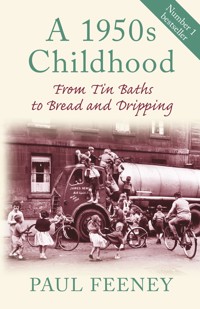
Do you remember Pathé News? Taking the train to the seaside? The purple stains of iodine on the knees of boys in short trousers? Knitted bathing costumes? Then the chances are you were born in or around 1950. To the young people of today, the 1950s seem like another age. But for those born around then, this era of childhood feels like yesterday. This delightful collection of photographic memories will appeal to all who grew up in this post-war decade; they include pictures of children enjoying life out on the streets and bombsites, at home and at school, on holiday and at events. These wonderful period pictures and descriptive captions will bring back this decade of childhood, and jog memories about all aspects of life as it was in post-war Britain.
Sie lesen das E-Book in den Legimi-Apps auf:
Seitenzahl: 253
Veröffentlichungsjahr: 2010
Das E-Book (TTS) können Sie hören im Abo „Legimi Premium” in Legimi-Apps auf:
Ähnliche

















A 1950sChildhood
In memory of my brother John (1946–2007)and all the fun we had.
Cover illustrations: (front) a group of Glasgow children play in the street (Mary Evans Picture Library); (back, upper) a group of children enjoy a donkey ride at Weston-super-Mare, 1955 (author’s collection); (back, lower) a young boy playing in the street in central London (author’s collection)
First published 2009
Reprinted 2009 (three times), 2010, 2011, 2012, 2013, 2014 (twice), 2015, 2016, 2017, 2019, 2020
The History Press
97 St George’s Place,
Cheltenham, gl50 3qb
www.thehistorypress.co.uk
© Paul Feeney, 2009
The right of Paul Feeney to be identified as the Author of this work has been asserted in accordance with the Copyrights, Designs and Patents Act 1988.
All rights reserved. No part of this book may be reprinted or reproduced or utilised in any form or by any electronic, mechanical or other means, now known or hereafter invented, including photocopying and recording, or in any information storage or retrieval system, without the permission in writing from the Publishers.
British Library Cataloguing in Publication Data.
A catalogue record for this book is available from the British Library.
ISBN 978 0 7524 6227 1
Typesetting and origination by The History Press
Printed and bound by Imak, Turkey
eBook converted by Geethik Technologies
CONTENTS
Acknowledgements
One A Decade of Innocence
Two Home Life
Three The Streets and Bomb Ruins
Four Games, Hobbies and Pastimes
Five Entertainment, Music and Fashion
Six Radio and Television
Seven School Life
Eight School Holidays
Nine Christmas
Ten Memorable 1950s Events
Eleven Whatever Happened To?
ACKNOWLEDGEMENTS
I would like to thank the following people and organisations for giving permission to reproduce photographs in this book: Page 209 (bottom): Gwen Lippingwell and Denise Baldwin. Pages 10, 21, 66 and 209 (top): Remington Images. Page 200: Remington Images and Maria Cowdell. All other pictures and illustrations are from the author’s collection. Every reasonable care has been taken to avoid any copyright infringements, but should any valid issue arise then I will look to correct it in subsequent editions.
One
A DECADE OF INNOCENCE
You lift one eyelid and poke your nose out from the blanket to exhale your warm breath into the freezing bedroom air, watching it condense into tiny droplets and form a fog that flows across the room like smoke from a cigarette. The hot water bottle lost its heat hours ago and has already been pushed to the very bottom of the bed. Your nose now feels like ice and you dread the thought of sliding your leg out from the bedcovers onto the cold lino floor below. You struggle desperately to dislodge the sheets and blankets that your mum tucked in so tightly under the mattress when you went to bed last night, and at last you poke a toe out to test the cold bedroom air. Memories of cold draughty houses in wintertime with curtains hung behind the street door to reduce the flow of cold air. Woollen socks worn in bed, and thick, coarse, heavy overcoats used as top-up blankets to keep you warm. Frost that formed overnight on the inside of bedroom windows, and the morning rush to get to the one heated room in the house, which was usually the kitchen or the living room.
Young girl dressed in a typical ’50s outfit. Behind her is a baby in a pram and some young boys playing on the pavement of a street in central London in 1952.
No self-respecting child would ever rise from its bed without the repeated call from parents to ‘get up’, but this is Christmas morning and the extreme cold is somehow stifled by the anticipation of delving into the stocking that is hanging on the end of the bed. It is a sign of the times that the meagre contents generate such excitement, but this is Christmas 1950 and the expectations of an unspoilt child are modest. An orange, a two-ounce bar of chocolate and some nuts come as a welcomed treat in these times of post-war austerity. Getting out of bed on Christmas morning is less of an ordeal than usual because all of the excitement and joy of Christmas Day awaits! Has Father Christmas been? Did he eat the mince pie and drink the glass of sherry that mum left in the fireplace for him? Has he left me a present? These are all very important questions for a child of any generation to ask, but much more so for a 1950s child that is likely to have seen little in the way of personal treats in the months leading up to Christmas. Children waking up on Christmas morning in 1950s Britain had experienced government-imposed rationing of food and clothes all their lives. To them it was quite normal to go without the sweets, biscuits, crisps and fizzy drinks that would be taken for granted by future generations.
Everyone that grew up in the 1950s will have his or her own indelible memories of their childhood, but there were many common factors that would have touched and influenced every child from that seemingly gentle and innocent period. Cold rooms, tin baths, and outside toilets. To a child, early day experiences are what life is expected to be, and the thought that things could get better is not even entertained. In towns and cities, the streets and local bomb ruin sites were often the only places for children to play and to expend their energy. It was a time when every street seemed to be full of children, with prams routinely parked outside houses to give the baby a good dose of fresh air. Residential streets were considered safe places for children to be left to play unaccompanied. Car ownership was still very low and most vehicles kept to the main roads. There was little need for motorists to use rat runs, and so side streets were generally traffic-free and without the danger or obstruction of parked cars. Most children were encouraged to be adventurous and they were expected to learn from their mistakes. Kids got dirty, fell out of trees, grazed their knees, and cut themselves. Most mothers kept a bottle of iodine in the house to disinfect the cuts and grazes of their wounded little soldiers. Head wounds might get some extra treatment, with a dose of smelling salts. Young boys commonly wore short trousers in the 1950s, and the telltale purple of the iodine was often to be seen on their knees. The sting from this chemical as it was applied was often worse than the pain of the accident itself. Once cleaned up and disinfected, the little soldier would be off to fight another battle. It was all part of growing up; there was very little mollycoddling of youngsters, it wasn’t considered to be helpful in their development.
Kids were not analysed or studied for their greater wellbeing. There were no such things as health and safety or children’s rights. Kids were taught discipline at home and at school, and corporal punishment was freely administered for bad behaviour. A child’s role was quite simple: to eat, sleep, learn and play. When little Johnny got punished at school, he wouldn’t dare go home and tell his parents because he was likely to get another wallop from them for having misbehaved at school in the first place.
The nation was recovering from the ravages of the Second World War and the camaraderie of wartime was still evident throughout the country. People had great pride in, and loyalty to, their country and seemed to share a common purpose in life. Everyone knew their neighbours and had a sense of belonging. There seemed to be a genuine air of humility among people and although many found it hard to make ends meet, there was a clear spirit of generosity. People were happy to surround themselves with modest personal belongings, and young couples were content to furnish their homes with post-war utility furniture. It was a time of innocence; children only knew the simple things of life and there were none of the peer pressures that exist today. People were grateful for the comfort of having shoes on their feet and food in their bellies. There was little evidence of jealousy or desire for luxuries. What you didn’t have, you didn’t miss! People were trusting and they frequently left their street door on the latch or the door key hanging down behind the letterbox for their kids to come and go as they pleased.
Children spent most of their lives outdoors, in all weathers. With children, time seems to pass slowly, and the long hot summer days of the ’50s seemed to go on forever. Every day was an adventure, with a new street, bomb ruin, field or wood to explore. These were the playgrounds for the 1950s child. New games were made up all the time, using anything that came to hand. Bits of old wood, rope, chalk, sticks, rags, just about anything was adapted for playful use. You could play cowboys and indians or swashbuckling pirates using nothing but your imagination. Girls and boys played happily together but were divided when it came to some street games. Boys were expected to play rough and tumble games and to get their clothes dirty and shoes scuffed, but mums usually spent time grooming their daughters and they were expected to stay clean and be ladylike in their games. There was the occasional tomboy that would climb trees and fences with the boys, but generally girls stuck to their own preferred adventures and games. There was no set-rule that said boys shouldn’t use a skipping rope, but somehow they were all useless at skipping! Why was it that girls could skip for ages without getting tangled up in the rope but they couldn’t lasso a tree stump like a boy could? And why could a girl juggle two or three balls in the air or against a wall whilst singing a rhyme but couldn’t kick a ball for toffee or even hit a ball with a bat? So many imponderables!
All girls loved to dress-up in their mother’s clothes and proudly parade up and down the street in high-heeled shoes, routinely catching the bottom of mum’s best dress in the heel as they obliviously went on their way. Their faces pasted with powder and lipstick, they did look a picture! True to their nature, boys would play war games and mimic the scene of soldiers returning from war by marching up and down singing ‘We won the war in 1944’ (and you thought they only did that at your school!)
Without the influence of television, there was no way for children in the early ’50s to compare different lifestyles around the country. They knew that some people had more money than others and that some were very rich, like the Royal Family, who rode around in gold carriages wearing diamond tiaras, as they did when the royal procession went through the streets of London after the queen’s coronation. Royalty would sometimes visit local areas and out would come the Town Hall’s paintbrush. People joked that the royals must have thought that everything outside Buckingham Palace smelt of fresh paint! Some things haven’t changed that much since the 1950s. Kids were aware that there was a social class system, and most knew at least one local child who was too good to play with the other kids. Rail travel was very popular in the 1940s and ’50s, and trains were often used for family outings to the country or seaside. Railway stations were a good place to see a mix of social classes in one location, but the harsh separation of rich and poor people into first- and third-class train compartments soon made you realise what social class you were in. It was a very humbling experience to travel in the crowded third-class section with the ‘riff-raff’ while the well-to-do enjoyed the luxury of first class. The absence of second-class train compartments was always a bit of a mystery to young enquiring minds, but it seems that second class was abolished on most trains early in the twentieth century and thereafter those trains only had first- and third-class compartments, that is until 1956 when third was re-named second. The change of name didn’t move you any higher up the social ladder but it made you feel that there was a bit less of a social gap.
Queen Street, Cardiff, in the 1950s. Note the old pram and 1950s trucks.
Railway stations were cold, smelly and unwelcoming places, but there always seemed to be porters roaming around and it was possible to get help with lifting luggage on and off trains, particularly if you were travelling first class! The stations had big draughty waiting rooms with untended open fireplaces that usually only served to assist the cold draught on its way through the room. You would stare through the waiting-room window at the empty sweet dispensing machine on the platform and dream of the day when sweet rationing would finally end. Your dream was only broken by the choking smell of soot and smoke from the approaching steam locomotive. Some station platforms had a large machine where you could print your name onto a metal strip using an alphabet pointer and a handle to print each letter. The fascination of this machine was such that kids would even buy a one-penny platform ticket just so they could go onto the platform and try it out. Such simple pleasures!
Pathé news, at the cinema, was a great source of education about life in other parts of the world, as were the Hollywood films, which portrayed everyone in America as having loads of money, and of course illustrated how the Americans won the war for us! It’s funny how children always enjoyed Pathé news and its wonderfully rousing theme music with the crowing cockerel. Cinemas would show two films, a feature and a B-movie, and between them they would show adverts and the Pathé newsreel with its dynamic voiceover narration. Cinema was always considered to be a proper night out and everyone would arrive early, often queuing outside for the one-and-nine-pennies, so that they would be sure to see the whole programme and not miss a minute – even standing for the National Anthem at the end. If you had the money then cinema was the best form of entertainment available to ordinary people. Whatever your way of life or dialect may have been, you were captivated by the wonderful magic of British and American films, and you will certainly remember those huge framed pictures of film stars that adorned the foyer walls and hung above the red-carpeted staircases in local cinemas everywhere.
There were, of course, big differences between urban and rural life, and in the early 1950s there was a noticeable disparity with food rationing when people in the countryside found it much easier to obtain eggs, butter and meat without rationing coupons. Most people supported the principles of rationing as a way of ensuring fair shares for all, but some people thought that the rationing system was very unfair on the poor and on the working classes living in towns and cities. Regardless of the government’s best efforts to control the rationing of goods, there was a black market operating, and if you had money you could get anything.
Despite the hardships, there was a cosy feel to the 1950s. Mums usually stayed at home to look after the kids while dads went out to work, and they generally worked long hours. Some children had lost their dads in the war or had an invalid dad through war injuries. Mums were very important in the home, and as housewives they had a significant daily workload, but many also found part-time work to help pay the bills and to make ends meet. Mums went shopping for groceries every day. Perishable foods were bought in small amounts – just enough to last a day. It was quite usual to buy a single item of fruit rather than by the pound. Kids seemed to spend half their lives running errands for their mum or for a neighbour. You were made to eat all sorts of foods because they were ‘good for you’ – bread and dripping, black pudding, fried bread, fried eggs, mashed potatoes, sandwiches and chip butties. Everything that was put in front of you was said to be good for you, especially carrots – after all, you wouldn’t be able to see in the dark if you didn’t eat your carrots! Mums were forever baking cakes and there was always a child hanging around ready with a finger to scrape the remains from the mixing bowl and devour the remnants of the heavenly mix. We ate a lot of bread, eggs, potatoes or chips, and drank a lot of tea and milk. In 1950, bread and milk were the main components of a child’s diet and 55 per cent of young children were drinking tea with their meals (source: Public Health Nutrition reports, National Survey of Health and Development, 1950). All mums could sew and knit. Mums were always altering clothes for growing youngsters: hems, sleeves, waistband and buttons were all moved several times before a garment was finally retired.
Mums would often dress siblings the same. This was more noticeable on girls than boys because the uniform colour, pattern and style of girls’ outfits would be seen to be the same, whereas most boys wore a boring and inconspicuous white or grey shirt, grey flannel short trousers, striped elasticated belt with a snake clip, long grey socks and black shoes or plimsolls. All boys experienced sore chapped legs in winter, made worse by the rubbing from the seams of short trousers against their bare legs. The clothes on younger siblings were usually hand-me-downs and always looked too big, whereas the older siblings either looked too clean-cut in their new oversized outfit or pitiful in their old, now too small, garments. There was nothing worse than having to wear clothes that were two sizes too big, either because they were hand-me-downs or because they were bought to last you until you grew another two inches. Young girls liked to dress in pretty clothes but there was no pressure or desire for pre-teen kids to be fashionable. For boys, brand new clothes were always an embarrassment, as was a new haircut – a sure signal for mickey-taking! Clothes were just things you wore to make you presentable and to keep you warm. Apart from the blazer, working-class kids usually wore the same clothes in and out of school. Cleanliness was a byword for most mums. They made great efforts to ensure that their little darlings were well scrubbed and clean-clothed before leaving the house. This was followed by a compulsory check that each child had a handkerchief in their pocket, and then a lecture on how to behave when out and about. All mothers dreaded the thought of their child out in the street with socks down to their ankles and a runny nose, and the awful thought that they might even use their sleeve to wipe it. The shame of it!
Hair was a definite bone of contention for everyone. Girls didn’t go to the hairdresser’s but they were still much better groomed than boys because their mums would spend hours washing and styling their hair with curls, plaits, ringlets and ponytails. Ribbons were very popular and girls’ hair was often tied with two ribbons on top. There were no hairdryers and so girls’ hair was usually dried in front of the fire. They complained and screeched with pain continually as their hair was combed and brushed to get all the knots and tangles out. Boys were easier to deal with; short back and sides was the order of the day and if your hair touched your ears or your collar then it was too long. The unlucky ones had to endure the ridicule of their mates when confronted with the pudding-basin haircut that had been inflicted upon them by their dad. The lucky ones would be sent or dragged to the barbershop for a good all around shearing. The barber would put a board across the chair for you to climb up onto so that he could cut your hair at eye level, but what was in that silver can with the black rubber pump that he would use to dampen your hair down at the end? The barbershop walls were covered in pictures of film star hairstyles with all sorts of quiffs and waves, but when it came to your turn there was never any discussion about style; it was always the same old short back and sides. And what was that ‘something for the weekend, sir?’ that men always sniggered about?
Young boy playing on his bike in the middle of a central London street, while behind him some girls are playing with their dolls’ pram. The only sign of any traffic is a bus passing at the end of the road.
Some well-off parents did like to show off their little darlings on Sundays and at Christmas by dressing them in adult fashions. It was all right for girls but there was nothing worse than the sight of an eight-year-old boy kitted out in a miniature two-piece suit and bow tie. They would hang their heads in shame every time they had to endure this public humiliation.
Kids in the 1950s were no angels; they got up to mischief and there were some young scallywags around, but in the main they had respect for their elders. There was no mugging of old ladies and people felt safe to walk the streets. There was very little vandalism and no graffiti. Telephone boxes were fully glazed and each one contained a set of local telephone directories and a pay-box full of pennies. If a public telephone was out of action then it was because of a technical fault and not because it had been smashed up by vandals. Many young boys carried a penknife but it was only used as a tool to whittle wood, not a weapon. When there were fights, kids would wrestle, punch, kick and scratch, but they would never think of using the penknife that might be in their pocket. Apart from the odd playground scrap involving hair pulling, girls were generally well behaved and didn’t do much fighting.
All kinds of knives and weapons were openly sold in the high street shops and some wild teenagers did carry and use flick-knives and knuckle-dusters in punch-ups, but such fights were usually between gangs of youths and they didn’t touch the lives of children. Teddy boys were tagged as being violent and could look threatening when they hung around in groups on street corners and in coffee bars, but many just wore Teddy boy style clothes for fashion purposes and were not at all violent. As with every generation of teenagers there was some fighting, but it was not exclusive to Teddy Boys; there were also Greasers, Beatniks and other non-descript young men that revelled in the occasional punch-up. However, any rebelliousness in unruly teenagers was generally knocked out of them when they got called up to do their National Service, which was still compulsory in 1950s Britain.
Young adults of the 1950s had lived through the terrible atrocities of war and experienced all of the post-war deprivation. This seemed to make them more protective of their own children and to value their innocence. Britain was nearly bankrupt and up to the hilt in debt to America. Nobody really knew what the future held for them and many people lived for today and were grateful for what they had. Children’s ambitions were modest and most wanted to have a practical job when they grew up. Boys wanted to be firemen or bus drivers, and girls wanted to be nurses or air hostesses. Everyone hated wearing school uniforms but for some reason kids were attracted to jobs that involved wearing a uniform, probably because they had seen them glamorised in films.
Many who look back on their 1950s childhood will remember simple little things that have stuck with them all their lives: the taste of Farley’s Rusk biscuits and thick syrupy welfare orange juice, toasting bread by the fireside, the rhythmic sound of your mum’s knitting needles, Sunday afternoon tea at Granny’s where the deafening silence was only broken by the sound of a ticking clock, Mrs Dale’s Diary on the radio, and the excitement of a visit to the local Woolworths store. 1950s weather will always evoke memories: the long, hot summer days playing outside were great but the cold, dark winters were horrible, and often boring because you spent so much of your time indoors. Those that lived in large urban areas, particularly London, will remember the dense fogs that would descend in the form of yellowish smog. These were often described as ‘pea-soupers’ because they were so thick. People would wear a damp handkerchief over their nose and mouth to protect them from breathing in the polluted air. The smog was caused by cold fog combining with coal-fire emissions from homes and industrial smokestacks. It was a very serious problem and thousands of people died from the resulting pollution. In 1952, extremely bad smog shrouded London and caused the premature death of an estimated 12,000 people over a three-month period.
The 1950s was probably the last decade in which children were able to retain their innocence through to the age of about twelve or thirteen. There was no peer pressure to grow up any quicker than nature intended. You were able to enjoy a carefree life that was full of childish fun and games, and the stresses of adolescence could wait!
Two
HOME LIFE
It’s another cold and wet Sunday afternoon and you’re stuck indoors with nothing to do. You kneel on a chair by the window, plant your elbows on the windowsill, and stare out into the street waiting for something to happen. The street is deserted. Everyone is stuck indoors, just like you! You detect a faint smell of roast beef coming from the kitchen, and in the background you can hear the dreaded sound of The Billy Cotton Band Show on the radio. ‘Wakey! Wakey! Hey you down there –yes, you with the glasses!’ You cover your ears to protect them from that dreadful signature tune Somebody Stole My Gal. The Billy Cotton Band Show has been on the radio for as long as you can remember, and it seems that you are condemned to a lifetime of Sunday lunchtime listening. There is some movement in the street, but no, it’s only next door’s cat scampering to get out of the rain. You hope that something will happen soon to relieve your boredom. Perhaps the rag-and-bone man will come down the road ringing his bell? Or what about the knife-sharpener with a grinder on the front of his pushbike? Maybe the ice-cream man will come on his three-wheeled bike with the box at the front filled with small blocks of ice cream? No, he won’t come; it’s winter, and he never comes in the winter. By now, your knees are starting to get sore from kneeling on the chair, but at least the rain has stopped and there is a chink of light between the clouds. You shuffle about a bit to get more comfortable, and lean forward to take one last look down the street. At last! Something is happening! A Salvation Army band has stopped at the corner and they look as if they are going to pitch up and play (yes, the local Sally Army bands did go around the back streets on a Sunday). Hooray! The day is saved! The Salvation Army band drowns out the sound of the awful Billy Cotton Band Show. In celebration, you jump down from the chair and slide across the linoed floor in your stocking feet. Well worth the risk of a wallop and lecture about wearing holes in your socks.
This HMV auto-change portable record player with radio would have been a dream machine for any teenager to own in the 1950s.
Sunday was always a very quiet day and kids were often kept inside and told not to annoy the neighbours. Other than going to church or Sunday school and having the obligatory Sunday lunch, people just did relaxing things like reading the papers; then after lunch, snoozing in the armchair, pottering in the garden (in shirt and tie, of course) or going to the park. Apart from the corner shop that opened on Sunday mornings to sell newspapers, all of the shops were shut and the streets were generally quiet.
Even the mildest of winters were horrible because you spent so much time stuck indoors, and you longed for milder days to arrive so that you could get outside again. On cold, dark winter nights, there was nothing more warm and comforting than to curl up by the fireside and listen to a play on the radio. Only the occasional spark from the fire and the gentle clicking sound of your mum’s knitting disturbed your concentration. Children were totally absorbed by the soft tones of the storyteller’s voice purring from the speaker cloth at the front of a big old valve-radio. Even if the reader did all the voices, it was totally believable, and your imagination took you right into the scene of the story. Anyone that was around in the mid-fifties will remember the very scary BBC Light Programme’s science fiction series, Journey into Space, which started on 21 September 1953. It frightened the life out of kids, but it was essential listening and had a huge audience – all those creepy sound effects and that mysterious haunting music. According to the BBC, by the time the series came to an end on 18 June 1958, there were 8 million people tuning in each week. There were loads of well-known people in it, including David Jacobs (he played many different parts), Deryck Guyler, Alfie Bass and David Kossoff.




