


Erhalten Sie Zugang zu diesem und mehr als 300000 Büchern ab EUR 5,99 monatlich.
- Herausgeber: The Crowood Press
- Kategorie: Sachliteratur, Reportagen, Biografien
- Sprache: Englisch
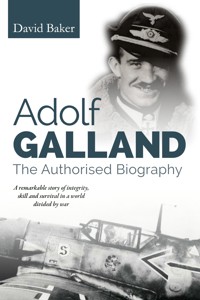
A remarkable story of integrity, skill and survival in a world divided by war The most famous German fighter pilot of World War II, Adolf Galland was respected by both comrades and former enemies alike. A highly decorated 'ace' with over 100 air-to-air victories in the West, he was a recipient of the Knight's Cross with Oak Leaves, Swords, and Diamonds, which was awarded to only 27 men among the millions who served. After the war, he built friendships with the very Allied pilots he once fought and was admired as much for his integrity as for his prowess as a pilot and commander. In his final years, he worked closely with historian David Baker to produce this authorised biography, largely illustrated with photographs from his private albums. Offering a rare glimpse into both the air battles of World War II and the inner workings of the Luftwaffe, and now featuring new appendices that include the latest research into Galland's aerial kills, this book stands as an essential record of one of history's most remarkable fighter pilots.
Sie lesen das E-Book in den Legimi-Apps auf:
Seitenzahl: 917
Veröffentlichungsjahr: 2025
Das E-Book (TTS) können Sie hören im Abo „Legimi Premium” in Legimi-Apps auf:
Ähnliche



















Dedication
This book is dedicated to fighter pilots throughout the world, who give of their best without pause to count the cost
First published in 1996 by Windrow & Greene Ltd
This updated edition published in 2025 by
The Crowood Press Ltd, Ramsbury,
Marlborough, Wiltshire SN8 2HR
www.crowood.com
This e-book first published in 2025
© David Baker 1996 and 2025
All rights reserved. This e-book is copyright material and must not be copied, reproduced, transferred, distributed, leased, licensed or publicly performed or used in any way except as specifically permitted in writing by the publishers, as allowed under the terms and conditions under which it was purchased or as strictly permitted by applicable copyright law. Any unauthorised distribution or use of this text may be a direct infringement of the author’s and publisher’s rights, and those responsible may be liable in law accordingly.
British Library Cataloguing-in-Publication Data
A catalogue record for this book is available from the British Library.
For product safety-related questions, contact:
ISBN 978 0 7198 4545 1
The right of David Baker to be identified as author of this work has been asserted by him in accordance with the Copyright, Designs and Patents Act 1988.
Thanks to Rob Erdos and Skies magazine for extracts from his flight in a Bf109E, told in Appendix II.
Contents
Foreword
Preface to the 2025 Edition
Glossary
Chapter 1: March 1912 – February 1932
Chapter 2: March 1932 – April 1933
Chapter 3: May 1933 – March 1935
Chapter 4: April 1935 – April 1937
Chapter 5: May 1937 – July 1938
Chapter 6: August 1938 – August 1939
Chapter 7: September 1939 – January 1940
Chapter 8: February – May 1940
Chapter 9: June 1940 – 24 July 1940
Plates
Chapter 10: 25 July – 12 August 1940
Chapter 11: 13 August – 21 August 1940
Chapter 12: 22 August – 14 September 1940
Chapter 13: 15 September – 5 December 1940
Chapter 14: December 1940 – November 1941
Chapter 15: December 1941 – February 1942
Chapter 16: February – December 1942
Plates
Chapter 17: December 1942 – September 1943
Chapter 18: October 1943 – July 1944
Chapter 19: August – 7 November 1944
Chapter 20: 8 November 1944 – April 1945
Chapter 21: May 1945 – 9 February 1996
Appendix I: Adolf Galland Victory Log
Appendix II: The Measure of the Messerschmitt Bf109
Afterword
Index
Foreword
I first came to know of Adolf Galland as a famous German pilot during the 1950s when, as a young boy, my admiration for fighter pilots everywhere was absolute. They were both role models and heroes. In the 1960s I had reason to read his doctrine of air combat presented as a lecture to NATO pilots; and in the 1970s I heard him speak at a US fighter base in North America. In the 1980s I used the life and career of this extraordinary man in my own lectures on air power to young pilots taking academic degrees; and finally, in the 1990s, I decided to write my own story of his life. In one way or another he has been a part of my life for more than 40 years.
In 1990 I met ‘Dolfo’ for the first time in private at his home above the beautiful town of Oberwinter not far from the Rhine bridge at Remagen - which has its own memorial to recent history. We spoke at length about a new book on his life, and discussed many aspects of his career. It was only then that I began to realise that all I had known up to that point was only a fraction of his story; and the events which we discussed over several days eclipsed in drama any fictional adventure I could have imagined. As a starting point, his autobiography published in 1953 was a very modest account of his career. I found others who could tell me much more about this man; and from declassified intelligence reports I began to get the full measure of the highs and lows of an astonishingly full life.
I wrote this book not in unblemished adoration of a proud and honourable officer, but as a true story of human endurance against odds, of principled strength in the face of unscrupulous deceit, and of service beyond the call of duty. This is what I found at the end of my quest for the real story behind the legend. I believe that much which has been said about Adolf Galland in the past starts and finishes with the public record of the valiant soldier; I was as intrigued to discover the loyal friend, dedicated in wartime to the men both above and below his rank, and committed to a personal set of moral principles. ‘Dolfo’ suffered both physical injury and crushing personal defeat several times in his life; but with iron determination and stoic endurance he simply refused to give in - to the very end. The events described in this book - violent, heroic, and tragic - must be judged in the light of the times in which they happened. The Germany of the 1930s and 1940s was a world distant from our modern Europe. Adolf Galland, like all men, was a product of his time and place; the story of his life is woven into a panorama of total war, of intrigue, of terrible loss and of human bravery under a totalitarian regime which changed the face of the 20th century, and transformed the world from the Atlantic to the Caspian.
Adolf Galland’s story is more than the tale of a talented fighter pilot with great physical courage. It follows the fortunes of a man who showed determination in the face of adversity; who could not suffer fools or knaves; who sometimes showed the intolerance of a resolute spirit, but who strove to reconcile the demands of honour and duty with a decent human consideration of others. It is also a story about the group of men of whom Galland was an exemplar, formed and framed by the turbulence of their times. Among that remarkable peer group of young men - by at least one measure, the greatest fighting airmen in history - Adolf Galland sought to be the first and the best; and in several senses he achieved it.
Preface to the 2025 Edition
In the 30 years since I wrote the biography of Adolf Galland, a considerable amount of research has been conducted - both on the Jagdwaffe and the man himself - undertaken by a wide-ranging and specialised group of aviation historians and specialists. It is, therefore, appropriate in the year in which the RAF remembers the 85th anniversary of the Battle of Britain that attention should once again turn to thoughts about those whose skills and tenacity in air combat forged a contest that will forever go down in the annals of air warfare.
While republishing the original text, this book now contains the best available research around the victory log of claims made by or on behalf of Adolf Galland, and it also carries a summation of the aircraft he flew and those he encountered. Rather than working with a diminishing amount of material, as time goes by the quantity of research increases and the diversity of analysis expands. With a seemingly endless interest in the events of the air war from 1939 to 1945, the appetite for information continues unabated.
When the first edition of this book came out, Germany was uniting for the first time since 1945 and the Cold War had just come to an end. There were events and activities that it was felt were inappropriate to write about at the time, but which now seem acceptable. We also pause for a reflection of personal engagement with people of that time, now no longer alive. In understanding the underpinning ethos behind the German fighter pilots of that period, it was important to seek out and understand the group of men for whom air combat was a daily routine and, unlike pilots flying for the Allied powers, their motivation.
Searching for this took me to meet with a wide range of people, from the ever-committed Hans Ekkehard Bob to Galland’s batman. All those I met and interviewed are no longer around, but the wide range of personalities and opinions about each other and the conflict in which they fought - not to mention the political system that they served under - helped form my own conclusions about this truly diverse range of people. Unlike the pilots of World War I, these men had grown up through turbulent times, first in a republic and then a dictatorship, yet they came together from a wide and diverse cultural background, many inspired by the wartime efforts of their predecessors.
Then there were the reunions to which I was admitted, sometimes in isolated dining places deep in Bavarian forests and sometimes in hired halls, quietly disregarded by a local populace ignoring these men from a different time. The most outstanding impression from those events was not of a politically motivated, radical or extreme ideology, but rather of a brotherhood loyal to their country and committed to the bonding comradeship shared among young lives threatened by sudden death. A few had supported the Nazi regime but the majority opposed the excesses of the days in which they fought for their country, and it was among this group that the most profound reflections flowed.
Later, when filming for a documentary on Galland’s life, more meetings followed, and to the peripheral story of Galland’s life came a still broader awareness of the small group in which he grew up, and the much larger arraignment of people he eventually commanded. In spending time with Dolfo at his home in Oberwinter, surrounded by replications of traditional German architecture and accoutrements, it was not difficult to see his loyalty to an ancient country and its people among whom his ancestors had been accepted after fleeing religious persecution.
Nothing can ever erase the bestial activities of Hitler’s fanatical regime, or the universal clamour for a national leader to raise Germany again after military defeat in 1918, but the story of the young soldiers of the Luftwaffe deserves to be understood on the basis of personal courage and loyalty, as much to each other in that exclusive band of brothers as to the government behind the swastika they wore.
Today I live in the hunting grounds of Luftwaffe fighter pilots, who were practising aggressive tactics eight decades ago among the hills, valleys and small villages visited daily by the feisty Jagdwaffe. Walking or driving the countryside in a different century, I remember their stories of crossing the narrow English Channel, reputedly flying so low that their propeller blades cut grass as they howled across the fields hunting down their prey. It is not so difficult to hear those engines in the distance, to gaze across the Channel coast, perhaps to glimpse the Pas de Calais from an England threatened by air and by sea, and not to reflect on those days when Britain stood in peril against forces mobilised for its destruction.
It is against this background that I bequeath this tale, of events forged in war and perpetuated in time.
David BakerEast Sussex, 2025
Glossary
Use of German words
This book contains a large number of German words, particularly referring to Luftwaffe organisation. In all cases the nouns are capitalised (as they are in written German) and adjectives are in lower case. The German umlaut is conventionally represented here as a letter ‘e’ following the vowel, e.g. Fuehrer, Goering. German words have different forms in the plural, often but not always adding ‘en’ or ‘n’ to the singular form; where the plural form is unchanged from the singular we show here (pl.-). Rather than attempt formal capitalised translations - which can only be approximate - of the more complex German appointment titles, we have chosen to use general translations in lower case, e.g. Fuehrungsstab der Oberkommando der Luftwaffe is here simply ‘Luftwaffe operations staff.
Luftwaffe units
The basic combat unit was the Staffel (pl.Staffeln) of between 9 and 16 aircraft, led by a Staffelkapitaen (pl.-kapitaene), usually an Oberleutnant. Three (or rarely, late in the war, four) Staffeln and a command staff element (Stab) usually of two aircraft formed a Gruppe (pl.Gruppen) of between 30 and 60 aircraft, led by a Gruppenkommandeur (pl.-kommandeure), usually a Hauptmann or Major. Three (later in the war, often four) Gruppen and a Stab element normally of four aircraft formed the Geschwader (pl.-), which thus had a serviceable strength of anything between about 90 and 150 aircraft, led by the Geschwaderkomm- odore (pl.-), usually an Oberstleutnant.
Although these units do not correspond directly in terms of strength or organisation with RAF and USAAF units, where they are translated in this book we use ‘wing’, ‘group’ and ‘squadron’ for Geschwader, Gruppe and Staffel respectively.
Staffeln were numbered in a single sequence throughout the Geschwader, e.g. 1./JG26 to 9./JG26 in a Geschwader of three Gruppen each of three Staffeln. Gruppen bore Roman numerals, e.g. III./JG26 was the 3rd Gruppe of Geschwader JG26, and comprised Staffeln 7., 8. and 9./JG26.
Unit category prefixes
The Geschwader - and occasionally, when formed as a single group for independent operations, the Gruppe - was identified by a number (the various coding conventions used at different periods are mentioned in the relevant chapter notes); and by a prefix indicating the category of aircraft - e.g., Jagdgeschwader (JG), Kampfgeschwader (KG), etc. There were many of these, but the examples found in this book, with their standard abbreviations, are as follows:
Ergaenzungs- (ErgGr)
Operational training group
Erprobungs- (EGr, Ekdo)
Experimental group, command
Jagd- (JG)
Single-engined fighter wing
Kampf- (KG)
Bomber wing
Lehr- (LG)
Tactical development wing
Nachtjagd- (NJG)
Night fighter wing
Schlacht- (SGr, SG)
Ground-attack group, wing
Stuka- (StG
Dive-bomber wing
Zerstoerer- (ZG)
Twin-engined fighter wing
Ranks
In several cases there is no exact equivalence between Luftwaffe, Royal Air Force and United States Army Air Force ranks, e.g. the non-commissioned grades. A rough comparative table would be:
Luftwaffe
RAF
USAAF
Generalfeldmarschall
Marshal of the RAF
5-star General
Generaloberst (Genobst)
Air Chief Marshal (ACM)
General
General der Flieger (Gen)
Air Marshal (AM)
Lieutenant General
Generalleutnant (Genlt)
Air Vice Marshal (AVM)
Major General
Generalmajor (Genmaj)
Air Commodore (Air Cdre)
Brigadier General
Oberst (Obst)
Group Captain (Gp Capt)
Colonel
Obersdeutnant (Obstlt)
Wing Commander (Wg Cdr)
Lieutenant Colonel
Major (Maj)
Squadron Leader (Sqn Ldr)
Major
Hauptmann (Hptmn)
Flight Lieutenant (Flt Lt)
Captain
Oberleutnant (Obit)
Flying Officer (Flg Off)
1st Lieutenant
Leutnant (Lt)
Pilot Officer (Plt Off)
2nd Lieutenant
Oberfeldwebel (Ofw)
Flight Sergeant (Flt Sgt)
Master Sergeant
Feldwebel (Fw)
Sergeant (Sgt)
1st Sergeant?
Unterfeldwebel (Ufw)
–
Tech./Staff Sgt.?
Unteroffizier (Uffz)
Corporal (Cpl)
Sergeant
Obergefreiter (Ogefr)
Lance Corporal (L/Cpl)
Corporal
Gefreiter (Gefr)
Leading Aircraftman (AC1)
PFC
CHAPTER 1 March 1912 - February 1932
Germany was a fragmented nation united only by a common tongue when, some time in 1742, a French Huguenot refugee named Galland was given employment as a bailiff on the estate of Count Graf von Westerholt near Essen in Westphalia. He would be the first in a long line of Gallands who would tend the sprawling Westerholt estate; but while his German descendants would sustain this commitment to the family which gave their ancestor a new home and a respectable place in society, the Gallands would give up the Protestant faith which had made them exiles, and became loyal Roman Catholics. Catholicism was both a faith and a code through which life’s rules could be expressed. Everything about the Galland family bespoke a sense of tradition and formality. Loyalty and obedience were unquestionable; no transgressions could be excused, and rules were enforced with patriarchal harshness.
Germany’s new-found unity in the second half of the 19th century provided a platform of national pride upon which respect for tradition, stern self-discipline, and dedication to the service of nation and Kaiser were the foundations for an honourable life.
Into this world, on 19 March 1912, was born the second son of Adolf and Anna Galland - Adolf the younger, who would eventually become the youngest general in the German armed forces.
Situated just outside the landowner’s walled house, the solid home where the young Adolf grew up was typical for a middle-class country family of the period. From the attic window a view resplendent in greens and browns stretched away across avenues of conifers and hardwoods to fields and woodlands clothing a gently rolling landscape, tended carefully over the centuries. Adolf Galland senior took his responsibilities to his employer seriously; and he extended to his growing family the same discipline which he demanded of his workers. Retribution for minor indiscretions could be severe and painful. Anna Galland was a haven of peace and understanding, occasionally intervening to temper the punishments meted out by their father to Adolf and his elder brother Fritz, to their eternal gratitude. Almost two years his senior, Fritz was a constant source of irritation and antagonism, and there was little love lost between the boys. When Adolf was barely two and a half years old he was presented with a second brother; born in October 1914, Wilhelm-Ferdinand was very different from Fritz, and Adolf became his affectionate protector and staunch friend from the outset.
Although the young Adolf saw his father as the personification of all he was taught to believe in, his unyielding domestic rule was not greatly missed after he went off to fight in the Great War as an officer in the Kaiser’s army - although Anna Galland was not about to condone wanton abandonment of her husband’s code while he was away fighting for his country. The war that began on 14 August 1914 did not touch the young Galland in any material way; he was too young to understand, and too busy learning his way around the Westerholt estate to care much for what lay beyond its boundaries.
It is not fanciful to trace the first seeds of Galland’s success as a fighting pilot to his life around the Westerholt estate when he was barely of school age. Although his father was only at home for brief periods during the war, the boy had a solid early grounding in the safe handling and use of guns, in marksmanship and, very soon afterwards, in the skills of stalking and hunting living prey. When only five years old Adolf had his first shooting lessons, and within a year he had shot his first hare.
Although still only six when the Great War ended in November 1918, Adolf was peripherally aware of the deep anguish caused to his, and almost every other family in Germany. Most of the 1,700,000 German citizens lost in 1914-18 were non-professional soldiers claimed for service from ordinary civilian homes. His father alone lost seven brothers, and the sadness was impossible to veil. The next of kin to every German lost received a small black book bearing inscriptions and illuminated drawings of Christ receiving the worthy souls in Heaven. It had been an unforgettable moment when the first little black book arrived from the German War Ministry to mark the death of one of Adolf’s uncles; and he kept that book until the end of his life.
Quite soon after hostilities ended Galland’s father returned to take up again the management of the Westerholt estate. For most Germans all the comforting certainties of prewar life had been swept away; it was a time of want, of political turmoil, and of humiliation. Yet Adolf senior and Anna Galland wanted nothing more than a return to things as they had been in 1914; and for this middle-class family leading a secure rural life, there was a reasonable chance of escaping the harsher realities endured by the urban poor. They chose to have a fourth child, and in November 1919 Adolf’s youngest brother Paul was born.
In some ways life for the children was even easier after the war. Adolf senior was less ready to use the stick, and the two younger boys escaped the sterner regime suffered by Fritz and Adolf when they were the only children. Now that there were four, rigid discipline was tempered with a degree of informality which even ‘Papa’ Galland found relaxing. He gave the family members nicknames, and young Adolf was known as ‘Keffer’.
As a growing child and adolescent young Adolf had many interests, and found reward in practical things. He was no academic, preferring sports and handicrafts to art and philosophy. Despite his strict religious upbringing the Catholic church held no particular appeal for him, although he would always adhere to Christian codes of conduct for family and daily life. He felt some attraction to music, however; at 14 years of age he began violin lessons, and worked hard at them for two years, before giving the instrument up because he felt himself to be a mediocre player. He later explained that this was not a fit of pique at not being the best, but simply a recognition that to continue would be a waste of time and resources which could be more effectively applied elsewhere.
What did matter to him were technical things, ingenious little devices that puzzled and challenged him. He spent hours putting Meccano sets together; and he was not content merely to indulge his delight in such things, but soon turned his talents into money. Having taught himself the basic principles of radio, he made little crystal sets which he sold to the local farmers who rented land from the Westerholt estate. His practical bent led him to build wooden model aeroplanes, sometimes fitting them with miniature motors and flying them on short hops. Something about the thought of flying seemed to touch an instinctive chord, and he eagerly sought out books recounting the exploits of the airmen of the Great War, who in the Germany of the early postwar years were immortalised in print as gallant heroes of the Fatherland. The young Adolf learned about Max Immelmann, one of the earliest air aces, who gave his name to a daring manoeuvre; Oswald Boelcke, the first great leader of a squadron of fighting airmen; and Manfred von Richthofen, the legendary ‘Red Baron’, with 80 victories the highest scoring fighter pilot of the war. He also learned of Hermann Goering, a successor to von Richthofen as leader of Jagdgeschwader Nr.l - the first ‘Flying Circus’, so called from its colourfully painted aircraft and tent hangars. In time he would come to know him better.
Although Adolf felt drawn to the stories of these men and their adventurous war, free to fight across the skies man against man, man against machine, they seemed to inhabit a world utterly distant from his own. At school he had to struggle to keep up; he saw no link between the mundane tedium of the classroom and the real world outside. The classics positively bored him, while science, wildlife and sport - all subjects he loved - seemed to get so little priority. He didn’t really care about his grades, and despite pressure from his father to study harder it all seemed to no avail. It was as though he was waiting for something to spring into his life and add the spark of commitment.
In these formative years his character and personality took shape. The young Adolf was highly opinionated and specific in his views. His religious upbringing played some part in developing his inclinations. Early on he showed a deep hatred of communism, and in later life this was to influence him in several key political and military judgements. Linked to this, and due in no small part to his father’s influence, he would come to share with many conservative Germans - men and women who would have no sympathy for Nazi ideology - a distrust for the Slav peoples who had historically been seen as a threat to Europe from the east.
As every second child in a large family has found, Adolf was in a difficult position. As the eldest, Fritz was marked as his father’s successor in the long line of Westerholt bailiffs. Young Wilhelm-Ferdinand and Paul were largely free from expectations and could follow their own paths. Only Adolf felt challenged by his older brother and excluded from the privileges kept for Fritz. It was this sense of coming second that spurred Adolf to succeed, even to eclipse his brother. Matters came to a head when Fritz wooed away from Adolf, albeit temporarily, a local girl of stunning attractions. Stung into action, Adolf got his girl back more as a warning to Fritz than out of any real devotion. Adolf was forming an implacable will to be a high achiever - not just to participate creditably in life’s game, but to be the first and the best. His upbringing shaped his stubborn refusal to fit into a preconceived role. It was both his strength and his weakness. In later years Adolf would steadfastly refuse to play the game according to rules dictated by a discredited authority; this would be his undoing as a soldier, but the making of him as a man.
* * *
The much-needed spark to release and focus Adolf’s energy appeared in his life when, in early 1927, a group of sailplane enthusiasts brought the first gliders to the Borkenberge, a stretch of rolling heathland on a corner of the Westerholt estate. It was to these cropped hillocks that the members of the Gelsenkirchen Luftsportverein - air sports club - came to hone their skills; and Adolf made the 30km (20-mile) trek on foot or horse-drawn wagon to watch the enthusiastic helpers prepare the slender-winged gliders. It was a revelation. For the first time he knew exactly what he wanted from life: he wanted to fly - and the immediate goal was to experience this silent, soaring freedom which looked so effortless. But that was easier said than done, especially as he was barely 15 years old; and the young Adolf came alive to the possibilities that study and instruction might afford.
For Germans, gliding was to become a national sport. The Treaty of Versailles of June 1919 had forbidden Germany to build, own or operate military aircraft. Now, just eight years later, the next generation of Germans were taking to the skies without engines, as the simplest way to build expertise in the control of aircraft. Adolf Galland would later testify, time and again, that you could tell a pilot who had first learned to fly a glider: he simply ‘felt’ the air, and exploited it to the full.
Sports flying of all kinds became popular when the Reichswehr (German armed forces) organised Sportflug GmbH; ten flying schools were set up across Germany, with at least one in each of the seven military districts. Army flying officers were reassigned to these, keeping their hand in and attracting the interest of air-minded German youth. Of all flying sports gliding was the most attractive. Flugsport magazine launched a series of gliding competitions in the Rhoen region, mountainous country between the rivers Fulda, Werra, and the Franconian Saale; first held in 1920, these contests quickly became the national arena for gliding prowess. Two influential army officers did much to advance this interest. On 31 October 1920 Hptmn Helmut Wilberg1 of the Truppenamt (the army’s secret General Staff, technically forbidden by the Versailles Treaty) recommended encouragement of gliding to his chief, Gen Hans von Seeckt2; and one of von Seeckt’s staff, Maj Kurt Student3, was an active participant in the Rhoen meetings.
A major expansion of civilian aviation was taking hold as protocols to the Treaty of Versailles relaxed some constraints on the development of passenger and transport aircraft. During 1927 and 1928 German aircraft would carry more passengers and fly a greater cumulative distance than the combined passenger aircraft of France, Britain and Italy. Adolf Galland was one of the boys who determined to find a place for himself at the heart of this revolution.
In 1927 Adolf set himself to acquire the essential working knowledge of aerodynamics and the structural theory of gliders. Before long the local schools were drawn into these daring activities on the Borkenberge, and the vocational high school at Gelsenkirchen began to make simple gliders. Soon they were turning out modifications to existing designs, one of which was the Zogling, a lightweight trainer which Adolf helped to build. His first abortive attempt at becoming airborne, during Easter 1927, was an event he would never forget. As he would recall later: ‘My heart was beating fast as I sat with the joystick between my knees on the little board above the skid-beam. My friends strapped me to the centre strut. Theoretically I knew every move, every reaction; but how would it go in practice?’ Predictably, without practical experience all the theory in the world comes down to earth - which is what the little glider did as the inexperienced Adolf pulled back too sharply on the stick. Instead of rising it stalled, and he returned to the ground with a sickening crunch in the first of several crashes which he would experience over the next 18 years. Apart from a few broken wires there was little damage, and on his next attempt Adolf was more successful; but it was all too obvious that there was more to flying than pointing in the right direction and pulling the joystick.
Over the months which followed he thoughtfully applied the lessons which he had studied hard to master, and came to understand the vagaries of the weather. This inherent ‘feel’ for the atmosphere was the one aspect of flying that could only be learned through gliding; meteorology is as important to the glider pilot as the theory of aerodynamics, and Adolf applied himself to both. The challenge to be the first and the best had taken root; now was the time to grasp it.
The opportunity came through the graduated system of examinations for sailplane pilots. A licence to fly gliders whenever and wherever the law permitted could only be obtained after successfully passing three tests - A, B and C certificates - which in turn would lead to a final test giving professional status as a glider pilot. Each test was more demanding than the last; success would only come by degrees, although there were experienced glider pilots around to help. One in particular, Georg Ismer, did much to help Adolf understand the aerodynamics of gliders and their control techniques. Galland was a committed student tutored by demanding instructors; and by now he had the support of his father, but only in so far as this enthusiasm acted as stimulus, and not a replacement, for his schoolwork. ‘Papa’ Galland even came up with a motorcyle, which gready eased the journeys between home and the Borkenberge.
The effort paid off in 1929, when a 34-second flight above the Borkenberge brought Adolf the handsome blue and white gull badge marking success in the A test. After a total of five flights in the same season he qualified for his B badge. For his C certificate he had to remain aloft for five minutes, a feat demanding the controlled use of thermals which, at the age of 17, Adolf had yet to master. There would be more flights to build greater experience, and yet more study of weather systems and the delicate balance between lift and drag.
All this inevitably distracted the boy from his academic studies, which by this time required him to attend the Hindenburg Gymnasium school at Buer. On hearing from the school that Adolf was seriously behind in his results and in danger of losing his place, ‘Papa’ was not amused, and threatened him with a flying ban unless his marks improved. Adolf had to tread a delicate line between the lure of the Borkenberge slopes and the tedium of school, and the next year was frustration personified. Compelled to devote more time to his school work, Adolf was unable to pick and choose when he travelled to the Borkenberge in pursuit of his longed-for C badge. The low, rolling heathland offered few opportunities for thermal soaring, and when they did he was never able to take advantage of them. The magic five minutes aloft were elusive for all the Borkenberge enthusiasts; so far the record stood at 4min 45sec, frustratingly short of the required time, although the young Galland had managed to stay aloft for 3min 15sec already.
Persistence, and the threat of being grounded, paid off in better school results, a place in the Upper First - and a chance to participate in the 1931 gliding championships in the Rhoen. The Mecca for soaring enthusiasts across Germany, the Rhoen mountains lay approximately 40km (25 miles) north-east of Frankfurt; they had drawn glider pilots since before World War I. Their tops frequently shrouded in mist, these majestic slopes were awe-inspiring to the 18-year-old Galland when he finally arrived at Easter 1931. One slope stood out as a spectacular place to find thermals - the Wasserkuppe, 950m (3,100ft) high. Now Galland was able to rub shoulders with the great names in gliding and soaring from all over Germany and abroad; it was the best possible opportunity for him to pick brains and compare techniques. Within a few days he had managed to get airborne in a Falke, and remained aloft for a full ten minutes before he was urgently signalled to land. At last he had his C class certificate; but a full professional licence still required a flight of at least one hour.
That autumn Galland was back on the Wasserkuppe to attend an international competition. With fellow members of the Gelsenkirchen club he helped ready their pride and joy, a glider called Meyer II with an 18m (60ft) wingspan, in which Adolf soared above the mountain slopes for the required hour. On his return home he was presented with his certificate of qualification as a glider pilot by the President of Westphalia; he was only the third pilot from the region to attain this standard. Now he could fly outside practice areas, make cross-country flights, exhibit at air shows, even train other pilots if he so desired. The benevolent Count von Westerholt, much impressed by his bailiff’s second son, decided that the achievement merited some reward.
‘Papa’ Galland had mused with the count over his son’s fortunes in the air and his struggles in the classroom. The count resolved to motivate the young man, offering to buy him his own glider if he successfully passed his matriculation from the Hindenburg Gymnasium. This he did, in February 1932; the incentive had worked, compounded by the knowledge that the hated schoolroom was now behind him and he could turn his full attention to flying. As part of his matriculation every pupil had to prepare a thesis of his own choosing. For his final essay Galland prepared detailed plans and description of a trailer designed to haul a sailplane; but this was no ordinary trailer. As well as containing the dismantled components it provided shelter, eating facilities and sleeping accommodation for the launch crew and its pilot! On his final report from the school, where the pupil’s preferred profession was noted, his tutor simply wrote, ‘Galland wants to be a pilot.’
Adolf got his glider, a much-coveted Grunau Baby tailored to his own specification, three days after the final examination. It arrived from Silesia, having been hauled across Germany by rail while its proud owner was busy recruiting helpers to build the trailer. Galland was growing up, acquiring the attributes that would single him out for leadership a decade hence; it was to him that the glider club now looked for leadership and direction, and he had little difficulty in getting the members to pitch in. When materials ran out, they scrounged; when funds ran low, they begged and borrowed until the job was done.
Suspicious of what he believed to be a diversion from the serious matter of choosing a suitable profession, even ‘Papa’ Galland had to admire the young man for his ingenuity and single-minded refusal to give in. Young Adolf had gained a lot since the day when the Gelsenkirchen Club came to rent land on the Westerholt estate; now he wanted to give something back, while making a name for himself. He wanted nothing less than to put the Westerholt flying club firmly on the gliding map. The endurance record for soaring above the Borkenberge was 47 minutes. With the excellent design and superb handling qualities of the Grunau Baby, that record could surely be improved upon.
At first conditions were marginal; but by 27 February, just 12 days after the glider arrived, Adolf was determined to make an attempt. It was still dark, and driving sleet numbed the hands of volunteers straining to pull the tiny glider up the Rauher Hang hill. Skating across the frozen ground it plunged into the air, only to smack hard down again on the solid turf. It was barely 09.25 when the second attempt was made, under a brooding sky and in biting wind.
Slowly, in ever-widening circles, Galland caught the wind and gained height. After about 30 minutes he had climbed 90m (300ft), and now began the delicate task of sweeping ever closer to the hillside to catch the rising currents, such as they were. Caught in a particularly violent updraught, his Baby was almost thrown to the ground, but he recovered to gain more height still. As the minutes ticked away Galland could see the coveted record edging into his grasp. At last he made it - 47 minutes aloft above the Borkenberge - and celebrated by eating half a bar of chocolate, throwing the other half down to his cheering, capering supporters on the frozen hill below. On and on he flew: one hour went by, then two, and still he kept the Baby perched at that elusive point between soaring flight and a stall. Already the hard-pressed little glider was creaking at the seams; it had been put through more than 320 turns, and aileron control wires were slackening to the point where it became increasingly difficult to maintain lateral control. It was prudent to land, and gradually the Baby returned to earth. Galland had been aloft for 2hr 6min 5sec; Borkenberge could now lay claim to being an official gliding site, and the Gelsenkirchen Club was formally accepted as a branch of the Luftsport Verband.
Adolf Galland approached his 20th birthday in the knowledge that he had found his own challenge, charted his own course, and set his sights firmly on a future in flying. He had already excelled far beyond his own expectations of a few years earlier. Against the objectives he had set for himself, he had become the first and the best. There would be several times throughout his life when he would match that achievement again.
Notes to Chapter 1
1Helmut Wilberg, as a captain, set up and headed in 1923-27 the Air Defence Referat (nearest equivalent term would be ‘desk’) within the Truppenamt to form an air force department within the army.
2Hans von Seeckt, head of the Reichswehr 1920-26, remodelled the army under the Weimar Republic and the strict terms of the Treaty of Versailles. His aim was to ensure a cadre of excellence whose every member was a potential leader and instructor when restrictions were lifted and a larger army became practical.
3Kurt Student fought in the German air force in World War I, and became Inspector of Airborne Forces in 1938. He was responsible for many of the classic German paratroop operations of the war, and rose to the rank of Generaloberst commanding Army Group H.
CHAPTER 2 March 1932 - April 1933
Adolf Galland had already confronted his father with his ambition to become a professional pilot. It happened just before matriculation when ‘Papa’ took his son on a walk through the Westerholt estate, recalling how he had taught Adolf to shoot and to hunt, how he had given him that elusive instinct for stalking prey, and how - to the lad’s distress - he had given him his first taste of pipe tobacco. But conversation quickly turned to the realities of life in a wider world where Adolf would have to make his way in dangerous and unpredictable times. Beneficiaries of a somewhat detached rural existence, the Gallands were nevertheless perfectly aware of how hard life was for many people in Germany. More than six million Germans were out of work with little or no prospect of employment.
In 1922 escalating inflation followed a flight of capital abroad, stagnant trade and a deepening balance of payments crisis; the heavy reparations claimed by the victorious powers made these conditions impossible to correct. In 1923 French troops occupied the Ruhr, provoking passive resistance and a temporary halt to reparations payments; in retaliation the French blockaded the Rhineland and virtually cut it off from the rest of Germany, worsening the financial crisis. In little more than 18 months the value of the mark against the dollar went from RM162 to RM4.2 billion. Food riots broke out as barter replaced currency. Across Germany a storm of despairing anger fanned support for a range of extremist factions which threatened to plunge the country into civil war. Communists in Saxony and Thuringia joined left-wing socialists in an attempt to seize control of the Reich; in Bavaria officials refused to obey calls from Berlin for the suppression of extremist parties such as Adolf Hitler’s National Socialists. In attempting a putsch in Munich early in November 1923 Hitler overreached himself; his party was dissolved, and he himself was sent to Landsberg prison following trial in April 1924. Later in the decade the reconstituted party would rise again to challenge the precarious order presided over by Field Marshal von Hindenburg. Successive, ineffective governments and continual readjustment of the reparations payment schedule stifled growth and rekindled the flames of dissent.
In September 1930 the communists and the Nazis both recorded major gains in elections. The government led by Heinrich Bruening struggled to maintain stability amid a chaos orchestrated by both left and right. On 13 March 1932 a mandatory election for president saw Hindenburg challenged by four candidates, one of whom was Hitler; a re-run one month later left Hitler in second place. This particular event was only weeks away as the Gallands, father and son, walked and talked in the Westerholt woods.
The dilemma that faced the 19-year-old Adolf was very real. Jobs were desperately scarce; but he had very specific ideas about what he wanted. Reluctant at first, ‘Papa’ Galland warmed to the idea when he saw the sheer determination and enthusiasm with which his son was fixed upon a career in flying. The odds were heavily against success: there were far too many hopeful young would-be pilots chasing far too few openings. Nevertheless, ‘Papa’ Galland put his heart and soul behind his son, and when the walk in the woods was over Adolf had a staunch supporter. It was a turning point in his relationship with his father. From that day forward he had nothing but respect for him, and would always remember how his father had allowed himself to be persuaded that what his son wanted, his son was going to get.
Shortly afterwards Galland applied for one of just 20 positions that year in the Deutsche Verkehrsfliegerschule or DVS (commercial flying school) - as did about 4,000 others in 1932. The odds were daunting, although his glider flying gave him some advantages. From these thousands of applicants about 100 were picked to attend a ten-day selection course at Braunschweig, about 55km (35 miles) south-east of Hannover; and Galland’s name was among the chosen few.
The DVS had four flying schools including Braunschweig; the others were at Warnemuende near Rostock, at Schleissheim outside Munich, and at List on the North Sea island of Sylt. All were heavily subsidised by Deutsche Luft Hansa (DLH), created on 6 January 1926 from the two major German airlines of the day - Deutsche Aero Lloyd and Junkers Luftverkehr - with 36 per cent government capitalisation. There had followed an unprecedented expansion in routes and destinations. Only the DVS could carry a pupil progressively through the five licence grades certifying a pilot for all types of aircraft. These were graded according to the number of engines, the number of people carried and the flight weight, from the basic A1 grade licensing a pilot to fly a single-engined, single-seat aircraft with a flight weight of up to 500kg (1,100lb), to the B2, for twin-engined aircraft of 5,000kg (11,025lb) with up to seven passengers. The C licence was for any aircraft type.
By 1930 DLH was Europe’s leading airline, and would become the de facto training school for Germany’s military pilots and the cradle of her military aircraft development, neither of which were permitted under the terms of Versailles. With heavy government funding DLH was able to stay one step ahead of the international competition in new airliners, feeding the nascent German aircraft industry with specifications to keep DLH equipped with German aircraft and engines - with predictable support from the military, against the expectation of less restricted days. Those days were coming a lot quicker than Adolf Galland or his fellows realised as they arrived at Braunschweig. But flying for Europe’s premier airline was an appealing enough prospect; only the previous year the company had introduced into service the giant Junkers G38, a massive 24,385kg (24 ton) four-engined airliner capable of carrying 34 passengers at 200kph (127mph) for 3,500km (2,150 miles).
There is no doubt that German transport aircraft were ahead of the competition throughout the 1930s, though lacking the markets available to the American, British and French industries. Over the next six years DLH were to specify and introduce into service three aircraft that would play central military roles in World War II: the ubiquitous Junkers Ju52 transport entered service in 1932, and the Heinkel He111 by 1936; and the Focke-Wulf Fw200 - the first four-engined landplane to have a trans-Atlantic capability - carried DLH passengers from 1938.
Life at Braunschweig proved tough and uncompromising. Dressed in blue civilian clothes, applicants were subjected to a disciplinary regimen that was military in its rigour. Scurrying from the modern barrack blocks to their various classrooms, examination rooms, instruction halls and interview boards, they endured psychological as well as technical tests. Evaluation was thorough and highly selective; DLH wanted highly trained and disciplined pilots, and the army wanted a pool of airmen from which the core of a modern air arm could emerge when the time was ripe. No one knew then that, when it did emerge, the air force would become a military service in its own right rather than an element of the army.
* * *
At the end of ten days 18 applicants were selected to go forward for DLH flight training, and Adolf Galland was among them. He was jubilant at this confirmation that he was among the best, but the going got tougher as the real instruction began. Constantly under threat of expulsion if they failed to perform as expected, the trainees got used to working and studying under pressure. Anyone who faltered could look forward to 50 Reichsmarks in his pocket and a train ride home. It was a fitting preparation for military life.
Most instructors were veterans of the 1914-18 war, who brought to their task a military style which did not endear them to their students. Proudly aware that they had been selected from among several thousand applicants, the trainees were unwilling to be brow-beaten like raw recruits. Yet there were some instructors who retained their military bearing while offering much that the trainees could identify with. One such was the principal of the flying school, Oberst Alfred Keller. A former bomber pilot who had conducted raids on London during the war, and who had been awarded Germany’s highest award for bravery - the Ordre pour le Merite - Keller achieved the right balance between maintaining discipline and allowing the freedom to explore individual talent and aptitude. A daunting figure at first sight, he understand how to lead young men, and more than once gave Adolf Galland the confidence to carry on.
An Albatros L101 provided Galland’s first experience at die controls of a powered aeroplane when he was taken into the air by an instructor named Stutz. Powered by a 110hp Argus inverted inline engine, the L101 was a high-wing monoplane with tandem seats; it had a cruising speed of just under 160kph (100mph), a ceiling of just over 4,900m (16,000ft) and a range of 740km (460 miles) in ideal conditions. Last in a long line of Albatros types, the L101 was a pleasant aeroplane to fly.
On a subsequent flight Galland made a heavy landing and broke the undercarriage, denting his confidence and raising the spectre of that rail ticket home. He was further shaken by an incident in which two Klemm trainers collided in midair while he was leading a three-plane formation; fortunately, no one was killed. As flight leader it was Galland’s role to make distinct signals when changing direction; by inference, the conclusion that poor formation tactics had led to the accident implicated Galland, and he took the judgement badly.
Aware that incidents like these boded ill for his prospects, Galland decided to apply for service with the 18th Infantry Regiment at Paderborn. He soon passed the entrance examination, unbeknown to his instructors at Braunschweig, and carried on with his training while awaiting the call to report, fully convinced that his two accidents would sooner or later result in his dismissal from flying school. Several weeks went by without further word; imagining that the backlog of applicants for regimental service had placed him far down the list - if not off it altogether - Galland settled back into the rhythm of the flying school.
He was soon gaining greater confidence in his flying abilities, and enjoying the freedom that came from cross-country flights. The Albatros L75 was a stout two-seat biplane specifically designed for flying schools; powered by a 350hp BMW engine, with a cruising speed of around 180kph (110mph) and a range of about 1,600km (990 miles), it made an admirable cross-country aeroplane, its design sympathetic to pupil error. By the summer of 1932 Galland had obtained his B1 certificate (for single-engined aircraft of 2,500kg/5,512lb with three passengers), and things began to look up. Just when he began to feel that he might, after all, have a future in aviation, the army summoned him to Paderborn.
There was nothing he could do but request permission from Keller to leave the school and join his regiment. But the colonel was not inclined to be co-operative; he assured Galland that he had every prospect of graduating from flying school if he kept to the task, and refused to release him. This was just what the young man needed; encouraged by this endorsement, he wrote to decline the offer of a career in the infantry with some considerable relief. Galland took a pragmatic view of military service; he believed that it was a German’s destiny to serve his country in an appropriate capacity, and recognised that stern discipline was a necessary part of service. But he saw the army as intractable and unyielding; he preferred the freedom to express himself and apply his skills in a self-selective way. This view of the army was shaped in no small part by the arrogant and dismissive attitude of several Reichswehr officers who attended the flying school along with the civilian students.
Now it was time to focus seriously on getting his B2 certificate, which required 150 hours’ flying time. In one sense he was encouraged by the steady attrition rate among the 18 pupils who had made it to Braunschweig; by Christmas 1932 only half would remain, yet he was one of them, and it became clear that if he worked hard enough he would pass. In the coming months Galland would indeed work hard; but he did manage to get some time in on the only sailplane at Braunschweig, where little attention was paid to anything other than powered flight.
There was also time to renew his links with the soaring club on the Borkenberge. During late summer Galland heard about a new sailplane built by the club to the specification of Georg Ismer, and that autumn he went along to see for himself. The club members had dubbed this glider ‘Keffer’ after Adolf’s nickname, and there was nothing for it but to try it out for himself. Hauled into the air by rubber catapult ropes, the glider proved unstable; the tail immediately dropped, causing the aircraft to stall and nose into the ground. Striking his head on the cockpit rim, Adolf suffered mild concussion and a few bleeding cuts in the first of several crashes which would remodel his dark and handsome features.
No sooner had Galland returned from the Gelsenkirchen flying club than he was sent to the aerobatic school at Schleissheim, where he learned skills that would stand him in good stead during the years to come. He acquired the techniques of inverted flight, rolls, loops, steep dives and complex integrated manoeuvres. With his background in sailplanes Galland found these lessons much to his liking, and became confident where others felt uncertainty. By Christmas he had recorded the necessary 150 hours, passed his B2 test, and was well on the way to becoming a fully qualified pilot.
Early in 1933 Galland was sent to the seaplane training base at Warnemuende on the Baltic coast. Here he was instructed in the basic handling of flying boats and seaplanes, logging 25 hours’ instruction in aircraft of this type. A lot of what the trainees learned was related to maritime navigation and seemed to have little to do with flying; uninterested in seamanship, Galland failed to see the point of this exercise. Soon it was back to Schleissheim, and more familiar territory - until he was summoned for an intriguing interview.
It was from Schleissheim that Galland and four other trainees were directed by the school authorities to go to the Zentrale der Verkehrsflieger Schule (ZVS - Central Airline Pilot School) in Berlin. They were not told why. When they arrived they were taken into a private room, and introduced to matters with which they had not previously concerned themselves. They were told, by officials dressed in civilian clothes, that in contravention of the Versailles terms Germany had a secret training programme for military pilots; and they were asked whether they were interested in volunteering for it. They were told that they would fly high-performance aircraft, and that they would get the chance to learn high-speed manoeuvres. All five accepted, and returned to Schleissheim to participate in this clandestine course. Thus for the first time the politics of the period played a direct part in the life of the young Adolf Galland. Unknown to the excited young pilots, Germany was set on a course that was lead inexorably to dictatorship and war.
* * *
The Nazi party had made impressive gains in the elections of 24 April 1932, becoming the majority party in the Prussian state. The fate of Germany’s democracy was sealed on 30 May when President Hindenburg replaced Breuning with Franz von Papen as head of government. He promptly lifted a ban on the Nazi SA (Sturmabteilung) storm troopers, and put Kurt von Schleicher in as minister of defence. Elections to the Reichstag held on 31 July saw further Nazi gains; but in a subsequent election on 6 November they lost nearly two million votes to the communists. Horrified, Schleicher forced von Papen to resign and took office himself. Unable to get the various parties to agree to power-sharing, Schleicher inveigled Hindenburg into approving a deal with the Nazis; and from 30 January 1933 the National Socialist German Workers’ Party received three out of 11 seats in the coalition cabinet.
Hitler became Reichskanzler (chancellor); Wilhelm Frick became the Reich interior minister, and Hermann Goering the Prussian interior minister and Reich minister without portfolio. Four days later Hitler appointed Goering Reichskommissar filer die Luftfahrt (Reich Commissioner for Aviation). Fearing a political take-over of military aviation the new defence minister, Gen Werner von Blomberg, merged the army and navy aviation offices on 1 April and effectively blocked any interference from Goering. But this measure lasted barely a month, and sweeping changes by the Nazi leadership denied the army and navy the control over air power which they sought to retain.
Back at Schleissheim there was a sense of expectancy in the air; but Galland had never been much concerned about politics, and failed to grasp the significance of what was happening. He did know, however, that his flying career might suddenly take a very different tack and carry him into a more exciting future. Hermann Goering, the charismatic Nazi with a strong military aviation pedigree, was now in government. Of Hitler, Galland had little knowledge or interest; anything not involved with aviation was unlikely to hold his attention for long.
Training was under the control of Maj Beyer, who had been one of the first batch of officers slipped into Russia for clandestine military flying training at a base set up for that purpose at Lipetsk in 1923 - a much deeper and darker secret than the use of DLH training centres to recruit military pilots. Adolf Galland’s dawning career, had he but known it, was the end product of a long conspiracy to build not only the manpower but also the technology for a modern air force. By the time Lipetsk closed at the end of September 1933 - when the more open expansion of military aviation in Germany ended its usefulness - about 450 flying personnel had been trained there over eight seasons (including some 120 pilots and 100 navigators), with a further 450 trained in ground duties. These formed the core of instructors who would train Germany’s resurgent air arm1.
When Adolf Galland returned to Schleissheim in early 1933 to participate in the military training course he had the chance to fly Albatros and Heinkel biplanes. The course as a whole proved to be poorly conceived, however, including a range of only vaguely relevant topics such as 1914-18 air tactics, aviation history and the principles of aerial combat, all of which would soon be revealed as out of date for an emerging generation of aircraft. The poor quality of the tutorials generally reflected the calibre of the teachers. Despite its disappointments the course did give Galland 25 hours in the air, sometimes with the heady experience of firing live ammunition at simulated - if unconvincing - ground targets. These mock attacks did instil an enthusiasm for combat, and tempered with realism the swashbuckling notions of air fighting which many of the pupils had brought to Schleissheim.
In the outside world events were moving fast. Toward the end of Galland’s course at Schleissheim Germany’s democratic government ran its course to extinction, proving impotent against the manipulations of Adolf Hitler. With no one party in control of the coalition, Hitler persuaded the cabinet to hold another election on 5 March 1933. In the meantime, as head of the Prussian police, Goering purged its leadership of non-Nazis, drafted in 50,000 SA and SS members as police auxiliaries, and forbade interference with political demonstrations. One week before the elections, on 27 February 1933, the Reichstag building was burned down by an SS Sondergruppe under orders from Reinhard Heydrich2; the outrage was blamed on a retarded Dutchman, the Nazis publicly held the communists responsible, and unleashed the SA and the SS. By the evening of the 28th, 4,000 communist officials and party members had been arrested. Despite this manipulation of public fear of foreigners and communists Hitler only barely managed to get a majority in the elections by doing a deal with the Nationalist party.




