


Erhalten Sie Zugang zu diesem und mehr als 300000 Büchern ab EUR 5,99 monatlich.
- Herausgeber: The History Press
- Kategorie: Sachliteratur, Reportagen, Biografien
- Sprache: Englisch
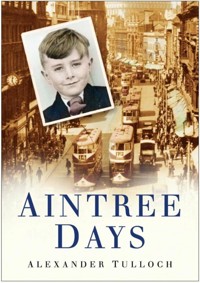
In Aintree Days, Alexander Tulloch recounts his life in Liverpool from 1945 to 1962, when he was growing up with his sister, parents and grandparents in a small terraced house in Aintree. It is also accompanied by an atmospheric selection of photographs, reflecting the England of yesteryear.
Sie lesen das E-Book in den Legimi-Apps auf:
Seitenzahl: 312
Veröffentlichungsjahr: 2006
Das E-Book (TTS) können Sie hören im Abo „Legimi Premium” in Legimi-Apps auf:
Ähnliche



















AINTREE DAYS
ALEXANDER TULLOCH
First published in 2006 by Sutton Publishing
Reprinted in 2012
The History Press
The Mill, Brimscombe Port
Stroud, Gloucestershire, GL5 2QG
www.thehistorypress.co.uk
This ebook edition first published in 2013
All rights reserved
© Alexander Tulloch, 2012, 2013
The right of Alexander Tulloch to be identified as the Author of this work has been asserted in accordance with the Copyright, Designs and Patents Act 1988.
This ebook is copyright material and must not be copied, reproduced, transferred, distributed, leased, licensed or publicly performed or used in any way except as specifically permitted in writing by the publishers, as allowed under the terms and conditions under which it was purchased or as strictly permitted by applicable copyright law. Any unauthorised distribution or use of this text may be a direct infringement of the author’s and publisher’s rights, and those responsible may be liable in law accordingly.
EPUB ISBN 978 0 7509 5326 9
Original typesetting by The History Press
Contents
Preface
1
The Warrior Returns
2
Roots
3
The Sport of Kings
4
Many Are Cold, but Few Are Frozen
5
Brotherly Love
6
Sunday Observance
7
Hogmanay & False Teeth
8
Reluctantly to School
9
Aintree Nights
10
Target Practice
11
The Spy Within
12
Footballs & Jam Jars
13
Forbidden Fruit
14
Keeping Mum
15
A Pint & a Fag
16
French Leave
17
Liverpool Wanderers
18
Recipe for Disaster
19
Welsh Rarebit
20
Glowing Futures
21
The Brush-off
22
Status
23
Union Jack
24
A la Parisienne
25
A World of Difference
26
Tending the Sick
27
Pride & Prejudice
28
Bon Voyage!
Preface
This is not an autobiography. Certainly, the book contains a good deal of autobiographical information but at the same time much has been omitted. The reason for this is quite simple: I did not wish to risk boring the reader with superfluous material which would have contributed little or nothing to the general purpose and ethos of the book. When I set out to describe life in Liverpool after the end of the war my main aim was to give present and future generations an idea of what it was like to live in an age that has long passed into history. I wanted to evoke a time when life was less complicated, when pleasures were simple and a relative lack of money did not seem to stand in the way of our enjoyment of life. This was a time when there was no central heating and we huddled round a coal fire in an attempt to stay warm in winter but, when the summer sun made the inside of our tiny houses almost unbearable, we still had to have a coal fire to heat the water! This was a time when, for entertainment, we played Ludo and snakes and ladders in the evening or sat gathered round the radio. In the 1950s we supported church socials on Saturday nights, even if we never went to church on Sunday mornings; cars, fridges and even televisions were a rarity, and computers, iPods and mobile phones were beyond our wildest imaginings. But we could derive as much enjoyment spending five bob on a night out as today’s younger generation does after spending the better part of a hundred pounds. It all seems very different from today’s world.
The fifties were a time when a sense of loss could exist side by side with a sense of hope. For many who were middle-aged or in their declining years the nightmare memory of the Second World War and what it had taken from them was still fresh; for the younger generation it was already ancient history. The older generation was still readjusting, but the younger was looking forward, bursting with energy and a creative drive that was to reshape the new world just over the horizon. They were exciting times, and before the decade was out the old world would be left far behind, surviving only in the minds of writers, historians and other chroniclers of the human condition who believed that they should never be forgotten.
In writing this book I have occasionally experienced amnesia when memories of over fifty years ago became slightly blurred. On such occasions my sister Margaret has been an invaluable source of information and has frequently been able to remind me of people, places and events which had faded in my memory or I had quite simply forgotten. Without her gentle prodding such details could have slumbered in the deepest recesses of my increasingly forgetful mind, probably for ever. My thanks to her for her help.
On those very few occasions when memory failed us both I have resorted to a little artistic reconstruction to paper over the gaps in the narrative. I hope none of this literary sticking plaster will detract from the overall effect of these recollections and happy memories or interfere with the reader’s appreciation of my efforts to recall times past.
In addition to my sister there are other people to whom I would like to express my gratitude for their contribution to this book. I have to thank the staff of the Liverpool Record Office for the cheery Scouse way in which they helped me on a recent visit to the William Brown Library when I needed to find the old photographs of Liverpool which feature here. Thanks also to Mr David Gee of the Craig-Ard in Llandudno for sending me an up-to-date photograph of his hotel, and to Keith Wilson and Sian Stephens of the We Three Loggerheads for providing a picture of their hostelry.
Most of the names mentioned in Aintree Days are real. In a few cases, however, I thought it better to substitute fictitious names where there was a danger of my causing embarrassment or annoyance, or both.
1
The Warrior Returns
‘Does nobody get a cuppa tea in this house any more? Anyone would think the bloody war was still on!’ I didn’t recognise the voice from downstairs, but could hear my mother laughing and joking with someone to the accompanying jingle of cups and saucers and the thumping and banging of the plumbing as she put the kettle on. The next thing I heard was my father coughing and asking if anyone had seen his fags.
It was still dark as I swung out of bed and suddenly felt the freezing cold lino as it seemed to spring off the floor and make contact with my feet. The noises from downstairs were now getting louder and louder as other members of the household, namely my grandparents, also made their way downstairs to greet the stranger. I joined them as fast as my little legs would carry me, but as I was only three or four years old at the time, the stairs were still a major obstacle and I had to control my enthusiasm to reach the bottom or suffer a nasty bump on the head if I fell downstairs and banged it on the monks’ bench at the bottom.
When I reached the kitchen where they were all standing I saw this figure in a blue uniform wearing a funny hat which looked to me like one of the paper bags which had the chips in when Mum brought fish ’n’ chips from the chippie. It was years later that I understood that the uniform was that of a flight sergeant in the RAF and the man standing in front of me was my uncle Alex, on leave for only the first or second time since the end of the Second World War.
‘Hello’, he said as I walked through the door, ‘Who’s this then . . . Wee Al?’ Without waiting for a reply he picked me up and started tickling me, all the time breathing his tobacco smoke into my face. ‘Here,’ he said, taking a bar of something out of his pocket, ‘would you like some chocolate?’
Alexander Guthrie, the author’s uncle. He was a Flight Sergeant in the RAF when this photo was taken during the Second World War. (Author’s collection)
Margaret Tulloch, the author’s mother, 1941. (Author’s collection)
After that I don’t remember anything else about that morning. I can’t even remember if I ever ate the chocolate or what it tasted like. All I know was that the man who offered it to me was to keep popping up throughout my childhood, because although the war was over he stayed on in the forces and I would probably have forgotten him altogether had it not been for the airmail letters he sent home from places like Cyprus, Hong Kong and somewhere in Africa with a name that sounded very strange to me and which I never could pronounce.
This was Liverpool in the mid to late forties. Battered, bloody but unbowed after all the bombing, with its defiant Liver Birds still towering over the pierhead. And Aintree, despite the fact that my mother always said it was one of the better parts of the city, was a grim place to be. The bomb damage was horrendous. The tiny houses were probably long overdue for demolition before Hitler decided to come to the aid of the City Council and create vast open spaces where the Victorians had erected houses for the workers. But things were not so bad there as they were a few miles down the road towards the centre of Liverpool. That part of the city was like a wasteland. When we sat upstairs on the tram as it clanked along Rice Lane, Walton Road and then on to what seemed to me like the end of the earth, all that we could see through the grimy windows was mile after mile of bombed-out buildings or the distorted, twisted skeletons of offices and shops and what had once been family homes. As my grandfather used to say in his inimitably sardonic manner, ‘At least Jerry cleared the slums a damn sight faster than the Council did.’
I’ve been a cigarette smoker since the day I was born. There were six of us in the family (me, my sister, Mum and Dad and the grandparents), and the four adults smoked from the moment they opened their eyes in the morning until they got into bed at night. So, as we now know, I was smoking all the time too. Fag after fag we smoked, all day, coughing, coughing, coughing, and there was smoke from the ceiling down to my knees so I can honestly say I never saw daylight through the sitting-room window. Even on bright sunny days all I saw was the roof on the house opposite through a kind of dirty yellow haze that passed for the atmosphere in our house. In those days nobody knew smoking was harmful and the term passive smoking was thirty years into the future: my mother even believed it was good for you as it killed the germs and kept the fleas away. It never occurred to her that the absence of fleas in the house might have been because (to her credit) she kept the house spotless. No. Smoke was the answer. Vermin hated it so she puffed away and encouraged everyone else to do so as well. In this way the germs and fleas and mice and every other nasty creature would leave us alone and take up residence in a nonsmoker’s home. She also had the strange idea that it was good for the teeth, as a good coating of tar protected them from whatever it was that caused tooth decay. ‘So why’, I used to think to myself, ‘has everybody in this family got false teeth?’
Bob Tulloch, the author’s father, during a break in a cricket match in the 1930s. (Author’s collection)
Then there was the watch. Kensitas, the cigarettes my mother smoked, introduced a coupon scheme allowing smokers to save up the vouchers in each packet in exchange for a free gift. I can’t remember the figure, but for God knows how many vouchers you could get a free wrist-watch. One year, as my dad’s birthday was looming on the horizon, she decided his present would be a Kensitas watch and increased her consumption of fags to make sure she got through enough by the deadline of 18 April. At the end of February she did a rough calculation and realised that at her present rate she didn’t have a snowball’s chance in hell of smoking enough to get the watch. Even if she stayed up all night, smoking twenty-four hours a day, she just didn’t have the puff to do it. So everyone had to help. My grandfather and grandmother were told to smoke more. Neighbours were asked to contribute. Even my father, who usually smoked Capstan Full Strength or Woodbines, was ordered to swap to Kensitas and at least make a contribution to his own present.
The vouchers were all gathered together in an old shoe box and every Saturday night, while listening to Saturday Night Theatre on the Home Service, she would take the box out from under the stairs and count them. I can hear her now, whispering in a hypnotic way which never failed to send me to sleep. Two hundred and twenty five . . . two hundred and twenty six . . . two hundred and twenty seven. . . . Eventually she’d done it. She’d got enough. So on the Sunday morning after the final count she announced to the family that she had achieved her goal and then parcelled up the vouchers ready for sending off to Kensitas first thing on Monday morning.
Ten days later the package arrived. Dad was out, so Mum opened it to inspect the goods. Sure enough, there it was. A crisp leather strap either side of a watch with a luminous dial. Mum was pleased and could hardly wait to show everybody else. Everyone except Dad, of course. He would have to wait until his birthday, which was still a few days away.
But I spoiled it. With the indestructible logic of a child I ruined her day. The sight of the watch brought back to me the months of everyone in the family smoking themselves to death, the anguish of wondering if she would gather together enough vouchers in time and the way she had browbeaten everyone into supporting her cause. All I said was, ‘It would’ve been cheaper just to buy a watch. They’ve got them like that over the road in Woollies for one pound ten and six.’ My mother looked stunned. I felt sorry for her. The look on her face said everything. She had slaved away smoking fag after fag for months. She’d encouraged everybody else to do the same. She’d begged, cajoled, persuaded and bribed friends and neighbours into taking part in her campaign . . . for what? The awful truth suddenly dawned on her. She could have just walked over the road and bought almost the same watch for probably a fraction of what she’d spent on fags. Dad’s birthday somehow lost some of its sparkle.
The smokers also, it has to be said, kept the house very clean. I remember my friends’ houses were never as clean as ours. And the cause was the smoke. Inside my mother’s brain two forces continually vied for supremacy. She had this irresistible urge to smoke for England and yet had a thing about decorating. Whenever she had a free moment she would get out the paintbrush and start painting, and my poor dad never had a minute’s peace. If she decided that the house needed decorating she gave him his orders and he, almost without a whimper, put his old clothes on and started stripping the walls. And the connection between the urge to smoke and the urge to decorate? Cause and effect. The acrid smoke of the cigarettes destroyed the paint and wallpaper. That little house was decorated inside from top to bottom every year because the smoke made all the paintwork turn yellow and settled like an oily scum on the walls. So as the seasons changed they were marked by annual rituals reminiscent of primitive tribal rites. Every spring the house was decorated. Summer was a fallow time because the windows and kitchen door could be left open and this would blow most of the smoke outside, over the wall into Mrs Kelsall’s back yard. But by October the paintwork and wallpaper needed a good wipe down with a damp cloth and my mother would set about the task with a will.
December was the time when the other source of smoke was seen to. The only source of heat in the whole house was the open fire in the sitting room. On the coldest nights in the dead of winter, when the wind was howling outside or the frost painted beautiful patterns on the windows, the only place to get warm was in front of the living-room fire. The trouble was that with six of us in the house it was difficult even to see the fire, let alone get close enough to it to get warm. And when you did get close enough to feel its warmth it only warmed your front. Your back was still cold and if anybody opened the door an icy blast blew straight in from the North Pole and almost sliced you in half. On the other hand, if the wind was blowing in the right (or wrong, depending on your perception) direction it would come down the chimney and fill the room with dense black smoke, making the whole place smell like Lime Street station before they electrified the railways.
And of course the chimney had to be swept. The responsibility for this fell for some reason on my grandmother. What a major operation it was! The night before the sweep’s visit the carpet had to be rolled up and laid on the stairs, and as much furniture as possible had to be carried into the drawing room (the other kids in the neighbourhood all had a front parlour, but in our house it was the drawing room). The bulky sideboard, which looked as if it had been pinched from some monastery, was covered in an enormous white sheet, as were the two big armchairs.
On the appointed day at eight o’clock in the morning the sweep arrived. He was old and covered in soot, even at that time of the morning. In he would trudge, taking care to walk only on the lino or where the newspapers had been strategically positioned to protect the fitted carpet in the hall. As long as he obeyed the rules his life was not in danger. But one foot in the wrong place and . . . !
While he was traipsing through the house with a variety of brushes and rods my grandmother would make a pot of tea. I say ‘make’ but in fact ‘distil’ would be a better word. When my friends’ mums or nans made tea they simply put tea in the teapot (never without warming it first!) and poured the boiling water on it. But not my nan. Oh no. She poured the boiling water into the pot, yes, but then she would put it on a low light on the stove and let it simmer and bubble and gurgle away for about half an hour. The result was a dense black liquid almost thick enough to stand a spoon up in. Then she poured it into two cups, added two hefty dollops of condensed milk (or ‘connie-onnie’, as it was universally referred to) and stirred it. Of all the people I remember from my childhood, only the sweep and my nan liked their tea like this.
Once he picked up the cup, that was it. The brushes and rods and cloths just lay on the floor while he and my grandmother chatted. One conversation I remember very well.
‘The missus is bad. Gorra growth.’
‘Och, the poor soul.’
‘Yis. I don’t think she’s got long to go. Bringin’ up all sorts she is. Yells in pain every night. Doctors can’t do nottin’ for ’er. Father Ryan says it’ll be a merciful relief.’
It’s all beyond me. The bits I do understand I don’t understand. What’s wrong with a growth? I thought growth was good. Everyone kept telling me to eat my food so I’d grow. And how could you bring up all sorts? I liked Liquorice All Sorts but once they were down they were down.
Eventually he got on with the job he came to do. He’d cover the grate with a big black cloth and then start feeding the big brush up the chimney, fixing wooden poles on one after another until there were none left. Then I was given the job of going out into the street to see if the brush was poking out of the chimney pot. When it was, Nan gave me sixpence for luck.
The result of all this was two or three sacks of soot which the sweep carried through the kitchen and dumped into his cart. Then he tied all his rods and brushes together, asked for five shillings and was on his way. Before he was at the end of the road Nan would have a bucket, mop and cloth out and start cleaning up all the mess caused by the errant soot as it settled on the floors, windows, walls – everywhere, in fact, that wasn’t covered by white cloth.
When the sweep had gone we knew that the cycle of the seasons had been completed. Everywhere now had to be cleaned up, the dust cloths had to be removed and the furniture put back in its proper place, so that we could all settle down and relax until after Christmas. Then, as sure as eggs is eggs, my mother would make plans for the spring clean and start thinking about how she was going to redecorate.
2
Roots
I never knew my grandparents on my father’s side. His mother had died when he was only seven and his father died not long after I was born. My grandparents on my mother’s side, or Nan and Granddad, as I always called them, were Scots. He was born John Scott Guthrie in Leith near Edinburgh in 1884 but grew up on a croft in the Orkney Isles where his father eked out a living as a carter. Then, in about 1900, he moved back to Edinburgh where he met my grandmother and they were married in 1909. When he landed a job as a shipping clerk (because of his fine penmanship, he always said) they moved down to Liverpool just before the First World War and spent the rest of their lives there.
Peter Guthrie, the author’s great-grandfather on his mother’s side, a native Orcadian. This photograph was taken on the Orkneys in about 1890. (Author’s collection)
John Scott Guthrie, the author’s grandfather, early 1900s. (Author’s collection)
Now John Guthrie was almost a caricature of your dour Scotsman. Not very tall, he was none the less powerfully built and in his youth was no mean footballer. He used to kid my sister and me that when he was a young man football clubs were queuing up all over the place to sign him up but he refused them all because although he was good at the game he was too attached to his knees. It was OK to play a game on a Saturday morning, but enough was enough and he did not want to be crippled with arthritis in the knees by the age of thirty, which was what happened to many of his friends who played a lot of football.
Granddad stayed in the shipping business all his life and always caught the five to eight train from the Black Bull station in the morning to take him to his office, which had transferred to Manchester during the war. He wore a businessman’s suit with a waistcoat and silver watch-chain, horn-rimmed spectacles and a trilby. But he always wore black boots. Even when he wore a suit I don’t ever remember him wearing shoes, but I would watch, absolutely fascinated, every night as he sat down in his armchair and unlaced his highly polished black-leather boots, pulled them off and placed them carefully in the corner by the chimney breast. Then he would put his slippers on and remove his collar and tie. In those days men wore detachable collars and Granddad was no exception.
There was a special drawer in the sideboard where he kept his clean collars, together with a small box in which he had a variety of front studs, back studs and cufflinks. Nobody was allowed to go in that drawer. It was only opened when my grandfather wanted to take out a clean collar, except for Thursdays. My grandmother never cleaned his collars. That job was done by a specialist laundry in the centre of Liverpool called Collars. Every Thursday a van would turn up outside the front door and the driver would deliver a small brown cardboard box containing six gleaming starched collars and take away six dirty ones, to be returned the following week all bright, white and gleaming. Another box which used to turn up, but not with the same degree of regularity, was also made of brown cardboard, but the greasy stain on the outside and unpleasant smell that came from the inside announced contents of a very different kind . . . kippers. To this day I don’t know why or how, but my grandfather managed somehow, when rationing was still on, to have Manx kippers delivered to the door. As a child I soon learned to distinguish kippers from collars.
When he retired in the early 1950s he took on the duty of going to fetch the Liverpool Echo. Morning papers such as The News Chronicle and The Daily Express and a deluge of Sunday papers were delivered by the local newsagent. But not the Echo. Oh no. The Echo was special and had to be fetched every evening; it was my grandfather who always undertook this arduous task. Hail, rain or shine, he insisted that it was his duty to venture forth from the comfort of the family home and return with his quarry some considerable time later. The significance of the paper-boy’s stand being right outside the Black Bull totally escaped me at the time. But, even though I was a child, it did occur to me that an hour and a half to run an errand which really should have only taken about ten minutes seemed excessive. And I suppose I must have been about eight or nine when I noticed that on his return there was a different smell about him. When he went out there was nothing more unusual than the smell of the ancient mothball that hung next to his jacket in the hall wardrobe. But when he returned with the evening paper he always smelled the way my father smelled after drinking the contents of a certain brown bottle with his Sunday dinner. As part of the process of growing up I came to associate that smell with what Dad called his ‘special lemonade’ but the label on the bottle called ‘Light Ale’.
Once he was back in the house my grandfather’s routine was always the same. He would throw the Echo on to his armchair in the corner of the sitting room and, no matter how eager anyone else was to read it, the unspoken law was that he had first claim on it. While he was in the hall taking off his coat and hanging it carefully in the wardrobe, the virginal rolled-up broadsheet lay where it had landed and slowly uncurled as the heat from the coal fire reached it. Not even my grandmother, who was by no stretch of the imagination a timid woman or doormat of a wife, and was always eager to read the horse-racing results, dared to pick it up before her turn.
Slippers on, collar and tie off, specs perched on the end of his nose, Granddad would give a slight cough, fold the paper into a shape more comfortable for reading, and that was it. That moment was the signal that the evening had begun. The tea dishes would have been washed by now (‘dinner’ was the meal we had at two o’clock on Sundays and on Christmas Day), the Home Service had been tuned in for the news, another shovel-full of coal had been heaped on to the fire (or, as my grandmother used to say, the fire had been ‘backed up’) and everyone was seized by a ritual fit of generosity as friendly arguments broke out over who should accept whose cigarettes.
My grandfather, then, would sit in the corner of the room, peering through his horn-rimmed spectacles and systematically ploughing through the Echo while other members of the family smoked and engaged in what always seemed to me to be incomprehensible and meaningless conversation. Now and again my sister Margaret would talk about a film she had seen at the Palace, the Carlton or the Walton Vale, and she and my mother would discuss the relative sexual attractions exuded by a variety of male film stars. Not that the word ‘sex’ ever crossed their lips and it was only years later that I came to understand that this, in fact, was what was being discussed. By common consent it was usually agreed by the end of these conversations that Clark Gable (or ‘Big Ears’, as my mother always referred to him) was more handsome than James Stewart or Errol Flynn.
When my father looked at the Echo he always turned first to the sports section. He, like my grandfather, had been a useful man on the field in his day, and he cherished a life-long passion for the game and his team (Liverpool, of course). This meant that he never missed a match if he could help it or the opportunity to read about one. If his team was playing well he would engage in ‘discussions’ with my grandfather, a keen Everton supporter whose impish sense of fun goaded him into making uncomplimentary remarks about Billy Liddell or Albert Stubbins, just to needle Dad. It has to be said, though, that these ‘discussions’ never got out of hand or could ever be described as being anything other than just friendly banter. Yes, there was rivalry between them, but it never stopped them going off to the match together on Saturdays to support whichever team was playing at home that week, or analysing the game the same night in the Queen’s Arms or the Sefton. Later on, when the Windsor Castle, the pub at the junction of Rice Lane and Orrell Lane (destroyed in the war), was rebuilt in about 1954, it became their regular Saturday-night venue for reliving the day’s match and comparing the players of the day with the pre-war greats.
I don’t remember how long the Home Service programmes lasted, but I do remember that they seemed to go on and on about things I could not understand and which seemed singularly uninteresting to me. I do have a clear memory, however, of how the announcer’s voice would sometimes fade so that my grandfather had to lean over in his chair and attempt to tune the station in again. At such moments all conversation would cease as Granddad put his ear hard up against the radio while simultaneously fiddling with the knob. The silence that accompanied these antics was frequently interrupted by the sound of a tram passing at the end of the road, much to my grandfather’s annoyance and interrupting his concentration. When this delicate operation eventually proved successful there would be a collective sigh of relief and the chatter would be resumed. My child’s mind could never understand why the family conversations were always loudest when the radio was working well and the reception was good, as it always seemed to me that the best time to talk was when no sound was coming out of the radio. But the logic of a child is seldom the logic of the adult world.
At what I suppose would have been about seven thirty the Home Service was abandoned and it was time to tune into the Light Programme. If my memory serves me right Tuesday night was when we listened to Have a Go, introduced by Wilfred Pickles with Mabel at the piano. On Friday nights it was Take it From Here, with Jimmy Edwards and his interminable saga ‘The Glums’, with Ron and Eth. As we got older my sister and I used to ask for Radio Luxembourg and, strangely enough, we were often supported in our request by Granddad, especially when Winifred Atwell was on. No musician himself, his fingers would nevertheless tap away on the arm of his chair in time with her inimitable style. But my abiding memory is not her dexterity at the keyboard, but the sponsor’s name, Horace Batchelor, read out at the end of every programme and the town where the main office was based which was spelled out letter by letter – K E Y N S H A M. This should, I suppose, tell us something about the power of advertising!
By this time the Echo had usually been dismembered and everyone in the family had claimed the pages he or she was particularly interested in. For my mother and sister it was the horoscope. My grandmother devoured the horse-racing page as she studied the form and my father got to grips with the crossword. As I trotted off to bed and turned to say ‘goodnight’ I little thought that the image of him, with his newly acquired retractable ballpoint pen poised over something as ephemeral as that evening’s edition of the Echo, would bring back such vivid memories fifty-odd years later.
3
The Sport of Kings
Then there was Nan. What a woman she was! Peggy Guthrie, 4ft 10 in her shoes, dominated the household for much of my childhood. She was born in 1885 in Edinburgh, the daughter of Alexander Robertson, who owned a tailoring business near the centre of the city. At the age of about thirteen she was taken out of school and put to work learning to become a seamstress alongside, as she always put it, Germans, Jews and Russians (although she always pronounced it Rooshians). And this training stood her in good stead for later life, as she went on to bring up four children and made all their clothing. She also learned a smattering of her workmates’ languages. Well into her seventies and eighties she could still recall phrases in Russian, German and Yiddish, and I have a theory that she was probably a gifted linguist at heart but just never had the opportunity to develop her talent.
Nan looked after my sister and me a great deal when we were very young. Mum, Dad and Granddad all left the house early in the morning to go off to their jobs, and my sister, seven years older than myself, would leave the house not much later to go to school. Then, until I started school too, I would come downstairs in my pyjamas and Nan would look after me for the rest of the day.
Dark winter mornings I loved. Even now, when I think back, a warm glow flows through my veins when I remember how she would have a lovely roaring fire dancing in the grate and my clothes all laid out in a neat row on the hearth. I would sit on a little stool by the fire eating toast dripping with butter and drinking lovely hot milk. Then there would be as much of a strange substance called calf’s-foot jelly as I could eat and which, Nan promised, was very good for me and would make me big and strong.
Breakfast over, she would bring in a bowl of warm soapy water and give me a good wash before dressing me. What a palaver dressing was! There seemed to be layers and layers of clothes: vest (or singlet, as Nan always called it), liberty bodice (does anybody else remember them?), shirt and pullover above the waist. The area below the waist, by comparison, was neglected. A pair of underpants and then short trousers. The result was that when I went out to play the top half was warm but the bottom half froze. My knees in the winter were always red and chapped with the wind and the rain; it never seemed to occur to anyone that some article of clothing designed to cover up the part between the hem of the short trousers and top of the socks could have been beneficial. Long trousers for boys were only invented in the late fifties or early sixties.
Margaret (Peggy) Guthrie, the author’s grandmother, photographed in the early 1900s. (Author’s collection)




