


5,95 €
Mehr erfahren.
- Herausgeber: Zombies Need Brains, LLC
- Kategorie: Fantasy und Science-Fiction
- Sprache: Englisch
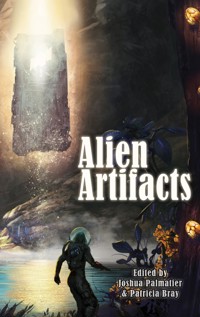
What might we run into as we expand beyond Earth and into the stars? As we explore our own solar system and beyond, it seems inevitable that we'll run into aliens … and what they've left behind. Alien artifacts: what might they reveal about us as we try to unlock their secrets? What might they reveal about the universe? In this anthology, nineteen of today's leading science fiction and fantasy authors explore how discovering long lost relics of alien civilizations might change humanity. Join Walter H. Hunt, Julie Novakova, David Farland, Angela Penrose, S.C. Butler, Gail Z. Martin & Larry N. Martin, Juliet E. McKenna, Sharon Lee & Steve Miller, Andrija Popovic, Jacey Bedford, Sofie Bird, James Van Pelt, Gini Koch, Anthony Lowe, Jennifer Dunne, Coral Moore, Daniel J. Davis, C.S. Friedman, and Seanan McGuire as they discover the stars and the secrets they may hold—both dark and deadly and awe-inspiring.
Sie lesen das E-Book in den Legimi-Apps auf:
Seitenzahl: 576
Veröffentlichungsjahr: 2016
Ähnliche












Alien
Artifacts
Other Anthologies Edited by
Patricia Bray & Joshua Palmatier
After Hours: Tales from the Ur-Bar
The Modern Fae’s Guide to Surviving Humanity
Clockwork Universe: Steampunk vs Aliens
Temporally Out of Order
Were-
Alien
Artifacts
Edited by
Joshua Palmatier
&
Patricia Bray
Zombies Need Brains LLC
www.zombiesneedbrains.com
Copyright © 2016Patricia Bray, Joshua Palmatier, and Zombies Need Brains LLC
AllRights Reserved
Interior Design (ebook): April Steenburgh
Interior Design (print): C.Lennox
Cover Design by C.Lennox
Cover Art “Alien Artifacts” by Justin Adams
ZNB Book Collectors #6
All characters and events in this book are fictitious.
All resemblance to persons living or dead is coincidental.
The scanning, uploading, and distribution of this book via the Internet or any other means without the permission of the publisher is illegal and punishable by law. Please purchase only authorized electronic editions of this book, and do not participate or encourage electronic piracy of copyrighted material.
Kickstarter Edition Printing, July 2016
First Printing, August 2016
Print ISBN-10: 1940709083
Print ISBN-13: 978-1940709086
Ebook ISBN-10:1940709091
Ebook ISBN-13: 978-1940709093
Printed in the U.S.A.
Copyrights
Introduction copyright © 2016byPatricia Bray
“Radio Silence” copyright © 2016byWalter H. Hunt
“The Nightside” copyright © 2016byJulie Novakova
“The Familiar”copyright © 2016byDave Farland
“Me and Alice” copyright © 2016byAngelaPenrose
“The Other Side” copyright © 2016byS.C. Butler
“The Hunt” copyright © 2016byGail Z. Martin & Larry N. Martin
“The Sphere” copyright © 2016byJuliet E. McKenna
“Shame the Devil” copyright © 2016bySharon Lee & Steve Miller
“The Captain’s Throne” copyright © 2016byAndrija Popovic
“Weird is the New Normal” copyright © 2016byJacey Bedford
“And We Have No Words to TellYou” copyright © 2016bySofie Bird
“TitanDescanso” copyright © 2016byJames Van Pelt
“Alien Epilogue” copyright © 2016byJeanne Cook
“The Haint of Sweetwater River” copyright © 2016byAnthony Lowe
“Music of the Stars” copyright © 2016byJennifer Dunne
“The Night You Were a Comet” copyright © 2016byCoral Moore
“The God Emperor of Lassie Point” copyright © 2016byDaniel J. Davis
“Pandora” copyright © 2016byC.S. Friedman
“Round and Round We Ride the Carousel of Time” copyright © 2016
bySeanan McGuire
Table of Contents
Introduction
by Patricia Bray
“Radio Silence”
by Walter H. Hunt
“The Nightside”
by Julie Novakova
“The Familiar”
by David Farland
“Me and Alice”
by AngelaPenrose
“The Other Side”
by S.C. Butler
“The Hunt”
by Gail Z. Martin & Larry N. Martin
“The Sphere”
by Juliet E. McKenna
“Shame the Devil”
by Sharon Lee & Steve Miller
“The Captain’s Throne”
by Andrija Popovic
“Weird is the New Normal”
by Jacey Bedford
“And We Have No Words to Tell You”
by Sofie Bird
“Titan Descanso”
by James Van Pelt
“Alien Epilogue”
by Gini Koch
“The Haint of Sweetwater River”
by Anthony Lowe
“Music of the Stars”
by Jennifer Dunne
“The Night You Were a Comet”
by Coral Moore
“The God Emperor of Lassie Point”
by Daniel J. Davis
“Pandora”
by C.S. Friedman
“Round and Round We Ride the Carousel of Time”
by Seanan McGuire
About the Authors
About the Editors
Acknowledgments
INTRODUCTION
Patricia Bray
First contact between humans and aliens is a staple of science fiction. But what if our first contact isn’t with an alien species, but with one of their artifacts? Perhaps in our explorations we stumble across an alien trash heap or an abandoned cache of treasures. We might find a device built to seek out other intelligent species, or an incomprehensible piece of debris from an ancient catastrophe. It could be something as seemingly simple as a sculpture, or as complex as a derelict spaceship.
In ALIEN ARTIFACTS we asked authors to imagine what would happen when humanity encountered one of these alien artifacts. What kind of object would it be? How would the characters react to finding this proof of alien life? Would the object be an intellectual curiosity? Or something that could transform Earth’s technology, catapulting our civilization to new heights—or our own destruction?
The result was nineteen intriguing stories of discovery, from humor to horror, with artifacts ranging from discarded trash to devices beyond human comprehension. There’s something for everyone in here.
Enjoy!
RADIO SILENCE
Walter H. Hunt
On the day that the world did not come to an end, Luanne Jacoby came into the Solar Observatory control room to begin her shift. To her surprise she found Jeremy Gonzalez sitting at his station, a few empty coffee cups and spent stimpaks on the console table, a detailed holo view of the Sun turning slowly in front of him.
“I thought you were off-shift.”
“I was supposed to be,” he answered. He reached for a coffee cup and noticed that it was empty. He put the hand to good use, running it through his thinning hair. “But there’s just the damnedest thing going on.”
To Jeremy, Luanne knew,the damnedest thingcould be a late-game loss by a favorite sports team, or a weird reflection of light in his quarters—not that she’d ever seen them:picsof them, but not the premises themselves—or any of a hundred other items that caught his interest for minutes or hours. But those didn’t usually keep him eight hours past his duty cycle.
“Tell me more,” she said, sitting next to him and looking up at the holo.
Jeremy’s face lit up like a small child getting ready to ask a knock-knock joke. “It’s just the damnedest thing. I was doing the usual analysis on sunspot activity—we’re near a maximum—”
“I know. Everyone knows.”
“Yeah. Sorry. We’re near a max, and I was analyzing the activity, but some strange data turned up.” He swiped a finger near the holo and a table of numbers appeared. “All of a sudden we saw a burst of neutrinos, which looked very,verymuch like a core collapse.”
“That’s impossible. The Sun doesn’t have enough mass for that. We’re millions of years from a possible nova or supernova.”
“Data, Lu.” He pointed at the numbers. “Therewasa neutrino burst. For about two and a half seconds we had the very beginning of a solar core collapse. If it had gone on just a little longer we’d not be having this conversation. No one in the inner Solar System would be having any sort of conversation, ever again.”
She waved at the image, bringing it closer, and zoomed in at the figures.
“Okay,” she said. “You’ve got my interest. What caused it?”
“Don’t know.”
“Whatstoppedit?”
“Don’t know exactly. But at the 2 point 48 second mark there was something, and then the neutrino burst stopped. It didn’t dissipate—it just stopped, instantly, nothing at all after that.”
“What sort of something?”
“That’s the interesting part.” He smiled again and turned to the console. He brought up another holo and waved at it.
There was a sudden burst of sound, like a low keening—actually more like someone playing a wind instrument through ductwork. She began to speak, but Jeremy put up his hand, and then theatrically pointed at the display. At just that moment the keening changed tone to a slightly lower register, then returned to its original pitch.
He waved away the second holo.
“You know what that was.”
“Some bad experimental band.”
“It’s the standard audio representation of the cosmic background radiation,” he said. “And right at the 2 point 48 second mark of the neutrino emission itchangedfor—let’s see—about 1 point 3 seconds.”
“And the neutrino emissions stopped.”
“Absolutely. And instantly.”
“Has this happened before?”
“Funny you should ask that. It was the first thing I thought of, and I went back through the data we have.”
“Are you insane? That’s attobytes of solar observations. No wonder you were up all through your off shift.”
“Fortunately,” Jeremy said, “I have the aid of powerful computing systems.” He smiled. “The answer is yes, it’s happened before: six times in the last twenty years. Each time there was a neutrino emission, and each time the CBR seemed to alter to compensate. What’s more, there’s a similar alteration in the CBR just about an hour earlier. Similar, but not exactly the same.” He slumped back in his chair and rubbed his eyes. “I have no explanation, Lu. Just the data.”
“You’re right,” she said. “Thatisthe damnedest thing. The CBR is the echo of the Big Bang—I wouldn’t think that there was anything that could alter it.”
“I was hoping you’d have some ideas.”
“I have some questions. What’s the period of this event? Is it regular?”
“Like clockwork. About 1100 standard days apart. I can give you the exact figure.”
“That sounds like an orbital component—like something at a distance from the primary, reaching some point in its orbit. 1100 days would be outside Mars—somewhere in the inner asteroid belt.”
“Something—like what?”
“An asteroid, I’d guess.” She smirked at him; usually he was first to the mark with wiseass comments. “All we have to do is find something with the correct orbital period, and we can see what’s interfering with the cosmic background.”
“Twice. Fifty-three minutes apart, every 1100 or so days. You realize how absurd the idea sounds.”
“Jeremy,” she said, “I’ve been working with you for two years. I’m used to absurd. As my astrophysics professor used to say, ‘when you eliminate the impossible whatever remains, no matter how unbelievable, must be the truth.’”
“That was Sherlock Holmes.”
“Fine. Whatever. Now why don’t you go get some sleep? I have work to do.”
* * *
The Solar Observatory maintained an orbit synchronous with Mercury, about five million kilometers further from the Sun and at opposition, so that the little planet never interfered with the station’s primary task. It had been described as the worst research posting in the Solar System when Luanne was at MIT a dozen years earlier, pursuing her astrophysics Ph. D.—but since her doctoral had been based on a careful study of sunspot patterns, it was the natural place to go.
She loved it. It was sparsely furnished and had only a small staff, most of which rotated out after a year or so—“the best tanning salon in the System” wasn’t interesting for most people. Luanne assumed they went out to Pluto or the Kuiper or something. When Jeremy had come on board, transferring from Arecibo, she assumed he’d come and go like most everyone else, but he seemed different, absorbed by the study of whatever he was assigned, a real scientific explorer. Most of the sorts of things he turned up were intellectual challenges but ultimately dead ends, but that’s science for you.
This one was different. He knew it; she knew it too. She dove into the problem the way she always did: straight ahead, completely focused, piecing together data on the visual workbench in front of her.
“Here.”
She felt her elbow being jostled and looked away from the asteroid database to see Jeremy standing there, still looking rumpled, holding out a cup of coffee. She took it and sipped: he’d made sure to add just enough cream.
“Shouldn’t you be getting some sleep?”
“I did. Four hours, then I read the sports net and got some breakfast.”
She looked at the chrono, then back at Jeremy.Oh.She gestured to a seat nearby.
“So.” He leaned back in his chair. “What have you turned up?”
“What makes you think I’ve turned anything up?”
He gestured at the holo, which was full of windows, pictures, and notes.
“There are fourteen asteroids at approximately the right orbit,” she said. “Eight of them are almost exactly the correct orbital length. None are among the five hundred largest asteroids, so these are all just random rocks.”
“Anything curious about any of them?”
“At first glance, no. But I think it’s a case of the dog in the nighttime.”
“More Sherlock Holmes references. What sort of curious affair are we looking at, Lu? In space no one can hear dogs not bark.”
“Yeah. That. I was curious about the eight asteroids I found, and one of them—” she pointed at a small picture, enlarging it until it was a few hundred centimeters across “—this one, is the most unusual. It has no signature: it’s not magnetic, it’s not thermal, and—”
“And it’s black.”
“It’s completely non-reflective. It was only discovered by occlusion: it passed in front of a larger object and, of course, it was of nointerest to anyone, except...”
“Except?”
“Except that every 1100 days or so it gives off a small amount of heat. Fifty or sixty joules—like a single drop of sweat.”
“And it happens right at the same time?”
“It’s on a delay, a little short of an hour. Fifty-three minutes. Right about the time the earlier CBR alteration occurs.”
Jeremy reached out to a console and operated a small calculator. “Nine hundred and seventy million kilometers. Sounds just about right. This little guy messes with the CBR and sends out a tiny bat fart, and at the speed of light it reaches Sol, which smells it and decides not to blow the Solar System to hell.”
“…Yes. Basically, yes, though it makes as little sense as the idea that Sol almost goes nova every 1100 days for two and a half seconds. There’s only one real explanation: this is some sort of technology. Alien technology.”
“Ooh.Aliens.”
“Do you have a better explanation?”
“No. Of course not. But what are we to make of this?”
“We need to tell someone. My guess is that we’re going to have to go take a look. Though I don’t know to what end: in fact, as soon as this data leaves this desk, it’s going to get into the hands of people who are all about taking alook. My biggest concern is...”
“They’ll want to fiddle with the knobs.”
“You have the best way of describing things,” she said, sipping her coffee.Bat farts, she thought.
* * *
One month after the day that the world did not come to an end, the UN cruiserAldrinwas keeping station eight thousand kilometers from a small asteroid that had neither a magnetic field nor a thermal signature: it was just an irregular bit of black rock drifting through an asteroid field, a billion kilometers from the Sun.
Luanne’s fears had been partially justified. Once Dr. Armand Gregory, director of the Solar Observatory, received word of the intermittent neutrino emissions, he ran with it directly to UN Space Command which, in turn, assigned a mission toAldrinto investigate the asteroid that she had identified. On the plus side, she and Jeremy had been permitted to accompany the mission as civilian observers in exchange for keeping the news off the net. Jeremy hadn’t liked the compromise, but Luanne wanted to see the asteroid close up and, with UNSC involved, this would be the only way to do it.
Aldrin’s astrographics section was very well-equipped, almost as handsomely kitted out as the Solar Observatory. Luanne and Jeremy made themselves at home, away from the bridge ofAldrin,where they had not been invited.
On their second day aboard, Luanne was trying to make some accurate measurements of the asteroid when she suddenly began to feel faint.
“Lu?”
Jeremy, more solicitous than usual, was suddenly by her side—she hadn’t even noticed him come over.
“I’m all right,” she said, trying to wave him off. But shewasn’tall right: the room seemed blurry, as if she was viewing it through a polarized filter. It seemed too bright, the contrast on the image turned way down...
She turned and found herself standing in a completely featureless place, white in all directions. Directly in front of her was a cat—a regular house cat, but a meter and a half tall.
“What the hell…Jeremy?”
The cat changed to a horse, then just as abruptly to a large predatory bird: a condor, she thought, though she wasn’t sure how she knew that. It went through a half dozen rapid changes and then became a human figure that looked like a cross between her Ph. D. advisor at MIT and Jeremy Gonzalez.
Then the cat that had become a horse that had become a human spoke to her in what she thought might be Chinese. Then it spent a few sentences in Hindi—which she’d heard a lot at MIT and at the Observatory—and then Spanish and then, at last, English.
“…sorry for contacting you in this direct fashion,” the man was saying. “But your vessel is trying to probe our station, and it would be better to avoid misunderstanding.”
“Your…station?”
“Yes,” the man said. “Did I use the wrong word? I am trying to assimilate your language as we speak, but there seem to be too many exceptions and double meanings—”
“At least you’re speaking English. How…? What…?”
“This is a mental contact,” the man said. “Miss Jacoby? Or shall I address you as Ms., or as Luanne, or Lu, or...” he shrugged, holding his hands out in a gesture that was very much Jeremy.
“Why don’t you go with Lu.”
“Lu it is then. As I was saying, forgive me for this direct contact, but it seems clear that you have discovered our station, and we want to avoid any misunderstanding. Yours is a warlike people, and it would be disastrous if you attempted to disable or destroy it.”
“I don’t think that was planned,” she said.
“Those commanding your vessel may have other ideas.”
“I wouldn’t know. I’m just a scientist.”
“We know,” the man answered. “Among our kind your profession is most highly honored. As the most intelligent mind aboard your vessel, we originally assumed that you were directing it, but it seems otherwise.”
“How is it you’re…?”
“Again,” the man said, “forgive the intrusion. Your mind was scanned for language and context. This figure—” he gestured to himself “—is drawn from your memory.”
“More or less.”
“There is little time,” he said. “I must try to explain our purpose to you in a way that makes sense.”
“Little time? Aren’t you…well, I mean, you’ve just done your job, haven’t you? It’s another whole trip around the Sun before you have to do anything else.”
“Ah. I have not been clear. You have not been adequately prepared for this contact, Lu, and as such it might do permanent damage to you. In fact...”
The scene went opaque. The man continued to speak but Luanne couldn’t understand what he was saying. She felt something being placed over her nose and mouth—
And suddenly the room came back into sharp focus. She was lying down, and someone had covered her face with some sort of breathing mask. The light was bright, and three people stood around her—a man was taking her pulse; another, a woman, unsealing Lu’s blouse; and the third held the mask in place from behind her head.
She slapped the hand on her blouse away,grabbed the mask, and tossed it off. The three people stepped back.
“What in the hell is going on?” she tried to say, but her throat was dry and it came out as “ut hli gunk can?”
She tried to sit up, decided it was a bad idea, and let herself lie back down. Someone handed her a squeeze bottle and she took a long sip.
“Slowly,” the woman said. “You’ve had a bit of a shock.”
“You have no idea,” Luanne managed after a moment. “I was talking...”
“You passed out, Lu,” said a familiar voice. Jeremy came into view. He looked worried as hell. “You dropped right to the floor. For a few seconds I couldn’t even feel your pulse. They moved you down here.”
“How long have I—”
“Four hours.”
“That’s a full night’s sleep at the Observatory,” she said, and Jeremy gave her a tight smile. “What’s going on topside?”
“I think the skipper is thinking about sending an EVA team.”
“No!” She tried to sit up again and managed it, but the room was none too steady. “Tell him not to do that.”
“I don’t think ship captains take orders from astrophysicists, but why not?”
“I’ve…been talking to the inhabitants.”
“Youwhat?”
“I need to talk to the captain, Jeremy. I don’t think anyone should set foot on that asteroid.”
* * *
Aldrin’s skipper was understandably skeptical.
“I realize that your profession requires a vivid imagination, Dr. Jacoby,” he said. Everyone else in his ready room was standing; he had gallantly offered her a seat opposite his perfectly neat desk. “But I hesitate to base my decisions on it.”
“I accept that, Captain Grier,” Luanne said. “But please understand that scientists base their conclusions on empirical evidence—observation, data, known facts.”
“Of course.”
“Of course,” Luanne repeated. “Meaning: I’m not making this up, I didn’t dream it, and I think the danger is real.”
“What danger, do you suppose?”
“I have no idea. I believe that there is no valid reason to risk your ship, or your personnel, before an adequate investigation has been made.”
“I thought that was your job. Instead you had a bout of space sickness, and a very detailed dream based on your own fears, and—”
“It wasnota dream,” she said, and it was clear that Captain Aaron Grier was unaccustomed to having anyone interrupt him. He leaned forward and folded his hands in front of him on his desk. His stare was regulation intense.
Before he could continue, Jeremy cleared his throat. “Whatever it might have been, Captain, I believe that Dr. Jacoby brought it to your attention out of genuine concern as well as scientific curiosity. All of the evidence we’ve been able to derive so far suggests—but doesn’tconclude, since we don’t have enough of it—that this is an artificial construct, not a random bit of rock floating in the Belt.
“No nation on Earth, or any other inhabited planet in the Solar System, has the ability to build such an object. If for no other reason, caution is called for.”
“As opposed to simply blowing the goddamned thing to splinters and be done with the threat.”
“No!” Luanne said, then thought better of it.
“I suppose you could do that if you thought it the best course,” Jeremy said. “But without a complete understanding of the target, isn’t that more dangerous than just leaving it alone?”
“I have no idea, Dr. Gonzalez. Do you?”
“Without adequate study, sir, no, I don’t. I assumed that we were out here to study the object, not blow it to splinters. At least not right away.” He gave his best scientist smirk; Luanne’s heart sank—she didn’t think that was going to go over very well.
Grier turned his thousand-meter stare on Jeremy Gonzalez, but it did not seem to have the desired effect.
“How long do you think you’ll need?”
“Twenty-four hours.”
“Unacceptable.”
“Really? Are we under some time constraint of which I’m not aware?”
“My orders are classified.”
Jeremy sighed. “Well, sir, I can waste all of our time by playing twenty questions with you, or you can tell me the greatest amount of time your super-classified orders will give us to evaluate a likely alien object with unknown capabilities.”
“Dr. Gonzalez—”
“Eight hours,” Luanne said. “Give us eight hours.”
Grier turned his head to look at her. She felt as if he was going to say something patronizing, or at least condescending, but Jeremy had clearly become the villain in the room, and the captain was more inclined to be charitable.
“Eight hours,” he said. “Then I want a complete report on my desk. Is that clear?”
“Thank you, captain,” Luanne said.
“Dismissed,” he growled. She stood up. Jeremy pulled out his comp to check something. After a few seconds Grier looked up. “Are you still here?”
“Empirical evidence says yes,” Jeremy said, and turned and left the room.
“Dr. Jacoby,” Grier said. “Your colleague is—”
“Refreshingly honest?”
“Disturbingly civilian,” the captain said. “But I’ll overlook that if you deliver the report as ordered.”
“Asrequested.”
“As requested,” Grier repeated, and then he swiveled his chair to look at his holo display. With nothing more to say, Luanne left the ready room.
* * *
“What do you expect to achieve in just eight hours, Lu?”
“I don’t know.” They were walking along the corridor back toward the sick bay, whereAldrin’s chief surgeon had demanded she return after speaking with the captain. “In a way, we already know everything we can learn without a close-up. There’s only one thing we can manage in that amount of time.”
“Which is?”
She stopped walking. “I have to make contact again. I was told that I wasn’t properly prepared for it last time. I experienced maybe five minutes, but there must have been some other stuff going on before I was actually talking to the…to whatever I was talking to. Some of that will have already been done: they know I’m human, and not a cat or a bird or a fish or a horse, and they know my base language is English.
“I’m thinking that if I’m able to reach some sort of meditative state, it might be easier for them to reach me. I know a few breathing exercises, but maybe the doc can administer something to calm me—an anxiety-disorder medicine.”
“And then you just go off and have a talk.”
“Do you have a better plan?”
“I didn’t have any plan at all. I just wanted Captain Grier to stop being a dick to you. He can be a dick to me instead.”
“Thanks for that, but it wasn’t necessary. I can take care of myself.”
“Whatever. Still, I’m not convinced thatyourplan is the best one. But I don’t have a better one. You’re not going to do this alone, though.”
“What does that mean?”
“At the very least, I’m going to stand by and monitor you.”
“I don’t need—”
“Those are my terms. Not that I’m dictating terms, though I apparently am. Sort of.”
* * *
Aldrin’s Chief Surgeon was not particularly thrilled with the idea, but consented at Luanne’s insistence. She settled back onto a couch after taking a minimal dose of diazepam, closing her eyes and letting herself settle into quiet.
It took less time than she thought. There was a sudden change in the air pressure, as if someone had opened an airlock door. She opened her eyes to find herself in a room—actually, a sort of mock-up of a room, as if drawn by an artist who didn’t have a particularly good eye for detail. Beyond the edges was the same white, featureless place she’d been before.
Facing her were six people, five of them looking essentially the same—Doctor Assad from MIT crossed with Jeremy Gonzalez.
The sixth was Jeremy himself.
“Hiya, Lu,” he said. “Wow, this is really creepy.”
“What’s the meaning of this?” she asked the nearest Assad/Jeremy. “Been dipping into my memory again?”
“Dr. Gonzalez appears to have found a way to enter the conversation,” he said. “We did not construct him—he is actually here.”
“I decided to take the ride with you,” Jeremy said. “Diazepam. And bourbon. Beats hell out of breathing exercises.”
“Am I…are we…properly prepared for this contact?” she asked the alien.
“It seems so, though I am unconvinced regarding your colleague. Still, the flow of time is different here. There is something we want to show you.” He made a slight gesture with his hand and white space and room vanished. They were hanging in space: it was enough to begin to induce vertigo. Nearby, she could see the inky black asteroid against the backdrop of another body that was lightly dappled by the distant sun.
“Wow,” Jeremy said. “Best planetarium ever.”
“The body in the center of your solar system has been in place for a few billion of your years,” the alien said. “It was created at the time of the First Event, and has been slowly moving away from that place ever since—cooling and forming planets, burning its fuel. And all of that time it has called out to its brothers and sisters.”
He gestured again, and she heard a distant keening sound—the cosmic background radiation, the same as Jeremy had played for her a month ago on the day the world didn’t end.
“You’re saying…you mean to say that the CBR is the sunsinging?”
“It is all of the suns in the universe singing,” he answered. “The sound you are hearing is a pale approximation of the true song of all ofcreation: here, elsewhere…everywhere. Your sun’s contribution is but the merest fraction of the entire song, which has continued since the beginning of the universe.
“Sometimes a sun reaches its end, for one reason or another—it consumes all of its fuel, or it comes in close contact with another sun—and the sound changes. But sometimes, as a sun ages, it begins to lose its ability to participate in the great song of all creation.”
“And it goes nova,” Jeremy said quietly.
“If it cannot hear its brothers and sisters answering its call, that is exactly what it does. And that is why we are here. This asteroid—this station—hears the songs of the near neighbors, the ones to whom your sun sings its portion of the song. When we receive it, we re-transmit it to your sun which has grown, you might say, hard of hearing.”
“That would be the tiny heat emission,” Jeremy said. “And the first alteration to theCBR. So the sun is having…panic attacks?”
“Correct. And the second alteration occurs when your sun replies. Of late, it has begun to panic, as you say, when it thinks it cannot hear its brotherscall. In due course it may be necessary to change our pattern to make sure that its panic does not consume it.”
“You talk as if it’s a living being—a sentient thing.” Luanne looked at the alien standing in front of her. “Wait. That’sexactlywhat you’re saying, isn’t it? Thesun is alive. The sun is…wow.”
“This is going to make one hell of a doctoral thesis for someone,” Jeremy said. “I wonder if it’s angry at us for lobbing spent fuel rods into it.”
“It’s hardly noticed,” the alien said. “Your sun is not angry…it is merely lonely. Its song is a longing for the place it has left, and will never see again.”
“And you make sure that it keeps in contact: that there’s never radio silence.”
“Our race has built these stations in many places. It is the mission of our species. Sometimes they fail; sometimes the sun is simply unstable. And, of course, everything ultimately dies. There is no preventing that. And when the native race achieves a certain level of capability, we turn the knowledge of the station over to it, to keep watch on its own sun.It is a step on the road to...”
The being didn’t finish the sentence, making Lu—and Jeremy—wonder what that particular road in fact led to.
“So we’ve never noticed this station because we…weren’t ready?”
“It is all but invisible to societies with primitive technology. Even when the capability to detect it exists, however, it requires a certain thought process.” The alien smiled, not Jeremy’s smirk, but Dr. Assad’s knowing grin. “And, of course, it only happens when the person doing the thinking is strongly attached and deeply interested in the sun and its life cycle.”
“The captain of the ship we’re currently on has some sort of secret directive,” Luanne said. “He might think your station is a threat and try to destroy it.”
“That would be disastrous,” the alien said. “Approximately three and a quarter years from now, when the time of the call comes, your sun would fail to hear the call from its near neighbor, and in despair would begin to become a nova.”
“What do I tell him then?”
“Well,” Jeremy said, “we could tell him the truth.”
“He had enough trouble believing anything I said before. What could possibly make him believe me now?”
“You’re not alone, Lu,” Jeremy said. “Now this is a group hallucination.”
* * *
Captain Grier received her in the large observation lounge in the forward part ofAldrin, below the bridge. The sky was full of stars, and the alien station hung in silhouette against an asteroid slightly further away.
He did not turn to face her when she entered, but remained standing with his hands clasped behind his back, looking out at the scene.
“I read your report, Dr. Jacoby. I read it through, then read it through again.”
“And?”
“And I’ve decided to leave the asteroid alone.”
Luanne felt very slightly faint but said, with as level a voice as she could manage, “I’m very glad to hear it.”
Grier turned around. “I’m sure you are. But it’s not for the reasons you offer—it’s because I don’t think this object posts any particular threat, whether or not I blast it outof existence. Your report…and your story…is interesting, but I simply don’t believe a word of it.”
“And yet you still don’t intend to destroy the station,” she said.
“My grandfather was a bit of an eccentric, Doctor,” Grier said. “He collected antique toys. The one of which he was most proud was a pinball machine. Do you know what that is?”
“I have to confess I don’t,” she answered, wondering where this was going.
“A pinball machine is a device with a sort of inclined box. A spring-loaded chute sends a metal ball up a ramp and into the top of the incline, and it bounces off various surfaces, going from place to place. The player tries to keep it in play by flipping it back up. The ball is knocked around, colliding with obstacles as it travels. Great fun, I might note. Grampa let us play with it when we’d been particularly well-behaved.
“The asteroid belt, Dr. Jacoby, is like a pinball machine, except more complex, and while a pinball is fairly indestructible and the obstacles in the machine are resilient, everything out here—” he waved one arm toward the view behind him “—is bumpy and sharp-edged. Things are always coming in contact with each other, shearing off bits and cracking into pieces. That’s been going on since the protoplanet in this orbit came apart eons ago.
“Thinking about that led me to wonder: if this station has been out here for a long time, how has it survived? How has it kept from colliding, malfunctioning, moving off its intended orbit? And if it has some capability to resist impacts or alter its course, why is it thatAldrin—or any ship from a puny culture like ours—poses any threat whatsoever? Why doesn’t it just move out of the way or laugh at our weaponry?
“And I concluded that you’ve been convinced that theyarethreatened by us, but that they can still change the content of the cosmic background. It doesn’t add up. Which means, Dr. Jacoby, that despite standing orders to contain or eliminate possible alien threats, I have decided that this simply isn’t worth my time.”
Luanne didn’t know how to respond—either to Grier’s logic or to his sneering tone—so she simply stood, silent, waiting for him to continue.
“I trust that you will be ready to debark at Mars Orbital in a few days. I plan for us to get underway immediately.”
* * *
1059 days after the world did not come to an end, Luanne Jacoby was sitting at her console at the Solar Observatory, monitoring the CBE. Things had been significantly upgraded since the encounter—which had never been made public, by agreement with the defense establishment—and whether the improved gear was a result of the right word in the right place by Captain Grier or someone further up the line, she never knew. Dr. Gregory was out at Ganymede now; Luanne had remained at the “tanning salon,” and was now its Director.
There had been talk of a stalled career. Certainly Jeremy, who knew just about as much about the event as she did, had wondered whether she should move on. There were better positions elsewhere in the System. He’d found one himself at the Tycho Deep Space Telescope Array, the recent replacement for the Copernicus (which had replaced the Webb, which had replaced Kepler...) and every time they spoke he told her how valuable she’d be there instead of at Solar.
He’d called early during her duty shift to see if she’d noticed anything. They’d refined the data on earlier instances to the point that they had it timed to within a minute. Like her, he was waiting for the CBE blips. She’d told him—at four minute delay each way,damn that pesky speed of light—that he was two hours early and should get back to work.
So here she was, the interference pattern of what she was told was the song of all of the stars in the universe spread out before her, the chrono running down toward the moment at which the station in the asteroid belt would echo what the Sun could no longer hear.
Thirty seconds—then fifteen—then the last countdown, like they used to do for space insertions, to zero.
And nothing. Radio silence.
She checked the equipment, scrolled the display backward to see if she’d missed it—no, there was no alteration in the pattern.
She tried not to panic, but her scientist’s mind formulated a simple sentence:everyone inside the orbit of Mars has about fifty-three minutes to live.
“Grier,” she said to no one in particular. “Grier, you stupid bastard. You destroyed the station anyway. I told you what it was, and you destroyed it anyway.” But the last telemetry—captured a few weeks ago—showed it there, a tiny speck against the background of a nearby, larger rock.
Jeremy must know this too: sometime in the next four or five minutes there would probably be an incoming signal askingwhat the hell, or just to see whether she knew, too, and what could possibly be done.
Radio silence, she thought to herself.
She leaned back in her chair, looking up at the ceiling, and closed her eyes.
“Lu.”
She opened her eyes to see the sketched room, the place she hadn’t seen for three and a quarter years, the place that Grier told her was in her imagination.
Jeremy/Assad was sitting alone opposite her, smiling faintly.
“You didn’t transmit,” she said. “Why didn’t you transmit?”
“We didn’t need to,” he answered. “You found us, Lu. Your civilization has learned what the station does, what it’s for. Now you will do it yourselves.”
“Alter the cosmic background radiation? How the hell do you expect me to do that—by force of will?”
“Essentially,” Jeremy/Assad said, “yes. There is no one in your Solar System who is closer to the Sun than you are—not just physically, but emotionally. You care about your primary. Now you are to be given the opportunity, and the responsibility, to careforit as well. And with that achievement, we can at last go home.”
Lu thought about it for a moment, then said, “In a little under an hour, the sun is going to blow all of the inner system to permanent hell, and you decidenowto have me learn on the job? You could have picked any time in the last three years plus to visit and teach me what I need to know, and you wait until now?”
“Though this matter has never been far from your mind, Lu, it is only now that it is foremost. That activated our programming and caused us to contact you. And as forlearninghow to do what is necessary—there is nothing to learn. All you must do is listen.”
“Listen—to the cosmic background.”
“Yes.”
“What if I don’t hear it? What if I fail—what if I can’t—”
“You will, and you can, and you will not fail.” Jeremy/Assad smiled again. “Don’t be afraid, Lu. Just listen.”
There was a tightness in her chest that made it feel as if it was going to burst. She was shivering—but she was not paralyzed.
She took a deep breath—and listened.
* * *
11,000 days after the world didn’t come to an end, there was a signal at Dr. Luanne Jacoby-Arnett’s door. She waved at the air, the door irised, and a young woman stepped into the office.
“You sent for me?”
Astrid Gonzalez was the very image of her father; Luanne had noticed that as soon as she’d come on board. Jeremy’s recommendation had brought her here, a brilliant twenty-seven-year-old astrophysicist who had done some very interesting work on the boundaries of the Sun’s chromosphere. When she’d come aboard she seemed skeptical—Dr. Jacoby-Arnett wasn’t the easiest person to work for, and at least in public, most of the staff was terrified of her.
But Astrid was bright, and interested in the Sun, and would do nicely.
“Yes,” Luanne said. “Yes, I did. Please sit.” She gestured to a floating chair; Astrid took it, a little tentatively—not many people were accorded the privilege of sitting when they were called to the boss’s office.
“If you’re asking about the status report—”
“No, Dr. Gonzalez. Nothing like that.” She smiled; everyone knewthatdidn’t happen very often. Boris Arnett, her husband, had been killed in some sort of accident in the transMartian asteroid belt six years ago, and no one at the Observatory was accounted as Dr. Jacoby-Arnett’s friend.
Astrid knew that her father was in that category, though. She waited for the older woman to speak.
“There’s an experience that your father and I had thirty-odd years ago,” Luanne began. She could see Astrid’s eyebrows go up. “Nothing likethat,” she said. “It has to do withthis.” She waved at the comp and a sound flooded the background, like a bad experimental band playing instruments through the ductwork.
“That sounds like the audio of the cosmic background radiation,” Astrid said.
Smart girl, Luanne thought. “Now listen carefully.” She pointed at the graphical representation on a holo she put up in the air between them. When the sound replay reached the place she pointed to, there was a slight alteration.
“What—”
“When we first heard it, your father and I asked what it was. I have an answer—and in order to explain, I will need you to listen...”
THE NIGHTSIDE
Julie Novakova
In some other reality, seeming so unreal and faraway now, Christmas time was approaching. It was snowing here.
Linus checked the updated weather feed. The snowfall had thickened recently due to the increased activity on the dayside. Here, hundreds of kilometers safely behind the terminator, the tiny flakes of condensed iron and titanium were drifting slowly to the ground. Barely a micron across, the metallic snow was invisible to human eyes. However, after millions of years of continuous fall, a fortune in purified ore had accumulatedin these regions.
“All good here,” reported Linus and closed the hatch of the tiny control room. “Moving to the last one.”
The nuclear-powered furnaces stood tall and wide in the perpetual night, spawning one block of iron or titanium after another. A few also processed other metals: aluminum, chromium, nickel. Tireless trains transported the raw ores here from the mining sites.
Linus couldn’t wait for his stroll outside to be over. Visual inspections of the machinery were largely outdated but they were still a mandatory part of the process forwhat ifandhuman resourcefulnessreasons.
“Going back,” he announced and set off for the maintenance rail.
“Trying to break the inspection speed record again?” answered a playful voice.
Linus frowned. Miranda always teased him when it was his turn to go outside. She seemed to enjoy the landscape; he did not.
He would never admit it but it struck some chords buried deep in the human mind—the fear of dark and cold—and the chords in his brain seemed to be particularly well-developed. Not a good trait for someone stationed to remain at this place for a wholeyear. But it could have been worse, he reminded himself. Actually much, much worse. He should be grateful for this.
But he felt most grateful when the train released him next to the airlock. He couldn’t wait to get out of the suit and spend as long as the scheduled water supply allowed in the shower.
When the cabin pressurized, Miranda appeared and helped him out of the suit. “Everything okay?”
“Yes. Everything in perfect working order.”We’re useless here, he added for himself.
“Great. Though from you, it sounds like a funeral speech,” Miranda remarked.
Linus left that without reply. He felt streams of sweat running down his whole body. The thought of a shower sustained him.
It was getting worse every time. He would have thought he’d get used to it—but the more time he spent on the planet’s surface, the more shaken each visit left him.
Five more months,he reminded himself.Then it’s over.
He staggered out of the cabin and headed straight into the tiny bathroom.
“You’re welcome,” Miranda called after him, still putting the suit’s components back in place.
“Sorry,” he mumbled though she couldn’t possibly hear that.
Just five more months. You can hold it.
He turned on the water and closed his eyes.
* * *
Miranda was sitting at the small table in the main room, chewing a dried protein stick. “Just in time for dinner,” she grinned at him. “I left you the chicken-flavored one.”
“Good,” he said mechanically and sagged to a chair.
“We’ve got news from outside. The suckers were driven back behind the outer belt.” Miranda produced a proud smile. “It’ll be months at least until they’re back in the gravity well—if they dare try it!”
Linus looked up full of hope. “So the inner belt is secure for mining?”
“Nope. The bloody clinkers left it full of their tech. The drones and traps are stupid but not stupid enough to allow us to mine the belt safely.”
So we’re not getting out of here soon.Linus suppressed a sigh. Without metal supply from the asteroid belt, this world was the best source even though its orbit extremely close to the sun made it highly inconvenient to extract metals here. It took enormous amounts of fuel to get out of this gravity well and good shielding to protect the ship.
Without knowing otherwise, he might imagine they were on a large moon or a small terrestrial planet somewhere normal. All they ever saw here above the cracked land was an ordinary night sky. Only when they occasionally needed to go near the terminator did the strangeness of this world become apparent.
Miranda interpreted his grim silence as a sign of doubt. “Hey, if they were still around, don’t you think we’d see them? Even if they just flew by inertia, we’ve got enough probes around to notice a ship’s thermal signature. They’re gone.”
Linus nodded apathetically. “What about other solar systems?”
“No news.”
There hadn’t been any for nearly three months now. It didn’t necessarily mean trouble. It just meant that either no ship or probe of theirs made the Ozaki crossing into this system, or that the information wasn’t intended for them.
Linus knew there were systems where new ships arrived only every four or five years. This system became one of the battlegrounds due to its location and the traffic was heavier, at least four scheduled Ozaki crossings there and away in a year. One of the ships was supposed to bring their replacements and take them back to civilization in five more months. He hoped it would arrive on time. The idea of being stuck here longer, foryearsin the worst case, made Linus shiver.
Without a word, he got up and took his food to his bunk.
* * *
Before we arrived, we learned that no crew really stuck to the planet’s official catalog name. You couldn’t miss the pattern in the nicknames: Hell, Hades, Gehenna, Furnace, Inferno. I personally liked The Oven. Sticking to this tradition of non-repeating names, we gave it our own: Tartarus.
Linus’ hand stopped above the touchscreen. As if he could ever send home any of the letters he composed. All communication was restricted: assignment reports only. During the long hours of nothing, he’d mastered the art of writing letters, started playing with the composition and word choice, style, tone.
Miranda never understood this.Why do you write home if you can’t send it?she kept asking.And why the hell are you writing at all? I’d just do a recording.
She appeared by his bunk door now. “Hey, Lin…You okay?”
“Of course I am. Just tired.” Linus put down his notepad. He wasn’t actually upset about how she’d teased him before—and he was certain she wasn’t feeling sorry. That wasn’t her style.
She smirked. “Too tired?”
“Not too much,” he admitted. A different answer had crossed his mind, a desire to stay alone, but he ignored it.I should be grateful for her.I’d go crazy if I’d been here on my own or with someone less like her.
Miranda smiled and climbed inside the tiny space with him. Linus quickly put his notepad away.
Afterwards, she fell asleep in his bunk, making the confined space even more claustrophobic. But he couldn’t bring himself to wake her up. Her warmth and regular breathing calmed him. He could imagine he was safely home and Miranda was his girlfriend, not a pragmatic crewmate who preferred him to a machine. He’d be sleeping in a real bed, after a day spent doing a real job, walking under a real sky—
Stop it! You’re just making it worse. Get some sleep.
He shifted next to Miranda, trying not to think. Thinking was a sleep-killer. However, it was not easy to stop. His thoughts inevitably moved to the war.
They’d talked about it just two nights before. Miranda was resolute and straightforward as ever. Sometimes he wondered if there was anything that could leave her uncertain.
“What do you think is going on up there, right now?” he’d whispered in a careless moment. Miranda had sneered in the dim light of the bunk.“What doyouthink? They’re probably shooting each other out of the skies.”
“Yeah, but I mean…How does this end? Andwhen?”
“We win, of course. We’re better than the clinkers. And we’vegotto defeat them.” Miranda had looked almost bored.Why’s he asking so stupid questions, he could imagine her thinking.He’d felt impossibly alone despite her presence.
How can she be so sure?Linus had thought.Am I a traitor because I have doubts?
Just because he’d occasionally wondered whether the so-called clinkers were as dangerous and distorted as presented, was he becoming dangerous, too? Because he’d pondered whethertheir ideology of abandoning planet colonization was so bad in itself, was he betraying his side? No one else he knew seemed to think these things—or they were hiding it better. The bunk’s ceiling seemed to be falling on Linus as he imagined long sleek ships accelerating beyond the point of survival of unenhanced human beings, painstakingly achieving near relativistic speeds in order to make the Ozaki crossing. Most carried soldiers and weapons instead of colonists these days. It could have been so great. Yet two factions of humanity—if the others were still human—fought throughout Orion’s Arm, the end growing no nearer.
“Maybe someone should wipe us from the Galaxy,” Linus whispered to himself. The thought was strangely soothing. He finally closed his eyes.
Maybe…if it wasn’t for the fact that there’s no one to do that—but ourselves.
There was no galactic club; no Federation; no wise, insanely old civilization guiding the wild youngsters; not even a common enemy, something to unite the forever quarreling humans.
Just a vast lonely emptiness.
Humans tried to fill it with their presence. And since they didn’t have anyone else to define themselves against, some outgroup to make them think they were a unity, they just continued comparing themselves to other humans.
We needed an outside reference frame for our species, and found none.
We still need it, desperately. At least an indication that we’re not alone.
Some forms of conflict seemed inevitable under such conditions. But to think that a warof this scale would come…You’d need to be the most misanthropic pessimist to believe that, yet it had happened. What did that say about humanity?
Maybe he should have enlisted. Maybe he’d be dead by now and everyone would be better off.Maybe if everyone was dead...
He blinked, vaguely surprised at the direction his own thoughts had taken.
Maybe he should try to get some sleep after all.
* * *
When the alarm clock woke him up, Miranda was no longer there. Linus found her in the main cabin, sweet and breezy, watching some show and holding a cup of coffee. She was always up and about first, ahead of the station schedule; another of the many things he had no idea how she could manage.
“Morning. Care for a little forecast for today? We’ve got a large titanium oxide cloud 11 km above the terminator, so we can expect a lot of snow!”
Good that I don’t have to go outside today, Linus thought and poured himself a cup.
His night ruminations now seemed ridiculous to him. Another day of routine chores might, with some luck, cure him of those. And then another, and another, until he got out of here safely.
He closed his eyes and imagined, for a sweet short moment, that he was home.
He almost didn’t realize the sound of Miranda’s show had stopped.
“Hey…one of the probes picked up something near the terminator,” said Miranda slowly. She was staring at the screen, no longer occupied by the old comedy. “See it? Seems like a really big chunk of metal—pure, solid metal.”
Linus skimmed through the data. A chill went through his veins.No, he stopped himself,it’s inconclusive. On the verge of the probe’s sensor range. All kinds of weird effects happen to electronics here, especially by the terminator with all the metallic snow and radiation.
“We’ve gotta confirm it,” Miranda whispered.
“Agreed. Let’s send a drone.”
“No. We won’t get anything useful. Hell, our machines have a hard time just mining there and coming back. The probe’s got about the best sensors here and you see the results.”
“You’re not going to propose...”
“It’s the only logical solution, Lin.”
Linus felt his insides shrink. He knew where this was going.I’m a software engineer, Lin. You’re the scientist. I can back you up from here.
“No,” he said, hardly audible.
“Come on, Lin. You’ll just take a rover and then a really short stroll. It’s no more dangerous than walking on Earth’s Moon.”
It is. The gravity is higher here, help is farther away, we’ll lose connection before I get there.
But she was right on one thing. One of them needed to go. He just had the bad luck of being more qualified.
* * *
Three hours later, Linus found himself driving to the terminator. So far, the rover more or less drove itself and he just sat there, looking out nervously. He was on the verge of panic.
I should have told her, admitted I’m more and more scared every time I go out.Sweat ran down Linus’ forehead.But she’d either laugh at me or get upset. And even if she offered to do all the future inspections herself, it wouldn’t be fair.
The rover was still able to receive transmissions from the station, even though they were distorted by the microscopic metal snowflakes. “I’m bored,” he managed to say in a casual voice. “Tell me something before we lose connection.”
“You can watch movies on your HUD. I’ve got work to do.”
“Please.”
A moment of silence. Linus almost thought he’d lost the signal before Miranda spoke again: “What do you wanna hear?”
“Anything. What about your family? You’ve barely spoken about them.”
“Yeah, for a reason.”
The pause was filled by silent crackling of white noise.
“I’m sorry,” he said. “Then…anything else. Anything you like.”
“I guess it’s okay. I just get angry whenever I think about them. They were always fighting, mom and dad. Five minutes in the same room and they were at each other. But see, they belonged to one of those sects that don’t believe in any kind of marital separation, so there was no escape. Sometimes I just wish they’d kill each other.”
There was another pause. Linus couldn’t think of any appropriate answer.
Miranda continued in a lighter tone: “I guess that wasn’t the kind of thing you wanted to hear because you were bored, was it? Never mind. We can always...”
Linus didn’t hear the rest. The static grew louder. He was on his own now.
They were always fighting.He’d never imagine such a background for Miranda—so joyful, decisive, reasonable. Maybe she was one of the lucky few who discovered this was the best survival strategy. Or maybe she just learned how to control it in adulthood, how to pretend—and maybebecomethe mask.
His thoughts shifted to his older sister Talia, always so proud and successful in everything. He could never compare. Oh, how he envied her at times. And what good did it do him? He stayed so distant, timid and low-esteemed. He never fought for anything.
And neither do I now, Linus thought bitterly,hiding from the war in this hole because I conveniently majored in geology and started my doctorate when I was supposed to be enlisted. In someone’s eyes, that made me suitable for work here.
Suddenly, the drive came to a halt.
He checked the nav: too fragmented land ahead. The rover couldn’t go any further. Linus groaned silently. He had no choice but to continue on foot.
Linus hesitantly emerged from the car and made a first step outside. Then another.
Eventually, he calmed himself enough to follow the instructions on his HUD. But all the same, he couldn’t wait to disappear from here and never come back.
After all, this very planet is disappearing beneath us, he thought. So far, the erosion was slow, only the lightest particles freeing themselves from the grasp of Tartarus’ gravity. But soon, from a geological time perspective, the planet would cross a threshold under which catastrophic mass loss would occur. In a mere hundred million years, there would be nothing left, not even poor remnants of the metallic core. It would be boiled and carried away, leaving a thin veil of metallic dust trailing behind the evaporating planet.
From up close, the land was heavily fractured, covered in deep cracks. The surface of Tartarus looked dead. But beneath it, furiously powerful convective cells spanned the entire depth of its mantle. In the substellar point, magma bubbles greater than man can imagine kept bursting, constantly staring at the face of Tartarus’ sun.
No one had everseenit. All craft orbiting Tartarus had an orbit permanently locking them to the nightside. None would withstand the heat of the dayside. Few land probes ventured behind the terminator. Even fewer survived and brought back data.
Heat almost prevented people from coming here. But once on the nightside’s surface, humans were all right. It was the voyage that threatened to kill them every time.




