


4,99 €
Mehr erfahren.
- Herausgeber: Samuel Shepherd
- Kategorie: Ratgeber
- Sprache: Englisch
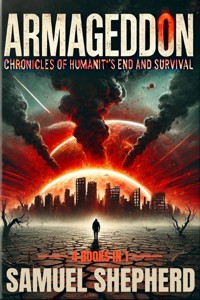
📖 Armageddon: Chronicles of Humanity’s End and Survival
🌍
“What happens when the world stands on the brink of destruction… and humanity must fight to survive?”
Are you ready to explore the edge of existence? 🔥
Armageddon is not just a book—it’s a journey through humanity’s darkest hours, its greatest threats, and the hope that rises from the ashes. This captivating four-book collection is a masterful blend of science, myth, technology, and the resilience of the human spirit.
📚
The Chronicles at a Glance
🌋
Book 1 -
Armageddon Rising: The Science of Global Catastrophes
From volcanic eruptions to asteroid strikes, deadly pandemics to climate collapse, discover the forces of nature and science that could bring civilization to its knees. Backed by chilling research and real-world scenarios, this volume exposes the fragility of our planet and the looming threats that science warns us to prepare for.
📜
Book 2 -
Prophecies of Armageddon: Myths, Legends, and Sacred Texts
What if ancient stories of the end of days hold deeper truths? From the Norse
Ragnarok ⚔️ to the Book of Revelation 📖, from Mayan calendars 🗿 to Hindu cycles of destruction, this volume unveils the legends and sacred warnings that have captivated humanity for millennia. Explore the myths that shaped civilizations and reflect on the lessons they carry for today.
🤖
Book 3 -
Armageddon 2045: The Future of Warfare and Technological Apocalypse
Artificial intelligence, autonomous weapons, and cyber warfare—what happens when the machines we create turn against us? ⚙️ The future is here, and the line between human control and machine dominance has never been thinner. This gripping volume explores the dangers of unchecked innovation, exposing a future where technology could trigger our ultimate downfall.
🌱
Book 4 -
After Armageddon: Rebuilding Civilization in a Post-Apocalyptic World
When the dust settles and the world has burned, what comes next? 🌄 This final volume takes readers on a powerful exploration of survival, resilience, and renewal. From rebuilding shattered societies to rediscovering humanity’s place in the world, this book is a testament to the strength of the human spirit to rise again.
🌟
Why You Need This Book Series
🌟
✅
A Journey Through Science and Myth: Immerse yourself in a seamless blend of fact and storytelling. Learn how science and legends intertwine to shape humanity’s understanding of the end.
✅
Thrilling, Thought-Provoking, and Eye-Opening: Each page pulls you deeper into a narrative that challenges your perspective on survival, progress, and resilience.
✅
Perfect for Fans of Apocalypse and Survival Stories: Whether you love
The Road,
The Walking Dead, or documentaries like
Ancient Apocalypse and
Planet Earth, this series will captivate you.
✅
Rich in Detail, Accessible to All: Written for enthusiasts, thinkers, and readers who love big ideas delivered in powerful storytelling.
🔥
Who Is This Series For?
🔥
- 🌍 Lovers of dystopian fiction, survival tales, and real-world science
- 📖 Readers fascinated by history, mythology, and cultural prophecies
- 🔬 Science enthusiasts curious about natural and man-made global threats
- 💭 Dreamers and thinkers who believe humanity’s greatest challenge is yet to come—and that there’s still hope
⚠️ Prepare Yourself ⚠️
Armageddon: Chronicles of Humanity’s End and Survival is more than just a book series—it’s a reflection of where we stand as a species and where we might go next. Will we succumb to the chaos, or will we rise above and rebuild?
✨ Don’t wait for the end. Start your journey today. ✨
📦 Order Now and Receive:
✅ All four volumes in one complete set 📚
✅ A gripping exploration of humanity’s greatest fears and hopes 🌟
✅ An experience that will stay with you long after the final page
👉 Click Buy Now and uncover the Chronicles of Humanity’s End and Survival.
🔥 The end is just the beginning… 🔥
Das E-Book können Sie in Legimi-Apps oder einer beliebigen App lesen, die das folgende Format unterstützen:
Veröffentlichungsjahr: 2024
Ähnliche


















ARMAGEDDON
CHRONICLES OF HUMANITY’S END AND SURVIVAL
4 BOOKS IN 1
BOOK 1
ARMAGEDDON RISING: THE SCIENCE OF GLOBAL CATASTROPHES
BOOK 2
PROPHECIES OF ARMAGEDDON: MYTHS, LEGENDS, AND SACRED TEXTS
BOOK 3
ARMAGEDDON 2045: THE FUTURE OF WARFARE AND TECHNOLOGICAL APOCALYPSE
BOOK 4
AFTER ARMAGEDDON: REBUILDING CIVILIZATION IN A POST-APOCALYPTIC WORLD
SAMUEL SHEPHERD
Copyright © 2024 by Samuel Shepherd
All rights reserved. No part of this book may be reproduced or transmitted in any form or by any means, electronic or mechanical, including photocopying, recording, or by any information storage and retrieval system, without permission in writing from the publisher.
Published by Samuel Shepherd
Library of Congress Cataloging-in-Publication Data
ISBN 978-1-83938-905-4
Cover design by Rizzo
Disclaimer
The contents of this book are based on extensive research and the best available historical sources. However, the author and publisher make no claims, promises, or guarantees about the accuracy, completeness, or adequacy of the information contained herein. The information in this book is provided on an "as is" basis, and the author and publisher disclaim any and all liability for any errors, omissions, or inaccuracies in the information or for any actions taken in reliance on such information.
The opinions and views expressed in this book are those of the author and do not necessarily reflect the official policy or position of any organization or individual mentioned in this book. Any reference to specific people, places, or events is intended only to provide historical context and is not intended to defame or malign any group, individual, or entity.
The information in this book is intended for educational and entertainment purposes only. It is not intended to be a substitute for professional advice or judgment. Readers are encouraged to conduct their own research and to seek professional advice where appropriate.
Every effort has been made to obtain necessary permissions and acknowledgments for all images and other copyrighted material used in this book. Any errors or omissions in this regard are unintentional, and the author and publisher will correct them in future editions.
BOOK 1 - ARMAGEDDON RISING: THE SCIENCE OF GLOBAL CATASTROPHES
Introduction
Chapter 1: The Earth’s Fury
Chapter 2: The Sky is Falling
Chapter 3: When the Waters Rise
Chapter 4: Firestorms and Infernos
Chapter 5: The Climate Collapse
Chapter 6: Plagues and Pandemics
Chapter 7: Cosmic Radiation and Solar Storms
Chapter 8: The Silent Killers
Chapter 9: Extinction-Level Events
Chapter 10: Humanity on the Brink
BOOK 2 - PROPHECIES OF ARMAGEDDON: MYTHS, LEGENDS, AND SACRED TEXTS
Chapter 1: The Apocalypse in Ancient Scriptures
Chapter 2: The Four Horsemen of the End
Chapter 3: Ragnarok – The Norse End of Days
Chapter 4: The Hindu Cycles of Destruction
Chapter 5: The Prophets and Their Visions
Chapter 6: Signs of the End in Christianity and Islam
Chapter 7: Mayan Calendars and Doomsday Clocks
Chapter 8: Lost Civilizations and Their Final Warnings
Chapter 9: Modern Prophets and End-Time Predictions
Chapter 10: Symbolism and Allegory of Armageddon
BOOK 3 - ARMAGEDDON 2045: THE FUTURE OF WARFARE AND TECHNOLOGICAL APOCALYPSE
Chapter 1: The Dawn of AI Warfare
Chapter 2: Cyber Wars and Digital Collapse
Chapter 3: Autonomous Killers – Drones and Robots
Chapter 4: Bioweapons and Engineered Pandemics
Chapter 5: Nuclear Armageddon 2.0
Chapter 6: The Space Battlefield
Chapter 7: Climate Wars and Resource Conflicts
Chapter 8: The Rise of Super Soldiers
Chapter 9: Nanotechnology – The Invisible Threat
Chapter 10: Humanity vs. Machine: The Final Stand
BOOK 4 - AFTER ARMAGEDDON: REBUILDING CIVILIZATION IN A POST-APOCALYPTIC WORLD
Chapter 1: The Fall of Civilization
Chapter 2: Survival of the Fittest
Chapter 3: Finding Shelter and Sustenance
Chapter 4: The Role of Knowledge and Technology
Chapter 5: Rebuilding Communities and Leadership
Chapter 6: Medicine and Health in the New World
Chapter 7: Preserving Culture and History
Chapter 8: The New Economy – Barter and Trade
Chapter 9: The Challenges of Nature and Environment
Chapter 10: A New Dawn – Humanity’s Second Chance
Conclusion
Introduction
The concept of Armageddon has captivated humanity for millennia, looming as both a symbol of our greatest fears and a reflection of our enduring hope for survival. Across cultures, religions, and eras, it has been imagined as the ultimate reckoning—a moment when the world, as we know it, falls apart. Whether through divine judgment, scientific inevitability, or technological miscalculation, the end has always been part of the human story, a shadow that forces us to confront who we are, what we value, and whether we can overcome the challenges of our own making.
The Armageddon series explores this intersection of destruction and renewal, taking readers on a journey through the science, myths, and future realities of humanity’s potential collapse—and its path to survival. This collection of books examines not only the ways our world could unravel but also the resilience, ingenuity, and spirit that define the human ability to endure and rebuild.
In Book 1 - Armageddon Rising: The Science of Global Catastrophes, we delve into the raw power of nature and the consequences of humanity’s actions on the environment. Earthquakes, volcanic eruptions, pandemics, climate collapse, and cosmic threats such as asteroid impacts all pose very real risks to civilization. These are not mere hypotheticals but scientific realities, ones that have shaped the course of history and may threaten our future. This exploration of the natural forces that can endanger our existence serves as both a warning and a call to action, reminding us of the fragile balance we depend upon.
Book 2 - Prophecies of Armageddon: Myths, Legends, and Sacred Texts transports us into the collective imagination of humanity. From the Book of Revelation to the Norse myth of Ragnarok, from Hindu cycles of destruction to Mayan calendars foretelling the end of days, these stories have offered explanations, warnings, and moral lessons. They reflect humanity’s need to find meaning in chaos and to prepare for a future that feels beyond our control. Prophecies of doom are not merely about the end—they are about transformation, rebirth, and the timeless struggle between destruction and creation.
In Book 3 - Armageddon 2045: The Future of Warfare and Technological Apocalypse, we move from ancient prophecies to a future defined by human innovation and its unintended consequences. The rise of artificial intelligence, autonomous weapons, biotechnological manipulation, and cyber warfare has created unprecedented opportunities but also existential risks. As technology advances faster than our ability to control it, the potential for catastrophic conflict grows. Here, the threat does not come from natural forces or divine punishment but from humanity’s own ambition, hubris, and the tools it creates.
Finally, Book 4 - After Armageddon: Rebuilding Civilization in a Post-Apocalyptic World shifts the focus to humanity’s remarkable capacity for resilience and reinvention. History has shown time and again that even in the wake of disaster, humans find ways to rebuild. Whether through restoring lost systems, creating new ones, or rediscovering old ways of life, this final volume explores how civilizations rise from the ashes. It is a testament to the human spirit, which persists even when faced with unimaginable loss.
This series is more than an exploration of the end; it is an examination of humanity’s choices, its fragility, and its potential. Armageddon is not just a story about destruction; it is about survival, transformation, and the unyielding hope that tomorrow can be better than today. These chronicles offer a sobering yet empowering reminder that while we cannot always control the forces around us, we can shape how we respond to them.
The journey through these pages invites you to reflect on the past, understand the present, and prepare for the future. Armageddon is not an inevitability—it is a possibility. And in that possibility lies humanity’s greatest test and its greatest opportunity: to rise, to endure, and to build a world worth saving.
BOOK 1
ARMAGEDDON RISING
THE SCIENCE OF GLOBAL CATASTROPHES
SAMUEL SHEPHERD
Chapter 1: The Earth’s Fury
The Earth, a seemingly stable and hospitable planet, harbors unimaginable power beneath its surface. For billions of years, immense forces have shaped and reshaped the planet, giving rise to mountains, carving deep valleys, and fueling cataclysmic events that have both created and destroyed life. These forces, hidden within the Earth's crust and mantle, periodically erupt with devastating consequences. At the heart of these phenomena lies the immense pressure and heat generated by the movement of tectonic plates, the relentless churn of magma, and the ceaseless pull of gravitational forces. The Earth, though tranquil on its surface most of the time, is constantly in motion, alive with energy. This energy manifests in the form of earthquakes, volcanic eruptions, tsunamis, and other natural disasters that strike without warning, leaving devastation in their wake.
Earthquakes, caused by the sudden release of energy along fault lines, remind us that the ground we walk on is not as solid as it seems. These events occur when tectonic plates, which float on the semi-molten mantle, grind against each other or pull apart. The build-up of stress over decades or centuries eventually triggers a violent rupture, sending shockwaves across the land. In places like the Pacific Ring of Fire, a zone of intense seismic activity, the destructive potential of these earthquakes is fully realized. Cities crumble, landscapes fracture, and countless lives are lost. The seismic waves ripple outward, shaking everything in their path, while aftershocks prolong the agony for days or even weeks. The unpredictability of earthquakes amplifies their terror, as even the most advanced warning systems provide mere seconds of notice. Beneath cities and oceans, faults lie dormant for centuries before awakening with catastrophic fury.
Volcanoes, another manifestation of the Earth's raw power, are a direct result of tectonic activity and the movement of magma beneath the crust. The planet’s interior, composed of molten rock and metal, generates tremendous heat, which seeks release through weak points on the surface. When a volcano erupts, it unleashes a deadly cocktail of lava, ash, and toxic gases. Pyroclastic flows, traveling at hundreds of kilometers per hour, can obliterate entire regions in minutes, leaving nothing but scorched earth behind. The 1815 eruption of Mount Tambora, for example, darkened skies across the globe, causing a volcanic winter and widespread famine. The explosive nature of such events serves as a grim reminder of the Earth's ability to influence the climate and alter life on a global scale. Even dormant volcanoes can awaken without warning, posing a persistent threat to communities that live in their shadow.
Tsunamis, often triggered by undersea earthquakes or volcanic eruptions, represent another facet of the Earth’s fury. These colossal waves, driven by sudden displacement of water, can travel across oceans at speeds exceeding 800 kilometers per hour. As they approach shallow coastal waters, they rise to staggering heights, swallowing entire cities and sweeping everything in their path back into the sea. The 2004 Indian Ocean tsunami, for instance, remains etched in memory as a devastating event that claimed over 230,000 lives across multiple countries. The immense force of the waves reveals the interconnectedness of Earth’s systems—what begins as a tremor beneath the ocean floor can transform into an unstoppable wall of destruction.
Landslides and avalanches, though often overshadowed by larger-scale disasters, showcase the Earth's ability to shift and reshape itself. Triggered by heavy rainfall, earthquakes, or volcanic activity, these events dislodge vast amounts of earth and rock, burying everything below. In mountainous regions, avalanches of snow and ice cascade with devastating speed, destroying villages and infrastructure in seconds. The sudden collapse of hillsides or cliffs underscores the instability of the Earth's surface, where erosion and environmental changes weaken the foundations upon which human settlements are built.
The Earth's fury is not limited to dramatic singular events; it also encompasses prolonged phenomena that quietly devastate regions over time. Droughts, heatwaves, and shifting climate patterns reveal the subtle but relentless power of natural forces. As temperatures rise and weather systems shift, fertile lands become barren, rivers dry up, and ecosystems collapse. Humanity’s reliance on stable weather conditions for agriculture and survival highlights our vulnerability to the planet’s moods. In some cases, these environmental changes are exacerbated by human activity, but the underlying power of nature remains the driving force.
In the face of these cataclysmic events, humanity can only marvel at the sheer scale and energy involved. The Earth is not a passive stage for human civilization; it is a dynamic, ever-changing entity with forces that operate far beyond our control. Throughout history, volcanic eruptions, earthquakes, and other disasters have wiped out entire civilizations, leaving behind ruins as testaments to the planet’s destructive capabilities. These forces are reminders that the Earth, though it sustains life, is not always gentle or forgiving. It is a planet of extremes—capable of nurturing existence but also wielding immense power to disrupt and annihilate.
Chapter 2: The Sky is Falling
For millennia, the sky has been a source of wonder, mystery, and fear. While it provides light, warmth, and the sustenance of life through rain, it also holds threats of immense destruction. Among the most fearsome and unpredictable of these are cosmic impacts—asteroids, meteoroids, and comets hurtling through the vastness of space. These celestial bodies, remnants of the early solar system, traverse the void at unimaginable speeds. When their paths intersect with Earth, the result can be catastrophic, causing devastation that reverberates across continents and, at times, the entire planet. Humanity has long looked to the heavens for signs of danger, from ancient omens to modern scientific observation, yet the potential for a cosmic collision remains as real today as it was millions of years ago.
Asteroids, the rocky fragments left over from the formation of the solar system, are among the most significant threats lurking in space. Most reside in the asteroid belt between Mars and Jupiter, but gravitational forces and collisions can send these massive objects hurtling toward Earth. Some are small enough to burn up in the atmosphere, creating nothing more than a brief flash of light in the night sky. Others, however, are large enough to punch through the atmosphere and strike the surface, releasing energy equivalent to thousands of nuclear bombs. The Chicxulub impact, which struck Earth 66 million years ago, serves as a stark reminder of this potential. The asteroid, estimated to be 10 kilometers in diameter, crashed into what is now Mexico’s Yucatán Peninsula with enough force to trigger massive wildfires, tsunamis, and a global climate shift. The resulting mass extinction wiped out nearly 75% of all species, including the dinosaurs, reshaping the planet’s evolutionary trajectory forever.
Comets, unlike asteroids, are icy wanderers originating from the distant edges of the solar system in regions like the Kuiper Belt and Oort Cloud. They travel in elongated orbits, sometimes passing close to the sun, where their icy cores heat up and form brilliant tails of gas and dust. While their ethereal beauty captivates the human imagination, comets are also dangerous. Their trajectories are less predictable than those of asteroids, making them harder to track. If a large comet were to collide with Earth, the icy body would release colossal amounts of energy, vaporizing upon impact and generating shockwaves that could obliterate vast regions. Historical records suggest that humanity may have narrowly escaped comet-related catastrophes in the past, and modern scientists continue to scan the skies for signs of potential threats.
Meteor showers, though often harmless and mesmerizing to observers, are reminders of the constant stream of debris that Earth encounters as it orbits the sun. Most meteoroids are tiny, no larger than grains of sand, and burn up harmlessly in the atmosphere, creating streaks of light known as shooting stars. However, larger fragments, known as bolides, can survive atmospheric entry and strike the surface as meteorites. Events like the Tunguska explosion of 1908 in Siberia showcase the destructive power of even modest-sized objects. In that case, a meteor likely 50 meters in diameter exploded in the atmosphere with the force of 10-15 megatons of TNT, flattening 2,000 square kilometers of forest. Had the explosion occurred over a populated area, the loss of life would have been staggering.
The technology to detect and deflect potential Earth-bound objects has advanced, but the vastness of space and the unpredictable nature of gravitational influences mean that the risk can never be completely mitigated. Programs like NASA’s Near-Earth Object Observations (NEOO) and international collaborations aim to identify and monitor objects that could pose a threat. Telescopes and satellites constantly scan the heavens, tracking the trajectories of thousands of celestial bodies. Yet the speed at which these objects travel—often tens of kilometers per second—means that even a small miscalculation could lead to disaster. In scenarios where a collision seems imminent, proposals to deflect asteroids using nuclear explosives, kinetic impactors, or gravitational tugs have been considered, but these methods remain largely theoretical.
Apart from cosmic impacts, the sky harbors other threats, such as solar storms. The sun, a vast and dynamic star, continuously emits charged particles in the form of solar wind. Occasionally, massive eruptions known as coronal mass ejections (CMEs) launch billions of tons of plasma into space. If directed toward Earth, these particles can disrupt the planet’s magnetic field, triggering geomagnetic storms. The Carrington Event of 1859, one of the most powerful solar storms on record, caused telegraph systems to spark and fail across continents. In today’s technologically dependent world, a similar event could cripple power grids, disable communication systems, and knock out satellites, plunging modern civilization into chaos.
While humanity’s understanding of the cosmos has grown, the unpredictability of celestial forces serves as a humbling reminder of our planet’s vulnerability. The sky, which inspires awe and wonder, is also a source of peril. Asteroids, comets, meteors, and solar storms, though rare in their catastrophic forms, remain ever-present threats, reminding us that Earth exists within a dynamic and sometimes hostile universe. The forces above are ancient, powerful, and indifferent to human existence, offering no warnings other than those we are able to detect through science and vigilance.




