


4,99 €
Mehr erfahren.
- Herausgeber: Samuel Shepherd
- Kategorie: Religion und Spiritualität
- Sprache: Englisch
📚 Unlock the Secrets of the Trickster Gods!
🌍🕸️🔥
Are you ready to dive into the world of chaos, cunning, and transformation?
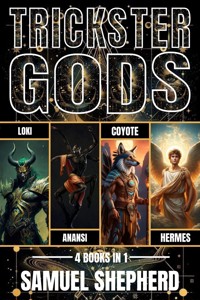
Trickster Gods: Loki, Anansi, Coyote & Hermes is your ultimate guide to four of the most fascinating and unpredictable figures in mythology. These gods of mischief and innovation challenge the rules of their worlds and ours, revealing lessons about resilience, creativity, and the human condition. This four-book series takes you on a journey through time, culture, and mythology to explore how these legendary tricksters shaped their stories—and how their stories can shape you.
🔮
What’s Inside?
Each book delves into the life and legacy of one iconic trickster god, blending thrilling stories, cultural insights, and timeless wisdom.
📖 Book 1: Loki’s Chaos: Unveiling the Norse God of Mischief
Step into the icy world of Norse mythology, where Loki, the ultimate shapeshifter, dances between hero and villain. From crafting divine weapons to orchestrating Ragnarök, Loki’s unpredictable schemes reveal the power of disruption to create and destroy. Learn why chaos isn’t just destructive—it’s essential for growth. ❄️⚡
📖 Book 2: Anansi’s Web: The Wisdom of the Trickster Spider
Travel to the vibrant traditions of West Africa and the Caribbean, where Anansi spins tales of wit and wisdom. 🕷️ Through his clever tricks, he brings stories, knowledge, and laughter to humanity, showing how adaptability and resilience can overcome even the greatest obstacles. 🌍🎭
📖 Book 3: Coyote’s Journey: The Shaping of the Natural and Supernatural World
In the vast landscapes of Native American mythology, Coyote’s mischief creates the rivers, mountains, and animals of the world. Both a creator and destroyer, he reminds us of life’s imperfections and the beauty hidden in chaos. 🌾🐺 From epic blunders to profound lessons, Coyote’s journey is a wild ride through the heart of creation. 🌄🔥
📖 Book 4: Hermes Unbound: The Messenger’s Legacy of Cunning and Communication
Fly with Hermes, the Greek god of speed, who bridges Olympus, Earth, and the underworld. His cleverness as a negotiator, thief, and messenger makes him the ultimate mediator in a world of gods and mortals. Learn how communication and adaptability are the keys to navigating life’s challenges. 🪶⚡🗣️
✨
Why Read
Trickster Gods
?
- 🌍 A Global Journey Through Mythology: From the icy north to tropical West Africa, Native American plains, and the heights of Olympus, this series explores the rich diversity of cultural storytelling.
- 🧠 Timeless Wisdom for Today: These stories offer more than entertainment—they provide insights into adaptability, creativity, and resilience.
- 😂 Mischief, Laughter, and Chaos: Whether you’re drawn to Loki’s daring schemes, Anansi’s clever tricks, Coyote’s wild blunders, or Hermes’ smooth-talking charm, you’ll find humor and humanity in every page.
Who Is This Book For?
- ✨ Mythology Lovers: Perfect for anyone fascinated by ancient stories and timeless archetypes.
- 🎨 Creatives and Thinkers: Discover how tricksters inspire innovation, challenge norms, and fuel creativity.
- 🌟 Seekers of Wisdom: If you enjoy finding profound lessons in unexpected places, these tricksters are your guides.
🌟 Join the Trickster’s Dance!
Let Trickster Gods: Loki, Anansi, Coyote & Hermes take you on a thrilling journey where chaos meets creativity, and mischief sparks transformation. Whether you’re laughing at Loki’s antics, marveling at Anansi’s wisdom, navigating Coyote’s unpredictable path, or racing alongside Hermes, this series will leave you inspired, entertained, and ready to embrace life’s twists and turns.
📖✨ Available now! Click below to order your copy and uncover the secrets of the trickster gods today. 🕸️🔥🐺⚡
Das E-Book können Sie in Legimi-Apps oder einer beliebigen App lesen, die das folgende Format unterstützen:
Veröffentlichungsjahr: 2025
Ähnliche











TRICKSTER GODS
LOKI, ANANSI, COYOTE & HERMES
4 BOOKS IN 1
BOOK 1
LOKI'S CHAOS: UNVEILING THE NORSE GOD OF MISCHIEF
BOOK 2
ANANSI'S WEB: THE WISDOM OF THE TRICKSTER SPIDER
BOOK 3
COYOTE'S JOURNEY: THE SHAPING OF THE NATURAL AND SUPERNATURAL WORLD
BOOK 4
HERMES UNBOUND: THE MESSENGER'S LEGACY OF CUNNING AND COMMUNICATION
SAMUEL SHEPHERD
Copyright © 2025 by Samuel Shepherd
All rights reserved. No part of this book may be reproduced or transmitted in any form or by any means, electronic or mechanical, including photocopying, recording, or by any information storage and retrieval system, without permission in writing from the publisher.
Published by Samuel Shepherd
Library of Congress Cataloging-in-Publication Data
ISBN 978-1-83938-911-5
Cover design by Rizzo
Disclaimer
The contents of this book are based on extensive research and the best available historical sources. However, the author and publisher make no claims, promises, or guarantees about the accuracy, completeness, or adequacy of the information contained herein. The information in this book is provided on an "as is" basis, and the author and publisher disclaim any and all liability for any errors, omissions, or inaccuracies in the information or for any actions taken in reliance on such information.
The opinions and views expressed in this book are those of the author and do not necessarily reflect the official policy or position of any organization or individual mentioned in this book. Any reference to specific people, places, or events is intended only to provide historical context and is not intended to defame or malign any group, individual, or entity.
The information in this book is intended for educational and entertainment purposes only. It is not intended to be a substitute for professional advice or judgment. Readers are encouraged to conduct their own research and to seek professional advice where appropriate.
Every effort has been made to obtain necessary permissions and acknowledgments for all images and other copyrighted material used in this book. Any errors or omissions in this regard are unintentional, and the author and publisher will correct them in future editions.
BOOK 1 - LOKI'S CHAOS: UNVEILING THE NORSE GOD OF MISCHIEF
Introduction
Chapter 1: The Trickster's Origins: From Giant to God
Chapter 2: Master of Deception: Loki’s Cunning and Schemes
Chapter 3: Shape-Shifter Supreme: The Many Forms of Loki
Chapter 4: Ties That Bind: Loki’s Relationship with the Aesir
Chapter 5: The Gifts of the Dwarves: Loki’s Role in Crafting the Divine Treasures
Chapter 6: The Blood Brother: Odin and Loki’s Complex Bond
Chapter 7: The Punisher and the Punished: Loki’s Feuds and Consequences
Chapter 8: The Catalyst of Ragnarök: Loki’s Betrayal and Prophecy
Chapter 9: The Legacy of Chaos: Loki’s Impact on Norse Mythology
Chapter 10: Trickster Reimagined: Loki’s Role in Modern Culture
BOOK 2 - ANANSI'S WEB: THE WISDOM OF THE TRICKSTER SPIDER
Chapter 1: Weaving the Web: Anansi’s Origins in West African Mythology
Chapter 2: The Spider's Cunning: Outwitting Gods and Mortals
Chapter 3: The Keeper of Stories: Anansi and the Gift of Knowledge
Chapter 4: Lessons in Trickery: Morality and Mischief in Anansi’s Tales
Chapter 5: The Web of Power: Anansi’s Role in Social and Spiritual Hierarchies
Chapter 6: Crossing Oceans: Anansi’s Journey to the Caribbean
Chapter 7: A Legacy of Laughter: Anansi in Folklore and Oral Tradition
Chapter 8: Trickster and Teacher: Anansi’s Lessons for Survival
Chapter 9: Threads of Resilience: Anansi as a Symbol of Resistance
Chapter 10: Anansi Reimagined: The Spider Trickster in Modern Culture
BOOK 3 - COYOTE'S JOURNEY: THE SHAPING OF THE NATURAL AND SUPERNATURAL WORLD
Chapter 1: The Eternal Wanderer: Coyote’s Origins in Native American Mythology
Chapter 2: Creator and Destroyer: Coyote’s Role in Shaping the World
Chapter 3: The Trickster's Tales: Stories of Mischief and Morality
Chapter 4: Balancing Chaos: Coyote as a Force of Nature
Chapter 5: The Fool’s Wisdom: Lessons Hidden in Coyote’s Folly
Chapter 6: Voices of the Ancestors: Coyote’s Connection to the Spirit World
Chapter 7: Bridging Worlds: Coyote’s Role in Mediating the Human and Divine
Chapter 8: Survival Through Cleverness: Coyote as a Symbol of Adaptability
Chapter 9: A Howl in the Night: Coyote’s Presence in Storytelling Across Tribes
Chapter 10: Coyote Today: The Trickster’s Influence in Modern Culture and Media
BOOK 4 - HERMES UNBOUND: THE MESSENGER'S LEGACY OF CUNNING AND COMMUNICATION
Chapter 1: Born to Fly: Hermes’ Origins in Greek Mythology
Chapter 2: The God of Boundaries: Mediating Heaven, Earth, and the Underworld
Chapter 3: The Great Messenger: Hermes as Zeus’s Trusted Envoy
Chapter 4: The Art of the Deal: Hermes, Commerce, and Thievery
Chapter 5: Tricks and Triumphs: Hermes’ Cunning and Clever Deceptions
Chapter 6: Guiding the Lost: Hermes’ Role as Psychopomp in the Underworld
Chapter 7: The Inventor’s Touch: Hermes’ Contributions to Music and Craft
Chapter 8: Bridging the Gap: Hermes as the God of Communication and Diplomacy
Chapter 9: Myth in Motion: Hermes’ Adventures and Transformations
Chapter 10: From Olympus to the Modern World: Hermes’ Enduring Legacy
Conclusion
Introduction
Across cultures and centuries, the figure of the trickster has captivated storytellers and audiences alike. Mischievous, cunning, and unpredictable, tricksters stand at the crossroads of chaos and creation, challenging the boundaries of societal norms and the rigidity of divine order. They disrupt the world not out of malice but to provoke transformation, offering lessons about resilience, ingenuity, and the complexities of life. Trickster gods embody this duality, moving freely between worlds, crafting schemes that unsettle and inspire, and leaving their indelible mark on mythologies that have shaped civilizations. This book, Trickster Gods: Loki, Anansi, Coyote & Hermes, delves into the lives and legacies of four of the most fascinating tricksters from mythology. Each of these gods is a master of disruption and ingenuity, wielding their wits to reshape the cosmos, navigate the human condition, and bridge the mortal and divine. Through their stories, we uncover not only the chaos they unleash but also the profound truths they reveal about humanity, nature, and the divine.
Book 1: Loki’s Chaos: Unveiling the Norse God of Mischief begins in the frostbitten landscapes of Norse mythology, where Loki dances between ally and adversary. A shapeshifter and a schemer, Loki’s deeds bring both calamity and innovation to the gods of Asgard. From crafting tools of power to setting the stage for Ragnarök, Loki’s role as a disruptor highlights the inevitability of change and the necessity of chaos in maintaining balance.
Book 2: Anansi’s Web: The Wisdom of the Trickster Spider spins its tale from the vibrant oral traditions of West Africa and the Caribbean. Anansi, the clever spider, is a master of storytelling and deception, teaching humans how to use their wits to navigate a world rife with challenges. Through his cunning, Anansi brings stories, wisdom, and laughter to humanity, embodying the resilience of cultures that thrive through adaptation and creativity.
Book 3: Coyote’s Journey: The Shaping of the Natural and Supernatural World ventures into the expansive landscapes of Native American mythology, where Coyote’s tricks and transformations shape the world itself. Both a creator and a destroyer, Coyote straddles the line between humor and catastrophe, reminding us of the interconnectedness of life, the necessity of imperfection, and the lessons hidden in chaos.
Book 4: Hermes Unbound: The Messenger’s Legacy of Cunning and Communication follows the swift-footed Greek god who bridges Olympus, Earth, and the underworld. As a patron of travelers, commerce, and thieves, Hermes embodies adaptability and eloquence, crafting a legacy built on ingenuity and the art of negotiation. His role as a guide and mediator reflects the timeless need for connection, movement, and understanding.
Together, these four trickster gods reveal the enduring power of myth to explore universal themes of disruption, adaptability, and transformation. Their stories transcend the boundaries of time and geography, speaking to the shared human experience of navigating a world that is as unpredictable as it is full of potential. Whether they appear as gods, animals, or messengers, these tricksters challenge us to question, to adapt, and to embrace the chaos that shapes our lives. As you embark on this journey through their tales, prepare to laugh, marvel, and perhaps even uncover the trickster within yourself.
BOOK 1
LOKI'S CHAOS
UNVEILING THE NORSE GOD OF MISCHIEF
SAMUEL SHEPHERD
Chapter 1: The Trickster's Origins: From Giant to God
Loki's origins in Norse mythology are as enigmatic as the character himself, shrouded in complexity and marked by his dual nature as both a giant and a god. Born to the giant Fárbauti and the goddess Laufey, Loki occupies a unique position in the pantheon, standing at the intersection of two worlds. His parentage, a blend of frost giant lineage and divine association, sets the stage for the ambiguity that defines his character throughout mythological tales. This hybrid origin allows Loki to navigate the realms of gods and giants with ease, though he is never fully trusted by either side. His actions, both ingenious and destructive, reflect his liminal status, existing between order and chaos, creation and destruction.
The significance of Loki's giant heritage cannot be understated. Giants, or Jötnar, in Norse mythology represent primordial forces of nature and chaos, often opposing the Aesir gods who strive to establish order. Loki, being born of a frost giant father, inherits this connection to the chaotic, untamed elements of existence. Yet, his mother Laufey is portrayed as gentle and nurturing, a stark contrast to the destructive nature typically attributed to giants. This duality in his lineage manifests in Loki's personality, enabling him to embody both the destructive and creative aspects of the cosmos. He defies categorization, operating as an outsider within the structured hierarchy of the gods, even as he becomes Odin’s blood brother and a key figure in Asgard.
Loki’s integration into the Aesir is as perplexing as his origins. Unlike other gods, who typically earn their place through feats of strength, wisdom, or lineage, Loki's entry into the divine realm seems to rely on his cunning and charisma. His role as Odin's blood brother elevates him to a position of influence and trust, despite his giant heritage and inherently mischievous nature. This bond between Odin and Loki is deeply symbolic, representing the necessity of balancing order and chaos to maintain cosmic equilibrium. Loki's allegiance, however, remains fluid, as he frequently shifts between aiding and undermining the gods, depending on his whims or personal agenda.
The early myths portray Loki as a clever and resourceful ally to the Aesir, often using his wit to solve problems that brute force cannot. For instance, in the tale of Sif’s golden hair, Loki’s mischief sets the conflict in motion, but his ingenuity ultimately leads to the creation of some of the most powerful treasures of the gods, including Mjölnir, Thor's iconic hammer. This narrative highlights Loki’s complex role as both a disruptor and a facilitator of progress. His actions often bring chaos, but they also yield benefits that the gods would not have attained otherwise. This duality reinforces his position as a liminal figure, essential to the mythological framework despite his untrustworthy nature.
Loki’s ability to shape-shift further emphasizes his role as a boundary-crosser, both literally and figuratively. Whether transforming into a fly, a horse, or an elderly woman, Loki’s capacity to change forms enables him to infiltrate spaces and situations inaccessible to others. This talent is both a reflection of his trickster identity and a symbol of his fluidity within the rigid structures of Asgardian society. Shape-shifting also underscores Loki’s connection to the natural world, a trait he shares with his giant kin. His transformations often serve as tools for both deception and survival, allowing him to manipulate events to his advantage while eluding the consequences of his actions.
Despite his integration into the divine realm, Loki’s giant lineage remains a point of tension. The gods, particularly Thor, often view him with suspicion and disdain, treating him as an outsider even as they rely on his cunning. This ambivalence is mirrored in Loki’s behavior, as he alternates between acts of loyalty and betrayal. His mischief is not always malicious; at times, it serves to challenge the gods and expose their flaws. Loki’s provocations force the Aesir to confront their own limitations, highlighting the vulnerability and imperfection within their seemingly invincible ranks. Through his actions, Loki serves as a catalyst for growth and transformation, driving the narrative of Norse mythology forward.
Loki’s origins as both a giant and a god are central to understanding his role in the mythological landscape. He is a bridge between opposing forces, embodying the chaos of the giants and the structured power of the gods. This duality allows him to act as a mediator, a disruptor, and an agent of change, ensuring that the delicate balance of the cosmos is constantly in flux. As a trickster, Loki’s unpredictability keeps the gods vigilant, reminding them that their dominion is neither absolute nor eternal. His unique heritage, combined with his cunning and adaptability, makes him an indispensable figure in the myths, one who defies expectations and challenges the status quo at every turn.
Chapter 2: Master of Deception: Loki’s Cunning and Schemes
Loki's reputation as the master of deception in Norse mythology stems from his unparalleled ability to manipulate, outwit, and deceive both gods and mortals. His cunning schemes and quick thinking are central to many of the myths, showcasing his intelligence and resourcefulness, as well as his willingness to exploit others for his own gain or amusement. Loki’s deceptions are not confined to acts of malice; they often reveal the flaws and vulnerabilities of the gods themselves, forcing them to confront challenges that would otherwise go unresolved. His role as the trickster figure is deeply tied to his ability to navigate complex situations with cleverness and guile, often creating chaos in the process.
One of the most famous examples of Loki’s cunning is his involvement in the theft and subsequent replacement of Sif’s golden hair. Loki, in a moment of mischief, cuts off Sif’s hair, much to the fury of her husband, Thor. When confronted, Loki does not deny his actions but instead promises to rectify the situation. Rather than merely apologizing, he orchestrates a complex scheme to have the dwarves craft new, golden hair for Sif, as well as other treasures for the gods, including Thor’s hammer, Mjölnir. This incident highlights Loki’s skill in turning a dire situation to his advantage. While his actions initially cause strife, his clever manipulation of the dwarves results in the gods receiving items of immense value, underscoring his ability to balance destruction with creation.
Loki’s mastery of deception is further demonstrated in the tale of the wall built around Asgard. When a mysterious builder offers to construct an impenetrable wall in exchange for the goddess Freyja, the sun, and the moon, the gods agree to the terms only after Loki assures them that the task is impossible within the stipulated time. However, the builder, aided by his powerful stallion Svaðilfari, makes swift progress, threatening to complete the wall ahead of schedule. In a moment of desperation, the gods turn to Loki to sabotage the construction. Transforming himself into a mare, Loki lures Svaðilfari away, effectively halting the builder’s progress. Though his actions result in the birth of Sleipnir, Odin’s eight-legged steed, Loki once again proves his ability to outmaneuver even the most capable opponents.
Loki’s cunning is not limited to grand schemes; he excels in verbal deception and manipulation as well. His sharp wit and silver tongue enable him to navigate difficult situations and evade blame. During the feast of Ægir, known as Lokasenna, Loki insults each of the gods, exposing their hypocrisies and weaknesses in a calculated display of verbal dexterity. Though his taunts lead to his eventual capture and punishment, the episode showcases Loki’s ability to wield words as weapons, turning them into tools of chaos and disruption. His insults often cut to the core of the gods’ insecurities, revealing truths that they would rather keep hidden.




