


4,99 €
Mehr erfahren.
- Herausgeber: Samuel Shepherd
- Kategorie: Geisteswissenschaft
- Sprache: Englisch
📚✨
Discover the Myths, Power, and Legends of the Roman Gods ✨📚
Step into a world of divine power, epic battles, and ancient mysteries with
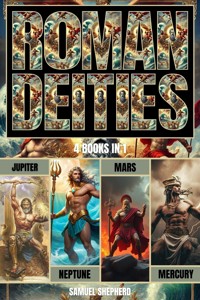
Roman Deities: Jupiter, Neptune, Mars, and Mercury—a captivating four-book collection that brings the gods of ancient Rome to life! 🏛️⚡🌊🗡️💨
🔥
What Awaits You in This Legendary Journey?
Dive deep into the lives, myths, and legacies of four of Rome’s most powerful gods. Each book unveils their stories, their dominions, and their timeless impact on Roman culture and history. Whether you’re a mythology enthusiast, a history lover, or simply fascinated by the epic tales of gods and mortals, this collection is your gateway to understanding the heart of the Roman pantheon.
⚡
Book 1 - Jupiter: King of Gods, Ruler of the Skies
Jupiter reigns supreme as the almighty ruler of Olympus. Wielding his thunderbolt, he governs the heavens with unmatched authority and divine justice. 🪶⚡ Explore the tales of his power, his rule over fate, and the way he shaped the balance of the universe. Jupiter is the symbol of sovereignty, order, and the skies above.
🌊
Book 2 - Neptune: Lord of the Deep, Master of the Seas
Plunge into the depths of the oceans and discover Neptune’s dual nature as both a giver of life and a harbinger of destruction. 🌊🌩️ With his mighty trident, Neptune commands the seas and shakes the earth. Witness his storms, his mysteries, and his influence over sailors, explorers, and empires.
🗡️
Book 3 - Mars: Blood and Honor – The God of War
Feel the pulse of the battlefield as Mars, the god of war, marches into action. 🛡️🔥 The spirit of conquest and protection, Mars inspires bravery, strength, and the founding of Rome itself. Honor, bloodshed, and valor define his tales as you explore the god who embodies Rome’s martial spirit.
💨
Book 4 - Mercury: The Swift Messenger of Gods and Trade
Race through the skies with Mercury, the messenger of the gods, the patron of travelers, merchants, and thieves. 🏹💫 His speed, wit, and adaptability make him the guide of souls and the master of communication and commerce. Discover how Mercury connected worlds and shaped the flow of trade and fortune.
✨
Why You’ll Love This Collection
✅
Engaging Narratives: Each book tells immersive stories about the gods, their adventures, and their influence over the world.
✅
Rich Mythology: Deep insights into Roman beliefs, values, and history through their most iconic deities.
✅
Stunning Symbolism: Explore themes of power, nature, war, and human ingenuity that resonate across time.
✅
Perfect for Enthusiasts: Whether you’re a mythology student, a history buff, or a fan of ancient legends, these books offer something unforgettable.
🌟
A Timeless Gift for Lovers of History and Mythology 🌟
This beautifully crafted collection is ideal for anyone who dreams of exploring the ancient world. Share the magic and grandeur of Rome’s divine stories with friends, family, or students. 📖🏺
🛒
Ready to Embark on the Journey?
📩
Order Now and bring home the legends of Jupiter, Neptune, Mars, and Mercury—gods whose stories still inspire awe and wonder. Dive into the myths that shaped an empire, and let the timeless power of Roman deities spark your imagination. ✨⚡🌊🛡️💨
👉
Don’t Miss Out—Claim Your Copy Today! 👈
📚 Roman Deities: Jupiter, Neptune, Mars, and Mercury—Your Gateway to Ancient Power. 🔥
Das E-Book können Sie in Legimi-Apps oder einer beliebigen App lesen, die das folgende Format unterstützen:
Veröffentlichungsjahr: 2024
Ähnliche















ROMAN DEITIES
JUPITER, NEPTUNE, MARS AND MERCURY
4 BOOKS IN 1
BOOK 1
JUPITER: KING OF GODS, RULER OF THE SKIES
BOOK 2
NEPTUNE: LORD OF THE DEEP, MASTER OF THE SEAS
BOOK 3
MARS: BLOOD AND HONOR – THE GOD OF WAR
BOOK 4
MERCURY: THE SWIFT MESSENGER OF GODS AND TRADE
SAMUEL SHEPHERD
Copyright © 2024 by Samuel Shepherd
All rights reserved. No part of this book may be reproduced or transmitted in any form or by any means, electronic or mechanical, including photocopying, recording, or by any information storage and retrieval system, without permission in writing from the publisher.
Published by Samuel Shepherd
Library of Congress Cataloging-in-Publication Data
ISBN 978-1-83938-907-8
Cover design by Rizzo
Disclaimer
The contents of this book are based on extensive research and the best available historical sources. However, the author and publisher make no claims, promises, or guarantees about the accuracy, completeness, or adequacy of the information contained herein. The information in this book is provided on an "as is" basis, and the author and publisher disclaim any and all liability for any errors, omissions, or inaccuracies in the information or for any actions taken in reliance on such information.
The opinions and views expressed in this book are those of the author and do not necessarily reflect the official policy or position of any organization or individual mentioned in this book. Any reference to specific people, places, or events is intended only to provide historical context and is not intended to defame or malign any group, individual, or entity.
The information in this book is intended for educational and entertainment purposes only. It is not intended to be a substitute for professional advice or judgment. Readers are encouraged to conduct their own research and to seek professional advice where appropriate.
Every effort has been made to obtain necessary permissions and acknowledgments for all images and other copyrighted material used in this book. Any errors or omissions in this regard are unintentional, and the author and publisher will correct them in future editions.
BOOK 1 - JUPITER: KING OF GODS, RULER OF THE SKIES
Introduction
Chapter 1: The Birth of Jupiter
Chapter 2: The War of the Titans
Chapter 3: The Thunderbolt’s Power
Chapter 4: The Throne of Olympus
Chapter 5: Jupiter and the Mortal World
Chapter 6: Trials of Justice and Judgment
Chapter 7: The Loves of Jupiter
Chapter 8: Signs in the Skies
Chapter 9: Rivalries of the Gods
Chapter 10: The Legacy of Jupiter
BOOK 2 - NEPTUNE: LORD OF THE DEEP, MASTER OF THE SEAS
Chapter 1: The Birth of Neptune
Chapter 2: The Division of the Universe
Chapter 3: The Trident’s Power
Chapter 4: Ruler of the Oceans
Chapter 5: Tempests and Earthquakes
Chapter 6: Neptune and the Sea Creatures
Chapter 7: Mortal Sailors and Sacred Waters
Chapter 8: Rivalry with Athena
Chapter 9: Neptune’s Wrath and Mercy
Chapter 10: The Depths of Neptune’s Legacy
BOOK 3 - MARS: BLOOD AND HONOR – THE GOD OF WAR
Chapter 1: The Birth of Mars
Chapter 2: The Warrior’s Calling
Chapter 3: Mars and the Founding of Rome
Chapter 4: The Sons of Mars
Chapter 5: The Sacred Spear
Chapter 6: Mars in Battle
Chapter 7: Festivals of War
Chapter 8: The Lovers of Mars
Chapter 9: Honor and Bloodshed
Chapter 10: The Eternal Guardian of Rome
BOOK 4 - MERCURY: THE SWIFT MESSENGER OF GODS AND TRADE
Chapter 1: The Birth of Mercury
Chapter 2: The Trickster’s First Deeds
Chapter 3: The Caduceus and Its Power
Chapter 4: Messenger of the Gods
Chapter 5: Patron of Travelers and Thieves
Chapter 6: Mercury and the Mortal World
Chapter 7: The God of Commerce and Wealth
Chapter 8: Tales of Deception and Wit
Chapter 9: Mercury’s Role in the Underworld
Chapter 10: The Legacy of the Swift One
Conclusion
Introduction
The gods of ancient Rome were more than figures of myth; they were living symbols of power, order, chaos, and life itself. Through their stories, the Romans sought to explain the mysteries of the natural world, the forces that governed their existence, and the ideals that shaped their civilization. Jupiter, Neptune, Mars, and Mercury were among the most revered of these deities, their dominions stretching across the heavens, the seas, the battlefields, and the trade routes that defined the Roman Empire’s ambitions and achievements. This book delves into the essence of these four gods, exploring their significance, their roles in mythology, and their lasting impact on the culture and spirit of ancient Rome.
In Book 1, Jupiter: King of Gods, Ruler of the Skies, we ascend to the heights of Olympus to explore the might of Jupiter, the supreme deity of the Roman pantheon. With his thunderbolts and commanding presence, Jupiter embodied sovereignty, justice, and divine authority. As ruler of the heavens, his decisions shaped the fates of gods and mortals, while his power symbolized order and the grandeur of the Roman state. Jupiter’s stories reveal a ruler who was both protector and judge, his influence extending from the skies to the hearts of those who worshipped him.
Book 2, Neptune: Lord of the Deep, Master of the Seas, plunges into the depths of the oceans to uncover the dual nature of Neptune, the god who ruled the vast, untamable waters. Neptune was both a bringer of life and a force of destruction, his trident capable of stirring storms and shaking the earth. To the Romans, whose empire was bound to the sea through trade and conquest, Neptune was a god to be revered and feared. This section explores the myths, power, and mysteries that surrounded the god of the deep, revealing his vital role in the ancient imagination.
In Book 3, Mars: Blood and Honor – The God of War, we march to the rhythms of conflict and conquest under the watchful eye of Mars, the god who shaped Rome’s martial identity. Mars was not merely a figure of violence but a symbol of honor, discipline, and protection. As the father of Romulus, the legendary founder of Rome, Mars stood at the heart of the Roman spirit, guiding its people to greatness through battle and sacrifice. His tales of war, glory, and bloodshed capture the essence of a civilization forged through struggle and triumph.
Book 4, Mercury: The Swift Messenger of Gods and Trade, takes us on a journey of movement, communication, and transformation as we explore the role of Mercury, the swift and cunning god of commerce, travel, and wit. Mercury’s influence stretched far beyond the heavens, reaching into the mortal world as a patron of merchants, travelers, and thieves alike. His fluidity and adaptability made him a figure of innovation and connection, qualities that defined Rome’s thriving trade networks and its ability to bridge cultures and ideas.
Together, these four deities form a tapestry of myths that reflect the heart of Roman belief and ambition. Each god represents a fundamental force that shaped not only the natural world but the very identity of the Roman people. Through thunder and sky, oceans and storms, war and valor, trade and cunning, Jupiter, Neptune, Mars, and Mercury ruled over the elements and ideals that defined an empire. This book invites readers to explore their stories, their legacies, and the ways in which their influence shaped the course of history. From the heights of Jupiter’s celestial throne to the depths of Neptune’s oceans, from the fire of Mars’ battlefields to the swift journeys of Mercury’s paths, the myths of these gods stand as timeless testaments to the power of divine forces and the enduring strength of the Roman spirit.
BOOK 1
JUPITER
KING OF GODS, RULER OF THE SKIES
SAMUEL SHEPHERD
Chapter 1: The Birth of Jupiter
The birth of Jupiter begins with a tale of power, survival, and rebellion in the earliest days of the cosmos. It was a time before the gods as they are known came into prominence, when the universe was dominated by the primordial deities and ruled by the Titans. At the center of this story is Cronus, the youngest of the Titans, who had risen to power after overthrowing his own father, Uranus, the sky god. Cronus’ ascension to the throne of the cosmos was not without sacrifice, for Uranus had forewarned his son that he too would meet the same fate, dethroned by his offspring. The prophecy left Cronus in perpetual fear and paranoia, and his dread led to a cruel and desperate course of action.
Rhea, Cronus’ sister and consort, gave birth to their children one by one—Hestia, Demeter, Hera, Hades, and Poseidon. Yet Cronus, consumed by his fear of betrayal, swallowed each child the moment they were born. He believed that by consuming them, he would neutralize the threat of his progeny rising up against him. Rhea, helpless and heartbroken, watched as her husband devoured their children, one after the other, his power growing as her family was reduced to a prison within his body. Each child’s existence seemed to vanish, swallowed into darkness. The grief and torment grew unbearable for Rhea, but she dared not openly challenge Cronus, for the Titans’ might was unyielding.
When Rhea became pregnant for the sixth time, she resolved to save this child. Seeking counsel, she turned to Gaia, her mother, and Uranus, her fallen father. Together, they devised a plan to ensure the survival of the infant and to set in motion the eventual downfall of Cronus. When the time of her labor arrived, Rhea traveled in secret to a hidden cave on the island of Crete, far from Cronus’ watchful gaze. There, in the shadows of the earth and under the protection of nature itself, she gave birth to Jupiter, the child who would one day reshape the destiny of gods and mortals alike.
To deceive Cronus, Rhea wrapped a stone in swaddling clothes, shaping it to resemble a newborn child. She presented this false infant to Cronus, who, blinded by his paranoia, did not question the deception. Without hesitation, he seized the stone and swallowed it whole, believing that he had once again neutralized the threat of his progeny. In his arrogance, he did not notice the cries of a real child, hidden far away, in a land where his dominion did not yet reach. Jupiter, the infant god, remained safe on Crete, nurtured and shielded by the forces of the earth.
The cave that housed the infant god became sacred ground. There, Jupiter was raised in secrecy under the care of Amalthea, a nurturing goat whose milk sustained him. The Kouretes, a group of warrior-spirits loyal to Rhea, also played a role in his survival. They danced and clashed their weapons against their shields to drown out the cries of the infant Jupiter, ensuring that Cronus would never hear or discover his presence. The constant clamor of the Kouretes served as a protective veil, a wall of sound that guarded Jupiter’s existence and kept his father’s attention away from Crete.
As Jupiter grew, his strength and divinity began to manifest. The nurturing power of nature, combined with the energy of his lineage, gave him a strength that surpassed that of his father and his Titan kin. While Cronus sat atop his throne, oblivious to the forces gathering against him, Jupiter prepared for the confrontation that would shape the order of the cosmos. His birth and survival were not just acts of defiance but were the first steps in a rebellion that would bring about a new age, one in which the Titans would fall, and the gods of Olympus would rise to take their place.
Jupiter’s existence remained a secret until the moment was ripe for action. Protected by the elements, nourished by the divine, and hidden from the eyes of his father, the child destined to wield thunder and lightning grew into the god who would alter the universe forever. From the moment of his birth, his fate had been intertwined with the prophecy that Cronus sought to deny, and his survival marked the beginning of the end for the reign of the Titans. Rhea’s courage, Gaia’s wisdom, and the protection of the natural world ensured that the king of the gods would live to fulfill his destiny.




