


4,99 €
Mehr erfahren.
- Herausgeber: Samuel Shepherd
- Kategorie: Ratgeber
- Sprache: Englisch
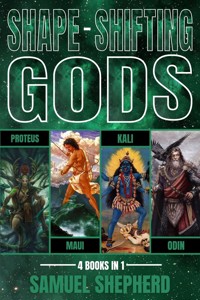
Shape-Shifting Gods: Proteus, Maui, Kali & Odin 🔥🔮🌊🌙
🌀
What if the gods could change their forms at will? What if transformation wasn’t just a power, but a way of life, a force that shaped the universe?
Across mythologies, certain deities stand apart—not because they are the strongest or the most feared, but because they are the most fluid, the most adaptable, the ones who refuse to be defined by a single identity.
Shape-Shifting Gods is a journey through the myths and legends of four such divine beings, each with their own mastery over transformation, deception, and rebirth.
🔥
Four Gods. Four Myths. One Timeless Truth.
💦
Book 1 – Proteus: The Ever-Changing Oracle of the Sea 🌊🔮
Proteus is a god of deep, hidden wisdom, but his knowledge is not given freely. He is the
Old Man of the Sea, the elusive oracle who changes form to escape those who would force him to reveal the future. From writhing serpents to raging lions, his transformations are his greatest defense, a symbol of the fluid nature of fate itself. Will those who seek his wisdom have the strength to hold on, or will he slip away like water through their fingers?
🌞
Book 2 – Maui the Trickster: Hero, Shapeshifter, and the Creator of Islands 🏝️🔥
Maui is the
divine rebel, the trickster whose clever mind reshapes the world itself. He slows the sun, steals fire from the gods, and raises entire islands from the sea. A master shapeshifter, he turns himself into birds, insects, and even the wind to outwit both gods and monsters alike. His transformations are not just survival—
they are revolution, acts of defiance against the limitations placed upon him. But even Maui, with all his cleverness, cannot escape fate forever.
💀
Book 3 – Kali: Goddess of Destruction, Transformation, and Rebirth 🖤🔥
Kali is both fearsome and motherly, the
goddess who dances on the edge of time itself. With her wild hair, bloodstained tongue, and necklace of skulls, she is the great destroyer, yet also the force that clears the way for new beginnings. She shifts between forms, from the nurturing mother to the unstoppable warrior, reminding all who worship her that
transformation is not a choice—it is inevitable. She does not kill for the sake of death, but to awaken those trapped in illusion, tearing away falsehoods until only truth remains.
🦉
Book 4 – Odin the Wanderer: The Shape-Shifting Seeker of Wisdom ⚔️🌪️
Odin is
not just a king, not just a warrior, but a trickster, a wanderer, a god of many faces. He rides into battle with wolves at his side, yet walks Midgard as a hooded old man, whispering riddles into the ears of kings. He sacrifices himself to himself, hanging from the great tree Yggdrasil to steal the wisdom of the runes. He becomes a bird, a snake, a shadow slipping through the nine realms, knowing that the true key to power is
never remaining the same.
🔥
Why Read This Book?
✔️ Explore the
most powerful shape-shifters in mythology 🌀
✔️ Experience epic
battles, riddles, trickery, and transformation ⚔️
✔️ Discover how these gods
mirror the human journey of change 🌍
✔️ A perfect read for lovers of
mythology, legend, and ancient wisdom 📖✨
🛒
Own the Power of Transformation!
If you are drawn to tales of divine rebellion, wisdom won through sacrifice, and the untamed power of gods who refuse to be bound,
Shape-Shifting Gods is your guide into a world where nothing stays the same.
🔥
Order your copy today and step into the realm of transformation! 🔥
Das E-Book können Sie in Legimi-Apps oder einer beliebigen App lesen, die das folgende Format unterstützen:
Veröffentlichungsjahr: 2025
Ähnliche
















SHAPE-SHIFTING GODS
PROTEUS, MAUI, KALI & ODIN
4 BOOKS IN 1
BOOK 1
PROTEUS: THE EVER-CHANGING ORACLE OF THE SEA
BOOK 2
MAUI THE TRICKSTER: HERO, SHAPESHIFTER, AND THE CREATOR OF ISLANDS
BOOK 3
KALI: GODDESS OF DESTRUCTION, TRANSFORMATION, AND REBIRTH
BOOK 4
ODIN THE WANDERER: THE SHAPE-SHIFTING SEEKER OF WISDOM
SAMUEL SHEPHERD
Copyright © 2025 by Samuel Shepherd
All rights reserved. No part of this book may be reproduced or transmitted in any form or by any means, electronic or mechanical, including photocopying, recording, or by any information storage and retrieval system, without permission in writing from the publisher.
Published by Samuel Shepherd
Library of Congress Cataloging-in-Publication Data
ISBN 978-1-83938-919-1
Cover design by Rizzo
Disclaimer
The contents of this book are based on extensive research and the best available historical sources. However, the author and publisher make no claims, promises, or guarantees about the accuracy, completeness, or adequacy of the information contained herein. The information in this book is provided on an "as is" basis, and the author and publisher disclaim any and all liability for any errors, omissions, or inaccuracies in the information or for any actions taken in reliance on such information.
The opinions and views expressed in this book are those of the author and do not necessarily reflect the official policy or position of any organization or individual mentioned in this book. Any reference to specific people, places, or events is intended only to provide historical context and is not intended to defame or malign any group, individual, or entity.
The information in this book is intended for educational and entertainment purposes only. It is not intended to be a substitute for professional advice or judgment. Readers are encouraged to conduct their own research and to seek professional advice where appropriate.
Every effort has been made to obtain necessary permissions and acknowledgments for all images and other copyrighted material used in this book. Any errors or omissions in this regard are unintentional, and the author and publisher will correct them in future editions.
BOOK 1 - PROTEUS: THE EVER-CHANGING ORACLE OF THE SEA
Introduction
Chapter 1: The Ancient Shapeshifter
Chapter 2: Master of the Tides
Chapter 3: The Reluctant Prophet
Chapter 4: The Many Faces of Proteus
Chapter 5: Wrestling with Fate
Chapter 6: Proteus and the Cosmic Order
Chapter 7: The Symbolism of Fluidity
Chapter 8: Beyond the Myths
Chapter 9: Shapeshifting in Ancient Religions
Chapter 10: Legacy of the Changing God
BOOK 2 - MAUI THE TRICKSTER: HERO, SHAPESHIFTER, AND THE CREATOR OF ISLANDS
Chapter 1: The Legend Begins
Chapter 2: The Trickster’s Gift
Chapter 3: Maui the Fisherman: Raising the Islands
Chapter 4: Capturing the Sun: A Battle for Time
Chapter 5: The Fire Thief: Stealing from the Gods
Chapter 6: Masters of Disguise: Maui’s Many Forms
Chapter 7: The Quest for Immortality
Chapter 8: Maui in Myth and Culture
Chapter 9: Shapeshifting Across Polynesia
Chapter 10: The Trickster’s Legacy
BOOK 3 - KALI: GODDESS OF DESTRUCTION, TRANSFORMATION, AND REBIRTH
Chapter 1: The Birth of Kali
Chapter 2: The Demon Slayer
Chapter 3: The Many Faces of the Dark Mother
Chapter 4: Dance of Destruction and Creation
Chapter 5: Blood, Sacrifice, and Devotion
Chapter 6: The Goddess and the Tantric Path
Chapter 7: Kali and the Power of Shakti
Chapter 8: Fear and Worship: Kali in Hindu Society
Chapter 9: The Eternal Cycle: Death, Transformation, and Rebirth
Chapter 10: Kali’s Legacy in the Modern World
BOOK 4 - ODIN THE WANDERER: THE SHAPE-SHIFTING SEEKER OF WISDOM
Chapter 1: The Allfather’s Many Faces
Chapter 2: The Sacrifice for Knowledge
Chapter 3: Master of Disguises
Chapter 4: Odin’s Animal Forms and Familiars
Chapter 5: The Runes and the Whispering Winds
Chapter 6: The God of War and Poetry
Chapter 7: The Wanderer’s Journey Through the Nine Realms
Chapter 8: Odin and the Shapeshifters of Norse Mythology
Chapter 9: The Prophecy of Ragnarok
Chapter 10: The Enduring Legacy of the Wise Trickster
Conclusion
Introduction
Throughout history, gods and spirits have taken many forms, embodying the mysteries of the natural world, the shifting tides of fate, and the ever-changing nature of existence itself. Some deities remain fixed in their identities, bound by singular domains of power, but others defy such constraints, moving freely between shapes, slipping between roles, becoming whatever they need to be. These are the gods who transform, the ones who refuse to be contained, the masters of deception, wisdom, creation, and destruction. They are Proteus, the enigmatic seer of the sea, Maui, the daring trickster who reshaped the islands, Kali, the fierce goddess of death and rebirth, and Odin, the relentless seeker of knowledge. Their power lies not just in their strength but in their ability to change, to defy expectation, to become something more than what they were before.
Shape-shifting is more than an illusion, more than a trick of the eye. It is a declaration of fluidity, a rejection of boundaries, a mastery over the forces of nature and destiny. In the myths of Proteus, transformation is a test, a challenge posed to those who seek wisdom, a reminder that knowledge is never easily obtained. In Maui’s legends, shape-shifting is a tool of rebellion and creation, a means of bending the laws of the universe to bring light and land to humanity. In the fearsome presence of Kali, transformation is not merely a power but an inevitability, the force of time itself, the cycle of destruction and renewal that none can escape. In Odin’s wandering, shape-shifting is the key to understanding, the path to wisdom, the means by which the god of war and poetry gathers secrets hidden beyond the grasp of lesser beings.
Across cultures and civilizations, these deities reveal the same essential truth—nothing is permanent. The world itself is in a constant state of transformation, the seasons shifting, the tides rising and falling, life emerging and fading away, only to return again. Those who embrace change wield power, and those who resist it find themselves broken by the forces they refuse to understand. The shape-shifting gods do not merely adapt to the world around them; they reshape it in their image, becoming forces of creation and destruction, wisdom and trickery, chaos and balance.
In this book, we will explore four such deities, each from a different corner of the world, each with a unique understanding of what it means to change. Proteus, the ancient Greek sea-god, refuses to be captured, shifting endlessly to escape those who would force him to reveal the secrets of fate. Maui, the bold Polynesian hero, defies the gods themselves, using his wit and transformation to slow the sun, steal fire, and raise the islands from the ocean’s depths. Kali, the terrifying yet nurturing mother of Hindu tradition, dances through destruction, tearing down the old so that the new may rise in its place. Odin, the wise and warlike Allfather of Norse mythology, wears countless faces, moving between realms, gathering wisdom through disguise, shaping the fate of gods and men alike with the knowledge he claims.
Each of these deities holds within them the power of transformation, not merely as a physical act but as a cosmic truth. They are not bound by a single identity, a single destiny, a single purpose. They show us that to change is to grow, that to embrace transformation is to wield power over the forces that shape reality itself. Through their stories, we see the endless possibilities of existence, the ever-shifting dance of the universe, the way that even the divine are not immune to the necessity of change.
To study these gods is to study transformation itself, to understand the forces that move not just through myth but through life, through history, through the fabric of the world we live in. The stories of Proteus, Maui, Kali, and Odin are not just ancient tales but reflections of the eternal truth that to shape-shift is to survive, to transcend, to become something greater than what came before.
BOOK 1
PROTEUS
THE EVER-CHANGING ORACLE OF THE SEA
SAMUEL SHEPHERD
Chapter 1: The Ancient Shapeshifter
The concept of the ancient shapeshifter has existed in mythologies and folklore for millennia, embodying transformation, fluidity, and the power of change. From the earliest civilizations, gods, spirits, and supernatural beings have been depicted as having the ability to shift their forms at will, assuming the likeness of animals, humans, or even elements of nature. These beings often used their shape-changing abilities to deceive, protect, guide, or manipulate, and their stories reflect humanity’s fascination with the fluid boundaries between identities, roles, and realms. The Greeks spoke of Proteus, the old man of the sea, a being capable of shifting into myriad forms to evade capture, only yielding his wisdom to those persistent enough to hold onto him. He did not shift for pleasure or amusement but rather as a defense mechanism, a symbol of the elusive nature of truth and the difficulty in obtaining it. Those who sought his counsel had to endure his transformations, proving themselves worthy before he relented and revealed his prophetic insights.
In Norse mythology, Odin, the wise and enigmatic Allfather, frequently assumed disguises to travel the realms, seeking wisdom and knowledge beyond the confines of Asgard. He became an old wanderer, a raven, or even a serpent, using deception and transformation as tools to navigate the complexities of fate and the cosmos. His shape-shifting was not merely for survival but a demonstration of his relentless pursuit of enlightenment, embodying the idea that wisdom comes to those who are willing to embrace different perspectives and experiences. The ability to change shape was not limited to gods alone, as various creatures and mortals also possessed this gift, sometimes as a blessing and other times as a curse. The werewolves of ancient Europe were believed to have been cursed men, condemned to transform under the full moon and lose their humanity, while the selkies of Celtic legend shed their sealskins to become human, only to return to the sea when their true nature called them back.
Shape-shifting was often linked to the manipulation of natural forces, with many traditions associating transformation with water, fire, and the elements. In Hindu mythology, the goddess Kali could assume terrifying forms to battle demons, her appearance shifting between the fearsome destroyer of evil and the nurturing mother of time and change. She embodied destruction and rebirth, revealing that transformation was not merely an external alteration but a profound metaphysical process tied to existence itself. Similarly, in Polynesian traditions, the demigod Maui possessed the power to change shape, using his abilities to slow the sun, fish islands from the sea, and outwit both gods and mortals alike. His transformations allowed him to challenge authority, bend the rules of nature, and reshape the world according to his will.
In many cultures, shapeshifters were associated with deception and trickery, figures whose changing forms allowed them to manipulate events and confound expectations. The trickster god Loki of Norse mythology could shift into any creature he pleased, using his abilities to cause chaos among the gods, sometimes for his own amusement and other times as part of a grander scheme. In West African and Caribbean traditions, Anansi the spider could shift forms to outwit his opponents, proving that intelligence and adaptability were often greater weapons than brute strength. In other myths, shape-shifting served as a means of punishment, transformation being inflicted upon those who defied the gods or broke sacred laws. Greek myths are filled with mortals turned into animals or inanimate objects, such as Lycaon, who was cursed by Zeus to become a wolf, or Arachne, transformed into a spider after challenging Athena. The act of changing form, in these cases, was not an ability to be harnessed but an irrevocable fate, a lesson in humility or divine retribution.
The perception of shapeshifters often depended on the context of their transformations, whether they were viewed as divine, heroic, mischievous, or cursed. Some figures wielded their transformations as symbols of power, like Zeus, who took the forms of animals to seduce mortal women, while others sought escape through transformation, such as Daphne, who became a laurel tree to flee Apollo. Many indigenous traditions saw shape-shifting as a bridge between the human and the spirit world, with shamans and spiritual leaders believed to be capable of assuming animal forms to commune with nature and the ancestors. The ability to shift between states of being, whether physical or spiritual, symbolized the interconnectedness of all life and the permeability of boundaries. The concept of transformation extended beyond individual beings to entire cultures, with stories of ancient cities lost to time, their people turned to stone, trees, or stars as a testament to the power of change. These myths reinforced the idea that nothing was fixed, that existence itself was a continuous cycle of becoming, an eternal state of flux where identity, form, and essence were fluid and ever-changing.
Chapter 2: Master of the Tides
The tides have long been regarded as forces beyond human control, a ceaseless movement dictated by unseen hands. In ancient mythology, deities and legendary beings were believed to command the tides, their influence stretching across the oceans, shaping the fates of sailors, civilizations, and even the land itself. The Greeks revered Proteus, the elusive sea god, whose mastery over the tides was not merely a function of his dominion over water but a representation of his deep connection to change and transformation. Like the tides that ebb and flow in an endless cycle, Proteus embodied the shifting nature of truth, revealing knowledge only to those persistent enough to hold onto him. He did not resist the pull of fate but instead embraced the rhythm of existence, allowing himself to be one with the tides, an eternal force of motion.
In Norse mythology, the ocean was ruled by Aegir, a god whose feasts were legendary and whose control over the waves could bring both fortune and ruin. The Vikings, masters of seafaring, knew that the tides were both friend and foe, carrying their ships to distant shores but also swallowing entire fleets in moments of fury. Aegir’s power was one of unpredictability, his hand unseen yet ever-present in the changing tides. The moon, believed by many ancient cultures to be the great orchestrator of the tides, was often linked to deities who wielded control over the ocean’s rise and fall. Selene, the Greek goddess of the moon, was said to guide the waters with her silver glow, while in Hindu traditions, Chandra, the lunar god, held sway over the rhythmic dance of the tides, binding the celestial with the terrestrial in an unbreakable cycle.




