


9,99 €
Mehr erfahren.
- Herausgeber: Parkstone International
- Kategorie: Geisteswissenschaft
- Sprache: Englisch
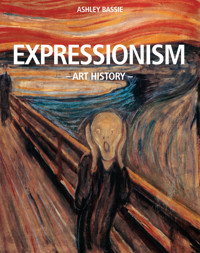
Max Beckmann, Otto Dix, George Grosz, Emil Nolde, E.L. Kirchner, Paul Klee, Franz Marc as well as the Austrians Oskar Kokoschka and Egon Schiele were among the generation of highly individual artists who contributed to the vivid and often controversial new movement in early 20th-century Germany and Austria: Expressionism. This publication introduces these artists and their work. The author, art historian Ashley Bassie, explains how Expressionist art led the way to a new, intense, evocative treatment of psychological, emotional and social themes of the early 20th-century. The book examines the developments of Expressionism and its key works, highlighting the often intensely subjective imagery and the aspirations and conflicts from which it emerged while focusing precisely on the artists of the movement.
Das E-Book können Sie in Legimi-Apps oder einer beliebigen App lesen, die das folgende Format unterstützen:
Seitenzahl: 57
Veröffentlichungsjahr: 2024
Ähnliche














Ashley Bassie
EXPRESSIONISM
© 2024, Confidential Concepts, Worldwide, USA
© 2024, Parkstone Press USA, New York
© Image-Barwww.image-bar.com
All rights reserved. No part of this may be reproduced or adapted without the permission of the copyright holder, throughout the world.
Unless otherwise specified, copyright on the works reproduced lies with the respective photographers. Despite intensive research, it has not always been possible to establish copyright ownership. Where this is the case, we would appreciate notification.
ISBN: 979-8-89405-007-2
Contents
The Amazing World Of Expressionism: Preface And What Is Expressionism?
Major Artists
Max Beckmann
Otto Dix
George Grosz
Wassily Kandinsky
Ludwig Kirchner
Paul Klee
Oskar Kokoschka
Franz Marc
Emil Nolde
Egon Schiele
List Of Illustrations
Max Pechstein,Seated Girl, 1910. Oil on canvas, 80 x 70 cm. Staatliche Museen zu Berlin, Nationalgalerie, Berlin.
The Amazing World Of Expressionism: Preface And What Is Expressionism?
Expressionism has meant different things at different times. In the sense we use the term today, certainly when we speak of “German Expressionism”, it refers to a broad, cultural movement that emerged from Germany and Austria in the early twentieth century. Yet Expressionism is complex and contradictory. It encompassed the liberation of the body as much as the excavation of the psyche. Within its motley ranks could be found political apathy, even chauvinism, as well as revolutionary commitment.
Ironically, it was first applied most often to non-German artists such as Gauguin, Cézanne, Matisse and Van Gogh. In practice, well up to the outbreak of the First World War, “Expressionism” was still a catch-all phrase for the latest modern, Fauviste, Futurist or Cubist art. The important Sonderbund exhibition staged in Cologne in 1912, for example, used the term to refer to the newest German painting together with international artists.
In Cologne though, the shift was already beginning. The exhibition organizers and most critics emphasized the affinity of the “Expressionism” of the German avant-garde with that of the Dutch Van Gogh and the guest of honour at the show, the Norwegian Edvard Munch. In so doing, they slightly played down the prior significance of French artists, such as Matisse, and steered the concept of Expressionism in a distinctly “Northern” direction. Munch himself was stunned when he saw the show. “There is a collection here of all the wildest paintings in Europe”, he wrote to a friend, “Cologne Cathedral is shaking to its very foundations”. More than geography though, this shift highlighted Expressionist qualities as lying not so much in innovative formal means for description of the physical world, but in the communication of a particularly sensitive, even slightly neurotic, perception of the world, which went beyond mere appearances. As in the work of Van Gogh and Munch, individual, subjective human experience was its focus. As it gathered momentum, one thing became abundantly clear – Expressionism was not a “style”. This helps to explain why curators, critics, dealers, and the artists themselves, could rarely agree on the use or meaning of the term.
Nonetheless, “Expressionism” gained wide currency across the arts in Germany and Austria. It was first applied to painting, sculpture and printmaking and a little later to literature, theatre and dance. It has been argued that while Expressionism’s impact on the visual arts was most successful, its impact on music was the most radical, involving elements such as dissonance and atonality in the works of composers (especially in Vienna) from Gustav Mahler to Alban Berg and Arnold Schoenberg. Finally, Expressionism infiltrated architecture, and its effects could even be discerned in the newest modern distraction – film.
Historians still disagree today on what Expressionism is. Many artists who now rank as quintessential Expressionists themselves rejected the label. Given the spirit of anti-academicism and fierce individualism that characterized so much of Expressionism, this is hardly surprising. In his autobiography, Jahre der Kämpfe (Years of Struggle), Emil Nolde wrote: “The intellectual art literati call me an Expressionist. I don’t like this restriction”.
Vast differences separate the work of some of the foremost figures. The term is so elastic it can accommodate artists as diverse as Ernst Ludwig Kirchner, Paul Klee, Egon Schiele and Wassily Kandinsky. Many German artists who lived long lives, such as Max Beckmann, George Grosz, Otto Dix and Oskar Kokoschka, only worked in an “Expressionist” mode – and to differing degrees – for a small number of their productive years. Others had tragically short careers, leaving us only to imagine how their work might have developed. Paula Modersohn-Becker and Richard Gerstl died before the term had even come into common use. Before 1914 was out, the painter August Macke and the poets Alfred Lichtenstein and Ernst Stadler had been killed on the battlefields. Another poet, Georg Trakl, took a cocaine overdose after breaking down under the trauma of service in a medical unit in Poland. Franz Marc fell in 1916. In Vienna the young Egon Schiele did not survive the devastating influenza epidemic of 1918, and Wilhelm Lehmbruck was left so traumatized by the experience of war that he took his own life in Berlin in 1919.
It is easier to establish what Expressionism was not, than what it was. Certainly Expressionism was not a coherent, singular entity. Unlike Marinetti’s Futurists in Italy, who invented and loudly proclaimed their own group identity, there was no such thing as a unified band of “Expressionists” on the march. Yet unlike the small groups of painters dubbed “Fauves” and “Cubists” in France, “Expressionists” of one hue or another, across the arts, were so numerous that the epoch in German cultural history has sometimes been characterized as one of an entire “Expressionist generation”.
Wassily Kandinsky,Church in Murnau, 1908-1909. Oil and tempera on cardboard, Museum of Fine Arts, Omsk.
Ernst Ludwig Kirchner,Marzella, 1909-1910. Oil on canvas, 75 x 59.5 cm. Moderna Museet, Stockholm.
Ernst Ludwig Kirchner,Potsdamer Platz, 1914. Oil on canvas, 200 x 150 cm. Staatliche Museen zu Berlin, Preussischer Kulturbesitz, National Galerie, Berlin.
The era of German Expressionism was finally extinguished by the Nazi dictatorship in 1933. But its most incandescent phase of 1910-1920 left a legacy that has caused reverberations ever since. It was a period of intellectual adventure, passionate idealism, and deep yearnings for spiritual renewal. Increasingly, as some artists recognized the political danger of Expressionism’s characteristic inwardness, they became more committed to exploring its potential for political engagement or wider social reform. But utopian aspirations and the high stakes involved in ascribing a redemptive function to art meant that Expressionism also bore an immense potential for despair, disillusionment and atrophy. Along with works of profound poignancy, it also produced a flood of pseudo-ecstatic outpourings and a good deal of sentimental navel-gazing.
Some of the most stunning products of German Expressionism came from formal public collaborations as well as intimate working friendships. There were elements of both in the groups most important for pre-war Expressionism, the Brücke (Bridge) and Blaue Reiter (Blue Rider), for instance. Fierce arguments were conducted and common ground was staked out in journals such as Der Sturm




