


Erhalten Sie Zugang zu diesem und mehr als 300000 Büchern ab EUR 5,99 monatlich.
- Herausgeber: Gesellschaft für Schweizerische Kunstgeschichte GSK
- Kategorie: Geisteswissenschaft
- Sprache: Englisch
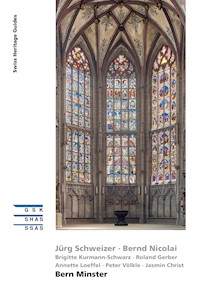
Bern Minster, the most important late Gothic church building in Switzerland, together with the new town hall, represents the remarkable awakening of the free city of Bern in the 15th century. The prerequisite for this were the favourable political and economic circumstances, promoted by an upwardly mobile class of merchants who rose to the ranks of the city’s patrician class. At the laying of the foundation stone in 1421, the mighty aspirations associated with the building project were already manifest in terms of size and expense. The city commissioned Matthäus Ensinger, son of the famous Strasbourg and Ulm cathedral master builder. Despite the lengthy construction period, Ensinger’s plans resulted in a church building of great harmony, with superb features including the medieval stained-glass windows, the opulently decorated vaults spanning the period from late Gothic to Renaissance and the Portal of the Last Judgement with its rich array of figures.
Sie lesen das E-Book in den Legimi-Apps auf:
Seitenzahl: 105
Veröffentlichungsjahr: 2022
Das E-Book (TTS) können Sie hören im Abo „Legimi Premium” in Legimi-Apps auf:
Ähnliche
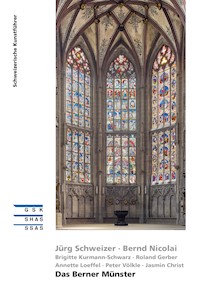














Jürg Schweizer · Bernd Nicolai
Brigitte Kurmann-Schwarz · Roland Gerber Annette Loeffel · Peter Völkle · Jasmin Christ
Bern Minster
Canton of Bern
Bern Minster – Highlights
Introduction
The Minster in the cityscape
Church history
The dawn of a new era
Architectural History
Laying of the foundation stone, start of construction, chancel
Rows of chapels and arcades, plinth of the west building, building stagnation
Resumption of building activity: side aisle vaults, tower piers, tower side chapels
Intensive phase: completion of the side aisle, choir and clerestory
The tower
The medieval construction site
The Reformation
The unfinished church
Finished at last – the 19th century and the tower extension 1889–1893
The perpetual building site
Exterior tour
The entire building, north side, choir, south side
West side and portals
Interior tour
Nave
Side aisles and side chapels
The choir as a major work of the late Gothic period
Tower ascent
Appendix
The Minster above the platform, built between 1334 and the 16thcentury. On the left, the collegiate building from 1745–1748 in the dimensions of the late Gothic House of the Teutonic Order, later the St. Vincent collegiate.
Bern Minster – Highlights
Bern Minster is one of the most important examples of late Gothic architecture in Switzerland. Its dominant position above the slopes of the Aare and its high west tower – only completed at the end of the 19th century – make it, even at first glance, the landmark of the city of Bern. Built in the 15th century, it was planned as a representative building for the aspiring city state, in competition with the church of St. Nicholas in Fribourg, Switzerland. Artistically, Bern Minster was influenced by major building projects along the Upper Rhine, the cathedrals of Basel (cloister vault) and Strasbourg (west tower with openwork spire) as well as Ulm Minster; but also by the large construction projects in Bohemia (Prague) and in the Danube region (Passau, Landshut). The Minster in Bern is thus also an expression of the broad horizons and great mobility of its patrons, architects and artists, who created something extraordinary here. Besides the building itself, its adornment is of particular importance. The multi-figured west portal (circa 1475) depicts the Last Judgement at the end of time, in a legible but dramatic manner, in combination with the portal figures depicting the Wise and Foolish Virgins, those who preserved the oil in their lamps and those who squandered it. The west façade leads up into the tower, past the medieval bells with the original belfry to the quadrangular gallery with busts of the master builders and stonemasons who were responsible for the tower’s completion in 1893, and then on to the octagonal gallery. From here, there is an exceptional view of the old town and the surrounding area.
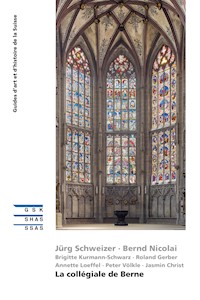
The richly decorated chancel not only preserves one of the most impressive series of stained-glass windows dating from the mid-15th century, but also, next to the eagle-shaped lectern, a three-seated sedilia, originally for the priest, designed as a miniature piece of Gothic architecture. The crowning feature is the web-like choir vault (1515–1517), the so-called “Heavenly Court”, with figurative branching stones depicting, among other things, the Holy Trinity, Our Lady, the apostles, evangelists and saints. There are also repeated references to the city of Bern as patron in the numerous coats of arms. The finale of this phase is the elaborate Renaissance choir stall, one of the earliest north of the Alps. The nave has large tracery windows and a late-Gothic pulpit. The beautiful star vault is to be found in the entrance bay, which dates back to 1476, where the information desk is now located.
BN
Introduction
The Minster in the cityscape
The town founded in the late 12th century, which extended from Nydegg Fortress (today Nydegg Church) to the Bell Tower (Zytglogge), built its first church on the south-facing slope, of which only a few traces have survived. In 1276, it was elevated to the status of a parish church, which led to a new building being erected, the so-called second “Leutkirche”. To get an impression of what it looked like, it is worth looking at the mendicant church (nowadays “Französische Kirche”) in Bern, which was built around the same time and can be considered a larger version.
Together with its walled churchyard, the Leutkirche was embedded in the original city plan, which is still well preserved today. The cemetery was extended in stages. Strikingly, the terrace of about 24 m in height, begun in 1334, was already as wide as it is today towards the south. It encompassed the eastern two-thirds of today’s terrace and is easily recognisable from the buttresses and the tuff. Later, the retaining walls were built up by 8 metres to their current height, reinforced and, from 1514, extended towards the west by a third to their present imposing size. The cemetery was removed in 1531 after the Reformation and the surviving public park was created. The corner pavilions were renovated in 1778 by the architect Niklaus Sprüngli in the late Baroque style. The imposing extension of the terrace, known as the platform, was a reaction in the early 16th century to the completed Minster building which was thus anchored monumentally into the fabric of the city. With its peripheral position in the city alongside the platform, the Minster was considered a prototype for large buildings in Bern until the early 20th century.
The urban planning changes made necessary by expanding the church on the three other sides were also undertaken in the 15th century, in particular with the demolition of the churchyard walls. The most significant alteration was the creation of the Minster Square (Münsterplatz). The eastern half was part of the churchyard until well into the 15th century, while the western half was built over with private houses. In-between a narrow alley, a continuation of the Münstergässchen, led from Münstergasse to Herrengasse. Between 1491 and 1506, the city council had the lowest five town houses opposite the large west building demolished to give the Minster the necessary free space. The fountain was built in 1544, but its present form with Moses on the column dates from 1790. During the 18th century, the houses were almost entirely renovated; only the house at 30 Münstergasse has retained its late Gothic form from 1569, shortly after the square was created. In addition to the attractive southern end of the square with its late Baroque collegiate building, constructed in 1745 by Albrecht Stürler to replace the House of the Teutonic Order built in 1432, the former Tscharner private residence on the west side at 12 Münsterplatz, built by the same architect from 1733, is also striking.
The urban setting of the Minster.
1Former churchyard, now Münsterplatz / Münstergasse
2Former churchyard, over which the Minster was built
3Former churchyard, now platform
4Former private houses, now Münster platz, on the east side including the old town hall, now Münstergasse
5Private houses and collegiate buildings
The cleared Minster square and the platform under construction shortly after 1514.
The Minster tower remained truncated after the Reformation, and ended at the level of the lower octagon with its striking three-centred arch windows. The tower was an important part of the city’s silhouette in this form for centuries. It was not until 1889–1893 that the tower was completed with an upper octagon and spire. Today it forms a counterbalance to the massive Parliament and Federal Buildings that were erected at the same time. The planning of Kirchenfeld quarter and Kirchenfeld bridge paid tribute to the Minster in 1881–1883 by aligning Luisenstrasse and Jungfraustrasse with the Minster. Building regulations were also intended to ensure an unobstructed view of the Jungfrau from the platform; however unrestrained forest growth has somewhat obstructed the view of the Alps. While the tower extension was still being criticised in the middle of the 20th century, the Minster in the form created at that time is now the undisputed landmark of the city of Bern.
JS
The Minster with the platform used as a public park, on the left the former house of the Teutonic Order. Painting by Antoni Schmalz in 1635.
Minster, platform and collegiate building from the southeast in the cityscape.
Church history
The Aare peninsula, according to legend wooded, on which Duke Berchtold V von Zähringen wanted to build the city of Bern around 1191, belonged to the much older parish of Köniz when the city was founded. The small church of the founding city – probably already dedicated to St. Vincent of Saragossa – was therefore merely a filial church of the parish church of Köniz, which had belonged to the Teutonic Order since 1227. When the Bern church was elevated to a parish in 1276, the Teutonic Order retained responsibility for it. During the 14th century the influence of the city increased, which ultimately led to it acting as the patron after 1418, without having the actual right of patronage, in the preparation and laying of the foundation stone. This remained the case throughout the construction period, which can still be seen today in the numerous Bernese coats of arms that can be found everywhere in and around the church. In 1484/85, the city council succeeded in obtaining permission from the Pope to establish a collegiate chapter under the control of the city, whose provost was even granted episcopal insignia, mitre, ring and staff. In addition to obtaining all canonical rights, the aim was also to provide the new representative Minster with a fitting priesthood, as the main endowment of the new building. In a dramatically described hostile takeover, the Teutonic Order was expelled and even their new order house, constructed only 50 years earlier, was allocated to the collegiate chapter. The foundation of the chapter was also an emancipation from the distant bishop in Lausanne. However, over half of the 24 planned canons’ posts were never occupied.
Two Bernese coats of arms are centrally and clearly displayed in the choir apex window installed in 1441.
The coat of arms of the upwardly mobile Ringoltingen family appears eight times in the Epiphany window of the choir, donated before 1448. With the coats of arms, the family documented their rise to the nobility.
The two panels on the outer right are reconstructions added in the 19th century.
Heinrich Wölfli in the fur cape of the canons in front of the altar of St Vincent, which is visited by pilgrims. Last scene of the choir hangings donated by Wölfli in 1515 (now in the Bern Historical Museum).
The vault ring in the choir vault, completed in 1517, encases a wooden cover with a large Bernese coat of arms (top), eight further coats of arms are borne by angels (centre). The coat of arms of the Brüggler family in the keystone of their chapel (below).
From the beginning, the construction of the Minster was also supported by private donors, who financed the side chapels with altars and benefices, but also contributed to the other furnishings of the church. In the late 15th century, all the chapels were taken, some changed hands, and altars on nave pillars were granted to other donors, so that by the time of the Reformation there were 25 altars in the church.
The Reformation in 1528 also made its presence felt in the chapter when various canons left and married. It finally brought about the ruthless end of the institution, which lives on only in the name of the baroque successor building at 3 Münsterplatz (Stiftsgebäude). It is astonishing that the main portal was spared during the so-called Iconoclastic Riot. With its emphasis on secular justice, the Last Judgement could at the same time be seen as an expression of the patrician rule bestowed by God; this is also indicated by the fact that the statue of Our Lady on the central pillar was replaced by Justitia in 1575.
The new Bernese state church entered the service of the Republic of Bern. The Minster became the main church of the Reformed chapter of Bern, the dean of the collegiate became the head of the Bernese clergy, and the Minster thus became the ecclesiastical centre of Old Bern. It was not until 1875 that ownership of the building was transferred from the city to the general church community. Today, its reorganisation is pending, in the course of which the small Minster parish will be abolished and the Minster will be transferred to the responsibility of a city-wide parish of Bern in accordance with its significance for the entire city.
JS
Long-distance trade connections of Bernese merchants in the first half of the 15th century.




