


Erhalten Sie Zugang zu diesem und mehr als 300000 Büchern ab EUR 5,99 monatlich.
- Herausgeber: The History Press
- Kategorie: Sachliteratur, Reportagen, Biografien
- Sprache: Englisch
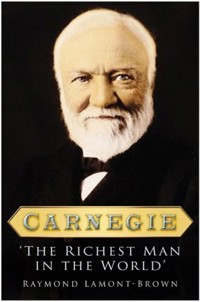
Raymond Lamont-Brown charts the life of Andrew Carnegie, from Dunfermline bobbin boy to Steel King of America.
Das E-Book Carnegie wird angeboten von The History Press und wurde mit folgenden Begriffen kategorisiert:
the richest man in the world,andrew carnegie,dunfermline,bobbin boy,steel king of america
Sie lesen das E-Book in den Legimi-Apps auf:
Seitenzahl: 455
Veröffentlichungsjahr: 2006
Das E-Book (TTS) können Sie hören im Abo „Legimi Premium” in Legimi-Apps auf:
Ähnliche
















First published in 2005 by Sutton Publishing
The History Press The Mill, Brimscombe Port Stroud, Gloucestershire, GL5 2QGwww.thehistorypress.co.uk
This paperback edition first published in 2006
Reprinted 2006
This ebook edition first published in 2013
All rights reserved © Raymond Lamont-Brown, 2005, 2013
The right of Raymond Lamont-Brown to be identified as the Author of this work has been asserted in accordance with the Copyrights, Designs and Patents Act 1988.
This ebook is copyright material and must not be copied, reproduced, transferred, distributed, leased, licensed or publicly performed or used in any way except as specifically permitted in writing by the publishers, as allowed under the terms and conditions under which it was purchased or as strictly permitted by applicable copyright law. Any unauthorised distribution or use of this text may be a direct infringement of the author’s and publisher’s rights, and those responsible may be liable in law accordingly.
EPUB ISBN 978 0 7524 9510 1
Original typesetting by The History Press
CONTENTS
Acknowledgements
Chronology
Preface: The Making of Andrew Carnegie
1.
The Tree of Radicalism
2.
The Weaver’s Boy
3.
Voyage to America
4.
The Industrious Apprentice
5.
The White-haired Scotch Devil
6.
War Clouds and a Silver Lining
7.
Bridging Gaps
8.
European Interlude
9.
New York and the Wolves of Wall Street
10.
Round the World
11.
Romance and the Charioteer
12.
Friendships Sweet and Sour
13.
Two Deaths and a Wedding
14.
A Honeymoon
15.
The Homestead Affair
16.
Fraud and Fraction
17.
A Daughter and a Dwelling
18.
A Rich Rector of St Andrews
19.
Pathway to Peace: Descent to War
20.
The Road to Sleepy Hollow
Epilogue: The Conundrum of Andrew Carnegie
Appendix I: The Development of the Carnegie Trusts
Appendix II: Andrew Carnegie Birthplace Museum
Appendix III: The Carnegies’ Farewell to Skibo
Family Tree
Notes
Bibliography
ACKNOWLEDGEMENTS
This volume has been enhanced by a review of the biographical work done on Andrew Carnegie by three writers in particular. The ‘official’ biography, The Life of Andrew Carnegie (1932), was written by Burton Jesse Hendrick, and remained the key work until the appearance of the biography Andrew Carnegie (1970) by Professor Emeritus Joseph Frazier Wall; Wall also wrote a study of Carnegie’s Scottish home at Skibo (1984). In more recent times Peter Krass’s Carnegie (2002) has added and expanded biographical research on Carnegie. Funded by Carnegie’s daughter Margaret Carnegie Miller, Burton J. Hendrick wrote a biography of Mrs Carnegie, Louise Whitfield Carnegie (1950), which was completed after Hendrick’s death by Daniel Henderson. In 2000 Linda Thorell Hills, great-granddaughter of Andrew Carnegie, edited the journals of Carnegie’s daughter for private circulation. Simon Goodenough produced an important work on Carnegie’s trusts and foundations in The Greatest Good Fortune: Andrew Carnegie’s Gift for Today (1985). To each of these writers I offer my gratitude for a sight of their research.
Much assistance has been given in compiling the book by the following, all of whom receive my indebtedness: Mrs Lorna Owers, Administration Manager, Andrew Carnegie Birthplace Museum; the Earl of Elgin & Kincardine, KT; Mr M. Farmer, Principal, Kilgraston School, Perth; The Carnegie Dunfermline & Hero Fund Trustees, and the Carnegie Trust, both at Dunfermline. Mr Angus McLaren, Club Captain of the Carnegie Club, Skibo, Sutherland, has also rendered important assistance on Carnegie’s Scottish ‘heaven on earth’. A special thank-you goes to Mr William Thomson, great-grandson of Andrew Carnegie, for information and advice on the Carnegie family past and present. A particular appreciation is expressed to my wife Dr E. Moira Lamont-Brown, who has acted as companion and helper on my tours of Scotland in search of Carnegie’s ‘Scottishness’.
Illustrations: Each is identified in situ for ownership. Grateful thanks are offered to Laura Whitton of the Picture Library, National Portrait Gallery, London, for tracing and identifying images.
Copyrights: Every effort has been made to trace the copyright holders of works quoted in the text, although the death of authors and reversion of rights often makes this difficult; however, each quote is sourced in the notes. Thanks for granting permission to quote from their copyright works are due to Peter Krass, Linda Thorell Hills and William Smith of Oxford University Press Inc., New York, on behalf of the Joseph Frazier Wall volumes. In 1986 Northeastern University Press (Houghton Mifflin Co.), Boston, produced a new edition of Andrew Carnegie’s autobiography. Carnegie’s original publisher – Charles Scribner’s Sons – is now a part of Simon & Schuster Trade Division, New York.
CHRONOLOGY
1835
25 November. Andrew Carnegie born at Dunfermline, Fife.
1840
Carnegie begins informal education alongside his cousin Dod with uncle George Lauder.
1843
Carnegie attends Robert Martin’s Lancaster School, Rolland Street, Dunfermline.
1847
Father William Carnegie’s handloom weaving business fails.
1848
17 May. Carnegies leave for America. 6 July. Arrival at New York and journey to Pittsburgh. Andrew Carnegie begins work as bobbin boy.
1849
Carnegie starts work as messenger at O’Reilly Telegraphs.
1850
Carnegie progresses to telegraph operator.
1853
Carnegie becomes personal telegraph operator and private secretary to Thomas A. Scott, Superintendent of the Western Division of the Pennsylvania Railroad.
1855
2 October. Death of father, William Carnegie.
1856
Carnegie purchases stock in the Adams Express Co.
1858
Carnegie signs deal with the Woodruff Sleeping Car Co.
1859
21 November. Carnegie becomes Superintendent of the Western Division of the Pennsylvania Railroad Co.
1861
12 April. American Civil War breaks out; Carnegie organises railroads and telegraph communications on a war footing.
1862
Carnegie and his mother visit Scotland.
1865
26 April. American Civil War ends. May. Carnegie departs on ‘Grand Tour’ of Europe.
1866
Returns to America.
1867
April. Carnegie and others organise Keystone Telegraph Co. Carnegie and his mother move to St Nicholas Hotel, New York.
1870
1 December. Carnegie, Kloman & Phillips manufacture steel.
1871
Carnegie in Europe.
1872
5 November. New company formed to forge steel.
1875
Trip to Dunfermline.
1878
24 October. Carnegie takes trip around the world aboard SS Belgic.
1879
Midsummer, back in America.
1880
Carnegie meets Louise Whitfield.
1881
1 April. Carnegie Bros & Co. Ltd formally established. 1 June. Carnegie makes coach trip through Britain.
1884
Coach trip to Europe. Breaks engagement with Louise Whitfield. Invests in London Echo, and is re-engaged to Louise.
1885
Trip to Britain.
1886
October. Carnegie gravely ill with typhoid fever. Death of only brother Tom Carnegie. 10 November. Death of mother, Margaret Carnegie.
1887
22 April. Marriage to Louise Whitfield. Leases Kilgraston House, near Perth.
1888
Leases Cluny Estate, near Kingussie.
1892
1 July. Foundation of Carnegie Steel Co.
1897
30 March. Birth of Carnegie’s only child, Margaret. Carnegie buys the mansion of Skibo and 22,000 acres of Sutherland.
1899
23 June. Foundation stone laid of new part of Skibo.
1900
Carnegie Co. established.
1901
Carnegie and family tour Mediterranean sites.
1902
Christmas Eve. Carnegie purchases the entire Pittencrieff estate, Dunfermline.
1903
3 August. Creation of Carnegie Dunfermline Trust.
1911
Carnegie Corporation of New York founded.
1919
22 April. Margaret Carnegie marries Roswell Miller. 9 August. Carnegie contracts pneumonia. 11 August. Death of Andrew Carnegie.
PREFACE
THE MAKING OF ANDREW CARNEGIE
It’s a God’s mercy I was born a Scotchman, for I do not see how I could ever have been contented to be anything else. The little dour devil, set in her own ways, and getting them, too, level-headed and shrewed, with an eye to the main chance always and yet so lovingly weak, so fond, so led away by song or story, so easily touched to fine issues, so leal [faithful], so true. Ah! you suit me, Scotia, and proud am I that I am your son.
Our Coaching Trip, 1882, p. 152
Andrew Carnegie created more millionaires than anyone before or since. He sold his business for $480 million and gave away tens of thousands of dollars every day. Newspapers even ran prize competitions to gather suggestions on how best he might spend his money. Today his name remains one of the most famous in the world, and from New York’s Carnegie Hall to the thousands of libraries he endowed, his memorials in stone outstrip all comers. Born in poverty, he walked with kings and statesmen and knew the great and good of his days from Theodore Roosevelt to Rudyard Kipling, from Mark Twain to Prime Minister William Ewart Gladstone.
But who was Andrew Carnegie? How did he become rich? Many books have been written about Andrew Carnegie, but for many he remains a shadowy figure whose money – he was dubbed ‘the richest man in the world’ – masks what he was really like. He was born into poverty, raised in a small two-roomed Dunfermline cottage and only went to school for four years in his life, but he challenged penury and advanced education through the provision of libraries and colleges as no one before him had done. Carnegie was a complex character; of no religious bent he nevertheless endowed thousands of church organs. He was known as ‘the King of Steel’, but personally he knew little about its actual manufacture. He had no diplomas in management, but succeeded in having hundreds of people working for him. In truth, he never really worked hard in his adult life: instead he travelled and socialised while others made money for him.
Whence did Andrew Carnegie obtain his golden touch, or his restless energy and sleepless ambition? Who influenced his life the most? This book seeks some answers. He admitted that he received his ‘brains’ from his domineering mother, and said that one of the driving forces of his life and spectacular career was his devotion to her. He even promised never to marry while she was alive. But the basis of Andrew Carnegie’s success rested on more than his mother’s character, and we go in search of these other folk and events.
In charting the life of Andrew Carnegie from poor Dunfermline weaver’s boy, through telegraph operator, railway developer, iron and steel manufacturer, oil magnate, banker and miscellaneous entrepreneur, we seek the real man behind the name. But he laid many false trails. He could be capitalist and socialist in the same breath, republican and democrat in the same sentence. Was he the true philanthropist that his remarkable trusts would suggest, or the robber baron of leftist academe? Was his promotion of ‘self-help’ a disguise for his own greed? Was he a naive fool, in self-appointedly pursuing international peace and, as has been pointed out, acting as a blinkered ‘ambassador extraordinary’ for the rapacious Kaiser Wilhelm II before the First World War? Did his competitive spirit only harm the workers he purported to champion? In looking at Andrew Carnegie’s life in new areas, and following different slants and angles, some further answers will be sought. As fellow-Scot Sir James Barrie said in his play What Every Woman Knows, ‘There are few more impressive sights in the world than a Scotsman on the make.’
ONE
THE TREE OF RADICALISM
A word, a look, an accent, may affect the destiny not only of individuals, but of nations.
Autobiography, 1920
Pattiesmuir lies on the southern edge of what was the boundary of the old parishes of Dunfermline and Inverkeithing in the Kingdom of Fife.1 Today, as when Andrew Carnegie’s forebears lived there, Pattiesmuir – or ‘the hamlet of the muir’ – hardly seems a likely centre of revolutionary thought. Yet two hundred years ago it seethed with secessionism and radicalism.2 Once a part of the lands of the Benedictine Abbey of Dunfermline, Pattiesmuir fell within the policies of the Earls of Elgin & Kincardine, and it developed in the lee of the hill that slopes southward to the Firth of Forth.
Writing in 1793, the Presbyterian minister of Inverkeithing, Andrew Robertson, commented that the folks hereabouts were in general ‘sober, industrious, and attentive’; he saw them as ‘kind and hospitable’ and ‘much given to company and entertainments in each others houses’. They were, said the Revd Robertson, ‘united in the same political sentiments and views’, but he regretted that, ‘Burgh politics, and the election of members of Parliament, had an unhappy influence upon the morals of the people’. The minister greatly disapproved of the ‘animosity’ engendered at election times.3
Old Rosyth churchyard contains the unmarked Carnegie graves4 and the burial places of the local folk described by the Revd Robertson, and the whole area, where the King of the Gypsies once had a palace, was later overshadowed by the nearby town and naval base of Rosyth established in 1903–9. Before that no principal highways came directly to Pattiesmuir, although the main route from the Queensferry Passage on the Forth to the north-west was nearby; nevertheless the hamlet enjoyed a vigorous life of its own.
Within this late eighteenth-century weaving society evolved Andrew Carnegie’s paternal roots. The Carnegies were a Lowland family and were property owners in Fife; the county was then called Fifeshire (usually with the suffix NB for North Britain). Their surname was derived from a Gaelic place name – Caither an eige, ‘fort at the gap’ – and appears in Fife charters from the late sixteenth century. At that time, one Magister David Carnegie of Kinnaird married Elizabeth Ramsay of Colluthie, in the north Fife parish of Moonzie; his second wife Euphame Wemyss was the mother of David, 1st Earl of Southesk, and John, 1st Earl of Northesk, and of the founders of the principal branches of the Carnegie family in Scotland.5 Nevertheless the not well-off Carnegies of Pattiesmuir asserted no kindred to their wealthy namesakes, nor would they have wished to, although their rich descendant Andrew Carnegie was a friend of the noble Carnegies.
As far as Andrew Carnegie was concerned, his closest ancestor was his great-grandfather, sometime tenant farmer and weaver James Carnegie, who had moved from his ancestral Kincardineshire to set up home at Pattiesmuir around the year 1760, when the Hanoverian Prince William George Frederick, Prince of Wales, ascended the throne of Great Britain as George III. The new king’s Scottish titles included the dukedoms of Rothesay and Edinburgh, and as he got to grips with the reins of government, James Carnegie tackled the problem of earning a living, and married a Fife woman called Charlotte Walker. Records of the Elgin estates show that James Carnegie had the right of ‘turf and divet’ – that is, the right to build for his own use a sod house at Pattiesmuir from local materials.6
Something of a rebel, James Carnegie played a prominent part in the Meal Riots of 1770 and was jailed on a charge of seditious incitement as a result. Nevertheless he earned enough to raise a large family. Customers for his linen came from all classes of society – even Martha, Lady Elgin, wife of the 5th Earl, bought linen from Carnegie.7
James’s eldest son Andrew followed his father’s craft of weaving. Being self-employed and constrained to sell their own wares, the weavers were more mobile than their agricultural neighbours who rarely, if ever, left their home milieux, even in the longest lifetime. So young Andrew – who would be the rich Andrew Carnegie’s grandfather – knew Fife well, from the cobbled wynds of Culross to the old ecclesiastical capital of Scotland at St Andrews. And at nearby Limekilns he would encounter romance.
Limekilns, with its then comparatively new Brucehaven Harbour for the burgeoning trade in coal shipments, was the focus of a variety of industries from brewing to soap-making, and was also the home of the seafaring Thom family. Here Andrew Carnegie’s grandfather met Elizabeth, daughter of the well-heeled ship owner Captain George Thom and his wife Elizabeth Wilkie. To her father’s dismay Elizabeth announced that she would marry the moneyless weaver, and despite the threat of disinheritance marry she did – for love. The Thoms did not attend their daughter’s wedding, and Elizabeth was further shunned when her father decided not to give her a vessel from his fleet as a dowry – which he had done when each of his other daughters married. Historian J.B. Mackie tells the story of how Elizabeth attempted a reconciliation with her family by promising that if she gave birth to a boy it would be given her father’s name or that of one of her sisters if the baby was a girl. A girl duly arrived and at the baptism Elizabeth’s family gathered at Limekilns Secessional Church to hear the child given a Thom family name. To Andrew Carnegie this smacked of bribery, and when the Revd Hadden asked what the child was to be called he declared: ‘She is to be called Ann for my aunt of the same name.’ Out of the church stormed the Thoms and there were no further inter-family exchanges.8
Education had long been held in high esteem in Scotland. After the Reformation had swept away the medieval church, the Scottish Presbyterian movement’s ‘First Book of Discipline’ (1560) set out a determination for ‘one school in every parish’.9 Furthermore, the eighteenth-century education system that creamed off gifted Scots children had opened up many opportunities for the bright within an atmosphere of educational egalitarianism, but many could still not afford the pennies to buy daily formal education for their children, so self-education was popular among the less well off. Not until the Education (Scotland) Act of 1872 did the state first assume direct responsibility for the education of children. Yet at Pattiesmuir, Andrew Carnegie was already involved in a form of self-education.
At Pattiesmuir is a building which was known as the ‘college’, where local weavers and agricultural workers met for self-improvement classes in a multitude of subjects from politics and philosophy to economics and theology. Their spiritual father was the working-class hero Robert Burns, whose revelries at the Tarbolton Bachelors’ Club in his Ayrshire homeland provided the template for the college. Soon Andrew Carnegie became a self-proclaimed ‘professor’ of this institution, which actually had as much to do with social drinking as self-education.10 Local tradition has it that the long-vanished Bull Head Tavern was the main campus of the college. With whatever spare money they had the members subscribed to the Edinburgh Political & Literary Journal, which first appeared in 1817 (becoming the Daily Scotsman by 1855), and clubbed together for the new Waverley novels produced by Walter Scott from 1814. If there were arguments or running disputes then Grandfather Carnegie was always at their heart. He was very much a man of his time.11
For decades Dunfermline was renowned, or abhorred, depending on one’s point of view, as the most radical area in Scotland, full of men willing to debate the politics of the day and pursue the philosophies of such men as Rochdale miller turned orator and statesman John Bright, free-trader Richard Cobden and the home-grown Scottish philosopher and historian David Hume. They would gather in groups to subscribe to the London broadsheets and listen to lectures by visiting radicals. It was a hothouse of revolutionary thought in which the Carnegies found a niche.
Andrew and Elizabeth’s sixth child William was born on 19 June 1804. He duly became a weaver like his father, but in 1830 he became the first to leave Pattiesmuir for nearby Dunfermline where he could pursue his skills as a damask weaver. Andrew and Elizabeth undoubtedly encouraged their son to move to Dunfermline in an effort to better himself, for in 1826 the Elgin estates factor noted that the Carnegies were unable to pay their rent because they were ‘very poor’.12 At Dunfermline William rented for around £8 per annum,13 paid on the Scottish quarter days of Candlemas, Old Beltane, Lammas and Old Hallowmans, a portion of a cottage at the junction of Priory Lane and Moodie Street. On the ground floor he set up his loom, living in the small attic room above.
On the heights beyond Priory Lane lies Maygate, where lived the prominent Morrison family. William Carnegie became a welcome guest here, for the head of the family Tom Morrison was a fiery radical. William eventually fell for the charms of Morrison’s fourth child Margaret, and in December 1834 they married and set up home together at William’s workshop-lodging. William and Margaret were to become the parents of the famous Andrew Carnegie. Thus history assembled the three great early influences on Andrew Carnegie’s life: his father William, his mother Margaret (by far the greatest influence) and his grandfather Tom, although in his veins also ran the ‘daft’ blood of his eccentric, ebullient and exuberant paternal grandfather Andrew. Of the latter Andrew Carnegie would say: ‘I think my optimistic nature, my ability to shed trouble and laugh through my life . . . must have been inherited from this delightful old masquerading grandfather whose name I proudly bear.’14
To assess these influences properly, it is vital to take a closer look at the main characters involved. William Carnegie was a hard worker, but was far more reticent than his effusive father. Family tradition has it that he was a keen reader and a solitary rambler on the roads and moors around Pattiesmuir. His artistic qualities enabled him to graduate from the plain designs of the weavers’ looms to the figured material of damask, which had originally been worked in silk. Dunfermline was the centre of the damask trade.
The manufacture and processing of textiles, particularly wool and linen, appears to have been well established in Dunfermline by the 1400s at the very latest, and the textile industry continued as cottage labour until well into the 1500s. As the centuries passed, textile production became increasingly mechanised and better organised. The development of the damask trade at Dunfermline involved an interesting piece of industrial espionage.
Some time in the early eighteenth century a small damask-weaving manufactory was set up at Drumsheuch in west Edinburgh by craftsmen from the continent. The process by which they worked was secret. So in 1709 a Dunfermline weaver called James Blake set out to discover what he could about the damask process. He decided his best chance lay in impersonating an imbecile. He hung around the homes of the immigrant workers and distracted them with his amusing capers. Gradually Blake was allowed to enter their workshops and there he took note of their machines and practices. Absorbing as much knowledge as he could, he returned to Dunfermline and was able to establish his own damask industry. Thus damask weaving was established at Dunfermline by 1718. The process was revolutionised by the introduction of steam power in 1849, just a year or two after the Carnegie family had left.15 It should not be forgotten though that coal was mined at Dunfermline as early as 1291, when William de Orbeville, proprietor of Pittencrieff, granted to the Benedictines of Dunfermline the right to extract coal for their use. So steam power was an important innovation.
Politically William Carnegie had been brought up on the Scottish working-class radicalism of his father and his friends, who believed that every man should have a say in who led them politically and religiously, and supported a thoroughgoing but constitutionally social and political reform. Yet while his father could harangue a crowd, William loathed speaking in public; nevertheless, although slow to anger, William would speak out boldly if his principles were slighted. A regular attender at public meetings, on one occasion William took his young son Andrew to hear John Bright, engendering in Andrew a lifelong respect for oratory.16
An anecdote from Andrew Carnegie’s autobiography helps to get the measure of William Carnegie. A short while after his son’s birth William attended a Sunday service at the Dunfermline Secessionist Presbyterian Church. The minister’s sermon that day was on the damnation of infants. His Calvinist rhetoric underlining the sure and certain damnation of children and punishment in the fires of Hell for their sins triggered anger in William’s mind. Somewhat out of character he stood up in his pew and said: ‘If that be your religion and that your God, I shall seek a better religion and a nobler God.’17 William Carnegie never returned to the church.
While William Carnegie was fairheaded and reticent, Margaret Morrison his wife was dark and resolute, loyal and determined in all that was personal to her. She proved in marriage to be devoted to the needs of her husband and was a fine Scots wife, ‘trig’ (neat), ‘scrimp’ (sparing in economy) and zealous in ‘warkin the wark’ (carrying out her housewifely duties) as the Lowland tongue described it. Throughout her son Andrew’s life she was the single greatest motivational force behind his success in business.
Andrew Carnegie’s third great influence was his maternal grandfather Tom Morrison. Unlike the Lowland Carnegies, the Morrisons were of Highland stock, whose clan derived from the ancient Norse inhabitants of the Hebridean island of Lewis. Like other clans, their members were dispersed through feuding. Tom Morrison’s immediate family had fetched up in Edinburgh in the mid-eighteenth century as leather workers. Tom was to inherit his father’s leather business and married Ann Hodge, the daughter of an Edinburgh merchant. Writing in 1935 John Pattison noted how the Morrisons had a substantial house in Edinburgh with all the refinements of a lower middle-class family.18 Alas, Tom Morrison made some bad investments; the business was lost, Ann Morrison’s marriage portion vanished and they moved to Dunfermline where Tom set up as a shoemaker.
Perhaps embittered by his own failures and shamed by the loss of his position, Tom Morrison took up the spirit of radicalism that was so prominent in early nineteenth-century Dunfermline, becoming part of a company of radicals bent on a programme of grass-roots political (but non-violent) action, which was a precursor of Chartism – a movement which began in 1836 for the expansion of political power to the working classes.
Tom Morrison suffered a bitter blow when his wife died in 1814, but the needs of his family and workbench did not stop him preaching the radical cause in the towns and villages of Fife. Should a representative of the successive Tory Prime Ministers the Earl of Liverpool and George Canning, or perhaps a Whig MP, speak at a political rally in Fife, there would be Tom Morrison heckling and promoting dissension. In those days his pen worked as quickly as his tongue to promote the cause of reform for the working-class masses. Around 1827 Tom Morrison gathered the skilled Dunfermline craftsmen into what was called ‘the Political Union’, proudly bearing on their banner the motto ‘Knowledge, Union and Fraternisation’, and thus Tom Morrison and his agitators were part of the pressure that resulted in the passing of the Reform Act of 1832, which initially gave the vote to the middle classes.
Tom Morrison was a friend and devotee of the English essayist and politician William Cobbett, and occasionally contributed copy for Cobbett’s Political Register, which was begun in 1802 and appeared weekly. Andrew Carnegie was proud of the fact that his grandfather had appeared in the Register and had been praised therein by Cobbett; in particular Cobbett said Morrison’s thesis on the need for technical education in Scottish schools was ‘the very best communication I have ever received in my life’.19
Keeping up the political pressure, Tom Morrison wrote and spoke against wealth and privilege. His series of letters attacking Archibald Primrose, Lord Dalmeny, the Liberal MP for Stirling Burghs, as a ‘stoolpigeon for landed interests’ are considered classics by socialist hagiographers. What Tom Morrison would have thought of his grandson hobnobbing with Lord Dalmeny’s son, the Liberal leader Archibald Philip Primrose, 5th Earl of Rosebery, is a matter for speculation. Morrison even started a radical newspaper in Dunfermline; The Precursor was to appear monthly at 2d from January 1833 but it was too seditious for most printers to risk and the enterprise soon folded. Yet Tom Morrison continued to write for any publication that would publish his rantings. Andrew Carnegie said later: ‘I come by my scribbling responsibilities by inheritance – from both sides, for the Carnegies were also readers and thinkers.’20
William and Margaret Carnegie, with Tom Morrison, all contributed to the cocktail of genes that would make Andrew Carnegie of Pittsburgh a ‘great empire-builder and philanthropist’. Yet he reworked these influences in his own idiosyncratic way, sometimes turning Tom Morrison’s opinions about wealth and privilege on their head. Thus Andrew Carnegie’s story begins at Dunfermline.
TWO
THE WEAVER’S BOY
A working man is a more useful citizen and ought to be more respected than an idle prince.
John K. Winkler, Incredible Carnegie, 1931
Andrew Carnegie, ‘Andra’ to his family, was born at Dunfermline on Wednesday 25 November 1835. It was the fifth year of the reign of William IV, the ‘Sailor King’, of the House of Hanover, and politically the Whigs (Liberals) had just returned to office with William Lamb, 2nd Viscount Melbourne, forming his second government as Prime Minister and First Lord of the Treasury. In those days Scotland remained without a parliament; from 1707 the ‘management’ of Scotland was in the remit of the Home Secretary, by now Lord John Russell. Andrew Carnegie entered a Scottish society fiercely proud of its history, culture and individuality, and being ‘managed’ from faraway London rankled with such as the Carnegie and the Morrison relations assembled at his birth.
Andrew Carnegie was eased into the world with the help of his mother’s childhood friend Ailie Ferguson, now Mrs John Henderson. He first opened his eyes in the little attic room of the one-storey eighteenth-century red pantiled grey-stone cottage at the junction of Moodie Street and Priory Lane, Dunfermline. With its swept dormers, the dwelling was once an end-of-terrace habitation, and the attic room was the family’s main living area. Today the cottage houses the birthplace museum of Andrew Carnegie, tracking his career in a ‘rags to riches’ story, while adjoining the cottage is architect James Shearer’s Memorial Hall of 1925, endowed by Carnegie’s wife Louise to tell the story of her husband’s unique business and charitable career. It is the Scottish focus of all he achieved.1 As the visitor stands at the corner of Moodie Street, the scenario that Andrew Carnegie first knew is all around; a scenario that embedded itself in his psyche and drove him years later to endow for future generations.
For baby Andrew, Dunfermline was a fine place to be born. Situated in south-west Fife, around 3 miles from the north shore of the Firth of Forth, and at the junction of several important medieval routes, Dunfermline was once the capital of Scotland.2 Historically it had long held a prominent position, for Carnegie was born in a place which had witnessed the emergence of Scotland’s story from the mists of legend. The town’s High Street occupies a ridge from which the ground falls away steeply down St Margaret Street and Monastery Street to the ancient abbey precincts below. These two thoroughfares funnel down to Moodie Street with Pittencrieff Park to the west flanked by the Tower Burn and Pittencrieff Glen. Here at the Abbey, the Burn and the Glen Andrew Carnegie spent his earliest days.
High on the eminence above the Moodie Street cottage stand the remains of the Benedictine Abbey of the Holy Trinity, founded as a priory in around 1070 by the saintly Margaret, wife of Malcolm III, King of Scots, soon after her marriage in 1068. It was elevated to the status of an abbey in 1128 by their son David I and functioned as one of Scotland’s most prominent ecclesiastical foundations and pilgrimage sites – to the shrine of St Margaret of Scotland – until it was annexed to the Protestant Crown of James VI in 1593. Adjacent to the fratery hall of the abbey lies the shell of the guest house refurbished as the Palace of Dunfermline by the Stuarts; here the royal family often resided and within its walls several monarchs of Scotland were born, the last being Charles I on 19 November 1600. Andrew Carnegie knew every path, wall and hidey-hole of the crumbling site, steeling himself to walk through its threatening shadows when night had fallen.
The history of Dunfermline is hardly separable from the rise of the abbey, without which the former would have remained a lowly place in history. In Pittencrieff Glen, by the abbey precincts, rises Tower Hill, the site of the tower-castle erected by the ‘swaggering bully’ Malcolm III, Canmore – bynamed ‘Bighead’ (c. 1031–93). Malcolm was changed from a coarse ruffian to a cultured nobleman by his second wife, the Saxon Margaret (d. c. 1093), daughter of Edward Atheling, son of Edmund II of England. Here they lived with their eight children. In due time Andrew Carnegie would buy what had been their royal property hereabouts as a gift for the burgh of Dunfermline.
Within the abbey today can be seen the tomb of one of Andrew Carnegie’s earliest heroes. The nave of the old abbey is preserved as a national historical monument, but the east end of the abbey was redeveloped as a functioning abbey church. When the site was being cleared in 1818 to make way for the new parish church a skeleton was discovered which experts declared to be that of Robert I, the Bruce. Bruce became Carnegie’s paragon, but his tomb was not graced with the fine memorial seen today until 1889, when the Carnegies had long since left Dunfermline. Bruce, though, was somewhat sidelined by the chief champion of Scotland’s independence, Sir William Wallace (c. 1274–1305), hanged, drawn and quartered for his pains by the English, when the young Andrew Carnegie discovered patriotism.
The original settlement of Dunfermline probably grew up near Malcolm’s Tower but was absorbed into a new township around the abbey; it became a Burgh of Regality, dependent upon the abbey from around 1130 until the confirming charter of James VI of 24 May 1588. All this – Malcolm’s Tower, Pittencrieff Glen and the surrounding parkland – were within the estate of the Hunt family in Carnegie’s time. By the fifteenth century these policies had been in the ownership of the Benedictine abbey, but when they were secularised following the Protestant Reformation they fell to George Seton, 1st Earl of Dunfermline. The estate and Pittencrieff House, a drydashed mansion of around 1635, built for Sir Alexander Clerk, had several owners, but were bought for £31,500 in 1799 by William Hunt.3 Thereafter the Hunts guarded their property with diligence, but by the 1840s they opened their gates for one day a year in May to allow Dunfermline folk to walk in the gardens. Because of their political affiliations the Hunts barred the Morrison family from visiting Pittencrieff. This angered the young Andrew Carnegie who, as tradition has it, swore that one day he would own Pittencrieff and throw the gates open to all. Buy it he did from the Hunts in 1902 for £45,000 and officially presented it to his native burgh on 21 November 1903; architect Robert S. Lorimer reconstructed the interior as a club and museum between 1908 and 1911. Today, almost as an eternal snub to the Hunt family, Richard Reginald Goulden’s 1913–14 statue of Andrew Carnegie in a frock coat is prominently placed in Pittencrieff Park, which is entered through the Louise Carnegie Memorial Gates of 1928.
At the time of Andrew Carnegie’s birth, Peter Chalmers, minister of Dunfermline abbey church, tells us the population of Dunfermline was some 11,500 souls, with 5,044 folk of all ages and both sexes employed in the linen weaving trade.4 As an esteemed craftsman William Carnegie’s finished fine weaves were eagerly sought, and he expanded his two looms at Moodie Street to three. This precipitated a move from the cramped cottage premises to a new home in Edgar Street, near Reid’s Park, with a bigger living area for his family. Thus Andrew Carnegie’s first recollections were of the Edgar Street home.5 William Carnegie continued to expand his business, acquiring a fourth loom and taking on apprentices to tend them.
For a long time Andrew Carnegie lived the life of an only child in and out of his father’s weaving room, fascinated as his busy white-aproned father fired the shuttle from left to right and vigorously pedalled the treadles of the loom. Before the entranced child’s eyes the threads trembled, criss-crossed and melded into the fine figured damask. William Carnegie’s strong tenor voice often accompanied the shuttle’s movement with Scot songs: ‘a very good foundation was laid for my love of sweet sounds in the unsurpassed minstrelsy of my native land as sung by my father,’ wrote Andrew Carnegie. ‘There was scarcely an old Scottish song with which I was not made familiar, both verse and tune.’6
A favourite Scots ballad of Andrew Carnegie’s which he often recited was Fife’s own ‘Sir Patrick Spens’, which begins:
The King sits in Dunfermline towne Drinking the blude red wine.
Carnegie loved the story of how Sir Patrick was sent from his home at Aberdour, Fife, on a mission by King Alexander III. In the version made famous by Sir Walter Scott the object of the mission was to bring to Scotland Princess Margaret, the Maid of Norway, King Alexander’s granddaughter. The mission was a disaster; the company and the Maid were drowned even though:
Sir Patrick Spens is the best sailor That ever sailed the sea.
The metre and flow of the ballad appealed to young Carnegie, who lisped the finale to any who would listen:
Half ower, half ower to Aberdour Full fifty fathoms deep There lies the gude Sir Patrick Spens Wi’ the Scots lords at his feet.7
During January 1840 Margaret Carnegie gave birth to a daughter, Ann. The child was sickly and died the following year.8 With his father busy at his loom, and his mother increasingly engaged for those worrying months with the sickly new baby, Andrew Carnegie was left to his own devices, exploring alone, or with friends, the graveyard and precincts of the old abbey, the mysteries of Pittencrieff Glen and the banks of the Tower Burn. His guide to the formal history of Dunfermline was his maternal uncle George Lauder, who was married to Margaret’s eldest sister Seaton and owned a grocer’s shop in Dunfermline’s High Street. By this time George Lauder was a widower. He was devoted to his young son George, who often joined Andrew Carnegie as a willing listener to his father’s tales. The two boys gave each other the nicknames Dod9 (George) and Naig, and for many years Andrew called Dod ‘my brother-cousin’.10 Dod’s father, wrote Andrew Carnegie,
possessed an extraordinary gift of dealing with children and taught us many things. Among others I remember how he taught us British history by imagining each of the monarchs in a certain place upon the walls of the room performing the act for which he was well known. Thus for me King John sits to this day above the mantelpiece signing the Magna Carta, and Queen Victoria is on the back of the door with her children on her knees.
It may be taken for granted that the omission [of Cromwell’s name] which, years after, I found in the Chapter House at Westminster Abbey, was fully supplied in our list of monarchs. A slab in a small chapel at Westminster says that the body of Oliver Cromwell was moved from there. In the list of the monarchs which I learned at my uncle’s knee the grand republican monarch appeared writing his message to the Pope in Rome, informing His Holiness that ‘if he did not cease persecuting the Protestants the thunder of Great Britain’s cannon would be heard in the Vatican’.11
Cromwell became a favourite of the two boys, but . . .
It was from my uncle I learned all that I know of the early history of Scotland – of Wallace and Bruce and Burns, of Blind Harry’s history, of Scott, Ramsay, Tannahill, Hogg and Fergusson. I can truly say in the words of Burns that there was then and there created in me a vein of Scottish prejudice (or patriotism) which will cease to exist only with life.12
William Carnegie and his relatives the Morrisons played no role in, nor formed any part of, the Presbyterian congregations in Dunfermline within the Church of Scotland or the breakaway Free Church. Yet William was not without a desire for religious refreshment which he eventually found among the Dunfermline Swedenborgians. This group followed the teachings of Emanuel Swedenborg (1688–1772), the Swedish scientist, theologian and mystic. He believed that the universe had a basic spiritual structure and in 1744, after he had a personal vision of Christ, he believed that he had received the call to abandon worldly learning. Thus he spent the rest of his career interpreting the Bible. In essence he believed that the Christian God was the power and life of all living creatures and that the Holy Trinity of old was expressed by the three essential qualities of God – love, wisdom and activity. After his death his followers founded a church in London in 1788 and by 1792 another was organised in Baltimore. This Swedenborgian philosophy appealed to William Carnegie and he took his young son Andrew to their meetings. Margaret Carnegie eschewed joining them; although she did not pursue the active Utilitarianism of the Morrisons, she regularly dipped into the essays and sermons of William Ellery Channing (1780–1842), the Rhode Island-born leader of the Unitarians. Andrew Carnegie said that, while he and his brother were encouraged to attend church and Sunday School, his mother considered the Scriptures ‘as unworthy of divine authorship or of acceptance as authoritative guides for the conduct of life’. Her underlying maxim, he said, was the Confucian saying: ‘To perform the duties of this life well, troubling not about another, is the prime wisdom.’13
Religion thus played little or no part in the early life of young Andrew Carnegie, whose nascent thoughts were moulded by his mother. She did not oppose the ‘New Jerusalem’ of her husband’s religious beliefs, nor the ‘Workers Paradise’ of her radical relatives, but she regarded life’s struggles in practical rather than philosophical terms. Hers was a simple Scottish economic philosophy: ‘Hard work brought siller [money], and siller brought meat [i.e. bread].’ So Andrew Carnegie was shown early in his life that the workings of the market-place were what brought a better life in immediate terms.
Andrew Carnegie’s formal education did not commence until 1843, when he was 8. Although the majority of his young friends had begun their schooling at 5, young Andrew shied away from the classroom saying he was not ready and his parents indulged him. Years passed without Andrew showing any inclination towards education; a situation which worried his by no means illiterate parents. At length they decided on a course of action. They approached Robert Martin (1806–60), a teacher at the school on neighbouring Rolland Street, to see if he would talk to Andrew about the importance of education. Martin was in charge of a school which taught the form of education promoted by the Quaker Joseph Lancaster (1778–1838); herein older children taught the younger after they had been tutored themselves by the schoolmaster. In this way school fees could be kept down, but the system led to a chaotically large number of children being taught in one room. For any progress to be made firm discipline had to be enforced with a hefty dose of the ‘tawse’ – a Scots leather strap with tails which was smacked across the hands. Not far away from Dunfermline was the mining village of Lochgelly, which was to become a centre for the making of these straps. Despite all this, Martin – nicknamed ‘Snuffy’ by his pupils – won the day with Andrew Carnegie, who entered the Rolland Street school soon after the pep talk. Carnegie wrote:
the school was a perfect delight to me, and if anything occurred which prevented my attendance I was unhappy. This happened every now and then because my morning duty was to bring water from the well at the head of Moodie Street. The supply was scanty and irregular. Sometimes it was not allowed to run until late in the morning and a score of old wives were sitting around, the turn of each having been previously secured through the night by placing a worthless can in the line. This, as might be expected, led to numerous contentions in which I would not be put down even by these venerable dames. I earned the reputation of being ‘an awfu’ laddie’. In this way I probably developed the strain of argumentativeness, or perhaps combativeness, which has always remained with me.14
Carnegie became ‘Martin’s pet’, a nickname which brought him the ‘utmost opprobrium’, yet in later years when writing to his old school chums he would sign himself with the nickname.15 It was through Martin that Andrew Carnegie earned his ‘first penny’,16 by the recitation of a poem written by Robert Burns at the height of his inspiration in the mid-1780s. Entitled ‘Man was Made to Mourne – A Dirge’, it contains the immortal lines:
Man’s inhumanity to man Makes countless thousands mourn!
Carnegie recited its eleven stanzas faultlessly for his penny, and retained throughout his life a talent to memorise large chunks of verse which he could declaim at will. It was a trick of memory that he had learned from his uncle Lauder: visualise what is read to fix it in the memory.
Summing up his schooling, Carnegie said: ‘I could read, write and cipher, and had begun the study of Algebra and Latin.’17 But he had also begun to flex his skills for ‘business’. ‘One of the chief enjoyments of my childhood,’ he remembered, ‘was the keeping of pigeons and rabbits.’ But how could he afford to feed them? He hit upon a plan. Each rabbit was given the name of one of his playmates, who fed the rabbit in return.
I treasure the remembrance of this plan as the earliest evidence of organising power upon the development of which my material success in life was hung – a success not to be attributed to what I have known or done myself, but to the faculty of knowing and choosing others who did know better than myself.18
At this time in his childhood Dunfermline was ‘paradise’ for Carnegie. ‘All my recollections of childhood, all I knew of fairyland, clustered around the old Abbey and its curfew bell, which tolled at eight o’clock every evening and was the signal for me to run to bed before it stopped.’19 As he hurried home from his uncle Lauder’s fireside tales he would always avoid the gaslit Maygate and go by the abbey. Often at dusk, when the wind screamed through the old abbey and palace windows high above his head, the spooky story of James VI he had just heard at his uncle’s came alive. Once the king had heard a piercing scream from the nurse attending his son, the future Charles I. The nurse was beside herself: ‘Your Majesty, an old man came creeping into the room and threw his cloak over the cradle and drew it towards him like he was taking the Prince away.’ The king knew well that this was the ‘Curse of the Devil’; an old Scots superstition averred that when such an old man crept into a room and engulfed a child with his cloak, that child was doomed to a life of pain and suffering.20 Carnegie heard such a scream as he passed by, but assured his pals that he was not afraid!
For Scotland in particular the 1840s brought economic depression; unemployment became an increasing blight and strikes began to break out. When the miners in the nearby county of Clackmannan went on strike Carnegie’s uncle Tom Morrison became involved in calls for a creeping general strike and the Dunfermline labour force responded, from coal mines to weaving sheds. The burgh became a hotbed of revolutionary intent. The aim was the enactment of the ‘People’s Charter’ of the Chartists. At the time only 10 per cent of the Scots male population had the franchise, and the People’s Charter clamoured for six main ‘demands’: votes for every male; secret ballots; annual parliaments; equality in electoral districts; payment for MPs; and the abolition of property qualifications for MPs. Already the Charter had been voted down in the House of Commons. But when Sir Robert Peel’s government threw it out again in 1842 the riots and strikes were renewed. Response to the strike call, though, began to weaken as bellies felt the pangs of hunger and families suffered. Government troops arrived in Dunfermline and Tom Morrison and his agitator colleagues were arrested. Morrison was bailed and his case was never brought to trial, and eventually he was elected to the town council.
Men went back to work. All this was another layer of experience never to be forgotten by Andrew Carnegie, who observed at first hand the workers’ agitation going on around him. His hero worship for men like Robert I, the Bruce, and the glories of the Battle of Bannockburn was transferred to his uncle and the Dunfermline men who saw relief in the People’s Charter. At 6 or 7 years old Andrew Carnegie enrolled himself as a knight fighting the dragon of privilege, and at 8 he was a republican. In his autobiography he declared: ‘As a child I could have slain king, duke or lord, and considered their deaths a service to the state and hence a heroic act.’21
Curiously, in these revolutionary times Margaret Carnegie took Andrew and his cousin Dod to a royal Scottish occasion. On Thursday 1 September 1842 Queen Victoria landed at Granton Pier and rode in a barouche to view Edinburgh’s sights for the first time. It was quite a spectacle; there had been no royal visit to Scotland since that of the Queen’s uncle, George IV, in 1822. In her Journal the Queen wrote: ‘The impression Edinburgh has made upon us is very great . . . .’22 Alas, the impression made by the Queen on the two young republicans was not so ‘great’:
‘She’s not sae tall as your mither,’ said Dod. ‘And her dress is nae sae braw [not so fine],’ replied Andrew.23
In 1843 Margaret Carnegie gave birth to her last child, a boy, named Tom after his maternal grandfather and rebellious uncle. But, economically at least, times were deteriorating. One by one the apprentices left, and William Carnegie’s extra looms were disposed of. The Edgar Street premises became too much of an outlay and the family moved back to another cottage on Moodie Street, not far from where they used to live. Here William began work again on his surviving loom, but orders were thin. Margaret supplemented the family finances by selling vegetables and sweetmeats from her front door, and helped her uncle stitch shoes.
If young Andrew Carnegie had not yet fully appreciated poverty, he did now. Years later he remembered:
I began to learn what poverty meant. Dreadful days came when my father took the last of his webs to the great manufacturer, and I saw my mother anxiously awaiting his return to know whether a new web was to be obtained or that a period of idleness was upon us. It was burnt into my heart that my father, though neither ‘abject, mean, nor vile’, as Burns has it, had nevertheless to
‘beg a brother to the earth To give him leave to toil.’
And then there came the resolve that I would cure that when I got to be a man. We were not, however, reduced to anything like poverty compared with many of our neighbours. I do not know to what lengths of privation my mother would not have gone that she might see her two boys wearing large white collars, and trimly dressed.24
Slowly the power-looms set up at Dunfermline put many of the handloom weavers out of business and William Carnegie was one of the casualties. The Carnegies now relied on what profit could be made out of the provisions sales and shoe work. It was more and more vital to find a way out of that poverty trap. As he sat at his idle loom, contemplating the sale of their household possessions, William Carnegie sang a new song, offering a clue to Andrew and his brother Tom as to where their future might lie:
To the West, to the West, to the land of the free, Where the mighty Missouri rolls down to the sea; Where a man is a man even though he must toil And the poorest may gather the fruits of the soil.25
Back in 1840 Margaret Carnegie’s younger sister Annie, wife of Andrew Aitken, had joined another sister, Kitty, wife of Thomas Hogan, who had earlier emigrated to North America; they settled in Allegheny City at Slabtown, a suburb of Pittsburgh, Pennsylvania. Andrew Carnegie remembered seeing a map of America being set out on their living-room table before his Aunt Aitken had emigrated; were they now to go too?
Aunts Aitken and Hogan had had an anxious time at first in America because of the poor employment prospects; these were the tempestuous years of Democrat John Tyler’s presidency. Yet by the winter of 1847 life in Scotland looked pretty bleak for the Carnegies, who were now convinced that their future lay in America. A recent letter from Aunt Aitken had strengthened their resolution:
Business here is much better now, as most individuals can find employment, although some are out of a job yet, and the wages are considerably reduced. The spring has been a most favourable one . . . and there is no fear of want throughout the length and breadth of the land. This country is far better for the working man than the old one.26
The year 1848 might well be described as the Year of Revolution; in February the weak French King Louis Philippe abdicated and fled to England following the republican and socialist revolution in Paris; and violence erupted in Italy, Austria and Germany. Meanwhile in Britain the Chartist Rising led by MP Fergus O’Connor failed and the movement was laughed out of existence. In Dunfermline the Carnegies put up their household goods to public ‘roup’ (auction), but the struggling local economy meant that the prices they received were low. Even with their meagre savings, they still did not have the amount needed for their passage to America. A loan of £20 from Margaret’s childhood friend Ailie Henderson at last allowed the plans to go forward.27




