


Erhalten Sie Zugang zu diesem und mehr als 300000 Büchern ab EUR 5,99 monatlich.
- Herausgeber: ESMOD
- Kategorie: Lebensstil
- Serie: The fashion design process
- Sprache: Englisch
Fashion creation, production and sales.
This book brings you behind the scenes to understand how fashion collections are born, organized and manufactured. Though the industry may be fragmented, the collection process itself is universal in the phases which compose it and the collaborators involved. The work proposes a parallel between the work methods of a ""creative” and a ready-to-wear designer.
ABOUT THE AUTHORS
After studies in graphic design in Maryse Eloy school of arts, Armelle Claudé also study interior design in Camondo. There, she discover a passion for fashion and graduate from ESMOD, ready-to-wear course. She start as assistant for Nathalie Garçon during 3 years and then work for brands like Bill Tornade ; Gérard Pasquier ; 1, 2, 3 or Ellesse as freelancer. In 2001, she found, with Eric Rabiller, a creation and consulting agency Rose pour les filles, bleu pour les garçons ... She also share her passion with the new generations, teaching in parisian fashion schools.
A graduate of Studio Berçot and having earned a certificate in textile design, Valérie Praquin has worked in the ready-to-wear and luxury industries. After being first assistant, production manager and collection coordinator for Véronique Leroy and then studio director for Jean-Paul Knott, she joined the Institut Français de la Mode in 2004 where she coordinates production for student prototypes in the post-graduate clothing and accessories design program and organizes exhibitions. In recent years she has also channeled her expertise into teaching.
Sie lesen das E-Book in den Legimi-Apps auf:
Seitenzahl: 131
Veröffentlichungsjahr: 2021
Das E-Book (TTS) können Sie hören im Abo „Legimi Premium” in Legimi-Apps auf:
Ähnliche












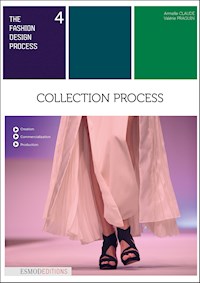
The fashion design process
Creation
Commercialization
Production
4
ArmelleclaudéValérie praquin
cOLLECTION PROCESS
10
25
45
70
sommaire
CREATION
Production
Commercialization
4 introduction
6 Evolution of the fashion market
11 Birth of a collection
17 Search for inspiration
23 Search for raw materials (Fabrics and trims)
29 Design research
35 Developing a collection plan (CP)
41 Muslins*: fittingand construction
47 Creating technical files and spec sheets
Creation
Commercialization
55 Styling the outfits
59 Calculating cost and wholesale prices
65 Sales book
69 Sales at trade fairs or in showrooms
Production
74 Organization and follow-up of production
Professions and skills
81 fashion jobs
102 Calendar of presentations and deliveries
103 overall Vision of the process
104 vocabulary
•
TABLE OF CONTENTS
4
Collection: this term associated with fashion promises dreams and beauty.
Everyone passionate about fashion waits feverishly for the presentations during the internationally-renowned Fashion Weeks which unveil the collections of the fashion houses.
Today’s ever more frantic consumer rhythm catches us up in a maelstrom where collections follow each other in rapid succession, sometimes up to six or eight per season.
This “major production”, which appears to be made
from imagination and pleasure, actually hides a well-established process that balances creation and production, craftsmanship and industry, sequins and dollars.
This book brings you behind the scenes to understand how collections are born, organized and manufactured.
Though the industry may be fragmented, the collection process itself is universal in the phases which compose it and the collaborators involved.
introduction
TABLE OF CONTENTS
Fashion is a form of ugliness so intolerable that we have to alter it every six months.
Oscar Wilde
„
•
6
Introduction
TABLE OF CONTENTS
6
Evolution of the fashion market
The fashion market is broken down in 3 main areas which define the different price ranges*:
Haute couture (HC)
Ready-to-wear (RTW)
Fast fashion
Mass market
Haute couture
The primary fashion vehicle in the modern sense of the term, it proposes a luxurious approach to clothing using top-quality, exceptional fabrics for one-of-a-kind, made-to-order garments with exquisite finishings.
Originated during the late 19th century by Parisian couture designer Charles Frederick Worth, it remains an exclusively
French term. It is reserved for a rich, privileged clientele who are the only ones capable of affording these presti-gious creations.
Presented in seasonal fashion shows, these collections are the opportunity for couture houses and craftsmen to show their skills and their capabilities for innovation.
The couture industry is overseen by Paris’ Chambre Syndicale de la Haute couture, created in 1868, which sets very precise criteria for obtaining the designation of “Couture Designer”.
La Chambre Syndicale de la Haute couture:
An organization grouping together all Parisian couture houses. Each season it elects new or associate members. Its advisory board, currently presided over by Mr. Ralph Toledano, submits a list to a commission headquartered at France’s Ministry of Industry which then issues a decree. The designers given the term benefit from the legally protected Haute couture designation. They are
7
Introduction
TABLE OF CONTENTS
7
also allowed to sponsor guests each season on the couture fashion show calendar.
2015 data listed 15 member companies with a calendar of 30 fashion shows for the season.
In the same way, the French Federation of Couture and Ready-to-Wear for Couture and Fashion designers was formed in 1973 that grouped together :
The Chambre Syndicale for Couture, Ready-to-Wear and Fashion designers;
The Chambre Syndicale for Menswear Fashions.
Today these 3 institutions include about one hundred French and international members.
Ready-to-Wear
After World War II, France’s Haute couture houses increased their propositions by creating models in standard sizes. They could thus be sold in stores and have a broader retail distribution. In the 60’s, this standardization process developed thanks to brands like Cardin, Courrèges or even Yves Saint Laurent. With simpler, industrialized construction, the garments cost less and ready-to-wear was born.
Since then, the concept has spread internationally.
With this diversification, RTW is broken down into different price levels:
Couture RTW
These are the RTW lines of couture houses. The collections are inspired by the Haute couture line but are adapted to industrial production and are suited to everyday wear.
Sales points: the parent companies are located in the “Golden Triangle” of Paris (bordered by the Avenue Montaigne, rue François 1erand the Avenue Georges V) where the creation, fabrication and sales of couture collections take place.
Luxury
A sector composed of brands with tradi-tional know-how and craftsmanship who often got their start in the leathergoods industry (Hermès, Gucci, Prada,…). By using codes linked with their original activity, they have created a global universe (fashion, accessories, items for the home,…). They entrust the creation of their lines to designers who are either well-known, have an impressive resumé… or both. The companies also spend a considerable amount of money on advertising. At the core of their success and what has built their reputation: a high-end image strategy with an adapted marketing.
Sales points: free-standing boutiques*, in-house boutiques, multi-brand shops* and concept stores.
Designer
A signature collection with a unique universe linked to the personality of its designer (with the exception of Comme des Garçons, the brand created by Rei Kawakubo which does not carry her name). This category appeared in the 80’s with the arrival of Japanese designers who proposed an alternative to RTW couture and Luxury. Though offering high-end products, their fashion vision
•
8
Introduction
TABLE OF CONTENTS
8
is more in synch with modern society and their collections are destined to be worn by “younger” clients.
These pillars on the fashion planet are now generally owned by international corporations or financiers.
Sales points: free-standing boutiques*, in-house boutiques, multi-brand shops* and concept stores.
The success of these brands contributed to fashion’s evolution in the 90’s and their role in society opened the doors to a new generation of designers: “Young Designers” or Independent Designers.
Independent Designers
These more affordable, signature brands propose collections which don’t make creative conces-sions and are highly personal. They have become part of the clothing landscape for fans of fashion.
Sales points: a network of free-standing boutiques*, in-house boutiques, multi-brand shops*.
RTW Diffusion
Brands proposing collec-tions which follow current Luxury or Creator trends.
Sales points: free-standing boutiques* and a franchise* network, in-house boutiques, multi-brand shops*.
Fast Fashion
A term that designates companies whose goal is to renew collections as quickly as possible by offering products directly linked with current trends at affordable prices. These brands must be both reactive and flexible in their production process and be able to manage an extremely short-term logistical fluidity. These garments have a short life cycle and are not destined to be kept more than one season. Instead, their objective is to incite the client to continually update his or her wardrobe!
Sales points: Zara, H&M,…
Mass market
Dedicated to the mass market, companies in this sector propose garments in standard sizes, produced rapidly in large quantities at lower costs, allowing for a frequent turnover in the stores with prices easily accessible for consumers.
Retail: in the group’s free-standing stores*.
Designer
RTW
9
Introduction
9
Creation
Manufacturing quality
Product ranges
Presentation
Distribution
Advertising
Directly inspired by the Haute couture presen-tations of the parent company (Dior, Chanel,…):
Creative innovation
A precursor
Very high end
Handcrafted, added values: embroideries, beadings, laces…
RTW, acces-sories, cosmetics, fragrances, licences
Fashion show and showroom*
International distribution, free-standing boutiques*, multi-brand shops*, in-house boutiques, franchises
Fashion shows
Big adver-tising budgets
Brands belonging to large luxury groups (LVMH, Gucci Groupe,…) or those with a craftsmanship tradition (Hermès, Prada,…).
Creative director: often well-known designer with strong marketing savvy…
Precursor of trends
Very high-end industrial:
Handcrafted added value: embroideries, beadings, laces,…
Broad range: RTW, acces-sories, cosmetics, fragrances, licences (from accessories to home)
Fashion show and showroom*
International distribution, free-standing boutiques*, multi-brand shops*, in-house boutiques, franchises
Fashion shows, special events, sponsor-ships.
And sometimes: huge adver-tising and promo-tional campaigns
Signature brand with strong identity (Martin Margiela, Jean-Paul Gaultier,…).
Conceptual and innovative
Precursor of trends
Very high-end industrial
RTW and accessories, sometimes cosmetics and fragrances
Licences
Fashion show, showroom* and trade fairs
Internationally known at retail.
Free-standing boutiques*, multi-brand shops*, in-house boutiques
Fashion shows,
ad campaigns, co-branding
Signature brand, a cultural identity and accessible style (Isabelle Marant, Sonia Rykiel, Tsumori Chisato…).
Precursor of trends
High-end industrial
RTW and accessories
Fashion show, showroom* and trade fairs
Sold inter-nationally: free-standing boutiques*, multi-brand stores*, in-house boutiques
Fashion shows
Lower advertising budgets
Brands that “follow” trends
Well-made industrial manufacturing
RTW and accessories
Showroom* and trade fairs
Sold inter-nationally. Free-standing boutiques*, multi-brand shops*, in-house boutiques
Sometimes: targeted ad campaigns
Differences and similirities of player in the RTW market
RTW couture
Luxury
Designer
Independent designer
Retail RTW
•
Presentation calendar
January
February
March
April
May
June
July
August
September
October
November
December
Women
Pre-fall*
Haute couture SS
RTW FW
RTW FW
Cruise*
Resort
Pre-spring*
RTW SS
RTW SS
Haute couture FW
SS : Spring-SummerFW : Fall-Winter
*Vocabulary p. 85
Men
11
Introduction
TABLE OF CONTENTS
11
Pre-fall*
Haute couture SS
RTW FW
RTW FW
Cruise*
Resort
Pre-spring*
RTW SS
RTW SS
Haute couture FW
Birth of a collection
The origins of RTW gave birth to the idea of a collection. In the past, Haute couture had proposed a succession of models without a true link, each piece demonstrated the couture designer’s talent.
The desire to propose numerous, more accessible models, meant putting in place an overall reflection that optimized creation, management and production of products.
A collection is a number of coherent, varied models that answer the different expectations of a client.
Since it represents the biggest number of companies in the clothing industry, by studying RTW you will discover the steps for the process of developing a collection from the initial inspiration to putting garments into production.
However, each brand is distinguished by its structure, positioning, product offer, image, company policy and marketing strategy plus how it presents itself to clients.
Brands also vary in their activities and annual calendar. For this reason, we will follow – in parallel –the conception and putting in place of an “independent designer” collection (a small structure, modest means, trendy image) and a RTW “diffusion line” (a larger structure, more money invested, an understandable fashion image).
Presentation calendar
To begin, let’s look at the calendars of different markets which present collections.
From this, we note that the HC cycle differs from the other markets.
The HC presents its collections one season before it delivers to clients, while companies in the other sectors are one year - meaning two seasons - in advance.
For RTW, the quantity of models and the fact that they are manufactured indus-trially, means that setting up production takes more time and requires more specific, organized steps.
•
12
Introduction
TABLE OF CONTENTS
12
Comparative flow chart
A company’s human structure, another key parameter, also has repercussions on the tasks to accomplish and how to organize them.
The breakdown of the flow chart for different types of RTW companies, presented below, is a reference model. Though everything is noted on the sketch, each company has specific points that we will not be addressing in this book.
RTW
Designer
13
Introduction
TABLE OF CONTENTS
Smaller companies are generally composed in the following way:
• designer,
• director/manager, the designer’s “alter-ego”, responsable for managing the company as well as sales and communication strategies.
Often designers work as part of a pair – well-known designer/manager tandems include Yves Saint Laurent and Pierre Bergé, Felipe Oliveira Baptista and his wife Séverine, Marc Jacobs and Robert Duffy.
2 distinct groups stand out in this analysis by their structure, indicating a fashion that functions differently: the “independent designer” and the “others”.
To make things simpler, we will call them “Designer” and “RTW”. They will determine our approach in the Collection Steps.
Collection cycle
Designer
•
14
Introduction
TABLE OF CONTENTS
14
Organization of the Creation phase
TABLE OF CONTENTS
Creation
•
16
Creation
TABLE OF CONTENTS
17
Creation
TABLE OF CONTENTS
Search for inspiration
The search for inspiration, the first step in elaborating a new collection, is both panoramic and synthetic.
It consists of laying down thematic bases for fashion directions by using icono-graphic panels which give a creative impulse for the next season.
These panels, or “mood boards”, are the grounds for reflection to conceive a collection, they are the style guides.
WHY?
To present themes in order to develop and define:
the season’s codes;
the color range*;
new shapes, lines and proportions;
details and finishings;
the season’s essential* products, which will lead themselves to the creation and conception of exclusive product lines, motifs* and prints (wovens, knits) which take into account the brand’s style and image.
HOW?
The search for inspiration is not approached in the same way by a name designer or a ready-to-wear company. The designer is much freer. In contrast with players in the RTW industry, he does not follow trends, he creates them.
Step 1:DEBRIEFING
Sales and marketing services go over the sales of past seasons:
what worked or didn’t and thus what should be continued and how to incor-porate it in the line;
competitors’ products which the company will either try to compete with or seek to distinguish itself from;
new, overall behavior trends (which often precede visible consumer trends);
consumer behavior which has appeared among the company’s clientele and for which an appropriate response must be found (new product range, specific assortments, product lots or sets,…).
•
18
Creation
Step 2:INSPIRATIONAL RESEARCH
This consists of taking the “fashion pulse” of what name designers are currently doing, keeping an eye on the competition and being aware of new phenomenons in society and what influences them (media, art, history, street…). The objective of this analysis is to assure the brand’s “trendiness” and validate its orientations. Thus, the design studio* can put its own themes in place.
It is vital to know what is being done in the market* to distinguish yourself.
The designer can also use “trend books” published by trend offices. This approach gives access to a broader vision besides just what is currently happening for creation and consumer consumption, and can have a reassuring effect as the themes to develop are being selected.
Step 3:MATERIAL DIRECTION
Research done on 3 axes:
Respect the imperatives linked to the season.
Respect the wardrobes that make up a collection which are determined by a precise fabric vocabulary (ex: suitings for Businesswear, cotton bases for Casual,…).
New items that follow trends and set the tone for new collections.
For his signature label*, the designer only works in relation to his personal universe and doesn’t take trends into account.
Step 1:DEBRIEFING
Though marketing is




