


Erhalten Sie Zugang zu diesem und mehr als 300000 Büchern ab EUR 5,99 monatlich.
- Herausgeber: ESMOD
- Kategorie: Lebensstil
- Serie: The fashion design process
- Sprache: Englisch
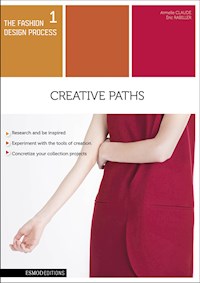
Research, be inspired, experiment and concretize your fashion collection projects
The first volume of ""The Fashion design process” series, Creative paths lays the base for the creative process today in the fashion world. Numerous techniques and tools can help one develop ideas, stimulate methods of thinking... and create. Look at things differently, research freely, without restrictions, take time to experiment, be conscious of the context in which you must express your creativity. This is a thought process of a creative person on an every day basis.
ABOUT THE AUTHORS
After studies in graphic design in Maryse Eloy school of arts,
Armelle Claudé also study interior design in Camondo. There, she discover a passion for fashion and graduate from ESMOD, ready-to-wear course. She start as assistant for Nathalie Garçon during 3 years and then work for brands like Bill Tornade ; Gérard Pasquier ; 1, 2, 3 or Ellesse as freelancer. In 2001, she found, with Éric Rabiller, a creation and consulting agency
Rose pour les filles, bleu pour les garçons ... She also share her passion with the new generations, teaching in parisian fashion schools.
Éric Rabiller discover his fashion passion through architecture. Graduated from ESMOD he worked for luxury haute couture and leather goods for brands like LVMH, Rihcemont or The Limited in the USA. He also designed ready-to-wear men's accessories. In 2001, he found, with Armelle Claudé, a creation and consulting agency
Rose pour les filles, bleu pour les garçons ... He also teach fashion drawing.
Sie lesen das E-Book in den Legimi-Apps auf:
Seitenzahl: 57
Veröffentlichungsjahr: 2021
Das E-Book (TTS) können Sie hören im Abo „Legimi Premium” in Legimi-Apps auf:
Ähnliche














TABLE OF CONTENTS
1
•
Table of contents
12
38
29
introduction
6Definitions
6Fashion: an applied art
7Designer: a creative person who has become practical
9The creator: a free, alternative spirit
11the Garment
12AREAS FOR USE
13Products and their identifying codes
18The wardrobe
creative process
29RESEARCH
29Collecting
31Organizing
32Brainstorming
37Analogy: helps the idea emerge
38Organize by theme: develop the idea
39Formalizing
39The mood board
Table of contents3Table ofcontents
6
Table ofcontents
91
41
51
77
40Experimenting
412-D experiments: collages or photomontages
42Substitute and rework: the “window” collage
44Combine: the creative collage
45Adapt
46Accumulate
47Shift
48Hybrid
513-D procedure
52”Creative” draping
62Manipulating vintage or second-hand pieces
70Produce and develop
77Communicate
79Research
82Portfolio
87The Shooting
90CONCLUSION
Concept
TABLE OF CONTENTS
•
4
Introduction
The Fashion cycle, as we know it today, imposes an ever-more-frequent renewal of our clothing wardrobe.
Like any other market that depends on the principle of consumption, this cycle means that it:
questions itself numerous times during the year;
fulfills new consumer needs and behaviors;
proposes a style and aesthetic in synch with our era.
the creative process is a key development tool if we want to meet the 3 imperatives: creation, adjustment, aesthetic..
Though creative potential may be une-qual among individ–uals, it can still be taught and thus be accessible to anyone.
Various techniques and tools can help us develop and stimulate our thinking methods. In the end it is a question of viewpoint, approach and discernment:
know how to look at things another way and think differently,
take the time to experiment,
be creative in your work methods.
This is the path any creative person uses to arrive at a result.
Throughout this book, you will discover a selection of creative techniques that, when applied to your future fashion projects, will help you imagine new perspectives.
But before going further, let’s explain a few essential bases.
Without imagination, there would be no creation.
Albert Jacquard
„
TABLE OF CONTENTS
introduction
Mary Tuma, Homes for the Disembodied, 2000. 50 meters of silk chiffon, thread, wire. In the Farhat Museum collection
TABLE OF CONTENTS
•
6
introduction
Applied Arts:a term used for all areas of scientific activity where theoretical research is used to resolve practical problems.
LAROUSSE
A fashion product exists not just for the quality of its aesthetic value – too often emphasized as the only concern – but also for its practical or functional quali-ties, the same as for any other product created with its final use in mind.
Definitions
Today, fashion is one of the many sec-tors that produces objects linked with a person’s immediate environment.
Producing a garment, to which is linked a complete chain of creative collaborators and technicians, means both creating a shape – to be constantly updated – and analyzing its function. A garment’s pri-mary purpose is to cover the body when outside one’s home. Its second purpose is to help cope with different climates.
Fashion: an applied art
This approach to a product in its concep-tion phase lets us qualify Fashion as an Applied Arts activity.
PEAU DE PUTE / HURENHAUT / HOOKED leaf gilding on shaved fur
TABLE OF CONTENTS
7
introduction
of a consumer society in the 1960s, the fashion industry organized itself to offer fashions to the mass market that had previously been associated only with Couture Designers.
Then the first Fashion Designers – stylistsin French-appeared (they “styled” cou-ture designs). These expert professionals were able to analyze the market and understand consumer expectations. Their role was to adapt collections inspired by the French fashion houses to manufactu-ring techniques by using industrial tools and their accompanying restrictions.
Couture Designer OR Designer:a person who defines the products of a couture collection and oversees their execution.
LAROUSSE
Designer: a creative person who has become practical
A bit of History…
In 1857 Charles Frederick Worth intro-duced the profession that today we refer to Fashion Designer. Using the term Couturier (couture designer), the “Collection” he presented in his couture house had characteristics we still see today:
seasonality,
an updated style,
products adapted to a specific activity or moment,
presentation of clothes on live models,
an accessorized silhouette,
fashion shows.
The democratization of fashion products during the industrial period and later, in the 1950s with the birth of Ready-to-Wear, duplicated this scenario on a larger scale. To meet the growing needs
TABLE OF CONTENTS
•
8
introduction
Since he is both creative and conscious of commercial imperatives, the designer must find a compromise between fashions with a high standard of style that have an attractive, competitive offer and take into account an increasingly aware consumer·
By conscientiously observing his envi-ronment, he must be capable of iden-tifying a market problem and offering a pertinent answer while respecting precise specifications.
His artistic and technical training, his sense of aesthetics, shape, color and materials allow him to reflect the demand in his creations.
Today, their job has become more com-plex and tends to be similar to that of a designer. Even though they are creative, they must be capable of analyzing and understanding the market’s expectations: this is the job of a Fashion Designer.
Design:comes from the Latin word designare: marking a distinctive sign. In French, it means both “design” or “intent” (to create something, a project) and “drawing”. In the French language, it thus associates two elements: an idea and its representation.
Designer:a person who conceives a product by harmonizing both its aesthetic and functional criteria. He or she is the interface between the sales staff, who determines client needs and the production department. The designer brings together the imperatives of both groups to formalize their input in an intelligentproduct.
CNRTL - LAROUSSE
Today, the profile of a designer is more specialized.
The importance of marketing in a collec-tion strategy obliges the designer to look at his work with a more practical eye.
TABLE OF CONTENTS
9
introduction
By defining fashion through their strong personal universe and creative concept, Creators offer never-before-seen visions. The successive waves and influences of their new trends will resonate over the next decades.




