


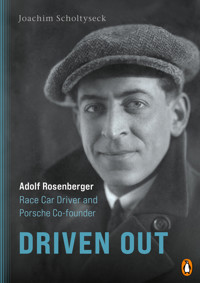
Driven Out - Adolf Rosenberger – Race Car Driver and Porsche Co-founder E-Book
Joachim Scholtyseck
34,99 €
Mehr erfahren.
- Herausgeber: Penguin Verlag
- Kategorie: Geisteswissenschaft
- Sprache: Englisch
In the 1920s, Adolf Rosenberger was one of Germany’s best known racing car drivers. He was also co-founder and managing director of a design firm that had recently been launched by Ferdinand Porsche, and it was his job to ensure financing for the design firm – a firm that provided important impetus during this time for technical innovation and racing car construction. When the firm fell into difficulties during the global business crisis, he ended up stepping away from his management role in the company, but remained active as partner and “foreign representative”. The Jewish Rosenberger was however unable to escape the increasing persecution by the Nazis: in 1935 he lost his shares in the company and landed for a time in a concentration camp. After emigrating in 1938 he would go on over the following decades to develop a precarious new existence in the USA. Compensation and restitution proceedings that he initiated against the company would end up severing any remaining ties with the now internationally renowned sports car manufacturer. This book, drawing on documents that have remained unpublished until now, frames and analyses the exceptional and moving biography of Adolf Rosenberger.
Das E-Book können Sie in Legimi-Apps oder einer beliebigen App lesen, die das folgende Format unterstützen:
Seitenzahl: 1124
Veröffentlichungsjahr: 2025
Ähnliche
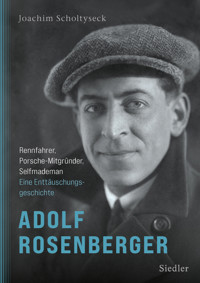












Joachim Scholtyseck
Driven Out – Adolf Rosenberger
Race Car Driver and Porsche Co-Founder
with contribution of Alexander von den Benken
Der Verlag behält sich die Verwertung der urheberrechtlich geschützten Inhalte dieses Werkes für Zwecke des Text- und Data-Minings nach § 44 b UrhG ausdrücklich vor. Jegliche unbefugte Nutzung ist hiermit ausgeschlossen.
If this publication contains links to third-party websites, we do not assume any responsibility for their content, as we do not adopt them as our own but merely refer to their status at the time of initial publication. The publisher has made every effort to identify all rights holders, to name them in accordance with publishing standards, and to compensate them. If we have been unable to do this in any individual case, we will, of course, fulfill any justified claims.The contents of this ebook are protected by copyright and contain technical safeguards to protect against unauthorized use. Removal of these safeguards or any use of the copyrighted material through unauthorized processing, reproduction, distribution, or making it available to the public, particularly in electronic form, is prohibited and can result in penalties under criminal and civil law.The publisher expressly reserves the right to exploit the copyrighted content of this work for the purposes of text and data mining in accordance with Section 44b of the German Copyright Act (UrhG), based on the European Digital Single Market Directive. Any unauthorized use is an infringement of copyright and is hereby prohibited.
Copyright © 2025 by Penguin Verlag, Munich,
A member of Penguin Random House Verlagsgruppe GmbH,
Neumarkter Straße 28, 81673 Munich, Germany
(The above information is mandatory according to GPSR and should be used for all queries relating to the safety of our books.)
Translation from the German: Noel Maurice
Editing: Karin Sirois
Cover Design: Büro Jorge Schmidt, Munich
Layout and typesetting: Markus Miller, Munich
Separations: Regg Media GmbH, Munich
ISBN 978-3-641-33579-3V001
www.penguin-verlag.de
Table of Content
Research Questions, Methodology, Sources
1 Pforzheim: Origin, Family, Childhood, and Youth
2 The Rosenbergers in the 1920s: From Hardware Store to Silver Screen
3 Adolf Rosenberger at Daimler-Benz: “Gentleman Driver” and Media Star?
4 Enzufer or Kronenstrasse? The Collaboration Between Adolf Rosenberger and Ferdinand Porsche Begins
5 Executive Shareholder: Tough Beginnings in a Sluggish Economy
6 Motor Racing Entrepreneurs: Auto Union and Hochleistungs-Fahrzeug-Bau GmbH (H. F. B.)
7 Parting Ways? Adolf Rosenberger’s Farewell as Managing Director of Porsche GmbH
8 Porsche in the “Third Reich”: Hitler Enters the Racing Car Game
9 Swing Axles and Patents: Adolf Rosenberger Becomes Porsche’s Foreign Representative
10 Moving Forward: The Volkswagen
11 Book Values: The Transfer of Business Shares and Adolf Rosenberger’s Withdrawal as Partner (1935)
12 Kislau Concentration Camp: Adolf Rosenberger’s Arrest, Imprisonment, and Release (1935)
13 Adolf Rosenberger and the Inevitable Farewell to Pforzheim
14 Porsche Saves on Taxes: From the GmbH to the KG (1937)
15 Eyes on the USA: America as a Way Out and Adolf Rosenberger’s Farewell to Europe
16 The “Aryanization” of the Rosenberger Family’s Pforzheim Properties
17 Adolf Rosenberger in the “New World”
18 A New Start in the USA: From Detroit to Beverly Hills
19 “Zero Hour”? The Seizure of Porsche Company Assets After World War II
20 Porsche/Robert 1945 to 1949: The Calm Before the Storm
21 The Restitution Proceedings Before the Restitution Chamber of the Regional Court of Stuttgart (1949/50)
22 Burying the Hatchet? Porsche and Alan Robert in the 1950s and the Hope for a Porsche Car Dealership
23 Alan Robert or Max Hoffman? The Battle for the General Distributorship of Porsche in the USA
24 “Reparations” and Restitutions in Pforzheim
25 From Majolica Figures to Coachcraft: A New Automotive Career for Alan Robert
26 A Retirement in the Northern Black Forest?
27 Reception: The Public Portrayal of Adolf Rosenberger in the Post-War Period
Conclusion: Adolf Rosenberger – A Tale of Disappointment?
Acknowledgments
Appendix
Notes
Sources and Archives
Bibliography
Index of Names
Index of companies and institutions
Research Questions, Methodology, Sources
Adolf Rosenberger’s life can be divided into two periods. Until the early 1930s, he enjoyed the high life of a racing driver, with his successes coming one after another. He was so well known that he even graced the cover of ADAC-Motorwelt magazine. As a man with gasoline in his blood, he made the leap after his sporting career to become a promising businessman in the automotive world. When Ferdinand Porsche initiated the founding of a design firm—in today’s parlance, a “start-up”—Adolf Rosenberger acted as co-founder, managing director, and partner, alongside co-founder Anton Piëch. Alfred Neubauer, the long-time racing director of Mercedes-Benz—who had known Rosenberger well ever since he first broke records in the then very popular hill-climb races, and who remained friends with him until the end of his life—remarked after Rosenberger’s death that he had been a “lucky man in his youth.”[1] It was only with the rise and establishment of National Socialism that the above-mentioned dichotomy in his life story became palpable: Rosenberger, who like most racing car drivers had not faced significant discrimination in the racing industry for many years, was, as a Jew, increasingly ostracized from 1933 onward, and by 1935 was forced to relinquish his business partnership completely. As a result, he disappeared from the collective memory, both as a key figure in motorsport and in Porsche’s corporate history, unlike other racing drivers whose names are still part of public lore as almost heroic figures today, such as Rudolf Caracciola, Hans Stuck, and Bernd Rosemeyer.
In his central role as co-founder of the Porsche design office, Rosenberger was either not mentioned at all or only in passing, or else in footnotes alongside engineers such as Karl Rabe and Erwin Komenda, who, although they were influential designers at the time, are today only known to motorsport enthusiasts. However, the shadow of Ferdinand Porsche, who is regarded as somewhat of a genius, loomed the largest. There was no light left to shine on the Jewish businessman from Pforzheim, who had to leave Germany in 1938, built a new life for himself in exile in the USA, and from then on played no role at all in German automotive history.
The events described and analyzed in this book seem at times like the events of a long-lost world: the racing cars in which Adolf Rosenberger roared to his victories, with their thin tires, were like hyper-motorized monsters that have little to do with the Formula I cars of today. Many of the automobile companies Rosenberger was involved with, first as a racing driver and then as a businessman, have either long since closed their doors, fallen by the wayside in the wake of structural change and globalization, gone bankrupt, or been taken over by competitors. The design office founded in 1930, which plays a central role in this study, has also long since ceased to exist. From today’s perspective, however, it was the nucleus of Porsche AG, which, with an annual turnover today of over 30 billion euros, is one of the largest German industrial companies, employing over 36,000 people worldwide. The sports car manufacturer, which has become synonymous with German engineering excellence, is a global player, in contrast to many other German high-tech companies, which tend to be seen by the public as hidden champions. The Porsche and Piëch family business controls car brands from Audi to Lamborghini as part of the Volkswagen Group. Unlike the Porsche designs, the Porsche sports cars were only developed and marketed after 1945. The best known of these is probably the Porsche 356, a sports car with a rear engine, which was largely based on the ideas of the VW Beetle. Rosenberger was still driving this Porsche model on the highways of Los Angeles when he had long since changed his name. The Porsche 911 introduced in 1963 also became legendary, a sports car icon that is probably even better known than the Citroën DS, whose shape and technology famously inspired the French philosopher Roland Barthes to write his essay on cars, describing them as “an almost exact analog of the great Gothic cathedrals.”[2]
What follows is therefore a matter of rescuing Adolf Rosenberger from obscurity and contextualizing him in the circumstances of his time. By the same token, this also means not reducing him to his professional activities at Porsche but rather portraying him properly, both as a Pforzheim resident and as an American citizen, within his social environment. This turns out to be no easy task. In contrast to Ferdinand Porsche and his entourage, who can be portrayed and characterized in comparatively great detail, the frequent lack of sources on Adolf Rosenberger sometimes made him appear rather pale as a person. His hopes, dreams, and fears—as well as his joy, which shines through in many early photographs—remain largely obscure. The fact that there is still no biography of Adolf Rosenberger is not only due to the unfavorable source material but also due to other reasons that will be explained in a separate, extensive section and analyzed in terms of the history of his reception.
In 2020, Sandra Esslinger, Adolf Rosenberger’s cousin twice removed, founded the non-profit Adolf Rosenberger gGmbH, and in April 2021, the organization approached Porsche. The aim was to conduct a more detailed investigation into the life and achievements of the Jewish co-founder of Porsche, Adolf Rosenberger, than had been attempted to date. The initial focus would be on evaluating the Rosenberger family archive managed by Esslinger in Los Angeles. In 2022, Adolf Rosenberger gGmbH and Porsche jointly commissioned me to undertake this task. The intention was to conduct an independent investigation and to present the entire life of Adolf Rosenberger/Alan Robert in a comprehensive, scientific, and independent manner, based on the relevant and yet unanswered research questions. I was granted unrestricted access to the material available in the respective archives (Rosenberger Archive and Porsche Company Archive). These documents were shared back and forth for better understanding and internal use. All further agreements and decisions were always made together with me as the author, responsible as I ultimately am for the results. The project was funded by a third-party grant at the University of Bonn.
One thing should be mentioned at this point: when referring to the name Adolf Rosenberger, it should be noted that Adolf Rosenberger changed his name to Alan A. Robert when he became a US citizen in 1943. From that time on, he signed under his new name; occasionally he also signed his name “Alan Robert, formerly Adolf Rosenberger.” He did not object, however, when old acquaintances continued to address him as Adolf Rosenberger. This study takes this renaming into account: everything concerning Adolf Rosenberger before 1943 is referred to by that name, while the protagonist is referred to as Alan Robert for events after 1943. This requires a certain attention on the part of the reader, but it corresponds to the dichotomy in his life mentioned above.
A quick look at the available sources shows the difficulties historians face when trying to piece together the life of this man. Alan Robert left no written record of his life, and he only rarely put anything in writing about his time in Pforzheim, the design office, and his early years in exile in the United States. In the absence of autobiographical accounts, the historian must therefore rely on a painstaking search for clues—a laborious task carried out in archives and sometimes with only fragments of files that, when compared with other sources, can be used to reconstruct a coherent, mosaic-like overall picture. Even so, questions often remain unanswered, and there is inevitably some room for interpretation.
The holdings of the Porsche AG Corporate Archive provide a central basis for Adolf Rosenberger’s work in the Stuttgart design office. However, these files are extremely patchy. After the design office moved from Kronenstrasse to Spitalwaldstrasse in 1938, numerous files were stored in the attic. After the war began, they were moved as a precaution to the basement, which was considered fireproof, but they were destroyed there in 1944 during a bombing raid.[3] Files were lost due to numerous relocations and probably also as a result of post-war attempts to “sanitize the files.” The scholarly requirements of the research project conducted by Wolfram Pyta, who was commissioned to research the early history of Porsche,[4] have led to numerous new entries since 2015. Research conducted for this work draws on additional sections of the corporate archive of Porsche AG, including files from the “Villa Porsche Furniture Storage” and archival materials from the “Supervisory Board Archive,” which was not known about until 2018. The records of the finance department and the restitution case files also come from the factory archive. The diaries of chief designer Karl Rabe and the (not fully complete)[5] copies of the diaries of Ghislaine Kaes, who served as a kind of private secretary to his uncle Ferdinand Porsche from the 1930s onwards, continue to provide a good insight into day-to-day business at Porsche.
The private collection in California, referred to here as the “Sandra Esslinger Archives,” provided another important basis for research. However, it is not a complete archive as such but more of a diverse collection. Alan Robert mainly kept things that were important for pension notifications and essential legal purposes, along with numerous documents relating to his professional activities as co-owner of the car company Coachcraft. This private collection was at first looked after by Hugo Esslinger, Alan Robert’s cousin, who immigrated to the United States in 1951. The collection is now in the care of Sandra Esslinger, the daughter of Hugo and Phyllis Esslinger. Phyllis Esslinger, who, as mentioned, had known Alan personally, was also happy to share her memories, which the study was able to use to add further details. Of course, the historian must always bear in mind that the accounts of contemporary witnesses “by no means reflect what happened; rather, their stories have been socially shaped and meaningfully constructed in a complex process.”[6]
One particularly important source is a large collection of letters written by Anne Robert, Alan Robert’s wife. In the postwar period, she maintained an intensive correspondence with her siblings in Pforzheim. Business matters were discussed in passing, and the exchange also provides a deep insight into the couple’s everyday life in California. These documents are part of the private collection of Hartmut Wagner in Pforzheim.
The situation regarding government records is far from satisfactory, especially for the years between 1933 and 1945. Some records from the Nazi era can be found in the State Archives in Ludwigsburg. However, all the records of the Foreign Currency Office, which was under the control of the Chief Finance President in Württemberg and could have provided information about the looted Jewish assets, were destroyed shortly before the end of the war in March 1945.[7] The documents of the Pforzheim branch of the Deutsche Bank, which would have been important for details about Adolf Rosenberger’s “Jewish capital levy,” were lost in the bombing of Pforzheim in February 1945. The same applies to the documents of the Pforzheim tax office and Karlsruhe State tax office, institutions that were involved in the illegal confiscation of the Rosenberger family’s assets.[8] At least some fragments of documents from the office for the confiscation of forfeited assets at the Berlin tax office Moabit-West are available. The registration records of the Passport and Registration Office of the Pforzheim Municipal Police Headquarters, however, were lost in the air raid of February 1945.
Despite the destruction caused by the war, the Pforzheim City Archives offer a reasonable source of information, especially for research into the real estate owned by the Rosenberger family in the city center, supported by a newspaper clipping documentation. The Zwickau City Archives contain documents relevant to the Zwickau automotive industry. Some materials—in particular, on Ferdinand Porsche’s first major order, the Auto Union race car project—can be found in the corresponding collection of the Saxon State Archives in Chemnitz. Numerous insights can be gained from the files on restitution and reimbursement in the years after 1945. These holdings, which are kept at the General State Archives Karlsruhe, provide information—albeit in a rather disorganized manner—about the lives of Adolf Rosenberger’s family, as well as about the legal proceedings from the 1940s through to the 1960s. Key documents, records, and letters from the period when Rosenberger was managing director and partner in the engineering office had to be reconstructed from the trial documents of the 1949/50 reparation proceedings and reproduced in a “secondary” manner, so to speak. The authenticity of numerous documents presented by Porsche during those months was officially recognized by Alan Robert, so they can be regarded as valid sources. However, the fact that these important primary sources, which must have been available at Porsche at least until the end of the proceedings in the fall of 1950, have now disappeared is both unusual and in need of explanation.
Additional relevant material was examined and evaluated in other archives: these include the Archives Nationales (Paris/Pierrefitte), the Main State Archives in Stuttgart, the Historical Archives of the Deutsche Bank, the Economic Archives of Baden-Württemberg, the Political Archives of the Foreign Office, the State Archives in Munich, the Federal Archives in Berlin-Koblenz and Bern, the Prototyp Museum Archives in Hamburg, the Corporate Archives of Volkswagen AG, the Mecklenburg State Archives in Schwerin, the Hamburg Institute of International Economics, the Historical Archives of Audi AG, and the Rastatt District Archives. The attempts to view relevant sources in the Daimler-Benz AG Historical Archive proved extremely difficult; the request to research the files ourselves was rejected—a lamentable reversion to the practices of the old days when a lack of transparency reigned.
Adolf Rosenberger’s activities outside Germany after 1933 are poorly documented. The Centre d’archives de Terre Blanche in Hérimoncourt, France, where documents relating to the French companies Citroën and Mathis are kept, holds no records related to Adolf Rosenberger that could provide information on patent issues, for example.[9]
Memento: Adolf Rosenberger’s racing goggles.
© Sandra Esslinger Archives
Despite a number of gaps, however, the files still provide a solid foundation for tracing the life of Adolf Rosenberger. To begin with, a tour d’horizon presents the circumstances in Rosenberger’s native town of Pforzheim, the social environment from which he came, and the family constellations that shaped his life. The factors that explain his path into the world of racing are also analyzed. The political history is intertwined with the social and economic history. Likewise, when necessary and if it seems plausible, the approaches of cultural history are used when, for example, the patterns of education, career paths, generational experiences and impacts, and values and attitudes are examined. The study will also scrutinize Rosenberger’s service as a volunteer with the rank of “airman” on the Western Front in the First World War, before going on to explore the middle-class background that led the Rosenberger family to become cinema and property owners—aided by the friendly proximity of the wealthy relative and businessman Ludwig Esslinger—enabling a financially secure life in the center of Pforzheim during the time of the Weimar Republic. This security also provided the conditions for Adolf Rosenberger’s entry into the fascinating new world of motor racing in the 1920s, in which he achieved numerous victories as a “Gentleman Driver”—in other words, as a private driver with a semi-official function—for Daimler-Benz.
After this, the spotlight is turned to the launch of Rosenberger’s business career and his collaboration with Ferdinand Porsche in the latter’s design office, starting in 1930. As managing director and co-partner of the office on Kronenstrasse, Rosenberger was there to experience the company’s difficult early days in the midst of the global economic crisis. In the face of the correspondingly bleak business situation, he was the man responsible for finances and project acquisition. His role in the initiation of the company’s racing car contract with the newly formed Auto Union and in the founding of the high-performance vehicle construction company Hochleistungs-Fahrzeug-Bau GmbH (H. F. B.) in 1932 is also examined.
The question of why Rosenberger initially resigned as managing director in 1933 and then as a partner in 1935 is of key significance here. The relationships between Rosenberger and Anton Piëch, who worked in the background as the legally experienced “éminence grise” of the design office, are accordingly analyzed. The following fundamental questions must be answered: When Rosenberger left the company in 1935, was Ferdinand Porsche the instigator, or was he merely one of many who profited from developments that ultimately led to governmental repression and the forced removal of Jews from economic life? Did an inherent antisemitism play a role in the attempt to force Rosenberger, as a non-family shareholder, out of the company? The background to the transfer of the stake in July 1935 is also presented: Was this a normal business transaction that might also have taken place under democratic auspices, or is it more accurate to characterize it as “Aryanization” or “de-Jewification”? In this context, the changes in the social structures of the company that operated under the name of Porsche GmbH until 1937, and as Porsche KG from then on, are also investigated. Of great consequence is the controversial question of when Porsche was able to emerge from the red and when the company’s profit expectations began to promise a better future.
The question of the leeway within, and alternatives for, commercial decisions made by the company’s founder, Ferdinand Porsche, and his responsibility for the fate of his co-partner Rosenberger runs like an Ariadne’s thread through this book. In this context, the strategies of the Porsche company in the second half of the 1930s are also of interest, in which the role of the “Volkswagen” project, as well as Hitler’s unconditional support, provided a solid basis for further economic growth. The importance of Rosenberger as Porsche’s representative abroad after 1933 and his efforts to market swing axles and patents abroad are also discussed, as he continued in this official role for the company until 1938. Rosenberger’s life was profoundly affected by his arrest and imprisonment in the Kislau concentration camp in the fall of 1935. The reasons for his imprisonment and release—and who stood up for him—are also covered. The traumatic experience of concentration camp imprisonment prompted Rosenberger to leave Pforzheim for good and move the central focus of his life to Paris. This provides an opportunity to cast a glance at the conditions in Pforzheim, the town of gold and jewelry where the living situation for his parents and his sister’s family worsened dramatically. The chapter in question discusses the “Aryanization” of the family business, as well as Adolf Rosenberger’s considerations of building a new life in the United States when, in 1938, he could no longer be in any doubt that Porsche was going to break off contact with him. The route from Paris to New York, on to Detroit, and finally to Los Angeles, and the arduous attempt to establish himself in the “New World,” are retraced as closely as possible, although the source material for the years 1939 to 1943 is particularly thin.
Although there was no “zero hour” in Germany in 1945, the Allies’ judicial prosecution of Nazi crimes and the denazification process represent an opportunity to analyze how the fatal legacy of the Nazi regime was dealt with. With the end of the Second World War, attention thus turned back to Europe; after the confiscation of the company assets in Zuffenhausen, the gradual Porsche revival from its self-imposed Austrian exile provided the backdrop for a cautiously tentative re-establishment of contacts by Alan Robert with members of the Porsche family, contacts that were ruptured in 1938. The inability to reach an amicable and mutually agreeable settlement regarding adequate compensation led to a reimbursement process lasting several months in 1949 before the Restitution Chamber of the Stuttgart District Court, the background of which can be minutely traced through the written correspondence. The same applies to the arduous negotiations for restitution and reimbursement that Robert led on behalf of his family with the authorities in Pforzheim and Karlsruhe well into the 1960s. Robert’s attempts in the early 1950s to have a Porsche dealership set up on the US West Coast encountered numerous obstacles. A chapter is devoted to the question of why his plans to re-enter discussions with Porsche in the United States came to nothing. In a secondary strand, the Porsche strategies of the early post-war period are also looked at, since they offer a possibility to address the questions of continuity and rupture in the years of the “economic miracle.” They also provide an explanation for the lack of interest on the part of the new company boss, Ferry Porsche, in reinstating Alan Robert into the company. The path that Robert embarked on, in his guise as an American self-made man—namely trying out alternative business models, from a less-than-lucrative trade in ceramic products to a planned new beginning as a partner in Coachcraft, an automotive coach-building business—allows us a glimpse into the automotive city of Los Angeles, which had by then become his new home. The book also presents the later years of Robert’s life: his departure from the struggling Coachcraft in the late 1950s, his increasingly peaceful life beneath Californian palm trees, and his occasional musings on retirement on the slopes of the northern Black Forest.
A final chapter is dedicated to reception history, since Adolf Rosenberger was largely forgotten by the public after 1945. Although there were some attempts at rescuing him from obscurity in his role as a successful racing driver and as a co-founder of the Porsche design office, it was only through sustained initiatives in the 2010s that these efforts finally came to fruition.
This book is an attempt to paint an accurate picture of Adolf Rosenberger’s life, despite the evident gaps in the historical record. Historians and especially biographers must not allow themselves to be overly influenced by personal sympathies. They argue “without either anger or passion” and seek to use the available sources to get as close as possible to what they have established as historical fact, even if this means incorporating all the various unknowns. One of the basic principles of the discipline is that, however thoroughly a project is researched, it should ultimately raise more questions than it initially posed. This is no different for the figure of Adolf Rosenberger/Alan Robert. Changing perspectives, taking into account new and sometimes surprising findings, and engaging in ongoing scientific debate—this is the essence of historical research, and it is always accompanied by the fluidity of history, its Janus-faced and ambivalent nature. Thomas Nipperdey’s comment that history is not black and white but a sequence of shades of gray has already become a cliché and is often quoted in “soapbox” speeches, but it is still true—or, to modify it slightly, as Hermann Oncken said, the essence of history lies in the nuance. Even works with copious notes and references can be wrong on some points and are thus automatically subject to revision. This is the fate of the historian, who knows that at some point another researcher will determine that some findings need to be supplemented, and this applies not least to an academic study about Adolf Rosenberger.
Busy activity on Brötzinger Gass in Pforzheim in 1900.
© City Archive Pforzheim
1 Pforzheim: Origin, Family, Childhood, and Youth
At the end of the 19th century, Pforzheim was a thriving city with a liberal, business-oriented spirit, where numerous silversmiths and banks had set up shop. Jewelry, watches, gold, gems, fine accessories: these were the hallmarks of the city, but it was also home to engravers, etchers, and enamel manufacturers. It was not until 1935, however, that the term “Golden City at the Gateway to the Black Forest” was coined by the local tourist board. The number of mainly family-run, medium-sized jewelry businesses had risen to 550 by the end of the 19th century, of which only about a dozen were under Jewish ownership. On the other hand, four of the eight banks in the city had Jewish owners.[1] Aside from the numerous doctors and lawyers, the occupations of Pforzheim’s Jewish citizens generally reflected those of a typical business community in a medium-sized town: in addition to dealers of jewelry, precious stones, and watches, there were owners of textile, furniture, and shoe stores as well as hardware stores and ironmongers. Pforzheim was a center not only for jewelry but also for iron production; the company Gebrüder Benckiser was the most important local manufacturer of machinery and bridge construction. However, there were also numerous smaller metalworking shops and rolling mills that produced wrought iron brought in from elsewhere for the local jewelry industry, among others.[2] Due to the amount of international business it conducted, Pforzheim had a truly cosmopolitan flair, however strange that may seem today.[3] So there were good reasons to try one’s luck in the thriving city on the Enz.
The synagogue in Pforzheim in 1905.
© City Archive Pforzheim
Adolf Rosenberger’s father, Simon Rosenberger, was born on May 26, 1868, in Westheim (near Hammelburg in Lower Franconia) and moved to Pforzheim as a young man. Adolf Rosenberger’s mother, Emma, affectionately called Elsa, was the daughter of the banker Josef Esslinger. Elsa was born on November 29, 1874, in Mühringen in the Oberamt (i.e., senior administrative unit) Horb am Neckar. The couple married in December 1897 in Pforzheim.[4] Simon Rosenberger took over a hardware wholesaler there, which had originally been founded in 1837 by Hirsch Külsheimer. Under Rosenberger’s management, it operated as “Külsheimer Nachfolger, Ironware Wholesale” and advertised itself as “Export and General Agency of the leading domestic and foreign firms.” This line of business was typical for Jewish merchants: 70 percent of the metal trading firms in the German-speaking area and almost half of the iron and scrap metal trade were owned by Jews in the 19th century.[5] The premises of Külsheimer Nachfolger were located at 27 West Karl-Friedrich-Strasse and 5 Metzgerstrasse.[6] Simon Rosenberger ran the hardware store together with his partner Isaak Prölsdörfer; the company was therefore also known as Prölsdörfer & Cie or Prölsdörfer & Rosenberger during the course of its business operations.[7]
The Rosenberger family quickly felt at home in Pforzheim. Ever since the 18th century, the Jewish community had its religious center in a prayer hall on Barfüssergasse. After the “Judenedikt” (Jewish Edict) was proclaimed by Grand Duke Karl Friedrich of Baden and the constitutional laws of 1808/09 were enacted, a remarkable wave of emancipation took hold in the city.[8] During the heyday of liberalism, steps toward civil equality continued, which were coupled with an increase in the size of Pforzheim’s Jewish community. Alongside those who “assimilated,” as it was called at the time, there was a sizable group of devout Jews who were committed to self-assertion and Jewish identity and who maintained their Jewishness. They met in the new Moorish-Gothic-style synagogue built in 1893 on Zerrennerstrasse, a symbol of the “great period of synagogue building throughout Germany.”[9] The activities of the community were associated with a rich community life, characterized by a wide range of social and charitable activities, which were carried out by, among others, the Women’s Association, the Women’s Federation, and the Chevra Kaddischa charity. The independent Jewish order B’ne B’rith (also: B’nai B’rith) also promoted similar activities.[10] Around 1900, the Jewish community in the city had 435 members, or about one in every 100 inhabitants of Pforzheim. By 1927, this number rose to 1,000 members. The relationship between Christian Pforzheimers and their Jewish fellow citizens has been the subject of comparatively little research to date. In the 20th century, we know that social stratification could result in a weakening of religious harmony in the Baden communities. What we would call intercultural dialogue today was marginal. There is much to suggest that it was more a case of living side by side than living together. A history of the city published in 1901 stated that the Jewish community members were “mostly wealthy”; their “participation in community life” was “not lacking in comparison to other denominations.” However, there was already talk of an antisemitic movement that was also making itself felt in Pforzheim.[11]
From the end of the 19th century, Simon and Elsa Rosenberger moved several times in Pforzheim. In 1898, the couple lived at 28 West Karl-Friedrich-Strasse, right next to the company’s premises. In 1908, the family, which by now had grown to four members, moved to 11 Lameystrasse. In 1914, they moved again to 12 Zerrennerstrasse, and in 1919, their address was 39 Jahnstrasse, in the southern part of Pforzheim. The couple first had a daughter named Paula, who was born in Pforzheim on October 10, 1898. A year and a half later, another child came along, this time a boy. Adolf Rosenberger was born on April 8, 1900, at 7 Bohnenbergerstrasse, another residential address very close to Karl-Friedrich-Strasse.[12]
Simon Rosenberger was not only a hardware dealer but also owned property in Pforzheim. He was the owner of the building at 11 Leopoldstrasse in the city center, where Rosenberger and Isaak Prölsdörfer had likely relocated their company by 1908.[13] In the same building, Simon Rosenberger also ran a cinema, the “Central-Theater,” where, for example, Protea, a “grandiose detective and espionage drama” lasting two and a half hours, was performed in June 1914.[14] In the backyard of this building complex, there was a warehouse that was used by Simon Rosenberger as an iron storage space and which was accessible from Lammstrasse.[15]
A colorized postcard from 1910.
© City Archive Pforzheim
Little is known about the children’s upbringing in the Rosenberger household. From 1906 to 1909, Adolf Rosenberger attended the local elementary school and then went to the Pforzheim Friedrichschule-Oberrealschule (high school). The classes were quite large, with 40 to 50 students; well over half of them were Catholic, the rest Protestant, apart from the four or five students whose religious affiliation was listed as “Israelite.” In the Sexta (fifth form) in the 1910/11 school year, Adolf Rosenberger’s grades were no better than average. In French, the only foreign language, as well as in arithmetic and algebra, the assessment was “deficient.” Under “Remarks” was this entry: “In the event of repeated unsatisfactory grades in French, promotion will be refused next year.”[16] The following school year was no better: on top of a lack of application, his French was once again inadequate, and to make matters worse, his performance in calligraphy and shorthand was rated as equally poor.[17]
In the 1912/13 school year, his grades were also anything but inspiring. Although his behavior was graded between 1 and 2 (1 being the highest), his diligence fluctuated between 4 and 5. The individual subjects fared little better: Religion between 4 and 5, German between 4 and 5, French 5, English between 4 and 5, History between 3 and 4, Geography between 3 and 4, Mathematics 4, Drawing 5, and Physical Education between 3 and 4. Once, the class register entry stated “restless,” another time “lying and deception etc.,” and there were also complaints about “mischief during recess and in class.” So it was inevitable that at the end of the school year, the message was again: “Will not be promoted.”[18]
A view of Leopoldstrasse in Pforzheim in 1912. The third building on the right is No. 11. Those who look closely will discover the sign “H. Külsheimer Successor – Ironmongery”.
© City Archive Pforzheim
After that, Adolf Rosenberger’s parents had seemingly had enough of their son’s poor school performance: he was sent to boarding school and was enrolled at the private educational institution of Friedrich Rauscher in Stuttgart. This commercial college at 22 Werastrasse had been founded by its namesake during the Bismarck years and was meanwhile headed by Professor Carl Widmann. It had small classes and was connected to a boarding school where two to four “pupils” were housed in each bedroom.[19] Rosenberger remained at this boarding school until the third year of secondary school, the ninth grade, when he was probably 15 or 16 years old.[20] On May 24, 1917, he passed his driving test in Pforzheim, initially only for category 1, i.e., for motorcycles.[21]
As far as religion was concerned, although Rosenberger was a member of the Jewish community in Pforzheim,[22] it is unlikely that he regularly went to the synagogue there or, later in California, to the Fairfax Temple in Hollywood. There are no sources that suggest any kind of interest in the Jewish faith, either in Pforzheim or later in the United States. To try to construct him as a religious Jew would be to ignore the reality of his life. If he engaged with this cultural and religious sphere at all, it was done passively, except for when the Nazis and their racial fanaticism forced it into the foreground of his life. His future wife Anne Junkert, who came from a Protestant family, ultimately brought Christian rituals into their California exile: from Easter to Pentecost to Christmas, with a Christmas tree and “Silent Night” on the radio and everything else that went with it.
Oberrealschule Pforzheim, school notebook with grades from the 1913 school year.
© City Archive Pforzheim
The lack of interest in Judaism—or even Zionism—in bourgeois Jewish circles was by no means unusual. Emancipation and legal equality had contributed to a secularization that was in evidence everywhere. In a sense, one was German, felt culturally connected to the German world of education, and identified with Germany as one’s homeland. Socially, however, Jews tended to remain rooted in their own Jewish milieu and did not convert to Christianity. Especially in times of growing hostility toward Jews and antisemitism, there was even a kind of “defiant Judaism” through which people could show that they wanted to protect the identity of those who embraced Judaism and practiced their religion.[23]
In the fall of 1917, Adolf Rosenberger, 17 years old at the time, volunteered for military service “to be of service to the Fatherland,” as he later put down in a curriculum vitae.[24] His uncle, the entrepreneur Ludwig Esslinger, was probably a role model in this regard, as he had also volunteered for the military in 1914, commanded a prisoner-of-war camp for British officers at the end of the war, left the army as a highly decorated lieutenant, and received the “Honor Cross for Front-Line Veterans” (Ehrenkreuz für Frontkämpfer), otherwise known as the “Hindenburg Cross,” in 1934.[25] Adolf Rosenberger belonged to the age group of the “war youth generation,” those born between 1900 and 1910, who were exposed to a “non-stop drumbeat of propaganda” during the First World War with the intention of inspiring this generation to embrace the military.[26] However, Adolf was not among those who, as young men, had gladly and enthusiastically enlisted without a second thought, convinced of the justness of the fight against the enemy. At the end of 1917, the pointless “battle of material” was still in full swing. In the face of the bloodbaths in Flanders and on the Somme, the initial enthusiasm of the young recruits had given way to a sense of obligation to defend Germany in a bitter military conflict. In addition, the depressing experience of the “Judenzählung” (Jewish Census)—which the Ministry of War used to estimate the number of Jewish men who were exempt from military service—had already been burned into the minds of German Jews everywhere. (This form of discrimination would later be used to support the idea of Jewish draft-dodging and offered a foretaste of the antisemitic attacks to come.)[27]
Rosenberger was assigned to an air squadron for aircraft maintenance.[28] His being assigned to the air force was no coincidence, since this branch of the military was greatly expanded in the second half of the war as part of the “totalization” of the war effort. However, this had more to do with the combat squadrons than the support squadrons. Hundreds of aircraft were sometimes involved in air battles, especially in Flanders. Air wings, with four squadrons each, could comprise up to 64 aircraft.[29] The romanticized glorification of the pilot officer as a “knight of the skies,” in which technology was a major incentive, no doubt also played an important role in Rosenberger’s choice of which branch of the military to join.
On September 19, 1917, Adolf Rosenberger began his basic training in the 4th Company of the Royal Prussian Air Force Replacement Department 14 with the rank of “Flieger” (pilot).[30] On November 30, he was transferred to the 3rd Company, where he underwent a rigorous training program to qualify as an aerial observer, which lasted from four to six months.[31] Beginning in late March 1917, it became mandatory for novice fighter pilots, who were trained for about nine months, to attend a fighter squadron school.[32] It is unlikely that Rosenberger became a pilot—or even an observer—given his young age and his low rank of “Flieger,” a rank that he never rose above. It is possible, however, that he simply couldn’t complete his training in the short time available. Aircraft crews worked closely together as a team: pilots and navigators underwent highly complex training. Even later, Rosenberger never claimed to have been one of the 150 to 200 Jewish pilots or navigators who flew missions during the First World War. It was a different story for his later racing colleague Willy Rosenstein; Rosenstein was also Jewish, but being eight years older, he had already obtained his pilot’s license by 1912 and recorded numerous downings as a lieutenant during the First World War.[33] What Rosenberger thought about military drill, physical training, and eventual deployment at the front remains unknown, since everything that is known about his time as a soldier comes entirely from the scant information in his military ID. There is nothing about the fears, expectations, and hopes of a young man who went to the front in a war whose length was uncertain. From March 24 to May 13, 1918, Rosenberger was assigned to Flieger-Abteilung (Flight Unit) A 225. From March 28 to April 6, he was deployed in France to support a “pursuit battle” near Montdidier and Noyon, and from April 7 to May 13, he was stationed at the Avre and again near Montdidier and Noyon.
The “Cross of Honor with Swords” awarded to Rosenberger on December 6, 1934, “in the name of the Führer and Reich Chancellor.”
© Sandra Esslinger Archives
At that time, it looked for a short while as if the German troops would break out of the “Hindenburg Line” (Siegfriedstellung) and advance on Paris, as had been planned at the beginning of the war in 1914. However, because of the hopeless inferiority of the German forces in terms of manpower and material, and not least due to the supply of freshly arrived US troops, this spring offensive soon came to a grinding halt. Everything Rosenberger experienced after that can only fall within the category of last-ditch defensive actions. On May 14, 1918, he was transferred to the 7th Fighter Squadron, and then from May 14 to June 17, he was deployed in combat again on the Avre and near Montdidier and Noyon. On June 17, he was transferred again to an infantry replacement troop in Beverloo, Belgium. Two weeks later, he was transferred once more to the 28th Reserve Infantry Division, a large unit of the Prussian Army, which fought in a rearguard action between the Marne and Vesle. He must have been wounded there, because on July 14, he was taken first by ambulance to the military hospital in Sedan, and from there, four days later, on July 18, to the reserve military hospital in Bad Ditzenbach in Württemberg, where he remained for a month. In the end, this was a blessing in disguise because it meant he wouldn’t be thrown into the fray in the last months of the war. On August 18, he was transferred to the convalescent company of the replacement battalion of the 109th Reserve Infantry Regiment in Karlsruhe. Five days later, on August 23, he was assigned to the command company of the replacement battalion of the same reserve infantry regiment.
For Adolf Rosenberger, the war was over. On November 18, 1918, he was discharged from military service and returned to Pforzheim. As the records show, all the units that he fought with attested to his good conduct as a soldier.
Incidentally, his voluntary military service in World War I would come up again during the Nazi era: on December 6, 1934, Rosenberger was awarded the “Honor Cross with Swords,” or Hindenburg Cross, for front-line veterans, “in the name of the Führer and Reich Chancellor,” on the basis of the decree of July 13 of that year.[34] This award had been created to mark the 20th anniversary of the outbreak of war at the instigation of Reich President Paul von Hindenburg, who had died while in office in August of the same year.
Adolf Rosenberger’s military pass from 1917.
© Sandra Esslinger Archives
Rosenberger himself must have submitted the application to the Pforzheim police department, which was responsible for this; probably, like many other Jewish citizens, he assumed that as a former World War I veteran, he would be safe from National Socialist persecution. This was a misapprehension, as it soon turned out. Ironically, he was awarded the Honor Cross by the Pforzheim police director, the head of the very authority that was to take him into “protective custody” a few short months later.
The certificate for the awarding of the “Cross of Honor with Swords” in 1934.
© Sandra Esslinger Archives
Adolf Rosenberger in flying gear, circa 1918.
© Sandra Esslinger Archives
“The Blue Angel,” directed by Josef von Sternberg with Marlene Dietrich and Emil Jannings in the lead roles, was a hit in 1930 as one of the first sound films at the Pforzheim Ufa movie theater.
© City Archive Pforzheim
2 The Rosenbergers in the 1920s: From Hardware Store to Silver Screen
Whether Simon Rosenberger’s hardware store was profitable is not known, but during the Weimar Republic, the family ventured into a new project: the construction of a large property in the center of Pforzheim. The parents did not have to worry much about their two children: Adolf worked for his uncle Ludwig Esslinger, whose banking business had always brought in enough money. As for Paula, on August 12, 1920, she married Dr. Bernhard Kern, a dentist born on July 6, 1895, who was the son of a wine merchant in Mainz. Kern was a French citizen, and the marriage gave Paula Kern a French passport, which she kept for the rest of her life.[1]
Since 1920, the Rosenbergers had owned a two-story warehouse at 5 Schoßgatterweg in the center of Pforzheim, on the banks of the Enz River. The building, which was more than 80 years old and somewhat dilapidated, was leased to the hardware store M. Rilling for 300 Reichsmarks per month, along with a small workshop. The property was subject to a loan debt of 25,000 Reichsmarks to the Pforzheim factory owner Heinrich Riexinger (1879–1956), co-owner of the jewelry and watch store Hummel & Cie.[2]
As early as the pre-war period, and again in November 1921, Simon Rosenberger expressed interest in having a new building constructed on the site of his shop and warehouse in Leopoldstrasse. The properties he owned in the city center were simply too valuable to be used as a store for hardware. But the period of hyperinflation initially prevented the realization of such a project; it took the currency reform and the stabilization of the economy to make the plan feasible. Finally, beginning in the spring of 1925, Simon Rosenberger commissioned the renowned architects Karl Faller and Josef Clev to build three imposing, interconnected new buildings on the site, as well as some on the neighboring properties: 11 and 13 Leopoldstrasse and 4 Zerrennerstrasse.
The house at 4 Zerrennerstrasse, where a large movie theater was planned, was built on the site of an earlier building that Rosenberger had acquired. Two tenants had to move out: the Gottfried Pfeifer family and the family of barber Franz Friton, who had run a shop for “ladies’ items” on the ground floor of the original building. The Rosenbergers bought this property from Friton’s wife.[3] The building application for the modern grand cinema was submitted in May 1925, and the building permit was granted five months later. The largest film company in Germany, Ufa of Berlin, was then secured as a tenant. The new building was designed by the aforementioned architectural firm and Ufa’s construction department, and in March 1927, after six months of construction, the cinema was ready for operation. The estimated value of the building was 354,000 Reichsmarks.
Pforzheim’s Leopoldstrasse in 1927. The “Central Theater” cinema at No. 11 still existed at that time. The sign “H. Külsheimer Successor” testifies to the still-existing ironmongery. However, the advertisement for Ufa on the corner building indicates the change in the building ensemble.
© City Archive Pforzheim
The construction plan for Leopold and Zerrenner Streets for the 1925 renovation. Marked in yellow is the old iron warehouse with access to Lammstrasse. Construction file Zerrennerstrasse.
© City Archive Pforzheim
In the mid-1920s, movie theaters were one of the fastest-growing sectors in the entertainment industry. Their innovative lighting and sound technology gave them an almost magical appeal in the time of the Weimar Republic.[4] The Rosenbergers’ cinema had real metropolitan dimensions and was described by the local press as a “first-class attraction”: “There are probably only a few cinemas in southern Germany that can stand comparison with the one built here. Even the magnificent façade, which impresses with its simplicity and straight lines, is strictly in keeping with the modern architectural style.”[5] With its imposing foyer, the cinema palace was easily a match for the other, older cinemas in Pforzheim. In the theater room, with around 1,000 seats, 584 of them in the hall and 420 in the gallery, the eye was drawn to the huge screen, which became visible as soon as the cherry-red curtain, which weighed about 1,500 pounds, was drawn aside. The hall was crowned with a double dome. Indirect lighting, mahogany paneling, and the dark red upholstery of the seats created an impressive setting. A philharmonic organ by Welte & Sohn was part of the furnishings, as was a modern ventilation and heating system. The building was leased to Ufa for ten years.
On March 24, 1927, under the supervision of director Eugen R. Schlesinger, the first film was shown in the neon-lit Ufa movie theater: the operetta film adaptation Die Csardasfürstin (The Csardas Princess).[6] The organ was played by well-known organists, and famous conductors directed the film orchestra. It was unfortunate, however, that the “sinfully expensive” Welte organ lost its significance only a few years after its inauguration,[7] when the sound film era began in Pforzheim on December 10, 1929, with Dich habe ich geliebt (It’s You I Have Loved) in the Ufa-Palast.[8] The cinema was successful from the start. Sunday morning matinees and world premieres were among the special features of the Ufa cinema in Pforzheim. Simon Rosenberger realistically assumed that the Central-Theater in Pforzheim would have served its purpose with the extensive renovation of the building complex on Leopoldstrasse and Zerrennerstrasse. Initially, the theater office was moved to the Ufa cinema. At the end of May 1928, the final curtain would fall on the Central-Theater at 11 Leopoldstrasse.
A view from the gallery into the theater room of the Rosenbergers’ Ufa cinema on Zerrennerstrasse 4. Even a philharmonic organ by the Welte company was part of the inventory.
© City Archive Pforzheim
We do not know how ticket sales at the Ufa-Palast developed in the 1930s. What we do know, however, is that the income of the major film companies also collapsed during the global economic crisis. In January 1933, for example, Ufa responded to the “catastrophically deteriorated situation” by negotiating a rent reduction with the owners of the movie theater.[9] After this, the income in Pforzheim must have improved again, otherwise Ufa would not have extended the contract with the Rosenbergers in 1937 (which we will discuss at a later point).
The new building at 13 Leopoldstrasse was designed as a large retail store. The basic structure was completed about a year after the new cinema was built, in the early part of 1928. By the middle of the year, this prestigious building, with its art nouveau façade, spanned 8,460 square feet (786 square meters), with a storefront about 50 feet long (15 meters) and a depth of nearly 164 feet (50 meters). The shop was rented to the Berlin-based department store company F. W. Woolworth Co.[10]
This “five-and-dime store,” a subsidiary of the huge American Woolworth Group, made its profits from selling cheap mass-produced goods. In the years that followed, the agreement provided the Rosenberger family with a reliable source of rental income. In 1938, the department store chain transferred around 49,000 Reichsmarks to them.[11] The Rosenberger couple also moved into an apartment in the building. Additional space on the second floor was rented to a furniture store. A branch of the large Frankfurt shoe store chain Speier also moved into another store on the ground floor.
The property value of the real estate at 11 Leopoldstrasse was 429,100 Reichsmarks. The Rosenberger couple only owned half of the building, however;[12] the other half belonged to a wealthy South Tyrolean woman by the name of Carla von Veyder-Malberg, who lived in Stuttgart and whose son Hans would go on to play an important role in Adolf Rosenberger’s life. The Kerns moved into an upper floor in the new building at 11 Leopoldstrasse, and Bernhard Kern, the Rosenbergers’ son-in-law, opened a dental practice on the second floor in this prime business location, a move which seems to have paid off over the following years.
As principal and investor, Simon Rosenberger took out cash and guaranty credits from the Pforzheim branch of Südwestbank for the real estate projects in the Pforzheim city center, projects which were substantial both in terms of expansion and volume. These were partly carried out through his company and partly through another company registered in his name, Compania Anglo-Americana, which was based at 13 Leopoldstrasse. This Romanian-German trading company, where Adolf Rosenberger was also employed—possibly only pro forma[13]—sold a number of German-made products in Bucharest. It also had a branch in Sibiu/Hermannstadt in Transylvania and was the general agency in Romania for the Mercedes and Stöver car brands. It is highly likely that the company was backed by Ludwig Esslinger, who, in his capacity as banker, had built up contacts in Eastern Europe extending from Odessa and Thessaloniki to Bucharest even before the First World War.[14] Now he had also stepped up as silent partner and financier for the building project in Pforzheim’s city center. The total amount of credit that had to be taken out for the construction project was between 500,000 and 600,000 Reichsmarks.[15] Simon Rosenberger’s financing strategy shows the great sense of optimism he had during the years of currency stabilization. Although these investments could hardly be called reckless, the real estate business in itself was still quite risky. This became evident when the world economic crisis hit, as this market too was drawn into the maelstrom of the downturn that was happening everywhere in Germany.
The value of the property at 4 Zerrennerstrasse, into which the Ufa-Filmpalast moved, amounted to 761,000 Reichsmarks, according to an estimate by the city council of Pforzheim in 1925.[16] Its assessed value amounted to 354,600 Reichsmarks. The loan amount was substantial: almost 300,000 Reichsmarks at the Rheinische Hypothekenbank Mannheim and 34,000 Reichsmarks at Victor Hirschfelder, a Pforzheim jeweler who was a maternal relative of Elsa Rosenberger. Further small amounts were also registered as second- and third-rank mortgages.
At 11 Leopoldstrasse, the mortgages and registered land charges amounted to a total of almost 135,000 Reichsmarks. Mortgage loans of about 60,000 Reichsmarks had been taken out with the Rheinische Hypothekenbank in Mannheim, and the rest was made up of further second- and third-ranking mortgages. In March 1929, a registered land charge of 40,000 gold marks in favor of Deutsche Bank was recorded at Südwestbank Pforzheim for 11 Leopoldstrasse. In September 1931, the remaining land charge amounted to 140,000 gold marks. In the settlement of these loans, the bank incurred losses that by 1937 would run to 100,000 Reichsmarks.[17]
In 1932/33, Simon Rosenberger was so deeply in debt that he had to ask the tax office of the city of Pforzheim for a deferment of his property, business, district, and municipal tax arrears. His income from renting properties to Ufa, Woolworth, and other tenants was swallowed up by loan repayments and interest to the banks; the rent for Schuhhaus Speier, a shoe store, had to be halved because of the crisis.[18]
All these investments—and the financial difficulties they caused—were not unusual in themselves. However, the bold investment decisions and their unpleasant consequences became a threat to the company’s existence when the National Socialists came to power shortly afterward.
Adolf Rosenberger (left) and Rudolf Caracciola with their laurel-laden Mercedes-Benz Type S in front of the Freiburg Martinstor after the International ADAC Mountain Record Race on the Schauinsland in August 1927.
© Mercedes-Benz Classic, © Mercedes-Benz AG
3 Adolf Rosenberger at Daimler-Benz: “Gentleman Driver” and Media Star?
After the end of the First World War, 18-year-old Adolf Rosenberger initially returned to Pforzheim. In a curriculum vitae, he later stated that he had used his “down time” to pursue “athletic activities.”[1] Regardless, he began working in the companies of the Esslinger and Rosenberger families. His uncle Ludwig Esslinger[2] had moved from Mühringen in Oberamt Horb to Pforzheim, like his sister Emma, Adolf’s mother. Before the turn of the century, he had worked for Louis Dreyfus, at his father’s bank, and in branch offices in Saloniki and Odessa, among others. After his return, he founded a company in Pforzheim that manufactured hat, skirt, and blouse pins. In 1907, Esslinger acquired his driver’s license, which was still very unusual at the time. He and his family lived on a sizable property, a villa at 1 Friedensstrasse in Pforzheim, an elegant avenue lined with a number of villas belonging to factory owners and bankers. The spacious building had been built in 1895 for the merchant Robert Lutz.[3] The Esslingers led a very comfortable life in the villa, with its numerous turrets and ornate gables, as Ludwig’s daughter Lotte would later recall in the 1960s: “According to credible statements by older relatives, my father was a millionaire in those years 1910/1914, which was quite an achievement, especially in those times of the gold standard.”[4]
After World War I, Esslinger worked with the Ludwig Augenstein costume jewelry factory, but he also worked in the automotive branch, something that offered Adolf Rosenberger, who had just returned to Pforzheim from the World War, his first opportunity to earn money: working for his uncle, he put together caravans of new vehicles and shipped them to Eastern Europe, mainly Romania.[5] It was a privileged few who had an automobile in the beginning of the 1920s, with this form of transport belonging only to industrialists, businessmen, lawyers, doctors, and other academics—namely, people who were also able to employ a chauffeur.[6]




