


Erhalten Sie Zugang zu diesem und mehr als 300000 Büchern ab EUR 5,99 monatlich.
- Herausgeber: Gesellschaft für Schweizerische Kunstgeschichte GSK
- Kategorie: Geisteswissenschaft
- Sprache: Englisch
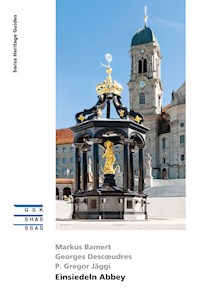
The Abbey of Einsiedeln is one of the most important baroque monastic sites. On the site of the cell of the hermit Meinrad a Benedictine monastery was built in the early Middle Ages. Over the course of time, a pilgrimage developed, first to the chapel built on the site of Meinrad’s cell, then to the first image of the Virgin Mary, consecrated by the Lord, in this chapel. Even today, the chapel with the miraculous statue of the Black Madonna is still the destination of a pilgrimage that radiates far and wide. The present abbey was built in the Baroque period according to the plans of Brother Caspar Moosbrugger, with the church in the centre and the monastery square in front. The abbey has survived all the storms of time, the Reformation and the suppression during the French invasion, and still houses a lively Benedictine monastery.
Sie lesen das E-Book in den Legimi-Apps auf:
Seitenzahl: 77
Veröffentlichungsjahr: 2022
Das E-Book (TTS) können Sie hören im Abo „Legimi Premium” in Legimi-Apps auf:
Ähnliche


















Markus Bamert · Georges Descœudres · P. Gregor Jäggi
Einsiedeln Abbey
Canton of Schwyz
A history of the construction of the abbey and its pilgrim facilities
The St Meinrad Chapel on Etzel
The Dark Forest
The abbey’s foundation and early years
Fire after fire
Pilgrimage routes to Einsiedeln
Restoration of the monastic complex
Sightseeing Tour
The abbey square and the abbey façade
A visit to the abbey
The abbey church
The nave
Architecture
Chapel of Our Lady
The vaulting
The pulpit, epitaphs and organs
The altars
The floor
The choir
Architecture
The lower church
Beichthaus
Confession hall
The Magdalene Chapel
The oratory
The library
The courtyard
The Great Hall
The Great Dining Room
The abbey in the Dark Forest
Theological interpretations of the church’s iconographic layout
A final appraisal
Appendix
The monastery complex from the northwest.
A history of the construction of the abbey and its pilgrim facilities
Shrouded in legend, the origins of the Einsiedeln Abbey are closely associated to the monk Meinrad. The hagiography of the ‘venerable hermit Meinrad’ reveals a monk who lived in Charlemagne’s time, he was sent from his mother monastery on the island of Reichenau, lake of Constance to be a teacher at an unspecified monastic foundation in Zurich’s Obersee. Not to long afterwards, Meinrad retired to a hermit’s life in the solitude of a cell he built on the Etzelpass.
The St Meinrad Chapel on the Etzelpass
It is said that in 1289, Einsiedeln Abbey commissioned the construction of a chapel dedicated to St Meinrad on Etzelpass, to commemorate his initial stay there as a hermit. A 16th-century depiction shows the medieval chapel with a choir tower similar to the one of the Church of St Peter and Paul on the island of Ufenau, which also belonged to Einsiedeln Abbey. The current chapel, built on the Etzelpass in 1698, was designed by the hermit Brother Caspar Moosbrugger, who was also the architect of the baroque abbey complex.
During the latest restoration in 2010, archaeological excavations inside the building failed to unearth any trace of a hermit cell. It is, after all, a stretch of the imagination to believe that Meinrad would have built a cell on the crest of Etzelpass, particularly exposed to inclement weather. The legend that the memorial chapel was built on the very spot of Meinrad’s first cell is therefore not to be taken literally; such an exposed spot was rather chosen for its emblematic nature.
Visible from afar, the chapel dedicated to St Meinrad on the Etzelpass was built in 1698, in memory of his stay there as a hermit.
According to tradition, Meinrad lived for seven years as a hermit on Etzel before an increasing number of visitors made him decide to retire to the so-called ‘Dark Forest’ – a familiar topos in stories of hermit lives. Once there, and ‘with the help of some pious men and an abbess in particular’ (most likely the abbess of Fraumünster in Zurich), he built a new cell where he lived until his life was brought to a violent end in the year 861. Sources refer to the construction of a small chapel, which became the initial core of the future Chapel of Our Lady.
The Dark Forest
A passage in the hagiographic tale suggests that even his new site in the Dark Forest was not entirely unaffected by anthropisation. Research into pollen deposited on the ground provides unequivocal evidence that the land around Einsiedeln was already in agricultural use in Meinrad’s time, and that it only intensified after the abbey was founded. Archaeological excavations conducted in the 1980s confirm to some extent the results of these pollenological analyses. Traces of a settlement were unearthed to the east of the oldest monastic church. Although hard to interpret with any certainty or to date with accuracy, they do not seem to be the remains of Meinrad’s cell.
According to monastic tradition, the hermit was slain on 21 January 861 by two brigands. Legend tells that two tame raven, which in the final years of the saint’s life lived with him, chased the attackers to Zurich where, thanks to the commotion they raised, the two criminals were arrested and convicted of his murder. Meinrad’s body was transported to the mother monastery on Reichenau Island. The saint’s mortal remains were later exhumed. In 1039, parts of his body, including the skull, were taken as precious relics to the restored abbey church in Einsiedeln.
On 15 June 1984, Pope John Paul II consecrated a commemorative altar at the abbey church of Einsiedeln, where a modern silvertopped reliquary containing the skull of St Meinrad was installed. Scientific examination of the skull, commissioned by the abbey to an anthropologist, confirmed that it was probably the one of the hermit. A dental analysis revealed a diet that was ‘certainly poor, but healthy, mostly vegetarian’.
Next to his hermit cell, St Meinrad built a chapel in the “Dark Forest”. Two ravens were the saint’s faithful companions in his final years.
St Meinrad is beaten to death and robbed. Both illustrations are from the 1466 “Blockbuch”.
The abbey’s foundation and early years
We have only vague and uncertain information about the period after Meinrad’s death. Other ‘pious men’ reputedly kept the tradition of his hermitage alive for some time. In the early 10th century, the Provost of Strasbourg Cathedral, Eberhard, is said to have established a monastic community in Einsiedeln under the Benedictine Rule. The year 934 is cited as the year of the abbey foundation, while the consecration of the abbey church in honour of the Holy Mother of God and St Maurice’ dates back to 948. The dukes of Swabia and the Ottonian Imperial House generously supported the newly established foundation. Considering it a strategic outpost in the Alpine foothills.
After a devastating fire – it is plausible to assume that the original buildings consisted of wood – the abbey was rebuilt in stone under Abbot Embrich between 1031 and 1039, as a three-nave basilica, its façade flanked by two towers. Below the sanctuary was a crypt, whose outer wall is still nowadays visible in the lower church. In the courtyard in front of the west entrance stood a chapel in honour of the Saviour. She is supposed to be the small church originally built by Meinrad, and which, according to tradition, was erected, where the Chapel of Our Lady stands today.
Fire after fire
In 1226, after another fire, the church was enlarged. The lower church was built above the Chapel of the Saviour, which was incoporated into the new complex. This effect, of a sanctuary within a sanctuary, has been maintained in later restorations of the Chapel of Our Lady.
Within the construction of the lower church resulted a partition of the religious building that is visible in the oldest representations: an upper Munster with two towers that was reserved for the monastic community, and a lower Munster that served as a church for the parish and the pilgrims.
In the 13th century, the pilgrimage to the monastic complex became more popular, better structured and organized. The figure of the enthroned Madonna holding the baby Christ on her left knee, which appears on an abbey seal from 1239, is considered Einsiedeln’s oldest miraculous image. The Chapel of Our Lady’s dedication was changed from the Saviour to the Virgin as the cult of St Meinrad left its predominance to the Marian cult. A wall Was built around the abbey, a clear indication of the increasing influx of pilgrims, during the abbacy of John I of Schwanden. Under Abbot John, an imposing atrium was added to the church, along with a courtyard full of small shops running along its north side. The choice of the north side for this space dedicated to devotional commerce was dictated by the fact that, before the railway was built in the 19th century, pilgrims arrived at the abbey from the north, rather than from the nearby village to the west. The Chapel of Our Lady was most likely destroyed by a third fire in 1465. In anticipation of the upcoming celebration of the five hundredth anniversary of the miracle of the Angelic Consecration, construction of a vaulted shrine to the Virgin was hastily begun in 1466. Around 1500, after an initial and temporary rearrangement, the lower church was restored and the aisles surmounted by new vaults. The nave of the lower church was given a vaulted roof in 1509, following another fire that also affected the village of Einsiedeln. Yet another fire, this time in 1577, once again necessitated costly restoration work. The few remains that exist of the late medieval abbey, which was rebuilt several times, include the keystone of a Gothic-style ribbed vault with depictions of three saints, possibly King Sigismund, St Justus as cephalophore (‘head carrier’), and St Maurice as a knight.
The monastic church erected under Abbot Embrich (first half of the eleventh century). The chapel of the Saviour stood in the courtyard, in front of the twin-tower facade.
Einsiedeln’s oldest miraculous image depicted an enthroned Madonna, the baby Jesus sitting in her arms, to her left.
An abbey seal from 1239 shows the oldest version of the miraculous image.
Keystone of a ribbed Gothic vault depicting three saints, presumably Sigismund, Justus and Maurice.




