


1,99 €
Mehr erfahren.
- Herausgeber: Quickie Classics
- Kategorie: Gesellschafts- und Liebesromane
- Sprache: Englisch
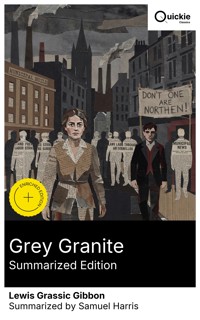
Grey Granite, the culminating movement of A Scots Quair, transposes Gibbon's vision from the Mearns to the industrial city of Duncairn, where Chris Guthrie and her son confront the machinery of interwar modernity. The narrative anatomizes strikes, municipal corruption, and the seductions and betrayals of revolutionary politics, setting private loyalties against collectivist demands. Stylistically, Gibbon braids Doric-inflected speech with taut, documentary prose; montage interludes—snatches of rumor, minutes, headlines—create a choric counterpoint rendering the city's pressure. The result is a novel as flinty as its title, an urban elegy that refuses consolation. Writing as Lewis Grassic Gibbon, James Leslie Mitchell (1901–1935) distilled an Aberdeenshire upbringing and radical sympathies into an art that registers both folk cadence and modernist fracture. His immersion in rural life and awareness of industrial capitalism's remorseless logics prepared him to trace Scotland's shift from soil to street; the trilogy's final turn to the city reflects his determination to test sentiment against structure. This unabridged edition restores the full verbal grain of Gibbon's design. It is indispensable for readers of Scottish modernism, labor history, or feminist studies, and for anyone who values fiction that thinks. Whether approached independently or as the Quair's consummation, Grey Granite compels. Quickie Classics summarizes timeless works with precision, preserving the author's voice and keeping the prose clear, fast, and readable—distilled, never diluted. Enriched Edition extras: Introduction · Synopsis · Historical Context · Brief Analysis · 4 Reflection Q&As · Editorial Footnotes.
Das E-Book können Sie in Legimi-Apps oder einer beliebigen App lesen, die das folgende Format unterstützen:
Veröffentlichungsjahr: 2026
Ähnliche










Grey Granite (Summarized Edition)
Table of Contents
Introduction
Between the hardness of the modern city and the soft, stubborn pulse of human loyalty, Grey Granite tests how far a life can bend before it breaks. Lewis Grassic Gibbon brings his gaze from field and small town to a smoking, stone-built metropolis where work, hunger, and political hope jostle in the streets. The novel’s title names both a material and a mood: resilient, abrasive, and coldly beautiful. Within that setting, a mother and her son search for livelihood and meaning amid factories, tenements, and meeting halls, their private compromises continually shadowed by public demands they can neither ignore nor fully command.
First published in 1934 as the concluding volume of the A Scots Quair trilogy, Grey Granite is a modern Scottish novel that blends social realism with the experimental energies of early twentieth‑century writing. Its action unfolds in an industrial Scottish city during the interwar years, a landscape of mills and municipal offices, crowded lodging houses and union rooms. The book belongs to a period when questions of class, democracy, and the authority of the state pressed urgently on everyday life. Gibbon’s prose, inflected by the rhythms of northeast speech yet attentive to national and international currents, makes this political moment feel intimately lived.
At the novel’s outset, Chris Guthrie and her son, Ewan, arrive in the city to make do with what work and shelter they can find, each discovering how quickly urban routines harden into fate. Chris takes her measure of offices and shops, of watchful neighbors and the daily arithmetic of rent and food; Ewan is pulled toward the clangor of meetings, pamphlets, and the fierce talk of men and women who want the world changed. The plot traces their diverging orbits through workshops, streets, and civic chambers, keeping the tension between family feeling and public conviction quietly, relentlessly in view.
The voice is by turns lyrical and flinty, moving from the crowd’s noise to a single beating heart with a swift, cinematic cut. Gibbon’s sentences bend English around Scots idiom without pedantry, letting cadence carry mood: the rush of a rally, the dreich drag of a shift, the hush of private reckoning that follows a hard choice. Irony sharpens the edges, but sentimentality rarely softens them; the novel cares by looking steadily. Names of places and institutions may be fictional, yet the civic machinery feels exact, and the city’s granite texture seems to press on every thought.
Grey Granite wrestles with the costs and possibilities of collective action, showing how ideals can clarify a life and also consume it. It studies class not as a slogan but as a daily choreography of bodies and wages, overseers and street-corner speakers, where risk and dignity are weighed moment by moment. It probes gendered expectations in home and workplace, the terms on which care is given and autonomy asserted. Memory and landscape persist, too, as echoes from rural pasts resound in urban rooms, asking what we keep of ourselves when the city insists on a single, grinding tempo.
For contemporary readers, the novel’s preoccupations feel uncannily current: insecure work, the pull of protest, and the strain placed on families when politics enters the kitchen and the pay packet. Its portrait of civic institutions—councils, courts, police, newspapers—invites reflection on how authority legitimizes itself and how citizens organize to be heard. The attention to language matters, too, as voice becomes a ground of belonging and a means of resistance in a culture that often prizes a single standard. In its unsparing clarity, the book helps us imagine solidarity without illusion and individuality without retreat into private comfort.
As the capstone of Gibbon’s sequence, Grey Granite gathers the trilogy’s long arc into a concentrated urban study, yet it can be approached on its own as a compelling portrait of work, kinship, and dissent. The unrelenting city sharpens the characters rather than swallowing them, and the narrative refuses to supply easy heroes or villains, asking readers to do the ethical labor of judgment. To read it now is to enter a chamber where history reverberates in the present tense, and to hear, unmistakably, the human voice within the noise.
Synopsis
Grey Granite, published in 1934, concludes Lewis Grassic Gibbon’s A Scots Quair by leaving the fields of Kinraddie for the industrial city of Duncairn. The novel follows Chris Guthrie and her son, Ewan, as they seek work and footing amid interwar austerity. The granite city’s mills, yards, and streets replace crofts and kirks, shifting the trilogy’s canvas from land and parish to factory and council chamber. Gibbon frames this transition as both social history and intimate study, attending to how economic pressure, urban anonymity, and competing loyalties reshape lives already marked by war, loss, and the dislocations traced in the earlier volumes.
Chris, older and wary yet resilient, tries to keep a household together in rented rooms while finding steady employment that will not break her spirit. She measures the city by its routines and prices, learning tram routes, queues, and the quiet solidarities of neighbors who seldom linger. Memories of harvests and parish rituals intrude, but she resists nostalgia, attentive instead to how a woman can bargain for security without surrendering pride. Her vantage remains practical and unsentimental, registering the chill of tenements, the discipline of budgets, and the muted temptations of escape, even as she watches Ewan drawn toward a harsher, more public struggle.
Ewan comes of age in workshops and hiring offices, learning quickly that skill and stamina rarely guarantee fairness. He listens to agitators and councillors, to pamphlets thrust at factory gates, and to older workers who remember better times that were never quite good. His impatience hardens into method: meetings, committees, marches, and arguments about tactics that pit patience against confrontation. The city teaches him a new grammar — wages, rents, lockouts, rates — and he begins to imagine solidarity as a discipline rather than a sentiment. That vision strains domestic peace, for Chris prizes survivable compromises while Ewan increasingly trusts movements that promise transformation.
Public conflicts mount as unemployment bites and employers tighten control, and Duncairn’s streets become classrooms and battlegrounds. Rallies test the boundaries of lawful protest; negotiations falter; the appearance of force reminds crowds how thin those boundaries are. Ewan rises within activist circles, admired for clarity and stamina, though he is drawn into disputes over doctrine and strategy that divide the left. Friendships flourish and fray under pressure, and a tentative romance is shadowed by the fear that private attachments blunt political purpose. The city’s press, councillors, preachers, and police chorus conflicting moral claims, each insisting it speaks for order, decency, or justice.
Gibbon’s narrative method tightens with the city’s geometry, yet his cadences continue to mingle Scots speech and lyrical reflection. The urban fabric becomes a moral landscape: granite blocks, tramlines, and smoke mapping endurance and constraint. Against this, the novel probes faith, class, and belonging after the churchly hopes and rural intimacies of the earlier books. Chris’s inward poise meets the clang of modern life; Ewan’s certainties sharpen in the friction between theory and need. The prose tracks these frictions without melodrama, attentive to rumor, minutes, and headlines, showing how public language seeps into private thought and how private grief stains civic resolve.
As pressures intensify, the novel gathers its strands into set pieces where speeches, arrests, ballots, and bargains jostle with ordinary errands and domestic reckonings. Mother and son navigate an impasse that is as much generational as ideological, their care for each other frequently submerged beneath competing duties. Unexpected alliances arise across class and party lines, while betrayals occur less from malice than from fatigue, fear, or the drift of events. Decisions made in council rooms echo down stairwells and factory floors, altering prospects quietly as well as abruptly, and leading toward a resolution that remains psychologically persuasive while sparing easy moral vindication.
Grey Granite closes the arc begun in Sunset Song and Cloud Howe by completing a migration from soil to street, from parish to polity. Without leaning on revelation or spectacle, it renders a society wrestling with modernity, and a family testing how love survives when convictions harden. The novel endures for its unsentimental clarity about work, gender, and power, and for its language, which refuses to choose between demotic energy and reflective poise. Read as the trilogy’s capstone or on its own, it offers an exacting, humane account of how the pressures of a historical moment shape, but do not wholly define, individual lives.
Historical Context
Grey Granite (1934), the final volume of Lewis Grassic Gibbon’s A Scots Quair, is set in the early 1930s in the fictional city of Duncairn, widely read as a version of Aberdeen, the “Granite City.” The setting shifts the trilogy from rural and small-town environments into a heavy, municipal urban world of engineering shops, granite yards, fisheries and harbor trades, unemployment exchanges, police courts, and city chambers. Britain is governed by a National Government after 1931, and Scotland’s northeast feels the economic chill of the global downturn. Institutions central to the narrative include trade unions, local councils, relief boards, and the kirk’s diminished urban presence.
The Great Depression struck Scotland unevenly but severely in export-dependent industries. UK unemployment surpassed three million in 1932, and rates in Scotland’s heavy-industrial districts were often higher than the national average. Cuts to unemployment benefits and the introduction of the household Means Test in 1931 under the National Government provoked widespread anger. Public Assistance Committees scrutinized claimants, and many families relied on soup kitchens or relief works. Fishing, granite, and engineering in the northeast contracted as orders fell. These conditions form the backdrop to tensions over relief, dignity, and survival that run through depictions of queues at the Employment Exchange and municipal aid.
Interwar labor politics shape the civic landscape evoked in the novel. The 1926 General Strike, called by the Trades Union Congress in support of miners and lasting nine days, left a legacy of organization and bitterness in Scottish workplaces. In 1932 the Independent Labour Party broke with the Labour Party, while the Communist Party of Great Britain and the National Unemployed Workers’ Movement campaigned vigorously among the jobless. Local branches organized meetings, pickets, and marches; municipal elections became contests over relief policy and rates. The ideological cross-currents of Labourism, revolutionary socialism, and liberal municipalism inform many of the arguments heard in council chambers and streets.




