


1,99 €
Mehr erfahren.
- Herausgeber: Quickie Classics
- Kategorie: Gesellschafts- und Liebesromane
- Sprache: Englisch
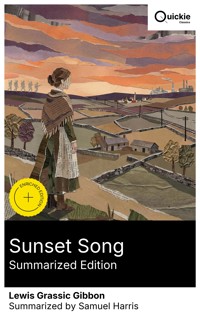
Sunset Song, the opening movement of the Scots Quair trilogy, follows Chris Guthrie in the Mearns of northeast Scotland from the last quiet years before 1914 through the dislocations of war and modernization. Gibbon fuses lyrical realism with modernist experimentation, braiding Doric Scots and supple English to create a voice at once intimate and communal. The novel's cadenced chapters register the endurance of land and the fragility of human bonds, treating sexuality, religion, class, and empire with unsentimental clarity within a pastoral elegy transformed by history. Writing as Lewis Grassic Gibbon, the pen name of James Leslie Mitchell (1901–1935), the author drew on his upbringing in the Mearns, his years as a journalist and traveler, and his radical politics. He witnessed the erosion of rural communities and the wrenching effects of war; Sunset Song transposes these experiences into art, preserving Doric speech while probing the costs of progress. Readers drawn to interwar modernism, feminist coming-of-age narratives, or the textures of Scottish rural life will find this World's Classic Series edition essential. Approach it for its musical language and moral intelligence; stay for Chris's indelible resilience and the land's stern, resonant beauty. Quickie Classics summarizes timeless works with precision, preserving the author's voice and keeping the prose clear, fast, and readable—distilled, never diluted. Enriched Edition extras: Introduction · Synopsis · Historical Context · Brief Analysis · 4 Reflection Q&As · Editorial Footnotes.
Das E-Book können Sie in Legimi-Apps oder einer beliebigen App lesen, die das folgende Format unterstützen:
Veröffentlichungsjahr: 2026
Ähnliche














Sunset Song (Summarized Edition)
Table of Contents
Introduction
At the heart of Sunset Song lies the ache between belonging and becoming, as a young woman and a tight-knit farming parish test whether the steadfastness of land and language can survive the wrenching forces of family duty, industrial modernity, and the oncoming shocks of a new century, where the seasons demand their due, the kirk polices conscience, education opens doorways that distance home, machines trespass on furrowed fields, and the promise of mobility collides with the cost of forgetting, so that every choice, however private, resounds across the community and the soil that binds it.
First published in 1932, Lewis Grassic Gibbon’s novel stands as a landmark of Scottish modernism and regional realism, inaugurating the trilogy known as A Scots Quair. Set in the early twentieth century in the fictional parish of Kinraddie, rooted in the farming country of the Mearns in northeast Scotland, the book evokes a world both intensely local and unmistakably shaped by broader historical currents. Its pages move through years when rural life faces new pressures, yet the narrative remains anchored in fields, kitchens, schoolrooms, and kirk sessions, revealing how large transformations register in the textures of daily work, speech, and custom.
At the center is Chris Guthrie, a capable, inquisitive daughter of tenant farmers whose education and resilience sharpen her sense of possibility even as circumstance binds her to place. The story traces her coming-of-age among neighbors whose lives intersect through seasons of toil, celebration, and strain. Gibbon’s voice interweaves supple Standard English with rhythms and vocabulary shaped by the northeast Scots tongue, producing a cadence at once lyrical and plainspoken. The narrative slips easily between intimate interiority and a broader communal perspective, creating a chorus-like effect. The tone is tender, stoic, and clear-eyed, refusing sentimentality while honoring endurance and joy.
One of the book’s abiding concerns is the relationship between people and the land—how soil, weather, and labor shape character as surely as family or schooling. That bond is not romanticized: hardship, debt, and exhaustion shadow every harvest, yet the earth confers dignity and measure. Equally central is language itself. The novel’s Scots-inflected idiom is not a decorative flourish but a way of thinking, a palette of feeling that resists flattening by centralized culture. In its textures of speech the book preserves local memory and values, inviting readers to consider how words carry belonging, history, and contested futures.
The novel also probes gender and power within home and parish, tracing how expectation, piety, and economic necessity constrain women while revealing the courage required to claim selfhood. The kirk’s moral authority, schooling’s promise, and the laws of tenancy all press upon choice, so that private hopes meet public structures at every turn. As the years advance toward the First World War, change gathers momentum, and the rural order must reckon with absences, new technologies, and shifting loyalties. Without anticipating events, it is enough to note that the book renders historical upheaval through intimate consequences rather than battlefield spectacle.
For contemporary readers, Sunset Song resonates with debates about sustainability, rural depopulation, and cultural homogenization, asking what is lost when economic efficiency becomes the sole measure of value. Its portrayal of caregiving, domestic labor, and female ambition speaks to ongoing conversations about autonomy and equity. The novel’s attention to local speech models an inclusive literary canon that honors diverse Englishes and minority languages. And in a time of ecological anxiety, its unsentimental reverence for land challenges both exploitation and nostalgia, suggesting forms of stewardship grounded in knowledge, endurance, and community memory rather than mere sentiment or technocratic fixes.
Newcomers to the book’s idiom may find that reading a few pages aloud clarifies cadence and meaning, and that unfamiliar words yield quickly through context and repetition. Patience with the opening rhythms is repaid by immersion in a voice capable of startling tenderness and quiet ferocity. The novel’s design balances intimacy with panoramic insight, offering a narrative that is both absorbing on first encounter and rewarding on return. As part of a classic of twentieth-century Scottish literature, it endures because it captures how ordinary lives carry history, and because it hears, in the dusk of change, a song that still carries.
Synopsis
Sunset Song, first published in 1932, is the opening novel of Lewis Grassic Gibbon’s A Scots Quair. Set in the fictional rural estate of Kinraddie in the Mearns of northeast Scotland, it follows the rhythms and upheavals of life around the turn of the twentieth century. Gibbon’s narrative blends close psychological observation with a Scots-inflected idiom, immersing readers in the textures of farming communities and their landscapes. The novel’s focus is intimate yet panoramic, framing one young woman’s coming-of-age against collective change. Without relying on melodrama, it steadily accumulates moments of work, kinship, and weather, so that the land itself feels like a central presence.
At the center is Chris Guthrie, a gifted schoolgirl divided between two futures: the pull of books, education, and the prospect of an urban life, and the pull of the fields, seasons, and a sense of belonging to place. Family demands shape this tension. Her father is exacting and proud, determined to hold the farm, while her mother bears the heavy burdens of rural domesticity. Chris observes the unadorned realities of poverty, toil, and small pleasures, her inner voice registering both tenderness for the countryside and a lucid awareness of how tradition can confine as much as sustain.
Hardship thrusts Chris toward decisive responsibility. Loss and misfortune within the family narrow her options, and she commits to the farm at Blawearie, anchoring her future to Kinraddie’s soil. Gibbon renders the agricultural year with granular detail, from sowing to harvest, and shows how community bonds interweave with labor. Neighbors, tenants, and itinerant workers form a chorus of perspectives, sometimes contentious, often mutually reliant. As Chris matures, she learns the practical skills that make survival possible and the moral courage needed to navigate gossip, hierarchy, and the shifting authority of landlords, teachers, and clergy.
Amid these duties, Chris meets Ewan Tavendale, whose steadiness and ambition complement her own. Their courtship unfolds through shared work rather than ornament, and marriage promises a partnership rooted in the discipline of the fields. In seasons of relative plenty, the couple’s hope takes the shape of planned improvements and the possibility of a family. Gibbon links intimacy to landscape: the sense of home is carried by soil and sky as much as by affection. Yet the novel quietly signals that security in Kinraddie is fragile, with prices, rents, and weather always threatening the thin margins of rural prosperity.
The outbreak of the First World War unsettles every routine. Kinraddie’s young men face pressure to enlist, and those who remain encounter suspicion or new burdens. News arrives in fragments, and the community’s resilience is strained by absence, rumor, and grief. Ewan’s departure and changed demeanor on leave show how the conflict reaches into marriage and household, challenging loyalty and trust. Chris endures the contradictions of patriotic rhetoric and the intimate costs of militarization, holding her ground at Blawearie even as the wider world intrudes more forcefully into fields that once seemed timeless.
As war and its aftermath reshape the district, social relations and economic prospects alter. Some farms falter; others chase modernization, machinery, or outside capital. Kinraddie feels an influx of new priorities, with ownership and authority reconfigured in ways that unsettle custom. Chris faces fresh choices about how to preserve what she loves in a place that may no longer be the same. Gibbon’s narrative emphasizes continuity and change in equal measure, suggesting that identity is negotiated between memory and necessity, between the language of the past and the urgencies of the present, with the land both witness and participant.
By closing on the enduring question of what can be saved when everything changes, Sunset Song attains a resonance beyond its period setting. It explores the costs and consolations of belonging, the pressures of modernity on rural life, and the intimate impacts of war on ordinary people. Gibbon’s fusion of vernacular cadence with lyrical prose helped define the Scottish literary renaissance of the twentieth century. Without revealing its final turns, the novel’s power lies in how it honors ordinary endurance and complexity, offering a portrait of place and character that continues to speak to questions of identity, community, and change.




