


1,49 €
Mehr erfahren.
- Herausgeber: The History Press
- Kategorie: Lebensstil
- Sprache: Englisch
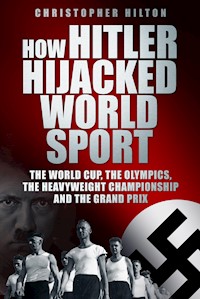
Adolf Hitler understood the importance of sport, and exercised his malign and dangerous influence to try to co-opt it for the Nazi cause. He intended to own the Olympic movement, housing it permanently in Berlin from 1940 in a stadium seating 450,000 people. His hijack of the 1936 Games remains one of sport's most controversial events, using it as he did to promote Aryan supremacy and showcase the Nazi state. Austria was forced to withdraw from the 1938 football World Cup just days before it started because the country no longer existed. The boxing matches between Joe Louis and Max Schmeling in 1936 and 1938 came to represent democracy versus fascism. German technology crushed all comers in Grand Prix racing, as well as the Isle of Man TT. A government ministry was even set up to use physical fitness to prepare the population for war. Hitler understood that sport has many uses: this is how he used it.
Das E-Book können Sie in Legimi-Apps oder einer beliebigen App lesen, die das folgende Format unterstützen:
Veröffentlichungsjahr: 2011
Ähnliche











German sport has only one task: to strengthen the character of the German people, imbuing it with the fighting spirit and steadfast camaraderie necessary in the struggle for its existence.
Joseph Goebbels, Minister of Propaganda, 23 April 1933
CONTENTS
Title
Dedication
Introduction
1 The Players
2 The Inheritance
3 Secrets of Power
4 Just One Jew
5 Olympic Heights
6 Tormented Tennis
7 Bombed
8 Last Lap in Belgrade
9 Endgame
10 If …
Bibliography
Plates
Copyright
INTRODUCTION
There is an inescapable reason why the Third Reich remains hypnotically fascinating even six and a half decades after it was buried. Nothing remotely like it had happened before, nothing like it has happened since and nothing like is remotely likely to happen again. The odds against the combination of circumstances which spawned it repeating themselves will always be heavily against, starting with a figure like Adolf Hitler.
In his twelve years of power he wreaked terrible havoc on many different fronts and that, by a great paradox, included the world of sport; a paradox because before he came to power he showed very little interest in it – apart from racing cars and what relevance it might have in military terms. Almost from the moment he had power all that changed.
He approached sport as he approached everything else, by being prepared to exploit it in the most shameless ways as long as it served his purpose. It brought an additional paradox because sport was built on exactly the opposite principles to those Hitler and the Nazis held, if indeed you can call what they believed principles.
To say that Hitler had no grasp of any sporting ethos would be an understatement of historic proportions. As one of his generals said, ‘I searched constantly for signs of genius and found only the diabolical.’
His chilled, bloodied hand would reach deep into the Olympic movement and an Olympic Games, soccer’s World Cup, Grand Prix motor racing, the World Heavyweight Boxing Championship, Wimbledon and the tennis circuit, and the Isle of Man TT motorbike races. To humanise this by making a random selection, that hand would reach for – sometimes fatally – a cyclist and several ice hockey players, a decathlete and a fencer, two sharecroppers’ sons from Alabama, two tennis players (one an aristocratic homosexual, the other a Jew), an English public schoolboy and a patriotic German high jumper.
The treatment of the high jumper was most shameless of all because she held the national record but was Jewish and, rather than select her for the Olympic team, the Nazis picked a man because, being stronger, he would be sure to win. I will repeat that. The Nazis picked a man to contest the women’s high jump. He did compete and, as if sport was exacting its own revenge for such a travesty, he finished fourth. You will see quite why he was able to be selected, and like so much of the Third Reich it does not make for happy reading.
Along the way, Hitler’s policies created a furore across the United States, Britain, France and Sweden, who all agonised over boycotting his Olympics – those in 1936 in Berlin. Bitter words were spoken and bitter accusations were made in the United States, drawing in politicians, diplomats, the Jewish community, innocent young athletes and power hunters. A chorus of voices tried to define what a free country really was, and what it should do.
Racism would never be far away, either: not just anti-Semitism but the purest kind of white supremacy, which, in turn, denigrated black people. This was unfortunate because the denigration would involve two of the very greatest athletes, Jesse Owens and Joe Louis, the sharecroppers’ sons.
Many individual stories have been told and it is senseless to pretend that they have not been. You can read whole books on the 1936 Olympics – including mine1 – or what the mighty German racing cars did or the life and times of the homosexual tennis player, but this book is the first, I believe, to bring all the aspects together. In that sense, most of the rich cast of characters are meeting themselves for the first time, if I can put it like that. Here, for example, you will find one of the most politically charged soccer matches ever played, where an Austrian genius publicly taunted thousands of Nazis. Again, you will see.
A word about the structure. I have re-created German sport in great detail because it is the best way to appreciate what was being done to it, and an inevitable by-product of this is that the book also becomes a history of Germany’s sports matches and competitions from 1933 to 1939. The first chapter traces Hitler’s rise to power across the 1920s with, interwoven, the people and events who will form the backbone of the story. I have included the main political events to give it an authentic context, although I stress that this is a book about how politics manipulated sport rather than a straightforward political book. There is a big difference.
The next seven chapters trace in chronological order what happened to sport and sports people from the moment Hitler took power in 1933. Because the impact of the Nazis was so immediate and wide reaching, the text risked darting from this sport to that all across the profusion of the summers (and winters), so to make it easier to digest I have amalgamated some of the material, breaking the strict chronological order. The seven chapters take the narrative to the moment the war broke out in 1939. As it happened, four of his mighty racing cars would be thundering round the cobbled streets of Belgrade in a Grand Prix on that very day, bringing the era to a close with, aptly, a roaring noise.
Chapter nine has the same framework as the first chapter, but pitched forward to chart what happened to all the people who formed the backbone, while chapter ten speculates about what world sport would have looked like if Hitler had won the war. Some escaped the chilled, bloodied hand. Some didn’t.
I offer sincere thanks to Tommy Wahlsten (vice chairman) and Linda Sandgren of the Swedish Olympic Committee; Michaël Guittard, Opérations et événements, Direction de la Communication et du Marketing, Fédération Française de Tennis; Irv Osterer and Patrick Houda of the Society for International Hockey Research; David Hayhoe for raiding his library for relevant books; Mail-Pressestelle team at [email protected]; Gabriella Strauss of BMW; Oliver Richtberg of the DTB press office; Thomas Grömer of the Austrian Tennis Federation; Dr Gunnar Streidt of the Rot-Weiss Tennis Club, Berlin; Scott Bowers, Group Director of Communications, The Jockey Club; Birgit Kubisch-Hillebrand; Eberhard Reuss, author of the definitive Hitler’s Motor Racing Battles for permission to quote, for his thoughts and for sending photographs; Robert Cellini of The Copenhagen Post; Andy Shaw for directing me towards Eric Morse (a foreign and strategic affairs commentator at the Royal Canadian Military Institute in Toronto, who was responsible for international sports relations at Canada’s foreign ministry – Department of External Affairs, as it then was – from 1973 to 1986); Jimmy Lindahl for researching Sweden’s reaction to the 1938 World Cup when their first-round opponents, Austria, ceased to exist; Søren Elbech of danskfodbold.com and Andreas Werner for help with two amazing soccer matches; Jim Hendry, MBE, Honorary Archivist, British Cycling; David Oldrey, a member of The Jockey Club and eminent horse-racing historian; Arjen Zegers of the KNVB, the Dutch FA and Timo Bootsma, a historian who found and translated invaluable material on the 1938 Holland-Germany match which never happened; Kay Crooks of the Wimbledon Lawn Tennis Museum.
The chapter titled ‘If …’ is about the shape of world sport assuming Hitler had won the war and represents, by definition, speculation. I am indebted to John Woodcock, Ian Cole and Linda Carlson for reading it, offering opinions, and contributing. I also owe a particular debt to James and Nancy Pinion, the co-directors of the Jesse Owens Museum in Oakville, Alabama, for providing a superb selection of photographs (taken by their friend Charlie Siefried) and daughter Marcy who sent them in high resolution. The Pinions are retired and keep the museum going on ‘donations, gift shop sales and annual grants from the State of Alabama’. They do it, unpaid, because they believe the Owens legacy should be kept alive. The museum can be accessed on www.jesseowensmuseum.org and reached at [email protected].
I have used many, many sources and each is acknowledged by chapter endnotes, but I must single out two books, Hitler’s Motor Racing Battles by Eberhard Reuss and A Terrible Splendor by Marshall Jon Fisher (Crown), as treasure troves of basic information. The internet is now such a wealth of information that it would be churlish to pretend that I haven’t been using it; I have. The websites are noted and their addresses given. Among them I salute The Golden Era of Grand Prix Racing (www.kolumbus.fi/leif.snellman/), which covers the 1930s in extraordinary detail. The Rec. Sport Soccer Statistics Foundation (http://www.rsssf.com/nersssf.html) is a mine of priceless information. The Official Berlin Games Report covers the 1936 Games in exhaustive detail.
BBC Four broadcast an important documentary in 2003, Fascism and Football, which contained a wealth of expert insights as well as provocative opinions and I have drawn from it. Again, in each case this is clearly accredited through chapter endnotes. The Journal of Sport History, vol. 16, no. 1 (spring, 1989) carried a beautifully researched and penetrating feature, ‘A Tale of Two Diplomats: George S. Messersmith and Charles H. Sherrill on Proposed American Participation in the 1936 Olympics’, by Stephen R. Wenn of the University of Western Ontario. I have drawn from this too, and it is also accredited through chapter endnotes. I am grateful for his generous permission to quote extensively from it. There is a full bibliography at the end which contains full citations to the texts referred to in the chapter endnotes.
Finally, a word for the (sometimes maligned) British Newspaper Library at Colindale, north London, which is a source of almost unlimited scope and importance. I have been using it for twenty-five years and have the deepest gratitude to it, and especially to the staff.
Notes
1 Hilton, Hitler’s Olympics.
1
THE PLAYERS
Munich was a place of big, solid stone buildings, churches and museums inhabited by big, solid, beer-fed citizens. The politics among its population of 666,000 stood in direct contrast: volatile and, at its sharp edges, revolutionary.
On 1 April 1920, Adolf Hitler left the army to work full time for the National Socialist German Workers’ Party, the Nationalsozialistische Deutsche Arbeiterpartei. The pronunciation of Nationalsozialist gave it the abbreviation the world would come to know so well and fear so much, Nazi. The party was based at a building called the Brown House in Munich and Hitler began to take it over. The local German Army Command was the ‘ultimate arbiter of public order’ and nothing officially to do with the Nazis, but Hitler had military friends and that allowed him to ‘exercise with impunity his methods of incitement, violence and intimidation’.1 He became party chairman a year later.
He looked like the army corporal he had been in the war and sounded like a raucous rabble-rouser with a wild look in his eyes. You would have predicted a sticky end, possibly very soon, as the volatility consumed him. Instead, across the next thirteen years, he manoeuvred towards power while in the most natural and usual way people who almost certainly had never heard of him were building their careers – mostly far removed from any kind of politics – in Germany, in Europe beyond Germany, in Britain and the United States. When he had power they would feel it.
Oakville can represent that. It was a very small place, lost in gently rolling farmland somewhere along the pencil-thin, pencil-straight roads of northern Alabama. Oakville was also poor and the bigotry of segregation cut wounds through it. Sharecroppers, tenants who worked the land for a percentage of the crop, picked cotton, but, because of the hilly terrain and woodland, corn was grown and molasses made. The black couple in the shanty dwelling – draughty, basic – had nine children and wished for no more but a tenth, a ‘gift child’, came. He was sickly, suffering from bronchial problems and pneumonia. They christened him James Cleveland Owens.
You would have predicted a back-breaking future picking the cotton, the segregation legally holding him forever from opportunity, as well as poverty and anonymity if he survived the bronchial problems and pneumonia. One day in 1922, while Hitler was beginning his journey to absolute power, Owens’ mother said the family were going on a train. J.C. asked, ‘but where we gonna go, Momma?’ ‘To a better life,’ she replied. That was Cleveland, Ohio, and when he got there a school teacher asked him his name. He replied in a strong southern drawl, ‘J.C. Owens’.The initials sounded just like the name the world would come to know so well and respect so much: Jesse.2
On a cloudy afternoon, with rain hanging in the air, the former corporal and the sharecropper’s son would find themselves in the same place and what happened there between them – or rather, what did not happen between them – remains one of the most memorably evocative moments of the whole twentieth century.
You can argue that sport is an international activity, essentially about anybody on the planet exploiting their talent (which, as it happens, is one way of defining the Olympic Games). The competitor’s background obviously has an impact in terms of opportunity3 and by its nature it produces some wonderfully improbable encounters but rarely anything approaching the undercurrents which flowed into the stone-clad stadium that August afternoon when the corporal and the sharecropper’s son faced each other.
In 1923 the Nazis staged a Beer Hall Putsch in Munich, starting at a political meeting at the biggest keller. Hitler climbed on to a chair and shouted, ‘the national revolution has begun’. It hadn’t. He fled, although by now the Sturmabteilung (SA), the storm troopers who formed the Nazi paramilitary force, numbered some 15,000 and the party itself 20,000.
At between six and seven o’clock on the morning of the putsch Adolf Hühnlein, an early party member and an unprepossessing man even though he had won the Iron Cross during the war, was dispatched with others to seize a police station. He failed and was arrested. He had no sense of humour, no mechanical knowledge and at the moment of his arrest seemed destined to be a figurine, not even an historical footnote.
Hitler would, in time, give him charge of all motor sport in Germany, so that he marched the European calendar of Grands Prix in his uniform and swastikas like an emperor. He embodied what Hitler had ordained: that racing would become an instrument of German power and a global demonstration of the superiority of our technology. The failed police station-seizer would have a stage – that stage – for his marching and, if appearances are anything to go by, he would adore it. You could tell by his body language. Hitler would also put Hühnlein in charge of all Germany’s motorised transport, training it for war.
Hitler received a five-year prison sentence in April 1924 for the attempted putsch, but was eligible for parole in six months. He spent his hours writing a turgid and wild tome, My Struggle, the title of which the world would come to know so well in the original, Mein Kampf. Hitler was paroled in December. He had spent time in Vienna as a rejected artist and there he learned to hate the Jews.
Manfred von Brauchitsch, handsome but haughty, came from a strong military family and at 18 his father put him into an infantry regiment on Germany’s north coast. He had a small inheritance and with it he bought a motorbike. He crashed, breaking his arm, his leg, four ribs and fracturing his skull. He left the army and recuperated in a cousin’s forty-room castle. The cousin owned a powerful Mercedes and taught von Brauchitsch to drive. In time, he would win – and lose – some extraordinary Grands Prix, try to flee to Switzerland when the Second World War began and, after it, flee to communist East Germany. Before any of that, Hitler would make his uncle, Walther, commander-in-chief of the German army.
Max Schmeling, born just north of Berlin, grew up in Hamburg where his father worked for a shipping company. He had a strong, open, almost pug-like face and a thicket of hair cut across his forehead. At 16 he went to the cinema and the show included newsreel coverage of the World Heavyweight Championship between reigning champion Jack Dempsey and Frenchman Georges Carpentier at an outdoor arena in New Jersey. It produced boxing’s first million-dollar gate and reached a large audience as one of the first radio broadcasts dedicated to a specific event. Dempsey stormed Carpentier and destroyed him in four rounds.
It also reached Schmeling. He bought second-hand gloves and, when he moved to the Rhineland, joined the local amateur club. He made such progress that by the time Hitler served his jail sentence he was contesting the German light-heavyweight title and fought for the first time as a professional that August, 1924.
In time, Hitler would use Schmeling as a model of Aryan supremacy against an American black sharecropper’s son in far, far away Yankee Stadium in the Bronx – just a couple of weeks before the cloudy afternoon when Hitler and that other sharecropper’s son found themselves staring at each other in Berlin. It was the same Schmeling who risked his life to save two Jewish children long after Hitler did get absolute power.
In 1925 the Nazis were holding mass meetings and the Schutzstaffel was formed to protect Hitler. The world would come to know it so well by its abbreviation: the SS. Heinrich Himmler, one of the most odious men in European history, commanded it.
Hans Stuck’s father owned an estate at Freiburg, in the rolling hills and flatlands of south-eastern Germany not far from France and Switzerland (the Stucks were originally Swiss). Stuck served in the artillery in the First World War and when his commanding officer was killed he was sent to give the bad news to the family. The commanding officer’s sister was called Ellen and, although five years older, they married. Stuck, tall and good looking, would always attract ladies – and marry twice again – but now he and Ellen ‘set up home on a farm south of Munich’4 and in the early mornings Stuck delivered milk from it to Munich.
He used to park his car at a garage and he became friendly with the man who parked next to him, Julius Schreck. Very soon Stuck would begin a career in motor racing and in time he and Schreck would shoot together on the farm. One day in 1925 Schreck arrived for a shoot and asked if his boss, who was in the car, might join them. Stuck said, ‘Of course’, and there was Hitler.
Stuck’s racing career stalled and Schreck said he should meet Hitler. Stuck thought that mildly absurd when Hitler was working day and night to take over Germany, but Schreck arranged it, explaining that Hitler had not forgotten the day’s shooting, and Stuck travelled to the Brown House. Stuck explained that the German companies had withdrawn and he didn’t want to drive for a foreign company like Alfa Romeo or Bugatti. Hitler was evidently sympathetic but pointed out that the party couldn’t finance a racing driver. He added, though, that ‘You’re an excellent driver, Herr Stuck. If you can avoid driving for a foreign firm I promise you that when I come to power the Reich will place a racing car at your disposal.’5
Stuck naturally assumed this was in the nature of a joke, ‘the sort of thing only a fantasist says with a straight face. I mean – a Reich racing car!’6 He would learn, as would the world, that Hitler didn’t really make jokes. However fantastic his words were, he always meant them literally.
In 1926 Hitler fought off internal dissent and by summer ‘felt strong enough to hold a mass rally in Weimar, in Thuringia, one of the few states in which he was still allowed to speak’.7 Meanwhile, a club-footed, lecherous little man called Joseph Goebbels began to move up through the party hierarchy.
Lafayette is ‘tucked away in the foothills of central East Alabama’,8 very close to Georgia. Bigotry overhung it. Sharecroppers bent their back here, just as they did in Oakville 160 miles away. Munroe Barrow married Lillie Reese, a daughter of former slaves, and they had eight children. They lived in a shack some 6 miles from Lafayette’s wide streets, large trees and fine old houses. The seventh child was christened Joseph Louis Barrow, but the Joseph would be shortened and the Barrow dropped. He would be known as Joe.
In 1926, one report says the family was ‘shaken’ by an ‘altercation’ with the Ku Klux Klan. The word came down that Ford at Detroit did not mind hiring black people and, although Munroe had mental problems which put him into an institution, the family moved north. Joe and his brother worked for Ford. In time the idealised image of Aryan supremacy would be tested to destruction against the seventh child on, simultaneously, the largest stage in the world (the global audience devouring the World Heavyweight Championship) and the smallest (a boxing ring).
Rudolf Caracciola had a boyish face and an almost button nose. Despite his Italian name he had been born in Remagen on the Rhine to a family who ran a hotel. He didn’t intend to make it his life and worked in a car factory at Aachen. That part of Germany was occupied by Belgium after the First World War and he got into a fight with some Belgians. He moved quickly to Dresden and worked as a sales representative, but he was crazy about motor racing and was soon racing a Mercedes. He would enter the German Grand Prix privately and win a very wet race. This was a genuine sensation. In time, he would advocate the Nazi cause in the spoken and printed word, lavishing praise on Hitler, both before and during the Second World War. He didn’t after it.
That September, 1926, a distinguished-looking English teenager arrived at Rugby School (founded 1567). He had well-bred manners and well-bred features, dominated by a very prominent nose, almost a beak. Rugby, in the English Midlands, was an august establishment where, in 1823, William Webb Ellis first picked up a football and ran with it, creating the game of rugby. Thomas Arnold, a fabled headmaster, believed in a complete education to form adults. Baron Pierre de Coubertin, who would found the modern Olympic Games, visited the school several times and was deeply influenced by what he saw.
The teenager was called Richard Seaman and there was money in the family. They intended him to go into law and later, perhaps, stand for parliament. But he was only interested in racing cars and in time that would take him to the Mercedes team, although Hitler’s permission had to be sought. He would fall in love and marry a beautiful young Bavarian, and his mother disapproved so much that she never spoke to him again because she knew war was coming. He would die at the wheel of the Mercedes and Hitler sent a large wreath to his funeral in London. What Seaman did and did not do remains controversial many decades later, as if escaping from Hitler remains almost impossible even for the purist sportsman and even from beyond the grave.
That September too, Matthias Sindelar, an ‘awkward, edgy character’,9 made his debut for the Austrian soccer team. They beat Czechoslovakia 2-1 in Prague. Sindelar came from poor Czechoslovakian immigrant stock who had settled in a working-class district of Vienna. His father, a blacksmith, was killed in the First World War. Sindelar played soccer in the streets but, then and later, he looked so delicate he was known as the ‘Man of Paper’, even though he was a centre forward. He’d been playing for a team called Hertha Vienna but now joined FK Austria Vienna. In time he became one of the greatest of all players in one of his country’s greatest teams. Then Hitler’s Reich ingested Austria whole and Sindelar faced an immediate problem: he hated the Nazis and everything they represented.
During a match to ‘celebrate’ that – Austria v. Germany in Vienna – he taunted the Nazis, who in turn suspected him of Jewish connections. He refused to play for Germany and one January morning was found dead next to his former prostitute girlfriend. Carbon monoxide poisoning, said the officials. Few believed it then and few believe it now. By that time, more than the Austria ingestion, Czechoslovakia had been dismembered and part of it ingested by the Reich too.
A 13-year-old with a mop of hair curling down his forehead joined a sports club in his home town, Leipzig. He’d grow to 6ft, ideal for a long jumper. He was called Carl-Ludwig ‘Luz’ Long, and in time he would work as a lawyer in Hamburg. Eventually, he would also challenge the sharecropper’s son from Oakville on the most public stage and, in doing so, become a trusted friend. With Hitler watching, it took rare courage. Long, with his warming smile and hair like breaking waves, had courage all right.
Across 1927 and 1928 the Nazis did not poll well but the party kept on growing. In the spring of 1928 soccer’s international body, FIFA, met at the Amsterdam Olympic Games and the president, Jules Rimet, announced that a new, professional competition was to be established. Up to then the Olympics represented the pinnacle. The new competition was to be open to all FIFA members. It would be first contested in Uruguay in 1930 and then in Italy in 1934. There, it grew so quickly that thirty-two teams went through a qualifying stage and sixteen contested the finals. Germany got through and, of the other fifteen, Hitler would absorb, occupy or declare war on ten. But neither Rimet nor anyone else could have imagined anything as fantastical as that while the Amsterdam Olympics was proceeding quite normally and FIFA had its momentous meeting.10
At Amsterdam, Helene Mayer – a blonde 18-year-old from Offenbach, a town on the river Main near Frankfurt – won the women’s foil. Mayer was ‘fresh, blooming, full of life, a wholesome portrait of German girlhood’.11 Her mother happened to be Christian; her father Jewish. In time she’d find herself in California and in a tug-of-war between Hitler, who wanted her as his token Jewish Olympian, and her own sensibilities. At a certain critical moment she held the destiny of the Berlin Olympic Games in her slender, sensitive hands.
Here was another wonderfully improbable encounter whose undercurrents flowed from the strong-willed corporal in his capital city to the strong-willed woman in the Californian sun and back again. Truth would be a casualty of the tug-of-war – and very quickly.
Rudi Ball, a Berlin Jew, stood at 5ft 4in and weighed 140lb, which was no kind of a physique for an ice hockey player. His father bought him expensive Canadian skates when he was 15 and he proved fast and elegant; so fast and elegant that his career began at 17 in 1928. In time, he would help Germany to an Olympic bronze medal at Lake Placid but, as a Jew, be discarded for the Winter Games in the German heartland of Bavaria. Another leading player refused to take part if Ball was excluded, so Ball became the only Jewish man to compete in any German Olympic team in 1936.
Nor was that all. He remained in Berlin, playing to capacity audiences during the war, and afterwards immigrated to South Africa. The question remains, perhaps never to be answered: why did Hitler and the Nazis not kill him as they killed 6 million other Jews? There may have been valid reasons, as we shall see, although with the Nazis terms like ‘valid reasons’ can acquire their own dimensions.
A classically blonde, tall, elegant man – someone said that when he wore his red-and-white-striped blazer he looked more like a host at a garden party – he moved to Berlin. Gottfried von Cramm had been brought up on the family estate in another German heartland, Lower Saxony. Their summer residence, a castle that they’d had since the sixteenth century, had a tennis court. Von Cramm took to the sport and, when the family visited friends nearby, their estate offered two clay courts. Old, famous players were guests there too.
His parents wanted him to go into diplomacy but he had already decided to devote himself to tennis. He needed to get into the exclusive Rot-Weiss Club in Berlin, and did. As a player he was noted for his grace, difficult service and impeccable ground strokes, but it was not so much his shot-making skills as his elegant presence that captured the public fancy.
His elegance and grey-green eyes were immediately attractive to women but his desires lay elsewhere and 1920s Berlin, arguably the most sexually liberated city in the world, indulged in mass catering for that and just about anything else you wanted. Soon enough von Cramm would find the Eldorado Club and an Israeli actor called Manasse Herbst. In time von Cramm would be pressured to laud Hitler outside Germany and he would refuse; the Gestapo would watch him closely, and he would be tried and then jailed for homosexuality. That he was by then a world-famous figure, admired as much for his chivalry as his tennis skills, did not inhibit the Nazis from doing this in any way.
Along the way, as von Cramm was preparing to play in the quiet, leafy, middle-class London suburb of Wimbledon, he would receive a message from Hitler suggesting he did not lose. That is the mythology, anyway. The swastika flew among the other flags at Wimbledon and Hitler’s sports minister sat in the Royal Box. As someone said, Hitler fully intended more than one swastika to fly over London one day.12 If that had happened, what would have happened to Wimbledon? It’s another question that can’t be answered (but for my speculation on this and the possible fate of other sports, see chapter ten).
By 1929 the Nazi Party had 130,000 members.
In November the police in Lingen, a town on the Rhine near the Dutch border, reflected the exasperation of the residents by taking the driving licence of a young man called Bernd Rosemeyer. They had all had enough of him going through the village at 70kmph over cobbles, standing up on his motorbike, sometimes scattering pedestrians as he went. His father owned a garage and repair shop, and that was the way in to racing once he had received his licence back. He had intuitive balance and that would bring him many advantages in fast, dangerous cars on fast, dangerous circuits. After one of his victories Himmler made him a ‘Storm Leader’ in the SS. It was not something you could refuse and he did not.
With war beckoning he would show Germans power – the power Hitler ordained and nurtured, the power Hühnlein marshalled and refined – to an enormous, enthralled crowd in typical country house parkland set gently in the Midlands of England (not far, as it happened, from Rugby). The power was so extreme nobody there would ever forget it. This was heightened by the fact that the cars against them were little, pug-like, elderly British ones driven by good chaps with, for a little spice, a Maserati driven by a Thai prince among them.
Rosemeyer won and the leading non-German car – the Maserati – finished more than 5 miles behind him. The crowd had witnessed, whether they understood it or not, a precise preview of the beginning of the war.
Hermann Lang was born in ‘humble surroundings’ near Stuttgart, but his father died in 1923 and Lang’s mother brought him and three brothers up ‘under great difficulties’. He became an apprentice mechanic and raced motorbikes in 1929. By persistence and skill he reached Grand Prix racing, though von Brauchitsch was caustic about his lack of breeding. Because Lang, like the other drivers, had to belong to the Nazi motoring organisation, he was classified as a ‘fellow traveller’ after the war. He would be forced to defend himself hard.
In mid-summer 1929 thirteen cars finished the German Grand Prix at the majestic Nürburgring. A Bugatti beat a Bugatti, a Mercedes third, then two more Bugattis, another Mercedes, two Bugattis and a Maserati, a Bugatti and an Alfa Romeo. Hitler was interested in this. Within five years he would be part-financing the most powerful racing cars the world had ever seen and Grand Prix racing would belong to him.
Georg ‘Schorsch’ Meier, a Bavarian, worked his apprenticeship after he left school at 14. He heard the Bavarian State Police were starting a motorcycle section and he liked that. When he was 19, he applied and was accepted. In time he would take a BMW to the Isle of Man, that curious expression of Britishness set in the Irish Sea, with the war only weeks away. He would force the bike through the stone-clad villages and twisting lanes of the island and dominate it, watched by a lot of other German riders and officials. It felt just like an occupation.
Daniel Prenn was ranked eighth in the world by the great American tennis professional Bill Tilden. Prenn had fled the Russian Revolution and, like so many Jewish émigrés, settled in Berlin where a large Jewish community had been for centuries. The International Lawn Tennis Federation reinstated Germany after the First World War so they could enter the Davis Cup again. Now, at the Rot-Weiss Club, they beat mighty Britain 3-2 in one of the rounds, intoxicating the whole of Germany. In time, Prenn and von Cramm would become formidable Davis Cup exponents, but that was before Prenn understood where Hitler’s anti-Semitic laws were really going and escaped to London. He took out British citizenship and played at Wimbledon, although never, as it happened, against a German. The luck of the draw, no less.
Laupheim, in southern Germany, was a small, ancient community, although Jews had only been allowed to live there from 1724. Since then they had settled, prospered and considered themselves quite normal members of the community. A long-legged, darkly attractive high jumper called Gretel Bergmann started to argue with her parents. She wanted to go to the University of Physical Education in Berlin but they felt that, at 16, she was too young. In time she would be ruthlessly exploited by the Nazis to prevent an American boycott of the 1936 Olympics, then discarded – and a male member of the Hitler Youth (the one mentioned in the introduction) was chosen to replace her on the theory that he would be bound to beat women and win the gold medal.
At the training camp she was forced to room with him because, under the anti-Semitic laws, the Nazis knew he would never dare risk a physical relationship with her. Nasty things happened to people who did.
Stan Cullis, who had had an unhappy childhood and wanted to be a journalist, played soccer in the streets of Ellesmere Port, Cheshire, and then for the local boy’s team. He was so good that talent scouts hovered at the match, but his father, a passionate supporter of Wolverhampton Wanderers, said the boy would play for them, and he did. He was a centre-half. In time it brought him to the England team and a match in the Olympic Stadium, Berlin, where in the interests of diplomatic relations the British ambassador decreed the team must line up and give Nazi salutes. Cullis refused and was quietly dropped. The others did and would find themselves haunted for decades by photographs and film of them doing it. Escaping Hitler remained problematical for them too.
Some historians have even postulated that the match, and the salute, were a part of the British government’s policy of appeasement, tacitly suggesting that it conveyed a sort of approval for Hitler to invade Czechoslovakia. That seems highly unlikely from whichever direction you approach it, but the fact that it can be made at all reflects the strange, ominous shadowland of the era.
In 1930, the German economy was floundering, the social democrats and communists were divided and Hitler exploited all that. He blamed the crisis on Jewish financiers and Bolshevicks, and in the September elections the Nazis became the second-biggest party in the Reichstag (the parliament).
As the crisis deepened into 1931, Germany was awarded the 1936 Olympics, something that would initially be treated with contempt by Hitler. This was until he understood that the Games could be mercilessly, unashamedly exploited and ultimately, after 1940 in Tokyo, held in Berlin forever.
On Saturday 11 April, a man called Augusto Turati – a fascist, a journalist, a leading Italian sports figure and a confidant of Mussolini13 – stood on a long, broad avenue holding a flag. At exactly 1 p.m. he lowered it, setting in motion a cavalcade of ninety-nine cars. They started at intervals, accelerating down the avenue through vast crowds and out of Brescia, an otherwise anonymous town in northern Italy. The Mille Miglia, 1,000 miles and one of the most famous, fearsome motor races, had begun.
Sixteen hours and ten minutes later, on a brilliant Sunday morning, Caracciola – the man from Remagen – brought his open-top Mercedes back to Brescia and to victory. Caracciola was now globally famous because, all else aside, the Mille Miglia had been running for four years and he was the first non-Italian to win it.
Shortly afterwards Caracciola was summoned to the Mercedes factory at Stuttgart by Dr Wilhelm Kissel, the company chairman, who explained that Hitler had ordered an open-topped Mercedes for himself. However, he demanded modifications, not least a glove compartment which could accommodate a revolver. These modifications had taken time, the delivery date had come and gone and Hitler was displeased. Dr Kissel felt he might even cancel the order.
Caracciola’s fame was to be deployed. Hitler could not have avoided knowing that he had not only won the Mille Miglia but had beaten a whole array of Italian drivers in their Alfa Romeos doing it. Caracciola, therefore, would travel to the Brown House at Munich and present the car to him. This would be followed by a demonstration run.
Caracciola drove the car to Munich and, while it was being washed, he and the Mercedes representative in Munich, Jakob Werlin, went to the Brown House, a typically heavy stone building decorated in what has been described as an ‘anti-modern style’. Hitler had a portrait of Henry Ford beside his desk. They admired each other. It cannot have been a coincidence that both men were fiercely anti-Semitic.
Caracciola remembered:
At the entrance steps we were met by a tall, slim young man with wavy hair. It was Rudolf Hess.14 He asked us to wait, and after a short time led us into a large room. In one corner of that room was a desk and behind it sat Herr Hitler. He got up and came toward us: a rather stocky man with a trimmed moustache and straight black hair that fell over his forehead. He congratulated me on my great success in Italy … His speech was clipped, tinged with Austrian-Bavarian accent. I thanked him for the congratulations and was searching for words to explain the purpose of my visit. But Hitler didn’t even let me begin; Italy seemed to be a matter of burning interest to him. He wanted to know what living conditions were like there, whether the people were happy and how they felt about Mussolini.15
Caracciola, who knew almost nothing about any of this, repeatedly tried to turn the conversation back to the Mercedes and explain the delay. Hitler was having none of it and gave Caracciola a conducted tour of the Brown House, including the vast conference room and the safes with the cards of 500,000 party members. Evidently the 500,000th had joined that very day.
Caracciola thought it was a lot of people, but was not particularly interested because he had come about the car. ‘Herr Hitler, the big Mercedes you ordered is now ready. I’ve come to demonstrate it for you. It turned out to be a very beautiful car and I’m sure you will like it. May I bring it here?’
Hitler thought for a moment and said he would prefer to see it in the garage. He would be there in half an hour – and was. The chauffeur, Schreck, who’d been a member of the party since 1921, explained to Caracciola that on no account should he drive at more than 30mph because any chance of an accident must be avoided.
Caracciola gave Hitler a tour of Munich and its outskirts at what he estimated was slower than walking speed. Hitler liked the car but had a favour to ask. Would Caracciola give Hitler’s niece a short run in it? Hitler gave Caracciola an address and they drove there:
Hitler went into the house and came back with a young, golden-haired girl. She was so pretty that it took my breath away … When we stopped in front of her house again she ran over to her uncle and exclaimed enthusiastically: ‘Uncle, oh, Uncle, it’s a magnificent car!’ The uncle beamed. As we drove off she waved for a long time.16
Caracciola did not consider meeting Hitler important because ‘I could not imagine that this man would have the requirements for taking over the government some day. He had made no impression on me as a personality.’ Perhaps, Caracciola reflected, if Hitler had had ‘the head of a Caesar, like Mussolini’, he – Caracciola – might have said ‘let me be number 500,001’, but Hitler had not. The notion that one day soon Hitler would wield ‘the power of life and death over a great nation’ was so inconceivable it never crossed Caracciola’s mind.
However, the historian William L. Shirer wrote:
Hitler had now, by the start of 1931, gathered around him in the party the little band of fanatical, ruthless men who would help him in his final drive to power and who, with one exception, would be at his side to help him sustain that power during the years of the Third Reich, though another of them, who was closest of all to him and perhaps the ablest and most brutish of the lot, would not survive, even with his life, the second year of Nazi government.17
This was Ernst Röhm, the leader of the storm troopers, or SA. Röhm had been enticed back from abroad by Hitler and:
immediately set to work to make the S.A. by far the most efficient of the Party armies … The organization was closely modelled on that of the Army, with its own headquarters and General Staff quite separate from the organization of the Party, and its own training college for S.A. and S.S. leaders opened at Munich in June 1931. [One of] Röhm’s auxiliaries was the N.S.K.K. – the Nazi Motor Corps, a flying squad under the command of Major Huhnlein. At the time Röhm took over, in January 1931, the S.A. numbered roughly a hundred thousand men; a year later Hitler could claim three hundred thousand.
The Nazi rise to power is straightforward at the factual level and infernally complicated at the human level. Perhaps Caracciola’s experience reflects the latter with great accuracy. Perhaps nobody – or very few – could foresee what was coming in any way. That must surely include the people we have already met in this chapter, however varied their backgrounds and personalities, who were simply enjoying their careers in the wholesome, and arguably innocent, world of sport.
In 1932 the Nazis were fighting running street battles with the communists and became the largest party in a July poll.
Between 30 July and 14 August, the tenth Olympic Games of the modern era were held in Los Angeles. Re-created in 1896 at Athens, the Games had visited Paris, St Louis, Athens again, London, Stockholm, Antwerp, Paris again and Amsterdam. The governing body, the International Olympic Committee (IOC), moved their headquarters to the calm of neutral Switzerland in 1915, so they would be safe from predators while they made sure the Games grew from its European-centric base to embrace every corner of the world. Hitler would have his own ideas about that and the Games would be very vulnerable indeed.
A cyclist from Cologne called Albert Richter had hoped to compete at Los Angeles but his federation could not afford the fare. He would know great success across the decade, however, though he was quite open in his dislike of the Nazis. At the end of the decade he would be hauled off a train at the Swiss border by the Gestapo and dragged along the platform. His date of death is given as two days later.
In January 1933 the German Organising Committee for the Berlin Olympics met in the council chamber of Berlin Town Hall. The mayor, Heinrich Sahm, a lawyer and experienced politician who stood at 6ft 6in, gave them a warm greeting. He would become vice chairman of the committee. Dr Theodore Lewald, almost 70, bearing a certain dignity and intimately connected to the Olympic movement for decades, estimated some 4,000 athletes and 1,000 officials would attend the Summer Games. That compared with 1,408 who had gone to Los Angeles in 1932. He also explained that the existing stadium they proposed would not be big enough.
Lewald evidently nursed suspicions about what might happen if the Nazis took power because he formed the Organising Committee as a ‘separate non-profit society’ which was independent and, because of that, even if the Nazis stripped him and Carl Diem of the positions they held in German sport, they could not be dismissed from the committee. Registering such a committee would normally have taken around six weeks but Lewald, sensing imminent danger, used his contacts and had it done in an hour.
Six days after the Organising Committee met, Hitler became Chancellor of Germany. The circumstances of his getting the position, and the niceties of what it ought to have entailed, are academic. The consequences are not. Hitler exploited it so quickly that, by March, civil liberties had been suspended and whatever the Nazi Party did was above the law. In practical terms he had attained absolute power.
Many had reason to fear this and many more would come to fear it, but the world of sport can hardly have been among them. Hitler was a political creature who, as we have seen, showed no interest apart from fast cars (driven slowly), although some reports suggest he spoke favourably about shooting, boxing and wrestling which, in retrospect, becomes ominous. Certainly in Mein Kampf he wrote of boxing: ‘There is no sport that cultivates a spirit of aggressiveness, that demands lightning-quick decisiveness, that develops the body to such steely smoothness.’18 He saw sport as a way of training soldiers as well as enhancing racial purity. ‘I want my youth strong and beautiful. I will train them in all of the athletic sciences. I want an athletic youth. That’s the first and most important thing.’19
It seems clear that if a political creed united the three fascist dictators – Mussolini in power from 1922, Hitler from 1933 and Franco20 from 1936 – a singular indifference to sport in general also united them. Hitler watched one soccer match – Germany lost and he left in disgust – and he never returned. Mussolini knew perfectly well the power of soccer and would manipulate it. Franco knew the depths of hatred between Real Madrid and Barcelona and he would use that like a blunt instrument.
What Hitler did show, to a degree quite separate from the other two dictators, was a pathological intent to exclude Jews from national life and, in time, exclude them from the life process itself. The domestic German sports were all suddenly within his absolute power, of course, and initially he would purge Jews from every sports club and association. That aside, there seemed to be no reason for him to interfere. Germany had played competitive soccer from 1894; for example, VfB Leipzig became the first national champions in 1903 and the game flourished. He had every incentive to leave it and the rest alone.
He would surely have a great many more pressing demands on every waking moment – from the ruined economy to the communists who wanted his power for themselves – than racing drivers, tennis players and small people playing ice hockey.
Wouldn’t he?
The answer was coming, and very, very quickly.
Notes
1 Bullock, Hitler.
2 Baker, Jesse Owens: An American Life.
3 Opportunity can depend on historical legacy, of course: an all-American boy from, say, Alabama is very unlikely to become a cricketer in much the same way that a Jamaican who can sprint is likely to become a very good sprinter. But I have interviewed a Danish county cricketer (an opening bowler) which, alone, proves that all things in sport are available if you want them badly enough. Sport ought to be the ultimate meritocracy.
4 Nixon, Silver Arrows.
5 Ibid.
6 Reuss, Hitler’s Motor Racing Battles.
7 Bullock, Hitler.
8 lafayetteal.com/default.aspx?MODE=AREA_HISTORY
9TheGuardian.
10 The sixteen countries were Germany, Italy, the USA, Spain, Brazil, Austria, France, Hungary, Egypt, Czechoslovakia, Roumania, Holland, Switzerland, Belgium, Sweden and Argentina. The five Hitler did not occupy or declare war on were neutral Sweden and Switzerland, Brazil and Argentina (too far away), and Spain, although of course German forces took part in the civil war there and Hitler made a concerted effort to persuade General Franco to join the invasion of the Soviet Union (he was unsuccessful and said he would rather have teeth pulled out than submit to another meeting with Franco).
11 Mogulof, Foiled.
12 Fisher, A Terrible Splendor.
13 Augusto Turati (1888–1955) was a dedicated fascist and held official positions in fascist organisations as well as occupying himself with several sports, including tennis, athletics and the Olympics.
14 Rudolf Hess (1894–1987) was Hitler’s deputy but became increasingly marginalised as the war progressed and, in an episode still cloaked in mystery, piloted himself to Scotland to try to negotiate peace. Whether he was mad or sane – or lost forever somewhere between the two – is also cloaked in mystery. He was sentenced to life imprisonment at the Nuremberg Trials and died in Spandau Prison, Berlin.
15 Caracciola, A Racing Driver’s World.
16 Ibid.
17 Shirer, The Rise and Fall of the Third Reich.
18 Quoted in Fisher.
19 Bachrach, The Nazi Olympics.
20 Franco’s full name was Francisco Paulino Hermenegildo Teódulo Franco y Bahamonde Salgado Pardo de Andrade, which must have had interesting consequences when he had to fill in forms. I assume (without being flippant) that one of the advantages of supreme power is that you do not have to fill in forms any more. He ruled part of Spain from 1936 and the remainder from 1939.
2
THE INHERITANCE
A physical education magazine, Forum, asked several prominent sportspeople for their 1933 predictions. Several felt that if the Nazis took power they would naturally follow Italian fascism by giving sport a great deal of big government support. That would make it ‘centralised and geared towards successful international competition to show not only pride and commitment to the Fatherland but also fitness and ability’.1
The predictions seemed entirely reasonable because they were made in a country that was still a rational place, whatever political and financial waves had buffeted it. Germany was a functioning multi-party democracy living under the rule of law with a capital, Berlin, famous for its science, its cocky irreverence, its culture and the sexual liberalism which attracted many and ensnared Gottfried von Cramm.
To recapture what the man in the street, never mind the sportsman on the pitch, might have predicted in those January days remains extremely difficult because it is a (using that word again) reasonable assumption that they did not foresee Germany becoming an irrational place. An irrational place with, within weeks, the multi-party democracy, the culture, the sexual liberalism and the rule of law absolutely destroyed.




