


9,99 €
Mehr erfahren.
- Herausgeber: The History Press
- Kategorie: Lebensstil
- Sprache: Englisch
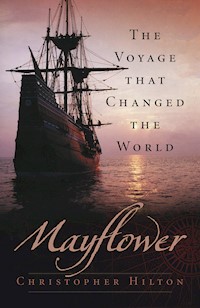
The little band of Puritan emigres that left Southampton in 1620 to found a godly colony in Virginia (as the eastern seaboard of the North American continent was known at the time) carried with them the ideological seed-corn of a new nation. They were leaving England so that they could worship God in the way their conscience told them was right, but they were the forerunners of the greatest feat of nation building in the early modern world. The vibrant self-determination of these Protestant exiles would play an important part in precipitating the imperial conflict with Britain after 1763 and would later stand at the core of the American ideal during the centuries after Independence, providing a powerful pull factor for aspirant migrants around the world. Mayflower is the story of their voyage, their settlement in New England and the influence they had on the forging of a nation.
Das E-Book können Sie in Legimi-Apps oder einer beliebigen App lesen, die das folgende Format unterstützen:
Veröffentlichungsjahr: 2005
Ähnliche

















MAYFLOWER
THE VOYAGE THAT CHANGED THE WORLD
CHRISTOPHER HILTON
First published in the United Kingdom in 2005 by Sutton Publishing Limited
The History Press The Mill, Brimscombe Port Stroud, Gloucestershire, GL5 2QGwww.thehistorypress.co.uk
This ebook edition first published in 2013
All rights reserved © Christopher Hilton, 2005, 2013
The right of Christopher Hilton to be identified as the Author of this work has been asserted in accordance with the Copyrights, Designs and Patents Act 1988.
This ebook is copyright material and must not be copied, reproduced, transferred, distributed, leased, licensed or publicly performed or used in any way except as specifically permitted in writing by the publishers, as allowed under the terms and conditions under which it was purchased or as strictly permitted by applicable copyright law. Any unauthorised distribution or use of this text may be a direct infringement of the author’s and publisher’s rights, and those responsible may be liable in law accordingly.
EPUB ISBN 978 0 7524 9530 9
Original typesetting by The History Press
Contents
Acknowledgements
The People
Maps
PART ONE OLD WORLDS
Prologue
Shoreline
One
Noises in a Quiet Land
Two
The Manor House
Three
Going Dutch
Four
Going Home
PART TWO NEW WORLDS
Five
Stormy Weather
Six
The Compact
Seven
Noises in Another Quiet Land
Eight
Among the Indians
PART THREE OUR WORLDS
Prologue
Shoreline
Nine
Thanksgiving
Ten
Roots
Eleven
Descent
Twelve
Common Ground
Notes
Bibliography
Acknowledgements
An American producer was making a documentary for the Discovery channel on the Berlin Wall the other month, and came over to interview me. That done, we fell to chatting and I told him I was working on the story of the Mayflower. ‘Interesting,’ he said, ‘because I don’t really know much about it.’ I suppose most people are the same. They know, perhaps vaguely, the basic outline but little or nothing beyond that: not the sequence of improbable and astonishing events, the religious fervour which tore the fabric of old England, the little group – now called the Pilgrim Fathers – from an obscure village who were swept up in that fervour, their harrowing flight to Holland to avoid persecution, their dangerous journey across the Atlantic in winter to found their own new world, their clinging on to survive …
This book is that story.
There are very few primary sources, and all who approach the story have to use them. The most important is Of Plymouth Plantation by William Bradford, who was a witness throughout and Governor of the Plantation. His prose is evocative and sometimes genuinely dramatic but at crucial moments maddeningly imprecise. This has fed a subsequent industry of assumption and speculation.
Mourt’s Relation (London, 1622) by Edward Winslow and other, anonymous, writers are eyewitness accounts of the very beginnings of the Plantation. Good News from New England (London, 1624), also by Winslow, continues the story.
Caleb Johnson (and his wife Anna) have produced a memorial volume – The Complete Works of the Mayflower Pilgrims – which contains all the above, and just about everything else the Pilgrims wrote, in its 1,173 pages. It has been a bedrock for me and has the feel of a labour of love about it. (He says it took ‘thousands of hours of transcribing, typing, and editing’.) I used it constantly for reference and have quoted Bradford and Winslow throughout (but with a caveat: see the section immediately below). Mr Johnson graciously said he had no problem with this. ‘The very purpose of Complete Works was to make these sources readily available to authors, reasearchers and historians.’ He printed 100 copies and I got the last of them! He is, however, considering republishing either the whole or some of its constituent parts, and he has a comprehensive website www.mayflowerhistory.com. The Complete Works and other material are on his Mayflower History Reference Collection CD-ROM available on the website. At present he is working on a new book The Mayflower and Her Passengers. I offer him my sincere thanks – and gratitude for the job he has done.
The historian is immediately confronted with what is not known. Many good men and true have toiled among parchments and records, teasing out fragments of information. A couple of outstanding practitioners of this are Jeremy D. Bangs, director of the Leiden American Pilgrim Museum, Holland, and the late Harold Kirk-Smith, whose book William Brewster, ‘The Father of New England’ contains invaluable original research. I am deeply grateful to Mr Kay for permission to quote from it. I have done so extensively.
The rendering of old English into modern is a problem which must be faced. Bradford’s and Winslow’s works are very heavy going (not to mention archaic words, long out of use) and Caleb Johnson has taken the sensible precaution of rendering them into more modern English. As he says, he ‘transcribed from originals or public domain editions, modernising the spelling but only very lightly touching up punctuation’. I have accentuated this, notably in smoothing and sometimes stripping out punctuation as well as clumsy and/or ambiguous phrases.
In the time covered by the book, people spelt their names freely – which is a polite way of saying several different ways. For example, John Smyth appears as Smith in various sources but I have standardised it to Smyth to avoid confusion.
The nomenclature needs resolving, too, because popularly the voyage from Plymouth, England, to Plymouth, Massachusetts, was undertaken by the Pilgrim Fathers. This term was first used much later and in any case is not all-embracing, because many who made the voyage were nothing to do with the original religious group but adventurers out to make whatever they could. However, once their destinies had intertwined, as inevitably they did, they all became part of a greater group. I have called them just settlers.
Time is tricky, too. Up to 1572, the Julian Calendar (known as Old Style) was used in England. This was inaccurate and by 1582 required adjustment: it was done by advancing ten days in October. This was called the Gregorian Calendar (known as New Style), after the Pope of that name – and the English wouldn’t use it. This explains why the same event can be ten days apart, depending on which Calendar was being used by whom. For uniformity, because the Pilgrims used the Old Style I have stayed with that.
I need to thank many people for their help. Malcolm J. Dolby, a resident of Scrooby and formerly of the Bassetlaw Museum in Retford, took pains to give me invaluable background; Dr Andy Russel, Archaeology Unit Manager at Southampton City Council, gave his time to fleshing out many details; John Cammack gave me insights into what happened at Boston (and a funny footnote or two); Maurice Barrick explored the mystery of where exactly the Pilgrims did try to sail from when they first decided to leave England for Holland; Nigel Overton, Maritime Heritage Officer at Plymouth City Museum and Art Gallery, sent a superb five-page response to my many specific queries – and thanks to Tammy Baines of the Chief Executive’s Department for steering me in the right direction. The respective staffs of the Greenwich Naval and Lambeth House libraries took me by the hand and led me to their treasures.
I am particularly indebted to Professor Robert Bliss, Dean, Pierre Lacede Honors College, University of Missouri–St Louis, for the breadth of his insights and explanations in Chapter 12, and grateful to Kenneth Bowling, Adjunct Associate Professor of History, the George Washington University, Washington DC for acting as a conduit to Professor Bliss, and Helen Veit, Bowling’s assistant, for making sure it all happened.
There is a bibliography at the end of the book, but I want to set down here my gratitude to the following for permission to quote from their work: Dr David Beale, Professor of Church History at Bob Jones University and Seminary, Greenville, South Carolina for extracts from his The Mayflower Pilgrims; Crispin Gill for his book Mayflower Remembered; Joanne Smith, Senior Archivist at Southampton City Council for the Mayflower pamphlet; Pearsons for The Stuart Age by Barry Coward and The Age of Plunder by W.G. Hoskins; Kevin Knight for the Catholic Encyclopedia website; Miss K.L. Merritt for a piece she wrote on Immingham; Blackwell Publishing for Reformation Thought by Alister E. McGrath; Jordan S. Dill for extracts from the Tolatsga website; Henry B. Hoff, Editor, for words from an article by Anthony R. Wagner, ‘The Origin of the Mayflower Children: Jasper, Richard and Ellen Moore’, in The New England Historical and Genealogical Register 114 (1960): 163–8; Penguin for The History of the Church, Volume 3: The Reformation by Owen Chadwick; Joke Kardux and Eduard van de Bilt for their Newcomers in an Old City; Random House for Puritanism and Revolution by Christopher Hill and A Place for Habitation by Francis Dillon.
Laurel Guadazno, visitor services manager of the Pilgrim Monument and Provincetown Museum, Massachusetts, extended a memorably warm welcome and was kind enough to take me around all the places I needed to see in the Provincetown area. She also allowed me to quote from her published material. Of course the name Plymouth, Massachusetts is now firmly embedded in world history, and rightly so, but the great adventure opened right around Cape Cod Bay, at Provincetown. Here is where they waded ashore for the first time and put their (soaking) boots on terra firma.
There might be confusion over the nomenclature: Plymouth, Plimoth Plantation and Plymouth Colony.
Plymouth is the generic term for the place in general.
Bradford’s book is called Of Plimoth Plantation. I am indebted to Caleb Johnson for this definition: ‘I do not believe that “Plimoth Plantation” has any formal definition, it is a more colloquial “common name,” which to my hearing has an agrarian sense to it. I personally would only use “Plimoth Plantation” to describe the town in its earliest years (before the founding of Duxbury), and I would probably not use it in any legal or political sense. If I were writing about raising corn, or an Indian visit in the early years, or something along those lines, I would be more inclined to use Plantation than Colony.’
I have been guided by this and used Plantation to mean the town which the settlers built and the land immediately around it.
Plymouth Colony, Johnson says, ‘was a political/governmental/legal entity. It originally consisted of just Plymouth itself, plus the Colony’s various land and trading rights that were established under English authority. The colony later grew over time to include other townships including Duxbury, Marshfield, Scituate, Barnstable, Sandwich, Yarmouth, Taunton, and others, all of which were under the jurisdiction of the Plymouth Colony Court.’
I have been guided by this, too, and have used Colony to mean the enterprise as a whole.
In days of olde, spelling conventions were much looser than now and I’m indebted to Nigel Overton for tracing the various versions of England’s Plymouth.
He says: ‘In terms of names and spellings I do not think there was one hard and fast rule. In most cases it would be the record keeper’s or cartographer’s spelling of the word. There was not always consistency; sometimes names would be spelt phonetically based on how they were heard, so accents could play a role too!’ So here goes: 1308, Bordeaux Custom’s Records, Plomuth; unknown source, Plymme; chart from about 1539, Plymmouth; 1590/91 map, Plommowth; 1592 map, Plymouth; 1592 map, Plimmouthe; 1593 map, Plimouthe; 1601/02 Italian maps, Pleymouth and Plimouth; 1643 siege map, Plymouth; 1646 map, Plimouth; 1665 plan, Pleymouth; eighteenth-century French map, Plimouth. From the sixteenth century, however, Plymouth was the more general usage and Mr Overton stresses that.
In other words, Plimoth Plantation is quite entitled to retain that spelling, and the towns in Massachusetts and Devon are quite entitled to call themselves Plymouth. Looking at Overton’s list, it is a mercy that we only have two versions to deal with. Incidentally, I have used a capital P for the Plantation throughout because, all else aside, it deserves one.
The People
Allerton, Isaac (1583/6–1658/9) One of the Leiden congregation who sailed on the Mayflower. A tailor, he became an assistant governor of Plymouth.
Allerton, John (before 1591–1620/1) Presumed to be a relative of Isaac Allerton (perhaps brother), he came from the Leiden congregation and sailed on the Mayflower. He was to return to Leiden to bring over more of the congregation later.
Arminius, Jacobus (1560–1609) A resident of Leiden, he was a controversial theologian at the University. His followers’ theory of salvation rejected predestination. He was – briefly – a contemporary of the English congregation in the town.
Boleyn, Anne (c. 1507–36) Henry VIII’s second wife, who bore him a daughter, Elizabeth, but no male heir. Anne was executed on dubious charges so Henry could marry Jane Seymour.
Bradford, William (1590–1657) The central pillar of the Plymouth Colony, its governor and guide. His sense of vision, justice and firmness may have been the key to its survival.
Brewster, William (1566/7–1644) The elder of the Scrooby church and postmaster. Served with diplomat Sir William Davison in Holland. Printed controversial material in Leiden and sailed on the Mayflower. He was the oldest passenger at the first Thanksgiving.
Browne, Robert (1550?–1633) A Cambridge University man, he was a leading independent (his followers were known as ‘Brownists’): he demanded freedom of conscience in religion, invoking separatism from the Church.
Catherine of Aragon (1485–1536) Henry VIII’s first wife, the widow of his brother Arthur, Prince of Wales. Henry and Catherine had a daughter, Mary. When he wanted an annulment the Pope refused, which led to the break between the Church of England and Rome.
Charles I, King of England (1600–49) He dissolved Parliament and ruled personally for eleven years before having to accept restrictions on his power. He was beheaded.Clyfton, Richard (?–1616) The Separatist pastor at Babworth, near Scrooby who eventually moved to Holland.
Corbitant (?–?) He was the chief of the Nemasket tribe and opposed to any dealings with the English settlers, against whom he conspired with other tribes. Eventually he befriended the settlers.
Cranmer, Thomas (1489–1556) As Archbishop of Canterbury, he was a pivotal figure in shaping the Church of England. Under the Catholic Queen Mary, he was burnt at the stake for heresy.
Elizabeth I, Queen of England (1533–1603) The daughter of Henry VIII and Anne Boleyn, she reversed the moves to Catholicism instituted by Mary. An enigmatic and accomplished woman, she never married.
Henry VIII, King of England (1491–1547) A giant figure, he became king on the death of his father, Henry VII, in 1509. He created the schism with Rome over his marriage to Catherine of Aragon, and married a further five times. He bent the Church of England to his will and plundered the monasteries. He can be seen as the bridge between the Middle Ages and modernity.
Hobomok (?–before 1643) An Indian of the Wampanoag, he spoke a little English and settled with his family near Plymouth, acting as interpreter. There are suggestions that he leant towards Christianity.
James IV of Scotland and James I of England (1566–1625) The son of Mary Queen of Scots, he was, however, a staunch Protestant; he tried to accommodate the Puritans at the Hampton Court Conference, and hoped to become a European peacemaker, but failed.
Mary, Queen of England (1516–58) She ascended the throne in 1553, was without any preparation for government and restored the papal position in England and punished leading Protestants, sometimes with violence.
Massasoit (c. 1590–1661) A chief of the Wampanoag tribe, it seems that he saw the future because he concluded a peace treaty with the settlers which was never broken.
Robinson, John (1575–1625) The pastor of the Pilgrims’ church at Leiden, he remained in Holland when the Mayflower sailed, intending to follow when the colony was established. He died in Holland soon after.
Samoset (?–?) He belonged to a tribe – of the Algonquins – then in Maine and spoke broken English which he had picked up from the fishermen on the coast. Of all the Indians, he was the first the settlers met: he suddenly came ‘boldly among them’.
Smyth, John (1570–1612) An ordained Anglican priest, he fell into dispute with the Church of England and moved to Holland, where he founded the first General Baptist Church.
Squanto (c. 1590–1622) A member of the Patuxtet tribe, he was taken to England by an expedition under Captain Weymouth, returned and befriended the settlers at Plymouth teaching them how to sow Indian corn. He played politics, too.
Standish, Myles (c. 1584–1656) A military man with a temper, he served as a soldier in Holland, travelled on the Mayflower and took responsibility for defence.
Weston, Thomas (1584–1647) A London ironmonger, he also sold cloth in Holland and heard that the Leiden congregation wanted to emigrate. He more than anyone put the whole project together, although he was of dubious integrity.
Winslow, Edward (1595–1655) He sailed on the Mayflower, was thrice governor of Plymouth and brought the first European livestock across the Atlantic in 1624.
Wyclif, John (c. 1329–84) A religious reformer who campaigned against wealth among the clergy and was a vociferous critic of the basis of Catholicism.
Maps
Scrooby area, Nottinghamshire, including Gainsborough, Headon, Sturton le Steeple, North Wheatley, Babworth, Austerfield, Worksop and Doncaster, the tight little circle of communities which proved to be a powerhouse.
The old world the Pilgrims left behind and their first new world, Holland.
The full sweep of the Atlantic seaboard: Plymouth, where the Mayflower went, the Hudson where it should have gone, and the nearest settlement, Jamestown, Virginia.
Indian tribes, often hostile to one another, covered the whole area.
PART ONE
Old Worlds
PROLOGUE
Shoreline
An ordinary place. At low tide the brown mud dries and cracks into a mosaic of squares, making the mudflat look, absurdly, as if it has been tiled. The creek which wriggles through it towards the distant sea is not really a creek any more but a gully, almost a crevice, holding a little static water. It will fill again when the tide rises to it. The gully has sloping banks and the mud on top of these dries in a different way, so completely that the tiling is parched and bleached, making a piebald-coloured patchwork.
This is industrial landscape, as any cargo port must be: car parks, metal security fences, men in hard hats, elephantine lorries murmuring under their loads. Great metal arms fold out into the sea on solid supports to embrace ships’ cargoes. Gantries wheel and turn silently, lifting loads and setting them down. Pyramids of coal, near a railway line where long freight trains clink and whisper as they lumber by, form one part of the backdrop. Vast, circular storage sheds, flanked by white office buildings in the geometrical modern style, form another. There is a permanent petrochemical smell in the air, borne on the wind.
The pathway to the gully, loose but slightly compacted shale, is the width of a lane and you do not see it until you are upon it. The walk down it to the shoreline is not long, perhaps twenty yards.
There is a clump of long, wild grass, unkempt as an old peasant’s hair. The detritus of the consumer culture – a discarded cigarette packet, chocolate wrappers, bits of cardboard, fragments of cellophane – lie embedded in this grass; then there is a low, brick parapet and, just below, the mudflat arching down to the sea.
Was it exactly here that it all began?
The sounds of industry are flattened by the wind, this same wind which brushes the sea into rilles full across the mouth of the broad estuary beyond the metal arms. The sea sighs as it licks the rim of the mudflat in its endless, timeless rhythm. This is not a silent place but it is a quiet place.
There are, I suppose, paradoxes in all things touched by human beings but few more poignant or bewildering than exactly here: an anonymous and ordinary creek which is not a creek butting on to the banality of commerce. There was a plaque to mark the spot but it has been moved somewhere else and, anyway, nobody really knows where the spot was.
That morning in 1608 – might have been spring, might have been early summer – a group of around a hundred people waited. They were mostly ordinary, country folk.
The location, ‘a large common a good way distant from any town’,1 had been chosen for the protection it offered. The nearest villages, Immingham and Killingholme, comprised just a few cottages and, anyway, Immingham was a couple of miles inland.2
Women and children rode in a boat in the creek, waiting.
The men walked the 40 miles from their homes in one English county, Nottinghamshire, to its neighbour Lincolnshire. What they were preparing to do was illegal without royal permission and they had none. As they walked, they were very vulnerable. Any little lad with sharp eyes tending sheep in a pasture might sound the alarm; any farm labourer sowing in the field might pause, wonder, go and tell his master; any crofter repairing a roof might glimpse them trekking their way across the flatland of Lincolnshire; any horseman riding by might come upon them.
Maybe they moved in groups, to attract less attention. Maybe they moved in one group, walked doggedly forward, drank with their cupped hands from freshwater streams, rested a moment or two under the boughs of old oak trees, gnawing hunks of bread they had brought. They may have had a serenity about them because, even in their vulnerability, they were sure their God was watching over them.
The women and children had come these 40 miles by river in a small sailing ship, known as a bark, which had been hired. The bark also carried the goods. The seamen had had to navigate the meres and waterways which meandered through the countryside to the estuary before they turned the bark towards the sea. They followed the shoreline towards the mudflat and the common. The bark got there a day early.
At the mouth of the estuary the water was so rough that it frightened the women. They, ‘very sick, prevailed with the seaman to put into a creek hard by, where they lay on ground at low water’.3 The women and children must have seen the mudflat drying as the tide slipped away, must have gazed across the grey waters towards the other side of the estuary a couple of miles away. To these people, whose horizons had been the area around their own communities, the estuary must have spread itself vast, hostile, forbidding.
Nobody knows when the men came in, that evening, in the hours of darkness or after dawn.
The women and children spent the night on the bark.
The ship to take them off was Dutch. It sailed into the estuary in the morning, but the tide had gone out, slipping down the mudflat and leaving the bark beached. It was some time before midday. From where he had dropped anchor in the estuary, the ship’s captain saw this just as he saw the men ‘ready, walking about the shore’.4 He sent a rowing boat and, when it reached the shoreline, some of the men clambered into it. The boat was rowed back to the ship and the men went aboard. Just as it was preparing to return for more, the captain ‘espied a great company’ of armed troops, both horse and foot. Someone, somewhere, had sounded the alarm.
The captain swore. Transporting illegals now posed a direct danger to him, so, ‘having the wind fair, weighed his anchor, hoisted sails and away’.5
The men left behind and the women and the children in the bark watched as the sails unfurled and the ship sailed out of the estuary and into the North Sea.
As the troops bore down on them some of the men dispersed and others stayed to help the women. It was heart-wrenching to see
these poor women in this distress. What weeping, and crying on every side, some for their husbands that were carried away in the ship … others not knowing what should become of them, and their little ones. Others again melted in tears, seeing their poor little ones hanging about them crying for fear and quaking with cold.6
The Dutch ship receded, but on deck the situation was no less heart-rending. The men there were in ‘great distress for their wives, and children’, now being taken by the armed force and were faced with the realisation that, as they stood on the deck powerless, they themselves had only the clothes they wore and ‘scarce a penny about them’.7
Within a comparatively few minutes the whole attempt at flight had broken up. Who knew where those who had fled were, or if they would even be seen again? Those guarding the bark were arrested and would clearly see the inside of a prison, perhaps for a long time, perhaps for life. The women and children would be taken into custody and if their men were on the Dutch ship they would not see them again.
The ship, receding further, was headed towards a great storm which battered it for fourteen days, sweeping it helplessly up to the Norwegian coast. Seven of those days were as dark as night and the storm so tremendous that the sailors cried out ‘we sink, we sink’.
The men were still certain their God was watching over them, even when ‘water ran into their mouths and ears’.8
Those who had fled, those who were arrested, those who were distraught and those who were nearly drowned would, together, help forge the matrix of a nation as mighty as any that had gone before it.
ONE
Noises in a Quiet Land
Always there are two concurrent stories. One, the foreground, is told incessantly and often in the most elaborate detail; the other, the background, is habitually not told at all.
The foreground is populated by notable people and notable events whose places in the long historical narrative are eternally fixed by deeds and dates. You probably know them. This is the domain of kings and conquerors, wives and mistresses, popes and prelates, dictators and diplomats, battles won and lost.
The background is a silent kingdom where the broad, constant flow of ordinary folk lived and died, generation after generation. They are strangers, held for ever in their anonymity. You might find their names in ancient, fragile, handwritten records or engraved into weathered, tilting headstones, but you will not find them anywhere else and you certainly do not know them.
The group at the mudflat were one such; having come from the small village of Scrooby in Nottinghamshire and its surrounding area, which would also have been anonymous except for a road, a manor house and regular stops by Royal Mail coaches. They were background people who had come to an ordinary place, waited there, and been scattered.
Here are some examples of the silent kingdom:
As to the landless, we know even less about them and have little idea about their numbers.
Of the houses of the working class in the first half of the sixteenth century we can say little. They are rarely described in contemporary documents and no structures have survived anywhere.
In Cheapside, London, alone there were fifty-two goldsmiths’ shops, so full of treasure that all the shops of Rome, Milan, Florence and Venice could not together rival such magnificence. But of the teeming, squalid streets and lanes and alleys of the poor we hear nothing.1
Of the first real settlement in the United States at Jamestown, Virginia:
What … could induce the labouring classes of England to abandon their homes for the dangers of the Virginia voyage? The answer, today, cannot be taken direct from the men and women best capable of giving it. To us, the poorer social classes are dumb. They had few means to tell their thoughts to posterity, since they were largely illiterate and since the presses were mostly used for the purpose of their betters, which did not include making surveys of mass opinion.2
Of the place from where, in the fullness of time, the group would cross the Atlantic:
Such a subject as the life of ordinary people in Southampton in the early seventeenth century is the hardest of all to illustrate since [it] is so wide – what their homes were like, their customs and habits, their entertainments, their relations and attitudes towards their neighbours, their conditions of work. [It] is made more difficult because most of the surviving records were for legal and administrative purposes … Ordinary people who were good and happy do not figure much.3
Eventually, the group would – without seeking it, without realising it, without calculating it and certainly without intending it – achieve the almost impossible feat of moving themselves to the foreground.
The pathway to this begins some three hundred years before, in the Reformation, a handy catch-all to express the growing tension between Catholicism’s grip on most of Europe and those seeking reform. There have always been deep disputes over whole tracts of the Reformation. One view was that the doctrine of the Catholic Church
had remained pure. Saintly lives were yet frequent in all parts of Europe and the numerous beneficial medieval institutions of the Church continued their course uninterruptedly … Gradually, however, and largely owing to the variously hostile spirit of the civil powers, fostered and heightened by several elements of the new order, there grew up in many parts of Europe political and social conditions which … favoured the bold and unscrupulous.4
Just as many said (and say) precisely the opposite. John Wyclif did. He is widely regarded, in another catch-all phrase, as the Morning Star of the Reformation. A Yorkshireman, his date of birth is unclear but seems to have been between 1320 and 1330. Many details of his life have been lost, but he is known to have spoken of ‘dominion founded on grace’, meaning:
the right to exercise authority in church and the right to own property. He maintained that these rights were given to men directly from God, and that they were not given or continued apart from sanctifying grace. Thus, a man in a state of mortal sin could not lawfully function as an official of church or state, nor could he lawfully own property. He argued that the Church had fallen into sin and that it ought to give up all its property and the clergy should live in complete poverty.5
To popes, accustomed to splendour and wielding absolute authority, this was revolution.
Wyclif did more than preach his own views: he took a practical step. In the early 1380s he led the movement to translate the Bible into English because he ‘believed that if the common people’ had it in ‘their own language they would demand a reformation of the church’.6 They would also be able to make up their own minds on how they wanted to worship.
In an age of authority, represented by the pope and, domestically, by hereditary kings and queens, this democratisation grew so dangerous it moved King Henry IV to decree, in 1401, that people preaching Wyclif’s ideas were heretics and could be burnt. How much influence Wyclif actually had still presents itself as one of those deep disputes. A couple of views on that: his ‘direct influence’ on the Reformation’s origins ‘appear to be surprisingly slight’,7 but Wyclif’s ‘ideas spread to the Continent and helped prepare the way’ for it.8
The core of the matter was that
the Pope’s laws interfered in many matters of Church and State and men talked of a need to limit the Pope’s authority; but some of them needed the help of the Pope to manage the Church in their lands, and used the Pope’s supreme power as a dispensing agent.
Everyone wanted reform, or professed to want reform. How to reform and what to reform was not so clear. The energies of some reformers went to create new religious orders, or little groups of prayer and study.9
They have handy catch-all labels of their own: Protestantism (any western Christian church separate from the Catholic Church ‘in accordance of the principles of the Reformation’)10 and Puritanism (simplifying and regulating worship because the Reformation was incomplete).
The emergence of Puritanism in the second half of the sixteenth century was a response to the unique form the Reformation had taken in England. Yet its roots can be traced back to a tradition of reform in the Christian Church. The Reformation itself began on the Continent, when in 1517 Martin Luther nailed his Ninety-five Theses on indulgence to the door of the cathedral of Wittenberg protesting against what he deemed to be the corruption and ecclesiastical abuses in the Church of Rome.11
That particular notable date, 31 October 1517, serves as well as any for a beginning to the journey to the shoreline, although
many students approach the Reformation in much the same way as medieval travellers approached the vast dark forests of southwest Germany – with a sense of hesitation and anxiety, in case what lay ahead should prove impenetrable … It is tempting for such students to ignore the ideas of the Reformation altogether, in order to concentrate on its social or political aspects.12
In December 1485, Ferdinand and Isabella of Spain had a daughter, Catherine. They immediately followed the contemporary custom of trying to find a political match for her because, in the ever-shifting foreground of European alliances and enmities, marriages were powerful cement. They found their match: Arthur, the eldest son of King Henry VII of England. Arthur was two, but that was as irrelevant as the fact that Catherine was three. An alliance had been cemented – she came as part of a treaty.
When Catherine was almost sixteen she travelled to England for the marriage. Her journey evidently took three months and the ship bringing her survived several storms, but she arrived safely at Plymouth on 2 October 1501. Here was, all unknown and un-knowable, a meeting point between foreground and background because, 119 years later, the shoreline people would embark from one of these Plymouth quays, perhaps the same one …
Catherine and Arthur were married a month after her arrival, Arthur’s younger brother Henry – then eleven – playing a prominent part at the ceremony. However, Arthur died six months later, possibly from lung disease. His death did not shift the foreground, but what to do? Young Henry had two assets, health and availability, and that gave the question its answer. Catherine was betrothed to him. It would prove, in all senses, a fateful step. By 1505, when Henry was old enough to marry her, the foreground had altered, taking with it the king’s enthusiasm for an alliance with Spain. That forced Henry to wait until the king died, four years later, before he became Henry VIII, the marriage could take place and the fateful step was taken.




