


11,99 €
Mehr erfahren.
- Herausgeber: Mercier Press
- Kategorie: Geisteswissenschaft
- Sprache: Englisch
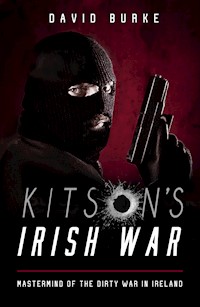
Brace yourself for a heart-pounding journey into the dark underbelly of Britain's dirty war in Northern Ireland. Kitson's Irish War is a gripping exposé that rips the lid off the clandestine operations and ruthless tactics employed by Brigadier Frank Kitson, the mastermind behind a brutal campaign that targeted Nationalists while turning a blind eye to Loyalist atrocities. From the shadowy assassinations carried out by the covert Military Reaction Force (MRF) on the streets of Belfast to the reign of terror unleashed by the notorious Parachute Regiment [1 Para] in Nationalist communities, this book leaves no stone unturned. Uncover the chilling truth behind the use of psychological warfare techniques, the torture of internees, and the infamous Bloody Sunday massacre perpetrated by Kitson's 'Private Army.' With explosive evidence from a deserter from 1 Para who joined the IRA, a deceitful MI5 agent, and a courageous whistle-blower who faced attempts to discredit them, Kitson's Irish War pieces together a shocking puzzle that the British government is determined to keep hidden. As efforts are made to halt the prosecution of soldiers responsible for civilian deaths, most of whom had no ties to paramilitary activities, this book is a timely and essential read for anyone seeking the truth behind one of the darkest chapters in Northern Ireland's history. Prepare to be shocked, outraged, and ultimately enlightened as you embark on this unflinching exploration of the secrets and lies that fueled Britain's dirty war. Kitson's Irish War is a powerful testament to the importance of exposing the truth, no matter how uncomfortable.
Das E-Book können Sie in Legimi-Apps oder einer beliebigen App lesen, die das folgende Format unterstützen:
Veröffentlichungsjahr: 2021
Ähnliche
















Dedicated
To all victims of state violence
MERCIER PRESS
3B Oak House, Bessboro Rd
Blackrock, Cork, Ireland.
www.mercierpress.ie
www.twitter.com/MercierBooks
www.facebook.com/mercier.press
Cover design by Sarah O’Flaherty
© David Burke, 2021
Epub ISBN: 978 1 78117 801 0
This eBook is copyright material and must not be copied, reproduced, transferred, distributed, leased, licensed or publicly performed or used in any way except as specifically permitted in writing by the publishers, as allowed under the terms and conditions under which it was purchased or as strictly permitted by applicable copyright law. Any unauthorised distribution or use of this text may be a direct infringement of the author’s and publisher’s rights and those responsible may be liable in law accordingly.
Printed and bound in the EU.
Dramatis Personae
BAKER, Albert: a soldier in the Royal Irish Rangers who deserted while in Belfast in 1972 and joined the UDA. He became a British military intelligence asset.
CARVER, Lord Michael: Chief of the General Staff (CGS) of the British army on Bloody Sunday. He worked with Frank Kitson in Kenya and Cyprus.
CHICHESTER-CLARK,James: prime minister of Northern Ireland, 1969–1971.
DUNNET, Sir James: Permanent Under-secretary at the Ministry of Defence, 1966–1974.
EASTWOOD, David: MI5 officer who was Director of Intelli- gence Northern Ireland on Bloody Sunday.
FARRAR-HOCKLEY, Maj.-Gen. Anthony: Commander Land Forces (CLF) Northern Ireland August 1970–August 1971. The CLF was the second most senior rank in Northern Ireland in the early 1970s. Gen. Robert Ford succeeded him.
FAULKNER, Brian: prime minister of Northern Ireland, 1971–1972.
FORD, Gen. Robert: Commander Land Forces in Northern Ireland on Bloody Sunday. A former paratrooper with counter-insurgency experience in Palestine and Aden, he succeeded Farrar-Hockley as internment was introduced.
HEATH, Edward: Conservative party prime minister of the UK, 1970–74.
HERRON, Tommy: Vice-chairman of the UDA who ran that organisation’s assassination programme. He had a relationship with British military intelligence through an officer who went by the nom de guerre ‘Capt. Bunty’.
JACKSON, Michael: a captain in 1 Para and adjutant to its commander Lt Col Wilford in 1971–2. He later rose to become Chief of the General Staff of the British army.
KITSON, Frank: British army counter-insurgency expert who served in Malaya, Kenya, Cyprus, Oman and Northern Ireland. He was the brigadier in charge of the 39 Brigade area which included Belfast, 1970–72.
LAGAN, Frank: Chief Superintendent with the RUC in Derry on Bloody Sunday.
LEWIS, Byron: radio operator with the Support Company of 1 Para on Bloody Sunday. His testimony was crucial in forcing the British government to set up a new tribunal which became known as the Saville Inquiry. He revealed that he saw his colleagues fire at unarmed civilians in Derry on Bloody Sunday.
LODEN, Edward Charles: the major who commanded 1 Para’s Support Company on Bloody Sunday.
MacLELLAN, Patrick: brigadier of 8 Brigade which oversaw military operations in Derry. He later rose to the rank of general.
McMULLEN, Peter: corporal with 1 Para based at Palace Barracks who deserted the British army and joined the Provisional IRA.
MOONEY, Hugh: Foreign Office official who worked for the Information Research Department (IRD), a propaganda organisation attached to the Foreign Office.
OBSERVER B:an agent of both British military intelligence and MI5 who had access to the ‘no-go’ area of Derry in 1972.
SAVILLE, Lord Mark: chairman of the Saville Tribunal into Bloody Sunday. While he vindicated the reputation of the victims vilified by Lord Widgery in his report on Bloody Sunday, he offered no plausible explanation for the behaviour of the paratroopers who perpetrated the massacre.
SMITH, Howard: Foreign Office official appointed by Edward Heath as the UK Representative (UKREP) to the Stormont government of Northern Ireland. He later became the director-general of MI5, 1978–1981.
TUGWELL, Col Maurice: British army officer who ran psycho- logical operations in Northern Ireland.
TUZO, Maj.-Gen. Harold: General Officer Commanding Northern Ireland (GOC, NI) on Bloody Sunday.
WIDGERY, John Passmore: Lord Chief Justice of England and Wales, 1970–1980. He chaired the Widgery tribunal into Bloody Sunday in 1972. He vilified the murdered civilians on Bloody Sunday in his report into the atrocity.
WILFORD, Lt Col Derek: Commander of 1 Para, 1971–2.
Organisations, terms, locations and acronyms
8 Brigade: British troops stationed in Derry and its environs were assigned to 8 Brigade. Its HQ was located at Ebrington Barracks in Derry.
39 Brigade: British troops stationed in Belfast and the eastern side of Northern Ireland (excluding the South Armagh border region) made up 39 Brigade. Its HQ was located at Thiepval Barracks, Lisburn, on the outskirts of Belfast.
APC: armoured personnel carrier such as a Saracen, sometimes referred to as a ‘pig’.
Ballymurphy: a predominantly Catholic/Nationalist area of Bel- fast. The Ballymurphy massacre took place here in August of 1971.
BIS: British Information Service.
B-Specials: members of the Ulster Special Constabulary, a part-time force disbanded in 1970.
Bogside: an estate below the Derry Walls. It is predominantly Nationalist/Catholic. The name derives from the fact it was built on an area of peat bog.
CDCs: Citizen Defence Committees.
CLF: Commander of Land Forces, the second most senior rank in the British army in Northern Ireland in the early 1970s.
CO: Commanding officer.
Creggan: a predominantly Nationalist/Catholic housing estate in Derry built on a hillside above the Bogside.
DYH:Derry Young Hooligans.
Ebrington Barrack: the HQ of 8 Brigade in Derry.
Fianna Fáil: the Irish political party in power in the Republic of Ireland during the Kitson era. Led by Taoiseach Jack Lynch.
Fine Gael: the Irish political party in the Republic of Ireland which led the opposition during the Kitson era.
Fort George: British army base located on the banks of the River Foyle on the northern outskirts of Derry adjacent to the Strand Road.
FCO: Foreign and Commonwealth Office.
Free Derry: first ‘no-go’ area in Northern Ireland.
Garda Síochána: the police force of the Republic of Ireland.
Glenfada Park: a small estate of low-rise flats adjacent to the Rossville flat complex in Derry.
HQNI: Headquarters NI, based in Thiepval Barracks in Lisburn.
HMG: Her Majesty’s Government.
Internment: imprisonment without trial.
IRD: Information Research Department: it was part of the Foreign Office. It ran propaganda campaigns for the British government.
JSIW: The Joint Service Interrogation Wing of the British army which trained RUC Special Branch officers in interrogation techniques in April 1971.
Kitson’s Private Army: see the entry regarding Support Com- pany below.
Knights of Malta: a voluntary paramedic organisation.
Low-intensity operations: a low intensity operation is any military operation other than those in a conventional, high-intensity war. They may include counter-insurgency, counter- guerrilla warfare, counter-terrorism, unconventional warfare, intelligence, peacekeeping, peace enforcement, security force assistance, nation-building, civil affairs, and information operations.
Mau-Mau: Kenyan rebel movement which opposed British rule in Kenya.
MI5: Britain’s internal security service, active inside the United Kingdom and her overseas colonies. It is attached to the Home Office.
MI6: Britain’s overseas intelligence service. It is attached to the Foreign Office.
MoD: Ministry of Defence. It is responsible for the British army.
MRF: Military Reaction Force (sometimes referred to as the Mobile Reaction Force), an undercover unit of the British army set up by Brigadier Frank Kitson in Belfast in the early 1970s. It was the forerunner of many similar units active in Northern Ireland during the ‘Troubles’.
NICRA: Northern Ireland Civil Rights Association: organisers of the anti-internment march through Derry on the day of Bloody Sunday.
OC: Officer in Command.
Official IRA: the Marxist wing of the Republican Movement which emerged after the split in December 1969. Its Chief of Staff in the 1970s was Cathal Goulding.
Operation Banner: the operational name for the deployment of British troops in Northern Ireland from 1969 to 2007.
Operation Calabra: the designation given to the interrogation programme of the prisoners who were swept up during internment by the British army in 1971.
Operation Demetrius: the codename provided to the internment swoops which took place in August 1971.
Operation Forecast: the plan by 8 Brigade of the British army to monitor and control the NICRA march in the city on 30 January 1972
Operation Hailstone: an action launched in July 1971 to lure the so-called ‘Derry Young Hooligans’ and the Derry IRA into the open so that soldiers from 1 Para could confront and arrest them.
Operation Linklater: an arrest operation launched shortly before internment in 1971. It was designed to collect information from those arrested – about IRA targets in their localities and elsewhere. It was hoped the information collected would enhance the prospect of capturing IRA leaders during the then forthcoming internment swoops.
Operation Motorman: the British army operation which ended ‘Free Derry’ on 31 July 1972.
Orange Order: an organisation formed in 1795 named after King William of Orange. Catholics. Its purpose is to defend Protestant interests, including the union with Britain.
Order 2/72: the order issued by Brigadier Patrick MacLellan of 8 Brigade in Derry to deal with the NICRA march that took place on Bloody Sunday.
Palace Barracks: HQ of 1 Para on the outskirts of Belfast.
Provisional IRA: the wing of the IRA which emerged after the IRA split in December 1969 with the intention of ending British rule in Northern Ireland. Its chief of staff from 1970–72 was Seán MacStíofáin.
PSYOPs: Psychological Operations.
RHC: Red Hand Commando: Loyalist paramilitary organi- sation led by John McKeague.
RUC: Royal Ulster Constabulary, the police force of Northern Ireland.
RUCSB: RUC special branch.
Saracen: an armoured personnel carrier used by the British army and sometimes referred to as a ‘pig’.
SDLP: Social Democratic and Labour Party – a nationalist political party supporting a United Ireland achieved through non-violence.
Sinn Féin: Republican political party. It is the political wing of the IRA.
Sticky: a nickname given to a member of the Official Republican movement.
Stormont: the home of the government of Northern Ireland.
Support Company 1 Para: elite section of the 1st Battalion of the Parachute Regiment. The title ‘Support Company’ de- rived from the fact that the troops originally assigned to it had carried anti-tank guns, mortars and other weapons in support of their comrades. In Northern Ireland there was no need for these types of weapons. It became the cutting edge of 1 Para and was known and feared throughout Belfast as ‘Kitson’s Private Army’. The soldiers attached to it were responsible for the shooting of civilians in Derry on Bloody Sunday.
Tánaiste: Deputy Prime Minister of the Republic of Ireland.
Taoiseach: Prime Minister of the Republic of Ireland.
Thiepval Barracks: A large military complex at Lisburn on the outskirts of Belfast. It was home to HQNI which oversaw all military operations in Northern Ireland and 39 Brigade which was responsible for Belfast and its environs.
UKREP: the United Kingdom Representative to the Stormont government of Northern Ireland.
UDA:Ulster Defence Association, established in 1970. De- clared illegal in 1992.
UFF: Ulster Freedom Fighters, a cover name used by the UDA when it carried out assassinations.
UVF: Ulster Volunteer Force, a Loyalist paramilitary organisation.
Introduction
The Dirty War in Ireland
Just after 5 p.m. on 14 August 1969, two companies of the Prince of Wales’ Own Regiment drove into Derry’s Guildhall Square. As the troops descended from their jeeps to the growing excitement of gathering Bogsiders, they had little inkling that this was the opening moment in a thirty-year British army operation that would become known as Operation Banner, its longest ever in peacetime; nor that almost 1,500 soldiers would be killed and over 6,000 wounded in Northern Ireland in the years to come. Nor indeed that within just years, this same army (now being welcomed by cheering Bogsiders as their unlikely protectors while an exhausted RUC withdrew, tails between its legs) would be interning hundreds of Nationalists without trial. Nor that it would ultimately end up facing the European Court accused of torture. The Bogsiders could not have suspected that within three years, just around the corner from Guildhall Square, the same army whom they welcomed would carry out Bloody Sunday, murdering their friends and relatives.
But surely the political establishments in London, Belfast and Dublin must have recognised, on that extraordinary afternoon, England’s historic Irish problem, after a half century of partition, was back with its gaping wounds as raw as ever.
The British army came in to ‘assist the civil power’ as the official government hand-out politely put it. The political reality, however, was that they were there to keep matters in check while the politicians came up, once again, with a solution to the Irish problem. It was a military task that proved hugely complex to achieve within the legal and political strictures of the liberal democracy which was the United Kingdom of 1969.
Harold Wilson, the British prime minister 1964–70, had been busy implementing a policy of colonial withdrawal, ‘East of Suez’. Under this, the British army had departed from places as far flung as Aden, Kenya and Malaya. But the act of soldiering in the old ‘white man’s burden’ colonies was polar opposite in terms of strategic and military competence to that operating within the United Kingdom. While con- centration camps and punishments like castration or the death penalty were liberally utilised in Mombasa and Kuala Lumpur, they were obviously not suitable for deployment in Northern Ireland.
By far the greatest crisis the government faced was how to lawfully deal with a raging insurgency, without resorting to their long-practised counter-insurgency methods. To put it quite simply how could you get away with fighting a ‘dirty war’ on your own doorstep? A soldier on a street in Northern Ireland, even in an armoured car and equipped with a self-loading NATO issue rifle, had no more legal power of arrest than any civilian had. When there was trouble, the troops were obliged to wait for the RUC to turn up before anyone could be taken into detention. The troops, who, in the main, had been equipped and trained to deal with invading Soviet Warsaw Pact forces, found themselves patrolling the back-streets of Derry’s Creggan estate and Belfast’s Ballymurphy.
Only a few now bother to deny that a ‘dirty war’ in Northern Ireland followed. It was fought behind elaborate official denials against a background of disinformation and duplicity. In the years since, the barest bones of information have been disinterring themselves from secret graveyards.
Hundreds of innocents were swept up in this dirty war, many died and still their relatives await the simple justice of being told the truth about what happened to them. But piece-by-piece this story is taking shape and I hope that in relaying as much as I can of the account of Brigadier Frank Kitson’s War in Ireland, this will lay bare that hidden narrative.
The Kitson era spanned September 1970 to April 1972. It is apparent from an indiscreet book Kitson published in November 1971, entitled Low Intensity Operations, that he believed the Catholic-Nationalist community was the enemy he had to confront. He engaged in an experiment to adapt some of the techniques he and his colleagues had developed in the colonies for use in a part of the UK to defeat the IRA. Ultimately, the experiment backfired.
The low point of the Kitson debacle played out on a crisp winter’s afternoon in Derry. On 30 January 1972, shots began to ring out in that city. The fingers curled around the triggers belonged to ‘Kitson’s Private Army’, an elite group of paratroopers more properly known as Support Company of the 1st Battalion of the Parachute Regiment.
Information continues to trickle out about Kitson’s Irish War. Yet, many questions remain unanswered, especially about Bloody Sunday:
* Why did the soldiers of Support Company murder a group of unarmed people who were predominantly young males?
* Was it simply a case of a handful of out-of-control mavericks going on a rampage?
* Did a selection of key operatives acting on orders from their superiors set out to ‘teach’ the Bogside a lesson for allowing the IRA build a stronghold in their midst?
*Or, in the most malign scenario, was it an attempt to provoke a battle with the IRA as part of a plan to smash Derry’s no-go area?
The Saville Inquiry into Bloody Sunday, which was estab- lished in 1998 and reported in 2010, did not delve deeply into this abyss, but it did reveal a number of clues that point toward some very dark corners in which Kitson and Col Derek Wilford (the commander of 1 Para), are found lurking. So too is their former superior, the late Gen. Robert Ford, Commander Land Forces in Northern Ireland. Of this trio, Kitson is the one who has escaped real scrutiny. To fully appreciate his significance in the war in the early 1970s, and the road that led to the calamity of Bloody Sunday at the tail end of his time in Ireland, it is instructive to review the tactics that Kitson and his brothers in arms practised around the globe in the decades before they arrived in Ireland. Following on from the analysis, the narrative will return to Ireland where Kitson’s relationships with Ford, Wilford and others will be considered in more depth.
1
‘He was 120% soldier’
Frank Edward Kitson was a product of his class and time. Born on 15 December 1926, he was the eldest son of Sir Henry Kitson, a vice-admiral in the Royal Navy, and Marjorie de Pass, daughter of Sir Eliot Arthur de Pass. His uncle, Frank de Pass, was a recipient of a Victoria Cross medal. He was educated at Stowe, then second only to Eton in the ranks of Britain’s most desirable boys’ public schools. It had been established by J.F. Roxburgh to produce eager young men destined to rule over Britain’s global empire. Kitson thrived in Stowe, becoming the head boy of his house. While a student, he developed a passion for blood sports. ‘Ever since childhood I have spent long hours waiting in hides trying to shoot things’, he once wrote.1
For over two centuries the Kitson family had supplied officers to the Royal Navy and his father fully expected him to join the ranks at the end of his schooling. This was not to be:
Being asthmatic I was no use to the Navy so I had to join the Army instead. This caused some stir in the family, but as I was obviously unsuited to the Church there was no alternative short of breaking a father-to-son tradition which had lasted for over 200 years. In fact, there was little harm done as my only brother was in the Navy and there is something to be said for a family not having all its eggs in one basket. My housemaster at Stowe was actually pleased and said something about a “narrow escape”: he was biased, however, having been a regular soldier himself for twenty years.’2
Kitson joined the Rifle Brigade in January 1945. He rose to become Gen. Sir Frank Kitson, GBE, KCB, MC & Bar, DL. He served as commander-in-chief UK land forces from 1982 to 1985 and as aide-de-camp to Elizabeth II from 1983 to 1985. Along the way, he fought the Mau-Mau in Kenya and was awarded the Military Cross. Thereafter, he confronted communist rebels in Malaya and subsequently helped suppress a revolt in Oman, while garnering some peacekeeping experience in Cyprus. He opposed the IRA in Northern Ireland in 1970–1972. A common thread in all of this was his devotion to intelligence gathering on a drift net scale. Rapt attention to detail was another of his hallmark traits as was the vigour he displayed during prolonged and intense interrogation of prisoners.
Physically, he was a small man with a sallow complexion, blue eyes and a ‘high, nasal voice’. In terms of his personality, he was ‘notorious for his dislike of small talk’.3Michael Jackson, who served as a captain in 1 Para in the early 1970s, described him as an officer with a ‘very distinguished record of counter-insurgency operations in Kenya, Malaya, Oman and Cyprus’.4 In terms of his personality, however, he was ‘cold and remote’.5
Jackson recounts the story of a dinner party at which an ‘ambitious young wife sat next to him. Her opening gambit was to say with a smile, “General, I have been bet I’ll get at least half a dozen words out of you”, to which he replied, “you’ve just lost” and didn’t say another word to her for the remainder of the evening’.6
A man who worked with him in intelligence in Kenya described him as ‘a loner, utterly devoted to his work, who took little part in Kenya social life’.7
James Kinchin-White, a soldier who worked with him as his clerk in Cyprus 1967, recalls that he was:
an absolute stickler for SOPs [Standing Operational Procedures]. He re-wrote those for the British battalion UNFICYP [United Nations Forces Cyprus]. I was duty clerk one evening and, unfortunately, I got the job of typing them all up on Gestetner duplicator skins. As he handed the drafts to me, he said ‘I’ll sign these in the morning’. I laughed and he said, rather sheepishly I thought, ‘I’m not joking’ – exit stage left. I don’t think I managed the task, but he never said anything. He was definitely a ‘workaholic’ – and expected the same from everyone.
He was cold, calculated and, I think he conveyed a sense of ‘reliability’, and ruthlessness in pursuit of objectives. But I have never seen or heard of him losing his temper. If you were a soldier heading for a fight, he was the kind of man you wanted to lead you. I am told that he did have a sense of humour, but that it was only revealed in appropriate company ... I met him and his wife, Elizabeth, by chance around 1998 – she was always the one who ‘talked’ while he focused on other things. ‘Aloof’ yes and ‘curt’ certainly, but never discourteous. One didn’t ‘cross’ the man, he tended to come down harder on errant senior people rather than on junior ranks.8
Capt. Colin Wallace, a psychological operations officer, who knew Kitson from Thiepval Barracks in Northern Ireland furnished a statement to the Saville Inquiry into Bloody Sunday describing how Kitson had done ‘much to enhance the army’s [initial] intelligence gathering capabilities during the 1970s. He became something of a bogeyman to those in Left Wing politics because of some of the books he had written about internal security operations. A very bright, dynamic officer, his stern expression and tough, ‘no-nonsense’ style sometimes intimidated those who worked for him. Despite his stern exterior, he had a good sense of humour and a sharp awareness of political issues’.9 When Wallace provided this succinct portrayal of his former colleague, he had not seen him for decades. During that time Wallace had become a high-profile whistle blower who shone a light on MI5 and military intelligence wrongdoing, hardly something of which Kitson would have approved. Wallace encountered Kitson at the Saville Tribunal hearings in London. ‘I had not seen him since Lisburn. Our relationship then had been very good. I was the last witness before Lord Saville while he sat in Ireland and the first to give evidence in London. I knew he was on after me. As I was leaving, he was coming in with his legal team. We caught each other’s eye, he smiled at me and we exchanged brief pleasantries but both of us were on the move and did not halt for a conversation. I am sure he recognised me, especially as he would have been aware of the witness list for the day.’10
Wallace also remembers Kitson as ‘a classic no nonsense figure. When he was talking to you, he would focus his attention on you intently. His gaze was quite severe, quite penetrating. For junior officers this could be quite intimi- dating. His world was the army. He was 120% soldier.’
2
Learning to Kill
Kitson’s first overseas assignment was to Germany in 1946 with the rank of second lieutenant. He remained there for seven years. He found plenty of sport to occupy his spare time such as racing horses in Rhine Army competitions, trout fishing and ‘many wonderful opportunities for shooting … and by shooting I don’t mean plugging holes in targets’, he wrote.1Playing bridge and attending the opera also helped to pass the time. By 13 September 1949, he had found his vocation and was appointed as an intelligence officer at the HQ of the Armoured Brigade in Germany.
Half a world away, in October 1952, the Kenya Land and Freedom Army KLFA) launched a rebellion against the white European colonist-settlers in their homeland. The British army and the local Kenya Regiment resisted them. The latter included British colonists, local auxiliary militia and some pro-British Kenyans. Later, MI5 was deployed to help suppress the rebellion. The KLFA, also known as the Mau-Mau, consisted of rebel tribesmen from the Kikuyu, Meru, Embu and other Kenyan communities.
In July 1953, Kitson was transferred to Kenya ‘to do a job connected with Intelligence’.2After seven years, he was glad to be leaving Germany. He was twenty-six.
The Mau-Mau rebellion was inspired by a desire on the part of the Kikuyu and other Kenyans to reclaim by armed insurrection land taken from them by the British. Kitson, however, seemed to think that opposition to Britain was inspired in large part through the intercession of witchcraft. He had a rose-tinted view of Britain’s presence in the country:
During the half century in which the British had ruled Kenya they had dispelled the fears which had formerly come from raiders, slavers and disease, but the fear of magic was still a powerful force. As I sat at home reading about the witch-doctors and their ways, I too felt that fear, flickering faintly across the four thousand miles which separated me from the Kikuyu.3
He did not see the Kikuyu as civilised people. Instead, he described how they:
relied mainly on magic and therein lay the greatest of all the horrors which beset them. Most witch-doctors were not malign in the sense of wishing harm to their clients. On the contrary, they doubtless did their best. On the other hand they sat in the middle of a web of superstition which bound the whole tribe in thrall to an unseen world of spirits, omens, curses and blood.4
At this time in his life, Kitson kept a Bible by his bedside.5 A clue as to the type of Christian he was can be gauged by the fact that on his first Sunday in Nairobi he attended a service in the local Anglican cathedral and wrote later: ‘I sat next to an African woman who had bad halitosis and I was surprised to find that there was no segregation of races into separate parts of the building’.6
The British campaign against the Mau-Mau was merciless. In 1953, Gen. George Erskine, commander-in-chief of British armed forces in Kenya reported to the secretary of state for war, Anthony Head, that in the early days there had been a ‘great deal of indiscriminate shooting by the Army and Police’ and he was ‘quite certain’ that prisoners had been:
beaten to extract information. It is a short step from beating to torture, and I am now sure, although it has taken me some time to realise it, that torture was a feature of many police posts. The method of deployment of the Army in the early days in small detachments working closely with the police ... had evil results.7
... I very much hope it will not be necessary for [Her Majesty’s government] to send out any independent enquiry. If they did so they would have to investigate everything from the beginning of the Emergency and I think the revelation would be shattering.8
What were these ‘evil results’, the revelation of which would have been ‘shattering’? In Cruel Britannia, A Secret History of Torture, Cobain summarises some of the atrocities in Kenya::
Men were whipped, clubbed, subjected to electric shocks, mauled by dogs and chained to vehicles before being dragged around. Some were castrated. The same instruments used to crush testicles were used to remove fingers. It was far from uncommon for men to be beaten to death. Women were sexually violated with bottles, rodents and hot eggs.9
This all took place against a background of curfews, intern- ment and capital punishment. Over 1,200 Kenyans died dangling at the end of a noose.
One of the torture victims was Hussein Onyango Obama who had served with the British army during the Second World War in Burma. When released after six months in detention, he was emaciated, suffering from a lice infestation of his hair and had difficulty walking. He died in 1979. His wife informed journalists that he had told her that the British had ‘sometimes squeezed [his] testicles with parallel metallic rods’. They had also ‘pierced his nails and buttocks with a sharp pin, with his hands and legs tied together with his face facing down’. Hussein Onyango Obama was the grandfather of Barak Obama.10
One British officer quoted by David Anderson in Histories of the Hanged revealed just how brutal the campaign became. He described how a police officer was interviewing three suspects:
… one of them, a tall coal-black bastard, kept grinning at me, real insolent. I slapped him hard, but he kept on grinning at me, so I kicked him in the balls as hard as I could ... when he finally got up on his feet he grinned at me again and I snapped. I really did. I stuck my revolver right in his grinning mouth ... and I pulled the trigger. His brains went all over the side of the police station. The other two [suspects] were standing there looking blank ... so I shot them both ... when the sub-inspector drove up, I told him the [suspects] tried to escape. He didn’t believe me but all he said was ‘bury them and see the wall is cleaned up’.11
Kitson recalled his initial thoughts upon arriving in Nairobi in August 1953 thus:
Soon afterwards we went for a walk in Nairobi. By this time it was dark but there still seemed to be a lot of Africans wandering about. The main streets were well lit but not the smaller ones, and as we walked past the entrance to one of these I saw two or three men squatting round a watchman’s fire some fifty yards away. I had been interested to see the Africans at close range in the street. I may even have been a bit excited. I had thought so much about the notorious Mau-Mau and their murders, mutilations and brutalities that I was naturally elated at last to be on the threshold of such things. But the sight of the three men round their fire had a different effect. This brought back to my mind stories of another sort. Stories of age-old magic rites, of bestiality, obscenity and the power of unseen forces. Again I felt the uneasiness which I had experienced in England but this time it was more than a faint flicker.12
Kitson’s ingrained colonial attitude can be gleaned from another passage in his 1960 book, Gangs and Counter-Gangs. He was assigned to Narok in the Masai region. According to Kitson, the Masai:
were not interested in the Mau-Mau. The Kikuyu were running the [Mau-Mau] movement and the Masai were their hereditary enemies. Unfortunately they had intermarried a lot with the Kikuyu as so many of their own women were barren due to congenital syphilis. From these mixed marriages there grew up a large colony of half-breeds who had forsaken the nomadic life of the proper Masai and who were working in shops and sawmills throughout the area. They proved to be enthusiastic supporters of the movement and by April several [Mau-Mau] gangs had formed and were doing quite a lot of damage.13
Kitson experienced no difficulty operating in the grotesque hell that Kenya had become. After dinner one night a colleague said he wanted to have a quick look in the Tigoni mortuary because he was missing an informer who might have found his way in there. ‘The shambles inside was past all describing’, he wrote.14 There ‘must have been eighteen bodies in a place the size of a small summer house ... Some of them had been there for five days and were partially decomposed. They were all lying around tangled up on the floor as there were no slabs in the Tigoni charnel house’. His colleague behaved as though nothing was wrong and ‘continued talking about whatever it was we had been discussing before we got there, as he rummaged around in the human wreckage. After a few moments while I looked out through the door I forced myself to look back inside again. In a surprisingly short time I found that I was no longer bothered by the sight. But for the smell, I might even have been looking at a lot of old bicycles lying on the ground ... Now I had seen something more revolting than I could have imagined – even the cinema could not have produced such a spectacle – and I had found that I hardly minded at all. From that time on I felt more sure of myself.’15
***
Kitson would go on to work closely with MI5 in Kenya and used the experience to fine-tune a counter-insurgency technique that involved the use of ‘counter-gangs’ or ‘pseudo gangs’. This was a practice of ancient pedigree. The Chinese military general and Taoist philosopher, Sun Tzu, had ordained centuries ago that ‘to understand your enemy, you need to be your enemy’. That attitude underpinned the concept of the ‘pseudo-gang’ and, in more modern times, has become known as asymmetric warfare. The principle involves the use of ‘friendly’ or ‘turned’ insurrectionaries to attack other insurgents and their supporters. In reality, it is State terrorism by proxy.
Some argue the concept can be discerned in the Yeomanry of 1798 in Ireland (or further back when Elizabethan and earlier English conquerors used Irish against Irish). Certainly, the counter-gang idea was in full flow in Kansas and Missouri during the American Civil War, and the British used it in South Africa during the 1899–1902 Boer War. The Second World War had so many such units, space does not permit a review. The French deployed similar tactics in Algeria in the 1950s and 1960s.
Kitson described how rebels could be turned through ‘carrot and stick’ tactics to work for the British. With their native appearance and local knowledge, they could move about freely with the aim of infiltrating and deceiving the rebels. Adopting the appearance of the enemy and generating confusion behind enemy lines was a tactic which the British had exploited not long before this in Palestine. When one of Kitson’s pseudo-gangs in Kenya met a band of rebels, they would either eliminate them or report their location to their headquarters. In his 1960 publication, Kitson gave a detailed account of how this was done with the help of one Mau-Mau fighter he called ‘George’.
Kitson wrote about his experience in Kenya in two books, Gangs and Countergangs (1960) and Bunch of Five (1977).The foreword to his first publication described Britain’s pre- sence in Kenya as a ‘benevolent autocracy of good Colonial administration’.16 ‘The Mau-Mau were associated in my mind with all that was foul and terrible in primitive savagery’.17 He described the thrill of chasing one wounded and bleeding Mau-Mau quarry thus:
This time there was a much bigger pool of blood. We started moving forward very slowly on hands and knees to see between the coffee bushes. Eric was in front as usual. Suddenly I caught sight of a bit of a rag just to Eric’s right and shouted a warning. I even went so far as to draw my pistol, which I seldom did for fear of accidents, but it was unnecessary. Eric and Bill Henning launched themselves simultaneously on the wretched fellow, who was made prisoner with little fuss. The hunt was over but it had been fascinating while it lasted. There is no doubt at all that one cannot savour the full thrill of the chase until one hunts something which is capable of retaliation.18
In his 1977 offering, he revealed that most British soldiers in Kenya ‘saw evidence of revolting Mau-Mau brutality from time to time, and probably regarded the finding and disposing of gang members in the same way as they would regard the hunting of a dangerous wild animal’.19
***
Kenya suffered its own Bloody Sunday, which took place in June 1953 shortly before Kitson’s arrival. In his books, he ignored it and other British atrocities despite the fact that two of them contained purported histories of the conflict. The massacre was perpetrated when Major G. S. L. Griffiths of the King’s African Rifles B Company descended upon the Chuka area of Kenya with his troops on 13 June. His intention was to flush out the Mau-Mau he believed were lurking in the nearby forest. Griffiths demanded of a prisoner they had captured that he assist them, but the captive refused. In response, he ordered his men to rip open a hole in his ear with a bayonet. After they complied, a piece of string was threaded through the wound and used as a leash for the next four days. A second prisoner had to watch what was happening. When he too refused to help, his ear was amputated. He continued to resist and was shot dead.
Over the next two days Griffiths’ troops captured a number of Mau-Mau rebels on the boundary of the forest. On 17 June, a patrol of ten men led by an African warrant officer began to search farmland on the edge of the forest. They came across a group of men whom they ordered to lie face down, after which they set upon them. Two of them managed to escape later, when they were sent to fetch food. The other ten were shot on the ground at close range.
The following morning another nine men and a child were murdered in cold blood in a clearing near a small coffee farm at the edge of the forest. Some of the soldiers chopped off the hands of six of the corpses and brought them back to their camp.
The next day the man with the string leash looped through his ear was murdered.
News of what happened soon spread. Gen. Erskine told his troops that he would not ‘tolerate breaches of discipline leading to unfair treatment of anybody’, and ordered that all of his officers should ‘stamp at once on any conduct which he would be ashamed to see used against his own people’.20 Having spoken so laudably, Erskine then proceeded to orchestrate a cover-up of what had happened at Chuka.
All of the troops involved in the massacre were arrested and held at Nairobi’s Buller Camp. A military inquiry was convened on 22 June but its findings were not made public. Erskine wrote letters to the local chiefs stating that ‘in- vestigations have satisfied me that whoever is to blame, it is not any of the persons killed’.
Files were not sent to the attorney general and hence prosecutions did not take place, allegedly due to lack of evidence. Instead, the families of those massacred were given compensation.
Griffiths was charged with the murder of two other Kenyans in a separate incident, one which had taken place a few weeks before the Chuka massacre. He was acquitted but then arraigned before a second court-martial, this time charged with the murder of the prisoner whose ear had been tethered to the lead. He was convicted, stripped of his rank and received a seven-year sentence. He eventually wound up in Wormwood Scrubs where Seán MacStíofáin of the IRA was serving a seven-year sentence for his botched attempt to steal guns from an armoury in Felstead with Cathal Goulding and Manus Canning. MacStíofáin later formed the Provisional IRA and became its first chief-of-staff. In his memoirs he wrote of how he had read about Griffiths, who had been involved in the torture of prisoners and decided that given the opportunity:
we would give him a thumping. Unfortunately, when he and I came face-to-face I did not have the chance. It was in the library, where I was always accompanied by an officer who would take me from my cell, stand beside me while I selected my books and bring me back to be locked up again. Anyway, there was the cashiered torturer, looking a bit new and uncertain.
‘I say, where does one pass these books out?’ he asked me.
I felt a strong temptation to let him have it there and then, but with that prison officer beside me I could see my few precious privileges going up in smoke if I did. Instead I ignored the question and deliberately turned my back. The warder said nothing.21
MacStíofáin and other prisoners felt that Griffiths seemed ‘very bitter about his come down and was doing his time really hard’. He was moved to an ‘open camp’ a few months later.
In the same passage where MacStíofáin described his encounter with Griffiths, he added that:
Little did I know it in Wormwood Scrubs, but at that very moment another British captain in Kenya was beginning to devise a new theory of counter-insurgency. His name was Frank Kitson. He was to become our deadliest enemy in the North.22
It took six decades for Britain to come to terms with what had happened in Kenya. In 2011, the Foreign and Commonwealth Office ‘rediscovered’ 1,500 previously classified files on the counter-insurgency campaign against the Mau-Mau at a secret facility at Hanslope Park. They detailed the way Kenyan prisoners were beaten to death, burned alive, castrated and kept in manacles for years. In 2013, the British government paid out £19.9 million in compensation to 5,228 survivors.
Kitson had provided the readers of his 1960 book with the impression that his nation had behaved honourably in Kenya: ‘The Security Forces certainly had better weapons, better kit, better transport and better command arrangements than the Mau-Mau but they had firmly fastened one of their hands behind their back with the cord of legal difficulties.’23
While he acknowledged some wrongdoing, he blamed it on mavericks and extenuating circumstances. He alleged that ‘once in a way, someone would take the law into his own hands and strike a blow where one seemed necessary, because the existing legal methods of dealing with the situ- ation were not good enough. Looking back, I am sure that this was wrong. This conduct saved countless loyalist lives and shortened the Emergency. All the same it was wrong because the good name of Britain was being lost for the sake of saving a few thousand Africans and a few million pounds of the taxpayers’ money. Regardless of their popularity, the leaders of the Government and Security Forces stood four square against such practices, which were anyhow very rare’.24
***
Kitson flourished in Kenya. He became Military Intelligence Officer for the Nairobi area and established a Special Methods Training Centre where courses were presented to field intelligence officers. Kitson caught the attention of Gen. Erskine who once donned civilian attire and drove to Kiambu to visit him and hear him read one of his papers on intelligence techniques. So impressed was Erskine, he provided the forward for Kitson’s 1960 book.
Kitson also impressed the chief of staff of the British army stationed there, Gen. Michael Carver, a high flier who proved beneficial to his future career. Carver rose to the pinnacle of the British army in 1971, Chief of the General Staff. Carver’s relationship with Kitson remained so close that Carver would wrote the introduction to his 1971 book.
The citation he received after Kenya pointed to a bright future:
Since August 1953 Captain KITSON has been responsible for the production of Mau-Mau intelligence in the southern parts of the Emergency affected area in KENYA. He has had the task both of identifying the terrorist organisation and obtaining contact information.
He has built up a military intelligence organisation which is the best in KENYA.
He has made excellent progress in identifying the enemy organisation.




