


Erhalten Sie Zugang zu diesem und mehr als 300000 Büchern ab EUR 5,99 monatlich.
- Herausgeber: Pitkin
- Kategorie: Geisteswissenschaft
- Sprache: Englisch
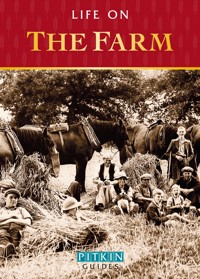
Somewhere around 4000 BC, people in Britain began to give up their old hunter-gatherer way of life, instead raising livestock and planting crops: they became farmers. This comprehensive and informative guide covers the history of farming in Britain since this time, when cattle were huge beasts and ploughs did little more than scratch the ground's surface. Tools and technologies may have changed since these primitive times, but the patterns of life on the farm have remained much the same. From the medieval farm to the Agricultural Revolution as enclosure transformed the landscape, here is the story of how farming has evolved into the tractors and mechanization we recognise today. With photographs and illustrations this book also illuminates the life of farmworkers and their families. What was it like being a cattle farmer or a shepherd? What did a farmer's wife spend her day making? An entertaining and detailed guide for anyone interested in the history and lives of the country's farmers. Includes a list of farms and museums to visit of historic and general interest.
Sie lesen das E-Book in den Legimi-Apps auf:
Seitenzahl: 54
Veröffentlichungsjahr: 2013
Das E-Book (TTS) können Sie hören im Abo „Legimi Premium” in Legimi-Apps auf:
Ähnliche















LIFE ON
THE FARM
ANTHONY BURTON
Pitkin Publishing
The Mill, Brimscombe Port
Stroud, Gloucestershire, GL5 2QG
www.thehistorypress.co.uk
This ebook edition first published in 2013
All rights reserved
Text © Pitkin Publishing, 2013
Written by Anthony Burton. The right of the Author, to be identified as the Author of this work has been asserted in accordance with the Copyrights, Designs and Patents Act 1988.
Edited by Gill Knappett.
This ebook is copyright material and must not be copied, reproduced, transferred, distributed, leased, licensed or publicly performed or used in any way except as specifically permitted in writing by the publishers, as allowed under the terms and conditions under which it was purchased or as strictly permitted by applicable copyright law. Any unauthorized distribution or use of this text may be a direct infringement of the author’s and publisher’s rights, and those responsible may be liable in law accordingly.
EPUB ISBN 978 0 7524 9438 8
Original typesetting by Pitkin Publishing
CONTENTS
Important Dates
Six Thousand Years of History
The Medieval Farm
The Agricultural Revolution
Preparing the Ground
Harvesting
Cattle Farming
Sheep Farming
Steam Power on the Farm
Crofting
Family Life
The Farm Labourer
The Wider Community
Seasonal Workers
The Age of the Tractor
Times of Change
Places to Visit
Glossary
IMPORTANT DATES
c. 4000 BC The first Neolithic farmers in Britain begin clearing the land to raise stock and grow crops.
AD 47 The Roman conquest of southern Britain: the Romans introduce water-powered grain mills.
1086–87 Domesday Book provides details of the English farming landscape.
c. 1200 Heavy horses introduced for ploughing.
1348 The start of the Black Death reduces England’s population by a third and results in much arable land being turned to pasture.
1623 Cornelius Vermuyden begins the first of a series of schemes for the drainage of the fens in East Anglia.
1701 Jethro Tull invents the seed drill.
1720 The start of a period of extensive enclosure of common land and open fields, each of which require a separate Enclosures Act.
1760 Sheep introduced into the Scottish Highlands and the start of the Highland Clearances.
1785 Robert Ransome takes out a patent for a plough with cast iron shares.
1786 Successful threshing drum invented by Andrew Meikle.
1800 Richard Trevithick invents a portable steam engine that can be used to power a threshing machine.
1831 American Cyrus McCormick invents a mechanical reaper that is soon widely used in Britain.
1834 Six Dorset farm workers arrested for forming a trades union: they become known as the Tolpuddle Martyrs.
1841 Robert Ransome demonstrates the first steam traction engine.
1842 John Bennet Lawes takes out a patent for the manufacture of ‘superphosphate’ fertilizers.
1858 The Royal Agricultural Society awards John Fowler a prize for his successful steam plough.
1886 Crofters’ Act passed, protecting Scottish crofters from eviction by landlords.
1889 The Charter Gas Engine Company of Chicago introduces the first internal combustion engine tractor.
1908 Formation of the National Farmers Union.
1943 Production of the synthetic pesticide DDT begins.
1972 Foundation of the International Federation of Organic Agriculture Movements.
2000 First full-scale trials of genetically modified crops in Britain.
SIX THOUSAND YEARSOF HISTORY
Somewhere around 4000 BC, people in Britain began to give up their old way of life as hunter-gatherers and began using stone axes to clear the forest to make permanent settlements. Here they began raising livestock and planting crops: they became farmers. We know something of their way of life: archaeologists have discovered that their fields were not ploughed in the sense that we understand it – their light ploughs did little more than scratch the surface; we know from the remains of bones that show marks of butchering that their cattle were huge beasts, closely related to the wild aurochs, but their sheep were quite small; and from one remarkable site we can get an idea of their domestic life. Skara Brae on Orkney, off the north-east tip of Scotland, was abandoned when it was covered by a sandstorm but reappeared in another storm in 1850. This little cluster of houses still have their furnishings, which include box-beds made of stone slabs that could have been filled with heather, a central cooking area and what can only be described as stone dressers. The remains show that they grew barley, kept livestock and fished, rather like later generations of crofters. The Stone Age gave way to the Bronze Age, c. 2000 BC. Grimspound in Devon is a cattle farm from that period, the remains of which show a number of circular hut dwellings contained within a substantial granite wall. Celtic fields from this time and the later Iron Age can be found in many upland areas of Britain, on moors and downland. They show a pattern of small, square fields, surrounded by high banks in which the soil was broken up by ploughing once in one direction, then again at right angles to the first furrows.
Following the invasion of AD 47, the Romans brought one major change to British farmers. Previously grain had been ground by hand, using simple stone devices called querns, but the newcomers built grain mills powered by waterwheels. The available tools and technologies of prehistoric farmers may have been primitive, but the pattern of life, sowing and harvesting, stock rearing and tending, had all the basic elements of farming through the ages.
THE MEDIEVAL FARM
In the upland regions of Britain, especially the Celtic lands of Wales and Scotland, farming continued much as it had for many centuries, but there were major changes in the lowland areas that began with the Anglo Saxons and continued into the period following the Norman conquest of 1066.




