


Erhalten Sie Zugang zu diesem und mehr als 300000 Büchern ab EUR 5,99 monatlich.
- Herausgeber: The History Press
- Kategorie: Geisteswissenschaft
- Sprache: Englisch
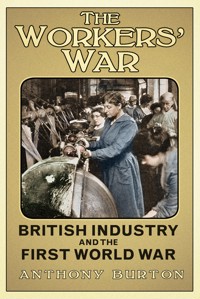
The First World War is famous for the unprecedented loss of life on a global scale; it was a conflict that affected the world forever. However, it wasn't only in terms of bloodshed that the war rocked the nation: it also massively impacted the industrial integrity of Britain. This was a war not just of fighting, but of technological and industrial advances. All areas of industry, from aviation to food production, leapt ahead in terms of development over the four-year period: from the Wright Brothers in 1903 to the Sopwith Camel in 1917, and from the first motorcars to the tank within twenty years. On a social level, working Britain experienced change as well: with the men at war, it fell to the women of the country to keep the factories going, challenging preconceptions as they did. Here Anthony Burton shows how the First World War produced fundamental changes in British society.
Sie lesen das E-Book in den Legimi-Apps auf:
Seitenzahl: 396
Veröffentlichungsjahr: 2014
Das E-Book (TTS) können Sie hören im Abo „Legimi Premium” in Legimi-Apps auf:
Ähnliche











CONTENTS
Title
Introduction
1 Business as Usual
2 Railways
3 Water Transport
4 Work for Women
5 Stirring the Devil’s Porridge
6 Steel and the Big Guns
7 Small Arms
8 A Peaceful Interlude
9 Internal Combustion
10 Water Carriers for Mesopotamia
11 Shipbuilding
12 The Flight Pioneers
13 Deep Underground
14 Textiles
15 Down on the Farm
16 The Aftermath
Notes
Plates
Copyright
INTRODUCTION
The inescapable visions of the First World War are of the slaughters in the fields of Flanders and the miseries of the trenches. It is a war that had been characterised as one of brave soldiers led by incompetent generals, or as it has often been more pithily put ‘lions led by donkeys’. But this is only a part of the story: it was also a war of competing technologies. Had it been fought fifty years earlier Britain would have begun with huge advantages as the world’s industrial superpower. This was the country that had created the Industrial Revolution and become the greatest manufacturing nation on earth. But warning notes were being sounded as early as 1838, when Benjamin Disraeli said, in a speech in Parliament, ‘The Continent will not suffer England to be the workshop of the world’. He was right. In Derry and Williams’ book A Short History of Technology (1961) – an interesting title for a volume with nearly 800 pages – there is an appendix listing important technological advances made throughout the world. During the period from 1760 to 1810, the conventional timescale adopted for the Industrial Revolution, forty-one important discoveries and inventions are listed for the United Kingdom, compared with only twenty-one for the whole of the rest of the world. Move forward to the second half of the nineteenth century and things look very different. Between 1850 and 1900, thirty-four inventions are recorded for Britain, compared with ninety for everyone else, with an increasingly large proportion coming from America. Britain was still a major industrial power when the war began in 1914, but it was no longer the greatest innovator. The country was suffering the fate of many who take what they see as an unassailable lead: they had slipped into complacency.
What was true of industry was no less true of the military. Britain had faced no real military threat in Europe since the defeat of Napoleon, so no one felt any urgent need to modernise either military technology or tactical thinking. If the leaders of industry had become complacent, they were positively revolutionary compared with the majority of generals and admirals. But the war that began in 1914 was going to require the country to change dramatically. Industry would have to be reorganised, develop new ideas and change its whole way of working to compete with the industrial might of their opponents. The military would need to adapt to a new sort of warfare of a type that had never been known before and that would use weapons that had scarcely been considered even two decades earlier. The country would also have to adapt to a situation it had not known for centuries. Britannia had ruled the waves for as long as anyone could remember but did so no longer, simply because a new enemy had appeared that the navy had not prepared itself to combat. The threat was no longer from mighty battleships firing broadsides, but from a secretive enemy lurking out of sight in the depths, the submarine. And if Britain no longer controlled the seas, then that would have a huge impact in a country that had come to depend for its prosperity and very life blood on international trade. This would be in every sense, a war unlike any other. It would be a war where what happened on the home front would be every bit as important as what happened on the battlefield.
The war years were not only a time of enforced, rapid technological change, but of great social change as well. The ruling ethos of laissez faire in which the government assumed that the best thing to do with industry was to leave it alone to sort out its own problems had to be abandoned. Confrontation between management and workers, with its inevitable succession of strikes and lockouts, had to give way to co-operation for the general good. With hundreds of thousands of men leaving all industries for the armed forces, someone had to fill the vacancies, and they were to be filled in many, many cases by women. There would be no shortage of sceptics who were convinced that the ‘weaker sex’ would be better off doing the sort of things they were ‘supposed to do’, and if they wanted to help the war effort they could always knit socks for the men on the front. The women who moved into factories, who worked on the buses, helped run the railways and drove trucks were to triumphantly prove the sceptics wrong. It was one of the great revelations of the war years that forced a reassessment of the roles of the sexes.
Superior technology can win wars. A small British force could trounce a mighty French army at Agincourt simply because they had the longbow and the French didn’t. In the nineteenth century the Opium Wars were over in no time at all because Chinese junks were no match for British gunboats. The war of 1914–18 was different. Both sides started on a more or less even footing, but both sides had to develop brand new technologies at an unsurpassed rate. It was a question of who would make the big technological breakthrough first. To understand the problems facing the industrialists of Britain it has been necessary to look back a little in time: what happened in the war years makes little sense unless one has some idea of how the various industries had arrived at the state they were in when it started.
In this book I have tried to look at how the different industries coped with the demands of war, but it is not just about technological and political advances. I have also tried to show the heroic efforts made by the ordinary men and women of Britain to overcome hardships and their enormous efforts to keep industry moving forward. The men in the British trenches fought a terrible war against the German soldiers lined up against them across the blood-drenched wastes of no-man’s-land. That they won was due in no small measure because of the other war being fought between the workers in the industrial regions of Britain and their opposite numbers in the Ruhr. This is the story of that war.
1
BUSINESSASUSUAL
When the Great War began in 1914, it was not intended that it should be a great war at all: it should have been a brisk affair, comfortably over in time for the troops to enjoy Christmas at home. Back in Britain, life would continue much as it had before: it would be ‘business as usual’. We all know now that the high optimism of the first few months soon died in the horror of the trenches. Far from being business as usual, life in Britain was to change dramatically. A.J.P. Taylor at the start of his great history of Britain between 1914 and 1945 wrote that, ‘Until August 1914 a sensible, law-abiding Englishman could pass through life and hardly notice the existence of the state, beyond the post office and the policeman.’1 In the following four years, all that was to change dramatically and nowhere was this more keenly felt than in the world of industry. The government would take control of some industries, regulate pay, impose restrictions on what could and could not be produced. It would ration food and tell farmers what to grow. It would introduce a section of the population, which had been all but absent from many traditional industries, to a new way of life. For the first time, women would appear in the workforce in a whole range of occupations that had previously been considered uniquely suitable for men. Nothing would ever be quite as it was before. In this book we shall be looking at the industrial world of Britain during these four years, the immense changes that occurred and how those changes had a profound effect on the whole of the civilian population. But nothing that happened at home could be divorced from the way in which the war was fought on land and sea and in the air.
It is not unreasonable to say that in August 1914 those in charge of Britain’s armed forces were anticipating waging a war that would be more or less like the wars of the past. On the battlefield, the artillery would exchange bombardments, infantry would advance and the cavalry would swoop down to finish things off. At sea, mighty warships would blast away at each other until one fleet was either crippled or turned tail and headed back to port. Britannia, it was assumed, would continue to rule the waves as it had throughout the nineteenth century. The idea that new technologies might have a decisive effect on the way the war was to be fought simply did not seem to enter anyone’s mind: at least not into the minds of generals and admirals.
At the start of the war the basic assumption that little needed to be changed was borne out in practice: guns would be hauled on the battlefield just as they had been at Waterloo by teams of horses, and the most efficient way to send a message from one commander to another was to give it to a man on a horse. That is why every infantry division of 18,000 men was accompanied by 5,600 horses. Throughout the war, the army continued to rely on its four-legged transport: in 1917 there were around 600,000 horses and 200,000 mules on army work. Yet as early as 1769 a former officer from the Austro-Hungarian Army, Nicholas-Joseph Cugnot, had invented a steam tractor specifically designed for military use. It has to be said that it was not a huge success. It suffered from one serious drawback as far as use by the army was concerned: the boiler only held enough water for twenty minutes’ use, after which it had to be allowed to cool down for another twenty minutes before it could be refilled. The idea of having an immovable target for the enemy for that length of time would have ruled it out for practical use. To add to that, there was a major problem with steering the cumbersome beast. According to a possibly apocryphal story, the problem was so acute that on its initial trial the machine got out of control and demolished a brick wall. At that point the authorities stepped in and arrested the inventor before he could do any more damage. It was to be nearly forty years before another steam carriage appeared on the scene, designed by the wayward Cornish engineer, Richard Trevithick. He overcame the steering problem by putting his engine on railed tracks, marking the start of the railway age.2 Communications problems could have been largely solved by the use of an existing technology, the field telephone: the army did not have any. Everything in 1914 was geared up for a mobile war, not one to be fought between armies crouched in trenches that stretched from the English Channel to the Swiss border, emerging at intervals to be mown down by machine-gun fire in the vain hope of making some sort of decisive breakthrough.
The early developments in mechanical transport may not have been successful and when success did come in replacing the horse by a machine, it was purely for civil use. But it is still remarkable that no serious attempts were made to mechanise the army until the arrival of the internal combustion engine. Even then there was little enthusiasm for the idea.
The navy had been no more enthusiastic than the army to adapt to the new steam age. At first they saw the steamboat as a useful device for towing large sailing battleships out of harbour. By the start of the Great War, however, the steam fleet was well established and included fast vessels powered by the new turbine engines developed by Sir Charles Parsons. His experimental steam yacht Turbinia gave a dazzling show at the Spithead naval review of 1897 when it raced across the front of the assembled fleet at the previously undreamed of speed of 34 knots. It must have been an incredible sight, with the busy crew getting up as much steam as they could, so that flames and red-hot cinders shot out of the funnel, leaving the little craft with a fiery wake.3 The turbine engine had proved its worth, but there was still the same sense that a war at sea would be fought in much the same way as Nelson had fought at Trafalgar, but with bigger guns. Shipbuilders had produced ironclads with heavy armament and good protection along the sides of the ship to withstand a broadside, but the German battleships fired from a greater distance on a higher trajectory. As a result, the shells fell like bombs on the less protected decks. This was easily remedied by adding extra armour plating, and the mighty British Navy was ready for a major battle with the German fleet. But the Germans declined to come out except on their own terms.
The Royal Navy was known to be spread all round the south and east coasts to protect against a possible invasion. On 15 December 1914 a formidable German battle fleet headed off for the north-east coast of England, led by two fast battle cruisers and a cruiser. The intention was to lure a small part of the dispersed British fleet into an engagement and inflict heavy losses before heading back quickly to home waters. The targets were scarcely of major military importance. The fleet divided, and the first barrage hit the seaside resort of Scarborough early on 16 December in a heavy bombardment that left fourteen civilians dead. The ships moved on to another undefended port up the coast, Whitby, where among the buildings that were damaged was the ancient Abbey of St Hilda high on the cliffs. Once again, civilians were the only casualties. In spite of German claims to the contrary, neither town possessed any form of coastal defence, nor did they contain a single site of military importance. The third attack by the other section of the German fleet took place at Hartlepool, which did at least have a military presence, and the battery there managed to land a shell on the German vessel SMS Blücher, inflicting some damage. The destruction here was much more severe and 102 died, including fifteen children. A cruiser and submarine in the harbour at Hartlepool were unable to leave port. British destroyers attempted to engage with the Germans and managed to fire off one torpedo, but mist came down and the battle was over.
The event caused shock and outrage throughout Britain. The press reported it as a cowardly action in which, once the British ships appeared, the Germans fled: ‘The raiding ships were not allowed to bombard the coast with impunity. British patrol vessels promptly engaged them, and a patrolling squadron at once set off in the endeavour to cut them off. When they found themselves in jeopardy the enemy ships “retired at full speed”.’4 Posters were rapidly produced with appropriate messages – ‘Remember Scarborough – Enlist Now’; ‘Men of Britain will you stand for this?’ It added further fuel to the already almost hysterical war fever, but it also provided an omen for the future. For centuries Britain had fought wars in other people’s countries. This one would also be fought at home. It helped to convince the people that this was a war in which everyone was involved, not one that was read about in the papers, fought by professionals in far off places.
After the skirmish off the north-east coast the battle fleets failed to meet in any major conflict until 1916 at the inconclusive Battle of Jutland, but in the meantime a very different war at sea was to have an immense impact on life in Britain. It was to be waged not by mighty, heavily armed capital ships, but by submarines. The British Admiralty was mostly contemptuous of the whole notion of submarine warfare. In 1900 Rear Admiral A.K. Wilson famously declared that the submarine was ‘underhand, unfair and damned unEnglish’. Admiral John ‘Jacky’ Fisher who watched submarine trials at Plymouth in 1904 took an entirely different view, declaring himself astonished that so few among his fellow officers understood just how significant this new development was. This view was expressed even more strongly by Admiral Percy Scott shortly before the outbreak of war in June 1914. He wrote to the leading newspapers5 and began his letter with a quotation from the First Lord of the Admiralty, Winston Churchill: ‘But the strength of navies cannot be reckoned only in dreadnoughts, and the day may come when it may not be reckoned in dreadnoughts at all.’ Admiral Scott took the argument a step further, claiming that the day had already arrived: ‘as the motor car has driven the horse from the road, so has the submarine driven the battleship from the sea’. For the next few days the correspondence column of The Times was full of naval experts pouring scorn on these ideas. The Secretary of the Navy League roundly declared that: ‘No competent naval authority will hold that the submarine has reached that stage of evolution which would justify Sir Percy Scott’s estimate of its fighting value.’ He went on: ‘His views are premature, ill-advised, and calculated to do serious harm to the cause of the maintenance of British supremacy at sea.’ The Times added its own view in an editorial: ‘there is nothing, even in peace experience, to justify the faith he places in torpedo attacks’. One correspondent summed up the views of many – spending money on submarine development was a waste of resources: they were ‘just marvellous toys’.
The submarine had a potentially powerful weapon, the self-propelled torpedo, first invented by Robert Whitehead in 1866. Early versions were more than a little wayward, but various improvements, including a balance chamber to maintain the missile at a fixed depth and the addition of a gyroscope to keep it in line, made it a formidable weapon by the early twentieth century. The Whitehead torpedo was matched by a German version, known as the Schwartzkopff: someone seems to have had a sense of humour as this translates as Blackhead. It was a powerful missile capable of carrying up to 200lb of TNT in its warhead. The British saw the torpedo as a weapon mainly to be deployed by specialist surface craft, especially fast destroyers. The submarine was merely an adjunct, a slow form of torpedo boat and not an effective weapon of war. The idea of using it against merchantmen was abhorrent and one admiral declared that sinking civilian ships was piracy and any crew involved should, if captured, be hung. It was assumed that the war would be carried out under ‘cruiser rules’. Enemy merchantmen could be taken, but first a warning shot had to be fired, then the crew and any passengers had to be given time to get into lifeboats before any further action was taken. This made the submarine almost useless. Its one advantage was its invisibility under the waves: on the surface it was slow and made an easy target. Churchill had given his opinion that no ‘civilised power’ would sink merchant ships without warning. But as early as January 1914, Lord Fisher had sent him a memo explaining the real logic of the situation:
[The submarine] cannot capture the merchant ship, she has no spare hands to put a prize crew on board, little or nothing would be gained by disabling her engines or propeller, she cannot convey her into harbour, and, in fact, it is impossible for the submarines to deal with commerce in the light of international law … there is nothing else the submarine can do except sink her capture.6
But if the British were writing it off as a marvellous toy, the Germans had other ideas. Experts may have scoffed at the threat, and dismissed the torpedo as too unreliable to be effective, but on 5 September 1914, the German submarine U-21 sank a British cruiser with a single torpedo. Only nine of the 268 crew survived. Three more British cruisers were sunk by the end of the month and panic spread through the Admiralty when a U-boat managed to penetrate the defences at Scapa Flow, where much of the British war fleet was at anchor. It was not able to do much damage, but it showed that this was a powerful new weapon of war. In the event, it was not attacks on other warships that were to prove important but attacks on merchant shipping.
Germany announced that any vessel from any country trading with Britain would be considered a target for attack. There would be no warnings: ‘cruiser rules’ no longer applied. The new tactics were ruthlessly applied, culminating in the sinking of the British passenger ship RMS Lusitania in May 1915. It went down in eighteen minutes with the loss of 1,198 lives, which included 128 American citizens. The Times unsurprisingly called it an act of barbarism, but in its editorial it pointed out a possible reaction to the tragedy. Beginning somewhat disingenuously, ‘It is not up to us to speculate upon the course to be adopted by the United States Government’, the editorial proceeded to offer some very strong hints that it was time for reprisals. After all, the US Government had sent an official note to Germany as recently as February that year stating firmly that they would take ‘any steps necessary to safeguard American lives … on the high seas’.7 The response across the Atlantic was ambiguous. TheNew York Times headed its account, ‘Divergent views of the sinking of the Lusitania’.8 It was pointed out that Germany had warned everyone that it intended to make such attacks, and the Lusitania was a British vessel and therefore a legitimate target. Nevertheless, there was concern in Germany that the Americans might be provoked into joining the war if there were any similar attacks, which was the last thing that they wanted. There was a temporary easing of U-boat attacks, but it was only temporary.
Towards the latter part of the war the British found a partial answer to the submarine threat by sending merchantmen out in protected convoys, which if they did not prevent attacks, gave the British fleet a chance to attack the attackers. The Admiralty had been reluctant to use the convoy system, because they still thought of the navy’s battleships as having been built to fight decisive battles with the enemy fleet. They were there for offence not defence: it was a view that had catastrophic consequences and threatened the whole war effort. The losses were colossal, totalling nearly 13 million gross tons of shipping, half of which was lost in just one year, 1917. The German U-boats suffered their own severe losses, roughly half of the 351-strong fleet was lost and some 5,000 submariners killed. But there could be no doubt of their effectiveness. Neutral ships were deterred from trading with Britain, and the British fleet was not, by itself, able to keep up with the demand for goods needed on the home front. In pre-war years the country had become more and more reliant on all kinds of imports, from foodstuffs to the raw materials of industry. When these were no longer available the country was forced to try and make do with what was available at home. It was a state of affairs that affected everyone from the industrialist to the housewife. The situation was so serious that for a time it seemed that Britain would be so starved of resources that the war could be lost. Huge efforts had to be made by all sections of the community to save the country from catastrophe.
The attacks from the sea in 1914 had awoken the British to the idea that their own country was now part of the war zone. The naval bombardment came as a considerable shock, but another threat would soon appear.
Ferdinand von Zeppelin spent his early life in the army and was keen to study modern warfare. As a young man, with nothing exciting happening in Europe, he managed to get himself to America where he joined the Army of the Potomac in the Civil War. In his own words: ‘I believe it my duty to use this opportunity through travel to gain information that I may be able to use for my fatherland at some time.’9 It seems extraordinary that there should be any connection between an event that seems as remote as the American Civil War and the Great War that still resonates with us today. Yet it is Zeppelin who provides the link. Returning to the peacetime army in Germany, he was fascinated by the implications of the balloon as an aid to reconnaissance in the field, but began speculating about how much more effective the balloon could be if it could be powered and steered. It was this that led him to develop an airship with a rigid frame. Initially it was developed for civil use and the Luftschiff [airship] Zeppelin 1 (LZ1) took to the skies in 1900. Over the next decade it was developed into a highly successful passenger-carrying craft, but as soon as war broke out Zeppelin’s first three airships were commandeered for use by the army. They were soon adapted for carrying bombs instead of passengers and, on 17 March 1915, Zeppelin ZXII set off to bomb London. It was not a promising start. The crew found themselves in dense fog and, after cruising around for some time, they failed to locate the Thames estuary, so they turned back south and bombed Calais instead.
Zeppelin raids continued over the southern and eastern counties of Britain, but had very little effect in the sense of causing meaningful damage. In order to avoid being hit by ground fire – and with the body full of inflammable hydrogen they were highly vulnerable – they had to fly at well over 10,000ft. At this altitude, life for the crew was cold and uncomfortable, navigation difficult and the chances of hitting any designated target negligible. People became quite complacent and regarded the arrival of the slow-moving cylinders high above their heads as something of a sideshow:
After a week in which there have been more than the usual number of air-raids on the ‘Eastern Counties’ and even on ‘the London District’ the British public may fairly congratulate themselves on the complete failure of these nightly visitors to achieve any moral or military success … the Zeppelins have offered an exciting spectacle to thousands of honest citizens, who show their indifference to the raiders when they appear by parading the streets of the Eastern counties and the London district in defiance of every rule and regulation.10
My mother was a young girl in Stockton-on-Tees during the war years, a town that, as a shipbuilding centre, was a likely target. She vividly remembered the slightly sinister long, grey shapes passing overhead and rushing out into the garden to get a better look. It was all very different from the next World War, when my grandmother, still living in that same house, was forced to spend many nights in the Anderson shelter in the front garden.
As the war progressed, the Zeppelin raids increasingly gave way to attacks by aircraft. The early attempts were no more successful by plane than they had been by airship. The Germans offered to award a medal to the first airman who managed to land a bomb on Dover. It was won by a gentleman called Traube, though his one and only hit landed in a kitchen garden. He received his medal and, thanks to his success, one Dover resident had a ruined greenhouse. It seems that the air raids were taken no more seriously than the Zeppelin raids had been. It was a contest between planes with no really successful means of aiming their bombs and anti-aircraft batteries that found it equally difficult to master the new problem of hitting an aeroplane. It appears to have been regarded almost as a spectator sport, with crowds turning out to cheer the gunners. The first attempt to down a plane over Dover turned out to be more farce than high drama:
On May 3 at 10.55am, an aeroplane coming from France and thought to be hostile was fired on for nearly ten minutes by the Dover guns … It was the first time anti-aircraft guns had been in action in Dover, and created intense excitement in the town. People rushed on to the Sea Front and expressed the greatest disappointment at the shots failing to hit the target … It was fortunate, however, that it was not hit, as it happened to be one of our own machines.11
There were to be over 100 raids on Dover and, although thirteen men, one woman and three children were killed, there was no real damage done to the port. The air raids did, however, have a demoralising effect on everyone in the country. The government imposed blackout regulations and the streets were plunged into darkness every night.
There were many aspects of the war that would directly affect the way that life in Britain was lived during the war years, but none had a greater effect than the disappearance of so many men into the army. There was no industry, no occupation that was not affected to some degree or other. When war began there was a patriotic rush to arms. Men believed it would all be a great adventure, in which the splendid British forces would emerge triumphant as they had in previous European wars. Eager young men wanted their share of the action and their moment of glory before it was all over, as all the experts declared it would be, in just a few months time. It was soon all too clear that not only would it not be finished by Christmas, but that it would develop into a long war of attrition with ever mounting casualties, so that more and more men would have to be sent to France. As a result, vital industries found themselves with a serious manpower shortage and many posts that would once have been thought entirely unsuitable had to be filled by women. It represented a massive social change.
The need for another great change that would be brought by the war was not immediately recognised and in some cases never accepted. This was to be a war that would eventually be fought and decided, in part at least, by new developments in technology. The reluctance of the old guard to accept change was typified by attitudes among the army top brass. A.J.P. Taylor pointed out that, thanks to the British generals’ unshaken but entirely mistaken belief that eventually cavalry would win the day, more shipping space was taken up sending animal fodder to France than was lost to submarine attacks.12 But it was not to be horses that decided the issue. It could be argued that many of the decisive battles of the war took place not in France but in the factories of Britain and Germany. It is the story of that war that we shall now be telling.
2
RAILWAYS
The day the war started, all the railways in Great Britain came under government control through the Regulation of the Forces Act 1871: Irish railways remained independent until the beginning of January 1917. The government took over a far more extensive system than the rail network we have today, with over 20,000 miles of track split up between companies that ran the full gamut from the mighty Great Western empire, covering the whole of south-west England and most of southern Wales, to the 19-mile-long Lynton & Barnstaple Railway. It was also a very busy system. In 1912 statistics recorded 514 million tons of freight being carried and 1,265 million passenger journeys made, not counting season-ticket holders. To put those figures in perspective: the population at the time was 46 million, so that is equivalent to the entire population making an average of one train journey every fortnight, and can be compared with the 46 million journeys registered in Britain today, which means we now average rather less than one journey a year per person. It was also highly profitable with working receipts of £124 million.1 Yet in 1914 company profits were no longer to be a priority: there was to be only one all-important concern, winning the war.
A new organisation had already been set up and was ready for action the day war broke out, with railway management passing at once to an executive committee, made up mainly of managers from the leading companies. They did their work well. One of their first tasks was to call a meeting with the leading trade unionists from the National Union of Railwaymen and the Associated Society of Locomotive Engineers and Firemen to ensure their full co-operation. The unions agreed to a truce. There would be no strikes over disputes about job allocation, and any disagreements over pay would be settled by government arbitration. One can be sure that the union officials did no more than represent the patriotism that had its effect on their workforce just as it did on the rest of the country, but it was also a big step forward in co-operation between management and workers. The unions were now formally recognised as representing the whole workforce and not just their own members. For the first time they also had a right to have their views taken into account on any changes in working practices. Theoretically, industrial action was officially ruled out for as long as the war lasted.
The results of the enthusiastic co-operation were rapidly apparent. The first necessity was to move men and equipment to Southampton for embarkation with the British Expeditionary Force. In the first month, 670 special troop trains were run and the Secretary of State for War, Lord Kitchener, expressed his delight in a speech in the House of Lords: ‘The Railway Companies in the all-important matter of the transport facilities, have more than justified the complete confidence reposed in them by the War Office, all grades of the railway services having laboured with untiring energy and patience.’2
The new ruling body had to cope with a system of great complexity. At the beginning of the twentieth century, there were 188 different railway companies in Britain, and that does not include subdivisions of larger companies such as the Tanat Valley Light Railway, which had already been absorbed into the larger Cambrian Railway.3 That was not the end of the complication. Apart from the rolling stock run by the companies themselves, many concerns had their own private wagons and sidings. To take just one example from a typical industrial town in northern England, Bolton in Lancashire: it was served by two railway companies, the London & North Western and the Lancashire & Yorkshire, each of which had its own station. There were also forty-one different sidings spread around the town, ranging from the Corporation Gas Works to the Bolton Iron & Steel Co. Deliveries could be made and wagons picked up from any or all of these concerns, either in privately owned or railway company wagons, which meant trains had to be made up with care to make sure that everything arrived and left in the right order. It was a logistic puzzle that had to be solved many times per day on railways all over Britain. Passenger travel might have seemed less complex, but journeys could involve passing over the tracks of many different companies. An individual might buy a ticket from one place to another and have no interest whatsoever in who owned each length of track that the train was crossing over, but it mattered to the companies. Each of them had to have their due share of the ticket price. The job of allocating the appropriate funds from freight and passenger services fell to the Railway Clearing House, established in 1851. It was a cumbersome system in many ways, but it worked. One reason that it worked was that the railways employed a vast workforce, with even modest stations having a large staff. Whatever its shortcomings it represented the most important system that the country had for moving goods and people, and it was at the forefront of technological advance.
When the first railways were built, scientific ‘experts’ prophesied all kinds of horrors. The magnificently named Dr Dionysius Lardner had declared that because the lines in Box tunnel on the Great Western were on a gradient, trains travelling down the slope would emerge at a speed of 120mph, at which velocity no human being would be able to breathe. The fact that the good doctor had neglected to include either friction or air resistance in his calculation, as the company’s engineer I.K. Brunel pointed out, didn’t of course alter his prognosis of what would happen should such a speed ever be reached. No one had quite got round to testing that in 1914, but ten years previously the locomotive City of Truro had achieved a speed of 102mph and no respiratory problems had been reported.
The new governing body had taken over a railway in which locomotive design had produced a range of engines capable of handling all kinds of traffic, from the fast passenger express to little tank engines that spent their working lives shunting wagons around marshalling yards. Rolling stock had also been improved, including goods wagons. For example, in 1900 the North Eastern Railway had only two wagons capable of holding over 12 tons, but by the start of the war had 18,000 of them. The raw material was there and the technology was well developed: the big question was how to make the best use of them. Not only was the rolling stock spread out between the different companies, but almost half of the country’s 1.5 million wagons were privately owned. It was a daunting task to bring everything together to serve the needs of war.
Making efficient use of goods trains was an urgent priority. There were a number of established practices that did nothing at all to increase efficiency. Because of the multiplicity of companies it was quite common for freight that had to cross company borders to be transferred from its original set of wagons to ones belonging to the owner of the new territory. This was easily dealt with by new regulations. A far less tractable problem was caused by the existence of the vast fleet of privately owned wagons. For years they had been regarded as a nuisance by the big companies, partly because they had no control over the quality and design of wagons, but more seriously because of the huge inefficiencies involved. The Railway Executive was well aware of the problem and quoted a typical example of wasteful, uneconomic practice:
In one instance, at least, a colliery company sending coal in their own wagons to a certain port refused permission to the railway company to make use of those wagons for the conveyance to them of hay for the ponies in their own collieries, the railway company being compelled to return the coal wagons empty and provide another set of wagons for the hay going to the same destination.4
This was clearly not acceptable when the whole railway system was being put under immense strain. It was not just the sudden increase in traffic that caused the problem. The companies had been ordered to supply 20,000 wagons for use in France. Somehow the stock had to be replaced, and the most obvious solution was to commandeer private wagons. An act was passed in December 1916 enabling the Railway Board to ‘take possession of any private owner’s wagons and to use them as they think best in the interests of the country as a whole’. It sounded a good idea in theory, but did not work out in practice. The private owners’ wagons were a hotchpotch of different styles, many of them colliery wagons, specifically designed for the loading and discharge of coal, but not much use for general purposes. The best that could be done was to control the use of wagons in a specific area to make the system as efficient as possible. This worked very well in the major coalfields, such as Durham and South Wales. This was particularly important for Wales whose collieries were famous for providing what was known as ‘steam coal’, coal of a very high calorific value, particularly valuable for use in ships. At the height of the war, 100 trains per week were running to the Grangemouth Docks on the Firth of Forth for the use of the fleet, carrying some 400,000 tons of coal.
Coal was such an important commodity, being essential for the running of industry and the heating of millions of homes, that regulations were brought in to ensure that it was moved around the country as efficiently as possible. In 1917 the most severe restrictions were imposed using Defence of the Realm Regulations. The aim was to keep to a minimum the distance that the coal had to be moved. To achieve this, the country was divided up into twenty districts and no one was allowed to move coal from one district into another without the permission of the Controller of Mines.
Sorting out the problems of goods traffic did not just involve freight trains and marshalling yards; a lot of traffic went through local stations. Even a modest local station would have its own goods shed and sidings. Customers expected wagons to be available to move material brought to the station or they would send their own wagons to be added to a train. Everything had to be sorted out, which was a complex business, to ensure that all the wagons were attached to the correct train and in the right order. At the medium-sized stations horses could be used to move the trucks around the sidings, while at bigger concerns small shunting engines were kept busy puffing to and fro.
Not everything was sent by goods trains. A lot of small items went in the guard vans of passenger trains. The railway porter of those days had quite a wide range of jobs to fulfil. Passengers expected someone to be available to carry their luggage to and from the train: the tip was an important supplement to wages. Wily porters knew that the first-class generally had the heaviest luggage but paid the lightest tips. As an old porter told the author many years ago: ‘Folk like them didn’t get rich by giving it to folk like us.’ But that was only a part of the duties. As each train arrived there would be barrows and trollies full of items, all labelled with their destinations, to load on board and others to be taken off. Mailbags and newspapers were among the items sent every single day of the year, but the rest was a miscellany of objects from modest parcels to bulky items. In the war years, staff shortages became ever more acute. Drivers and firemen were too valuable to be called up for military service – though some were sent to France to drive the military trains. The biggest staff shortages, however, were among the ordinary station workers. As early as June 1915 it was clear that there was a limit to what could be handled, so a rule was brought in that no item weighing more than 3cwt (hundredweight) could be sent by passenger train.
Staff shortages were felt everywhere. The huge increase of traffic meant that locomotives had to be worked harder and harder and that, in turn, meant that less and less time was available for essential maintenance work. As a result, drivers and firemen had a difficult job coaxing good performances out of locomotives that no longer responded to the controls with the smooth efficiency of earlier days. That was only a part of the problem. In pre-war years there were strict regulations covering the maximum loading for each particular class of locomotive. The Midland Railway, for example, had a good all-purpose workhorse in its Class 2 locomotives that were officially never supposed to haul loads in excess of 180 tons, yet on one occasion at least one of these little engines was recorded as pulling a goods train of 400 tons. This was not just a strain on the locomotive, but a challenge to the crew. In those days there was no through braking on goods trains, with the majority of trains being made up of wagons loosely coupled together. When the train slowed, accelerated or stopped, only the engine and the brake van could control the movement. Each truck moved under its own momentum. Sudden movement when accelerating might cause a coupling to snap under the strain; in stopping there was the danger of one truck moving too violently into the one in front. It took a great deal of skill to control a long goods train, but the job was done.
Passenger traffic also showed an increase during the war years: by the middle of 1917 it was up by roughly 60 per cent over what it had been in 1914. A large proportion of this was due to movement of members of the armed services, both being sent to the battle zones and coming home, some on leave and a depressingly large number with injuries. Special ambulance carriages were developed. The military gave their own designs to the companies, with slightly different versions being asked for by the army and the navy. The first ambulance train for the navy was ordered shortly after the start of the war and was built at the London & North Western railway works at Wolverton. Adapted from existing passenger coaches, it was delivered to Chatham within thirty hours, to the delight of the Surgeon General, Sir James Porter: ‘Royal Naval Corridor Ambulance Train from Wolverton has arrived to-day, and has gladdened me very much. It is so satisfactory that I am asking the Admiralty for a second of similar construction. I consider great praise is due for the manner the department under your care has carried out this work.’




