


13,99 €
Mehr erfahren.
- Herausgeber: The History Press
- Kategorie: Sachliteratur, Reportagen, Biografien
- Sprache: Englisch
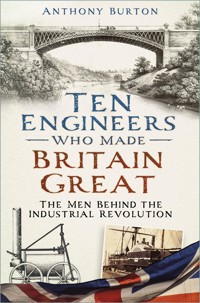
Samuel Smiles published Lives of the Engineers in 1862. The noted biographer presented his engineers as heroic progress makers who conquered nature and overcame impossible obstacles to drive the Industrial Revolution forward, but included twisted and often fabricated accounts in his work. In Ten Engineers Who Made Britain Great, Anthony Burton seeks to correct this narrative by offering nuanced portraits of some of the best-known engineers of the eighteenth and nineteenth centuries. Burton investigates the common themes that run between the stories of John Metcalf, James Brindley, John Smeaton, William Jessop, Thomas Telford, James Watt, Richard Trevithick, George and Robert Stephenson, and Isambard Kingdom Brunel, and also explores how each of these men learned from one another.
Das E-Book können Sie in Legimi-Apps oder einer beliebigen App lesen, die das folgende Format unterstützen:
Veröffentlichungsjahr: 2023
Ähnliche









Cover illustrations: Front, clockwise from top: Galton Bridge, built by Thomas Telford in Smethwick (British Waterways); British flag (Shutterstock); Isambard Kingdom Brunel’s Great Eastern (George Stacey); Richard Trevithick’s portable steam engine (Francis Trevithick, A Life of Richard Trevithick, 1872). Back, clockwise from top left: John Metcalf; Richard Trevithick; Thomas Telford; Robert Stephenson; John Smeaton; George Stephenson.
First published 2023
The History Press
97 St George’s Place, Cheltenham,
Gloucestershire, GL50 3QB
www.thehistorypress.co.uk
© Anthony Burton, 2023
The right of Anthony Burton to be identified as the Author of this work has been asserted in accordance with the Copyright, Designs and Patents Act 1988.
All rights reserved. No part of this book may be reprinted or reproduced or utilised in any form or by any electronic, mechanical or other means, now known or hereafter invented, including photocopying and recording, or in any information storage or retrieval system, without the permission in writing from the Publishers.
British Library Cataloguing in Publication Data.
A catalogue record for this book is available from the British Library.
ISBN 978 1 80399 299 0
Typesetting and origination by The History Press
Printed and bound in Great Britain by TJ Books Limited, Padstow, Cornwall.
eBook converted by Geethik Technologies
CONTENTS
Preface
1 John Metcalf
2 James Brindley
3 John Smeaton
4 William Jessop
5 Thomas Telford
6 James Watt
7 Richard Trevithick
8 George and Robert Stephenson
9 Isambard Kingdom Brunel
Bibliography and Further Reading
PREFACE
The idea for this book came from reading Samuel Smiles’s famous work of 1862, Lives of the Engineers, in which he portrayed them as heroic figures. It has always been valued for its historic role in treating the subject in a way that made the work both popular and accessible to non-specialists. But there are problems. Smiles likes to have his heroes face and overcome obstacles, some of which research suggests are inventions or very twisted versions of actual events, and he also includes dialogue that no one could ever have recorded and written down at the time. What follows is perhaps a little more sober, but it is hoped that in writing about these ten great men, the readers will appreciate just what they achieved; achievements that need no embellishments.
1
JOHN METCALF
Image: John Metcalf. (The Life of John Metcalf, 1795)
The story of John Metcalf, popularly known as Blind Jack of Knaresborough, is a remarkable one. His exploits can seem almost too extraordinary to be true, but almost everything we know about him comes from the autobiography that he dictated to a publisher in York. He can certainly never be accused of modesty and there are times when readers may feel twinges of doubt creeping in. What is not in question is that he was a remarkable man and that would still be the case if only half the stories were true.
Knaresborough is a Yorkshire market town that stands on a hill, rising steeply above the River Nidd, and dominated by the ruins of a Norman castle. Metcalf was born here near to the castle to a working family on 15 August 1717. He was sent off to school at the age of 4, but two years later he contracted smallpox, which left him completely blind. However devastating this must have been for a young boy, he proved a remarkably resilient character, for within just six months he was setting out to go to the end of the street and return home without a guide. Soon he was able to wander all over the town and began mixing as an equal with boys of his own age. He did what the others did – climbed trees and went for walks in the surrounding countryside. Although his parents were simply described as ‘working people’ they were obviously not poor, as the father kept horses and encouraged his son to take up riding. The boy revelled in this new achievement and was encouraged by a local gentleman called Woodburn, who was master of a pack of hounds and took the lad, now generally known as Jack, with him on the hunt. From the start he was not only able to cope remarkably well with his blindness, but showed a certain reckless bravado that was to be the hallmark for much of his life.
Metcalf’s boyhood was marked by a series of episodes that showed him to be up for any challenge – not all of which ended well. He was known to have ‘borrowed’ one or two of Woodburn’s hounds without permission and gone off on expeditions on his own – and those lasted until the hounds were found to have attacked a farmer’s lambs. He and his friends were enthusiastic visitors to a plum tree and Jack was the one who was always given the job of climbing and chucking the fruit down to the others. All went well until the boys on the ground saw the owner approaching and promptly ran off, leaving Jack stranded. He clambered down, but while following the others he tumbled into a gravel pit and gashed his face: plum stealing joined illegal hunting in the list of abandoned activities. Another of his passions was swimming in the river, where he was the most boisterous of the group – often pulling the others down and swimming over their heads. The picture is of a strong, fun-loving boy who would have been quite unusual even without his blindness, but who was determined not to let the disability spoil his enjoyment of life.
Metcalf was growing up to be a strong and powerful young man – he would eventually grow to be over 6ft tall. But the mischievous spirit did not seem to leave him in his later teens. He was visiting Scriven, a village a mile or so from Knaresborough, where there was a dispute going on about some sheep penned up outside the inn. Metcalf left the two men arguing, and jumped over the wall into the pen, where he started catching sheep and depositing them over the wall. It was easy at first as the sheep were huddled together, but as more went over the wall, the rest became more and more difficult to catch. Anyone who had happened to pass by at the time would have been met with the amazing vision of a young blind man chasing a bleating sheep around an enclosure. But he got them all over the wall and went home. When the two men left the inn, they faced an even more astounding and puzzling sight: a flock of sheep grazing outside the pen that had been, and still was, locked.
The time came when decisions had to be made about Metcalf’s future. There is a long tradition behind one occupation for the blind – playing the fiddle. The boy set about learning the violin, playing by ear as there was no possibility of reading music. He soon became sufficiently competent to perform at country dances at Knaresborough and nearby towns. He continued to enjoy hunting and also took an interest in cock fighting – and he developed a growing reputation for devilry and pranks. As this is an account that should be centred on his future role as an engineer, it is not necessary to repeat every story that has been told about him, but one at least shows the resourcefulness and initiative that were to be a feature of everything he tackled.
In 1732 he finally got regular employment at the fashionable Queen’s Head hotel in Harrogate, which had a long room for dancing. The previous fiddler had finally decided to retire, not unreasonably, having reached his 100th birthday. Metcalf proved very successful, and he received another invitation, this time to the Green Dragon also in Harrogate. He seems to have made himself extremely popular with the gentry, for the Squire of Middlethorpe near York invited him to stay with him for the winter, where he could go out with him and his hounds and practise music. He also arranged for a more accomplished musician to give him lessons to improve his skills. He was returning on horseback through York when the landlord of the George Inn, who knew him, asked if he was going back to Knaresborough as he had a guest who needed a guide to Harrogate. Metcalf agreed to take the stranger along, provided he didn’t mention his blindness. It was only when they had safely reached their destination that the stranger discovered, to his horror, that he had been led all the way by a blind man.
Metcalf returned to his regular playing in Harrogate, and one of the inns he visited was the Royal Oak, where the landlord’s daughter, Dorothy Benson, took a liking to the young man, and they began a secret liaison. During this time, there is a whole range of stories about him and his exploits, in particular a readiness to bet on anything, from his prowess on a horse to his skill at cards. At this point, one does begin to stop and wonder how accurate all these tales might be. It is just about acceptable to find a blind man galloping across the countryside, but how does he possibly play card games? Did he have a friend whispering in his ear to tell him what he held and what was going on? Or did he perhaps retain a slight amount of vision, enough to make out rough shapes but no details? Total blindness seems to have been accepted by all who knew him, so it is a puzzle that may never be solved.
By the time he reached the age of 21, Metcalf was thoroughly enjoying life, and quite happy to take on any new pleasure that came his way. Two of his friends had a sister who shared his attitude, and she suggested that if he put a candle in his window, she’d come that night for a visit. The candle was lit, the visit was made and a few months later the consequences appeared. The young woman insisted he married her, but he seems to have thought that, as she had instigated the whole affair, he had no moral obligation – and he was still in love with Dorothy Benson. Benson, it seems, was remarkably understanding, and simply told him that he definitely should not marry the young woman. A law officer soon appeared on the scene demanding that he do his duty, but Metcalf offered to pay the girl off – and it was agreed that a sum of £30 to £40 would seal the matter. He told the officer to wait while he went to Harrogate to get his money: the officer waited, but Metcalf never appeared. He was on his way to Scarborough, where he stayed for several months, before travelling to Whitby and taking a boat to London.
In the capital, he met a fellow northerner, who played the pipes and who introduced him to Colonel Liddell, the Member of Parliament for Berwick-upon-Tweed, who lived near Newcastle, but spent three weeks of the year at Harrogate. He was about to make the trip north, on horseback with his servants, and invited Metcalf to join him. But Metcalf declined, saying he would walk as it would be quicker. They agreed to meet up each evening along the way. Metcalf being quicker probably seemed unlikely to the colonel, but it says a great deal about the state of the roads of Britain at that time that he was usually the first to arrive at each stage of the journey – and also goes some way to explain why Metcalf appears in this book at all.
It has often been noted, that at the start of the eighteenth century, the roads of Britain were in a far worse condition than they had been under the Romans. In medieval times, the King’s Highway was often little more than a well-established track. This was not a problem when the roads were mostly used by the poor on foot or the rich, either on horseback or being carried in litters. Transport of goods was mainly in broad-wheeled wagons. If the middle of the road got boggy after rain, travellers simply moved out to the drier edges, spreading the highway, which was not a problem until the nature of wheeled traffic changed. But in 1555, the Duke of Rutland was reported to have been seen riding in a carriage suspended in a narrow-wheeled frame. When Queen Elizabeth I acquired one of the new-fangled devices, the trend was set – anyone who could afford a carriage wanted one. They also wanted a smooth ride on a decent surface. The big question was – who would pay for better roads?
The government attempted to legislate better roads into existence by passing a series of laws covering such matters as wheel widths, which were almost entirely ineffective. The problem lay with the old system that had existed since the Middle Ages that made local authorities responsible for the highways within their parishes. A surveyor of roads was appointed by the parish to supervise road maintenance, and he was empowered to call on the local men to carry out what was known as their Statute Duty to spend six days a year on the job. Not surprisingly, the idea was seldom greeted with any enthusiasm. John Hawkins described the situation in his Observations on the State of the Highways published in 1763:
Let us now see in what Manner the Law at present under Consideration is observed in those few Parishes, where the Inhabitants are disposed to yield obedience to the Letter of it: the Days for performing the Statute Duty are so far from being considered as Days of Labour, that as well the Farmers as the common Day-Labourers, have long been used to look on them as Holidays, as a kind of Recess from their accustomed Labour, and devoted to Idleness and in concomitant Indulgences of Riot and Drunkenness.
The surveyor did not have to use the parishioners, but could, if the parish provided the money, pay day labourers to do the work. But the money was seldom forthcoming, and if it did arrive it was scarcely adequate for the task. The problem was compounded by the fact that the surveyor usually had no training of any sort and no experience of road construction. All too often he bumbled along with an unwilling workforce, or as Hawkins aptly described the situation: ‘A Contest between Ignorance armed with Authority on the one Side, and invincible Obstinacy on the other.’ In the circumstances, it is scarcely surprising that the roads were often in a terrible condition. Daniel Defoe, travelling through Britain at the start of the eighteenth century, noted that the road between Dunstable and Nottingham was so bad, with a surface that was little more than soft clay, that horses were known to drop dead with the strain of trying to pull carts along it. While in the Stoke-on-Trent area, potholes had a literal meaning, as local workers were quite likely to take clay from the highway for their works. This was not a matter of scooping up a little to make a teapot, but removing such serious quantities that on one occasion a traveller at night fell into one of these holes and drowned. Small wonder then that when Metcalf and the colonel set out for Harrogate, it was the walker who arrived each day before the riders.
The situation was, however, beginning to change. It was clear that neither the government not the local authorities were going to make matters better. The answer was to turn to private contractors. They would build the roads and recoup the expense by charging those who used them: these new toll roads became known as turnpikes, from the gates that crossed them where the money was collected. It was on these new turnpikes that Metcalf was to make his mark, but there was a great deal to happen to him before then.
Back in Harrogate, he once again made his way to the Royal Oak and Dorothy. He returned to his old life and was soon a regular performer at Ripon. He began to think seriously about marriage and started saving, leaving his money with Dorothy, who was more likely to look after it well than he was. But old habits soon took over. He had saved £15, but took it from Dorothy as an ‘investment’, which turned out to be a cock fight – and lost the lot. The remainder went on a horse, which won, but Dorothy must by now have been wondering whether her intended would ever settle down. In the meantime, she had another suitor and to Metcalf’s chagrin he heard the banns being read in the parish church.
Metcalf was forced to take decisive action and propose to Dorothy – on the eve of her wedding. It seems that little in his life followed a conventional path. That night he ‘borrowed’ a horse. Dorothy hastily packed a few clothes and off they went, where she was left with a friend some miles from Harrogate. Metcalf then galloped back to Harrogate to be there when it was discovered that the bridegroom no longer had his bride. He pretended to know nothing of it, but the story soon came out: the couple were married and set up house in Knaresborough. He continued to make money by playing his violin at Harrogate, but he also bought four-horse and one-horse chaises that he rented out to the public. The business was successful for a while, but as competition grew with Harrogate’s increasing popularity as a spa he found it difficult to make a good profit, so he began a brand new business, travelling to the coast for fish, which he brought back on four pack horses to sell in Leeds and Manchester. He had become an experienced traveller and knew the roads of the north – and their shortcomings – well. He often found himself crossing streams and rivers where there were no bridges, and one winter on his way to Leeds the ice gave way and one of his horses fell in. He unloaded the animal to free it, but as soon as it was out the beast decided it had had enough and bolted back to Knaresborough. He managed to distribute his load over the remaining animals, but it was a miserable experience. He eventually found that being a fishmonger entailed a great deal of unpleasantness that was, unfortunately, not accompanied by a suitable profit, so he returned to earning a living at Harrogate with his fiddle.
His life changed once again, very dramatically in 1745, when Bonnie Prince Charlie raised a Highland regiment to march on England to reclaim the throne for the House of Stuart. William Thornton was a wealthy man and an enthusiastic patriot. He proposed at a meeting at York that money raised to support the regular army should be used to fund a regiment of 4,000 volunteers to join the cause. The idea was not well received, so he decided to raise a company of his own and at his own expense. Thornton visited Knaresborough, where he gave a blood-curdling speech, describing what would happen if the Scots and their French allies invaded England: ‘if not vigorously opposed they would violate all our wives, daughters and sisters’. Metcalf, never one to refuse a challenge, promptly volunteered to join Thornton, who had appointed himself to the rank of colonel, and was invited to join the recruiting sergeant in encouraging others to sign up. Fearing the threat of seeing the females in their families being raped might not be enough, Thornton promised them promotion in the army and lucrative contracts from the government once the battle was won. With such impossible bribes, he persuaded 140 men to volunteer, of whom sixty-four were selected as privates in the company. He got his men blue tunics from tailors in Leeds and with arms provided from London began drilling his recruits. They then went to the colonel’s home at Thornbury for more drill, and it seems a rather enjoyable time, feasting on roast oxen and being served ‘seven years’ old beer’ – this was considered a great luxury, although it is hard to imagine what it would have been like.
The day came when they were ready for action, and the company marched off to Newcastle, encouraged by Metcalf playing patriotic airs and marches. Once they arrived, they made camp on Newcastle Moor, where they joined General Wade’s army. Thornton bought tents for the men, each being supplied with a blanket, and a marquee for himself. After staying there a week, they were ordered to Hexham and began a long march in atrocious conditions, with hail and snow. They were severely hampered by the wretched state of the roads, and the engineers had to carve out a way for the baggage train and artillery, so they took fifteen hours to cover just 7 miles. Straw had been laid out for them at the Hexham site, but the ground was so hard the men could not drive in the tent pegs. Thornton had gone into Hexham, so Metcalf took it upon himself to take control, and told the men to burn the straw to get warm. He played his fiddle while they danced around the fire.
The whole character of the war was changing: the Jacobites had advanced as far as Derby, but there they were turned back by forces under the command of the Duke of Cumberland. The Scots began a retreat back to Scotland, pursued by the English, who were once again hampered by the poor state of the roads. Eventually the Highlanders finished up at the hamlet of Torwood between Falkirk and Stirling, where they camped. The English camp, which included Thornton’s company, was just 3 miles away. An attack was expected, but the Scots were apparently moving away towards Stirling. It is a curiosity of this campaign that the English were so often led by aristocracy, who seemed unwilling to put aside social engagements. General Hawley, in charge of the English, happy that things were going well, went off to Callander House for breakfast with Lady Kilmarnock, whose husband was fighting with the Scots.
While the general was supping his morning tea, the English found to their horror that, far from retreating, the Scots had turned and were about to attack. Thornton’s men were ordered to join the matrosses, the soldiers who assisted the gunners. When the cannon sank in the boggy ground, Thornton rode off to join the cavalry attacking the Scots line. The attack was repulsed, and the English were ordered to make a stand at Falkirk. It was then discovered that the rain had soaked the powder, and there was little chance of holding the position. A retreat was ordered to Linlithgow, which would be easier to defend. No one, however, had realised, just how close the Scots were. Twenty of Thornton’s men were captured, together with the lieutenant. Thornton himself had gone to a nearby house to change out of his wet clothes and was still there when the rebels came to the house. The lady of the house hid him in a closet, and put a dresser in front of the door. The house was full of Highlanders, but the woman managed to sneak food to the unfortunate Thornton. It was a desperately uncomfortable position, but the woman arranged to get help from an old loyalist carpenter, and the following night they dressed Thornton up in plaid and brogues, put a black wig on his head and gave him a bag of carpenters’ tools. Before they left, Thornton gave the kind woman 8 guineas from the 10 guineas he still had on him. In disguise they made their way through the crowds of Scots and reached Edinburgh and the English army in safety.
Metcalf knew none of this adventure, and if that story reads like something out of a book by Robert Louis Stevenson, then the next narrative is, if anything, even more dramatic. He remembered that Thornton had two horses stabled nearby and went to fetch them. They were both saddled and as he led one out was stopped by a band of Scots, who demanded the horse. When he refused, they drew pistols and said it was needed by Prince Charles, and Metcalf handed it over, pretending to be a loyal supporter of the prince. He eventually made his way to Edinburgh, still not knowing what had happened to Thornton. He was determined to locate him, but he found a man he knew from Knaresborough, who supported the Jacobites, and told him he was now wanted to play fiddle for Prince Charles, which was convincing as the general view in Scotland was that the English were losing the war. Metcalf was offered the help of an Irish spy, who would help him cross the English lines and make his way to Falkirk. They were, in fact, stopped by the English, but Metcalf insisted on going ahead with his plan and eventually reached Falkirk. He was well received there and, when questioned by the Scots who had taken the town, told them he was a fiddler employed by the English officers, but his ambition was to play for Prince Charles. However, someone recognised him as the fiddler from Knaresborough and he was arrested and imprisoned for three days. He was court-martialled, but stuck to his story and was released. He eventually made his way to Edinburgh, where he and Thornton returned to the army. They continued with it as the campaign moved north, and were present at Culloden, where the rebel army suffered its final bloody defeat. Metcalf was now free to return home.
He returned to his old habits, playing for money at Harrogate, but his travels had convinced him that there was money to be made in trading goods from Scotland. He bought worsted and Aberdeen stockings, which he sold in York at a profit. He bought horses that he took north of the border and returned with Galloway cattle. He also discovered that an even more lucrative trade was possible: he became a smuggler. He was nearly caught out by exciseman at Chester-le-Street, where he had 100cwt of tea hidden under a load on pack animals, but talked his way out of it without being discovered. His biggest scheme involved selling a string of horses in Scotland and using the money to buy £200 worth of tea, rum and brandy. He put his goods on a vessel bound for Leith, and walked there himself, expecting it to be there more or less the same time as the ship. He had an anxious time as the vessel failed to appear – six weeks went by before it finally berthed and Metcalf boarded it for Newcastle. His relief was short lived. A storm blew up, the mate was washed overboard and the mainsail blew away. The ship seemed doomed to founder off the Norwegian coast, but the captain managed to turn the vessel and head back to Scotland hoping to reach Arbroath. No pilot was willing to help the vessel into harbour, but somehow it made it, but not without hitting the harbour wall and taking in water. When she was finally made safe, there was found to be 5ft of water in the hold. Metcalf set off again in another vessel with his illicit cargo – he had 400 gallons of run and brandy for which he had permits and another 40 he was hoping to smuggle in. The ruse was discovered, but once again he managed to wriggle out of the difficulty. He explained that the 400 gallons were for sale and quite legitimate, while he had intended the remainder for treating the sailors and to take home for his personal use. The story was believed, otherwise he would have forfeited the whole lot.
In 1751 Metcalf began yet another new venture, running a stage wagon between Knaresborough and York, a journey of roughly 21 miles each way. This would have been an ordinary wagon with a canvas cover pulled over metal hoops and would have been used to carry both goods and passengers. He made two return trips a week in summer and one a week in winter. That same year, an Act was passed for a turnpike road to be constructed from Harrogate to Boroughbridge. Metcalf offered to take on the construction of 3 miles of the new road between Minskip and Frensby (now Ferrensby). There is little indication of what was involved in the way of laying a foundation, but the top surface was to be gravel. All the material was to be available from one gravel pit, and Metcalf recruited a team of men, who were housed locally, and built temporary stabling for a dozen horses. This was his first venture into road construction, but it marked the start of the period of his life that earned him his place in history – and, indeed, in this book.
Being blind, Metcalf had developed his own system of mental arithmetic and used it not merely for everyday business, but for practical measurements as well. According to the biography, plans were being put forward for a new bridge at Boroughbridge and a general meeting was called to receive estimates. Various masons put in bids, at a great variety of prices, and with various estimates of the amount of stone needed for the job. At this point Metcalf offered to take on the work, though he had no experience of bridge building whatsoever. When asked to explain his ideas, he had his reply ready:
The span of the arch, 18 feet, being a semi-circle, makes 27; the archstone must be a foot deep, which if multiplied by 27, will be 486, and the base will be 72 foot more – This for the arch: it will require good backing, for which purpose there are proper stones in the old Roman wall at Aldborough, which may be brought, if you please to give directions to that effect.
There is a puzzle here, because no new bridge was built here at that time. However, the old bridge dated back to 1562 and could well have been in such a dilapidated condition that it required extensive rebuilding. He also refers to the span of the arch, suggesting there was just one, but as one can see from the photograph (p. 20), there are three arches. This tends to reinforce the idea that he was actually repairing a part of the bridge, not constructing a brand new one.
He was soon involved in a number of road constructions, starting with the route from Knaresborough bridge to Harrogate. Along the way, when investigating the route, he told the men with him that the grass he was walking on seemed different and he thought there was stone enough. The turfs were lifted and revealed an older stone causeway, which Metcalf decided was probably Roman. Today, this would be considered an important archaeological find: then, it was simply a useful source of stone for the new road. Faced by a patch of boggy ground, the surveyor in charge of operations thought it would be necessary to go around it, but Metcalf thought otherwise. The surveyor agreed that if he could make a sound road over the bog, he would pay the same amount in terms of distance as though he had gone around. Metcalf used bundles of gorse and heather to soak up the water and to form a firm base for his road – a technique he would use again in the Pennines.
1.1 The bridge at Boroughbridge, the construction of which Metcalf was partly responsible. (John D. Hall)
He would go on to build many more roads in the north. In surveying the route, he used a viameter, a large diameter wheel with a dial on the handle. As he walked along, the wheel turned at his side and at each full revolution the hand on the dial moved on. The dial was calibrated so that he could read the distances by touch. In his travels around Britain, Metcalf had all too often been held up by roads made impassable by rain, churning the surface into a cloying mass. To remedy this, he ensured his roads had sound foundations and the top surface was curved so that water ran off down to the sides. This was not an original idea: as early as the sixteenth century the famous Italian architect Andrea Palladio had designed similar roads, with good bases and pronounced cambers. But, until the turnpike age made it profitable, road builders in Britain had not felt the need to go to that much trouble and expense. There is, therefore, a very good case for describing Blind Jack as Britain’s first modern professional road builder. He was not quite alone in constructing sound roads. Following the end of the Jacobite rebellion, where the English army had been frequently held up by poor communications, a series of military roads were built in Scotland. One extensive section of a road built under the direction of General Wade can be seen crossing Rannoch Moor. The surface is too worn to be able to see clearly whether there was an extensive camber, but the drainage ditches to either side suggest that at least the engineers responsible were aware of the need to remove surface water. That others had the same idea does not distract from Metcalf’s achievements.
1.2 A statue of Metcalf with his viameter in the Market Square at Knaresborough. (M. Taylor)
1.3 An illustration by the eighteenth-century Artist W.H. Pyne showing typical road construction of the time. (From W.H. Pyne, Microcosm, 1807)
Among the most demanding routes he undertook was a road down the Colne Valley from Huddersfield via Marsden to a point just outside Oldham. The initial survey had included a section over Pole Common that included an extensive area of marsh. Metcalf was told he should excavate the area until he reached a solid bottom. Not only would that have involved vast excavation work, as soundings suggested that they would have to dig down to a depth of 9ft, but the road would have to dip down into the hollow, which was likely to fill up with snow every winter. He returned to the idea first tried on the Knaresborough–Harrogate road. He had the men make up bundles of heather in squares, adding another layer of bundles on top and pressing them well down and afterwards laying on the stones and the top layer of gravel. The system worked and it was said that the road only needed to be repaired for the first time after twelve years’ use. The next obstacle was to take the road across the wasteland of Standedge Moor and down the far side into Lancashire. The line of the road is more or less that of the modern A62.
The narrative is interrupted in the biography with the first mention of his wife, Dorothy, of whom almost nothing has been written since their elopement. In fact, they had had four daughters. While Metcalf was working on a new road in Cheshire, Dorothy became ill. He brought her to Stockport where one of his married daughters lived and where there was a doctor, who was said to be an expert in curing rheumatic complaints. He could do nothing and Dorothy died at Stockport in the summer of 1778 at the age of 60. She seems to have been a lady of modest needs. Metcalf did his best to provide her with gifts and comforts, but she wanted and needed little.
1.4 Paying tolls on a turnpike road, also by Pyne. (From W.H. Pyne, Microcosm, 1807)
As always with Metcalf, when something new turned up that looked as if it might show a profit, he was keen to get his share. His son-in-law manufactured stockings in Stockport, and Metcalf decided there was money to be made in the textile industry. The cotton industry was booming, and the spinning process had been first mechanised by James Hargreaves, who patented his jenny in 1770. It was manually operated, but one worker could drive a whole series of spindles to produce yarn. Before spinning, the cotton fibres had to be aligned, a process known as carding, because originally it involved pulling the threads through a card studded with metal spikes. That process too had been mechanised. Metcalf bought a carding engine and six jennies and began manufacturing. Unfortunately, he found the price he got for his yarn meant he was working at a loss – the first water-powered cotton mills were already coming into use. He was not a man to be easily discouraged, so he bought looms and began making cloth. He produced calico, which he had bleached and printed, and velveret, an inferior form of velvet, with a cotton base and a silk pile. He sent off 800 yards of material for sale in Yorkshire and, having got the business up and running, left his son-in-law in charge and began to make his way back to Yorkshire.
On his way home, he stopped at Marsden, where he heard of a road and bridge being needed and promptly bid for both. He also began work on a major project in Lancashire, linking Bury and Accrington, with a branch to Blackburn. The terrain was far from ideal for road construction, a succession of hills and hollows, so that in some places the road had to be carried on embankments as much as 30ft high, while in others it had to lie in deep cuttings. He was paid £3,500 for the work, but at the end of the day made a net loss of £40. One of the problems he faced in his latter days was a shortage of labour: the canal age had reached what became known as the mania years and was paying good wages – and it was clear that investors were now much more interested in putting their money into waterways than they were in spending it on roads.
In 1792 he retired to Spofforth, near Harrogate, where he lived with another daughter and her husband. This account of his life ends with few details apart from a description of a visit to his old friend and comrade Colonel Thornton at Christmas 1792. He remained remarkably active in his latter years. In January 1795, he walked to Green Hammerton, covering the 10 miles in a very respectable three and a half hours, and then walked on to Knaresborough. He died at Spofforth on 26 April 1810 at the age of 92. He was buried in Spofforth churchyard, with this epitaph on the headstone – one suspects he might well have written it himself:
Here lies John Metcalf, one whose infant sight
Felt the dark pressure of an endless night;
Yet such the fervour of his dauntless mind,
His limbs full strong, his spirits unconfined,
That, long ere yet life’s bolder years began
The sightless efforts mark’d th’ aspiring man;
Nor mark’d in vain – high deeds his manhood dared,
And commerce, travel, both his ardour shared.
’Twas his a guide’s unerring aid to lend –
O’er trackless wastes to bid new roads extend;
And, when rebellion reared her giant size
’Twas his to burn with patriot enterprise;
For parting wife and babes, one pang to feel,
Then welcome danger for his country’s weal.
Reader, like him, exert thy utmost talent given!
Reader, like him, adore the bounteous hand of Heaven.
How important was John Metcalf to the history of engineering? He is generally agreed to be the first professional road builder, although that only occupied a part of an amazingly varied life. It is difficult to be precise, but he was certainly responsible for building about 180 miles of sound, well-constructed turnpike roads. He set a standard that was by no means the case with other road builders, establishing the need for sound foundations and adequate drainage. Whether his better-known successors such as Thomas Telford learned directly from his example or not is uncertain, but he deserves full recognition for his achievements. They are, of course, all the more remarkable given his blindness. He must have been a man of great energy and enthusiasm – as willing to take on the responsibility of a major construction project as he was to accept a bet in the pub. He could walk distances in a day that would tax a fit, sighted man and was always up for a gallop with the hounds. For once that much overused word ‘unique’ seems wholly applicable.




