


Erhalten Sie Zugang zu diesem und mehr als 300000 Büchern ab EUR 5,99 monatlich.
- Herausgeber: Pitkin
- Kategorie: Lebensstil
- Sprache: Englisch
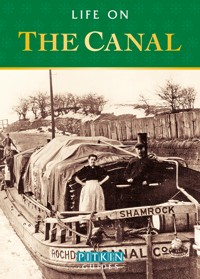
For centuries it was far more efficient to move goods by water than by road. The end of the 18th century saw 2,000 miles of canal built in Britain: the Canal Age had begun. Constructing the canals consisted of a great deal of hard work and manual labour, headlines by individual names but mostly done by tens of thousands of men across Britain called navvies. Initially much like carting on roads, boating on canals grew as canal systems expanded across the country, but still required long hours, hard work and specific skills. This detailed and informative guide tells the story of the boats and their workers. From the professional leggers who walked boats through tunnels to lock keepers to canal children running ahead of the boats, original photographs and artefacts such as tug tickets and timetables show what life was like on the canal. A classic Pitkin guide to immerse readers in the world of canals in Britain, including a list of museums and heritage centres to provide further insight into the history of the canal network.
Sie lesen das E-Book in den Legimi-Apps auf:
Seitenzahl: 49
Veröffentlichungsjahr: 2013
Das E-Book (TTS) können Sie hören im Abo „Legimi Premium” in Legimi-Apps auf:
Ähnliche


















Pitkin Publishing
The Mill, Brimscombe Port
Stroud, Gloucestershire, GL5 2QG
www.thehistorypress.co.uk
This ebook edition first published in 2013
All rights reserved
Text © Pitkin Publishing, 2012, 2013
Written by Anthony Burton. The right of the Author, to be identified as the Author of this work has been asserted in accordance with the Copyrights, Designs and Patents Act 1988.
This ebook is copyright material and must not be copied, reproduced, transferred, distributed, leased, licensed or publicly performed or used in any way except as specifically permitted in writing by the publishers, as allowed under the terms and conditions under which it was purchased or as strictly permitted by applicable copyright law. Any unauthorized distribution or use of this text may be a direct infringement of the author’s and publisher’s rights, and those responsible may be liable in law accordingly.
EPUB ISBN 978-0-7524-9183-7
MOBI ISBN 978-0-7524-9182-0
Original typesetting by Pitkin Publishing
IMPORTANT DATES
THE CANAL AGE
In the 18th century it was well known that moving goods by water was far more efficient than doing so by road. On even the best roads, and there were not many of those, a single horse could not pull more than two tons in a wagon, but that same horse could haul 30 tons if it was harnessed to a barge on a river. A huge amount had been done to improve river transport in the early decades of the century, using locks and artificial cuttings to bypass difficult sections of the natural waterway. However, by the middle of the century river improvement had gone as far as it could; there were still whole areas that were a long way from any form of water transport, and these included the new, rapidly developing industrial regions.
The Duke of Bridgewater had coal mines on his estates at Worsley and wanted to sell his coal to Manchester, 6½ miles (10km) away. His first plan was to build a canal to link the mines to the nearby River Irwell, but when the river authorities turned him down he came up with a far bolder idea: he would build his own canal that would be carried across the Irwell on an aqueduct. When the Bridgewater Canal opened in 1761 it created a sensation. People came from miles around to witness the miraculous sight of boats floating over a river, while others were far more impressed by the fact that the price of coal in Manchester was halved. Over the next half-century some 2,000 miles (3,200km) of canal would be built in Britain. The Canal Age had begun.
BUILDING THE CANALS
Canal construction continued right through to the end of the 1820s, when the focus shifted from waterways to railways. The planning of all the different routes was the responsibility of the Chief Engineers, each of whom had their own individual way of doing things. The first important figure was James Brindley (1716–72), who began his career as engineer for the Bridgewater Canal and found himself in demand for almost all the canal schemes begun over the next few years. His approach was cautious, preferring to go round obstacles rather than through or over them, so that his canals tend to wander across the landscape in great meandering loops, following the natural contours of the land. After Brindley’s death a new generation of engineers took over the work, notably William Jessop, Thomas Telford and John Rennie. Their approach was very different, meeting obstructions head on by using a technique known as ‘cut and fill‘, in which the canals would pierce hills in deep cuttings and the spoil would be used to build up embankments across the valleys.
JAMES BRINDLEY
James Brindley died in 1772, with his greatest work, the Trent & Mersey Canal, still unfinished. His epitaph, published in the Chester Courant, began:
James Brindley lies amongst these Rocks,
He made Canals, Bridges, and Locks,
To convey Water; he made Tunnels
for Barges, Boats, and Air-Vessels …
NAVVIES
It has been customary to speak of canals as being built by named individuals. The Staffs & Worcester was ‘built’ by Brindley, the Rochdale by Jessop, but they did not do the actual building themselves: that was the job of the tens of thousands of men who worked on canal construction all over Britain. They were known originally as ‘navigators’ because they built canal navigations, but that soon became abbreviated to the more familiar ‘navvies’. They are as much a part of the story of the life of canals as the boatmen who were to use the waterways.
At first canals were constructed using local labour, but as the men became accustomed to the hard work they found that they could earn more money as professional navvies by moving around the country from canal to canal than they could by returning to their old jobs. It was estimated that an experienced navvy could dig out 12 cubic yards (9 cubic metres) of earth a day – the equivalent of digging a trench 36 feet long, 3 feet wide and 3 feet deep (10m × 1m × 1m).
In 1788 the company that built the Basingstoke Canal tried to employ local men but they proved to be quite incapable of keeping up with the more experienced navvies.




