


Erhalten Sie Zugang zu diesem und mehr als 300000 Büchern ab EUR 5,99 monatlich.
- Herausgeber: Parkstone International
- Kategorie: Geisteswissenschaft
- Sprache: Englisch
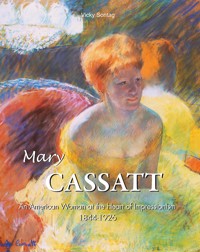
The biography, entitled Mary Cassatt – A Woman's Art, provides an insightful account of the life and career of Mary Cassatt . She was one of a select few women who managed to establish a presence in the male-dominated art world of the late 19th and early 20th centuries. Cassatt, originally from the United States, spent most of her life in France, where she became a prominent member of the Impressionist movement alongside Degas and Monet. This book, which features approximately 100 reproductions of her works, demonstrates how Mary Cassatt , with her distinctive female perspective, transcended the prevailing artistic norms of the era. Her intimate portrayals of motherhood and domestic scenes exemplify her resilience and perceptivity. Her œuvre serves as a compelling testament to the advancement of women in the art world.
Sie lesen das E-Book in den Legimi-Apps auf:
Seitenzahl: 106
Veröffentlichungsjahr: 2025
Das E-Book (TTS) können Sie hören im Abo „Legimi Premium” in Legimi-Apps auf:
Ähnliche


Vicky Sontag
Mary Cassatt
An American Woma
Author: Vicky Sontag
© 2025 Parkstone Press International, New York, USA
© 2025 Confidential Concepts, worldwide, USA
© Image-Barwww.image-bar.com
All rights reserved.
No part of this publication may be reproduced or adapted without the permission of the copyright holder, throughout the world. Unless otherwise specified, copyright on the works reproduced lies with the respective photographers, artists, heirs or estates. Despite intensive research, it has not always been possible to establish copyright ownership. Where this is the case, we would appreciate notification.
ISBN: 979-8-89405-873-3
Contents
IntroductionMary Cassatt: An American Eye in Paris
Her Life before Paris and her Family BackgroundRoots of Independence: Childhood, Family and Early Aspirations
Early Years in ParisApprenticeship in the Capital of Art
Back in EuropeJourneys of Formation: Italy, Spain and Beyond
Degas and MaryCassatt’s lifelong FriendshipA Dialogue of Equals
The Mystery of Artistic IntimacyThe Private Language of Art
Aging and vulnerabilityLate Works and Inner Convictions
Spiritual Values and CulturalContextStrength in Fragility
Cassatt as Cultural ConnectorThe Silent Strength of an Impressionist
Index
IntroductionMary Cassatt: An American Eye in Paris
Mary Cassatt is, above all, the painter of motherhood. There is perhaps no other artist who has captured so convincingly the profound attachment between mother and child, the spirit of intimate companionship and the subtle exchanges of feeling that bind generations. Where lesser painters might have sunk into sentimentality, Cassatt transformed this theme into a vision at once dignified, modern and psychologically penetrating. Her mothers and children are not decorative motifs but emblems of endurance, tenderness and strength. Where a lesser hand might have fallen into sentimentality, her brushwork maintains a rare dignity—vigorous yet restrained—affirming the profound humanity of these relationships.
Cassatt occupies a unique place in the history of modern art. The achievement is remarkable when one considers the cultural conditions of the nineteenth century. Cassatt lived at a time when women artists were expected to pursue art as a polite pastime rather than as a vocation. Few were encouraged to enter the professional arena. Yet Cassatt not only claimed a place among the Impressionists—the most audacious group of her age—but also carved out an independent reputation equal to theirs. That she did so without compromise and without adopting the fashionable trappings of femininity, is central to her legacy.
Born in Pittsburgh in 1844 yet spending the greater part of her creative life in France, she bridged two worlds: The rising cultural ambition of the United States and the radical artistic ferment of Paris in the late nineteenth century. This dual allegiance shaped both her identity and her art. Independent, practical and uncompromisingly committed to integrity, she remained thoroughly American in spirit, while her training, friendships and immersion in Impressionist debates placed her firmly within the French avant-garde. From this fertile tension, she forged a body of work at once personal and universal rooted in a woman’s lived experiences, yet expressed in the modern language of line, colour and light.
Cassatt’s art was rooted in both tradition and innovation. She trained rigorously, studying the Old Masters in Italy, Spain and Belgium, copying Correggio, Velázquez, Rubens and others. From them she absorbed discipline of drawing, economy of means and command of composition. Yet she sought more than academic mastery. In Paris she found the ferment of modern life and in Degas she discovered a kindred spirit who shared her devotion to line and structure while opening new possibilities in pastel and printmaking. Their friendship would shape her career but never define it: Cassatt was not Degas’s pupil so much as his equal, sharpening her own vision in dialogue with him.
That vision was distinctive. While her male colleagues—Monet, Renoir, Pissarro—turned their attention to landscapes, street scenes, or sensuous portraits, Cassatt devoted herself to the sphere of women and children. This choice was not retreat but strategy. She demonstrated that modernity could be found not only in boulevards or railway stations but also in parlours, nurseries and gardens. In elevating the domestic, she asserted its dignity and revealed its universality. Her women are not passive ornaments but active presences: Reading, sewing, caring for children, attending the theatre, visiting museums. These scenes dignify the intelligence and agency of women at a moment when their cultural role was still contested.
Cassatt’s style combined clarity of line with delicacy of colour. Critics remarked on her ability to suggest solidity with the fewest strokes, to create intimacy without excess. Her palette, often high-keyed and luminous, bore traces of her study of Japanese prints, while her structural precision echoed Degas and the Old Masters. The fusion produced images at once modern and timeless.
At first glance, Cassatt is remembered above all as the “painter of motherhood,” the artist who most vividly visualized the maternal bond. Indeed, her canvases teem with scenes of intimacy: The child nestled against its mother’s cheek, the ritual of bathing or grooming, the serenity of shared reading. Yet to confine her legacy to this subject alone would diminish the radical force of her vision. Her maternal portraits are not decorative idylls but renderings of strength, clarity and psychological depth. By elevating the domestic sphere—so often dismissed as secondary to the public world of men—Cassatt redefined the very terms of modern art. She demonstrated that the private life of women contained a dignity, complexity and truth equal to the spectacle of boulevards, battlefields, or salons.
Bacchante, 1872. Oil on canvas, 61 x 50.6 cm. Pennsylvania Academy of Fine Arts, Philadelphia.
Children in a Garden (The Nurse), 1878. Oil on canvas, 65.4 x 90 cm. Museum of Fine Arts, Houston.
Woman reading in a garden, 1878-1879. Oil on canvas, 89.9 x 65.2 cm. The Art Institute of Chicago, Chicago.
At the Theatre, c. 1879. Pastel, 53.3 x 43.2 cm. The Nelson-Atkins Museum of Art, Kansas City, Missouri.
Young Woman Sewing in a Garden, 1886. Oil on canvas, 91.4 x 64.8 cm.
Her achievement was recognized early. At an 1880 Paris exhibition, the critic Jules Castagnary praised her as “the only artist of an elevated, personal and distinguished talent actually possessed by America, aside from Whistler.” Though perhaps exaggerated, his remark reflects the singularity of her vision: Cassatt always looked at life with her own eyes, forging a distinctive style through rigorous discipline and unswerving independence.
Cassatt’s path to mastery was neither smooth nor conventional. She began at the Pennsylvania Academy of the Fine Arts, one of the few institutions admitting women, but soon grew frustrated with its conservatism. With characteristic resolve, she persuaded her family to support her studies abroad. Italy, Spain and the Low Countries provided her with the lessons of the Old Masters—the clarity of Renaissance structure, the gravity of Baroque drama. Ultimately, Paris became her chosen home, at a time when debates over modern art reached their peak. Here she encountered Manet, Renoir and most decisively, Edgar Degas, whose friendship proved a turning point. Recognizing her skill as a draughtswoman, Degas encouraged her to join the Impressionist exhibitions. Their dialogue, sustained for over fifteen years, was one of mutual respect: She admired his discipline and mastery of line, while he valued her fresh perception and independence. His influence sharpened her technical daring—her firm drawing, bold handling of colour and tone and clarity of form—while she retained her own distinct voice.
Though closely linked to the Impressionists, Cassatt was never bound by the movement’s orthodoxy. Like them, she embraced brighter palettes, freer brushwork and contemporary subjects. Yet, unlike many, she resisted dissolving form into pure light, preserving structure and contour with a discipline akin to Degas. Her prints, deeply inspired by Japanese art, reveal her mastery of spatial innovation and her bold exploration of design. In this synthesis—line and colour, discipline and freedom—she carved out her own modernity.
If Cassatt’s art was forged in France, her impact extended across the Atlantic. She played an indispensable role as a mediator between French Impressionism and American collectors. With remarkable foresight, she urged her compatriots to acquire works by Degas, Monet and Manet—artists still ridiculed in Paris. Through her counsel, many masterpieces entered American collections, forming the foundations of the great museums. In this way, Cassatt not only created her own oeuvre but also shaped the institutions through which modern art would flourish in the United States.
On a Balcony, 1873. Oil on canvas, 101 x 54.6 cm. Philadelphia Museum of Art, Philadelphia.
Spanish Dancer Wearing a Lace Mantilla, 1873. Oil on canvas, 65.2 x 50.1 cm. Smithsonian American Art Museum, Washington, D.C.
Her career also illuminates the condition of women in the nineteenth-century art world. Denied access to the academies and salons where men trained and exhibited, she constructed her education through determination, travel and personal alliances. Her eventual place among the Impressionists was a triumph not only of talent but of perseverance. Equally significant was her choice of subject matter: Women and children in daily life. By depicting these realities with seriousness and authority, she asserted their worthiness of artistic representation, subtly anticipating the themes of modern feminism—not by rhetoric, but through the quiet strength of her imagery.
Even in later years, Cassatt’s creativity remained restless. She revived the brilliance of pastel in the tradition of the eighteenth-century French masters while pioneering daring new colour etchings and printmaking techniques. Her technical audacity never waned, even as her eyesight failed and painting grew increasingly arduous. To the end, she remained admired for her courage and unyielding devotion to her art.
Today, to stand before a Cassatt canvas is to encounter a vision of intimacy suffused with modernity. Her women are not distant muses but vital presences—strong, tender, thoughtful and complex. Her children are not props for charm but individuals, absorbed in their sensations and discoveries. In brush, pastel, or etched line, Cassatt gave modern art a new vocabulary for human connection, one that continues to resonate more than a century later. She endures not only as a bridge between America and France, nor solely as a companion of the Impressionists, but as an artist of indomitable independence—one who saw, with rare clarity, the strength and beauty of everyday life.
The study that follows seeks to situate Cassatt within the broader history of nineteenth-century art while also attending to the singularity of her vision. It traces her formation in America and Europe, her encounters with Degas and the Impressionists, her innovations in pastel and printmaking and her persistence in the face of illness and prejudice. Above all, it considers the central paradox of her career: That an American woman, working in France, found her most original voice in the intimate depiction of women and children and in so doing gave modern art one of its most enduring images of humanity.
The Young Bride, c. 1866-1867. Oil on canvas, 88.9 x 70.5 cm. Montclair Art Museum, Montclair.
Little Girl in a Blue Armchair, 1878. Oil on canvas, 89.5 x 129.8 cm. Collection of Mr. and Mrs. Paul Mellon, National Gallery of Art, Washington, D.C.
Portrait of MadameXDressed for the Matinée, 1878. Oil on canvas, 100 x 81 cm. Private collection.
Her Life before Paris and her Family BackgroundRoots of Independence: Childhood, Family and Early Aspirations
Before narrating Mary Cassatt’s life story, we’ll begin by exploring three key stages of her development, as captured in three of her portraits.
The first Mary Cassatt portrait is depicted as a young artist, her story pieced together from the words of her contemporaries and the influence of Degas, for whom she was an informal model.
Mary Cassatt Self Portrait, c. 1880. Gouache and watercolour over graphite on paper, 32.7 x 24.6 cm. National Portrait Gallery, Smithsonian Institution, Washington, D.C.
The second Mary Cassatt was a woman past middle age, still able to work with full mental vigor despite occasional illness. Her conversations were rich with memories of the great French artists of her time. Her knowledge was dazzling yet uneven, shaped by vivid visual memories from a wide array of experiences rather than a structured course of study. She expressed her opinions confidently and was well-versed in French and American politics. Her biting characterizations of politicians were interspersed with personal stories of Degas, her first meetings with him, her time in Italy, trips to Spain and her vivid memories of masterpieces in every medium—stone, glass, wood, tapestry, painting and pastel. She could recall and recreate beautiful objects from her past with a mastery of language and an uncanny visual memory.
Portrait of the Artist, 1878.




