


Erhalten Sie Zugang zu diesem und mehr als 300000 Büchern ab EUR 5,99 monatlich.
- Herausgeber: Escola de Gestão Aquila
- Kategorie: Fachliteratur
- Sprache: Englisch
Plan. Do. Check. Act. Four simple words that together form a powerful management technique for improving processes, activities, and organisations. We wrote this book to help readers understand and apply the PDCA (Plan, Do, Check, Act) method. It is a model that we have used successfully with clients around the world, helping deliver sustainable performance improvement and shareholder value. The concepts and theory behind the method appear simple and straightforward, but we found that most of the literature on the subject is complicated, overblown, and dull. So, we decided to write this book. We have set out to bring the PDCA method to life, using clear language, simple concepts, and examples from our own experience. We hope that, after reading this book, you will be able to apply the PDCA method to your work, as well as other areas of your life, because the concepts and approach are universally applicable. We do not pretend to cover everything there is to know about the subject, but we hope that this book is the start of your experience of understanding and using the PDCA method to make a difference to everything you do.
Sie lesen das E-Book in den Legimi-Apps auf:
Seitenzahl: 161
Veröffentlichungsjahr: 2020
Das E-Book (TTS) können Sie hören im Abo „Legimi Premium” in Legimi-Apps auf:
Ähnliche















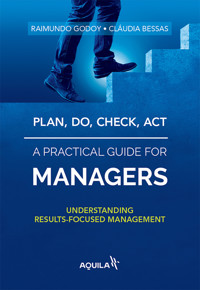
RAIMUNDO GODOY and CLÁUDIA BESSAS
PLAN, DO,CHECK, ACT
A PRACTICAL GUIDEFOR MANAGERS
UNDERSTANDING RESULTS-FOCUSEDMANAGEMENT
Copyright © 2020 by Raimundo Godoy and Cláudia Bessas
All rights reserved.
Published by Aquila Institute Pty Ltd
Level 12, 95 Pitt Street, Sydney NSW 2000, Australia
www.aquilaaustralia.com.au
Translated and edited: Charles Bacon, Felipe Dalcin, Murray Priestman, Taiana Zanata.
Cover design: Walter Santos
Interior design: Walter Santos
Printed in China
Godoy, Raimundo.
Plan, do, check, act - a practical guide for managers: understanding results-focused management / Raimundo Godoy, Cláudia Bessas – Sydney, Australia – 2020
ISBN-13: 978-0-646-81338-7
1. Business Management. 2. Organisational efficiency. 3. Operational Excellence.
National Library of Australia Cataloguing-in-Publication entry:
Godoy, Raimundo, author
Bessas, Cláudia, author
Plan, do, check, act - a practical guide for managers: understanding results-focused management / Raimundo Godoy, Cláudia Bessas.
9780646813387 (paperback)
Summary
About this Book
Preface
Acknowledgements
INTRODUCTION
The PDCA Method
About the Method
The Evolution of Management Theory
Taylorism and Scientific Management
Quality Control and Cyclical Thinking
Deming Focuses on the Customer
Time for Total Quality Control
PLAN
Introduction
1. Find Opportunities
Zero Tolerance for Recurring Mistakes
Defining Opportunity
Tools to Identify Opportunities
Bottleneck Analysis
Analysis of Chronic Bottlenecks
Benchmarking
Historical Benchmarking
Internal Benchmarking
Competitive Benchmarking
Functional Benchmarking
2. Analysis of Facts and Data
Tools for Analysing Facts and Data
3. Is the Process Capable?
4. Yes: See and Act
See and Act Actions
5. No: Defining the Goal and the Action Plan
Establish Goals
Identify the Causes and Prepare the Action Plan
Brainstorming
Cause and Effect Diagram
The Five Why’s Technique
Prioritisation of Causes
Preparing the Plan
Conclusion of the Planning Stage
DO
About the Implementation
6. Train those Involved
7 & 8. Implement See and Act Actions and Action Plans
CHECK
About the Check Phase
9. Visual Management
10. Management Rituals
Updating Actions
Results Analysis
Check Tools
ACT AND STANDARDISE
Introduction
11. Corrective Actions
12. Standardisation
Process Mapping and Identifying Critical Tasks
Preparing Standards
Standards Training
Monitoring Results and Adherence to Standards
Treatment of Anomalies
Anomaly Report
Root Cause Analysis / Ishikawa Diagram
Hosotani Diagram
Defining Actions
Verification of Effectiveness
IMPROVEMENT TEAMS
One-Page Report
CASE STUDY: A WHITE BELT ORGANISATION
CONCLUSION
The PDCA Method
Management Maturity: A Framework
APPENDIX
ABOUT THIS BOOK
Plan. Do. Check. Act. Four simple words that together form a powerful management technique for improving processes, activities, and organisations.
The concepts and theory behind the PDCA method appear simple and straightforward, but we found that most of the literature on the subject is complicated, too technical, tiresome, and with a vocabulary far from the organisational routine. So, we decided to write this book to bring the PDCA method to life, using clear language, simple yet powerful concepts, and examples from our own experience. It is a model that we have used successfully with clients around the world, helping deliver sustainable performance improvement and shareholder value.
The reader is invited to practice these management techniques in the challenges of everyday life, leveraging the ability to identify and capture opportunities from the explanation of each step of the PDCA method (Plan, Do, Check, Act).
We hope that after reading this book you will be able to apply the PDCA method to your work and in other areas of your life, because the concepts and approach are universally applicable.
We do not intend to cover everything there is to know about the subject, but we hope that this book is the start of your experience understanding and using the PDCA method to make a difference to whatever you do.
Enjoy the reading!
PREFACE
Thirty-two years ago, when we were working in the School of Engineering at the Federal University of Minas Gerais (‘UFMG’), we set out to improve management practice in Brazil.
We developed a program based on what we found in our research was global management best practice, both in Brazil and around the world. In particular, we focused on the simplicity of the Japanese model and built our program around this, adapting the techniques to the Brazilian context.
We had clearly hit on something — the movement inspired by our program spread across the country. We worked hard to meet the demand, working with several organisations including partnering with Japanese specialists to supplement our team.
The momentum grew at an incredible rate, and during the 1990s we trained thousands of managers. In 1996 our organised and systematic approach was recognised by the JUSE-Union of Japanese Scientists and Engineers as the second international management movement. The first, of course was Japan. The management movement contributed significantly to the development of many companies and became important for the establishment of Brazilian multinationals.
In 1997 we left UFMG and started the Management Development Foundation (‘FDG’) to continue our work. In 2003 the foundation’s clients were split between the education sector, serviced by FDG, and the businesses and for-profit organisations, serviced by INDG.
The Aquila Group was founded in 2011 by a team of consultants led by Raimundo Godoy and Rodrigo Godoy. This year, Aquila celebrates its eighth anniversary as a company of 500 professionals who are deeply experienced and working with clients all over the world. Since our launch we have completed over 1200 projects in 20 countries and helped deliver great results for our clients in a diverse range of companies and public organisations, bringing consistent growth and recognition to the Group.
Today, FDG and Aquila are two strong institutions empowering managers to improve performance and results.
Aquila works for a broader range of clients, helping businesses and organisations around the world maximise their performance. We are constantly growing, and with that comes recruitment and the need to train our new employees in our approach.
This book is born in part from this growth; we wanted to document and share the experience and skills we have learned through delivering hundreds of projects for clients around the world, not just for our people but also for our clients. The book is written by two of our leaders, Raimundo Godoy and Cláudia Bessas Juscelino.
RAIMUNDO GODOY’s life is dedicated to work.
Raimundo started early; when he was 15 years old I helped him get a job in the dispatch department of ALCAN (now Rio Tinto). Working during the day and studying at night, he finished high school and went on to study chemical engineering at the Federal University of Minas Gerais. He supplemented his income by teaching in schools.
After graduation, he joined the FIAT Group, where he remained for 19 years. He had a successful career working in Brazil, Argentina, Italy, and Spain.
Since 2000 he has been dedicated to helping businesses improve through consultancy. He joined first FDG, then INDG, and finally Aquila, where he is a founding partner.
Since joining Aquila, Raimundo has delivered complex projects around the world, mainly in Brazil, Europe, and the USA. He is an expert at producing results; he knows how to drive a company to achieve and exceed its goals.
He is generous with his expertise and remains a great teacher. He will challenge his teams, pushing them out of their comfort zone to drive continuous improvement. He has had a powerful impact on his clients and colleagues around the world, and I am delighted that we can broaden this impact by sharing his knowledge in this book.
CLÁUDIA BESSAS JUSCELINO graduated from the Faculty of Industrial Engineering (FEI) in Computer Science. She is a senior consultant with 12 years’ experience and a founding partner of Aquila.
Claudia has worked for clients in 10 countries in Europe and South America, delivering operational excellence solutions, including goal alignment, business process management, and income and expense management. She has deep experience across a wide range of sectors including resouces and metals, construction, agribusiness, food processing, media and advertising, sports, and telecommunications.
In this book Claudia leverages the experiences she has acquired in the course of her work and shares the knowledge and insights she has gained from the rich blend of clients and companies she has worked with since helping establish Aquila.
Each of our consultants have interesting histories and Claudia is a great example. Some years ago, INDG was about to start a project in France and we needed consultants who spoke French. We saw from our database that Claudia is fluent in French. We asked her to come for an interview and sent her the plane tickets. At first, she thought it was a joke because of the speed with which we moved, flying her across Brazil at short notice.
Claudia had never travelled by plane; coming to Belo Horizonte was her first flight. But she took a chance on us and the rest, as the cliché goes, is history. Her first project was in a small town near Lyon, France. Asked why she studied French, she could not explain. It was, certainly, a fate of destiny. Since then Claudia has worked in 10 countries to date and is currently based in London, from where she runs projects in Portugal. After all, a consultant has to be prepared to face major challenges and a high rate of unpredictability.
I am convinced that this book, through its combination of simple language and richly detailed examples and tools, will help a new generation of managers and leaders learn and apply the methods that we have used to such good effect with clients around the world. It is a very significant work for the much needed improvement in competitiveness in businesses.
Belo Horizonte, June 2019
Prof. José Martins de Godoy, Dr.Eng.
President
Board of Directors of the Aquila Group
ACKNOWLEDGEMENTS
RAIMUNDO GODOY
Dreams are dreamt alone, but it takes a team to turn them into reality.
This book began life as a dream, a series of ideas that took shape in my head. But I needed a team to help me turn my thoughts into words, to get them into a state worth sharing with others. Many people have helped me do just that, but I would like to thank the following in particular:
• Cláudia Bessas, who I thank for the long years of trust and friendship, and for the clarity and perceptiveness with which she helped me shape the dream.
• Natália, my daughter and business partner, who I greatly admire: thank you for the meticulous corrections and invaluable contributions to this book.
• Érico Barros and Roberto Heleno, friends and colleagues, for their edits, revisions, and thoughtful contributions.
• Paulo Coimbra, for his confidence, patience, and dedication.
• My many colleagues and associates, always by my side, supportive and encouraging me to never give up.
• Professor Godoy, for the preface and for all the teaching during our time together, my role model of strength and perseverance.
• Our clients, with whom we always learn, because they are a source of inspiration, for driving us to keep going and becoming better at what we do. They are the greatest promoters of our profession.
Finally, I thank my family for their support, respect for my profession, and because they make every effort and struggle worth it!
I am grateful to you all.
I dedicate this book to my grandchildren, Manuela and Raimundo (Raimundinho), who are my greatest achievements, and who will continue to write my story.
Raimundo Godoy
CLÁUDIA BESSAS
Many incredible people contributed to this project; I am grateful to all of them.
To the partners of Aquila for sharing the dream of spreading management expertise and to our clients for the trust they place in us in every project.
Thank you Professor Godoy, Paulo Coimbra, Gustavo Massa, Roberto Heleno, Érico Barros, Natália Godoy, and Nabila Fonseca for driving this project, for the revisions, for the hours of reflection, and for your unique contributions.
In particular, I thank Raimundo Godoy, a source of inspiration with whom I have had the privilege of working alongside for more than 10 years. Thank you for your untiring teaching, for the advice, the example of leadership, and the opportunity to write this book with you.
I dedicate this book to my family for their unending support and understanding: Marcio (my husband), Waldemar (my father), Manon (my mother) and Cris (my sister).
And to all my clients and colleagues at Aquila, for the opportunity to learn every single day.
Cláudia Bessas
INTRODUCTION
INTRODUCTION
The role of the manager in the modern business world is an increasingly professional one; qualifications and a structured approach to learning are critical for survival.
Understanding how to manage has become a basic requirement for any professional; it helps accelerate problem-solving, improves the quality of decision-making, and creates a way for effective managers to not just survive but to differentiate themselves.
This makes the PDCA method, which combines both technical knowledge and leadership principles, a powerful tool for today’s managers. It provides leaders with a toolkit to help add discipline and structure to the way their teams operate, heighten impact, and strengthen their ability to produce truly extraordinary results.
But the PDCA method is not exclusive to offices or industries; it can be used by everyone, from students managing exam pressures and families juggling busy domestic schedules, to the executive who has to make decisions about the future of a multinational company.
The inspiration for this book came from the stories of ordinary people looking for tools to help them tackle the problems and pressures of daily life. Many of the people we spoke to found the current literature on the subject boring, overly technical, and full of jargon.
This book tries to take a different approach. We want to enable readers to take their first steps in applying the PDCA method and to be able to use it to produce better results in their businesses, companies, and personal lives.
Give me six hours to chop down a tree and I will spend the first four sharpening the axe.
Abraham Lincoln
THE PDCA METHOD
ABOUT THE METHOD
Meet John. A young graduate in his new job at a food factory, John speaks to his boss about what he wants to get out of the graduate program he is currently in: to understand how to become a better manager. John shares how he always felt overwhelmed by the number of theories he was taught at university, many of which had little emphasis on practical application, or how the abstract concepts could be applied to the actual work he now found himself doing.
Over lunch his manager, Joseph, listened while John talked about his experiences at university.
John came from a relatively poor family, but he was determined to graduate in Engineering. He planned his move to university well in advance. He took an administrative job in a small company in his hometown and was able to save up the money he needed. However, during his first year at university John found himself running low on money because his expenses were higher than he had expected.
Writing down all his outgoings in detail, John saw that energy bills and transport costs were his biggest problems and he realised that at his current rate of spending he would be unable to finish his course. If he wanted to graduate as an engineer then something would need to change.
John began to structure his activities more carefully. He monitored and reduced his shower length, and moved from reading at night on the sofa at home to the university library. He switched to cycling to campus on a bicycle given to him by a friend, which virtually eliminated all transport costs.
By the end of his second year, John found that simply by controlling monthly expenses and making adjustments when necessary, not only had he spent less than expected but he had also recovered his losses from the first year.
Listening to his story, Joseph saw the opportunity he needed to describe what a management method was: regardless of the method (or the acronym — PDCA, DMAIC, A3 or 8D), all techniques for improving performance essentially contain the same four elements — Plan, Do, Check, and Act.
In other words, without even realising it John had applied these four steps to finish university. He identified the required resources and implemented his plan. In the first year he found out that the plan was not working so he adjusted it and got a better result in the second year. He was then on track to at least maintain, if not exceed, this performance in the following years.
PDCA is a method known worldwide and used by businesses to identify and capture opportunities. The four steps — Plan, Do, Check, Act — may seem obvious, even simple. But as with so many other things, only a small number of people manage to effectively apply the technique.
It is common to find people who do not value the planning phase and skip straight to action, or who start by proposing actions without taking time to understand the underlying root cause of the problems being tackled. All four elements of the PDCA method are critical, and success depends on applying them carefully in sequence.
Even though it can sometimes be obvious, as in John’s example, the simplicity of the framework belies the depth of thinking and experience that underpins it. As proponents of PDCA will tell you, there is always something to learn, be it a new application or new tools.
In a nutshell, the PDCA method provides managers with four simple steps to continuously improve processes and develop more structured management that is focused on results.
Not only that, but the PDCA method creates a virtuous cycle; with each application it provides better results and further improvement. And just as the improvement is continuous, so is — or should be — the use of PDCA within companies, at all levels of management and on all processes and activities.
THE EVOLUTION OF MANAGEMENT THEORY
Just as society and technology evolve, so should management.
The world has never been more connected, nor the pace of change as fast. Communications that once took weeks to arrive by letter now reach their target on the other side of the world within seconds.
New products are launched, new technologies emerge — and disappear — quicker than ever. With this pace of change comes increased expectations and impatience. Results are needed now, and clients and stakeholders will not wait as long as they might have once done.
Management as a discipline needs to adjust to reflect this environment. In other words, in modern management speed is an imperative.
There are many reasons why some businesses fail and others succeed. But one factor that is clearly crucial is the ability to anticipate trends and react to changes. In a world advancing at breakneck speed, understanding the implications of this before the competition and adjusting accordingly is a critical source of competitive advantage.
Managers who are equipped to do this — equipped with tools such as the PDCA method — are well-placed to thrive.
It is not the strongest that survives, nor the most intelligent, but the one that best adapts to the changes.
Charles Darwin
Just as the wider environment is changing rapidly, so too is the PDCA method continuously evolving: new technologies emerge every day that can be incorporated into the method to help us do even more with less, and at a greater pace.




