


Erhalten Sie Zugang zu diesem und mehr als 300000 Büchern ab EUR 5,99 monatlich.
- Herausgeber: The History Press
- Kategorie: Sachliteratur, Reportagen, Biografien
- Sprache: Englisch
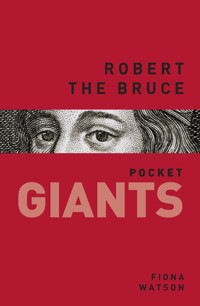
From disastrous beginnings after he took the throne of Scotland, having murdered a powerful rival, Robert I became a military leader of consummate genius. Throwing away the rulebook of medieval warfare, which favoured the mounted knight, he remodelled the Scottish army as a disciplined, audacious band of brothers capable of surprising castles, raiding and extracting blackmail as far south as Yorkshire and even defeating a mighty English army in pitched battle. Ruthless, charismatic, indomitable and lucky, the 'Bruce' is a towering example of an underdog capable of turning disadvantage into advantage and winning the day through talent and sheer determination. The English turned the lessons they learnt from him to good effect in their Hundred Years war against France.
Sie lesen das E-Book in den Legimi-Apps auf:
Seitenzahl: 118
Veröffentlichungsjahr: 2014
Das E-Book (TTS) können Sie hören im Abo „Legimi Premium” in Legimi-Apps auf:
Ähnliche
















Contents
Title
Introduction: Giant
1 Origins
2 The Testing Ground (1297–1306)
3 The Trouble with Robert the Bruce
4 A King in Search of his Throne (1306–09)
5 The Unlikely Road to Bannockburn (1310–14)
6 The Exception that Proved the Rule (1314)
7 Piling on the Pressure (1315–26)
8 The Search for Peace (1326–28)
Notes
Timeline
Further Reading
Web Links
Acknowledgements
Copyright
Introduction
Giant
Scots wha hae wi’ Wallace bled,
Scots wham Bruce has oft-times led,
Welcome tae yer gory bed.
Or tae victory.
Robert Burns, ‘Scots wha hae’, 1793
Perched on a rocky summit high above a plain dotted with vineyards, the Castle of the Stars at Teba in Andalucía salutes the vastness of the azure sky. This is a dry land, drawn from a palate of browns and yellows and ochres. It is very different from Scotland, that wet, green place 1,800 miles away. And yet, on a late summer’s day nearly 700 years ago, Scotland and Spain joined together on this very spot.
The memory of that moment lives on in Teba’s small, neat square beneath the castle, where a giant slab of granite commemorates the help given by ‘the Good’ Sir James Douglas, formidable general and close friend of King Robert the Bruce, to Alfonso XI of Castile against the Moors, who still occupied much of Spain. Douglas had been entrusted with the task of taking his king’s heart on pilgrimage to the Holy Land, a journey Bruce had always wanted to make in life but had never managed. Alas, Douglas and the Scots with him, in typically gung-ho fashion, charged so deep into enemy lines that they were cut off and most of them killed in the ensuing battle on 25 August 1330, though the castle was captured soon after. Both the body of Sir James and the casket containing Bruce’s heart were brought home to Scotland. And so, after this final arduous journey, King Robert, who had died over a year earlier, was allowed to rest in peace, a legend both at home and abroad.
It was not always thus. Robert the Bruce was not born to be a giant. It is true that he inherited wealth, land and considerable privilege, but until the age of 32, his name is not one that should have drifted beyond the peaceful sanctuary of Scotland’s more obscure history books, scarcely troubling the consciousness of present-day Scots, never mind inhabitants of the wider world. Bruce lived through extraordinary times, however, and these proved the perfect testing ground for his genius, forging a military leader with an international reputation for triumphing against the odds and putting his small, peripheral kingdom on the European map.
Much of what he did should make for uncomfortable reading. He was overwhelmingly ambitious, and ruthless with it – a fourteenth-century Macbeth in the eyes of some: a murderer, usurper and excommunicate. But he was also an extraordinarily innovative military commander who succeeded in liberating the medieval kingdom of Scotland from the control of its powerful southern neighbour, England. And he did so, to begin with at least, with the most limited of resources.
In 1314, at the Battle of Bannockburn, he defeated a numerically and – as contemporaries saw it – tactically superior cavalry army with a force made up almost entirely of foot soldiers armed with spears. His reign, partly as a result of the particular circumstances in which he took the throne, produced one of the most passionate and early expressions of the right of a nation to self-determination in medieval Europe. (Ironically, perhaps, the experience of fighting against Scotland also helped to crystallise and define England’s identity and prompted her kings to remodel their armies, focusing also on the capability of the foot soldier – especially one armed with the longbow – which then served them so well during the Hundred Years War with France.) If Robert Bruce is less well known than other great military leaders, it is not because his deeds and reputation are less worthy, but because the theatre of war that he dominated has been undeservedly overlooked.
Today, Robert Bruce is regularly awarded the sobriquet of ‘hero king’ in Scotland. In 2006 he came third, with 12 per cent of the vote, in a list of ‘most important Scots’, behind William Wallace and Robert Burns.1 His statues look down upon the people of Stirling, Edinburgh and Aberdeen, as well as presiding over the site of his great victory at Bannockburn (see Map). In his own day, he was known as ‘The Bruce’2 even by his enemies, a moniker that hints at affection among his own supporters and profound respect well beyond. ‘The Bruce’ was also the title given to the great epic poem written forty years after his death by Archdeacon John Barbour. Today he is most commonly referred to as Robert the Bruce.
However, a degree of ambivalence towards his reputation has developed over the last few centuries. Pursuit of his ambition to claim the throne of an independent Scotland is contrasted with the supposedly selfless and ideologically driven patriotism of William Wallace, another key figure in the Scottish wars with England. A strange form of class war has been projected on to these two heroes, with Wallace emerging as the champion of the working man, from whose forefathers he is deemed to spring, whilst Bruce is viewed as a member of a shifty, self-seeking nobility who espoused patriotism only when it was expedient to do so.
This version of their characters attained its most potent and wide-reaching form in the 1995 film Braveheart. Then the cult of Wallace, which had existed in Scotland for at least 500 years, reached a global audience. The film united two themes that struck a chord from Motherwell to Memphis to Medina: the desire to live freely and the ability of one man to change the world. ‘Freedom’, as it would have been understood in the thirteenth century, was a vastly different concept than it is today, rooted as it was in the social status of male property owners rather than the right of one nation or ethnic group to be responsible for its own destiny without interference from another. Equally, the myth of Wallace as a superman has long resided in his apparent responsibility for almost every blow struck in Scotland’s struggle to rid herself of English rule during his lifetime, up to and including (in the film) fathering the next King of England after a brief liaison with the Princess of Wales. In reality, Wallace was one of a number of Scottish military commanders and, though he did become Guardian of Scotland3 from the autumn of 1297 until his defeat at the Battle of Falkirk in July 1298, he later played a subsidiary role in the army of a subsequent Guardian. Even at his famous victory at Stirling Bridge in September 1297, he shared command with a young nobleman from northern Scotland, Andrew Murray.
Not even Hollywood dared to change Wallace’s grisly demise, but at least the doomed hero could be portrayed showing Robert the Bruce the way, giving the film a ‘happy ending’ at Bannockburn, which, so it was implied, brought Scotland her freedom. This is certainly not a novel interpretation; almost from the beginning, histories of the wars written from a Scottish perspective have stressed what Bruce inherited from Wallace. But in reality, and despite the undeniably challenging fact that Bruce’s ambitions brought him to fight his own people as much as the English, there is no comparison between the two men in terms of innovation, leadership and success. Wallace is the short-lived, ill-fated martyr. Bruce is the enduring, successful military genius – the monarch who, against the odds and the fallout of his own actions, forcibly united his kingdom and reigned for over two decades. A giant.
1
Origins
But Anthony Bek, bishop of Durham, put this question to him [Edward I]:
‘If Robert of Bruce were king of Scotland, where would Edward, king of England, be? For this Robert is of the noblest stock of all England, and, with him, the kingdom of Scotland is very strong in itself; and, in times gone by, a great deal of mischief has been wrought to the kings of England by those of Scotland.’
John of Fordun,Chronicle of the Scottish Nation, 1873
The Bruces, like many others, were an adventurous Norman family who exploited opportunities to increase their landed wealth and status in the British Isles in the decades following William of Normandy’s conquest of England in 1066. Their original seat lay at Brix, near Cherbourg, but, by the early twelfth century, the first Robert Bruce had become Lord of Cleveland in North Yorkshire.
At some point after 1124, he was also granted the lordship of Annandale in south-west Scotland by the Scottish king, David I, who had grown up at the court of Henry I of England. Henry was married to David’s elder sister, Matilda, and was the ultimate owner of the lands south of the River Forth. This territory had once been the most northerly part of Anglo-Saxon Northumbria but was formally granted to the Scottish kings, who already controlled it, in 975.
The civil war that broke out after King Henry’s death in 1135 gave King David the excuse he needed to invade England, partly in defence of the claims of Henry’s daughter, Matilda, against her cousin, Stephen of Blois, and partly in pursuit of more territory. For the last twenty years of his reign the Scottish king held the three northern English counties of Cumberland, Westmorland and Northumberland. The gift of the lordship of Annandale with vice regal powers to Robert Bruce was not, therefore, about defending the border with England, which moved dramatically – if temporarily – some 100 miles further south during this period. Rather, it was intended that Bruce should keep an eye on the independent-minded lords of Galloway, west of Annandale, who had little enthusiasm for accepting the authority of the Scottish Crown.
Though they continued to hold lands in England, this branch of the Bruce family soon rooted itself firmly in Scotland, becoming well respected and well rewarded. The wife of the third Robert Bruce was an illegitimate daughter of the Scottish king, William I, while his nephew, the fourth Robert, married Isobel, a great-granddaughter of King David I, around 1219. It was this marriage that would provide Robert and Isabella’s son – yet another Robert, nicknamed ‘the Competitor’ – with his claim to the throne of Scotland some seventy years later (see Family Tree).
In March 1286, the Scottish king, Alexander III, died riding through a storm to visit his new young queen. His three children by his first wife, Margaret, daughter of Henry III of England, had predeceased him. This left his granddaughter, a tiny Norwegian princess, as the only surviving direct heir. The Scottish nobility had already reluctantly promised to accept this Margaret as their future queen. However, Bruce the Competitor, now in his sixties, was adamant that he was a better choice as an adult male who, so he said, had been named heir to King Alexander II in the late 1230s, before the birth of the latter’s son, the future Alexander III.
As Margaret’s great-uncle and Scotland’s nearest neighbour, King Edward I of England naturally took an interest in these events, not least in order to ensure that the dispute did not degenerate into civil war and destabilise his northern border. Relations between the two kingdoms had improved dramatically over the last few decades, once Scotland had officially given up on claims to the northern counties of England, and intermarriage and the wealth generated by their wool trade had encouraged many Scots to seek property south of the border.
The Scots were well aware that Edward could be high-handed and single-minded: the English king had run roughshod over native law and custom when he conquered Wales in the 1280s. Nevertheless, given the need to safeguard Margaret’s future, the Scots were prepared to countenance her marriage to Edward’s son, Prince Edward, with the safeguard of a treaty defending Scotland’s integrity and independence.
However, the lynchpin of this agreement, the little princess herself, proved too delicate to survive the rigours of an autumnal crossing of the North Sea. She reached her father’s island of Orkney at the end of September 1290 and died there, the sombre news then being carried to the Scottish nobility and English envoys waiting to greet her at Scone, near Perth. The Scots now faced the very real threat of a violent squabble over the throne between Bruce the Competitor and his neighbour in south-west Scotland, John Balliol, Lord of Galloway, whose grandmother was the elder sister of Bruce’s mother, Isobel (see Family Tree).
Deciding how a new king should be chosen, and by whom, was never going to be easy. However, whether the Scots liked it or not, King Edward, a renowned lawmaker, was determined to preside over the court that would make that decision. No doubt by now he also saw Scotland’s vacant throne as an opportunity to extend his own power into the northern kingdom. Having encouraged other candidates to come forward and after making them all swear homage and fealty to him as Lord Superior of Scotland, King Edward’s court took over a year to make its decision. Finally, in November 1292, it was adjudged that the rightful ruler of the northern kingdom was not the Competitor, but John Balliol. Despite later assertions to the contrary, most Scots agreed.




