


8,49 €
Mehr erfahren.
- Herausgeber: Atlantic Books
- Kategorie: Sachliteratur, Reportagen, Biografien
- Sprache: Englisch
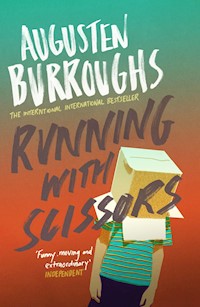
The #1 New York Times Bestseller An Entertainment Weekly Top Ten Book of the Year Now a Major Motion Picture This is the true story of a boy who wanted to grow up with the Brady Bunch, but ended up living with the Addams Family. Augusten Burroughs's mother gave him away to be raised by her psychiatrist, a dead ringer for Santa Claus and a certifiable lunatic into the bargain. The doctor's bizarre family, a few patients and a sinister man living in the garden shed completed the tableau. In the perfect squalor of their dilapidated Victorian house, there were no rules and there was no school. The Christmas tree stayed up until summer and Valium was chomped down like sweets. And when things got a bit slow, there was always the ancient electroshock therapy machine under the stairs... 'This is the Brady Bunch on Viagra... it is impossible not to laugh at all the jokes; to admire the sardonic, fetid tone; to wonder, slack-jawed and agog, at the sheer looniness of the vista he conjures up' -- Rachel Cooke, Observer
Das E-Book können Sie in Legimi-Apps oder einer beliebigen App lesen, die das folgende Format unterstützen:
Veröffentlichungsjahr: 2004
Ähnliche

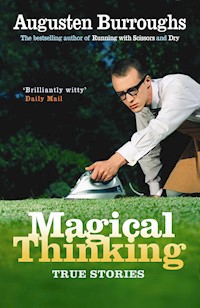














AUGUSTEN BURROUGHS was a child actor in a Tang Instant Breakfast Drink Commercial, It was a small role and did not, as he had expected, lead to a slot on The Brady Bunch or his own variety show. He has no hobbies, interests or skills, other than writing about himself. He lives in New York.
From the international reviews:
‘If you thought that your family was odd, try this one for size . . . Running with Scissors is hilarious: Adrian Mole scripted by Hieronymus Bosch. You couldn’t make this up. You find yourself laughing like a drain at each surreal event and Burrough’s deadpan asides . . . When life is this awful you have to laugh or go under. Luckily Burroughs has a talent for laughter.’ Fiona Hook, The Times
‘It is impossible not to laugh at all the jokes; to admire the sardonic, fetid tone; to wonder, slack-jawed and agog, at the sheer looniness of the vista he conjures up. What Burroughs has given us is the Brady Bunch on Viagra: just listen to all those manmade fibres crackle. Call me twisted but, I cannot wait for the next in the series.’ Rachel Cooke, Observer
‘Augusten Burroughs is Judy Garland in A Star is Born, or Eminem in 8 Mile – another poor winner from nowhere, validated and transfigured, living the Dream.’ Lewis Jones, Daily Telegraph
‘Running with Scissors is – in every positive sense I can think of – a blast . . . Augusten Burroughs is a likeable and wry narrator, and a born writer . . . So, if you thought The Ice Storm showed how messed up the liberated 1970s were, think again. In the world of horrific and self-amazed childhood memoirs, Running with Scissors sets a new standard.’ Lynne Truss, Sunday Times
‘The memoir tradition isn’t famed for its belly laughs but Augusten Burroughs’s account of growing up, Running with Scissors, is Dave Pelzer with a whoopee cushion attached. Burroughs starts out with an uninterested father and a mad mother. So he’s packed off to live with his mother’s shrink, but the shrink is nuts too. Part harrowing, part hilarious, the tale barrels along helped by snippy dialogue and oddball characters . . . genuinely memorable.’ Top 50 Cultural Events of the Season, Observer
‘Funnier and more alarming that any memoir in recent history . . . In the hands of Burroughs, a spirit of upbeat geniality emerges so that his family episodes become Reader’s Digest episodes from hell, filled with honesty, hilarity and horror.’ Christopher Fowler, Independent on Sunday
‘A remarkable autobiography . . . achingly funny and terrifyingly cruel.’ Sally Morris, Sunday Mirror
‘An exceptionally fine memoir of an extraordinary upbringing . . . a shocking, passionate, hilarious, compelling, at times scatological and ultimately redemptive book.’ John McTernan, Scotland on Sunday
‘The hilarious but harrowing memoir of Augusten Burroughs, raised by crazy parents and an insane psychiatrist’ 5 Best Debuts for 2003, Observer Magazine
‘A frank account of an unusual and harrowing upbringing . . . Powerful’ Herald
‘Augusten Burroughs’s bawdy, irreverent account of his bizarre American upbringing charts the ultimate in flamboyant dysfunction.’ Irish Times
‘A darkly comic memoir’ Vogue
‘Gripping like a car crash, and just as painful, * * * * *’ Marie Claire
‘Deftly written, smart and funny . . . Running with Scissors is a story so strange it could never be fiction’ GQ
‘Twisted, hilarious and relentlessly bizarre . . . Running with Scissors single-handedly redefines the term “fucked-up childhood”’ Sleazenation
‘Burroughs will be hard pressed ever to better this, his debut effort . . . It’s one you’ll never forget’ Time Out
‘An incredibly moving memoir, but also at times jawdroppingly funny. One to definitely savour’ What’s on in London
‘Bawdy, outrageous, often hilarious . . . so flippant, and so insanely funny (quite literally), that the effect is that of a William Burroughs situation comedy’ Janet Maslin, New York Times
‘Hilarious, freaky-deaky, berserk, controlled, transcendent, touching, affectionate, vengeful, all-embracing . . . Amazing’ Carolyn See, Washington Post
‘Hilarious and horrifying . . . the nuttiness of the goings-on described in this memoir seem to exemplify the adage: truth is stranger than fiction’ Merle Rubin, Los Angeles Times
‘The events of five years in the life of Augusten Burroughs, as recounted in a memoir that is both horrifying and mordantly funny, are so unbelievable, they make even the most outrageous episode of The Jerry Springer Show seem rational by comparison. Running With Scissors just might be the most aptly titled book ever written.’ David Wiegand, San Francisco Chronicle
‘Augusten Burroughs’s memoir makes you laugh, because it’s as funny as it is twisted’ GQ (US)
‘A witty and vivacious account of a wildly unconventional childhood . . . vivid and entertaining’ Mandy Sayer, Sydney Morning Herald
‘Jaw-dropping, often hilarious, and always engaging’ Catherine Keenan, Sun Herald
‘Sharp and irreverent . . . insightful, genuinely funny and often disturbing’ Mary Philip, Courier-Mail
‘This is a memoir brilliantly executed, with writing that glows’ James Macgowan, Ottawa Citizen
RUNNING WITH SCISSORS
A MEMOIR
Augusten Burroughs
First published in 2002 in the United States of America by St. Martin’s Press, New York.
First published in Great Britain in 2003 by Atlantic Books, an imprint of Grove Atlantic Ltd.
This paperback edition published by Atlantic Books in 2004.
Copyright © Augusten Burroughs 2002
The moral right of Augusten Burroughs to be identified as the author of this work has been asserted in accordance with the Copyright, Designs and Patents Act of 1988.
All rights reserved. No part of this publication may be reproduced, stored in a retrieval system, or transmitted in any form or by any means, electronic, mechanical, photocopying, recording, or otherwise, without the prior permission of both the copyright owner and the above publisher of this book. Author’s note: The names and other identifying characteristics of the persons included in this memoir have been changed.
3 5 7 9 8 6 4
A CIP catalogue record for this book is available from the British Library.
1 84354 151 3 eBook ISBN: 978 0 85789 352 9
Printed in Great Britain by Mackays of Chatham Ltd Atlantic Books An imprint of Grove Atlantic Ltd Ormond House 26–27 Boswell Street London WC1N 3JZ
For
Dennis Pilsits
Look for the ridiculous in everything
and you will find it.
—Jules Renard, 1890
CONTENTS
Something Isn’t Right
Little Boy Blue Navy Blazer
The Masturbatorium
Imagine My Shock
The Cleaning Lady
Just Add Water
The Burning Bush
Pure Projection
He was Raised Without a Proper Diagnosis
The Joy of Sex (Preteen Edition)
School Daze
The Seven-and-a-Half-Inch Disaster
Queen Helene Cholesterol
Toilet Bowl Readings
Phlegmed Before a Live Audience
Here, Kitty Kitty
I Would Dye For You
A Family Affair
Inquire Within
Life in the Great Outdoors
You are Nothing But a Sex Object
Thin Air
All-Star Running Back
Pennies From Heaven
Oh, Christmas Tree
Running with Scissors
You’re Gonna Make It After All
Epilogue
Acknowledgments
SOMETHING ISN’T RIGHT
MY MOTHER IS STANDING IN FRONT OF THE BATHROOM MIRROR smelling polished and ready; like Jean Naté, Dippity Do and the waxy sweetness of lipstick. Her white, handgun-shaped blow-dryer is lying on top of the wicker clothes hamper, ticking as it cools. She stands back and smoothes her hands down the front of her swirling, psychedelic Pucci dress, biting the inside of her cheek.
“Damn it,” she says, “something isn’t right.”
Yesterday she went to the fancy Chopping Block salon in Amherst with its bubble skylights and ficus trees in chrome planters. Sebastian gave her a shag.
“That hateful Jane Fonda,” she says, fluffing her dark brown hair at the crown. “She makes it look so easy.” She pinches her sideburns into points that accentuate her cheekbones. People have always said she looks like a young Lauren Bacall, especially in the eyes.
I can’t stop staring at her feet, which she has slipped into treacherously tall red patent-leather pumps. Because she normally lives in sandals, it’s like she’s borrowed some other lady’s feet. Maybe her friend Lydia’s feet. Lydia has teased black hair, boyfriends and an above-ground pool. She wears high heels all the time, even when she’s just sitting out back by the pool in her white bikini, smoking menthol cigarettes and talking on her olive-green Princess telephone. My mother only wears fancy shoes when she’s going out, so I’ve come to associate them with a feeling of abandonment and dread.
I don’t want her to go. My umbilical cord is still attached and she’s pulling at it. I feel panicky.
I’m standing in the bathroom next to her because I need to be with her for as long as I can. Maybe she is going to Hartford, Connecticut. Or Bradley Field International Airport. I love the airport, the smell of jet fuel, flying south to visit my grandparents.
I love to fly.
When I grow up, I want to be the one who opens those cabinets above the seats, who gets to go into the small kitchen where everything fits together like a shiny silver puzzle. Plus, I like uniforms and I would get to wear one, along with a white shirt and a tie, even a tie-tack in the shape of airplane wings. I would get to serve peanuts in small foil packets and offer people small plastic cups of soda. “Would you like the whole can?” I would say. I love flying south to visit my grandparents and I’ve already memorized almost everything these flight attendants say. “Please make sure that you have extinguished all smoking materials and that your tray table is in its upright and locked position.” I wish I had a tray table in my bedroom and I wish I smoked, just so I could extinguish my smoking materials.
“Okay, I see what’s the matter,” my mother says. She turns to me and smiles. “Augusten, hand me that box, would you?”
Her long, frosted beige nail points to the box of Kotex maxi pads on the floor next to the toilet bowl. I grab the box and hand it to her.
She takes two pads from the box and sets it on the floor at her feet. I notice that the box is reflected in the side of her shoe, like a small TV. Carefully, she peels the paper strip off the back of one of the pads and slides it through the neck of her dress, placing it on top of her left shoulder. She smoothes the silk over the pad and puts another one on the right side. She stands back.
“What do you think of that!” she says. She is delighted with herself. It’s as if she has drawn a picture and placed it on her own internal refrigerator door.
“Neat,” I say.
“You have a very creative mother,” she says. “Instant shoulder pads.”
The blow-dryer continues to tick like a clock, counting down the seconds. Hot things do that. Sometimes when my father or mother comes home, I will go down and stand near the hood of the car to listen to it tick, moving my face in close to feel the heat.
“Are you coming upstairs with me?” she says. She takes her cigarette from the clamshell ashtray on the back of the toilet. My mother loves frozen baked stuffed clams, and she saves the shells to use as ashtrays, stashing them around the house.
I am fixated on the dryer. The vent holes on the side have hairs stuck in them, small hairs and white lint. What is lint? How does it find hair dryers and navels? “I’m coming.”
“Turn off the light,” she says as she walks away, creating a small whoosh that smells sweet and chemical. It makes me sad because it’s the smell she makes when she’s leaving.
“Okay,” I say. The orange light from the dehumidifier that sits next to the wicker laundry hamper is looking at me, and I look back at it. Normally it would terrify me, but because my mother is here, it is okay. Except she is walking fast, has already walked halfway across the family room floor, is almost at the fireplace, will be turning around the corner and heading up the stairs and then I will be alone in the dark bathroom with the dehumidifier eye, so I run. I run after her, certain that something is following me, chasing me, just about to catch me. I run past my mother, running up the stairs, using my legs and my hands, charging ahead on all fours. I make it to the top and look down at her.
She climbs the stairs slowly, deliberately, reminding me of an actress on the way to the stage to accept her Academy Award. Her eyes are trained on me, her smile all mine. “You run up those stairs just like Cream.”
Cream is our dog and we both love her. She is not my father’s dog or my older brother’s. She’s most of all not my older brother’s since he’s sixteen, seven years older than I, and he lives with roommates in Sunderland, a few miles away. He dropped out of high school because he said he was too smart to go and he hates our parents and he says he can’t stand to be here and they say they can’t control him, that he’s “out of control” and so I almost never see him. So Cream doesn’t belong to him at all. She is mine and my mother’s. She loves us most and we love her. We share her. I am just like Cream, the golden retriever my mother loves.
I smile back at her.
I don’t want her to leave.
Cream is sleeping by the door. She knows my mother is leaving and she doesn’t want her to go, either. Sometimes, I wrap aluminum foil around Cream’s middle, around her legs and her tail and then I walk her through the house on a leash. I like it when she’s shiny, like a star, like a guest on the Donnie and Marie Show.
Cream opens her eyes and watches my mother, her ears twitching, then she closes her eyes again and exhales heavily. She’s seven, but in dog years that makes her forty-nine. Cream is an old lady dog, so she’s tired and just wants to sleep.
In the kitchen my mother takes her keys off the table and throws them into her leather bag. I love her bag. Inside are papers and her wallet and cigarettes and at the bottom, where she never looks, there is loose change, loose mints, specs of tobacco from her cigarettes. Sometimes I bring the bag to my face, open it and inhale as deeply as I can.
“You’ll be long asleep by the time I come home,” she tells me. “So good night and I’ll see you in the morning.”
“Where are you going?” I ask her for the zillionth time.
“I’m going to give a reading in Northampton,” she tells me. “It’s a poetry reading at the Broadside Bookstore.”
My mother is a star. She is just like that lady on TV, Maude. She yells like Maude, she wears wildly colored gowns and long crocheted vests like Maude. She is just like Maude except my mother doesn’t have all those chins under her chins, all those loose expressions hanging off her face. My mother cackles when Maude is on. “I love Maude,” she says. My mother is a star like Maude.
“Will you sign autographs?”
She laughs. “I may sign some books.”
My mother is from Cairo, Georgia. This makes everything she says sound like it went through a curling iron. Other people sound flat to my ear; their words just hang in the air. But when my mother says something, the ends curl.
Where is my father?
“Where is your father?” my mother says, checking her watch. It’s a Timex, silver with a black leather strap. The face is small and round. There is no date. It ticks so loud that if the house is quiet, you can hear it.
The house is quiet. I can hear the ticking of my mother’s watch.
Outside, the trees are dark and tall, they lean in toward the house, I imagine because the house is bright inside and the trees crave the light, like bugs.
We live in the woods, in a glass house surrounded by trees; tall pine trees, birch trees, ironwoods.
The deck extends from the house into the trees. You can stand on it and reach and you might be able to pull a leaf off a tree, or a sprig of pine.
My mother is pacing. She is walking through the living room, behind the sofa to look out the large sliding glass door down to the driveway; she is walking around the dining-room table. She straightens the cubed glass salt and pepper shakers. She is walking through the kitchen and out the other door of the kitchen. Our house is very open. The ceilings are very high. There is plenty of room here. “I need high ceilings,” my mother always says. She says this now. “I need high ceilings.” She looks up.
There is the sound of gravel crackling beneath tires. Then, lights on the wall, spreading to the ceiling, sliding through the room like a living thing.
“Finally,” my mother says.
My father is home.
He will come inside the house, pour himself a drink and then go downstairs and watch TV in the dark.
I will have the upstairs to myself. All the windows and the walls and the entire fireplace which cuts straight through the center of the house, both floors; I will have the ice maker in the freezer, the hexagonal espresso pot my mother uses for guests, the black deck, the stereo speakers; all of this contained in so much tall space. I will have it all.
I will walk around and turn lights on and off, on and off. There is a panel of switches on the wall before the hall opens up into two huge, tall rooms. I will switch the spotlights on in the living room, illuminating the fireplace, the sofa. I will switch the light off and turn on the spotlights in the hallway; over the front of the door. I will run from the wall and stand in the spotlight. I will bathe in the light like a star and I will say, “Thank you for coming tonight to my poetry reading.”
I will be wearing the dress my mother didn’t wear. It is long, black and 100 percent polyester, my favorite fabric because it flows. I will wear her dress and her shoes and I will be her.
With the spotlights aimed right at me, I will clear my throat and read a poem from her book. I will read it with her distinctive and refined Southern inflection.
I will turn off all the lights in the house and go into my bedroom, close the door. My bedroom is deep blue. Bookshelves are attached to the wall with brackets on either side of my window; the shelves themselves are lined with aluminum foil. I like things shiny.
My shiny bookshelves are lined with treasures. Empty cans, their labels removed, their ribbed steel skins polished with silver polish. I wish they were gold. I have rings there, rings from our trip to Mexico when I was five. Also on the shelves: pictures of jewelry cut from magazines, glued to cardboard and propped upright; one of the good spoons from the sterling silver my grandmother sent my parents when they were married; silver my mother hates (“God-awful tacky”) and a small collection of nickels, dimes and quarters, each of which has been boiled and polished with silver polish while watching Donnie and Marie or Tony Orlando and Dawn.
I love shiny things, I love stars. Someday, I want to be a star, like my mother, like Maude.
The sliding doors to my closet are covered with mirror squares I bought with my allowance. The mirrors have veins of gold streaking through them. I stuck them to the doors myself.
I will aim my desk lamp into the center of the room and stand in its light, looking at myself in the mirror. “Hand me that box,” I will say to my reflection. “Something isn’t right here.”
LITTLE BOY BLUE NAVY BLAZER
MY FONDNESS FOR FORMAL WEAR CAN BE TRACED TO THE womb. While pregnant with me, my mother blasted opera on her record player while she sat at the kitchen table addressing SASEs to The New Yorker. Somehow, on the deepest, most base genetic level, I understood that the massively intense music I heard through her flesh was being sung by fat people dressed in cummerbunds and enormous sequined gowns.
When I was ten, my favorite outfit was a navy blazer, a white shirt and a red clip-on tie. I felt I looked important. Like a young king who had ascended the throne because his mother had been beheaded.
I flatly refused to go to school if my hair was not perfect, if the light didn’t fall across it in a smooth, blond sheet. I wanted my hair to look exactly like the mannequin boys’ at Ann August, where my mother shopped. One stray flyaway was enough to send the hairbrush into the mirror and me running for my room in tears.
And if there was lint on my outfit that my mother couldn’t remove with masking tape, that was a better reason to stay home than strep throat. In fact, the only day of the year I actually liked going to school was the day the school photo was taken. I loved that the photographer gave us combs as parting gifts, like on a game show.
Throughout my childhood, while all the other kids were starting fights, playing ball and getting dirty, I was in my bedroom polishing the gold-tone mood rings I made my mother buy me at Kmart and listening to Barry Manilow, Tony Orlando and Dawn and, inexplicably, Odetta. I preferred albums to the more modern eight tracks. Albums came with sleeves which reminded me of clean underwear. Plus, the pictures were bigger, making it easier to see each follicle of Tony Orlando’s shiny arm hair.
I would have been an excellent member of the Brady Bunch. I would have been Shaun, the well-behaved blond boy who caused no trouble and helped Alice in the kitchen, then trimmed the split ends off Marcia’s hair. I would have not only washed Tiger, but then conditioned his fur. And I would have cautioned Jan against that tacky bracelet that caused the girls to lose the house-of-cards-building contest.
My mother chain-smoked and wrote confessional poetry around the clock, taking breaks during the day to call her friends and read drafts of her latest poem. Occasionally she would ask for my opinion.
“Augusten, I’ve been working on what I believe could be the poem that finally makes it into The New Yorker. I believe it could make me a very famous woman. Would you like to hear it?”
I turned away from the mirror on my closet door and set the hairbrush on my desk. I loved The New Yorker because it featured cartoons and ads. Maybe my mother would get her poem published right next to an ad for a Mercury Grand Marquis! “Read it, read it, read it,” I bounced.
She led me into her study, took a seat at her desk and turned off her white Olympia typewriter. Then she quickly checked the cap on her bottle of Wite-Out before clearing her throat and lighting a More cigarette. I sat on the twin bed she had converted into a sofa with throw pillows and an Indian bedspread.
“Ready?” she asked
“Okay.”
She crossed her legs, resting the side of her wrist on her knee as she leaned forward and read from the page. “Childhood is over. My youth. And bonds with people I have loved are broken now. My grief ascends into the clouds. And those tears that fall from the sky build the land anew, even the dead climb from their graves to walk with me and sing. And I . . .”
She read for many pages, her voice perfectly modulated. She practiced reading her poems out loud into a microphone that she kept in the corner of the room on a stand. Sometimes, when she was visiting her friend Lydia or in the living room trimming her spider plants, I would borrow the microphone and stuff it down the front of my pants, examining myself from every angle in the mirror.
When she was finished reading her poem, she looked up at me and said, “Okay, now I need your honest reaction. Did it feel powerful to you? Emotionally charged?”
I knew that the only correct answer to this question was, “Wow. That really does seem like something you’d read in The New Yorker.”
She laughed, pleased. “Really? Do you really think so? The New Yorker is very selective. They don’t publish just anyone.” She stood and began to pace in front of her desk.
“No, I really think they would publish this. All the stuff about your mother pushing you backwards into the heart-shaped goldfish pond in the backyard, the thing with your paralyzed sister, that was great.”
She lit another cigarette and inhaled deeply. “Well, we’ll see. I just got a rejection letter from The Virginia Quarterly. So that worries me. Of course, if The New Yorker did accept this poem, your grandmother would see it. I can’t imagine what she would say. But I can’t let her reaction stop me from publishing.” Then she stopped pacing, placed one hand on her hip and brought the other one holding the cigarette to her lips. “You know, Augusten. Your mother was meant to be a very famous woman.”
“I know,” I said. The idea that someday we might have our own stretch limousine parked in the driveway instead of that awful brown Dodge Aspen station wagon was so thrilling that I almost couldn’t stop myself from screaming. “You will be famous,” I told her. “I just know it.” I also knew I wanted tinted windows and a mini-bar in the back.
My father was otherwise occupied in his role of highly functional alcoholic professor of mathematics at the University of Massachusetts. He had psoriasis that covered his entire body and gave him the appearance of a dried mackerel that could stand upright and wear tweed. And he had the loving, affectionate and outgoing personality of petrified wood.
“Can we play checkers,” I whined, while he sat at the kitchen table grading papers and drinking vodka from a tumbler.
“No, son. I’ve got too much work to do.”
“Later can we play checkers?”
My father continued to scan the page with his red pen, making a note in the margin. “No, son. I told you, I’ve got a lot of work to do and later I’ll be tired. You go out and play with the dog.”
“But I’m sick of the dog. All she wants to do is sleep. Can’t you play one game?”
Finally he looked at me. “No, son, I can’t. I’ve got a lot of work to do, I’m tired, and my knee is acting up.”
My father had a bad knee. Arthritis caused it to swell, so he would have to go to his doctor and have it drained with a needle. He limped and wore a constant pained expression on his face. “I wish I could just sit in a wheelchair,” he used to say. “It would be so much easier to get around.”
The one activity my father and I did do together was take the garbage to the dump. “Augusten,” he called from downstairs in the basement. “If you load the car up, I’ll take you for a ride to the dump.”
I slipped on a mood ring and ran downstairs to the basement. He was wearing a red-and-black checkered field coat, hoisting two green plastic bags over his shoulders as he winced in pain. “Make sure the top is closed,” he warned. “You don’t want that bag breaking open and spilling garbage all over the floor. That would just be a nightmare to clean up.”
I dragged one of the bags across the floor toward the door.
“Jesus, son. Now, don’t drag that bag. You’ll tear the bottom and we’ll have garbage all over the place. I just warned you about that.”
“You said check the tops,” I said.
“Yes, but it should go without saying that you can’t drag a garbage bag across the floor.”
He was wrong. I’d seen the commercials for Hefty garbage bags on TV. “They won’t break,” I corrected him, dragging.
“Now, Augusten. You’ve got to carry that bag. If you can’t behave and carry that bag, I won’t let you come to the dump.”
I sighed deeply and carried the bag outside to the Aspen, then returned to the basement for another. We tended to let garbage collect for weeks, so there were always at least twenty bags.
When the car was filled, I squeezed into the front seat between my father and one of the trash bags. The sour smell of old milk cartons, egg shells and emptied ashtrays filled me with pleasure. My father, too, enjoyed the aroma. “I rather like that smell,” he commented as we made the six-mile trip to the public dump. “I wouldn’t mind living next to a landfill one bit.”
At the dump, my father and I opened the rear hatch of the station wagon and all of the doors. Perched on the ledge overlooking the pit where we threw the bags, the car looked poised for flight. Its doors were like wings and the grille in front seemed to be smiling. Here, I was free to pull out a bag, drag it across the ground and then hurl it out.
Afterward, we drove past the gray cinder block recycling building where people left the remains of their broken baby strollers, rusty stoves and unwanted dollhouses.
“Please, can I take it home?” I whined upon seeing a chrome coffee table with a chipped, smoked-glass top.
“No, we’re not taking any of that stuff home. You don’t know where any of this garbage has been.”
“But it’s still good.” I knew I could hide the chip by fanning a display of magazines on the surface, like in a doctor’s office. And it certainly wouldn’t be dirty after I polished it with Windex for three hours.
“No, son. Now stop touching that filthy thing and get back in the car. And don’t touch your face now that you’ve got those coffee table germs all over your fingers.”
My mood ring went black. “Why can’t I have it? Why?”
My father sighed, exasperated. “I told you,” he said through clenched teeth, “we don’t know who that dirty thing belonged to. We just finished taking trash out of the house. We don’t need to be bringing more trash in.”
I sat pressed against the unlocked door, miserable. It was my secret hope that the door would fly open on the highway and I would tumble from the car, rolling onto the highway where I would be crushed beneath the tires of the Barstow onion truck behind us. Then my father would be sorry he wouldn’t let me have the coffee table.
Unfortunately, my parents loathed each other and the life they had built together. Because I was the product of their genetic fusion, well, it’s not surprising I liked to boil my change on the stove and then shine it with metal polish.
“You infantile tyrant,” my mother shouted from her position on the sofa, legs folded up beneath her. “You goddamn bastard. You’d like nothing more than to see me slit my wrists.” She absently twisted the tassel on her long crocheted vest.
This was Cream’s cue and she tucked her tail between her legs and slipped from the room, heading downstairs to sleep next to the boiler.
My father’s face grew red as he added a splash of tonic water to his glass. “Deirdre, will you just settle down. You’re hysterical, just hysterical.” Because he was a professor, he was in the habit of repeating himself.
She stood up from the sofa and walked slowly across the white shag carpeting, as if finding her mark on a soundstage. “I’m hysterical?” she asked in a smooth, low voice. “You think this is hysterical?” She laughed theatrically, throwing her head back. “Oh, you poor bastard. You lousy excuse for a man.” She stood next to him, leaning her back against the teak bookcase. “You’re so repressed you mistake creative passion for hysterics. And don’t you see? This is how you’re killing me.” She closed her eyes and made her Edith Piaf face.
My father moved away from her. He brought the glass to his lips and took a deep swallow from his drink. Because he’d been drinking all evening, his words were slightly blurry. “Nobody’s trying to kill you, Deirdre. You’re killing yourself.”
“I wish you’d rot in hell,” she spat. “I regret the day I ever married you.”
While they were fighting, I was sitting at the dining-room table fastening and unfastening the lobster claw clasp on the gold chain my mother had bought me in Amherst. I worried constantly that it would fall from my neck. And the only thing that reassured me was to test its dependability over and over again. I glanced up and said, “Can’t you two stop fighting? You always fight and I hate it.”
“This is between me and your father,” my mother said coldly.
“No it’s not,” I shouted with surprising volume. “It’s not just between you because I’m here too. And I can’t stand it. All you ever do is scream at each other. Can’t you just leave each other alone? Can’t you try?”
My mother replied, “Your father is the one who is making things difficult for us.”
Eventually, the fight moved next door to the kitchen, providing them with better lighting as well as potential weapons.
“Look at your damn face,” my mother said. “You’ve got the face of a man twice your age. Thirty-seven years old going on eighty.”
My father was very drunk by now and the only way he could imagine restoring silence to the house was to stop my mother from breathing.
“Get your damn hands off of me,” my mother screamed, struggling against my father’s hands, which had found their way around her neck.
“Shut the hell up, you bitch.” His teeth were clenched.
I had followed them into the kitchen, and was standing in the doorway in my Snoopy pajamas. “Stop!” I screamed. “Stop this!”
In one motion, my mother shoved my drunk father, sending him reeling backward against the kitchen counter. His head hit the dishwasher on the way down and when he made contact with the kitchen floor, he didn’t move. A small pool of blood began to form under his ear and I was sure he was dead.
“He’s not moving,” I said, moving closer.
“This spineless bastard is only playing another one of his pitiful games.” She nudged his bad knee with her red toe. “Get up, Norman. You’re frightening Augusten. Enough of your pranks.”
My father eventually sat up, leaning his head back against the dishwasher.
With disgust, my mother tore a Bounty paper towel from the roll and handed it to him. “I should just let you bleed to death for terrifying our son like that.”
He pressed it against the side of his face to absorb the blood.
Seeing that my father was still alive, I was now worried about my mother. “Please don’t hurt her,” I said. “Please don’t kill her.” The problem was, my father’s unemotional nature scared me. There was a difference between the calm expression of the man on a jar of Taster’s Choice coffee and the blank expression my father wore. I was afraid he was, like my mother said, Bottled with rage, ready to snap.
Again, I leaned forward. “Please don’t kill her.”
“Your father isn’t going to kill me,” my mother said, switching on the front burner of the stove, pulling a More from her pack, and leaning over to light it on the heating coil. “He’d rather suffocate me with his horribly oppressive manipulation and then wait for me to cut my own throat.”
“Will you please just shut the hell up, Deirdre?” my father said, weary and drunk.
My mother smiled down at him, blowing smoke through her nostrils. “I will please shut the hell up the day you please drop the hell dead.”
I was seized with panic. “Are you going to cut your own throat?” I asked her.
She smiled and held out her arms. “No, of course not. That’s just a figure of speech.” She kissed the top of my head and scratched my back. “Now, it’s nearly one in the morning; way past your bedtime. You need to go to sleep so you can be ready for school in the morning.”
I walked off to my room, where I selected an outfit for school and carefully arranged it on hangers at the front of the closet. I would wear my favorite polyester tan pants and a blue shirt with the vest cleverly sewn on. If only I had a pair of platform shoes the outfit would be complete.
Still, knowing my clothes were ready gave me a sense of calm. I could control the sharpness of the crease in my double-knit slacks, even if I couldn’t stop my mother from hurling the Christmas tree off the porch like she did one winter. I could polish my 14k gold-plated signet ring with a Q-tip until the gold plating wore off even if I couldn’t stop my parents from throwing John Updike novels at each other’s heads.
So I became consumed with making sure my jewelry was just as reflective as Donnie Osmond’s and my hair was perfectly smooth, like plastic.
Besides clothing and jewelry, there were two other things I valued in life: medical doctors and celebrities. I valued them for their white jackets and stretch limousines. I knew for sure that I wanted to be either a doctor or a celebrity when I grew up. The ideal would have been to play a doctor on a TV show.
And this is where the fact that we lived in the woods surrounded by pine trees came in handy. Because in desperation, pine trees can become Panavision cameras. Their broken branches, boom mics. This allowed me to walk through the woods or down the dirt road we lived on, imagining that there was always a camera trained on my every move, zooming in close to capture my facial expression.
When I looked up at a bird in the sky, I wondered how the light was falling on my face and if that branch was catching it just right.
Mine was a delusional world filled with tall trees that held long lenses and followed me on dollies. A fallen branch in the woods was not a fallen branch; it was “my mark.”
When I wasn’t “on the set” throwing branches around with my bionic arm or doing a toothpaste commercial in front of a boulder, I was trying to trick my mother into taking me to the doctor.
By the time I was ten, I was having weekly allergy shots—eleven in each arm. I had persistent warts on my fingers that needed to be burned off and my throat was constantly sore due to the dust that I cupped into my hands and inhaled.
A visit to the doctor meant exposure to those crisp, clean white jackets and the glint of a silver stethoscope around the neck. I was also aware that doctors got to park where they wanted and speed without getting tickets, both of which seemed the height of privilege when President Carter had made us all drive forty miles an hour and live in the dark.
I had two doctors that I saw regularly. Dr. Lotier, who had long hairs sprouting from his nose and the backs of his hands, and a dignified Indian allergist named Dr. Nupal. Dr. Nupal drove a white Mercedes (I asked him) and smelled like freshly washed hands with subtle undertones of Aqua Velva.
Just thinking of my doctors filled me with soothing images of overhead fluorescent lighting, shiny new needles and shoes so polished they inspired in me a sense of awe unequalled by anything except the dazzling sets of the Academy Award shows.
And then there was Dr. Finch.




